Positioning Statement Template
 By Jan Suski. I go deep on every review, checking every number against its source and digging up details other coverage misses, a habit from six years of SEO and link building for tech companies. Bylines at Surfer, Brand24, and Senuto. How the scoring works.
· Prefer this source on Google
A positioning statement defines a brand's unique market position in a handful of sentences: who the product is for, what market category it competes in, the brand promise it makes, and the reason to believe that promise. Positioning statements are intended for internal use and not for public-facing marketing; a marketing team writes one to align everyone else. It never goes on the homepage.
This guide is written for marketing professionals, brand strategists, and small business owners who need to name a brand's unique position in the market and get a team pointed at the same statement. A positioning statement matters to that group because it settles, in writing, the one claim every campaign, sales script, and product decision has to trace back to.
This positioning statement template walks through the four elements that make up a good positioning statement, shows real positioning statement examples from named brands, and gives a fill-in-the-blank statement template a small business or a product marketing team can adapt in one sitting.
Download the Free Positioning Statement Template
Download the positioning statement template (DOCX)The fill-in-the-blank statement template, the four elements defined, and a worked example filled in.
What Is a Positioning Statement?
A positioning statement guides branding and marketing strategies by clarifying what sets a company apart from competitors offerings before a single ad gets written. It identifies the target market and value proposition together, so every downstream marketing effort, a campaign, a sales deck, a landing page, traces back to the same core idea.
A common framework for positioning statements includes target audience and key benefits: for [target audience], [brand] is the [market category] that [unique benefit], because [primary benefit or reason to believe]. No ambiguity should exist in a positioning statement regarding target audience or value proposition; a statement that could describe three different competitors just as easily has failed at the one job a positioning statement has.
The Four Elements of an Effective Positioning Statement
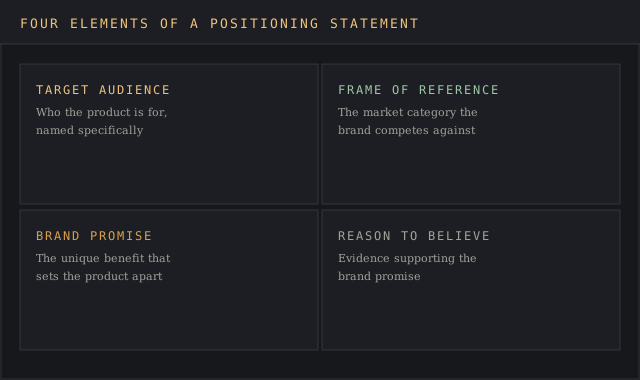
The four main elements are target audience, frame of reference, brand promise, and reason to believe. Every effective positioning statement includes all four; drop one and the statement stops functioning as a positioning statement and becomes a slogan instead.
Target Audience
Target audience defines the specific group of consumers for the product, named specifically enough that internal teams can picture a real person. A positioning statement for busy professionals reads differently than one for small business owners, even if the underlying product is the same.
Frame of Reference (Market Category)
The market category tells the reader what alternative the brand is being compared against: a project management tool, a budgeting app, a professional services firm. Naming the primary competitor's category, even without naming the primary competitor directly, gives the brand promise something concrete to stand out from.
Brand Promise
Brand promise communicates the unique benefit that sets the product apart, the one thing a customer should expect and receive every time they interact with the brand. A brand promise that oversells creates a gap between what the brand offers and the actual customer experience, and that gap is what erodes trust fastest.
Reason to Believe
Reason to believe provides evidence supporting the brand promise: a specific product's features, a measurable outcome, a track record. Positioning statement examples that skip a real reason to believe read as marketing copy.
Positioning statements should be brief and clear, ideally under five sentences. A statement that needs a paragraph to explain itself usually means the market category or the unique benefit hasn't been decided yet.
Positioning Statement vs Value Proposition vs Mission Statement
A positioning statement is an internal document unlike mission statements, which are written for a public audience including employees, investors, and customers. Mission statements define a company's purpose and core values, the reason the company exists at all, while a positioning statement is one product or brand's specific claim inside a specific target market.
A mission statement answers why the company exists; a positioning statement answers where a specific brand sits relative to competitors offerings inside one market category. Value propositions outline how a product delivers superior value to a customer, and positioning statements are typically created after value propositions, once the internal team already knows what unique value the product delivers and needs to translate that into a market position.
A brand strategist drafting all three documents in the same sitting keeps them consistent: the mission statement sets the north star, the value proposition explains the product's value, and the positioning statement translates both into language a sales team and a marketing team can use immediately.
How to Write a Positioning Statement
- Identify the target market precisely: not "small businesses," but small business owners with a specific pain point the product addresses.
- Review the value proposition already on file, and pull the unique benefit directly from it.
- Identify the primary competitor or market category the brand competes against, so the frame of reference is clear to anyone reading the statement cold.
- Identify what sets the brand apart: the reason to believe, backed by a real product offering detail or a measurable result.
- Draft the statement using the standard template, then revise the tone until it matches how internal teams describe the product day to day.
Write the positioning statement as an internal document first, in plain language, before anyone tries to make it sound clever. A statement written for cleverness usually loses the clarity that makes a positioning statement useful in the first place.
A Positioning Statement Template to Adapt
For [target audience] who [target audience's pain points], [brand] is the [market category] that [unique benefit] because [reason to believe]. Unlike [primary competitor or other brands in the category], [brand] [key differentiator tied to product or service offerings].
This statement template works across industries because it forces the same five decisions every time: who, what category, what promise, why believe it, and what makes the brand different from other brands making a similar promise. A team filling in this positioning statement template honestly ends up with a statement that accurately reflects the brand.
Real Positioning Statement Examples
Nike's positioning statement emphasizes sustainability and innovation in sports, aimed at athletes and, in the company's own words, anyone with a body, competing on innovation and performance.
Apple's statement highlights its leadership in personal technology since 1984, a reason-to-believe element built on decades of continuous product releases across Apple devices. Apple leads with design and simplicity as its brand promise, backed by a track record long enough that the claim needs little further justification.
RateGenius connects consumers with over 150 lending institutions for auto loans, a positioning statement built entirely around scale and choice as the unique benefit. Parse.ly serves over 300 enterprise clients with content analytics solutions, using client count itself as the reason to believe.
Mailchimp empowers millions of small businesses with its marketing platform, positioning itself around accessibility and reach, a deliberate choice given its target audience of small business owners.
What Makes a Good Positioning Statement
A good positioning statement is concise and focused, resisting the temptation to list every product offering the brand has. A strong positioning statement picks one primary benefit and defends it.
A great positioning statement passes a simple test: could a competitor's positioning statement be swapped in and still make sense? If yes, the statement hasn't done its job. An effective positioning statement names something specific enough to the brand that swapping it into a competitor's marketing materials would read as wrong on sight.
Guiding business decisions is a benefit of implementing a strong positioning statement well beyond marketing: a positioning statement serves as a guide for marketing and product decisions, so product roadmap debates, pricing conversations, and content creation choices all get measured against the same standard. That standard doesn't shift with whoever's in the room that week.
Brand Positioning Statement vs Product Positioning Statement
A brand positioning statement sits one level above a product positioning statement. Writing a brand positioning statement means defining the company's overall place in the market, its brand identity, its brand values, and the brand strategy that guides every product launched under that name. A product positioning statement narrows that same exercise to one specific product or service offering.
Own positioning statement work should happen at both levels for any company selling more than one product: the brand positioning statement sets the brand strategy and core values that every product-level statement then has to respect, while each product and service offerings gets its own tighter statement underneath.
Brand messaging and brand positioning are related but distinct: brand positioning decides where the company sits relative to an industry leader or a primary competitor, while brand messaging is the language used to communicate that position across marketing efforts. A company can have a strong brand positioning statement and still fail if the messaging built from it doesn't match how the target audience talks.
To write a brand positioning statement that holds up, start with the key elements shared across every product statement: the same brand values, the same reason to believe, adapted per product. A differentiation statement built at the brand level, then inherited by each product, keeps a company's full portfolio pulling in the same direction. Without that shared root, every product team writes its own version of what the brand stands for.
How a Positioning Statement Shapes Marketing Strategy
A successful marketing strategy starts with the positioning statement. The nesting runs that way round. Marketing campaigns, content marketing calendars, and paid marketing efforts should all trace back to the same brand promise, so potential customers seeing three different assets from the same company recognize it as one consistent voice, communicated in a relevant way to each channel without changing the underlying promise.
Messaging align across every channel once the positioning statement is fixed: a content marketing piece, a product page, and a sales script should all describe customer needs and the product the same way, using the same core language.
A positioning statement also shapes the emotional response a marketing strategy is trying to produce. Beyond the rational reason to believe, a good positioning statement implies how the target audience feels once the promise is delivered, confident, relieved, ahead of the competition, and a successful marketing strategy translates that feeling into creative.
User behavior data should feed back into the positioning statement over time. If customer experience data shows the target audience responding to a different unique benefit than the one in the current statement, that's a signal the positioning statement needs revisiting. Running marketing campaigns against a promise the market has moved past wastes the spend.
Why Many Brands Get Positioning Wrong
Many brands write a positioning statement that lists quality products and broad claims. What's missing is one specific, defensible promise. "We offer quality products at a fair price" says nothing a competitor couldn't also claim, and it fails the test that separates a real positioning statement from a generic company slogan.
Other brands make the opposite mistake: cramming every product and service offering the company has into one platform description. A positioning statement should live in a customer's mind as one clear idea. A list of everything the product satisfies lands as none of it.
What a brand shows publicly should match the internal positioning statement closely enough that a customer's positive experience with the product confirms the promise. A company can survive an imperfect positioning statement; it can't survive a positioning statement the actual customer experience keeps disproving in customers minds every time they use the product.
Common Positioning Statement Mistakes
Mistakes to avoid include using vague language or trying to appeal to everyone. A positioning statement written to avoid offending any potential customer usually ends up describing no one, which defeats a document whose entire purpose is clarity.
Skipping the reason to believe is the second common mistake. A brand promise without evidence reads as an unsupported claim, and internal teams asked to repeat it to customers will either avoid it or undermine it by hedging when a customer pushes back.
Treating the positioning statement as a permanent internal document is the third mistake. Market category assumptions shift, a primary competitor's positioning changes, and a statement drafted three years ago against a different competitive set can quietly stop matching customer needs or the product's actual current offering.
A Worked Example
A small business selling project management software for construction firms starts its positioning statement writing process by naming the target audience precisely: mid-size construction firms running five to twenty active job sites at once, far more specific than the broad label "project managers."
The market category becomes construction-specific project management software, a frame of reference that immediately narrows the primary competitor set to firms serving the same niche. The brand promise centers on a unique benefit: cutting change-order approval time from days to hours. Procore, with 3 million individual users, is the incumbent in that set and places seventh in our construction intelligence platforms ranking.
The reason to believe pulls a real product's feature, an automated approval routing system, and a measurable result from an early customer: forty percent fewer delayed approvals in the first quarter of use.
The finished positioning statement reads: for construction firms managing multiple active job sites, [Brand] is the project management platform that cuts change-order approval time from days to hours, because automated routing gets the right approver the request the moment a change is logged.
Using the Positioning Statement Across the Business
A positioning statement earns its keep once it stops being an internal document nobody references and starts shaping actual customer interaction. Sales teams should hear the same brand promise a marketing team writes into a campaign; a mismatch between what a rep says on a call and what a positioning statement claims creates exactly the ambiguity the statement was written to prevent.
Marketing and sales teams reviewing the positioning statement together tend to catch language that sounds right in a boardroom but confuses a real customer. A quarterly review, checking if the statement still matches the product offering, the target market, and how competitors' offerings have shifted, keeps the document from quietly going stale.
A positioning statement also gives a brand strategist a clear understanding to hand off when new team members join marketing or sales: read the one document, and understand in minutes what took the original team weeks of positioning strategy work to settle on.
FAQ
What is an example of a positioning statement?
Nike's positioning statement, emphasizing sustainability and innovation for athletes, and Apple's statement, built around leadership in personal technology since 1984, are two widely cited positioning statement examples that each lead with one clear brand promise.
How do I write a position statement?
Identify the target audience, name the market category or primary competitor, state the brand promise as one unique benefit, and back it with a specific reason to believe, then keep the whole statement under five sentences.
What is Nike's positioning statement?
Nike positions itself around sustainability and innovation in sports, targeting athletes broadly, competing on performance and design as its primary point of differentiation.
What are the 4 parts of a positioning statement?
Target audience, frame of reference or market category, brand promise, and reason to believe, the same four elements that separate a positioning statement from a slogan or a mission statement.
Bottom Line
A positioning statement earns nothing sitting in a slide deck; it pays off only once sales repeats the same brand promise a prospect hears from marketing. The construction-firms example above turned an automated approval routing feature into forty percent fewer delayed approvals in one quarter, proof the promise carries the weight while the document just records it.
Name the target audience precisely, pick one brand promise and defend it with real evidence, and revisit the statement whenever the market category or the competitive set shifts underneath it; the OKR tracker and the rest of the planning set live in the rest of the templates.