STP marketing: segment, target and position, with one company carried through
 By Jan Suski. I go deep on every review, checking every number against its source and digging up details other coverage misses, a habit from six years of SEO and link building for tech companies. Bylines at Surfer, Brand24, and Senuto. How the scoring works.
The short version 11 points · 40 seconds
- 01STP runs segmentation, targeting, positioning in orderEach stage feeds the next one
- 02The model's three parts date from 1956, 1967 and 1972Smith, Kotler, then Ries and Trout
- 03Each segment needs a size, a channel and a differenceSegments that fail the test get merged
- 04Score every segment on attractiveness and fitSize alone picks what every rival picked
- 05Five targeting strategies shape the budget differentlyUndifferentiated through micromarketing
- 06Write one positioning claim for the chosen segmentTrue, relevant and unowned by a rival
- 07Check the claim on a positioning map firstCrowded corners show overlapping claims
- 08e.l.f. Beauty prices at $6.50 against $20+ for prestigeFiscal 2025 10-K, citing Nielsen
- 09e.l.f. reported 25 straight quarters of sales and share gainsNet sales up 28% to $1,313.5 million
- 10A low-fit segment gets close to zero media budgetMeasure acquisition cost segment by segment
- 11Targeting by size alone is the first way STP breaksRescore segments as consumer behaviour shifts
STP marketing is the three-step sequence of segmentation, targeting and positioning: split a market into groups, choose which groups to serve, then decide what the product should mean to them. Most STP marketing guides spend their length on the first step, with a few examples of segments and little on what comes after them. This one doesn't, because the segmentation lessons on this site already do that work.
If the segmentation step is new, start with market segmentation examples from real companies. This page picks up where they stop: scoring segments, choosing a targeting strategy, and writing a positioning strategy for the segment you chose.
It's written for marketing teams and analysts who already have segments on a spreadsheet and need to decide what to do with them. One company, e.l.f. Beauty, runs through all three stages of the STP marketing model with figures from its own SEC filings.
What the STP marketing model is, and where it came from
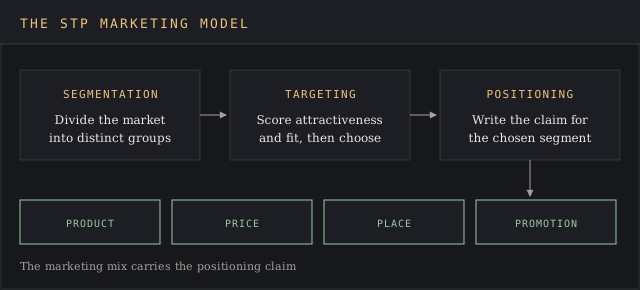
The STP marketing model is a strategic framework with three stages in a fixed order. Segmentation divides a market into distinct groups of buyers. Targeting chooses which groups get the company's money. Positioning defines how the product should be perceived by those target customers relative to competitors. Applied well, an STP marketing strategy turns a target market from a guess into a ranked list.
Each stage feeds the next, which is why the STP model sits upstream of marketing strategies, campaigns and the media plan.
Its pieces arrived separately. Wendell R. Smith introduced market segmentation as a strategy in "Product Differentiation and Market Segmentation as Alternative Marketing Strategies," published in the Journal of Marketing in July 1956.
Philip Kotler's Marketing Management, published in 1967, "swiftly became the marketing textbook of choice," according to Northwestern's alumni magazine, and its editions are where most marketers first meet segmentation, targeting and positioning as one sequence.
Positioning came last. Al Ries & Jack Trout wrote a three-part series titled "The Positioning Era Cometh" for Advertising Age in April and May 1972, according to the history page of Ries' own firm.
Segmentation: the input targeting works from
Market segmentation is the step everyone knows. It splits buyers by demographics (age, gender, income, education, occupation), geographic segmentation (country, region, city, climate, urban or rural), psychographic segmentation (values & lifestyle) and consumer behaviour (purchase habits, brand loyalty, benefits sought). The market segmentation lesson covers each base and the ADAMS test.
What the STP model adds is a demand on the output. Each segment needs measurable differences from its neighbours, a size estimate, and a channel that reaches it. A geographic segmentation by region and a psychographic segmentation by values can both pass that test, or both fail it. Audience segments that fail it get merged: if two audience segments buy the same thing for the same reason through the same store, they're one segment wearing two names.
The output of this stage should be a table of potential segments, one row each: who's in it, how many, what they spend, where they shop, and what they want that they aren't getting. Customer data from your own CRM & order history fills most of it; market research fills the rest. Without those columns, targeting turns into a wild goose chase.
Targeting: scoring segments before choosing any
Targeting involves evaluating every one of the audience segments on two axes, then committing the company's resources to the ones that win on both. In the STP marketing model, this is the step that decides where the money goes. Most teams skip the scoring and go straight to the biggest segment of the target market.
Attractiveness and fit
Attractiveness is about the segment. For consumer segments & business accounts alike, the inputs are segment size, growth potential, margin, how many rivals already serve it, and what it costs to reach.
Market sizing language helps here: the serviceable available market is the part of the total you could sell to with your current product and channels, and the serviceable obtainable market is the slice you can win in a set period. The market sizing lesson walks through both figures.
Fit is about you. Does the product already solve that segment's problem, can your sales & marketing channels reach it, and does serving it pull against what you sell to your other customer segments? A segment that scores high on attractiveness and low on fit is a capability project for a later year.
Score each potential segment from 1 to 5 on four or five criteria per axis, weight the criteria, and plot the totals. The most valuable customer segments sit in the top-right corner. The others go on the back burner, with a note on what would move them. Where specific segments score high, write down why; that note becomes the competitive edge the positioning claims later.

Five targeting strategies
Once scoring names the attractive segments, the choice is how many to serve and how differently. Each of the five options shapes the budget another way.
| Strategy | Segments served | Offer and message | Main risk |
|---|---|---|---|
| Undifferentiated | Whole market as one | One offer, one message | Loses each segment to a specialist |
| Differentiated | Several | A separate offer per segment | Cost of running parallel campaigns |
| Concentrated | One large segment | Everything aimed at it | All eggs in one basket |
| Niche | One small sub-segment | Specialist product, premium price | Segment too small to grow from |
| Micromarketing | Individuals or postcodes | Personalised offer per buyer | Needs customer data at row level |
An undifferentiated plan is a jack of all trades: it treats the entire market as a single segment and works only where buyers want the same thing.
Concentrated marketing focuses on one well-defined segment. A niche strategy focuses on a sub-segment small enough that bigger firms ignore it. Differentiated marketing targets several target audience segments with tailored offerings, and it's where most growing companies end up, because one STP strategy can then carry several brands under one owner.
Positioning: STP marketing's last step
Of segmentation, targeting and positioning, the third step is the one buyers see. Positioning STP marketing's way means writing one claim for the target segment and making all marketing messages repeat it. It creates a distinct identity in customers' minds relative to the alternatives they'd consider. A positioning strategy passes three tests: the claim is true, it matters to that segment, and no competitor already owns it.
Positioning types
Five product positioning types cover most cases, and any positioning model you pick should rest on one competitive advantage you can prove. Price-based positioning competes on cost to the buyer. Attribute-based positioning names a feature or ingredient. Prestige-based positioning sells status and usually a higher price. Competitor-based positioning defines the product against a named rival. Consumer-based positioning defines it by who uses it.
A second layer sets the angle. Functional positioning solves a problem, symbolic positioning speaks to self-image, and experiential positioning sells how using the product feels, which is where an emotional connection to the brand comes from. A brand selling premium makeup products to high income working women at $40 a lipstick would lean symbolic; an $8 lip oil aimed at teens can lead with function and price.
The positioning map and the statement
A positioning map plots brands on the two attributes buyers trade off, usually price against one quality measure. Crowded corners show where the claims overlap; empty space shows where they don't. It's the quickest way to identify gaps before writing the claim. The market mapping lesson covers how to choose the axes, and the perceptual map template gives you the grid.
The statement then fixes the value proposition in one sentence: for these target customers, this product is the one that does this, because of this proof. The positioning statement template lays out the four parts. Write it so that marketing communications, packaging & sales scripts all quote from it, keeping every team on the same page.
e.l.f. Beauty carried through all three stages
e.l.f. Beauty is a prime example because its annual report spells out each stage of its STP strategy in numbers. The figures below come from its 10-K for the fiscal year ended 31 March 2025 unless another source is named.
Segment: price tier, age, values and channel
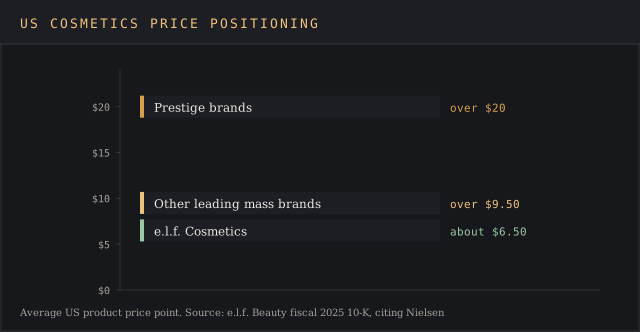
The US cosmetics target market splits cleanly by price. The 10-K puts e.l.f. Cosmetics' average US price point at about $6.50, against over $9.50 for other leading mass brands and over $20 for prestige brands, citing Nielsen. That's a behavioural cut: price-sensitive buyers who still want what prestige counters sell.
Values form a second cut. The company says it chooses not to use over 2,500 ingredients in its formulations and makes more than 85% of its products in Fair Trade Certified facilities, which speaks to environmentally conscious consumers who read labels.
Target: one segment first, then several
The core target segment is concentrated: young, value-seeking cosmetics buyers. Piper Sandler's spring 2025 Taking Stock With Teens survey, which polled over 6,450 US teens, named e.l.f. Cosmetics the number one cosmetics brand among female teens. The same survey put the teen core beauty wallet at $374, its highest level ever.
In fiscal 2025 Target took 23% of net sales, Walmart 16%, Ulta Beauty 12% and Amazon 12%, with e-commerce at 17% overall. Those are the stores where the right audience and other potential customers in the segment already shop.
Then the strategy went differentiated. The portfolio now runs e.l.f. Cosmetics, e.l.f. SKIN, Naturium, Well People and Keys Soulcare. e.l.f. paid about $333 million for Naturium.
On 28 May 2025 it agreed to buy rhode, the skincare brand Hailey Bieber founded, for $800 million at closing ($600 million cash and $200 million stock) plus up to $200 million in earnout, per its fiscal 2025 results release. Each brand is aimed at a different set of target audiences.
Position: prestige quality at a mass price
The positioning line in the 10-K reads: "We make premium-quality, prestige-inspired cosmetics at an extraordinary value." That positioning strategy is price-based with an attribute claim on top, and the filing proves it with products priced against prestige equivalents, such as an $8 lip oil set against a $40 prestige comparable.
The marketing mix repeats the claim. Price: $6.50 average. Place: Target, Walmart and the company's own site, which the 10-K says makes it the only top-five mass cosmetics brand with a direct-to-consumer store. Promotion: $318.8 million on marketing and digital in fiscal 2025, about 24% of net sales.
Result: what the filings report
Fiscal 2025 net sales rose 28% to $1,313.5 million, the fourth quarter was the 25th consecutive quarter of net sales growth and market share gains, and the company gained 190 basis points of US share. In fiscal 2026 net sales rose 25% to $1,636.5 million, per the fiscal 2026 results release, which calls it the 7th consecutive year of net sales and market share growth.
Read between the lines before crediting the STP marketing model with all of it. Fiscal 2026 includes rhode after the deal closed, with $581.7 million of net cash paid for acquisitions that year, so part of the growth was bought.
What STP changes in marketing campaigns and budgets
The practical gain of STP marketing is fewer wasted impressions. Marketing campaigns aimed at target audiences in three distinct segments with three messages cost more to produce than one campaign, but each dollar lands on buyers who match the offer. That's the argument for marketing ROI, and the place to test it is customer acquisition cost measured segment by segment.
Audience segmentation also tells you where not to spend money. If a segment scored low on fit, its share of the media budget should be close to zero, whatever its size. Marketing efforts that follow the scoring look lopsided on a budget sheet, and that's the point. Audience-based messaging is how teams boost engagement on the same budget: the spend moves to fewer buyers who match the offer.
Brand loyalty is the slower payoff. A buyer who sees the same claim on the shelf, in the feed and in the product itself has one reason to remember the brand. Mixed marketing messages split that one reason into three weaker ones.
Your marketing strategies should be able to name, for each campaign, which segment it's for and which line of the positioning statement it proves.
Where an STP marketing strategy breaks
Targeting by size alone is the first failure. The biggest segment draws every competitor, so customer acquisition costs climb while the share you can win shrinks. Scoring fit next to attractiveness stops a team from jumping on the bandwagon.
Audience segments that can't be reached are the second failure of an STP model. A psychographic segment defined by values, with no list, channel or media placement that isolates it, is a red flag: the team can describe the buyers but can't put an ad in front of them.
The third is treating the result as set in stone. Consumer behaviour shifts, new rivals arrive, and a segment that scored 4 out of 5 two years ago may score 2 now. e.l.f. says it changes up to 20% of its retail assortment each year, which is one way of forcing the review.
The last is skipping the hand-off. Positioning that never reaches the shelf is a slide in a deck. The final stage of effective STP marketing is the price tag, the product page and the ad creative all making the same claim.
FAQ
What is STP in marketing?
STP marketing is a three-step method for deciding which target audiences to sell to and what to say. Segment the market into groups, target the groups worth serving, then position the product for them. It's the planning step that sits upstream of a company's marketing strategies and every campaign they produce.
What does STP stand for in marketing?
STP stands for segmentation, targeting and positioning. The three words describe the order of work: segmentation, targeting and positioning each use the output of the step before.
What are the 5 steps in the STP process?
Expanded, the STP process runs in five steps: define the segments, profile each one with data, score and select target segments, write the positioning for each, and carry that positioning into product, price, place and promotion.
What is an example of STP?
In STP marketing terms, e.l.f. Beauty segments US cosmetics by price tier, age and values, targets young value-seeking buyers through Target, Walmart, Ulta Beauty and Amazon, and positions on prestige-style quality at a $6.50 average price.
Who created the STP model?
Wendell Smith described market segmentation in 1956, Philip Kotler's Marketing Management (1967) put the steps into one textbook sequence, and Al Ries & Jack Trout named positioning in a 1972 Advertising Age series.
How do you create audience segments for an STP model?
Start from customer data you already hold: order history, product usage and channel. Group buyers into customer segments that share a need and a way to reach them, size each group, and check that each one differs from the next in something you can measure.
Bottom line
STP marketing is the choosing exercise behind a company's marketing strategies. Segmentation produces options, targeting scores them on attractiveness and fit and commits money to the winners, and positioning writes the one claim those target audiences should hear. e.l.f. Beauty's filings show each step in figures, from a $6.50 average price to a 23% share of net sales through a single retailer.
Get the targeting wrong and marketing efforts spread across every segment equally, so none of them hears a claim loud enough to remember. Get the positioning wrong and the money buys awareness for a rival's message.
To put the segments on paper with scores, open the customer segmentation template, which carries the four segmentation bases and RFM scoring you'll need before the targeting step.