Customer Acquisition Strategy Template
 By Jan Suski. I go deep on every review, checking every number against its source and digging up details other coverage misses, a habit from six years of SEO and link building for tech companies. Bylines at Surfer, Brand24, and Senuto. How the scoring works.
Get the customer acquisition strategy template
An Excel workbook that turns a quarterly growth target into an ICP, a six-stage funnel plan, a channel budget with CAC per channel, and the LTV:CAC and payback math that says which channel earns its money back.
Download XLSXA customer acquisition strategy template is a spreadsheet that turns a growth target into a plan you can audit: who the ideal customers are, which marketing channels attract them, what each channel costs per new customer, and how long that spend takes to pay back.
This one ships as an Excel workbook with live formulas for customer acquisition cost (CAC), customer lifetime value (LTV), the LTV:CAC ratio and the payback period.
The page walks through each tab, the funnel stages behind the plan, the unit-economics math, and a full customer acquisition strategy example: a fictional home services software company spending $84,000 in one quarter across six channels and landing 32 paying customers.
It's written for founders, marketing teams and sales leaders at any business that already spends money to acquire customers and can't yet say which channel earns it back. Braze defines a customer acquisition strategy as "a structured, repeatable approach to attracting and converting new customers"; the template is the structured half, and the repeatable half comes from refilling it every quarter with real numbers.
A customer acquisition strategy without per-channel math hides the expensive channel. In the worked example below, LinkedIn ads cost $7,500 per customer against a $9,360 lifetime value while the referral program brought customers in at $500 each, and both sat inside one blended CAC of $2,625 that looked healthy on a dashboard.
Download the free customer acquisition strategy template
Download the customer acquisition strategy template (XLSX)Seven tabs: strategy summary, ICP and segments, funnel plan, acquisition channel plan with CAC formulas, unit economics, a test log, and how-to notes, pre-filled with the Crewbook worked example.
The workbook opens in Excel, Google Sheets and LibreOffice Calc without reformatting. Every formula is plain arithmetic (SUM, division, multiplication), so nothing breaks on import, and the amber-shaded input cells are the only ones you overwrite.
What a customer acquisition strategy covers
A customer acquisition plan answers four questions on one sheet: who you're selling your products or services to, what you're telling them, where you'll reach them, and what each paying customer costs. An effective customer acquisition strategy hangs everything else off those four answers.
Smart Insights breaks the customer acquisition process into eight steps, from defining the target audience, market and competitor research, and the value proposition through funnel design that integrates channels, content marketing that shows expertise, landing pages and nurturing to analyzing metrics. Act's CRM guide stretches the same work to ten steps, starting with a team drawn from sales, marketing, product, customer service and leadership.
The template compresses both lists into six working tabs, because most of those steps write to the same few cells. The ICP decides the channels, the channels decide the budget split, and the budget split decides the CAC.
It sits between two other files on this site. The go-to-market plan template covers a launch: pricing, positioning and the first push for new products or services. The customer engagement strategy template covers what happens after the sale. This one covers the repeating middle job: how a company keeps buying new revenue every quarter and which customer acquisition efforts deserve next quarter's budget.
The tabs in the customer acquisition strategy workbook
Each tab maps to one decision in the customer acquisition strategy. The table lists what each holds and which cells calculate on their own; a seventh tab carries the how-to notes.
| Tab | What it holds | Calculated cells |
|---|---|---|
| Strategy Summary | Quarter goal, ICP in one line, value proposition, owner, review date | Total spend, new customers, blended CAC, LTV:CAC and payback, pulled from the other tabs |
| ICP & Segments | Firmographics, buyer role, trigger event, pain point and disqualifiers per segment | None, text only |
| Funnel Plan | Goal, message, channel, call to action and KPI for each of six stages | None, text only |
| Channel Plan | Spend, leads and lead-to-customer rate per channel | New customers, CAC, share of budget, share of customers, LTV:CAC per channel |
| Unit Economics | ARPA, gross margin, monthly churn | LTV, blended CAC, LTV:CAC ratio, CAC payback months, new MRR |
| Test Log | Hypothesis, channel, metric, baseline, target, decision date, result | None |
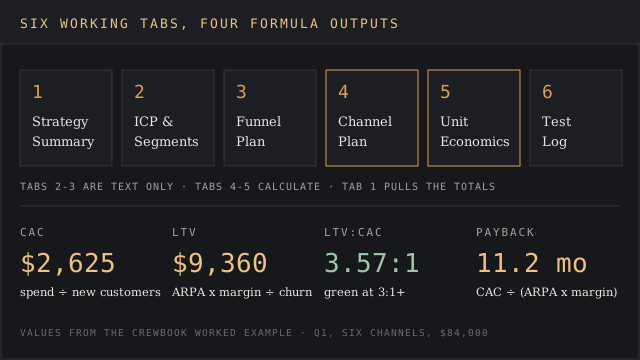
The two text-only tabs carry the most weight. Channel numbers mean little while the ICP tab still describes potential customers as any small business that needs software; a segment definition precise enough to exclude prospects outside the target audience is what lets the channel tab find the right customers. The devil's in the details there, and the disqualifiers column is where most of them live.
How to build a customer acquisition strategy with the template, step by step
The fill-in process runs seven steps, in the order the tabs depend on each other:
- Set the quarter's goal in new customers and new revenue, working backward from the revenue target the way Act's guide recommends. Crewbook's goal was 30 new paying customers and $9,000 in new monthly recurring revenue. An OKR tracker template holds the same goal if the company already runs quarterly OKRs.
- Write the ideal customer profile on the ICP tab, naming the ideal customers by company size, trade and trigger event. Talk to existing customers who match it; Act's guide calls their "language, concerns, and buying process" the most reliable inputs for defining a target audience. The customer segmentation template shows which segment holds your most valuable customers before you pick one.
- State the value proposition in one sentence: what the product does, for whom, and why prospects pick it over the competitor already on the shortlist. The positioning statement template covers that sentence in depth.
- Fill the Funnel Plan tab with a goal, message, channel, call to action and KPI for each stage, including the landing pages each ad points to.
- List every channel on the Channel Plan tab with its planned spend, including the salary of anyone whose job is to acquire customers, an SDR or a content writer, alongside ad spend and tools.
- Enter the three unit-economics inputs: average revenue per account (ARPA), gross margin and monthly churn.
- Log one test per weak channel with a decision date, then refill the Channel Plan tab at quarter end with actual leads and closes.
Steps 1 through 4 take an afternoon and get the ball rolling. Steps 5 through 7 repeat every quarter, and that repetition is the data-driven part of an acquisition strategy: the next budget split comes from last quarter's analytics and channel performance, and nobody's hunch about which channel feels busy gets a vote.
Funnel stages and the customer journey on the Funnel Plan tab
Salesforce splits the acquisition funnel into five stages: awareness, interest, consideration, conversion and onboarding. The template adds retention as a sixth row, since customers who churn in month two never pay back their CAC. Frederick Reichheld's research at Bain puts the profit gain from a 5% lift in retention at 25% to 95%, as Harvard Business Review reported in 2014.
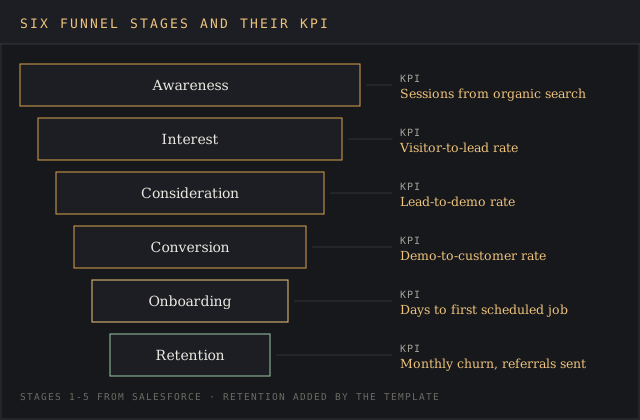
Each row holds the same five fields: the goal at that stage, the right message, the channel that carries it, the call to action, and the KPI. The company's filled-in rows read like this:
| Stage | Goal | Channel | Call to action | KPI |
|---|---|---|---|---|
| Awareness | First awareness among potential customers who own home services businesses | Blog post, paid search, short form videos for brand awareness | Read the scheduling guide | Sessions from organic search |
| Interest | Lead generation: capture an email address | Landing pages with a free dispatch-board download | Download the board | Visitor-to-lead rate |
| Consideration | Book a demo | Email marketing nurture, brand review profiles | Book a demo | Lead-to-demo rate |
| Conversion | Sign a paid plan | Sales team demo, 14-day trial | Start the trial | Demo-to-customer rate |
| Onboarding | First 20 jobs scheduled | In-app checklist, setup call | Import your job list | Days to first scheduled job |
| Retention | Renew and refer | Check-ins with existing customers, new features email | Refer a contractor for a $500 credit | Monthly churn, referrals sent |
Drop-offs in the sales funnel show up between rows. Contentsquare's guide recommends a dashboard tracking conversion rate, funnel drop-offs, CAC and lifetime value, then A/B tests on ad copy and landing page layouts wherever the data flags a leak in the process.
Keep an eye on the gap between adjacent KPIs: when Crewbook's lead-to-demo rate sits far below its visitor-to-lead rate, the fix goes into the nurture emails and the ad budget stays put. Closing the leak lowers customer acquisition cost with no new spend, because the same budget signs more customers. The full stage-by-stage map of touchpoints lives in the customer journey map template.
Customer acquisition cost (CAC), lifetime value and payback period
Four formulas, the important metrics behind every channel decision, run the Unit Economics and Channel Plan tabs. They follow David Skok's SaaS Metrics 2.0 definitions, including his gross-margin adjustment:
- Customer acquisition cost (CAC): total sales and marketing spend in the period divided by the new customers you acquire in the same period.
- Customer lifetime value (LTV): ARPA times gross margin, divided by monthly churn.
- LTV:CAC ratio: LTV divided by CAC.
- CAC payback period: CAC divided by ARPA times gross margin, in months.
Skok's benchmarks set the template's conditional formatting. "The best SaaS businesses have a LTV to CAC ratio that is higher than 3," he wrote in 2013, and many recover CAC "in 5-7 months"; past 12 months, in his words, "profitability is anemic."
The Channel Plan tab colors a channel green at 3:1 or above, amber from 1:1 to 3:1, and red below 1:1. A payback past 12 months is the red flag the Unit Economics tab exists to catch.

Monthly ARPA pairs with monthly churn. Skok's own rule is that if ARPA is monthly, churn has to be monthly too, and pairing an annual price with a monthly churn rate inflates LTV twelvefold. The SaaS statistics report carries current churn benchmarks to sanity-check your own input.
Customer acquisition strategy example: Crewbook's $84,000 quarter
Crewbook is a fictional software business selling a scheduling app to home services contractors (HVAC, plumbing and electrical) with 10 to 50 technicians in the US. The company charges $300 a month per customer, runs a 78% gross margin, and loses 2.5% of its customers a month. Its Q1 customer acquisition strategy aimed at 30 new customers.
Those three inputs put LTV at $9,360 ($300 × 78% ÷ 2.5%). At Skok's 3:1 line, any acquisition channel can spend up to $3,120 per new customer and stay green.
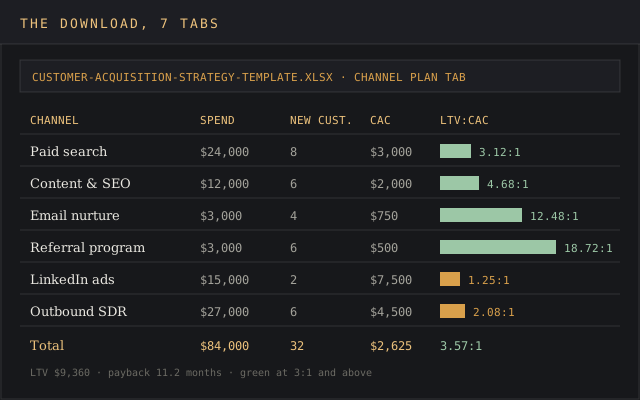
| Channel | Spend | Leads | Lead-to-customer | New customers | CAC | LTV:CAC |
|---|---|---|---|---|---|---|
| Paid search | $24,000 | 320 | 2.5% | 8 | $3,000 | 3.12:1 |
| Content & SEO | $12,000 | 160 | 3.75% | 6 | $2,000 | 4.68:1 |
| Email nurture | $3,000 | 80 | 5% | 4 | $750 | 12.48:1 |
| Referral program | $3,000 | 15 | 40% | 6 | $500 | 18.72:1 |
| LinkedIn ads | $15,000 | 100 | 2% | 2 | $7,500 | 1.25:1 |
| Outbound SDR | $27,000 | 75 | 8% | 6 | $4,500 | 2.08:1 |
| Total | $84,000 | 750 | 4.27% | 32 | $2,625 | 3.57:1 |

Blended customer acquisition numbers pass. Thirty-two customers beat the goal by two, $9,600 of new MRR beats the $9,000 target, the blended CAC of $2,625 gives a 3.57:1 ratio, and payback lands at 11.2 months, inside Skok's 12.
Per-channel rows tell a second story. Paid search and outbound took the lion's share of the budget, $51,000 of $84,000. LinkedIn ads spent $15,000 for two customers, and outbound spent $27,000 for six at $4,500 each: together, 50% of the budget for 25% of the new customers.
Referral and email combined spent $6,000, 7% of the budget, for 10 customers, 31% of the total. Email's $3,000 was a drop in the bucket next to the $84,000 total, and it still closed four new customers.
For Q2, the Test Log carries two changes to the customer acquisition strategy. LinkedIn moves to retargeting prospects who already read a blog post, with a CAC target under $3,120 and a decision date of 30 June; if it misses, Crewbook cuts its losses and the $15,000 moves to content and the referral credit.
Outbound keeps its SDR and zeros in on contractors with 20 or more technicians, tested against the same $3,120 line, with the win-loss analysis template logging why demos die.
For a company this size, cutting both expensive channels outright would put all the eggs in one basket. Referrals can't grow past the size of the existing customer base, which caps the cheapest row in the table.
Customer acquisition methods by channel
Six customer acquisition methods carry most early marketing efforts. They differ in what they cost to attract a lead up front, how fast they produce the first paying customer, and which number says they're working.
| Method | Cost shape | What to track |
|---|---|---|
| Content marketing & SEO | Writer and tool costs land before the first lead; a ranking blog post keeps pulling organic search traffic from search engines without per-click fees | Organic sessions, lead generation from gated downloads |
| Paid ads (pay per click) | Linear: when spend stops, leads from search engines stop, though brand searches keep converting | Cost per lead, conversion rate by landing page |
| Email marketing | Low marginal cost on a list of prospects you already own | Lead-to-demo rate, unsubscribes |
| Referral programs | Paid per customer, after the sale closes | Referrals sent per customer, referred-customer churn |
| Social media & short form videos | Production time; brand reach depends on the platform's feed | Reach, engagement, assisted conversions |
| Outbound sales | One salary per SDR, fixed regardless of output | Meetings booked, meeting-to-customer rate across the sales process |
Two of these channels have research worth knowing. Schmitt, Skiera and Van den Bulte tracked about 10,000 customers of a German bank for almost three years and found referred customers were worth at least 16% more than comparable nonreferred ones, with a retention gap that persisted (Journal of Marketing, 2011).
Email has its own benchmark. Litmus's State of Email 2025 report found 35% of respondents get $10 to $36 back for every $1 spent on email; the email marketing statistics report has the wider benchmark set.
Reviews sit underneath every channel, because prospects check them before they talk to sales. Northwestern's Spiegel Research Center found the purchase likelihood for a product with five reviews is 270% greater than for one with none, and displaying reviews lifted conversion on a higher-priced product by 380%. That's why the consideration row names where the brand's reviews live.
Content marketing covers blog posts, videos, infographics and more, per Smart Insights, so one research piece can create content for awareness and consideration at once and return as relevant content in nurture emails.
The Smart Insights nurturing step leans on personalization and automation: dynamic content that changes with user behavior keeps the digital experience relevant to prospective customers between the first visit and the demo. In a customer acquisition strategy, demand generation builds first awareness and lead generation captures the contact.
Common mistakes in a customer acquisition plan
Each of these mistakes changes what it costs to acquire customers, and each shows up in the spreadsheet before it shows up in a board meeting:
- Reporting only blended CAC. Crewbook's 3.57:1 blended ratio hid a 1.25:1 channel spending $15,000 a quarter.
- Leaving salaries out of CAC. The SDR's quarter cost is the whole outbound row; drop it and outbound looks free.
- Mixing time units. Annual ARPA against monthly churn multiplies LTV by twelve.
- Counting leads as customers. The CAC formula divides by signed customers, and Crewbook's 750 leads became 32 new customers.
- Skipping retention. Customer loyalty is part of the math: a customer who leaves before month 11.2 never repays Crewbook's blended CAC.
- Testing everything at once. The Test Log holds one change per channel per quarter, so a change in channel performance traces back to its cause.
Customer feedback catches the mistakes no formula can, and it surfaces new opportunities. Sales calls surface the objections, and support tickets show the problems new customers hit in week one; both belong on the ICP tab's pain-point column before the business writes next quarter's plan. A stitch in time saves nine: one rewritten disqualifier costs less than a quarter of ad spend aimed at the wrong prospects.
Excel, Google Sheets or a CRM for your acquisition strategy
A spreadsheet is the right size for a business while lead and close counts change weekly. The workbook runs in Excel, Google Sheets and LibreOffice with the same formulas, and Sheets keeps a sales team and a marketing team on the same page, editing the same acquisition channel rows live.
Once customer acquisition counts change daily, they belong in a CRM, with the template pulling quarterly totals out of it. The CRM statistics report covers adoption and pricing; the spreadsheet stays where the customer acquisition strategy's budget decision gets made, because it's the one file where every channel sits on the same scale.
FAQ
Can you give me an example of an acquisition strategy?
Crewbook's customer acquisition strategy above is one: a $84,000 quarter split across paid search, content and SEO, email, a $500 referral credit, LinkedIn ads and one outbound SDR, producing 32 customers at a blended CAC of $2,625 and a 3.57:1 LTV:CAC ratio.
What are customer acquisition strategies?
A customer acquisition strategy is the set of channels and methods a business uses to attract potential customers and convert them into paying customers. The common set is content marketing and SEO, paid ads, email marketing, referral programs, social media and outbound sales, each measured by its own CAC.
What are the 4 Ps of sales strategy?
Product, price, place and promotion for any products or services, the marketing mix E. Jerome McCarthy set out in his 1960 textbook Basic Marketing: A Managerial Approach. In a customer acquisition strategy, product and price feed the value proposition and ARPA, place maps to marketing channels, and promotion fills the Funnel Plan tab.
What is a good CX strategy?
One that names the customer experience at each stage after the sale, onboarding and renewal especially, and measures it with a number such as days to first value or monthly churn. The retention row here covers the start; the customer engagement strategy template covers the rest of the customer journey and the customer experience that keeps them paying.
What is a good LTV to CAC ratio?
3:1 or higher for a SaaS business, per David Skok's SaaS Metrics 2.0, with CAC recovered inside 12 months. Below 1:1 the business loses money on every customer a channel brings in.
How do you measure customer acquisition success?
Track CAC, LTV:CAC and payback per channel, plus the conversion rate at each funnel stage. Salesforce's list of acquisition KPIs adds lead-to-customer rate and channel ROI; all of them sit on the Channel Plan and Unit Economics tabs.
How do you calculate customer acquisition cost?
Divide total sales and marketing spend for a period by the new customers you acquire in it. Crewbook's $84,000 over 32 customers gives $2,625.
Bottom line
Reach for this template when a business already spends money on two or more channels and needs to know which marketing efforts earn it back. The Channel Plan tab and the LTV:CAC column are the parts worth keeping past the first quarter; the blended figure is the one that hides problems. For the pricing side of the same math, the monetization strategy template runs LTV:CAC and payback per pricing tier.
For a business launching a single product, the go-to-market plan template fits better.
For deciding which customers to chase in the first place, start with the customer segmentation template and bring its winning segment back to the ICP tab here. A successful customer acquisition strategy is the one refilled with real numbers every quarter, so each dollar spent to acquire customers traces to a measured CAC and stays on the path to sustainable growth.