Crunchbase review: the funding data, the AI agent, and the billing complaints buyers keep filing
 By Jan Suski. I go deep on every review, checking every number against its source and digging up details other coverage misses, a habit from six years of SEO and link building for tech companies. Bylines at Surfer, Brand24, and Senuto. How the scoring works.
· Prefer this source on Google
Best for
A researcher, founder, or business-development rep who needs one signal above every other tool they already own: who just raised money, and from whom. Priced for a single Pro seat to buy without a manager's sign-off.
Not for
A team whose primary job is filling a CRM with verified phone numbers and emails at scale; ZoomInfo, Apollo, Cognism, and Lusha all beat it there. Anyone wary of auto-renewal risk should also weigh the 1.5/5 Trustpilot record.
What it costs
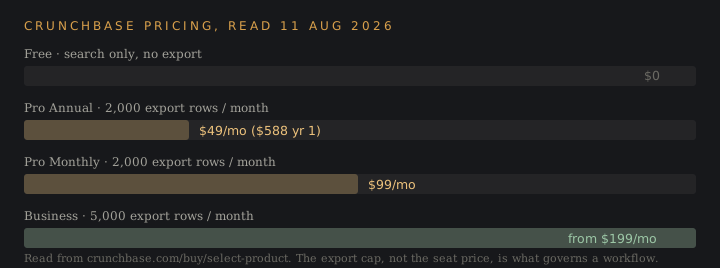
Free is $0 for search only, no export. Pro runs $99/mo month to month or $49/mo equivalent ($588 first year) annually. Business starts at $199/mo billed annually; the API is custom-quoted only.
- Private company profiles
- 4M+ companies, 30M+ data updates a year (vendor claim)
- Funding round detail
- Amount, investors, and the valuation where reported
- AI agent (Crunchbase Scout)
- Limited on Pro; full access on Business
- AI Search
- Natural-language search with Insights filters, both tiers
- Predictions & Insights
- Business tier only, not included on Pro
- Heat Score
- Built from activity across an 80M-person network
- Free
- $0; search only, no export
- Pro Monthly
- $99/mo; 2,000 export rows/month
- Pro Annual
- $49/mo equivalent, $588 first year; 2,000 export rows/month, AI agent limited
- Business
- Starts at $199/mo billed annually; 5,000 export rows/month
- Data Enrichment / Data Licensing API
- Custom quote only, sold through the sales team
- Saved searches and list alerts
- Unlimited on both Pro and Business
- Stages (deal kanban tracker)
- Included on both tiers
- CRM integrations (Salesforce, HubSpot)
- Add-on on Pro; broader access on Business
- CSV/CRM export
- 2,000 rows/month Pro; 5,000 rows/month Business
- Team admin controls
- Business tier only
- Dedicated Customer Success Manager
- Business tier only
- Free trial
- 7 days; exports stay locked the entire time
- Auto-renewal
- On by default on both Pro and Business
- G2 rating
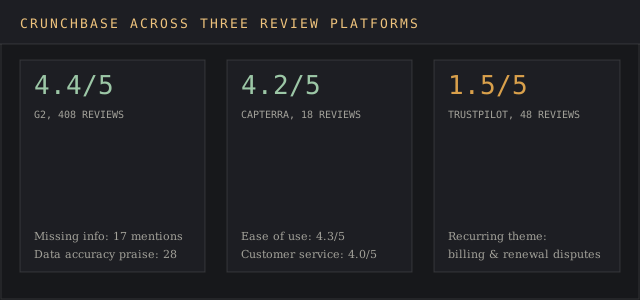
- 4.4/5 across 408 reviews
- Capterra rating
- 4.2/5 across 18 reviews
- Trustpilot rating
- 1.5/5 across 48 reviews
- Security certification
- SOC 2 Type II compliant, per the pricing FAQ
ZoomInfo
Not forA single researcher who wants to start without a sales call, which is the reason Crunchbase's free tier put them on this page.
Apollo.io
Not forA deal team whose job is sourcing rounds; Apollo is built for the sequences that follow.
Pairs well with Crunchbase
Sources for the facts above
Feature and pricing figures come from Crunchbase's own pricing page and its Pro feature support article, checked as of August 2026. Ratings are G2's, Capterra's, and Trustpilot's own aggregates.
Crunchbase is a private-company database, headquartered in San Francisco, built around one core object: a funding round. Every company profile links back to who invested, how much closed, and when the round finished closing, which is why sales teams built on a trigger-based selling strategy keep a seat here even when their contact data comes from somewhere else.
Rounds range from six-figure pre-seed checks to raises worth hundreds of millions, and every size shows up in the same feed.
This review covers what the Pro and Business tiers unlock, how far the underlying data holds up before it needs a second source, and what a buyer signs up for on the billing side, because that last part generates more complaints on Trustpilot than any feature gap does. The tables above come straight from Crunchbase's own pricing page as of August 2026.
It's aimed at two kinds of buyer: a solo researcher or founder who needs one seat to track who's raising in an industry, and a business-development team that wants funding events as an outreach signal layered on top of a contact database it already owns and keeps.
Crunchbase shipped Crunchbase Scout, its AI agent, and a rebuilt AI Search this year, which is why this review covers pricing on a product that changed shape faster than its tier structure did, a gap several of the complaints below trace directly back to.
What Crunchbase tracks: funding data and company profiles
The funding data is the product, and a company's funding history is what every other field builds around. Crunchbase logs the round amount, the investor list, and, where a company or filing discloses it, the post money valuation, then links each round to the company's acquisitions, headcount changes, and leadership changes on the same profile.
A Capterra reviewer who compared it against DiscoverOrg and ZoomInfo Sales during procurement put it plainly: "it kind of reduced 80% of our prospecting time... The Funding information and the decision-makers information were the more I liked about this product."
Verified Reviewer, BDE, Information Technology and Services, Capterra, 29 March 2022.
On G2, a small-business user rated the sports-industry search experience five stars specifically for the funding trigger: "I like how Crunchbase makes it easy for me to see companies who have raised rounds of funding. It has also been so easy to ask the AI for different lists."
Verified User, Small-Business, G2, 2 October 2025.
Where Crunchbase data comes from, and where it breaks down
Coverage runs deep for venture-backed technology companies and thin everywhere else, "abundant for tech startups but lacking for other industries especially music and entertainment," per a G2 reviewer in that field (Verified User, Entertainment, Mid-Market, G2, 5 March 2026).
Part of the reason is structural. A commenter on a message board thread about data reliability traced it to SEC filing rules: "the only requirement for disclosure of funds raised is to state either the range of revenues, or range of value of assets... This results in the vast majority of information collected by crunchbase end up either being collected by the few people that put actual info into form d or self reporting."
u/thatdude391, Reddit r/Entrepreneur.
Freshness is the second complaint. "The data is only as good as the last time it was updated and you can never be quite sure when that was. So many details might be missing," a UK commercial director wrote on G2, rating the platform 3.0/5 (Jock R., Commercial Director, Small-Business, G2, 27 November 2024).
Users reported the same gap on Capterra: "there are considerable amount of errors in the details that is populated as a result likelihood of time getting wasted going behind wrong details is inevitable" (Dijin D., Client Partner, Information Technology and Services, Capterra, 4 April 2022).
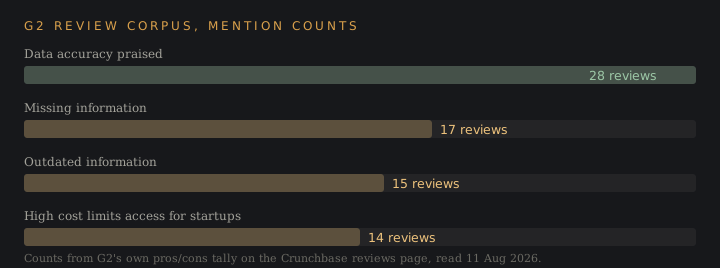
New profiles get created from self-reported founder submissions about as often as from a filing, and nobody independently verifies a submission before it publishes. G2's own review corpus tallies the pattern too: missing information drew 17 mentions and outdated information 15, against 28 mentions praising data accuracy on the same page.
AI Search, Crunchbase Scout, and industry trends predictions
Crunchbase Scout is the AI agent layered over company profiles this year, built to summarize a profile and answer follow-up questions without making a user click through tabs, per Crunchbase's own support documentation.
Pro gets a limited version; Business gets the full agent plus Predictions & Insights, the module that forecasts industry trends and flags growth signals in companies likely to raise next. Free-tier and Pro users are left waiting on that module, since it's gated to Business only.
Not every reviewer likes the redesign that shipped alongside it. "The new AI feature and the post-update website layout. I feel like not the most relevant information is at the top, and I need to click stuff several times to open what I want to see when the information is very basic," one venture-capital user wrote, still rating the product 4.5/5 overall.
Verified User, Venture Capital & Private Equity, Small-Business, G2, 23 June 2025.
The predictions themselves draw enough outside interest that the Wall Street Journal covered the feature's odds of calling the next big IPO, evidence the predictions layer is being watched past Crunchbase's own user base.
Saved searches, alerts, and internal tools for deal teams
Saved searches and list-update alerts are unlimited on both paid tiers, the one spot where Crunchbase leaves usage unmetered. No row count rations it here. A user can set a filter for, say, seed-stage fintech in a target region and get notified the moment a new profile matches. Heat Score, built into the same panel, is Crunchbase's attempt to flag what's happening inside a company before a press release does.
That search depth is what one G2 reviewer, rating the product a full 5.0, called out by name: "The platform is a real powerhouse for market research and competitive mapping. I especially value the 'similar companies' feature, which helps surface competitors" (Hector G., G2, 10 May 2026).
The same reviewer's dislikes section, in a separate review, flagged the cost of getting that access in the first place: "the pricing tier for smaller teams or individual departments still feels quite steep."
Internal tools built on Crunchbase data lean on the API. Data Enrichment gives "full and unlimited API connection for internal tools," per Crunchbase's own support documentation, while Data Licensing covers building a separate product on top of the dataset; both require a custom quote, with no published rate card.
Pricing for sales teams: Pro, Business, and the export ceiling
Pro Monthly runs $99/mo. Pro Annual works out to roughly half that, $49/mo equivalent, billed as $588 for the first year under Crunchbase's introductory discount. Business starts at $199/mo billed annually and needs a custom quote past that entry point.
The number that governs a prospecting team's workflow is the export cap, not the seat price: 2,000 rows a month on Pro, 5,000 on Business, with API access as the only way past either ceiling. A Trustpilot reviewer hit that wall directly: "2000 exports/mo is a joke! if you export something by mistake or something went wrong you have to pay $500/mo what a ridiculous pricing!!!"
Bojan Sandic, Trustpilot, 23 December 2025.
Buyers who priced Crunchbase against PitchBook say the buying process itself, not the feature list, decided it: "Crunchbase had transparent pricing with better self-service without the need to schedule sales calls or demos," one Capterra reviewer wrote after choosing it over PitchBook, while still flagging the jump from free to paid: "the price jump is fairly substantial" (Ryan A., CEO, Information Technology and Services, Capterra, 13 May 2022).
Account settings, billing, and the Trustpilot complaint pattern
Crunchbase's pricing FAQ also states the account is SOC 2 Type II compliant, the security certification most procurement teams ask about before signing.
Both Pro and Business auto-renew by default, and the account settings page is where a buyer has to go proactively to turn that off; Crunchbase confirms the renewal policy in the same FAQ. Every subscription accepted is credit card, PayPal, Google Pay, or Apple Pay, with no invoice option, so the money moves automatically at renewal unless someone cancels first.
Trustpilot carries the sharpest version of that complaint. "I was on a Lite plan @ $88 per year. Crunchbase sent me a single email to a secondary email address to warn me that I was automatically transferred to a Pro plan @ $588 per year. 1 month notice, no reminders. No refunds," Patrice Courty wrote in a review titled "Beware undue payments!"
Patrice Courty, Trustpilot, 21 March 2026.
A second reviewer described the same renewal mechanic surfacing in a support conversation that reached a better resolution: "the lack of transparency around subscription pricing and renewal is the major issue. my subscription renewed today for nearly twice the amount from last year... CB promptly provided a full refund which shows good customer service" (Tom Chiarella, Trustpilot, rated 3/5, 1 August 2025).
Cancellation timing is the third recurring thread. "I signed up for Crunchbase's 7-day free trial on May 5, 2025, and canceled on May 11, 2025. However, I never received a cancellation confirmation. Despite this, I was charged once," a reviewer identified only as "K" wrote (Trustpilot, 2 October 2025). The trial itself runs 7 days, and exports stay locked the entire time, per Crunchbase's own support article on the free trial.
What users complain about most
Support response time draws complaints across every review platform. A Capterra reviewer who rated the product 1.0/5 wrote: "They offered a free trial and then charged my card without permission... I contact support for hours... when they see its about a refund they stop replying every time" (Lucas C., CEO, Consumer Services, Capterra, 24 August 2023, review titled "Terrible Software - DO NOT USE").
Trustpilot's own aggregate score reflects how consistent that pattern is: a 1.5/5 rating across 48 reviews, with William Weekley adding in December 2025 that "I have made many attempt to talk with support and sales and have never ever received a response... The company appears to be on autopilot."
The other repeat complaint, contact data thinness, is a scope mismatch. "I would love to have access to people's email or phone like ZoomInfo," Charles C. wrote in a review titled "Essential for Lead Generation, But Needs Better Integration" (Senior Product Manager, Small-Business, G2, 11 December 2025). Crunchbase was never built to compete on that field, which is the split the comparison section below runs through.
Who uses Crunchbase
The customer base skews toward the same San Francisco venture and startup scene the funding data covers best: investors sourcing deals, corporate development teams tracking acquisitions, and sales teams selling into the same prospects the funding feed just surfaced. When one of those deals reaches diligence, the documents move into a data room, priced across 17 vendors in our virtual data room pricing report.
ZoomInfo sells a dedicated Talent product aimed at recruiters; Crunchbase doesn't attempt that, staying closer to research and business-development roles. Crunchbase's own customer stories page claims a 25% shorter deal cycle for one growth-equity client, a number Crunchbase sourced and published itself.
A venture-capital user summed up why that audience keeps renewing despite the billing complaints above: "I appreciate the wide company coverage and the genuinely helpful customer support" (Verified User, Venture Capital & Private Equity, Small-Business, G2, rated 5.0/5, 16 June 2025).
Agencies managing multiple clients show up less often in the review corpus than in-house teams do, and the ones that do mention it tend to pair Crunchbase with a dedicated contact-data tool, exporting funding signals into whatever CRM or LinkedIn Sales Navigator list the clients' own outreach happens from.
Crunchbase vs ZoomInfo, Apollo.io, Cognism, and Lusha
ZoomInfo, Apollo, Cognism, and Lusha are sales intelligence platforms first; Crunchbase is a company database that happens to feed those same prospecting workflows downstream. It competes least on contact data and most on the funding event itself, so every comparison below runs on that axis, a different class of workflow than the contact-list categories the other four compete in.
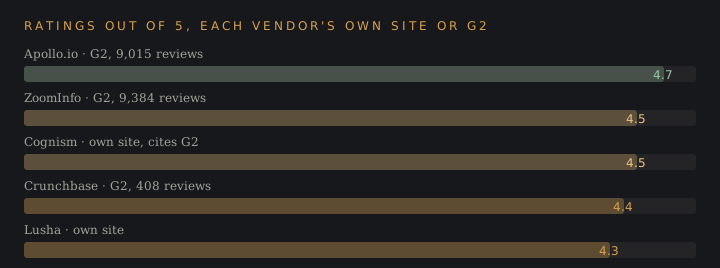
ZoomInfo carries a G2 rating of 4.5/5 across 9,384 reviews, published on ZoomInfo's own pricing page, against Crunchbase's 4.4/5 across 408. ZoomInfo publishes no rate card either; both vendors require a custom quote past the entry tier.
The trade-off is direct: ZoomInfo wins on verified direct-dial phone numbers and emails, the exact gap a Crunchbase user named on G2 ("I would love to have access to people's email or phone like ZoomInfo"). Crunchbase wins on the funding trigger and the free tier that lets a single researcher start without a sales call.
Apollo.io cites 4.7/5 across 9,690 reviews on its own pricing page and keeps a free plan with 900 credits per seat a year. Paid seats run $49 to $119 a month on annual billing, with 30,000 to 72,000 credits per seat a year.
Apollo's own FAQ confirms cancellations take effect at the end of the billing cycle with no manager needed to approve a mid-cycle downgrade, a lighter process than the renewal disputes described in Crunchbase's own reviews above. Apollo wins for a team whose main job is outbound email volume; Crunchbase still wins for surfacing which of those accounts just raised money.
Cognism doesn't publish tier prices at all, listing Standard and Pro as quote-only packages with five seats included and a credit model where an already-revealed contact carries forward at no extra charge unless that person changes jobs. Cognism holds 4.5/5 on G2 and 4.7/5 on Capterra, both cited on its own pricing page.
It's the pick for a European prospecting team that needs compliance-first mobile numbers; Crunchbase's data self-reporting problem, documented above, isn't one Cognism shares, because Cognism verifies numbers on demand.
A Reddit commenter framed the split bluntly: "Many VC and financial firms use B2B platforms like Uplead, Clay or Zoominfo to get their data instead of CB."
u/Merrygoround-, Reddit r/venturecapital.
Lusha starts free with 40 credits a month, charging 1 credit per revealed email and 10 per phone number, and its own pricing page states 4.3 out of 5 stars from customers. It's built for volume-based contact reveals, so the two tools rarely compete for the same budget line; a team running both usually buys Lusha for the seat that dials and Crunchbase for the seat that researches.
Try it yourself
Sign up for Lusha
Free plan available, credit-based pricing after that.
 Visit Lusha →
May earn a commission if you sign up through this link, at no extra cost to you. Full affiliate disclosure.
A Capterra reviewer who bought Crunchbase specifically for deal sourcing captured why it still beats the dedicated financial-data platforms on breadth, in a review titled "Crunchbase is the best in class tool for prospecting companies based on investment data".
"The data on VCs in Crunchbase is unparalleled and incredibly helpful whilst we were identifying targets for series round funding... Crunchbase is also exceptionally important for identifying M&A opportunities globally," though the same review's cons line adds, "Crunchbase is quite expensive" (Lucien H., VP of GTM, Capterra, 23 May 2024).
A different Capterra reviewer who evaluated it against PitchBook directly reached the opposite verdict on usability: "Pitchbook is simpler to use... The data can be patchy or just wrong for younger companys, the UI is cluttered and navigation is a mess sometimes" (Verified Reviewer, Investment Manager, Computer Software, Capterra, 1 December 2021).
Verdict
Crunchbase is for a researcher, founder, or business-development rep who needs one signal above every other tool they already own: who just raised money, and from whom. At $49 to $99 a month for a single Pro seat, it's priced for that person to buy it themselves, without a manager's sign-off, and the free tier still powers basic company lookups for anyone still deciding if the paid tiers are worth it.
ZoomInfo, Apollo, Cognism, and Lusha each beat it on verified phone numbers and emails at volume, and say so in their own review corpus; Crunchbase keeps its contact fields sparse by design and puts its engineering into the funding signal instead.
A team whose primary job is filling a CRM at scale belongs on one of those four. The export ceiling draws the same line: 2,000 or 5,000 rows a month caps list-building at scale, and the only way past it runs through a custom-quoted API contract with no published price.
A 10-person marketing or sales team can use it well as a second seat layered on top of a contact database they already pay for, provided whoever owns procurement sets a calendar reminder for the annual renewal date. The billing complaints above trace to the renewal and cancellation process, a consistent thread across Trustpilot and Capterra reviews over several years, and that risk is worth pricing in before the first invoice.
Disclaimer
This page includes one or more affiliate links. If you sign up for a product through one of them, this site may earn a commission at no extra cost to you.