What trademark infringement costs a growing business
 By Jan Suski. I go deep on every review, checking every number against its source and digging up details other coverage misses, a habit from six years of SEO and link building for tech companies. Bylines at Surfer, Brand24, and Senuto. How the scoring works.
· Prefer this source on Google
The numbers Trademark infringement risk, checked 24 August 2026
A trademark owner does not need to win in court to make a name expensive.
A cease and desist letter alone forces a decision inside a few thousand dollars.
Once the USPTO flags two marks as too similar, the TTAB overturns that call in roughly one refusal out of ten.
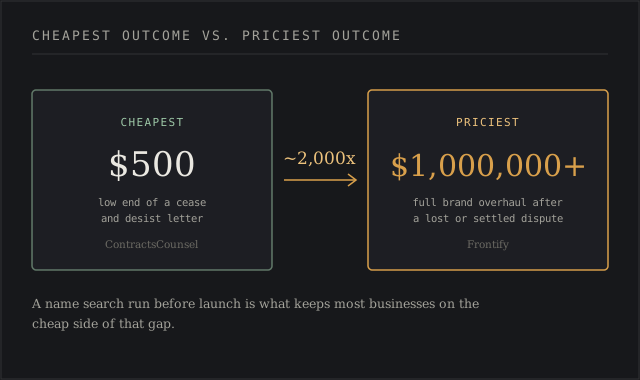
The gap between the cheapest outcome and the priciest one runs close to 2,000 times.
The gap between the cheapest way a name collision ends and the priciest one runs close to 2,000 times. Answering a cease and desist letter costs $500 to $1,500, per ContractsCounsel. Losing the fight and rebranding afterward runs $50,000 to $1,000,000 or more, per Frontify's own pricing guide, and that bill lands the day a company grows big enough for a competitor's attorneys to notice its name.
This total has four parts. The letter, the lawsuit, and the damages a court can award make up three of them. The fourth is the rebrand a loss or settlement forces, alongside how the USPTO and federal courts decide if two names conflict and what a trademark search catches before any of it starts.
It's built for founders naming a company, marketers relaunching an old one, and agencies advising both, including anyone drafting the positioning statement for the new name. Every figure here comes from law firms, the USPTO's own filings, and branding firms that price rebrands for a living.
What counts as trademark infringement
Trademark infringement happens when a business uses a mark "on or in connection with goods and/or services" in a way likely to cause consumer confusion, deception, or mistake about who is selling what, per the U.S. Patent and Trademark Office.
In court, the side suing is the plaintiff and the side being sued is the defendant. A plaintiff bringing a claim has to prove three things: it owns a valid mark, its rights came first, and the defendant's mark creates a likelihood of confusion for consumers, according to Cornell Law School's Legal Information Institute. Many plaintiffs file an unfair competition claim alongside the trademark infringement claim, since both rely on much of the same evidence.
None of that requires the two names to be identical. A name that sounds the same, reads the same on a page, or carries the same meaning as an existing one can trigger a claim even if the spelling is different. "Kwik" reads as "Quick" to a court the same way it does to a shopper. Examiners and courts both line up the newer mark against the trademark owner's mark already on file; how the newer business plans to use it later doesn't factor into that comparison.
The likelihood of confusion test
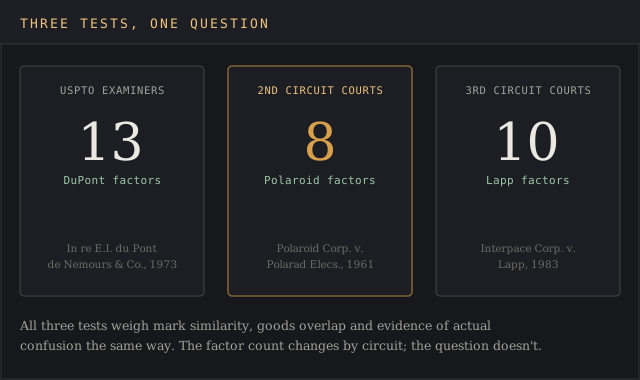
Every infringement case and every USPTO refusal comes down to one question: is the allegedly infringing mark close enough to the trademark owner's mark that consumers could mix the two up. Courts and examiners use multi-factor tests to answer it, and the factors overlap more than they differ. That single likelihood of confusion question drives every factor test that follows. Not all factors carry equal weight, and courts typically lean hardest on three of them.
The USPTO applies 13 factors drawn from a 1973 case, In re E.I. du Pont de Nemours & Co. Federal courts run circuit-specific versions of the same likelihood of confusion analysis: the Second Circuit applies 8 factors known as the Polaroid factors, and the Third Circuit uses 10 Lapp factors.
Other factors show up in specific circuits and specific industries, but outcomes vary by circuit far less than the underlying likelihood of confusion question would suggest. In most cases, the analysis comes down to how similar the marks look and sound, how related the goods and services are, and if there's evidence of actual confusion.
For example, a founder who expects a trademark infringement claim can often predict it just by running the same likelihood of confusion factors an examiner would: the degree of similarity between the marks, how related the goods and services are, and the strength of the trademark owner's mark in its own market.
How similar is too similar a mark
The comparison covers three things together: sight, sound, and meaning, per Nolo's legal encyclopedia. A similar mark doesn't need matching letters to fail this test, and the degree of similarity a court demands drops further once two businesses sell related goods and services to the same consumers.
Shared advertising channels count against a newcomer too: two names running search advertising and social advertising to the same buyers, the kind of overlap digital marketing intelligence tools are built to flag, push the likelihood of confusion analysis further toward the plaintiff even when the names differ by a syllable.
Physical packaging counts too. A defendant's mark on packaging that copies a rival's color scheme and layout adds to the similarity even when the words themselves are different, and courts generally treat that as relevant evidence on its own.
Evidence of actual confusion
Actual confusion, meaning a real consumer who bought from the wrong business or called the wrong support line, is the single strongest piece of evidence when it exists, but courts can find infringement without it.
When confusion exists in the real world, it usually shows up first in support tickets and social media messages, the kind of signal social listening tools are built to catch, well before it shows up in a courtroom. A handful of documented mix-ups among consumers can outweigh pages of argument about how two marks look on paper.
The defendant's intent
A court also weighs the defendant's intent behind the new name, along with the extent of potential confusion it could cause. Copying a rival's color palette, tagline, or font choice alongside a similar mark reads as an attempt to trade on someone else's reputation with consumers, and it moves a case toward the plaintiff fast.
Defenses that can beat a claim
A defendant has real defenses available, per Cornell's Wex: fair use, when the name describes a product without functioning as a brand for it; collateral use, when a trademarked component sits inside a wider product name; laches, if the plaintiff waited too long to object; and unclean hands, if the plaintiff's own conduct undercuts the claim.
None of these defenses are common outs, and none are free. Raising any of them is itself a legal expense: attorneys still have to research the circumstances, brief the court, and bill attorney fees along the way, win or lose. Courts weigh each defense against the specific facts of the case, and the relevant factors can point in different directions from one case to the next.
None of this changes if a trademark infringement claim never reaches a courtroom. An examiner runs the same likelihood of confusion factors during the application, well before any lawsuit exists. A trademark that gets refused at the application stage never turns into a courtroom infringement claim at all.
For example, two businesses selling similar services under an allegedly infringing mark can settle the question with a search alone, no filing required. That's the cheaper way for a trademark owner and a newcomer to determine, factor by factor, if the similarity between the names amounts to a real conflict before either side spends real money. Businesses that conduct this comparison before picking a name skip the fee an attorney would charge to run it later.
The cease and desist letter is the first bill
Most disputes start well before a courtroom gets involved. A cease and desist letter, sometimes called a demand letter, is a formal notice from a trademark owner telling a business, often labeled the alleged infringer inside the letter itself, to stop using a name, per the USPTO's own guidance for anyone who receives one.
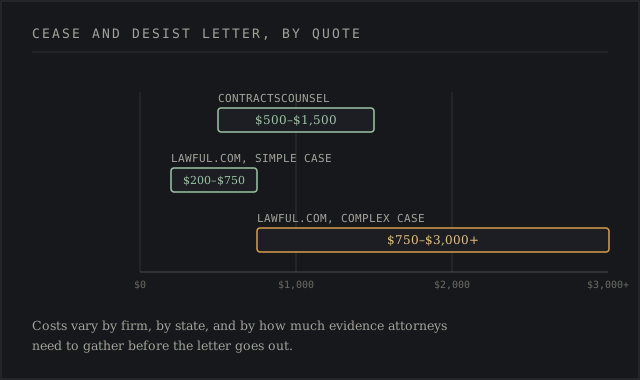
Attorneys price this stage lower than any other stage that follows. Legal-fee comparison site ContractsCounsel prices attorneys drafting or answering one cease and desist letter at $500 to $1,500.
Legal-cost site Lawful.com puts simple cases lower, at $200 to $750, and complex ones with detailed argument or a high-value claim at $750 to $3,000 or more, billed against an hourly rate of $150 to $400-plus, per Lawful.com. Costs vary by firm, by state, and by how much evidence attorneys need to gather before the letter goes out.
The letter itself costs the sender nothing to send. It's the opening move before any lawsuit gets filed, and what it buys a trademark owner is a paper trail: proof the alleged infringer knew about the conflict and kept using the name anyway, which matters later if intent becomes part of the case.
A trademark owner running an enforcement campaign usually starts here, since it's the cheapest way to test if a business will conduct itself differently once attorneys have flagged the conflict in writing. Most businesses that conduct a search before launch never get one of these letters at all.
What a lawsuit costs, stage by stage
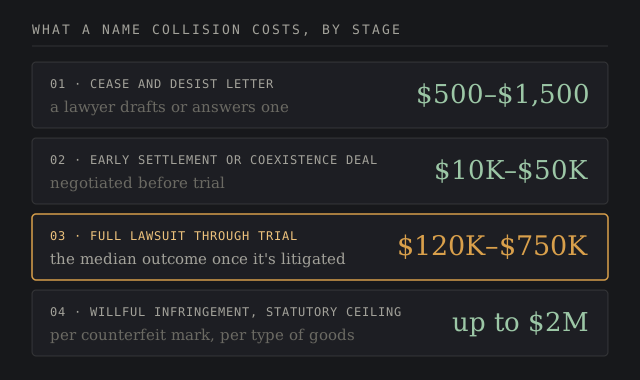
The cost of a name collision climbs fast once it passes the letter stage.
Cost climbs in a set order, and a business can usually see it coming several steps before the bill arrives. Attorneys on both sides run up hours during discovery, and that phase is what determines if a case stays cheap or turns expensive.
| Task | Typical cost | Source |
|---|---|---|
| Professional trademark clearance search | $300–$1,000 | ContractsCounsel |
| File a trademark application (attorney fee) | ~$970, plus USPTO filing fees of $250–$350 per class | ContractsCounsel |
| Respond to a USPTO office action | $300–$1,500 | ContractsCounsel |
| Draft or answer a cease and desist letter | $500–$1,500 (simple) to $3,000+ (complex) | ContractsCounsel; Lawful.com |
| Negotiate a settlement before trial | Low to mid five figures | Trademarkia |
| Full lawsuit through trial | $120,000–$750,000 | Trestle Law |
| Willful counterfeit damages ceiling | Up to $2,000,000 per mark | Lanham Act, via UpCounsel |
Figures are attorney-quoted retail rates from the source named in each row; actual cost depends on jurisdiction, firm, and case complexity.
A plaintiff rarely wants a full trial either. Discovery alone can run into six figures before a judge rules on anything. Most cases that survive the cease and desist letter settle before trial, since neither side wants to pay attorneys for a jury to decide it.
What a court can make a defendant pay
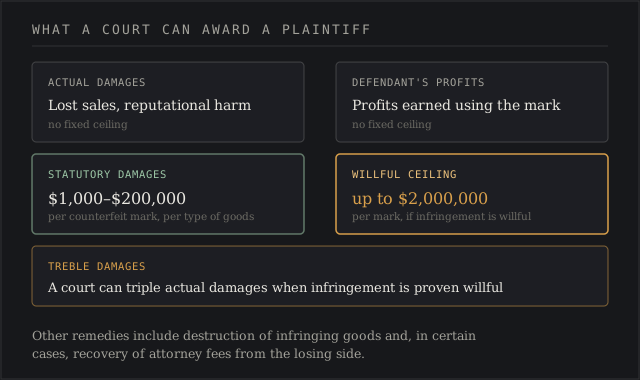
When a case does reach a verdict, a plaintiff can recover several kinds of relief under the Lanham Act, per UpCounsel's breakdown of the statute. Courts generally award actual damages from lost sales or reputational harm, the defendant's profits earned from using the mark, and statutory damages of $1,000 to $200,000 per counterfeit mark per type of goods.
When infringement is willful, statutory damages can climb to $2,000,000 per mark, and a court can triple actual damages, a remedy known as treble damages. Other remedies include the destruction of infringing goods and, in certain cases, recovery of attorney fees from the losing side. Attorneys on the winning side can recover their own attorney fees this way, which raises the stakes for a defendant weighing a settlement.
An injunction almost always comes with a damages award. A court can order the defendant to stop using the name immediately, and that order is the point where the rebrand bill starts.
The other bill: a forced rebrand
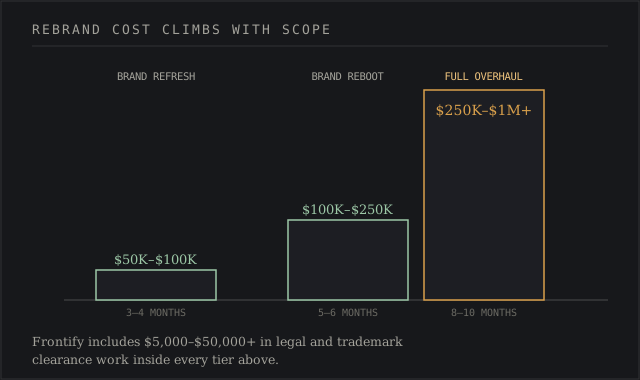
Losing a name dispute, or settling one on the condition the name changes, moves the cost from a law firm's invoice to a design and marketing budget.
Brand consultancy Frontify prices a straightforward brand refresh at $50,000 to $100,000, a full identity reboot at $100,000 to $250,000, and a complete rebrand for a global company at $250,000 to $1,000,000 or more.
Frontify includes a legal and trademark line item of $5,000 to $50,000-plus inside that budget, on top of design work and separate from anything already spent fighting the original claim. A complete rebrand touches the name, the logo, the domain, the signage, and every piece of marketing built under the old one.
| Rebrand scope | Typical cost | Timeline |
|---|---|---|
| Brand refresh (logo and identity tune-up) | $50,000–$100,000 | 3–4 months |
| Brand reboot (new identity system) | $100,000–$250,000 | 5–6 months |
| Full brand overhaul (global enterprise) | $250,000–$1,000,000+ | 8–10 months |
| Legal and trademark clearance (inside the above) | $5,000–$50,000+ | Runs parallel |
Cost and timeline bands are Frontify's own tiers, and the legal and trademark clearance row is already included inside each tier's total.
None of that counts the cost a rebrand doesn't show up as a line item for: the search ranking a business built under the old name and tracked in tools like Semrush, the reviews and backlinks that stop counting toward it, and the customers who keep searching for a name that no longer exists.
What the USPTO's own numbers say about a crowded market
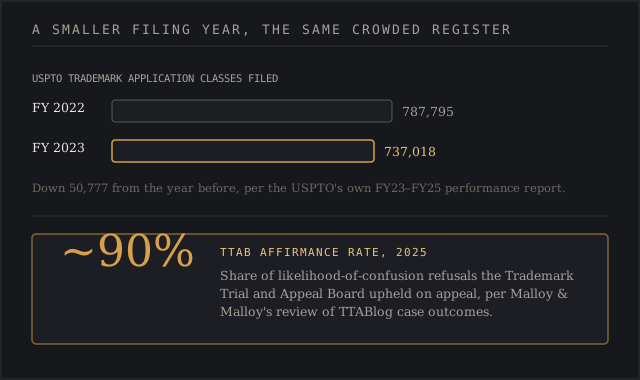
The USPTO received 737,018 trademark application classes in fiscal year 2023, a drop of 50,777 from fiscal year 2022, per its own performance report. Filing volume moving down doesn't make the register less crowded: every new application still gets checked against every registered mark already on file for related goods and services, and a name too close to an existing one gets refused before a plaintiff ever has to identify a defendant to sue.
Once an examiner refuses an application on likelihood of confusion grounds, that call is hard to undo. Intellectual-property firm Malloy & Malloy, citing a review of 2025 case outcomes by The TTABlog, found the Trademark Trial and Appeal Board affirmed roughly 90% of those refusals on appeal.
An appeal adds filing fees and attorney fees on top of the original application, for a result that goes the trademark owner's way about 9 times out of 10. An examiner's job is to protect consumers from exactly the confusion this report is about, well before a case like this reaches a courtroom.
What a trademark search catches before any of this starts
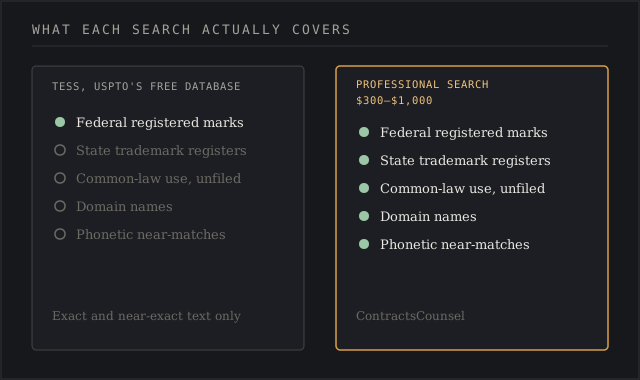
A trademark search run before a name launches is the one step that heads off the cease and desist letter, the lawsuit, and the rebrand at once. The USPTO's own Trademark Electronic Search System, at tmsearch.uspto.gov, is free and searches every federally registered mark. It only catches exact and near-exact text matches, though. It won't flag a name that sounds the same or reads the same under a different spelling.
A professional clearance search goes further. It checks state trademark registers, common-law use that was never federally registered, domain names, and marks used for related goods and services in categories that aren't identical, the places a do-it-yourself search misses.
OpenCorporates, a company-data platform indexing registrations across more than 140 jurisdictions, catches the unfiled common-law use a federal-only search misses; our company data providers rankings cover the alternatives to it. It also helps determine, before any money is spent on a launch, if a name reads the same to consumers as one already in use. The goal is to catch a conflict early, before it turns into litigation.
ContractsCounsel prices a professional search at $300 to $1,000, a fraction of the $500-plus a single cease and desist letter costs to answer, and well under 1% of what a lawsuit runs if the name has to be defended in court. For example, a founder who spends $600 on a clearance search before filing spends less than a single hour of a litigation attorney's time.
A naming or trademark-screening tool that layers company-name, domain, and social-handle checks on top of the USPTO database helps identify the gap a text-only search leaves open.
What this means before you lock in a name
A name free to register is a different question from a name safe to use. A business can pick a name nobody else has filed and still draw a cease and desist letter from another business using a similar mark without ever registering it. Unlike a registered mark, which requires a completed filing, common-law trademark rights exist the moment a mark is used in connection with real goods or services.
The cheapest point to identify a conflict is before a logo gets designed, a domain gets bought, or developing a full brand identity begins. A go-to-market plan is where that clearance check belongs, next to the budget line for the logo and the domain.
Every dollar a name collision costs sits on the far side of that decision, and it grows fast once marketing spend, signage, and customer recognition attach to the name. What to expect if a conflict does surface: a letter first, a negotiation second, and a courtroom only if both sides refuse to move.
A trademark clearance search won't guarantee a business never sees a trademark infringement claim, but it lowers the risk by an order of magnitude. Attorneys who conduct these searches for a living put it the same way in different words: the goal is to determine risk before it becomes a lawsuit.
Circumstances vary by industry and by how crowded the relevant goods and services category already is, so what counts as acceptable risk for one business can sit too close for another selling in direct connection with a bigger, better-known trademark owner's mark.
Frequently asked questions
What qualifies as trademark infringement?
Using a mark on goods or services in a way likely to cause consumer confusion, deception, or mistake about who is selling them, per the USPTO. The defendant doesn't need to have copied the mark on purpose for a claim to hold. Everything else in this report follows from that one likelihood of confusion question.
What does a cease and desist mean?
It's a formal letter from a trademark owner demanding that a business stop using a name, logo, or slogan the owner believes infringes its rights. It's a demand with no court order behind it, and a business that ignores one isn't automatically in violation of anything until a court says so.
How powerful is a cease and desist letter?
On its own, none. Its power comes from what happens if the business ignores it: the letter becomes evidence the alleged infringer knew about the conflict, which can turn a later infringement finding into a willful one and expose it to treble damages.
Can I do a trademark search myself?
Yes, through the USPTO's free TESS database, but a self-run search only catches exact and near-exact matches already on the federal register. It won't catch phonetic near-matches, state-level registrations, or marks in use but never filed, which is what a paid clearance search adds.
How much should a rebrand cost?
Frontify puts a basic refresh at $50,000 to $100,000, a full identity reboot at $100,000 to $250,000, and a global overhaul at $250,000 to $1,000,000 or more, plus $5,000 to $50,000-plus in legal and trademark clearance work on top of design.
Is rebranding risky?
Yes, mostly because of what a name change costs outside the design budget. Search rankings, review histories, and customer recall built under the old name usually take months to rebuild, on top of whatever the rebrand itself costs to produce.
Bottom line
A likelihood of confusion problem rarely announces itself as an infringement problem until a letter arrives.
A business name collision is cheap to fix before launch and expensive to fix after. A search costs a few hundred dollars. A cease and desist letter costs a few thousand. A lawsuit through trial costs six figures more often than not, and a forced rebrand on top of a loss adds six or seven figures more depending on how big the business grew before the letter arrived.
None of that math changes based on how the name was picked. Consumers don't know or care if the collision was deliberate or a coincidence between two founders who never heard of each other, and a trademark owner deciding if a letter is worth sending doesn't either. The cost of fixing it is the same either way, and a clearance search before the name is locked in is the one step on this list cheaper than every other option on it.
Sources, and what the figures above don't cover
Cease and desist letter, trademark filing, office-action and professional-search costs are ContractsCounsel's own published rates, read off contractscounsel.com/b/trademark-lawyer-cost. Lawful.com's simple and complex case bands are its own, at lawful.com/costs/cease-and-desist-letter-cost. Full litigation cost through trial is Trestle Law's, at trestlelaw.com.
Rebrand cost and timeline tiers are Frontify's own, at frontify.com/en/guide/rebranding-costs. Statutory and treble damages figures are the Lanham Act's own text, read via UpCounsel's summary at upcounsel.com/suing-for-trademark-infringement.
Filing volume and its year-over-year change are the USPTO's own FY23–FY25 Annual Performance Report, published at uspto.gov. The TTAB affirmance rate is Malloy & Malloy's own review of TTABlog case outcomes for 2025, at malloylaw.com. Definitions and the DuPont factor count are the USPTO's own, at uspto.gov/page/about-trademark-infringement and uspto.gov/trademarks/i-received-letter.
The plaintiff's burden, the four defenses and the Polaroid and Lapp factor counts are Cornell Law School's Legal Information Institute, at law.cornell.edu/wex/trademark_infringement. The sight-sound-meaning comparison test is Nolo's legal encyclopedia. All URLs accessed 24 August 2026.
None of the firms named here publishes a figure for what a name collision costs a business that settles quietly, before a letter is ever sent; that cost exists and never reaches a public rate card.