Patent search tools: 10 platforms ranked for 2026
 By Jan Suski. I go deep on every review, checking every number against its source and digging up details other coverage misses, a habit from six years of SEO and link building for tech companies. Bylines at Surfer, Brand24, and Senuto. How the scoring works.
· Prefer this source on Google
Quick comparison of patent search tools
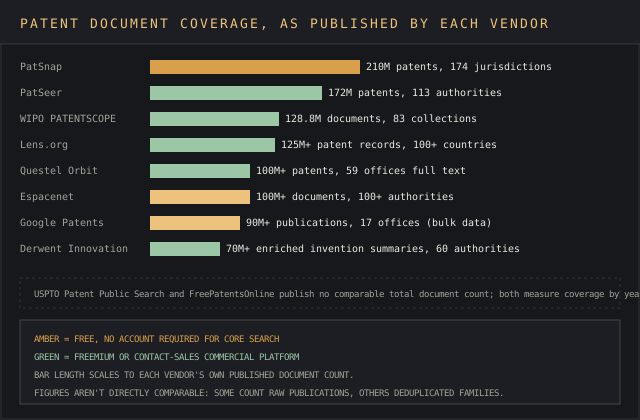
The table below orders all ten by final position. Coverage figures are each vendor's own published number, read on 15 August 2026; price is the vendor's own published rate where one exists, or "Contact sales" where it doesn't.
| # | Tool | Published coverage | Entry price | Best fit |
|---|---|---|---|---|
| 1 | Espacenet | 100M+ documents, 100+ authorities | Free, no account | Prior art searches needing family & legal-status data |
| 2 | Google Patents | 90M+ publications, 17 offices with bulk data | Free, no account | Fast natural-language search linked to Scholar prior art |
| 3 | WIPO PATENTSCOPE | 128.8M documents, 83 collections | Free, no account | International PCT and national-collection searches |
| 4 | USPTO Patent Public Search | Full text 1976-present, images to 1790 | Free, no account | US-only searches needing the deepest historical archive |
| 5 | Lens.org | 125M+ patent records, 100+ countries | $1,000/yr commercial* | Linking patents to scholarly-literature citations |
| 6 | FreePatentsOnline | Not published; measured by year range | Free; Pro tier on inquiry | Free full-text search with saved-search alerts |
| 7 | PatSnap | 210M patents, 174 jurisdictions | Contact sales | Enterprise IP teams wanting AI-native landscape analytics |
| 8 | Questel Orbit Intelligence | 100M+ patents, full text across 59 offices | Contact sales | Law firms needing FamPat family & citation data |
| 9 | Clarivate Derwent Innovation | 70M+ enriched invention summaries, 60 authorities | Contact sales | Teams wanting DWPI's expert-rewritten abstracts |
| 10 | PatSeer | 172M patents, 113 authorities | Contact sales | Portfolio analytics teams open to a negotiated price |
The price marked * is Lens.org's own published Individual Commercial Use Agreement rate; it does not cover institutional pricing, which Lens.org does not publish. Everything else is a figure the vendor or its own documentation publishes directly.
Where these figures come from
Coverage counts are each vendor's own published figure, read on 15 August 2026: Espacenet, Google Patents, WIPO PATENTSCOPE, Lens.org, PatSnap, Questel Orbit Intelligence, Clarivate Derwent Innovation and PatSeer all state their own document and jurisdiction counts on their own sites.
USPTO Patent Public Search and FreePatentsOnline publish no comparable total document count; both describe coverage by year range instead, so the table states that. None of the four enterprise platforms publishes a public rate card either.
Patent search tools let an inventor, an attorney or a licensing analyst search patent applications and grants by keyword, classification code, applicant name or legal status, to check if an idea has already been filed, claimed or abandoned. Ten platforms compete for that job, split into two groups that don't behave alike.
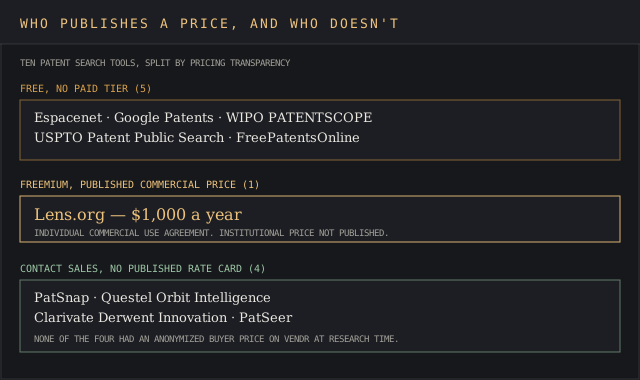
Five of them, run by patent offices or by nonprofits with a public mission, cost nothing and require no account for a core search: Espacenet, Google Patents, WIPO PATENTSCOPE, USPTO Patent Public Search and FreePatentsOnline. The other four are enterprise analytics platforms sold on a sales call, built for portfolio work at a scale a free tool wasn't designed to carry.
This ranking covers all ten, scored against five checkable criteria: published coverage, family and legal-status enrichment, search sophistication, price transparency and documented export limits. It's written for anyone choosing a first patent search tool, from a solo inventor running a prior art check to an IP team weighing a paid platform.
None of these ten platforms replace a registered patent attorney for a filing decision. What they replace is guessing, since each puts the same office data directly in front of a search box anyone can query.
This ranking covers dedicated patent search tools. For company-level due diligence that touches an IP portfolio without being a claims search, the data mining tools ranking and the data providers guide cover the same research from a company-research angle. Patent-claims research is what this ranking covers.
How to evaluate patent search tools
Five criteria decide the shortlist, and the ranking below applies them in this order: published coverage and jurisdiction breadth, family and legal-status enrichment, search sophistication for prior art, price transparency, and documented export or data-access limits.
Published coverage and jurisdiction breadth
A criterion here is admissible only if the vendor states its own document and authority count. Espacenet states 100 million-plus documents from over 100 authorities; PatSnap states 210 million patents across 174 jurisdictions. Neither figure means equal depth everywhere, but both are checkable against the vendor's own site.
Family and legal-status enrichment
Raw coverage answers if a document exists in the index. It doesn't answer if it's still in force, expired or withdrawn, or which other filings around the world claim the same invention. That's a separate, named layer:
- Espacenet's INPADOC family and legal-status data, built and maintained by the EPO itself.
- Questel Orbit's proprietary FamPat family and citation database.
- Clarivate's Derwent World Patents Index (DWPI), with abstracts rewritten by in-house scientists.
A tool returning only raw filings, with no named family or status layer, fails this criterion regardless of document count.
The year Clarivate's Derwent World Patents Index began. It's the oldest continuously maintained value-added patent database in this ranking, and every DWPI abstract since is written by an in-house scientist.
Search sophistication for prior art
The test is if a tool searches by more than exact keyword match. A named classification system (CPC or IPC), chemical structure search, cross-lingual query translation, or natural-language search linked to non-patent literature all count; plain keyword-in-title matching does not.
Google Patents links directly to Google Scholar's citation graph. WIPO PATENTSCOPE translates a query across languages and offers chemical compound search tied to PubChem, and a tool limited to keyword matching loses ground here even with a large document count.
Price transparency
Six of the ten tools in this ranking publish an actual price, or publish none because there's genuinely nothing to charge. Four enterprise platforms route every buyer to a sales call with no rate card at all, a real cost this ranking counts as such, since a buyer can't compare a number that doesn't exist.
Lens.org's published Individual Commercial Use Agreement rate, the only actual dollar figure any tool in this ranking states on its own site. The four enterprise platforms below it publish none.
Documented export and data-access limits
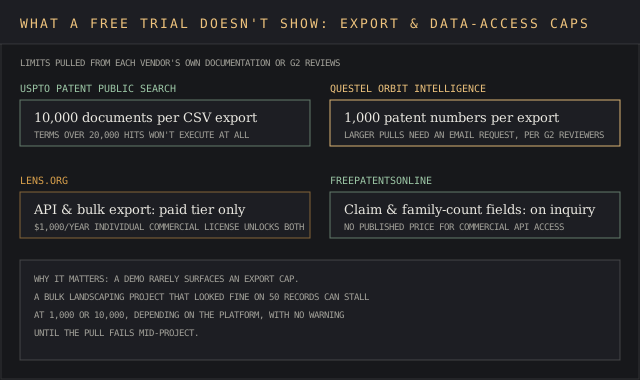
A free trial rarely surfaces this until a real project hits it. USPTO Patent Public Search caps a CSV export at 10,000 documents and won't run a query over 20,000 hits; Questel Orbit caps an export at 1,000 patent numbers before a buyer has to email for more, per G2 reviewers. A platform that documents its limit scores higher here than one that reveals it only once a project stalls.
Run the same query on Espacenet and Google Patents before paying for anything. If both surface the same top results, a free tool is doing the job; if family or legal-status data changes the picture, that's the moment a paid platform starts earning its price.
Top 10 patent search tools, ranked
Ranked on published coverage and jurisdiction breadth, family and legal-status enrichment, search sophistication, price transparency, and documented export limits.
Espacenet
Best fit
Anyone running a prior art search who needs authoritative family and legal-status data beyond keyword matching against a filing.
Espacenet is the EPO's own free search tool, drawing on more than 100 million documents from over 100 patent authorities worldwide. It runs on the same INPADOC family and legal-status data the EPO uses when it examines an application, through two interfaces: a guided Smart Search and a field-code Classic Search.
Patent Translate, built with Google, machine-translates non-English filings into English, a real help for anyone searching prior art outside their own language.
Key features
- INPADOC patent family and legal-status data across 100+ authorities.
- Patent Translate machine translation, built with Google, for non-English filings.
- Cooperative Patent Classification (CPC) search, jointly maintained by the EPO and USPTO.
- Smart Search and Classic Search interfaces for guided or field-code queries.
- Weekly publication cycle tied to the EPO's own Wednesday release schedule.
Pricing
Free, with no account required for a core search and no paid tier of any kind.
Pros
- INPADOC family and legal-status data comes straight from the office that grants the patents.
- Patent Translate removes the language barrier on non-English prior art without a separate tool.
- No account, no paywall, no export cap on a standard search.
Cons
- Classic Search's field-code syntax has a real learning curve for a first-time user.
- No built-in analytics or landscape visualization, unlike the paid platforms further down this list.
- No bulk API access for large-scale automated pulls.
Why it's ranked #1. Espacenet's own INPADOC layer spans 100+ authorities, more than Google Patents' 17 offices with bulk full-text data, and it comes from the office that examines against that same data.
Google Patents
Best fit
A first-pass prior art search that needs natural-language speed and a direct line into non-patent literature, without needing exhaustive family data.
Google Patents indexes more than 90 million publications, with full bulk data available from 17 patent offices, and it's free with no account required. Its advantage over a pure patent-office tool is the direct link to Google Scholar: a "Similar documents" panel and a citation graph surface related prior art, including academic papers a patent-office search wouldn't return.
Google also publishes the data as Google Patents Public Datasets on BigQuery, machine-readable bulk access most free tools don't offer.
Key features
- Full-text search across 90M+ publications, with bulk data from 17 offices.
- Direct citation linking to Google Scholar's academic and non-patent literature.
- "Similar documents" panel surfacing related prior art automatically.
- Google Patents Public Datasets on BigQuery for machine-readable bulk research.
- Natural-language search that doesn't require field-code syntax to use well.
Pricing
Free, with no account required and no paid tier.
Pros
- Fastest natural-language search of the free tools in this ranking.
- Only tool here with a direct citation link into Google Scholar's non-patent literature.
- BigQuery public dataset gives bulk access no other free tool offers.
Cons
- Google doesn't publish its own legal-status or family database the way the EPO does for Espacenet.
- Full bulk text data covers 17 offices, fewer than Espacenet's 100+ authorities.
- No official support channel; Google treats it as a free product with no SLA.
Why it's ranked #2. Its Scholar-linked citation graph and BigQuery dataset outrun WIPO PATENTSCOPE on search sophistication, even though PATENTSCOPE's declared 128.8 million-document collection is larger. It trails Espacenet because Google doesn't publish its own family or legal-status database.
WIPO PATENTSCOPE
Best fit
Searching international PCT applications alongside national patent collections, especially across languages.
PATENTSCOPE is WIPO's free search tool, covering 128.8 million documents across 83 collections, the largest declared count of any free tool here. It indexes PCT international applications alongside dozens of national and regional offices in one search.
Its cross-lingual search translates a query across languages, and its chemical compound search, built on PubChem data, matches by chemical structure directly.
Key features
- 128.8M documents across 83 national, regional and PCT collections.
- Cross-lingual search that translates a query across multiple languages.
- Chemical compound search tied to PubChem data.
- Full-text search of PCT international applications.
- Direct access to WIPO's own primary PCT filing collection.
Pricing
Free, with no account required and no paid tier.
Pros
- Largest declared document count of any free tool in this ranking, at 128.8 million.
- Cross-lingual search is a real differentiator for non-English prior art.
- Chemical compound search is a genuine advantage for pharma and materials searches.
Cons
- Query syntax and advanced search options take longer to learn than Google Patents' plain search box.
- No unified legal-status layer as authoritative as Espacenet's INPADOC data.
- Interface response can lag on complex cross-collection queries.
Why it's ranked #3. Its 83-collection, 128.8-million-document reach covers more national offices in one search than USPTO Patent Public Search's single-country archive. It ranks below Google Patents because it lacks a direct link into non-patent scholarly literature.
USPTO Patent Public Search
Best fit
US-only searches that need the deepest possible historical archive, back to the country's first issued patent.
USPTO Patent Public Search is the USPTO's official free tool, replacing the agency's legacy PatFT and AppFT systems, retired in 2022. It offers full text and images back to 1976, and images alone back to 1790, the deepest continuous archive in this ranking for a single country.
Two search panes are available: Basic for a fast keyword query, Advanced for field-code and classification-based search.
Key features
- Full text and images back to 1976; images alone back to 1790.
- Basic and Advanced search panes for different levels of query complexity.
- Official replacement for the retired PatFT and AppFT legacy systems.
- CPC classification search built into the Advanced pane.
- Direct, authoritative access to USPTO's own record of every US filing.
Pricing
Free, with no account required and no paid tier.
Pros
- Deepest historical archive in this ranking: images back to 1790.
- Official, primary system of record for US patents.
- Advanced pane supports field-code and classification search for serious prior art work.
Cons
- US filings only; no non-US authority coverage at all.
- CSV export caps at 10,000 documents, and a query over 20,000 hits won't run.
- Basic pane's keyword search is weaker than Google Patents' natural-language matching.
Why it's ranked #4. Its 1790-to-present archive beats every other free tool on historical depth for US filings, but its single-country scope loses to PATENTSCOPE's 83-collection international reach. Its 10,000-document export cap also sits below Lens.org's paid-tier ceiling.
Lens.org
Best fit
Researchers and IP teams who need to trace citations between patents and the scholarly literature behind them, citations beyond patent-to-patent relationships.
Lens.org is built by Cambia, an Australian nonprofit, and covers more than 125 million patent records from over 100 countries alongside a separate scholarly-literature index. That dual index is the real differentiator: a researcher can trace which papers a patent cites, and which patents cite a given paper, in one search.
Free access covers individual academic and non-commercial use with registration. Commercial use runs through a published Individual Commercial Use Agreement priced at $1,000 a year; institutional pricing isn't published.
Key features
- 125M+ patent records spanning 100+ countries.
- A separate scholarly-literature index cross-linked to patent citations.
- Published $1,000/year Individual Commercial Use Agreement for commercial access.
- API and bulk export, gated to the paid commercial tier.
- Free registration tier for academic and non-commercial searches.
Pricing
Free for individual academic and non-commercial use with registration. Commercial use requires the Individual Commercial Use Agreement, published at $1,000 a year; Lens.org does not publish an institutional rate.
Pros
- Only tool in this ranking that publishes an actual commercial price on its own site.
- Patent-to-scholarly-literature citation linking that no other tool here offers.
- Free tier offers unlimited research for academic and non-commercial use.
Cons
- API and bulk export sit behind the $1,000/year commercial tier.
- Institutional pricing isn't published anywhere on the site.
- No family or legal-status layer as deep as Espacenet's INPADOC data.
Why it's ranked #5. Its citation link between patents and scholarly literature is a real capability none of the four tools above it offer, but USPTO Patent Public Search's fully free, no-tier access still beats a platform that gates its API behind a $1,000 annual fee.
FreePatentsOnline
Best fit
Downloading full-text patent PDFs and setting up saved-search alerts without paying for anything.
FreePatentsOnline (FPO) runs a free full-text search across US, European and PCT collections, with PDF download built into the core product. It publishes no total document count; coverage is described by year range instead.
A paid tier adds features FPO doesn't price on its own site: claim and family-count fields and commercial API access, both on inquiry.
Key features
- Free full-text search across US, European and PCT collections.
- Built-in PDF document download at no cost, in the free tier.
- Saved-search alerts delivered by email.
- A paid tier with claim and family-count fields, priced on inquiry only.
- Boolean and field-restricted search for narrowing a broad keyword query.
Pricing
Free for core search and PDF download. The paid tier's claim and family-count fields, and commercial API access, are priced on inquiry, with no published rate on FPO's own site.
Pros
- Free PDF download built into the standard, no-cost product.
- Saved-search email alerts at no charge.
- Covers US, European and PCT collections in one search box.
Cons
- Publishes no total document count, unlike Espacenet, Google Patents or PATENTSCOPE.
- Paid-tier pricing isn't published anywhere; a buyer has to ask.
- No cross-lingual or chemical-structure search like PATENTSCOPE offers.
Why it's ranked #6. Free PDF download and email alerts hold their own against the other free tools, but FPO publishes no document count where Espacenet, Google Patents and PATENTSCOPE all state one, and its paid tier's pricing stays opaque against Lens.org's published $1,000 rate.
PatSnap
Best fit
Enterprise IP teams that want AI-native landscape analytics on top of search, and have the budget for a sales-quoted contract.
PatSnap, founded in Singapore in 2007, states the largest coverage figure in this ranking: 210 million patents across 174 jurisdictions. It combines patent search with technical literature and company-level intelligence, aimed at landscape analysis and competitive IP tracking.
A $300 million Series E round in April 2021, backed by SoftBank Vision Fund 2 and Tencent among others, pushed PatSnap's valuation past $1 billion and funded an AI-native analytics layer none of the free tools attempt to build.
Key features
- 210M patents indexed across 174 jurisdictions, the largest count in this ranking.
- Combined patent, scientific-literature and company-intelligence search in one platform.
- AI-assisted novelty, invalidity and freedom-to-operate search workflows.
- Patent landscape and portfolio-analytics visualizations.
- Chemistry structure search integrated alongside standard text search.
Pricing
PatSnap publishes no rate card; access runs through a sales quote with no published starting price.
Pros
- Largest declared coverage figure of any tool in this ranking, at 210 million patents.
- Combines patent, literature and company data in one search.
- Well-funded platform, backed by a $300M round that closed in April 2021.
Cons
- No published pricing anywhere; every buyer starts with a sales call.
- No free tier at all, unlike every tool ranked above it.
- Full analytics depth needs onboarding time a single prior art search is insufficient for.
Why it's ranked #7. Its 210-million-document count beats every other platform here, but FreePatentsOnline's free core search still outranks a platform that offers no self-serve tier and no published price at all.
Questel Orbit Intelligence
Best fit
Law firms and IP teams that need FamPat's proprietary family and citation data alongside a professional search interface.
Questel, a French IP services group, built Orbit Intelligence on FamPat, its proprietary family and citation database, covering more than 100 million patents with full text searchable across 59 offices. Questel's broader group also owns the PatentSight and IPStudies analytics brands.
G2 reviewers report an export cap of 1,000 patent numbers per pull, past which a buyer has to email Questel directly for a larger extract, a documented limit.
Key features
- FamPat proprietary patent family and citation database.
- Full-text search across 59 patent offices.
- Professional search interface built for repeat, high-volume searching.
- Group ties to PatentSight and IPStudies for portfolio-valuation analytics.
- Documented 1,000-patent-number export cap per pull.
Pricing
Questel publishes no rate card; access runs through a sales quote with no published starting price.
Pros
- FamPat's family and citation data is purpose-built for professional searchers.
- Full text searchable across 59 offices in one platform.
- Export limit is documented by reviewers.
Cons
- No published pricing; every buyer starts with a sales call.
- 1,000-patent export cap is lower than USPTO Patent Public Search's free 10,000-document limit.
- 100M+ coverage trails PatSnap's declared 210 million patents.
Why it's ranked #8. FamPat's 59-office full-text reach makes it a stronger professional search tool than PatSeer's broader but less analytics-integrated 172-million-document index, yet its 1,000-patent export cap and unpublished pricing keep it behind PatSnap's larger declared coverage.
Clarivate Derwent Innovation
Best fit
Teams that want DWPI's expert-rewritten abstracts and don't mind the smallest raw document count among the paid platforms in exchange for that depth.
Derwent Innovation is built by Clarivate, a publicly traded company on the NYSE under the ticker CLVT. Its core asset is the Derwent World Patents Index (DWPI), started in 1963 and still built on abstracts an in-house scientist rewrites for every entry, the oldest continuously maintained enrichment layer in this ranking.
Coverage runs to 70 million-plus enriched summaries across 60 authorities, the smallest raw count of the four enterprise platforms, a tradeoff against each entry's manual enrichment.
Key features
- Derwent World Patents Index (DWPI), running continuously since 1963.
- Abstracts rewritten by in-house scientists for every entry.
- Patent Citation Index for citation-based analytics.
- Coverage across 60 authorities, enriched.
- Backed by Clarivate, a publicly traded parent (NYSE: CLVT).
Pricing
Clarivate publishes no rate card; access runs through a sales quote with no published starting price.
Pros
- DWPI's 1963 start date is the longest continuous enrichment history in this ranking.
- Every abstract is scientist-rewritten, a manual editorial step most platforms skip.
- Publicly traded parent company gives buyers financial visibility the private vendors here don't offer.
Cons
- Smallest raw document count of the four enterprise platforms, at 70 million-plus.
- No published pricing; every buyer starts with a sales call.
- Manual enrichment means new filings take longer to appear than in a raw full-text index.
Why it's ranked #9. DWPI's scientist-written abstracts, running since 1963, are the deepest enrichment layer in this ranking, but its 70-million-document count is the smallest of the four paid platforms, behind Questel's 100 million-plus.
PatSeer
Best fit
Portfolio analytics teams open to a negotiated price who want broad authority coverage without Clarivate's or PatSnap's institutional backing.
PatSeer is built by Gridlogics Technologies, a privately held company based in Pune, India, and states coverage of 172 million patents across 113 authorities, the second-largest declared count in this ranking after PatSnap. It offers machine-learning-assisted classification alongside landscaping and portfolio analytics comparable in scope to the platforms above it.
Unlike Clarivate's public listing, PatSnap's venture backing, or Questel's diversified group structure, Gridlogics carries none of that outside financial visibility, leaving a buyer less third-party insight into the company behind the product.
Key features
- 172M patents indexed across 113 authorities, second-highest count in this ranking.
- Machine-learning-assisted patent classification.
- Patent landscaping and portfolio-analytics tooling.
- Built and maintained by Gridlogics Technologies, based in Pune, India.
- Search interface comparable in depth to Orbit Intelligence and Derwent Innovation.
Pricing
Gridlogics publishes no rate card; access runs through a sales quote with no published starting price.
Pros
- 172-million-document count beats Questel's and Derwent's declared coverage.
- 113 authorities is the broadest jurisdiction count among the four enterprise platforms.
- Machine-learning classification tools comparable to the larger, better-funded platforms above it.
Cons
- No published pricing; every buyer starts with a sales call.
- Privately held with none of the public-market or venture-funding visibility the other three enterprise platforms carry.
- Smaller market profile than Clarivate, Questel or PatSnap makes reference-checking harder for a buyer.
Why it's ranked #10. Its 172-million-document, 113-authority coverage beats Questel's and Derwent's declared numbers, but Gridlogics carries none of the public-market, venture-funding or diversified-group visibility the other three enterprise platforms offer a buyer weighing a sales-quoted contract.
What patent search tools do
Every tool on this list searches the same raw material: patent applications and grants that a national or regional office publishes as a legal record, in exchange for the inventor's limited monopoly.
What differs is how much work happens on top of that filing. A free office tool like Espacenet or USPTO Patent Public Search returns it close to as-published. An enterprise platform like PatSnap or Derwent Innovation adds classification, translation, family linking and citation analysis on top.
Classification systems: CPC and IPC
Two classification systems recur across this ranking. The International Patent Classification (IPC), maintained by WIPO, is the older, broader system most national offices use as a baseline. The Cooperative Patent Classification (CPC), jointly developed by the EPO and USPTO, breaks the same subject matter into finer subdivisions, and it's the system Espacenet and USPTO Patent Public Search both search by default.
Searching by classification code catches filings that use different words for the same invention, which is the single biggest reason a keyword-only search misses real prior art.
Run a CPC or IPC classification-code search alongside your keyword search every time. A filing that never uses your exact search term still turns up under the right classification code.
The year US patent images begin in USPTO Patent Public Search, the deepest single-country archive of any tool in this ranking. Full text starts later, in 1976.
Prior art search, freedom-to-operate search and invalidity search, differentiated
These three terms describe different jobs, and vendor marketing often blurs them. A prior art search asks if an idea has already been disclosed anywhere, which is the standard check before filing a new application.
A freedom-to-operate (FTO) search asks a narrower question: if launching a product would infringe a currently enforceable claim, which is why legal-status data decides the answer. An invalidity search works backward from a granted patent, hunting for a document that predates it and should have blocked the grant.
A free tool answers the first question well. The second and third lean on the family and legal-status layer this ranking weights directly, which is why an FTO opinion typically draws on enriched data.
How to choose a patent search tool
Start with jurisdiction. A US-only search misses prior art published in Japanese, Korean or Chinese collections that Espacenet's 100+ authorities or PATENTSCOPE's 83 collections would surface.
Check the export limit before committing to a bulk project. A landscaping pull that looks fine against 50 sample records can stall against a 1,000-patent cap on Questel Orbit or a 10,000-document cap on USPTO Patent Public Search, with no warning until it fails.
Ask a paid platform's sales rep to run your actual search terms live. A tool with real classification-code and family-data depth handles an unfamiliar query in the room. One that needs a "follow-up call to configure it" is selling a sales process.
Weigh price transparency against feature depth deliberately. Lens.org is the only tool here that states an actual commercial price, $1,000 a year; the four enterprise platforms route a buyer to a sales call with no number attached, turning a feature comparison into a negotiation before anyone sees a demo.
Patent activity is one signal among several in a broader competitive picture. The company data providers ranking covers the firmographic and ownership data that usually sits alongside a patent search in a due-diligence workflow.
Common mistakes when searching patents
The most repeated mistake in this category is treating a keyword-only search as complete. A classification-code search, run alongside the keyword pass, catches filings describing the same invention with different words, which is why every tool here that supports CPC or IPC search treats it as a real feature.
A second mistake is skipping legal-status data on a freedom-to-operate question. A patent that expired, lapsed for unpaid fees, or was withdrawn no longer blocks anything, and a raw full-text search returns it looking as enforceable as one still active; Espacenet's and Orbit's family-and-status layers exist to answer that question. A third, specific to the paid tier: sign nothing before testing a platform against a query whose answer you already know.
Patent search tools FAQ
What are patent search tools
Patent search tools are platforms that let a user search patent applications and grants by keyword, classification code, applicant or inventor name, priority date, or legal status, to run a prior art search, an FTO check or a portfolio analysis against the public record.
Which patent search tool is completely free
Five tools in this ranking cost nothing and need no account for a core search: Espacenet, Google Patents, WIPO PATENTSCOPE, USPTO Patent Public Search and FreePatentsOnline. Lens.org is free for individual academic and non-commercial use but charges $1,000 a year for commercial access; the four enterprise platforms are all sales-quoted.
What's the difference between Espacenet and Google Patents
Espacenet runs on the EPO's own INPADOC family and legal-status data across 100+ authorities, the same data the EPO uses when it examines an application. Google Patents indexes 90 million-plus publications with bulk text from 17 offices and links directly to Google Scholar's citation graph, a capability Espacenet lacks.
Do I need a paid patent search platform for a legal freedom-to-operate search
A freedom-to-operate opinion depends on accurate legal-status data, and a free tool with a deep status layer, Espacenet's INPADOC data in particular, can support a competent first pass. Most FTO opinions issued by counsel still draw on a paid platform's enriched family and citation data.
What is a patent family, and why does it matter when searching
A patent family is the group of related filings, across different countries, that claim the same underlying invention. Searching without family data means the same invention can look like several unrelated results, or a foreign-language filing in the family can hide prior art an English keyword search would otherwise miss.
Bottom line
Espacenet is the safest default for most prior art searches: it's free, needs no account, and its INPADOC data comes straight from the office that grants the patents. Google Patents is the fastest first-pass tool when speed matters more than jurisdiction depth, thanks to its Scholar-linked citation graph.
WIPO PATENTSCOPE and USPTO Patent Public Search both earn a place for specific jobs: PATENTSCOPE for international PCT and cross-lingual work, USPTO for the deepest US-only historical archive. Lens.org is worth its $1,000 fee for anyone tracing patent-to-scholarly-literature citations, a capability none of the free tools offer.
The four enterprise platforms, PatSnap, Questel Orbit Intelligence, Clarivate Derwent Innovation and PatSeer, all earn their place for portfolio-scale IP work.
PatSnap's 210-million-document coverage suits a large, well-funded team; Derwent Innovation's scientist-written abstracts, running since 1963, suit a team that values depth over raw count. None of the four publishes a price, so the real cost only shows up after the sales call.