Patent search cost in 2026: $0 to $4,500, plus the $770 USPTO search fee
 By Jan Suski. I go deep on every review, checking every number against its source and digging up details other coverage misses, a habit from six years of SEO and link building for tech companies. Bylines at Surfer, Brand24, and Senuto. How the scoring works.
The numbers Patent search cost, checked 30 September 2026
IPApproach's $1,200 search costs 6.0 times Patentia's $199 search-only report, and Klemchuk's $2,600 flat fee, which adds an attorney's reading of the results, costs 13.1 times it.
Office charges rose on both sides of the Atlantic, with USPTO filing, search and examination fees up 10% in total from 19 January 2025 (Finnegan), the EPO's European search charge up from €1,520 to €1,595 and the UKIPO's online charge up from £150 to £200 on 1 April 2026.
Six patent database vendors sell team plans by quote only, and PatSnap's $200-a-month Pro seat is the one public price among them.
Searching the patent record yourself costs $0 on Espacenet, Google Patents or USPTO Patent Public Search. A self-serve AI report runs $149 to $499, a human patentability search on a published rate card $400 to $2,600, and a worldwide FTO search $4,500. Every non-provisional application filed with the United States Patent and Trademark Office also pays a $770 search fee, or $154 for a micro entity.
The bill comes from two price lists. Patent office charges are government fees every applicant pays on patent filings, and the USPTO, the European Patent Office and the UKIPO all raised their fees between January 2025 and April 2026. The private search is an optional search you choose to buy, and AI pushed its price down until a $199 report sat next to human rate cards of $1,200 to $2,600.
This report prices 19 patent offices, firms and tools, with 44 price rows re-checked on 30 September 2026, for individual inventors, small businesses & in-house intellectual property teams budgeting a search before filing a patent application or launching a product. It covers official fees, AI reports and seats, human search firms, quote-only databases and six pricing claims tested against their sources.
The price tracks the question asked. A $199 report checks if a great idea is already in print, and a clearance study at Brown & Michaels costs $25,000 or more and ends in a patent attorney's legal opinion a company can rely on before a launch.
Quick answers, where a $1,200 human search costs 6.0 times a $199 AI report
Note that Patentia's $199 product is search only, so reading it as a like-for-like swap for a firm misses the mark. Klemchuk's $2,600 flat fee pays for a professional searcher plus a patent attorney who reads the results against your patent claims, so each pair below compares two different jobs. The quality of a search report depends on the analysis on top of the hit list.
| Human firm | Price | AI self-serve | Price | Ratio (derived) |
|---|---|---|---|---|
| IPApproach novelty search | $1,200 | Patentia search, search only | $199 | 6.0x |
| Klemchuk, with attorney interpretation | $2,600 | Patentia search, search only | $199 | 13.1x |
| IPApproach and Klemchuk | $1,200 and $2,600 | Patentia analysis, PriorArtCheck top tier | $499 | 2.4x and 5.2x |
| IPApproach and Klemchuk | $1,200 and $2,600 | PriorArtCheck report | $149 | 8.1x and 17.4x |
All four prices are list prices from each vendor's own rate card or pricing post, read 30 September 2026. The ratio column divides the human price by the AI price.
Yury Kapgan, partner and co-chair of the AI practice group at Quinn Emanuel Urquhart & Sullivan, gave the buyer's view in Patlytics' Series B announcement, carried by The AI Insider on 8 April 2026: "When the stakes are high, you need an edge."
Free databases for prior art research
Espacenet is free around the clock and covers more than 150 million patent documents, per the EPO, and WIPO opened a free AI-assisted search in PATENTSCOPE in 2026 for anyone with a WIPO account. The Rapacke Law Group lists Google Patents and USPTO Patent Public Search at $0 too, and our ranking of search databases compares all four.
Quick decision guide, from a $0 idea check to a $4,500 search before a worldwide launch
Your reason for searching sets the price more than the vendor you pick. Each row maps a common situation to the cheapest published route, and patent office fees come on top of every row.
| If you | Then buy | Price | Published by |
|---|---|---|---|
| Want to know if the invention is already out there | A free database search or one AI report | $0, or $149 and $199 | EPO, WIPO, PriorArtCheck, Patentia |
| Are about to file a US patent application | A human patentability search, then the USPTO charge at filing | $400 to $2,600, plus $770, $308 or $154 | WashPat, Klemchuk LLP, USPTO |
| Plan to sell a product | An FTO search per market or a clearance search | $1,500 for one jurisdiction to $4,500 worldwide, or from $2,250 | IPApproach, WashPat |
| Want to challenge a competitor's patent | An invalidity search priced by claims | $1,000 for one independent claim to $2,250 for all claims | IPApproach, WashPat |
| Need a written opinion you can rely on | A law firm opinion | $7,500 to $25,000, or $25,000 and up for a clearance study | Brown & Michaels |
| Search every week | A database seat | $200 a month, or from $500 a month billed annually | PatSnap, Amplified |
USPTO figures come from the official fee schedule; every other price is a list price published by the named firm or vendor, read 30 September 2026.
An idea check costs $0 to $199 and a pre-filing search $400 to $2,600 on the published rate cards. The devil's in the details of the search type, since FTO work in several jurisdictions or a legal opinion moves the bill into four and five figures. Drug makers run that FTO step against patent expiry dates, a cycle our pharma market intelligence guide follows from discovery onward.
Patent professionals who sell searches now compete with AI reports at $149 to $199. Stephanie Curcio of NLPatent described the pressure on a panel IPWatchdog reported on 6 April 2026.
"You need to figure out the X factor that you can give clients as these tools proliferate."
Stephanie Curcio, NLPatent, IPWatchdog LIVE 2026 panel reported by IPWatchdog, 6 April 2026
Two price lists, the $770 patent office fee you owe at filing and the private search you choose to buy
Every non-provisional US patent application pays the patent office's own search fee at filing, the step where the patent application process formally starts. US law asks no applicant to run a search first. A provisional patent application secures a filing date without that fee, which gives individual inventors time to buy a private search before the non-provisional application falls due.
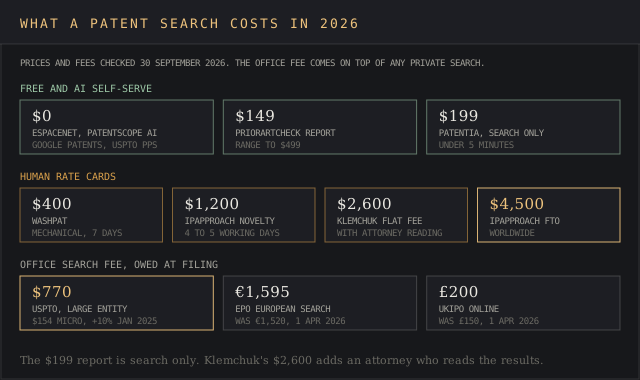
Official fees at each patent office, $770, €1,595 and £200
The USPTO charges $770 to search a utility patent application from a large entity, $308 from a small entity and $154 from a micro entity at filing, fee code 1111 on the current USPTO fee schedule, updated 14 August 2026. The rates date from 19 January 2025, when the office's fee rule lifted filing, search and examination fees by 10% in total.
The European Patent Office charges €1,595 for a European search on payments from 1 April 2026, and the old €1,520 figure survives on a Boult Wade Tennant bulletin. Among national offices, the UKIPO raised its online charge from £150 to £200 on the same date and its paper charge from £180 to £240, a 33% rise online that Hindles flagged.
| Office | Fees for the search | Effective |
|---|---|---|
| USPTO | $770 large, $308 small, $154 micro | 19 January 2025 |
| EPO | €1,595 European search, €1,885 as ISA | 1 April 2026 |
| UKIPO | £200 online, £240 on paper, £160 online on an international patent application (was £120) | 1 April 2026 |
| WIPO, PCT filing | CHF 1,330 filing fee plus CHF 15 per sheet over 30, search set by the ISA | current PCT schedule |
Every figure is an official fee from the office's own schedule: the USPTO fee schedule, OJ EPO 2026 A2, the UKIPO fee list on GOV.UK and the WIPO PCT schedule.
Each patent office sets its own schedules, and the US fee structure itself is far from set in stone. Patently-O reported in September 2026 that the USPTO's fee-setting authority runs only through 11 December, and law professor Dennis Crouch of the University of Missouri wrote about the House hearing of 2 September 2026.
"IPR discretionary denial has nothing to do with fees, but the fee sunset is the one moment when the Office must come to Congress and ask for something."
Dennis Crouch, Patently-O, September 2026
Micro entity status and small entity status, $154 and $308 for the same search
The USPTO describes micro entity status as "an 80% reduction on most fees" on a help page updated 17 September 2026, with a gross income cap of $262,380 from 15 September. The discount knocks the lion's share off most of those fees, including the $770 charge, and first time filers and small businesses that qualify as a micro entity pay $154.
Filing, search and examination fees come to $2,000 for large entities, $800 for a small entity filing on paper, $730 for a small entity that filed electronically ($70 electronic filing fee, code 4011) and $400 for a micro entity, all sums of fee schedule lines, before the issue fee. Small entity status alone takes $1,270 off the $2,000 bill.
International patent filing through the PCT, $600 to $2,400 for the search
On the PCT route, the international searching authority you pick sets the price for international patent filings. Search fees paid through the USPTO as receiving office run from $600 at the Philippines office to $2,400 when the USPTO itself searches at the full rate, or $960 small and $480 micro.
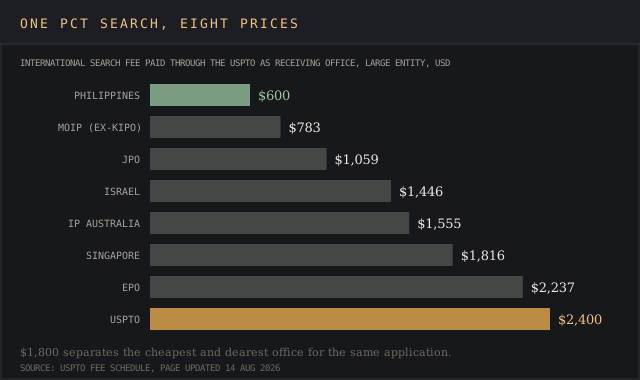
MOIP, formerly KIPO, charges $783, the JPO $1,059, Israel $1,446, IP Australia $1,555, Singapore $1,816 and the EPO $2,237, or €1,885 paid to the EPO directly. Picking the ISA is a piece of patent strategy, and reading between the lines of the schedule pays, since $1,800 separates the cheapest patent office from the dearest.
Filing fee, examination, office actions and maintenance fees around the search
The search is one line item in the US front end. At full rates, an applicant pays a $350 filing fee, the $770 search charge and an $880 examination fee, $2,000 in USPTO fees before a patent examiner opens the patent application and prosecution starts. The issue fee, a request for continued examination and three maintenance fees sit further down the schedule, and the maintenance fees run $2,150, $4,040 and $8,280 at 3.5, 7.5 and 11.5 years at full rates.
Maintenance fees drive patent portfolio management. Companies with larger portfolios track each patent in management software, review the portfolio against the business roadmap to decide which inventions to protect next, and prune patents that no longer cover a product, which saves the $8,280 fee due at 11.5 years.
Prosecution brings office actions, and they're par for the course. Brown & Michaels charges $1,900 to $4,500 to answer an uncomplicated one and estimates that 85% to 90% of patent applications draw one or more office actions. IPWatchdog put first office action pendency at 16 to 22 months on 8 June 2026.
A full utility patent application costs far more than its search once drafting and prosecution are billed. Lightbringer's FAQ puts it at "$10,000 to $20,000 or more through a traditional law firm," and Brown & Michaels prints attorney fees of $6,000 to $10,500 for an average mechanical or electrical case, up to $22,000.
The published-price tier, $149 AI reports and $400 to $2,600 human searches without a sales call
Eight paid products print a price you can buy at, four AI tools and four human search firms. Teams that already watch rival patent filings, one of the signals in how to gather market intelligence, can run the same searches on their own ideas.
| Vendor | Product | Price | Turnaround | Pricing model |
|---|---|---|---|---|
| PriorArtCheck | AI patentability or FTO report | $149 ($149 to $499) | not published | per report |
| Patentia | Search, analysis, "Full journey" | $199, $499, $998 | under 5 minutes for the search | per report |
| PatSnap | Eureka IP Search Pro | $200 a month | on demand | monthly seat |
| Amplified | AI search seat | from $500 a month | on demand | billed annually |
| WashPat | Patentability search | $400 mechanical, $500 other fields | 7 days, 2 days on rush | per search |
| IPApproach | Novelty search | $1,200 | 4 to 5 working days | per search |
| Brown & Michaels | US search, simple mechanical invention | from about $1,800 | three to four weeks | per search plus hourly |
| Klemchuk LLP | Search plus attorney interpretation | $2,600 | not published | flat fee |
Prices are list prices from each vendor's pricing page, rate card or pricing post, read 30 September 2026. Turnaround is the vendor's own stated figure.
AI self-serve search, $149 a report to $500 a month
PriorArtCheck lists a guided AI report at $149, running to $499. Patentia's pricing post, by Daniela Estevez, lists $199 for search only, $499 with a patentability analysis and $998 for its "Full journey" package. PatSnap's Eureka IP Search Pro runs AI novelty, FTO and design FTO agents for $200 a month, and its 14-day trial of 10,000 credits covers "≈ 2 Targeted Analyses" by PatSnap's count.
Amplified starts at $500 a month, billed annually. Lightbringer runs a $0 AI patentability check, and one of its patent attorneys reviews what the software finds.
Flat fees, per-search rate cards and hourly billing at human firms
Klemchuk LLP's $2,600 flat fee covers the whole nine yards, a professional searcher plus attorney interpretation, and that fixed pricing caps the bill before work starts. IPApproach and WashPat price per search, and Brown & Michaels mixes a US search from about $1,800 with hourly billing for attorney fees at $265 to $540 an hour.
Flat fees reach filing work as well, with Lightbringer charging $7,200 per patent application per year through to a decision on grant, official fees on top. ipCapital Group, which prints no price of its own, put the market range for a professional search with an analyst report at $1,000 to $3,000 and up in June 2026.
Bernard Tomsa of Brooks Kushman warned the same IPWatchdog LIVE 2026 panel that "There are diminishing returns for doing more work for less money." Venture money keeps flowing into the AI side all the same. LawNext reported in May 2026 that Stilta raised a $10.5M seed round led by Andreessen Horowitz for AI invalidity work, and General Partner David Haber made the case in the press release.
"Patent litigation runs on labor-intensive workflows that haven’t meaningfully changed in decades," [...] "Stilta automates them and, in doing so, becomes the system of record for how enterprises protect and monetize their most valuable intangible assets."
David Haber, General Partner, Andreessen Horowitz, press release quoted by LawNext, May 2026
The quote-only tier, six vendors with no team price and one public anchor at $200 a month
Six patent database vendors sell team or enterprise plans by quote, and PatSnap's $200-a-month Pro seat is the one public figure in the group. The same sales-call pattern runs through what social listening tools cost and through market intelligence platform pricing, so intellectual property buyers who have priced those will recognize it.
PatSnap
PatSnap prints two prices, $200 a month for Eureka IP Search Pro and $100 for 10,000 Open Platform credits, with a $100 minimum and a one-year life. It keeps team rates under the radar, and Teams and enterprise plans show "Contact us." A Bloomberg report of 15 June 2026, relayed by Judith Murphy at Startup Fortune, put PatSnap's dual Hong Kong and Singapore IPO target at $300M to $400M.
Questel Orbit, Minesoft PatBase, IPRally and PatSeer
GetApp's Orbit Intelligence listing, updated September 2026, reads "Starting from No pricing info." Minesoft offers a free trial of PatBase and lists no price. IPRally sells "Per seat annual pricing / Discounts from 3 seats" with "no onboarding or implementation fees", and Gridlogics sells all four PatSeer editions as a flat fee subscription behind "Contact us for pricing."
Patlytics
Patlytics closed a $40M Series B in April 2026 and publishes no rate card. Its release claims "$30,000+ saved per claim chart" and an 80% cut in project time, both the vendor's own figures, and a savings claim with no public price to test it against is a red flag for a buyer.
Wayne Hu, general partner at SignalFire, called IP "one of the most consequential and underserved markets in professional services" in the same announcement. Francesca Cruz of Juristat told the IPWatchdog LIVE panel that "Many companies will be cutting AI budgets in 2026 if no ROI is identified."
Three buyer scenarios, from a solo inventor to an enterprise IP team
A solo inventor with one invention spends $0 on the free databases, $149 to $199 on one AI report, then $154 for the search as a micro entity at filing. A startup about to file its first patent application pays $1,200 (IPApproach) to $2,600 (Klemchuk) for a human search, plus a $730 USPTO front end as a small entity filing online, or $2,000 at full rates, before office actions.
An enterprise intellectual property team buys seats. PatSnap Pro at $200 a month and Amplified from $500 a month are the only printed seat prices, so ask every other vendor for seat count, credit pool and renewal terms in writing. The six platforms in our competitive intelligence tools ranking leave patent data out, and buyers pricing regulatory tools from the same budget can compare the eight platforms in the regulatory intelligence software ranking.
The add-on, WashPat's rush fee turns a $400 search into $800
Speed is the one line item a published rate card prices in the open. WashPat charges $400 for a mechanical patentability search in 7 days, $600 at its middle tier and $800 in 2 days, a 100% rise for five days saved. Electrical, software, chemical and biotech inventions cost $100 more at each tier ($500, $700 and $900), since technical complexity sets the depth of a search, and the fee schedule PDF the live page links is named 2017FeeSchedule.
Patent validity, infringement and clearance searches climb harder, from $2,250 in 14 days to $3,500 in 10 days and $5,000 in 7 days. A week saved costs $2,750, a 122% rise from bottom to top. A filing date days away costs an arm and a leg at that tier, and PatSnap sells its own add-on for heavy users at $100 per 10,000 credits.
The search side of the patent process runs in three steps. You send the invention disclosure, a technical disclosure of what the invention does and how, and pick the type of prior art search. You then pick the turnaround, and the add-on sits in that choice. The report comes back in under 5 minutes at Patentia, in 4 to 5 working days for IPApproach's novelty search, 10 to 12 for its worldwide FTO search and 15 to 20 for its $6,000 "Patent Landscape" study.
"The costliest thing is to create efficiencies with AI and then reward the person responsible for the efficiency with more work"
Bruce Berman, The Center for Intellectual Property Understanding, IPWatchdog LIVE 2026 panel reported by IPWatchdog, 6 April 2026
A $0 search you run yourself, and the USPTO AI pilot that drew 169 petitions
Free patent databases cut the price of looking. The risk of missing a reference stays with the person searching, and hunting alone across the 150 million-plus documents in Espacenet can feel like looking for a needle in a haystack. The USPTO's own free AI search drew few takers.
The USPTO's Automated Search Pilot (ASAP) ran AI prior art research on new patent applications. Its petition fees are $450 at the full rate, $180 small and $90 micro, and the patent office waived the fee for petitions filed on or after 23 March 2026. The pilot was capped at 3,200 and closed to petitions on 1 June 2026.
By 16 April 2026, 169 petitions had been filed and 76 granted, per IPWatchdog. IPWatchdog is the source for both counts, since the USPTO pilot page lists the cap and closing date without them.
A DIY search that dumps every hit into an information disclosure statement costs money too. The USPTO charges IDS size fees of $200 above 50 references, $500 above 100 and $800 above 200. Bernard Tomsa told the IPWatchdog LIVE panel that "Quantity is a dangerous metric, it can indicate that you’re not vetting the output."
DIY searching works as an idea check, and DIY filing services sell templates for independent preparation that leave the search judgment with the person behind the invention. For a filing or a launch, professional help starts at WashPat's $400 search and reaches $2,600 at Klemchuk, where a patent attorney reviews the hits.
A registered patent attorney or registered patent agent then turns those results into patent claims. The USPTO registers both, and a registered patent agent can handle prosecution for an applicant without a law degree. When a company needs a document it can rely on, Brown & Michaels prices an infringement or validity opinion at $7,500 to $25,000.
Six pricing claims tested against the source, from a 75% micro discount to a $190 filing bill
Each of the six pricing claims below sits on a page that ranks for common patent questions or feeds AI answers, the same failure mode our report on pricing errors in AI answers found in software. Four fail against the source, one can't be checked and one holds.
| Claim | Where it appears | Real number | Verdict |
|---|---|---|---|
| "Micro entity status cuts them by 75%." | PatentAILab, also in AI answers | 80% off most fees, $154 against $770 for the search | doesn't hold |
| "At the minimum, you must pay the full cost of applying for a patent, which is between $190 and $380." | UpCounsel, updated 20 October 2025 | USPTO filing, search and exam total $400 micro, $730 small filed online, $2,000 large | doesn't hold |
| "That is a $1,558 spread between the most and least expensive ISA options" | PatentAILab, using MOIP at $842 | MOIP is $783 and the Philippines $600, so the spread from $2,400 is $1,617 and $1,800 | doesn't hold |
| "Traditional firms charge $1,500 to $4,000 and take 4 to 12 weeks." | Patentia | WashPat $400 to $900 in 2 to 7 days, IPApproach $1,200 in 4 to 5 working days, Klemchuk $2,600, Brown & Michaels from about $1,800 in three to four weeks | doesn't hold |
| "Patsnap | $1,000-$5,000/year" against "PatSnap: Estimated $15,000 to $50,000+ per year" | PriorArtCheck and Patentia | The one published PatSnap price is $200 a month ($2,400 a year) for Eureka Pro | unverifiable, the ranges differ 10 times |
| "Automated patent searches often cost between $100 and $500." | AI answers citing ipCapital Group and others | $149 PriorArtCheck, $199 Patentia, $200 a month PatSnap Pro, $0 Lightbringer and PATENTSCOPE AI | holds, and the floor is now $0 |
Claims are quoted as they appear on each page. Real numbers come from the USPTO fee schedule and help pages and the vendors' own rate cards, read 30 September 2026.
The errors run both ways. One page puts the front-end fees at $190 to $380 when they run $400 to $2,000, and another sets the firm floor at $1,500 when published cards start at $400. Note that the 75% micro figure survives even though Lightbringer's own FAQ says "80% for micro entities at the USPTO."
ipCapital Group describes a range "commonly advertised from about $100 to $500 for automated or quick knockout searches," and that one passes. Checking a claim against its source is easier said than done when the page carries no date, and every fix to those claims comes from the fee schedule or the vendor's own rate card, read on 30 September 2026.
Scope and search type, the features that move a quote from $400 to a $25,000 clearance study
Each search answers a different question. A novelty or ISA search tests if the invention is new, an FTO search checks if a product infringes someone else's existing patents, and a validity search hunts for prior art that could invalidate a patent's claims. The same vendor charges $1,200 or $6,000 depending on the question, and the table lists each driver with the prices vendors print.
| Driver | Low | High | Source |
|---|---|---|---|
| Target jurisdictions | $1,500 for one jurisdiction | $2,250 for 1 to 3, $3,000 for 3 to 5, $4,500 worldwide | IPApproach |
| Foreign files (PCT, EPO, Japan) | base search price | about 50% added | Brown & Michaels |
| Search type | $1,200 novelty search | $6,000 "Patent Landscape" study | IPApproach |
| Search type | $400 to $500 patentability | $2,250 validity or FTO, $3,000 to $6,000 landscape | WashPat |
| Claims covered | $1,000 for one independent claim | $1,500 for all independent claims, $2,250 for all claims | IPApproach |
| Technology field | $400 mechanical | $500 electrical, software, chemical or biotech | WashPat |
| Legal opinion on top | $7,500 | $25,000, or $25,000 and up for a clearance study | Brown & Michaels |
| IDS size at the USPTO | $200 above 50 references | $800 above 200 references | USPTO |
| ISA on the PCT route | $600 (Philippines) | $2,400 (USPTO) | USPTO |
Low and high figures are list prices from the named firm's rate card, or official USPTO fees where the USPTO is the source.
Additional claims add $500 at IPApproach, from one independent claim to all of them. Searches tied to foreign patent filings cost more again, with Brown & Michaels adding about 50% of the base price. An ISA search reviews the applicant's own application and leaves FTO open, and IPWatchdog estimated on 8 June 2026 that an automatic IDS option would save $400 to $1,400 per continuing patent application in attorney time and USPTO fees.
AI patents carry their own budget and patent strategy. For AI patent filings in three markets, PatentAILab's Dr. Golam Rabiul Alam estimated the PCT route at $25,043 to $44,101 in July 2026, a single third-party estimate. The claims of AI patents have to show a concrete technical improvement to a patent examiner, so the search results feed straight into how those patent claims get drafted.
Paul Lee, co-founder and CEO of the AI vendor Patlytics, wrote in the company's Series B announcement that "Patent work demands judgment no AI will ever replace." Generic drug makers time launches to patent expiry with data from platforms such as Cortellis, whose generics patent tracking our Cortellis review covers.
How to budget in six steps, from a $0 check to a $2,000 USPTO front end
Order matters more than vendor choice for small businesses here, because each step costs more than the last and each one can stop the spend.
- Check your entity status first. A micro entity pays $154 for the USPTO search on a utility patent, a small entity $308 and everyone else $770, and the micro income cap is $262,380.
- Run a free search on the invention in Espacenet, Google Patents or PATENTSCOPE for $0.
- If the idea survives, buy one AI report before filing, at $149 from PriorArtCheck, $199 for a Patentia search or $499 with a patentability analysis.
- Before filing, send one invention disclosure to a human searcher, from $400 at WashPat for a mechanical invention to $2,600 for Klemchuk's flat fee. Skip the rush tier unless a filing date forces it, since $400 becomes $800. A clean AI report is a filter, so don't count your chickens before they hatch.
- Budget USPTO fees for the front end, filing fee included, at $400 for a micro entity, $730 for a small entity filing online and $2,000 for large entities. Budget $1,900 to $4,500 for each response to office actions during prosecution, because 85% to 90% of patent applications get at least one.
- Price FTO per market only when a launch is planned, and cross that bridge when you come to it, from $1,500 for one jurisdiction to $4,500 worldwide.
A micro entity that takes steps 1 to 5 with the cheapest published option pays $0 + $149 + $400 + $400 = $949 (derived) before office actions arrive. The issue fee and maintenance fees come later, once the patent process reaches allowance. An inventor who files a provisional patent application first can run steps 3 and 4 before the non-provisional application falls due. A launch also carries a trademark bill, priced in our report on what trademark infringement costs.
Every option side by side, $0 to $4,500 for a private search and $600 to $2,400 for a PCT one
In a nutshell, the cheapest route and the dearest one differ by the question asked. Flat fees and per-search rate cards set most private prices in the table, the effort column is an editorial label for the buyer's work, and every price traces to a source cited above, checked 30 September 2026. Teams mapping a technology field on a smaller budget can start from our trend research tools ranking before paying $3,000 to $6,000 for a landscape search.
| Option | Cost | Time | Buyer effort (editorial) | When to use |
|---|---|---|---|---|
| DIY on Espacenet, Google Patents, Patent Public Search, PATENTSCOPE AI | $0 | self-paced | high | idea check |
| AI report (PriorArtCheck, Patentia) | $149 to $499 | under 5 minutes (Patentia) | low | before paying a firm |
| AI seat (PatSnap Eureka Pro, Amplified) | $200 a month, from $500 a month | on demand | medium | repeated searching |
| Human patentability search | $400 to $2,600 | 2 days to four weeks | low | before filing |
| Invalidity search (IPApproach, WashPat) | $1,000 to $2,250 | 5 to 7 working days, 14 days | low | challenging a patent |
| FTO or clearance search (IPApproach, WashPat) | $1,500 to $5,000 | 7 days to 12 working days | medium | before a launch |
| Landscape study (IPApproach, WashPat) | $3,000 to $6,000 | 15 to 20 working days (IPApproach) | low | mapping a field |
| Law firm opinion (Brown & Michaels) | $7,500 to $25,000 and up | not published | low | when you need something to rely on |
| USPTO office search | $770, $308 or $154 | first office action in 16 to 22 months | none | every non-provisional application |
| PCT international search | $600 to $2,400, or €1,885 at the EPO | not published | medium | international filing |
Costs are official fees (USPTO, EPO, PCT) or list prices published by the named firms and vendors, read 30 September 2026. The buyer-effort column is an editorial label.
Frequently asked questions
How much is a patent search?
A DIY search on a new invention costs $0 on Espacenet, an AI report $149 to $499 and a human patentability search $400 to $2,600 on published rate cards, and a non-provisional application adds USPTO fees, starting with the $770 search charge, or $154 for a micro entity.
How much is a professional patent search?
IPApproach charges $1,200 per invention in 4 to 5 working days, Klemchuk $2,600 flat with attorney interpretation, WashPat from $400 and Brown & Michaels from about $1,800.
What does a worldwide search cost?
IPApproach lists $4,500 for a worldwide FTO search in 10 to 12 working days, and the official PCT international search costs $600 to $2,400 at PCT filing through the USPTO, covering the patentability of your own patent application.
How much is an AI search report?
An AI report costs $149 at PriorArtCheck and $199 at Patentia for search only, or $499 with a patentability analysis, and PatSnap Eureka Pro costs $200 a month.
What is the USPTO search fee in 2026?
The USPTO charges $770 to search a utility patent for a large entity, $308 for a small entity and $154 for a micro entity, rates in force at filing since 19 January 2025.
What does the EPO charge for a search?
The European Patent Office charges €1,595 for a European search on payments from 1 April 2026, and €1,885 as ISA on a PCT filing.
How much does the UK IPO charge to search?
The UK patent office charges £200 for a search request filed online from 1 April 2026, or £240 on paper, up from £150 online.
Do micro entities pay less for the search?
A micro entity pays $154 against the full $770, from an 80% reduction on most fees, with a gross income cap of $262,380.
Is a freedom-to-operate search more expensive than a patentability search?
WashPat charges $2,250 for a clearance search and $400 to $500 for a patentability search, and a law firm clearance study at Brown & Michaels can reach $25,000 or more.
How much do PatSnap, Orbit and PatBase cost?
PatSnap publishes one seat price, $200 a month for Eureka IP Search Pro, and PatSnap Teams, Questel Orbit, Minesoft PatBase, PatSeer and IPRally sell by quote.
Does a rush search cost more?
WashPat charges $800 for a mechanical search delivered in 2 days and $400 for one in 7 days, and its clearance search runs $2,250 in 14 days and $5,000 in 7 days.
Bottom line
Start at $0 for any new invention. Check your entity status, run the free databases, and treat a $149 to $499 AI report as the filter before any paid human work. A buyer saves most of the money in those first steps, since AI cut the price of the middle of the market while government fees paid at the USPTO, EPO and UKIPO went up.
Before filing a patent application, buy one human patentability search at $1,200 to $2,600 on published rate cards or flat fees, where an attorney reviews the results, and budget for office actions and maintenance fees. Price FTO per market only when a launch date exists. The $4,500 worldwide search and the $25,000 clearance study still come from human searchers and attorneys at published prices, and the quote-only database seats need every term in writing.
Where each fee and rate card was read, and the prices nobody prints
Official fees come from uspto.gov (the fee schedule updated 14 August 2026, the micro entity page updated 17 September 2026, the January 2025 fee rule and the ASAP pilot notices), epo.org (OJ EPO 2026 A2 and the Espacenet page), gov.uk (the UKIPO fee list for 1 April 2026) and wipo.int (the PCT fee schedule and the 2026 PATENTSCOPE AI notice). All were read on 30 September 2026.
Rate cards and pricing pages were read the same day on ipapproach.com, klemchuk.com, washpat.com, bpmlegal.com, lightbringer.com, eureka.patsnap.com, open.patsnap.com, patentia.online, priorartcheck.com, amplified.ai, iprally.com, patseer.com and minesoft.com, plus GetApp's Orbit Intelligence listing (updated September 2026) and ipcg.com (June 2026).
Fee commentary and news come from finnegan.com, boult.com, hindles.co.uk, arapackelaw.com, ipwatchdog.com (6 April, 16 April and 8 June 2026), patentlyo.com (September 2026), theaiinsider.tech (8 April 2026), lawnext.com (May 2026) and startupfortune.com, relaying a Bloomberg report of 15 June 2026. The tested claims sit on patentailab.com and upcounsel.com (updated 20 October 2025).
PatSnap Teams, Questel Orbit, Minesoft PatBase, IPRally and PatSeer print no team price, Patlytics prints no rate card, PriorArtCheck and Klemchuk print no turnaround, and the USPTO pilot page carries no count of ASAP petitions filed or granted.