GlobalData Pricing (2026): What a Subscription Costs
 By Jan Suski. I go deep on every review, checking every number against its source and digging up details other coverage misses, a habit from six years of SEO and link building for tech companies. Bylines at Surfer, Brand24, and Senuto. How the scoring works.
· Prefer this source on Google
The numbers GlobalData pricing, checked 8 September 2026
GlobalData's tracked median runs close to four times AlphaSense's $17,500 median, the closest quote-only comparator on this site.
A market capitalisation near £472 million and a P/E ratio of 16.84 sit behind that quote, the scale of company that can hold a five-figure annual contract firm through a sales call.
None of the eight numbers above came from a GlobalData price list, because the company has never published one.
GlobalData licenses its platform by industry vertical. A buyer covering two of the company's twenty-two industries pays a different number than one covering six, and neither figure appears anywhere on globaldata.com. Vendr's tracked deals put the median annual contract at $68,500, with observed contracts running from $43,000 to $73,875.
This report pulls together what GlobalData publishes against what a buyer gets billed, using Vendr's tracked contract data, GlobalData's own site copy, and the cost complaints buyers have posted on G2. It covers what a subscription includes, what pushes a quote higher, and how the price compares against AlphaSense, Bloomberg Terminal and Similarweb, three platforms buyers shortlist against it. Figures were checked 8 September 2026.
It's built for a life sciences strategy lead pricing out market access data, a corporate development team scoping an industries insights platform, or a procurement analyst who needs a real number to push back against a first quote, since GlobalData's own marketing never states one.
How much GlobalData costs
Vendr's tracked buyer figures put the median GlobalData contract at $68,500 a year, with observed contracts running from $43,000 to $73,875. Those are figures from closed deals, independent of GlobalData's own marketing, and Vendr states plainly that it is reporting anonymized buyer transactions.
GlobalData's own pricing behavior backs that pattern up. Neither globaldata.com nor its pharma-focused site at marketaccess.globaldata.com lists a single dollar figure for a subscription; every path on both sites routes to a "Request demo" or "Contact us" form. A buyer has to read between the lines of that copy to guess at scope before the first call.
The company sells three separable things: an ongoing platform subscription, single reports sold outside that subscription, and commissioned custom research, and each gets its own quote.
That means a buyer's real cost depends entirely on scope.
GlobalData licenses its platform by industry: aerospace and defense, agribusiness, apparel, automotive, banking and payments, construction, consumer, foodservice, insurance, healthcare, medical devices, mining, media, oil and gas, packaging, pharmaceutical, power, public sector, retail, sport, technology, and travel and tourism all sit behind separate industry front doors on globaldata.com.
A buyer who licenses two industries pays a different number than one who licenses six, and GlobalData's sales team decides that number without a published starting point.
GlobalData's own marketing describes the business plainly, and it's worth reading before any sales call.
Its Vendr-listed profile quotes GlobalData as providing "unique data, expert analysis & innovative solutions to companies in the world's largest industries," and each of its ten Intelligence Center products carries a near-identical line: "GlobalData has decades of experience in being the trusted, gold standard intelligence provider... helping them to make faster, more informed decisions."
The homepage frames the same pitch as "the future of intelligence," built around an AI research analyst called Ava, and promises to "access the data, tools, and insights to power every decision with one digital subscription." None of that copy names a number.
It reads like every other vendor pitch in this market, which is exactly why the Vendr figures above matter more than the tagline.
How GlobalData prices its healthcare industry and market access work
GlobalData reports its structure in two segments to shareholders: Data, Analytics and Insights, Healthcare, and Data, Analytics and Insights, Non-Healthcare. That split isn't a marketing category.
It's how GlobalData Plc breaks out revenue in its own filings, and it means the pharma and life sciences group, pharmaceutical pricing and reimbursement figures, and market access strategy work run as a distinct commercial unit from the other eighteen verticals.
The pharma-specific site at marketaccess.globaldata.com sells pharmaceutical pricing and market access strategy work, consulting, and microsimulation modeling on top of five separate data lake products: life sciences pricing and reimbursement, healthcare spending and pharmaceutical sales, World Market Health information, and a dedicated pharmaceutical prices product built on GlobalData's POLI database.
A buyer pricing therapeutic area coverage, payer reimbursement figures or drug pricing intelligence is quoted against that pharma-specific catalog, separate from the general industries platform. Our life science intelligence tools ranking compares GlobalData with nine pharma, biotech and medtech rivals.
GlobalData markets this arm as work for strategy teams who need country-level forecasts and named-analyst reports, and the reviews collected on this site back that framing: users cite the platform for regulatory market figures, patent-filing data and market-size numbers across countries, with the caveat that coverage thins outside the largest markets. For patent filings alone, the free patent search tools Espacenet and Google Patents need no account at all.
What proprietary data and strategic intelligence add to the quote
GlobalData markets its platform around four pillars: proprietary data with what it calls unrivaled coverage, the 2,000-person analyst bench, an AI engine layered over both, and a set of tailored solutions built for specific workflows.
Strategic Intelligence is one of those named solutions, sold alongside Sales Intelligence, Market Intelligence, Competitive Intelligence, Deals Intelligence and Innovation Intelligence, each pitched as an add-on aligned to a department's workflow.
That structure is why two buyers can pay different amounts for what looks like the same product on the homepage. A pharma strategy team buying Strategic Intelligence for one therapeutic area pays for a narrower slice of coverage than a corporate development team licensing Deals Intelligence across every industry GlobalData covers. That same team pays a separate bill once a deal reaches diligence, set out in our virtual data room pricing report.
GlobalData's own copy calls this "tailored to your needs," an accurate description of how the quote gets built. That phrase says nothing about a lower price.
What a GlobalData subscription includes
Vendr's marketplace listing names at least ten separate GlobalData products sold under its Intelligence Center line, each covering a distinct industry.
| Product | Industry covered |
|---|---|
| Construction Intelligence Center | Construction contractors, suppliers, professional services |
| Construction Intelligence Center, Markets | Construction market sizing and forecasts |
| Medical Intelligence Center | Medical device manufacturers, distributors, suppliers |
| Medical Intelligence Center, Markets | Medical device market sizing and forecasts |
| Oil & Gas Intelligence Center | Oil and gas companies, equipment and services suppliers |
| Pharma Intelligence Center | Pharmaceutical brands, manufacturers, suppliers |
| Pharma Intelligence Center, Drugs Intelligence | Drug-level data within pharma |
| Pharma Intelligence Center, Themes | Cross-industry themes inside pharma |
| Pharma Intelligence Center, Therapeutic Analysis | Therapeutic area breakdowns |
| Pharma Intelligence Center, Trials Intelligence | Clinical trials data |
Each Intelligence Center bundles company profiles, financial information, country-level forecasts, and cross-industry theme tracking like AI and digital transformation, all delivered through one account login.
The platform's own copy describes an intuitive search interface, configurable dashboards, a content library covering corporate, market and financial figures, predictive analytics and ready-made graphics, all included once a sector is licensed.
What sits outside the subscription
A subscription doesn't buy everything GlobalData sells. Single reports are priced and sold separately from the platform subscription, which lets a buyer who needs one answer skip the account-level commitment.
GlobalData's own store lists individual titles at $495 for "Tech in 2030 – Thematic Intelligence," $1,950 for reports like "Travel Apps – Thematic Research," "Electric Vehicles (EV) – Thematic Research" and "Buy Now Pay Later – Thematic Research," and $3,950 for "Cyber Security Market," all published prices.
Next to a $68,500 median subscription contract, a $495 report is a drop in the bucket. It lets a buyer test the research before committing to the platform.
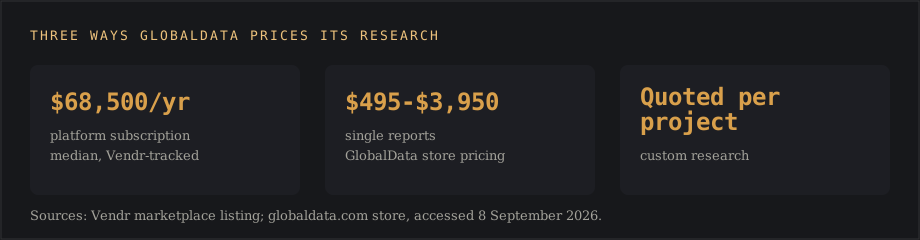
Custom research and consulting engagements are commissioned outside the subscription entirely, scoped and quoted project by project, and GlobalData's own pharma site lists that project work as a distinct line item from those products.
AI-enabled tools, branded as the Ava digital worker on GlobalData's homepage, are bundled into the same subscription as the analyst work. That is a real point of differentiation: many platforms meter AI features separately as a paid add-on.
What drives a GlobalData quote higher
Breadth is the single biggest lever. A buyer licensing one industry's Intelligence Center pays for a narrower slice of GlobalData's proprietary data than a buyer licensing five, and the review already published on this site puts it bluntly: which sectors a buyer licenses decides the bill, and breadth nobody opens is the fastest way to overspend.
Seat count, account-level access, and which of the named solutions (Sales Intelligence, Deals Intelligence and the rest) get bundled into the quote all move the number as well. Geographic scope adds to the total too: licensing country-level coverage across more markets pulls in more of GlobalData's data-lake and forecasting work than a single-country license does.
None of that pricing logic is published; a sales conversation has to iron out those details account by account, which is exactly the gap Vendr's tracked evidence exists to close.
Custom dashboards, system integrations and any work that connects GlobalData's platform to a buyer's internal tools sit outside the base quote as well, priced the same way as consulting: scoped and billed separately once a buyer asks for them. None of it appears until a sales conversation irons out the details on what a team wants connected.
Hidden costs buyers report
Data export limits are the most concrete complaint on record. One G2 reviewer, an Associate in Research at an enterprise company, wrote:
"the data export has a limit and to download more than 1k, I every time have to reach out to support, which takes them 48 hours to share the simple download."
Abhinav S., Associate in Research, G2 review, 13 June 2023.
That two-day turnaround is a real cost when a deliverable is due sooner, and it doesn't show up anywhere in a sales quote.
The learning curve is the second recurring theme: multiple reviewers describe the platform as steep for new users, and the site's own GlobalData review puts the ramp-up at several weeks, a labor cost a buyer should budget separately from the subscription line.
What GlobalData buyers pay in practice
Vendr's tracked figures are the only independent evidence of what GlobalData charges, since the company itself won't say. The median sits at $68,500 a year, with the observed range running from $43,000 to $73,875, a spread of roughly $31,000 between the cheapest and most expensive tracked deal.
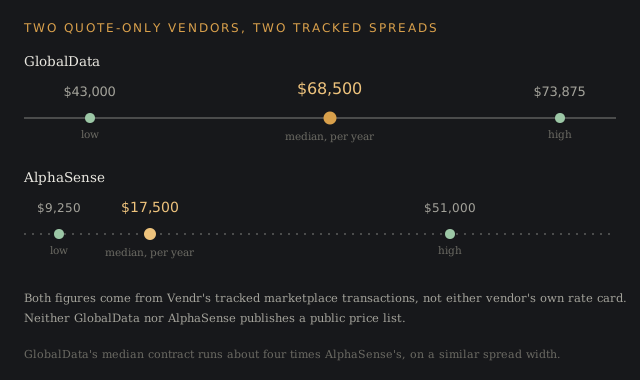
That comparison matters because AlphaSense is the closest structural match on this site: another analyst-driven research platform that publishes no rate card and gets tracked the same way, through Vendr's marketplace.
GlobalData's median sitting near four times higher says more about the depth of its analyst coverage and research bench than either company is willing to disclose directly.
How to negotiate a GlobalData quote
Two G2 reviewers flagged cost directly as a weakness, both in reviews that otherwise rated the platform highly. Lakshmidas P., who described 15 years of experience in U.S. telecom provisioning at a small business, wrote:
"Service charges are little expensive compared to the other compitators in business analytics and data science market. GlobalData is little behind to justify the amount they are changing."
Lakshmidas P., Telecom Provisioning, G2 review, 22 August 2023.
Srishti G., an SDET at a mid-market computer software company, was shorter about it:
"Global data service is little more expensive."
Srishti G., SDET, G2 review, 24 August 2023.
Neither reviewer names a dollar figure, a fair way to call a spade a spade when neither ever saw a price list to argue against. The one number a buyer can cite is Vendr's tracked median of $68,500 and the $43,000 floor observed in the same dataset.
Anchoring a first counteroffer near that floor, and asking GlobalData to itemize which of the ten named Intelligence Center products and named solutions the quote includes, gives a procurement team something concrete to push against, without negotiating blind.
A few practical steps protect a buyer from paying the wrong price. A procurement team that leaves no stone unturned asks GlobalData to itemize the quote by industry, seat count and named solution before signing, so it's clear exactly which accounts and add-ons the number covers.
Read the renewal terms as closely as the first-year quote: a discount that makes year one look affordable can disappear at renewal, and that's when the true cost of the platform shows up.
Buyers who act fast on a quote tied to the end of GlobalData's fiscal quarter report more room to negotiate than ones who ask mid-cycle; speed matters more than most procurement teams expect from an enterprise data vendor.
A quote based on industry scope alone also tends to ignore the export limits and support delays reviewers report, so raise those separately.
That doesn't happen by accident. Companies that skip this step often find the true cost of a GlobalData subscription only after the first renewal invoice lands. Account-level enterprise deals like this rarely close fast: budget for a procurement review running months once legal, security and finance sign-off get added to the sales cycle.
Who the cost fits
GlobalData's own reviewers sort cleanly into two camps on fit. Abhigyan A., a Senior Analyst at an enterprise company, wrote a recommendation that draws the line precisely:
"So, if someone if looking to do a macro-level analysis that is not affected by minor inaccuracies in individual data points, Global data is highly recommended. However, Global Data is not recommended for company-level or micro analysis."
Abhigyan A., Senior Analyst, G2 review, 8 July 2021.
Sagar C., who reviewed the platform from an enterprise company, flagged the onboarding cost of that macro-level depth:
"The Globaldata platform could be complicated for beginners but they have good documentation and modules available to aid in the learning process."
Sagar C., G2 review, 8 September 2023.
Read together, the fit is strategy teams doing analyst-driven research across a handful of industries, with the headcount to absorb a multi-week ramp-up and the budget to license enough sector breadth to make the $68,500 median worth paying.
That's the type of buyer GlobalData prices for: large companies with multi-country operations and enough analyst headcount to put the depth of coverage to use. A lean team that needs an answer today is a mismatch for this platform.
Reviewers across industries from construction to consumer goods to information technology report the same complex learning curve and the same tools once a team gets past it.
Teams needing real-time operational reporting, deep coverage of small or niche markets, or a fast onboarding curve are working against the platform's design, whatever industries type of buyer they are.
GlobalData against the alternatives, on cost
Only one platform in this comparison publishes a rate card. The rest, including GlobalData, quote per account, so every figure below except Similarweb's is buyer-reported and tracked.
| Platform | Published rate | Annual cost, tracked | Source |
|---|---|---|---|
| GlobalData | None | $43,000 to $73,875, median $68,500* | Vendr |
| AlphaSense | None | $9,250 to $51,000, median $17,500* | Vendr |
| Bloomberg Terminal | $24,000 to $27,000 per terminal | $240,000 to $270,000 for ten seats | Buyer-reported |
| Similarweb | $125/mo annual, $199/mo monthly | Roughly $1,500 to $2,388 a year, Competitive Intelligence tier | similarweb.com |
Prices marked * are Vendr median annual contract values from anonymized buyer data.
GlobalData sits above AlphaSense on tracked median cost and well below a multi-seat Bloomberg Terminal deployment, which fits its position: broader industry and company research than AlphaSense's research-and-transcript focus. It's priced as an account-level subscription.
Similarweb's Competitive Intelligence tier runs $125 a month billed annually, or $199 a month billed monthly, a name change and a price cut from the flat $199 "Starter" rate this site tracked earlier in 2026, and it's the only platform here a buyer can price without a sales call. All four sit inside the wider financial data providers market this site tracks.
What to budget for GlobalData
A single-industry subscription, based on Vendr's low end, starts budget conversations around $43,000 a year.
A buyer licensing multiple Intelligence Centers, adding a named solution like Strategic Intelligence or Deals Intelligence, or negotiating from a weaker position should plan closer to the $68,500 median, with room to reach the $73,875 tracked high on a broader scope.
Add the time commitment: reviewers consistently describe a multi-week learning curve before a new account gets full value out of the platform, and that ramp-up sits on top of whatever the subscription line costs.
Single reports and custom research sit outside all of those figures entirely, quoted per engagement, so a buyer weighing a one-off need against a full subscription should ask GlobalData for both numbers before committing to either.
For most enterprise companies, that subscription is a multi-year investment in analyst time as much as in coverage, and the depth of that coverage only pays off once a team has put in the hours to understand what the platform delivered for the price. The wider market intelligence platform pricing report sets those tiers against the rest of the category.
Account-level pricing isn't unusual among enterprise research vendors, but it puts more work on the buyer than a published rate would.
Similarweb proves a data company can quote a real starting number without losing deals to companies that quote nothing at all; GlobalData, like dozens of platforms selling proprietary data and expert analysis to enterprise customers, has decided the opposite trade works better for its sales team.
Buyers who understand that trade before the first call, and who analyze the Vendr spread without accepting the first number, close on better terms than ones who don't.
Ask for an itemized quote quickly, before a renewal deadline creates urgency on GlobalData's side. That first step is what turns a vague pitch about unique data and expert analysis into a number a procurement team can evaluate.
A subscription this complex, spanning ten-plus products and a handful of named add-on solutions, rewards buyers who ask for the breakdown and penalizes ones who accept a single bundled figure on trust.
Frequently asked questions
Who owns GlobalData?
GlobalData Plc is a public company. Its shares traded on AIM until 4 March 2026, when the company moved its listing to the Main Market of the London Stock Exchange under the same ticker, DATA. Founder Mike Danson, the company's chief executive, holds the controlling stake.
Shareholders retain the standard voting rights that come with any Main Market listing, and every page on globaldata.com closes with the same line: "Copyright © GlobalData Plc 2026. All Rights Reserved."
What does GlobalData do?
GlobalData sells subscription access to proprietary data, analyst-written research, company profiles and country-level forecasts across more than twenty industries, split commercially into a Healthcare segment and one other.
A community of 2,000 in-house analysts, built up over decades, produces the research and expert analysis behind every report; an AI layer and configurable dashboards sit on top of it.
The pitch is a single insights platform that consolidates market trends, company accounts and industry insights buyers would otherwise pull from a dozen separate tools, aimed at strategy teams who need informed decisions delivered faster than an internal research team can produce them, backed by decades of coverage depth GlobalData positions as the reason its subscription costs more than most.
How does GlobalData compare to other data providers?
On tracked pricing, GlobalData's $68,500 median contract runs well above AlphaSense's $17,500 median and below a multi-seat Bloomberg Terminal deployment.
On content, GlobalData leans toward analyst-written industry and company research across many verticals, where AlphaSense concentrates on broker research and expert-call transcripts, and Bloomberg concentrates on real-time market figures.
Who are GlobalData's competitors?
Buyers researching GlobalData most often shortlist it against AlphaSense, Similarweb, Bloomberg Terminal, S&P Capital IQ Pro and FactSet, depending on the need: broad industry research or financial-market figures.
Gartner comes up in the same conversation for buyers comparing analyst-driven research firms more broadly, though Gartner's subscription structure and content focus differ enough that it rarely gets evaluated head to head with GlobalData on the same shortlist.
Is GlobalData trustworthy?
GlobalData Plc publishes audited accounts each year, names its board publicly, and now answers to the Main Market's stricter listing rules, more disclosure than most privately held rivals in this category offer. Independently, GlobalData holds a 4.5 out of 5 average across 15 verified G2 reviews.
Is GlobalData a good stock to buy?
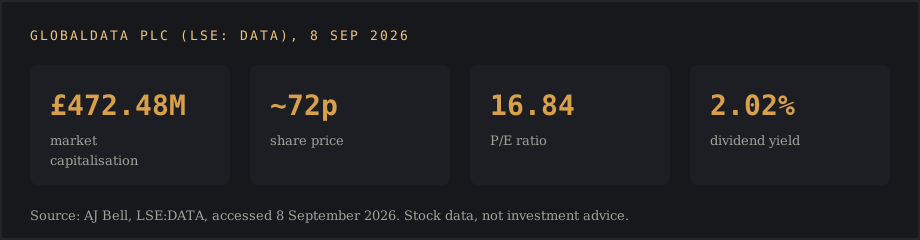
This page covers subscription pricing. Nothing here is investment advice or a recommendation to buy or sell GlobalData Plc shares. What's publicly disclosed as of 8 September 2026: a market capitalisation of £472.48 million, a share price near 72p, a P/E ratio of 16.84, and a dividend yield of 2.02%, up from a 0.30p payment in October 2025 to 1.20p in May 2026.
Anyone weighing the stock should check current filings and talk to a financial adviser.
Bottom line
GlobalData charges a median of $68,500 a year for a subscription it will not itemize in public, and the only reason a buyer can plan around that number at all is Vendr's tracked transaction data.
The account-level quote scales with how many of GlobalData's ten-plus Intelligence Center products and named add-on solutions get bundled in, and the two G2 reviewers who called the platform expensive never had a published number to argue against.
Budget from the $43,000 to $73,875 tracked range, add weeks for the learning curve reviewers consistently describe, and ask GlobalData to break the quote down by sector and product before signing. That question costs nothing. It's the closest thing to a rate card the company will hand over, and it puts the buyer back in the driver's seat for the rest of the call.
Sources, and what GlobalData does not publish
The $68,500 median, the $43,000 to $73,875 range and the ten-plus Intelligence Center product names come from Vendr's marketplace listing for GlobalData, read at vendr.com. GlobalData's own pricing behavior, industry list and product descriptions come from globaldata.com and marketaccess.globaldata.com.
Market capitalisation, share price, P/E ratio and dividend yield are the London Stock Exchange's own figures, read via AJ Bell. The AIM-to-Main-Market listing move and the Healthcare/Non-Healthcare segment split come from GlobalData Plc's own filings.
All five reviewer quotes and the 4.5-of-5 average across 15 reviews come from GlobalData's G2 profile. Similarweb's tier pricing comes from similarweb.com/packages/web. All figures checked 8 September 2026. GlobalData publishes no rate card, no per-industry price list and no published figure for what any named solution adds to a quote.