Data providers: the categories, and how to pick the right one
 By Jan Suski. I go deep on every review, checking every number against its source and digging up details other coverage misses, a habit from six years of SEO and link building for tech companies. Bylines at Surfer, Brand24, and Senuto. How the scoring works.
· Prefer this source on Google
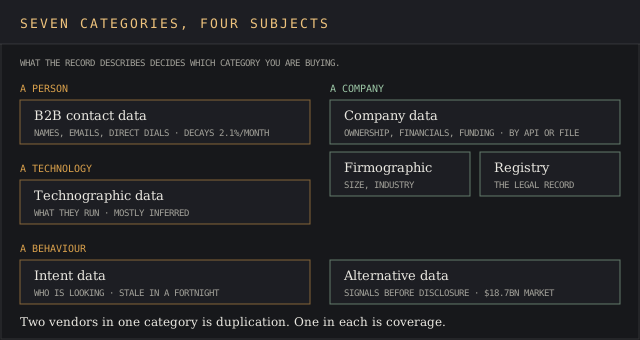
Every data vendor sells company records. What separates them is which question those records answer, and buyers who skip that distinction end up with two contracts covering the same ground and a gap where the answer was.
This page is a map. Ten categories across nine rankings. Registry data is the one without a page of its own, because the providers selling it are the same ones selling company data.
If you already know the category you need, skip to it. If you do not, the routing table below is the fastest way to find out.
Which data vendor answers which question
| Your question | Category | Typical buyer | Where to read more |
|---|---|---|---|
| Who do I call at this company? | B2B contact data | Sales teams, SDRs | B2B data providers |
| Which companies exist that match my ICP? | Firmographic data | Marketing, RevOps | Firmographic data providers |
| What does this company run? | Technographic data | Sales, product, partnerships | Technographic data providers |
| Who is looking to buy right now? | Intent data | Revenue teams, ABM | Intent data providers |
| What do I know about this business itself? | Company data | Data teams, strategy, risk | Company data providers |
| What can I infer before the numbers are published? | Alternative data | Investors, corporate strategy | Alternative data providers |
| Is this entity real and who owns it? | Registry and compliance data | Risk, compliance, procurement | Covered inside company data providers |
| What is this security or market doing? | Financial and market data | Traders, analysts, risk | Financial data providers |
| Who owns this building and what is it worth? | Real estate and property data | CRE, lenders, investors | Real estate data providers |
| What is this company's environmental and social risk? | ESG and sustainability data | Asset managers, corporates, procurement teams | ESG data providers |
Most teams need two or three of these. The mistake is buying two that answer the same question because both vendors described themselves as a B2B data provider.
The categories of data provider
Ten categories, in the order most teams encounter them. Nine have a ranking of their own; registry data sits inside company data providers.
B2B data providers for contact data
B2B data providers sell contact data with company records attached: names, job titles, verified email addresses, direct dials and phone verified mobile numbers, priced per seat and built for a rep to read.
This is the largest and most crowded category, a dog-eat-dog corner of the market, and the one with the worst decay problem. B2B contact data decays at roughly 2.1% per month, 28% of email addresses go stale annually, and poor data quality costs organisations an estimated $12.9 million a year.
ZoomInfo, Cognism, Apollo, Lusha and UpLead lead it. Accuracy, regional coverage and compliance separate them far more than database size does.
Company data providers
Company data providers sell records about the business: firmographics, ownership, financials, funding and technology signals, priced per volume and built for a system to consume.
The buyers are data and strategy teams. Coresignal, Bright Data, People Data Labs, Bureau van Dijk and OpenCorporates sit here, delivering by API or bulk file.
Data accuracy can deteriorate by 15% monthly across this category, which is why refresh cadence matters more than record count.
Firmographic data providers
Firmographic data is the attribute layer: industry, company size, annual revenue, geographic location, ownership type and growth indicators.
It is less a separate market than a field set every provider claims. What differs is completeness. Companies with a strong ideal customer profile see 68% higher win rates, and that ICP is built from firmographic fields that are either populated or not.
Technographic data providers
Technographic data describes technology usage: the CRM, cloud services, marketing automation and security tools a company runs.
Coverage claims vary wildly because they measure different things. ZoomInfo publishes 30,000+ technologies across 100 million companies; BuiltWith detects 123,000+ across 670 million websites; HG Insights tracks around 32,000 IT contracts with spend attached. Those are three different products wearing one label.
Intent data providers
Intent data providers sell behavioural evidence that a company is actively researching solutions in your category, gathered from publisher networks, review sites, search behaviour and your own website.
Scale claims here are enormous and largely unverifiable. Bombora tracks 17 billion interactions monthly across 5,000+ sites; Demandbase reports 500+ billion signals across 300,000 keywords; 6sense processes over a trillion buying signals daily. Read between the lines of vendor-reported totals before betting a strategy on them, and treat intent signals as a prioritisation input.
Alternative data providers
Alternative data means non-traditional sources read for what they reveal before disclosure: transactions, satellite imagery, web traffic, job postings, geolocation.
The buyers are investors first and operators increasingly. The global alternative data market reached $18.74 billion in 2025 with projections of $135.8 billion by 2030, and hedge funds allocate over $1.6 million a year each to it.
Registry and compliance data
The smallest category and the only one with an authoritative source. Company registries publish incorporation, officers, status and filings, and providers like OpenCorporates resell it with provenance attached to each field.
Nothing else in this list can tell you an entity legally exists. Risk, compliance and procurement teams buy here and rarely need anything else.
Financial data providers
Financial data providers sell market prices, company fundamentals, credit ratings and reference data on securities and entities, priced per seat for a terminal and per feed for everything a system consumes.
LSEG and Bloomberg hold the real time end, S&P Global and FactSet the fundamentals, Moody's the credit layer and MSCI the indexes. Exchange fees pass through on top of every quote, which is why the sticker never matches the invoice.
Real estate data providers
Real estate data providers resell county records, assessor files and recorded deeds after normalising them, then add valuation models, ownership resolution and visitation data on top.
CoStar leads commercial. Cotality and ATTOM lead residential records, and Placer.ai measures who turns up. Every provider draws on the same 3,000 county sources, so the difference is parsing quality. Placer.ai builds its counts from phone location data, and our Placer.ai pricing report puts a year of access at $12,000 to $34,000 in public order forms.
ESG data providers
ESG data providers score a company's environmental, social and governance performance or disclosure, built for an asset manager, a lender, or a procurement team running due diligence without starting from scratch.
The buyers split three ways: portfolio screening, corporate engagement and supplier risk, which is a different product from an investment-grade rating. MSCI, Sustainalytics, S&P Global, LSEG, Bloomberg, FactSet, Moody's, EcoVadis, CDP and ISS ESG lead it, and every EU-facing provider is racing against the clock to register with ESMA under the ESG ratings providers regulation by November 2026.
How to evaluate data quality
The same four checks apply whichever category you are buying, and none of them is the record count on the homepage.
Data accuracy and freshness
Ask for the accuracy rate and the verification method behind it in writing. Providers that publish one are rare enough that it is a differentiator; UpLead's 95% guarantee, stated at the point of download, is the clearest example in this market.
Real-time verification at the point of export beats batch cleaning outright. At 2.1% monthly decay on contact data, a record verified in January is meaningfully worse by April, and continuously updated data is worth paying for on the volatile fields, a stitch in time saving nine once a record's shelf life is measured in weeks.
Refresh cadence varies enormously. Coresignal refreshes every six hours, Global Database updates many records within 24 hours, MixRank updates monthly while holding five years of history. Those suit an application, an operational workflow and a trend analysis respectively.
Data coverage against your ICP
Data coverage is regional and role-specific. A provider strong on US enterprise is often half as complete on European mid-market, and broad global coverage in the marketing copy usually means a home region plus licensed feeds.
Sub-50-employee coverage is where databases thin out. If you sell to small businesses, test there specifically, because aggregate completeness figures are carried by enterprise records.
Some vendors specialise in specific industries and beat the generalists inside them. That trade is often worth taking if your target market sits in one vertical.
Ask for a data sample
Never evaluate on the sample the vendor picks. Give them 50 to 100 accounts from your closed-won list, which are your ICP by definition and independently verifiable.
Score three things per record: was the company found, how many fields were populated, and how many populated fields were correct. Data depth matters as much as match rate, and the third number is the one nobody quotes.
Providers that decline to run that test are pricing on hope. The ones that run it and report their own gaps honestly are worth negotiating with.
Data sourcing and provenance
Ask which fields are observed and which are inferred. Most datasets blend both, and few vendors label the difference, which matters because you can't weight a scoring model when every field looks equally confident.
Third party data has a structural weakness worth knowing: vendors license from each other. Two providers appearing to corroborate a figure while both sourcing it upstream from the same feed is not corroboration, and counting it as independent verification means barking up the wrong tree.
Data collected from public web sources, company websites and job boards is cheap and observable, and Bright Data is the largest single vendor selling that raw collection layer across every category in this guide. Human verified data is accurate and does not scale. High quality data usually means knowing which you are holding.
How you access data
Delivery method decides who can use the data, and it is worth settling before price.
Web application. A person searches and exports. Suits sales teams, priced per seat, and the export is where the data goes stale.
CRM integration. Fields write onto existing records automatically, turning data enrichment into infrastructure. Integration capabilities with existing systems are what decide if the purchase survives year one.
API access. Code queries on demand. Suits applications and enrichment inside data pipelines, priced by call volume.
Bulk datasets. Files land in a warehouse. Suits analysis, market mapping and model training, and it is the only sensible route at real data volume.
Paying per seat for data your application consumes is the most common overspend in this market, proof that money doesn't grow on trees even inside a software budget. If code reads the record, buy the dataset.
Data compliance and security
Company records are less exposed than personal ones, and the exceptions are where teams get caught.
Contact data falls squarely under GDPR and CCPA. So do officer records, employee profiles and any dataset naming individuals, whatever the product page calls it. Data privacy regulations follow the data subject.
Check that a data provider adheres to DNC screening before phone numbers change hands, and ask how consent was obtained for European records specifically. Cognism's positioning is built on exactly this, which tells you how much buyers care.
Secure data handling is the other half. Ask where records are stored, who at the vendor can access them, and what happens to data you already pulled if the contract ends. Perpetual rights on delivered records cost more upfront and far less than re-licensing later.
Choosing the right data vendor
Four key factors, in the order that matters.
The question you need answered. Contact, company, firmographic, technographic, intent, alternative or ESG. Getting this wrong makes every other criterion irrelevant.
Coverage on your ICP. Not the market, yours. Tested on accounts you can verify.
Delivery into the tools people use. Data that requires a manual export gets applied once.
Compliance in the regions you operate. The only criterion with legal consequences.
Price comes fifth and still matters. Published pricing lets you model consumption; custom pricing means negotiating with less information than the vendor has.
Running more than one data provider
Most teams past their first year run several, refusing to put all their eggs in one basket, and the pattern is consistent.
One primary provider for the category that carries the most weight. One fallback for the records the first misses, queried only on gaps, which is the waterfall enrichment approach high-performing outbound teams use.
Then a verification step before anything reaches a sequence, because accurate data at purchase is not accurate data at send.
Beyond that, one provider per distinct question. Intent alongside contact data. Technographic alongside firmographic. Adding a second vendor in the same category is duplication; adding one in a different category is coverage.
Data providers FAQ
What is a data provider?
A company that collects, structures, verifies and sells information about businesses or the people who work at them. Delivery runs from a web app through CRM integration and API access to bulk datasets, and buyers range from sales teams to model builders.
What is the difference between a data vendor and a data supplier?
In practice the terms are used interchangeably. Where a distinction is drawn, a data supplier originates the data it sells and a data vendor may resell or aggregate from others. Skip the label. Check which fields a provider collects first-hand.
Who are the biggest data providers?
By coverage claims: ZoomInfo publishes over 500 million contacts, Coresignal 75 million company and 839 million employee profiles, BuiltWith detection across 670 million websites. Size and usefulness are separate questions, and the largest provider is rarely the right one for a specific ICP.
How much do data providers cost?
Published figures span $39 a month for narrow tools to $250,000 a year at the top of the enterprise ABM platforms, enough to cost an arm and a leg before a single record ships. Contact data platforms commonly land between $15,000 and $40,000 annually; company data and alternative data price by volume.
How do data providers collect their data?
Public web sources including company websites and job boards, licensed third-party datasets, contributor networks where users share their own records, registry and government filings, and direct human verification for premium fields. Most large providers blend all five.
Is buying B2B data legal?
Yes, within the rules of the jurisdiction you prospect into. GDPR governs European personal data, CCPA covers California, and phone outreach requires DNC screening. Legality depends on the provider's data sourcing and on your own usage, and both need checking.
What is the difference between a data provider and a sales intelligence platform?
A data provider sells records. A sales intelligence platform wraps records in workflow: sequencing, scoring, alerting and reporting. ZoomInfo, Apollo and Cognism sit in both categories, which is why they appear on several of our rankings under different orders.
Bottom line
Start from the question. Contact data to reach someone, firmographic to find the right companies, technographic to know what they run, intent to know when, company data to build something, alternative data to see before disclosure.
Then test on accounts you already know, check the delivery method against who will consume the records, and settle compliance before price.
Every provider in every one of these categories looks complete in a demo, but actions speak louder than words, and the difference shows up on your own list.
What each data type contains
Six data types run through these categories, and the same record can carry several.
Contact data points. Names, job titles, verified email addresses, direct dials and mobile numbers. The most perishable type and the one every outbound motion depends on.
Firmographic data points. Industry, company size, revenue, headquarters, ownership type. The layer segmentation runs on.
Technographic. Technology usage across CRM, cloud, analytics and security tools, mostly inferred.
Behavioral data. Content consumption, search activity and site visits. Engagement data of this kind is what intent products are built from, and it ages fastest of everything here.
Event data. Funding events, leadership changes, acquisitions and job postings. Discrete, dated and far more actionable than a static attribute, since acting in the nick of time on an event beats acting on one that never changes.
Financial and registry data. Revenue, credit indicators, ownership chains and incorporation records, thin on private companies and authoritative where filings exist.
Internal data against external data
Everything above is external data, bought to describe companies you do not control. Internal data is what your own systems already hold: closed-won accounts, product usage, support tickets, sales notes.
The two are worth more joined than separately. Internal data defines the ICP; external data finds more companies matching it. Teams that buy external data without first mining what they already have usually buy the wrong segment.
Historical data matters for both. A single snapshot tells you what is; a time series tells you what changed, and change is what triggers outreach.
Web data as a source layer
Web data underpins most of these categories. Company websites, job boards, review sites and public filings are where the majority of commercially sold B2B records originate.
That has a consequence worth internalising. If a fact is not published somewhere public, somebody either surveyed for it, bought it from a contributor, or estimated it. Private company data is mostly the third.
How teams use data providers
The same records serve several jobs, and the buying case usually rests on one while three others quietly benefit.
Sales and marketing
Sales and marketing teams are the largest buyer group. Contact data reaches key decision makers, firmographics build the target accounts list, intent orders it, and technographics shape the message.
The two functions break down when they stop being on the same page and read different fields. Marketing segmenting on an attribute sales cannot see produces leads reps cannot contextualise, which is a data problem presented as an alignment problem.
Sales engagement tools consume the output. Data that can't reach a sequence without a manual export reaches it late or not at all.
Market research and market mapping
Market research uses the same firmographic records to count. Market mapping asks how many companies exist at what size in which geography, which is a query once the data is in place and a guess before it.
Market trends emerge from the time series. Counting companies adopting or dropping a technology, hiring into a function, or entering a geography is how market intelligence teams see movement before it is reported.
Competitive intelligence tools read the same feeds pointed at named rivals: their hiring, their stack, their funding, their web traffic.
Investment analysis and risk
Investment analysis leans on alternative and company data. Funding events, headcount trajectory and technology adoption are the observable proxies for private companies that disclose nothing.
Risk and procurement read ownership chains and registry status instead. Three suppliers that turn out to share a parent is concentration nobody modelled, and it surfaces in company data.
Key features to compare
Beyond the data itself, five features separate products inside every category.
Enrichment triggers. Do fields populate on form fill and record creation, or only on a manual run. Automatic enrichment compounds; manual enrichment decays.
Visitor identification. Resolving anonymous website traffic to named companies. Offered by intent and enrichment vendors, and the most qualified first-party signal most teams have available.
Predictive analytics. Scoring accounts by fit or buying stage. Useful once there is enough pipeline history to calibrate, and misleading before that.
Free plan or trial. Apollo, Lusha, People Data Labs and Wappalyzer all offer one; the enterprise platforms do not. A free plan beats a demo because it runs on your data, letting a team hit the ground running before anyone signs a contract.
Try it yourself
Sign up for Lusha
Free plan available, credit-based pricing after that.
 Visit Lusha →
May earn a commission if you sign up through this link, at no extra cost to you. Full affiliate disclosure.
Data usage rights. What you may do with records after the contract ends, and if the licence covers model training. Data vendors focus their terms here more tightly than buyers expect.
Where LinkedIn Sales Navigator fits
LinkedIn Sales Navigator appears in most of these categories and belongs to none of them. Its data is member-declared and therefore unusually up to date on job titles and headcount, and it exports nothing.
That makes it a research surface. It cannot feed a segmentation, a sequence or a warehouse, so treat it as a complement to a data purchase.
Data security and detailed data
Data security questions get skipped in evaluation and asked in procurement, which is the wrong order. Where records are stored, who at the vendor can query them, and what breach notification looks like are contract terms.
Detailed data raises the stakes. A dataset carrying named individuals with behavioural history is a different risk profile from a firmographic file, and it should be reviewed as such regardless of which category the vendor sells under.
Keeping data fresh after purchase
Fresh data is a process, and the decay rates make that concrete.
Monthly decay on B2B contact records. Company-level accuracy can deteriorate by 15% monthly across some datasets, and intent signals are worthless after a fortnight. One refresh schedule across all three wastes budget at one end and leaves staleness at the other.
That argues for splitting refresh cadence by volatility. Continuous monitoring on contact and event fields, quarterly on firmographics, annual on industry classification.
Enrichment on record creation is the highest-return version, the early bird catching the worm because every account entering the CRM starts complete and the decay clock starts from a better baseline. Retrofitting a stale database costs more and convinces nobody.
How data providers price their products
Three pricing models dominate, and they suit different consumption patterns badly enough that picking wrong costs more than picking the wrong vendor.
Per seat
Standard for sales-facing platforms. You pay for people who log in, usually with a credit allocation attached to cap how much each one exports.
It suits teams where humans read the records and punishes wide distribution. Giving a 60-person sales organisation access to a per-seat platform is where budgets break, which is why most deployments end up narrower than intended once teams cut their losses on seats nobody uses.
Per record or per credit
Standard for enrichment and API products. You pay for what you pull, which makes the cost track usage.
Exploratory work is where this gets expensive. An analyst browsing consumes unpredictably; an application enriching every signup consumes predictably. Model both before signing, because credit overage is the most common surprise in this market.
Flat platform fee
Common at the enterprise end and among the dataset vendors. You pay for access to a defined scope, and volume within it is unmetered.
This is the friendliest model for building on, and the hardest to get without an annual commitment. It also removes the internal politics of who gets a seat, which is worth more than it sounds.
What to negotiate beyond price
Credit rollover, seat reduction rights at renewal, a cap on annual increases, and perpetual rights on records already delivered. All four are negotiable at signature and almost none of them afterwards.
Vendr's contract data across this category shows average savings against opening quotes running from 12% to 21% depending on vendor. Buyers who settle rollover, seat reduction and price caps upfront pay materially less over three years than those who accept standard paper.
Common mistakes when buying data
Five patterns account for most of the disappointment in this market.
Buying on database size. A provider advertising 100 million records is describing acquisition. Accuracy is a separate number. The two figures move independently, and only one of them appears in the marketing.
Buying two vendors in one category. Running Crayon and Klue, or ZoomInfo and Apollo, duplicates spend without adding coverage. Running one of each across two categories adds both.
Skipping the compliance check. The only mistake here with legal consequences. Ask how consent was obtained and how DNC screening works before phone numbers change hands.
Not testing on your own list. A week spent checking 100 known accounts settles arguments that otherwise run for a year after signature.
Buying data nobody can activate. If no integration routes the records into the CRM or the sequence, the purchase produces a dashboard. Decide where the data lands before deciding what collects it.
Where to go next
Leave no stone unturned, since each category has a detailed ranking with vendors, pricing and the trade-offs between them.
Start with the B2B contact category if you need to reach people, or the company data category if you are building something that consumes records programmatically.
Firmographic and technographic providers cover the attribute layers underneath both, while intent covers timing, alternative data covers the investor side, and ESG covers ratings and disclosure risk, with every category above linking to its own ranking.
Readers who already know the category and are comparison-shopping across vendors should start with our data buying companies ranking, which ranks the generalist vendors and marketplaces selling records at volume across several of the categories above.
Disclaimer
This page includes one or more affiliate links. If you sign up for a product through one of them, this site may earn a commission at no extra cost to you.