TinyFish review: does 82% on hard tasks hold up outside the demo?
 By Jan Suski. I go deep on every review, checking every number against its source and digging up details other coverage misses, a habit from six years of SEO and link building for tech companies. Bylines at Surfer, Brand24, and Senuto. How the scoring works.
· Prefer this source on Google
Best for
A data or engineering team running complex, authenticated web workflows that need an agent to get past a login screen and a bot wall reliably, and prefers to pay per step for a managed platform.
Not for
A team that needs vendor-neutral proof before committing budget. Every headline number traces to TinyFish's own blog or a benchmark it designed and ran itself, and G2 and Gartner Peer Insights both list zero submitted reviews a year after founding.
What it costs
Search and Fetch are free on every tier. Agent and Browser run $0.015 a credit on Pay As You Go, down to $0.012 a credit on Pro ($150/month for 16,500 credits), with Enterprise credit volume and overage quoted case by case.
- Search API
- Free on every plan, 30 requests/min on Pay As You Go rising to 120 on Pro, custom on Enterprise
- Fetch API
- Free on every plan, 150 URLs/min on Pay As You Go rising to 600 on Pro
- Browser sessions
- 1 credit per 4-minute session, sub-250ms cold start from a cold Chromium instance
- Agent steps
- 1 credit per step; a natural-language goal in, a multi-step workflow out
- Output formats
- Clean markdown, JSON, or HTML from a rendered page
- Agent framework integration
- MCP-native for Claude and Cursor, plus n8n, Dify, AG2, ChatGPT, Grok
- Hard-task accuracy
- 81.9% on TinyFish's own Online-Mind2Web run, 300 tasks across 136 live websites
- Independent benchmark
- 91.1% on a third-party WebVoyager run of 641 tasks, May 2026
- Concurrent agent runs
- 2 (Pay As You Go), 10 (Starter), 50 (Pro), custom (Enterprise)
- Concurrent browser sessions
- 5 (Pay As You Go), 10 (Starter), 50 (Pro), custom (Enterprise)
- Anti-bot pass rate
- Up to 85% on standard commercial websites, TinyFish's internal testing
- Bot detection coverage
- 99.3%, per TinyFish's own published figure
- Proxy routing
- Residential proxies across US, GB, CA, DE, FR, JP, AU with one parameter
- Session persistence
- Vault and Profile hold logged-in state across runs for authenticated pages
- Failed-run billing
- $0. A failed run or a failed fetch draws no credit
- Pay As You Go
- $0.015 per credit, 500 free credits at account creation, no monthly minimum
- Starter
- $15/month for 1,650 credits, $0.014 per credit past that
- Pro
- $150/month for 16,500 credits, $0.012 per credit past that
- Enterprise
- Custom credit volume and overage, dedicated engineer, SOC 2 and on-premise
- 1 credit equals
- 1 agent step, or 4 minutes of browser session time
- Example cost
- 100 agent tasks a month runs about $1.50; 1,000 tasks runs about $15
- Support tier gating
- Priority email from Starter, Slack and onboarding from Pro, a dedicated engineer on Enterprise
- Compliance
- ISO 27001 and SOC 2, on-premise deployment: Enterprise only
Alternatives to TinyFish
Firecrawl
Not forA workflow whose first step is a login screen; TinyFish's own test put Firecrawl at 1 of 6 on sites with active bot protection.
Browserbase
Not forA team that wants the agent written for it; Browserbase ships infrastructure and expects the browsing logic to arrive with you.
Pairs well with TinyFish
TinyFish sells API access to a web agent platform that logs into sites, fills in forms, and pulls data back out, the parts of the web that a plain HTTP request can't reach. The company came out of stealth in August 2025 with $47 million in funding and a claim that its agent scores 81.9% on hard, multi-step tasks where OpenAI's Operator scores 43.2%.
This review covers what the four APIs do, what the pricing works out to at real volume, and what developers building AI agents on Hacker News and Reddit have said about the gap between the benchmark and the product they got to use.
The company sits in an odd spot for a market intelligence buyer: it isn't a dashboard or a data feed, it's infrastructure a team's own engineers would build agents on top of. That makes this tinyfish review closer to an API evaluation than a software review.
The standard the site holds itself to still applies: every claim below traces to TinyFish's own domain, a funding filing, or a named commenter, never to marketing copy repeated as fact.
TinyFish is barely a year past its founding, and the evidence available reflects that. Gartner Peer Insights lists it with zero submitted reviews. G2 lists it as a product with no user ratings.
What exists instead is a company blog heavy on TinyFish's own benchmark numbers, a pair of Show HN threads where the team fielded live questions from other developers building AI agents of their own, and a Reddit post announcing a free tier. That's the material this review works from.
What TinyFish's four APIs do
AI agents built on nothing but an HTTP client hit a wall the moment a page needs a login, a click sequence, or a session, and that wall is the gap TinyFish's platform is built to close.
Search returns structured data, JSON results ranked from TinyFish's own index, in under half a second by TinyFish's own published figure. Fetch takes any URL and returns clean markdown, JSON, or HTML with the navigation, cookie banners, and script tags already stripped out.
In TinyFish's own words, announcing the free tier: "Fetch is the one that removes more friction: submit any URL, get back clean Markdown or JSON... Most raw fetches dump nav bars, cookie banners, and script tags straight into your context window. Your model pays for every token of that noise." Both APIs are free on every plan, rate-limited by tier.
Browser and Agent are the paid half, and the two work at different layers. Browser lets a developer create a remote, cloud-managed Chromium session over a WebSocket URL, driven with Playwright or Puppeteer directly, with a cold start TinyFish puts under 250 milliseconds and no warm pool required.
Agent sits above that, handling complex, multi-step workflows: hand it a goal in plain English, and it plans and executes the click-fill-submit action sequence itself, holding session state across pages through what TinyFish calls Vault and Profile.
It finds page elements the same way throughout, by what they are; one developer account TinyFish features on its own site describes an agent that "does semantic element finding instead of CSS selectors so it doesn't break when the site changes."
Every action inside that sequence, a click, a scroll, a form fill, runs inside the same billed session, and TinyFish's own recipes show that sequence running in parallel across sites, checking pricing on ten gaming platforms in a single pass.
That session persistence is the real point of difference from a scraper, and the reason Search, Fetch, Browser, and Agent work as one platform. A workflow that needs to sign into vendor portals, dashboards behind a login screen, a distributor's order history, a carrier's rate page, isn't something Search or Fetch can reach.
It needs a browser session built for interacting with an authenticated page across multiple steps, one that remembers it's already logged in, and TinyFish's pitch is that Browser and Agent handle that without a developer building session management, proxy rotation, and anti-bot handling from scratch, the assembly work still required on a proxy-only platform like Bright Data.
TinyFish Search and getting past anti-bot walls
The free tier isn't a limited trial. TinyFish made Search and Fetch permanently free in a Reddit post to r/AI_Agents, and the caps scale with plan: 30 requests a minute on Search at the entry Pay As You Go tier, rising to 120 on Pro; 150 URLs a minute on Fetch, rising to 600. A small team building a research tool never touches a credit unless the workflow needs Browser or Agent.
The tradeoffs showed up fast in the comments under that same Reddit post. In one comment, Haunting_Month_4971, on r/AI_Agents in May 2026, raised the real challenge with owning a search index:
"Owning the index sounds nice on paper but the bar is whether the results are actually better for agent workflows, not just different. Also wondering what the rate limit looks like on the free tier before it stops being viable for anything past hobby use."
Haunting_Month_4971, r/AI_Agents, May 2026.
A second comment, from snikolaev, asked the harder engineering question and never got a public answer in the thread: an agent "answering "whats the latest..." with a 24-hour-stale index is a different product than one with hourly." Freshness and rate limits both matter for a workflow checking competitor pricing daily, and neither figure changes or gets published anywhere on TinyFish's own site.
On the anti-bot side, TinyFish's claim is specific: up to 85% pass rate on standard commercial sites in internal testing, with 99.3% detection coverage, built on a native Chromium browser session with anti-fingerprinting techniques baked into what TinyFish's own docs call a stealth profile.
Residential proxy routing across seven countries comes bundled with every session, with no separate configuration. TinyFish's own head-to-head against Firecrawl reports Firecrawl "succeeded on only 1 of 6 protected sites," a TinyFish-run test that should be read as a vendor claim.
It tracks the architectural difference though: Firecrawl renders and extracts a page in a single call, and it isn't built to carry a session across a multi-step, authenticated flow the way Browser and Agent are.
Benchmarks on the live web: Mind2Web and WebVoyager
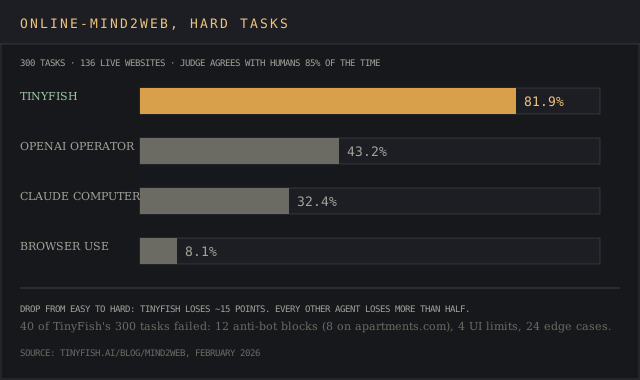
TinyFish's headline figure comes from its own Online-Mind2Web run: 300 tasks across 136 live websites, three difficulty tiers, graded by a judge TinyFish says agrees with human raters 85% of the time.
TinyFish picked that benchmark over the more commonly cited WebVoyager specifically because, in its telling, WebVoyager's judge only agrees with humans 62% of the time. On the hard tier, TinyFish scored 81.9%. Operator scored 43.2%. Claude Computer Use scored 32.4%. Browser Use scored 8.1%.
The company's real point wasn't the top-line number: every other one of the agents in the run loses more than half its accuracy going from easy tasks to hard ones, and TinyFish loses about 15 points. Where TinyFish and its critics on Hacker News agree is that a benchmark built around easy, Google-searchable tasks undercounts how hard the live web gets.
TinyFish posted this as a Show HN in February 2026; the post drew 17 points, one Hacker News vote at a time, and a comment thread that stress-tested the number. agenticagent laid out the drop-off across all four agents and drew the conclusion TinyFish wanted read into it: "That's the difference between "cool demo" and "I can ship this.""
salmacodes had already hit the pattern the benchmark describes, before ever reading it:
"Been trying to get Operator to handle a multi-step workflow for a client (login → navigate nested menus → fill form → confirm) and it just... breaks in the middle every time."
salmacodes, Hacker News, February 2026.
In a comment right below, codebyron read the architecture into the same drop-off: "Every other agent here shows exponential degradation as task length increases, which is what you'd expect from a naive screenshot-action loop with no error recovery."
Not everyone let the number stand unchallenged. In a comment of his own, pants2 targeted TinyFish's own promotional behavior, not the agent's competence:
"I assume you used your own product to hype up this post? @dang I was excited about it till I saw this behavior. Please operate ethically next time."
pants2, Hacker News, February 2026.
houmercodes raised a methodology question TinyFish never answered publicly in the thread:
"Genuine question about the eval methodology — how do you handle website non-determinism? ... Would be useful to know if all agents were evaluated on the same snapshots or same time window."
houmercodes, Hacker News, February 2026.
And dontrack-rxv was blunter: "how did a random start up beat openai/claude?!?"
What the thread does credit TinyFish for is showing its work. TinyFish published every one of the 300 execution traces in a public spreadsheet. Skyzzd checked it: "I didn't expect to be able to verify every result in the spreadsheet myself." ivywho went further:
"The failure traces being public is a nice touch. Looked through a few and they're actual failures, not cherry-picked easy ones. Most companies in this space wouldn't do that."
ivywho, Hacker News, February 2026.
TinyFish's own writeup of the run backs that transparency claim with a number: 40 failures out of 300 tasks, 12 from anti-bot blocks (8 of those on a single site, apartments.com), 4 from UI interaction limits, the rest edge cases.
A second, independent run adds a data point TinyFish didn't control. Mersault ran the WebVoyager benchmark, 641 tasks across 15 live sites, in May 2026, using Claude Sonnet as the underlying model for every agent tested and GPT-4o as an outside AI judge.
TinyFish scored 91.1%, ahead of Browser Use at 88.3%, Smooth at 86.6%, and Notte at 84.2%, and its results held up against three other agents in the same run. TinyFish's own failures on that run were mostly infrastructure, not reasoning: 75% were CAPTCHAs and timeouts, and the agent posted perfect scores on Apple (42 of 42 tasks) and ESPN (44 of 44).
kathyyyyyyyliu's read on the Hacker News thread holds up against both runs: "Promising numbers, especially if Online-Mind2Web better reflects real multi-step workflows than WebVoyager... 80%+ on truly stateful web tasks is a strong claim."
Pricing and the credit system
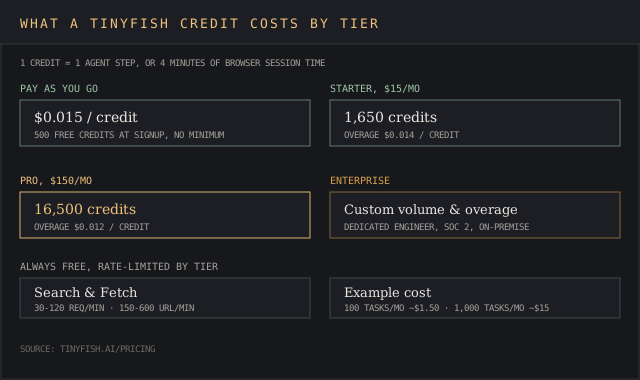
One credit buys one agent step or four minutes of browser session time. Pay As You Go runs $0.015 a credit with 500 free credits at signup and no monthly floor. Starter, at $15 a month, includes 1,650 credits and drops the overage rate to $0.014.
Pro, at $150 a month, includes 16,500 credits and an overage rate of $0.012. Enterprise is quoted, and it's the only tier that adds a dedicated engineer, ISO 27001 and SOC 2 compliance, and on-premise deployment.
Run the numbers against a concrete task and the pricing math makes sense fast: it looks close to negligible for anything that fits inside the free rate limits, and scales close to linearly past that.
A five-minute browser session to check a flight price and screenshot the confirmation page costs two credits, about $0.03 on the Pay As You Go rate. TinyFish's own math backs this: 100 agent tasks a month lands near $1.50, 1,000 tasks near $15.
Failed runs cost nothing, which matters more than it sounds like it should; on a workflow hitting sites with active bot defenses, a real share of runs will fail before a page even loads.
Setting up a working agent
Every API sits behind a documented REST endpoint, for example https://api.search.tinyfish.ai for Search, with a separate host each for Fetch, Browser, and Agent. SDK, CLI, and MCP access come included on every plan.
The MCP integration is native to Claude and Cursor, and TinyFish ships integrations for n8n, Dify, AG2, ChatGPT, and Grok, so a team already standardized on one of those platforms doesn't need to build a custom connector for its web agent.
Complete-Appeal-9808, replying to TinyFish's own free-tier announcement post on Reddit, asked the question most developers ask first when a new API shows up: "This is insane! And what are the rate limits? RPM? anything we should take into considering when entering it to our workflows?"
The rate limits are published, the ones in the features table above, but they sit in the docs. They're absent from the pricing page itself, which means a developer has to go looking for the ceiling before committing a live workflow to it. They're also fixed by plan; a team can't change them without moving to a higher tier or negotiating Enterprise terms.
What developers question
The sharpest criticism in either thread is pants2's comment, and it targets TinyFish's own promotional behavior. zkitty used the same benchmark controversy to make a related point about a competitor's numbers: "That's not a performance drop…. that's a different product than what's being advertised."
The same standard applies to TinyFish, one of many new web agent tools racing to publish the biggest number first: its own hard-task figures are self-reported and self-graded until an outside party like Mersault reruns them under different conditions.
houmercodes's non-determinism question is the one that matters most to a buyer evaluating this. Websites serve different layouts, A/B tests, and cookie-consent modals across sessions, and if TinyFish and the agents it benchmarked against weren't evaluated on the same snapshots at the same time, part of the score gap could be a timing artifact.
Nobody from TinyFish addressed it in the thread, and the wider developer community response to TinyFish so far runs entirely through Hacker News and Reddit comments.
Funding, founders, and where the data feeds decision making
TinyFish launched from stealth on August 20, 2025 with $47 million in Series A funding led by ICONIQ Capital, with USVP, Mango Capital, MongoDB Ventures, ASG, and Sandberg Bernthal Venture Partners also participating.
The company is based in Palo Alto and was founded in 2024 by Sudheesh Nair, the former president of Nutanix, alongside Shuhao Zhang, a former engineering leader at Meta, and Keith Zhai, a former senior correspondent at The Wall Street Journal.
- Customers named on TinyFish's own site: Google, DoorDash, ClassPass, Amazon, NextEra Energy Partners, Grubhub, The Zebra, Digital Garage, GetGo, and TestSprite.
- TinyFish says it runs hundreds of thousands of enterprise web agents every month at scale across those accounts.
- A joint case study with MongoDB describes product matching and competitive pricing analysis, run through a Voyage-3.5 embedding model to index competitor catalogs and a Rerank-2.5 model to surface the closest matches.
- That pipeline feeds real-time decision making. A traditional pipeline would spend weeks on ETL processing to get there.
Separately, TinyFish put $2 million behind a nine-week accelerator with Mango Capital, structured so investment size per company is a case-by-case call.
The program partnered with MongoDB, Vercel, ElevenLabs, Fireworks.ai, Google for Startups, and Composio to give admitted teams free credits and direct engineering contact, skipping the usual slide-deck pitch meetings. Its stated criteria rule out chatbots and single-API-call wrappers; the challenge it screens for is a working app built on real browser infrastructure, on topics ranging from logistics to retail to insurance.
toliveistobuild's reaction on the Hacker News thread announcing it captured the appeal to the developer audience TinyFish is chasing: "finally an accelerator that values code over slides! this is a massive win for anyone building real agentic infrastructure. time to ship."
TinyFish vs Firecrawl, Browserbase, and Browser Use
Three other agents and agent-adjacent tools show up constantly next to TinyFish in developer comparisons, and each answers a different question about how much of the web-scale infrastructure a team wants to own itself.
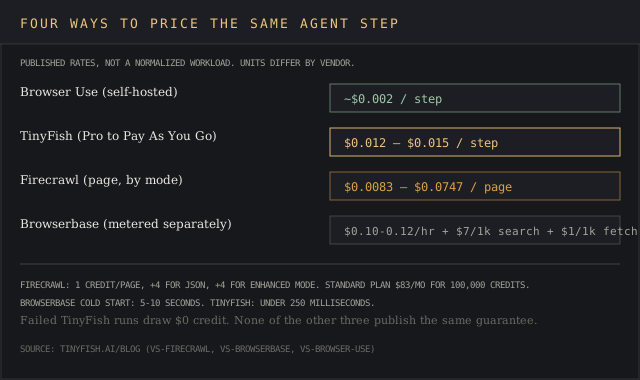
| Tool | Pricing model | Auth & anti-bot fit | Best for |
|---|---|---|---|
| TinyFish | $0.015 – $0.012 per agent step or browser-session credit | Native stealth browser profile, up to 85% anti-bot pass rate in internal testing | Production agents needing a login and a bot wall solved end to end |
| Firecrawl | Credit per page, 1 to 9 depending on mode; $83/mo for 100,000 credits on Standard | Static extraction only; 1 of 6 on protected sites in TinyFish's own test | Fast bulk crawling and mapping of public, unauthenticated pages |
| Browserbase | $0.10–$0.12/hr browser time, $7/1,000 search calls, $1/1,000 fetch calls | Bring-your-own-code; search is a wrapped Exa integration | Teams migrating existing Playwright code who want full control |
| Browser Use | ~$0.002 a step self-hosted, MIT-licensed | No managed anti-bot layer; a team builds and maintains its own | Cost-sensitive teams running many parallel agents at high volume |
Of the developer tools built to let something else browse the web on an agent's behalf, Firecrawl wins the static-extraction case. Its /crawl endpoint recursively discovers an entire domain, its /map endpoint returns every URL fast, and its AGPL-3.0 core is self-hostable, with 103,000 GitHub stars and native integrations into LangChain, LlamaIndex, Zapier, and n8n behind it.
What it isn't built for is a task that needs to log in first; TinyFish's own testing put it at 1 of 6 successes on sites with active bot protection. A team whose work depends on authenticated pages should look at TinyFish or Browserbase instead.
Browserbase is the closer architectural match: bring-your-own-code infrastructure, with search powered by a third-party Exa integration. Cold start runs 5 to 10 seconds against TinyFish's sub-250-millisecond figure, an overhead that compounds across a multi-step workflow.
Browserbase's edge is session length, up to six hours against TinyFish's per-credit model, and control: a team migrating existing Playwright code, or one that wants to swap in its own model, should pick Browserbase over TinyFish.
Browser Use is the cost play. Self-hosted, on its own model, it runs about $0.002 a step, roughly 7.5 times cheaper than TinyFish's per-step rate, and it's MIT-licensed for a team that wants to own the code outright.
Browser Use Cloud supports up to 500 concurrent sessions against TinyFish's 50 on the Pro plan, and self-reports 97.7% on Mind2Web with two tasks excluded as impossible. That last figure is the one to check against the same skepticism zkitty raised on Hacker News: Browser Use's own self-reported 89% on WebVoyager fell to 8.1% on TinyFish's hard-task benchmark.
A team that can build and maintain its own agent loop, and wants the lowest per-step cost across many parallel agents at high volume, should look at Browser Use first. A team that wants a production deployment, shipping end to end, without owning that maintenance should look elsewhere.
Verdict
TinyFish suits a data or engineering team running complex, authenticated web workflows that need an AI agent to get past a login screen and a bot wall reliably, and prefers to pay per step for a managed platform.
The hard-task gap over Operator, Claude Computer Use, and Browser Use is real and independently reproduced once, by Mersault's WebVoyager run, which is more validation than most year-old infrastructure startups have behind them.
TinyFish is a poor pick for a team that needs vendor-neutral proof before committing budget. Every headline number traces back to TinyFish's own blog or a benchmark TinyFish itself designed and ran; only one of the two major figures in this review has a genuine outside party behind it.
Zero reviews on G2 and zero on Gartner Peer Insights, a year after founding, means there's no buyer community yet to check a purchase decision against.
It might suit a team in between, one running a pilot on the free Search and Fetch tier for its own agents before committing Agent or Browser spend, going in with the open questions from the Hacker News thread still unresolved: no public answer on how every benchmark run controlled for site-side non-determinism across the agents it tested, and no published figure on how the free-tier rate limits hold up once a workflow moves past hobby scale.
FAQ
What is TinyFish used for?
TinyFish sells API access to a web agent platform, Search, Fetch, Browser, and Agent, that logs into sites, fills in forms, and pulls data out of pages a plain HTTP request can't reach. Developers use it to build agents that check authenticated dashboards, vendor portals, and pricing pages that need a persistent session.
Is TinyFish legit?
TinyFish is a real, operating company that launched from stealth in August 2025 with $47 million in Series A funding led by ICONIQ Capital, based in Palo Alto with named customers including Google, DoorDash, and Amazon. It also carries zero submitted reviews on G2 and Gartner Peer Insights as of this review, so there is no independent buyer community yet to check a purchase against.
How much does TinyFish cost?
Search and Fetch are free on every plan. Agent and Browser run on credits: $0.015 each on Pay As You Go, $0.014 on Starter ($15/month for 1,650 credits), and $0.012 on Pro ($150/month for 16,500 credits). Enterprise credit volume and overage are quoted case by case.
How accurate is TinyFish on hard tasks?
81.9% on TinyFish's own Online-Mind2Web run of 300 tasks across 136 live websites, and 91.1% on an independent WebVoyager run of 641 tasks by a third party, Mersault, in May 2026. Both figures are for the hardest task tier tracked in each benchmark.
Who founded TinyFish?
Sudheesh Nair, the former president of Nutanix, alongside Shuhao Zhang, a former engineering leader at Meta, and Keith Zhai, a former senior correspondent at The Wall Street Journal. The company was founded in Palo Alto in 2024.
Does TinyFish have a free tier?
Yes, and it's permanent. Search and Fetch are free on every plan, rate-limited by tier: 30 to 120 requests a minute on Search, 150 to 600 URLs a minute on Fetch. Only Agent and Browser draw credits.
How does TinyFish compare to Firecrawl, Browserbase, and Browser Use?
Firecrawl wins static, unauthenticated crawling and is cheaper for bulk page extraction, but TinyFish's own testing puts it at 1 of 6 successes on sites with active bot protection. Browserbase offers longer sessions and more developer control at a higher cold-start cost. Browser Use is the cheapest self-hosted option for a team that can build and maintain its own agent loop.
Bottom Line
TinyFish's own numbers hold up better than most year-old infrastructure startups': a real independent benchmark run, published failure traces, and a genuinely free tier.
What it doesn't have yet is a buyer community. Zero reviews on G2, zero on Gartner Peer Insights, and every comparative claim against a competitor traces back to a test TinyFish designed and ran itself.
A team with authenticated, multi-step workflows and the engineering time to build against a REST API gets real value here. A team that needs a peer's word before it signs anything should wait for one to exist.