Clay review: waterfall data enrichment for teams juggling multiple vendors
 By Jan Suski. I go deep on every review, checking every number against its source and digging up details other coverage misses, a habit from six years of SEO and link building for tech companies. Bylines at Surfer, Brand24, and Senuto. How the scoring works.
· Prefer this source on Google
Best for
RevOps and growth engineering teams already paying two or three data vendors separately who want one waterfall and one workflow builder sitting over all of them.
Not for
Low-volume senders wanting predictable per-seat pricing with no setup curve, or small teams without a dedicated RevOps resource to own the table builder.
What it costs
Four tiers from $0 to $495/mo across Free, Launch and Growth, plus custom Enterprise pricing; legacy Starter, Explorer and Pro customers keep their old rate until migrated.
- Data provider network
- 200+ marketplace providers; no first-party database of its own
- Waterfall logic
- Queries providers in sequence per field until one returns a match
- Data Credit cost per record
- 6 to 20 credits, depending on the data types requested
- Claygent AI research agent
- Fixed cost on native models; variable, token-based cost on GPT-5.1 and Claude 4.6 Sonnet
- Bring-your-own API keys
- Skips the Data Credit charge for that provider; the Action still meters
- Table row cap, Free and trial
- 50 rows per table
- Table row cap, Launch and Growth
- 50,000 rows per table
- Job-change and company-news signals
- Arrive at Launch, $185/mo on annual billing
- Web intent signal tracking
- Growth plan only, $495/mo on annual billing
- Native CRM sync (Salesforce, HubSpot)
- Growth plan and above only
- Built-in sequencer
- Capped around 4 outreach steps per campaign
- Native integrations
- 27 listed on G2, including Salesforce, Apollo, HubSpot, Slack, Outreach, Instantly, lemlist and Smartlead
- SSO and role-based access control
- Enterprise plan only, with workbook-level credit budgets
- Free
- $0/mo, 100 Data Credits, 500 Actions, 50-row table cap
- Launch
- $185/mo, $167 on annual billing, 2,500 Data Credits, 15,000 Actions
- Growth
- $495/mo, $446 on annual billing, 6,000 Data Credits, 40,000 Actions
- Enterprise
- Custom; Vendr median $40,500/yr across 80 purchases
- Data Credit rollover
- Capped at 2x the plan's monthly allocation
- Mid-cycle credit top-up
- 30% premium over the plan's per-credit rate
- Seats included
- Unlimited on every tier; billed on usage, not headcount
- Series C valuation
- $3 billion in June 2025, per TechCrunch
Apollo.io
Not forA growth team already waterfalling 200-plus providers, since Apollo owns one database and ships no workflow builder.
ZoomInfo
Not forA solo founder on Clay's free tier, since ZoomInfo prices for teams with procurement support and a five-figure budget.
Lusha
Not forA team running multi-provider lookups outgrows Lusha, which reveals from one database and moves those buyers toward Clay or Apollo.
Pairs well with Clay
Sources, and which figures are third-party estimates
Provider counts, plan prices, Data Credit and Action allocations, and row caps were verified against Clay's own FAQ, pricing and University documentation pages on 11 August 2026. The retired Starter, Explorer and Pro credit figures come from third-party pricing trackers' convergent estimate; Clay has never published an archive of its own. The Enterprise contract figures come from Vendr's tracked buyer data; Clay has never published its own Enterprise rate card.
Clay runs as an orchestration layer that sits on top of 200+ data providers, waterfalling a lookup through them until one returns a match, then handing the result to a spreadsheet-style table an operator can wire into a CRM, an AI model, or an outreach tool.
This review covers what Clay's data enrichment does, how the Data Credit and Action pricing works after the March 11, 2026 overhaul, where G2 and TrustRadius reviewers report it breaking down, and how it stacks up against Apollo, ZoomInfo, Cognism and Lusha on cost and coverage. It's ranked #4 on our lead intelligence software ranking, and our separate Clay pricing breakdown covers the Data Credit math in more depth than fits here.
It's written for RevOps leads sizing a Clay purchase, growth teams already paying for two or three data vendors and wondering if a waterfall consolidates them, and sales and marketing teams deciding if the credit-based pricing fits a five-seat outbound motion better than a per-seat contract.
Clay carries a 4.6 out of 5 rating across 226 G2 reviews and a 9.3 out of 10 score across 147 TrustRadius reviews, both checked 11 August 2026. That combination, strong marks alongside a repeated complaint about the learning curve and the credit system, is the tension this review works through.
What Clay does: data enrichment, AI powered research and lead scoring
Clay's core job is data enrichment: filling gaps in a contact or company record by querying outside providers and returning what comes back. A user builds a table, imports a list, and adds enrichment columns that each call a provider or an AI model.
How Clay's waterfall pulls from 200+ data providers
A worked example from Clay University: enriching 100 contacts with LinkedIn profiles and email addresses through the marketplace consumes 95 Data Credits total, 50 for LinkedIn matches at 0.5 credits each and 45 for email finds at the same rate. Bring an existing provider key to the email step and that run drops to 50 credits, since Clay skips its own marketplace purchase and only meters the Action.
The waterfall runs providers in sequence for each field: if Provider A has no work email, Clay tries Provider B, then C, charging credits only for the providers it queries.
A TrustRadius reviewer implementing Clay for other B2B SaaS companies described the same mechanic from the build side, praising "the data orchestration" for letting a table pull from a find-companies tool, then a find-people tool, then an enrichment step, before AI writes the outreach message.
"...letting a table pull from a find-companies tool, then a find-people tool, then an enrichment step, before AI writes the outreach message."
Verified User, Executive in Sales, TrustRadius review, September 29, 2025.
Connecting an existing ZoomInfo, Apollo, or Clearbit key eliminates the Data Credit cost for that provider's calls, while the Action for the platform's orchestration work still applies. Clay's data partners set the wholesale rate for each lookup, and volume discounts pass through as lower Data Credit prices at higher tiers. New buyers can't get a Clearbit key anymore, since Clearbit pricing now runs through a paid HubSpot seat.
Claygent, the AI research agent
Claygent is Clay's AI research agent, drawing Data Credits the same way a marketplace lookup does. Most native models run on fixed-price Data Credit costs per task; token-intensive models such as GPT-5.1 and Claude 4.6 Sonnet run on variable pricing tied to actual token consumption, billed at Clay's own cost with no markup.
The AI Formula Generator sits alongside it, writing custom formulas and code from a plain-language prompt. Both tools draw from the same Data Credit pool as the enrichment columns, so a heavy AI research workflow competes with a heavy waterfall for the same monthly allocation.
Clay pricing: Free plan, Data Credits and the March 2026 overhaul
On March 11, 2026, Clay replaced its old Starter, Explorer, and Pro plans with Free, Launch, Growth, and Enterprise, splitting the single credit pool that powered the old tiers into two separate meters: Data Credits for provider purchases and Actions for platform orchestration.
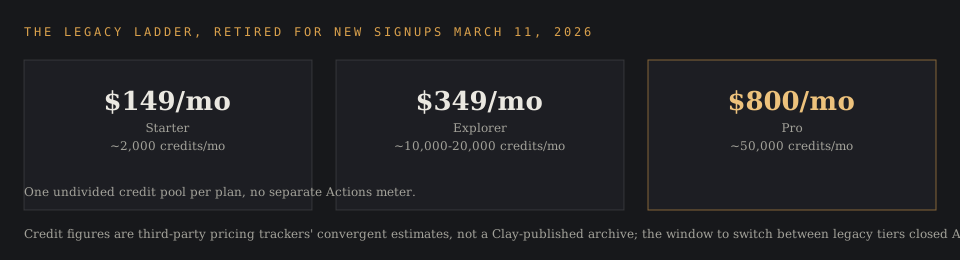
The retired ladder ran three rungs on one undivided credit pool: Starter at $149/mo with roughly 2,000 credits, Explorer at $349/mo with roughly 10,000 to 20,000, and Pro at $800/mo with roughly 50,000. Clay doesn't publish an archive of those figures; the numbers above are third-party pricing trackers' convergent estimate, unconfirmed by the vendor.
Legacy customers who stayed on Starter, Explorer, or Pro keep that plan's rate, but the window to switch between legacy tiers closed April 10, 2026.
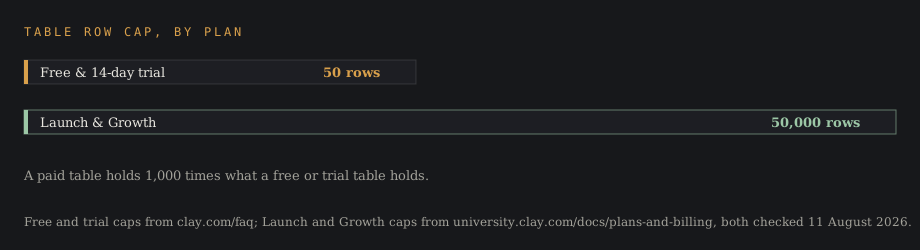
The Free plan needs no card and includes 100 Data Credits and 500 Actions a month, unlimited users, and the full workflow builder, capped at 50 rows per table with phone enrichments excluded outright. Clay's own FAQ says the cap exists so new users test different data sources and workflows before committing credits to one large table.
Vendr's research notes that most buyers exhaust the free allocation within days of running an active workflow, making it a proof-of-concept tier.
Paid tables run far larger: Launch and Growth both cap at 50,000 rows per table, a thousand times the free ceiling, per Clay's own plans documentation.
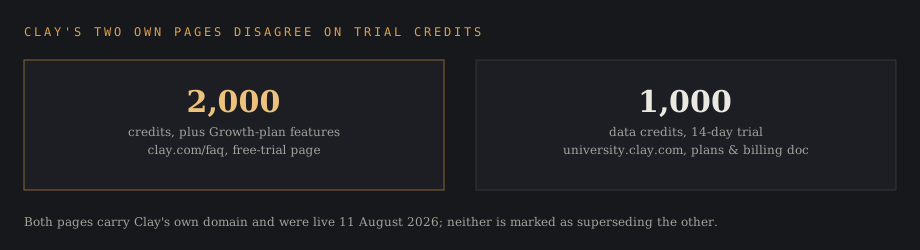
Clay's own pages don't agree on what the 14-day free trial includes. The FAQ page promises 2,000 credits and Growth-plan feature access; the University plans-and-billing doc, also on Clay's domain, says the trial carries 1,000 data credits. Both pages were live on 11 August 2026, and neither flags the other as outdated. Confirm the current figure with Clay before sizing a trial around either number.
Trial tables share the Free plan's 50-row ceiling and add a 10,000-Action cap; phone number enrichments stay off-limits until a paid plan starts.
Launch starts at $185/mo ($167 on annual billing) for 2,500 Data Credits and 15,000 Actions, sized by Clay for roughly 10,000 enriched records a year. It adds phone enrichments, job-change and company-news signals, and email campaign integrations, but carries no native CRM sync and no HTTP API access; teams export manually or route through Zapier or Make.
Growth starts at $495/mo ($446 annual) for 6,000 Data Credits and 40,000 Actions, the plan Clay itself flags as "Recommended." It's the first tier with native Salesforce and HubSpot sync, HTTP API access, webhook-triggered signals, and web intent tracking, the feature that decides most Launch-to-Growth upgrades according to Clay's own onboarding data.
| Plan | Monthly | Annual | Data Credits/mo | Actions/mo | The limit that binds |
|---|---|---|---|---|---|
| Free | $0 | $0 | 100 | 500 | 50 rows per table; no phone enrichment |
| Launch | $185 | ~$167 | 2,500 | 15,000 | No native CRM sync |
| Growth | $495 | ~$446 | 6,000 | 40,000 | First tier with CRM sync and web intent tracking |
| Enterprise | Custom | Custom | 100,000+ | 200,000+ | Vendr median $40,500/yr, range $16,044 to $117,900 across 80 purchases |
Free, Launch and Growth verified against Clay's own pricing page, 11 August 2026. Enterprise figures are Vendr's tracked buyer data; Clay publishes no rate card for that tier.
Advanced features gated to Growth and Enterprise
Enterprise pricing is custom, built around 100,000-plus Data Credits and 200,000-plus Actions a month. It adds single sign-on, role-based access with workbook-level credit budgets, a custom Data Processing Agreement, unlimited row bulk enrichment, and a dedicated growth strategist. Vendr's tracked contract data puts the median Enterprise deal at $40,500 a year across 80 purchases, ranging from $16,044 to $117,900.
Running out of Data Credits mid-cycle means buying a top-up at a 30% premium over the plan's per-credit rate, down from the 50% markup Clay charged before the March restructure. Data Credits roll over month to month, capped at 2x the plan's monthly allocation; Actions never roll over and reset every cycle since they represent fixed platform capacity.
Data quality, coverage and where enriched data breaks down
Clay publishes no accuracy rate and no coverage count of its own, a direct consequence of running as an orchestration layer. Enriched data quality varies with the providers wired into a given waterfall; Clay reports no company-wide accuracy number of its own.
A G2 reviewer running Clay for phone-number enrichment named the gap specifically:
"The UI looks like a friendly spreadsheet, but when you need conditional logic and formula chains, it's basically programming. The phone number coverage is really weak, with mobile matches only around 30-35%."
Chris J., PMM, Mid-Market, G2 review, May 4, 2026.
TrustRadius's synthesis across 101 reviews published in the last 18 months found data enrichment across contact and firmographic fields cited as a strength by 57% of reviewers, alongside integrated AI research and personalization features. The same synthesis lists slow performance for complex tables and a need for more data sources and standardization tools among the recurring cons.
Learning curve and who needs training
Setup drives Clay's steepest complaint across both review platforms, ahead of sticker price. A TrustRadius reviewer building sales automation for client accounts put it in mechanical terms:
"One thing is, in terms of extraction of data and handling multiple data points like contact information and others, Clay does very, very well. However, it also needs a certain level of engineering configuration to make it better. So there are pros, but if you're an engineer, you'll really enjoy working with Clay."
Srikrishna Swaminathan, Co-Founder and CEO, Factors.AI (51-200 employees), TrustRadius review, April 30, 2026.
A marketing operations reviewer at a 1,001-5,000-employee company drew the line even sharper, naming who Clay fits inside an organization:
"Clay is too open and wide for specific scenarios on different teams, so only marketing operations people are good at using it. I'm thinking about tools like 6sense, Nooks, and Common Room where other teams want to use AI to propel their selling or marketing strategy."
Verified User, Contributor in Corporate, TrustRadius review, October 1, 2025.
Some reviewers skipped the ramp entirely. A VP of marketing running LinkedIn automation on top of Clay's enrichment called the table-and-integration model itself the selling point:
"It's a spreadsheet with every column is an integration, so whatever you want to do... it's just so easy."
Justin Ashby, VP of Marketing, Glyphic (11-50 employees), TrustRadius review, September 26, 2025.
His stated con was narrower: a column limit he ran into often enough to force workarounds across multiple tables.
Cold outreach: what Clay automates and what it doesn't
Clay handles enrichment, research, and lead scoring for cold outreach, then hands a table of personalized rows to whatever sends the message; the built-in Sequencer caps out around four steps per campaign.
Teams running multi-step cold outreach, social automation, or dedicated deliverability monitoring typically layer one to three extra tools on top of Clay. Those add-ons run $150 to $400 a month per user, on top of the Clay invoice, before the outbound stack is complete.
LinkedIn enrichment workflows are the clearest case: several perform better, or only work at all, with an active LinkedIn Sales Navigator subscription attached, priced at $1,079.88 a year per Core seat billed annually and billed entirely outside Clay.
Integrations and what each sync carries
G2 lists 27 native integrations for Clay, including Salesforce, Apollo, Attio, HubSpot Marketing Hub, HubSpot Sales Hub, Hunter, Instantly, lemlist, Make, Outreach, Slack, and Smartlead. Two are AI models: ChatGPT and Claude connect directly for research and message-writing columns.
- CRM sync (Salesforce, HubSpot): native, but gated to Growth and above; Launch users route through Zapier or Make instead.
- Outreach tools (Outreach, Instantly, lemlist, Smartlead, HeyReach): push enriched rows directly into a sending sequence.
- AI models (ChatGPT, Claude): power Claygent and the AI Formula Generator's research and code-generation columns.
- Workflow tools (Make, Slack): route data between Clay and everything Clay doesn't natively touch, including notifications.
The CRM gate is the integration gap buyers hit hardest. A Small-Business G2 reviewer on a Launch-equivalent plan flagged it directly: "Nothing I dislike, but I wish it was easier to integrate with my CRM and LinkedIn."
Verified User, Small-Business, G2 review, January 2024.
Company stability: funding, ownership and reliability
Clay raised a Series C at a $3 billion valuation in June 2025, according to TechCrunch. By January 2026, the company had reached $100 million in annual recurring revenue and let employees sell shares at a $5 billion valuation in a tender offer, reported by the New York Times.
Clay's own status page, checked 11 August 2026, listed all systems operational, with 11 logged incidents between June and August 2026. Most resolved within hours; the longest ran two days (slower AI enrichment runs, resolved July 8) and the most recent, an August 10 partial cloud-provider outage that disabled webhook processing for a small number of workspaces, resolved after 5 hours 28 minutes.
What users praise most
Beyond the waterfall itself, reviewers repeatedly cite time saved on manual research. A VP of Partnerships at a member-community company put a business outcome on it:
"Clay is revolutionizing how we approach much of the manual work that is executed by the Pavilion operations team."
Aaron Leeder, VP, Partnerships + Alliances, Pavilion (11-50 employees), TrustRadius review, "Pavilion loves Clay," October 17, 2025.
A Dell engineering manager's recommendation was shorter, and notable mainly for the name attached to it: "I recommend Clay for it's integrations."
Divya Reddy, Manager, Engineering, Dell (1,001-5,000 employees), TrustRadius review, October 15, 2025.
That same implementation partner put the provider count at "like 200 plus," in line with the 200+ providers Clay's own data marketplace page claims today. Provider counts like this move as vendors add marketplace partners, which is worth checking again on a future visit.
What users complain about most
Credit unpredictability is the complaint that shows up most often, ahead of the learning curve. A one-person prospecting shop put a number on the frustration:
"pricing is too high for me and there credit system is somewhat messy like its unpredicatble to get how I much credit will be used for the enrichment...Clay is well suited if you need to do filtering and enrichment in volume like alteast 2k leads."
Jitendra Dhage, Founder, Prospectvista (1-10 employees), TrustRadius review, "Good Tool with High Accuracy But Pricey for Small Agencies," January 2, 2026.
Reviewers want visibility into credit burn while it's happening, before the invoice arrives. One reviewer asked for a feature that still doesn't exist:
"I think it would be that it can in some cases be quite easy to burn a lot of credits quickly without realizing it. Especially if you're pulling in a ton of different data sources. With that in mind, it could be helpful to have 'credit estimates' or 'maximum credit usage' for a given run to help mitigate that."
Max T., Small-Business, G2 review, December 2023.
The learning curve complaint holds even from a reviewer who stayed a customer for years:
"It's not the easiest tools to use, to be fair. Over the months they've evolved but at least in my memory when I started it took me weeks to understand what's what."
Leon W., Revenue Operations Specialist, G2 review, December 2023.
A CEO's review landed in between: praise for the outbound results, a specific complaint about the price of getting there.
"It can get very expensive if you don't know how to use it with API's and integrations. Creating the correct waterfall and using the correct API's can make it a game changer for your outbound."
Farzana N., CEO, G2 review, September 2024.
Clay alternative options: Apollo, ZoomInfo, Cognism and Lusha
Clay competes less on having its own database and more on orchestrating everyone else's. Four platforms come up most often as the Clay alternative buyers compare against.
Apollo.io fits solo founders and small sales teams that want prospecting, multi-channel sequencing, and dialing in one product, starting from a usable free plan. Its Basic tier runs $49 per user monthly on annual billing, Professional $79 and Organization $119 with a three-seat minimum, against Clay's unlimited-seat, usage-based model.
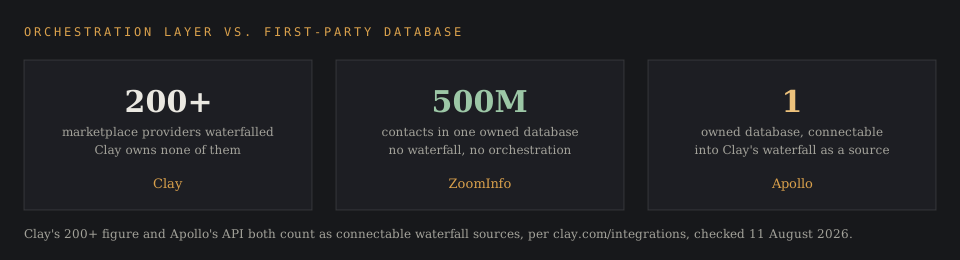
Apollo carries a 4.7/5 rating across 9,718 G2 reviews, the largest sample of any tool in this comparison. Where Clay wins is providers: Apollo owns one database, Clay waterfalls across 200-plus, including Apollo's own API as a connectable source.
ZoomInfo targets mid-market and enterprise teams with procurement support and budget for a five-figure annual contract. Entry packages run near $200 a month, Professional near $15,000 a year, and Enterprise is reported above $7,000 a month, all set in a sales conversation.
ZoomInfo operates its own verified database of 500 million contacts, a first-party number Clay can't match since it owns none of its own. A team that wants one vendor accountable for accuracy outgrows Clay's waterfall model at that scale; a team that wants to keep ZoomInfo and add cheaper providers around it can connect a ZoomInfo API key into Clay and skip the Data Credit charge for those specific lookups.
Cognism is the European-data alternative: phone-verified mobile numbers and do-not-call screening across 15 countries, sold as annual Standard or Pro packages on a credits model running $1,500 to $25,000 a year by third-party estimate, since Cognism publishes no rate card.
Cognism supplies data only, gated behind a demo, with no built-in sequencing. A RevOps team running EU outbound compliance alongside a Clay waterfall would use Cognism as one of the connected providers.
Lusha undercuts both on entry price: free at $0 with 40 credits a month, Starter $49.90, Pro $69.90, Premium $399.90, with only Scale requiring a quote. A phone reveal costs 5 credits, an email 1, a simpler unit than Clay's dual Data Credit and Action meters. Lusha fits a solo rep pulling numbers off a LinkedIn profile through a Chrome extension; it has no workflow builder and no waterfall, so a team outgrowing single-provider lookups moves toward Clay or Apollo instead.
Try it yourself
Sign up for Lusha
Free plan available, credit-based pricing after that.
 Visit Lusha →
May earn a commission if you sign up through this link, at no extra cost to you. Full affiliate disclosure.
FullEnrich is the narrower waterfall, and Clay lists it as a connectable provider inside a table. It queries 20-plus providers behind a CSV upload at 1 credit a verified work email and 10 a mobile number, from $29 a month for 500 credits with unlimited users; a team that wants contacts back with no table to build runs FullEnrich on its own, and a team that wants AI columns and buying signals on top calls it from inside Clay.
| Tool | Entry price | Owns its own database | Workflow builder |
|---|---|---|---|
| Clay | Free, then $185/mo Launch | No, waterfalls 200+ providers | Yes, multi-provider waterfall |
| Apollo.io | Free, then $49/user/mo | Yes, one database | No, sequencing and dialing built in |
| ZoomInfo | ~$200/mo entry | Yes, 500M contacts | No |
| Cognism | $1,500 to $25,000/yr, third-party estimate | Yes, EU-focused | No |
| Lusha | Free, then $49.90/mo | Yes, contact database | No |
Clay, Apollo and Lusha prices from each vendor's own pricing page; ZoomInfo and Cognism entry prices are third-party estimates since both publish no rate card. Checked 11 August 2026.
Enriched data for sales teams, growth teams and marketing teams
Clay's buyer base splits three ways in practice. Sales teams use it for prospecting lists and personalized outreach columns feeding a sequencer. Growth teams use it for signal-based triggers: job changes, funding events, and intent data routed into an automated play. Marketing teams use it for CRM enrichment and lead scoring against a target market defined by company size, job title, and custom data points.
All three draw from the same Data Credit pool, which is why sizing a plan means estimating combined usage across teams. Clay sizes each plan so 90% of customers never hit the Action ceiling; teams that do must upgrade, since Actions can't be topped up the way Data Credits can.
FAQ
How much does Clay cost?
Clay pricing runs $0 to $495/mo across Free, Launch, and Growth, with custom pricing above that on Enterprise. Legacy accounts on the old Starter plan, $149/mo before the March 2026 overhaul, keep that rate until Clay migrates them; new signups only see Launch.
Does Clay have a free plan?
Yes. The free plan includes 100 Data Credits and 500 Actions a month, unlimited users, and the full workflow builder, capped at 50 rows per table.
What does Clay's AI agent do?
Claygent, Clay's AI agent, handles complex tasks like company research and message drafting, drawing Data Credits the same way a marketplace lookup does. G2's product summary credits the AI-written messages with lifting response rates and meetings booked, a vendor-supplied claim.
Does Clay cover phone numbers as well as email?
Yes, from Launch upward. Phone numbers, like email, pull through a waterfall against multiple providers and third party data sources, so data coverage depends on which providers a given table connects.
Is Clay better than Apollo for prospecting?
It depends on the prospecting process a team runs. Apollo owns its own database outright and fits sales engagement out of the box; Clay's multi provider waterfall pulls from Apollo's own API alongside 200-plus others, suited to teams scaling outreach across multiple data providers.
Who uses Clay day to day?
Sales teams enrich leads and score leads for personalized outreach and personalized messages; growth teams route inbound leads and go to market signals into an automated play; marketing teams run lead enrichment against a target market. Users report that workflow complexity decides who on a team ends up owning the table builder, ahead of any single feature.
Is Clay an all in one solution?
No. Clay operates as an enrichment and orchestration layer; outreach tools like Instantly or Smartlead still sit alongside it for scaling outreach, and Clay's own Sequencer covers only a handful of steps.
Testing Clay against a specific workflow before committing to Growth or Enterprise is the surest way to confirm it fits, since credit consumption varies by team and by workflow far more than the published starter plan or Launch price suggests.
What does Clay's steep learning curve mean in practice?
Reviewers describe a tool built for engineers first: teams focused on RevOps or growth engineering pick up Clay's conditional logic quickly, while non technical users tend to hand the table builder to whoever on the team already knows API keys and formulas. That split is what reviewers name as the steep learning curve.
Clay's own pricing page has stayed up to date with the March 2026 overhaul, but predictable costs are the harder promise: the Data Credit and Action split makes the sticker price clearer without making monthly usage easier to forecast, which is why Clay excels for teams that already track their own credit consumption closely.
Bottom line
Clay is for RevOps and growth engineering teams already paying two or three data vendors separately, who want a single waterfall and a workflow builder sitting on top of all of them, and who have someone on staff comfortable with conditional logic and API keys.
It isn't for a low-volume sender who wants predictable per-seat pricing with no setup curve, or a small team without a dedicated RevOps resource to own the table builder; the credit system and the "weeks to understand" ramp reviewers describe land hardest there.
It might suit a mid-market sales team weighing Growth against an Enterprise conversation, provided they budget the 30% top-up premium and the CRM-sync gate into the decision before signing, ahead of finding them on the first invoice. It's ranked #4 on our lead intelligence software list for the multi-vendor waterfall job specifically.
Disclaimer
This page includes one or more affiliate links. If you sign up for a product through one of them, this site may earn a commission at no extra cost to you.