Gong review: pricing, Gong Credits, and who the median contract fits
 By Jan Suski. I go deep on every review, checking every number against its source and digging up details other coverage misses, a habit from six years of SEO and link building for tech companies. Bylines at Brand24 and Senuto. How the scoring works.
· Prefer this source on Google
Best for
Sales and revenue teams above roughly 25 seats on Salesforce, HubSpot or Microsoft Dynamics that record calls in Zoom, Teams or Google Meet and can run a sales-managed procurement process.
Not for
Teams under 10 reps, or anyone who wants a price before talking to sales: Gong publishes no rate card and no free tier, and Vendr puts the typical minimum at 10 to 15 seats.
What it costs
No rate card. Vendr's median is $55,333 a year across 1,157 purchases, range $11,572 to $204,802, with per-seat bands of $1,400 to $2,600 plus a platform fee and usage-based Gong Credits.
- Founded
- 2015 by Amit Bendov (CEO) and Eilon Reshef (CPO)
- Last primary round
- Series E, $250 million, June 3, 2021, at a $7.25 billion valuation
- Total disclosed funding
- About $584 million
- ARR
- Above $500 million, growing more than 55%, per Gong on May 12, 2026
- Customers
- More than 5,000 companies
- Median annual contract
- $55,333, Vendr, 1,157 purchases
- Contract range
- $11,572 to $204,802
- Per-seat bands
- $1,400 to $2,000 standard (25 to 75 seats), $1,800 to $2,600 advanced (50 to 150 seats)
- Typical minimum
- 10 to 15 seats
- Included Gong Credits
- 2,000 per paid core seat a year, pooled, reset each contract year
- Renewal
- One-year auto-renewal, 60 days' written notice, fees non-refundable
- Trackers
- Question-based smart trackers written as a prompt, plus the older example-based kind
- Revenue Graph inputs
- Calls, emails, SMS, calendar events, LinkedIn messages; 300+ listed integrations
- Native CRMs
- Salesforce, HubSpot, Microsoft Dynamics
- Custom Agents
- Generally available June 2026, with the Gong Revenue Harness
- Gong Enrich
- Third-party account and contact data, launched September 30, 2026
- G2
- 4.7/5 from 6,784 reviews, 5,942 of them five-star
- Capterra
- 4.8/5 from 561 reviews
- G2 time to implement
- 1 month
- Status page, Jul to Oct 2026
- 20 days with incidents, 4 at outage level
- Certifications
- SOC 2 Type 2, ISO/IEC 42001, 27001, 27017, 27018 and 27701
- Also listed
- PCI DSS SAQ D, CSA STAR, EU-U.S. Data Privacy Framework
- Claimed uptime
- 99.5%
- Default retention
- Up to three years or the contract length, whichever is shorter
- After termination
- Data permanently deleted after 30 days
Avoma
Not forAn enterprise buyer that needs Gong's agent tooling, the Microsoft Copilot connection and a procurement-grade compliance stack.
Clari
Not forA team whose main need is call coaching and rep-level conversation review, the job Gong was built around.
Pairs well with Gong
Where these facts come from
Company, product and security facts come from Gong's company page, press releases, help center and security page, with funding from TechCrunch and Calcalist. Pricing comes from Vendr's anonymized purchase data and Gong's own terms, because gong.io/pricing carries no dollar figures. Ratings are G2's and Capterra's own aggregates, read November 4, 2026, and the incident count comes from the status.gong.io calendar for July to October 2026.
Gong is the conversation intelligence tool that broke new ground by turning recording, transcribing, and scoring sales calls into a software category. Founded in 2015 by Amit Bendov and Eilon Reshef, the San Francisco company now calls itself a "Revenue AI OS," built around a data layer it calls the Revenue Graph.
In 2026 that stack grew a set of AI agents that act on deals, on top of the dashboards that describe them. Gong describes itself as a revenue intelligence platform designed around recorded customer interactions, and its revenue intelligence page carries the line "Trusted by 5,000+ customers."
This Gong review is written for two readers. One is a revenue operations lead scoping a first Gong contract. The other is an existing customer facing a renewal under the new Gong Credits model. Both need what gong.io's pricing page won't give them: real numbers. Both also face the same reality: the decisions that matter most get made before the first of their customer conversations is ever recorded.
Gong's pricing page states that "Licenses are priced per user" and that "There is a platform fee based on the number of users supported." No rate card follows. That's a simple model to describe, and budgeting for it is easier said than done, because the final number depends on three factors: seat count, modules, and how hard you negotiate. Every dollar figure below comes from Vendr's anonymized buyer data, from Gong's help center, or from Gong's own terms.
2026 has been a busy year inside Gong. It shipped a new pricing mechanism (Gong Credits), a batch of agents (Mission Big Dipper), a Microsoft Marketplace listing, and a data enrichment layer (Gong Enrich), on top of the RightBound acquisition it announced in December 2025. A tool that looked stable at last year's renewal has moved, and a buyer who skips the fine print this cycle is skating on thin ice.
How Gong works: recording, trackers, and the Revenue Graph
Gong records calls and ties each one to CRM data and a deal-risk view. Per its help article on how calls are recorded, Gong scans a rep's calendar once an admin connects Google Workspace or Microsoft Outlook, then "joins the meeting as a virtual participant and records the call." In Zoom, "the Gong recorder appears in the attendee list like any other participant."
So yes, Gong works as a meeting recorder first. The recorded audio goes through automatic speech recognition (ASR), and natural language processing turns the transcript into searchable data. Gong transcribes conversations, tags speakers, and writes the output into the Revenue Graph.
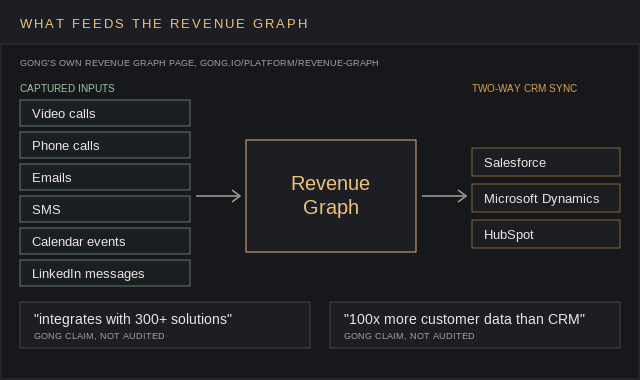
The Revenue Graph page lists what goes in: video calls, phone calls, emails, SMS, calendar events, and LinkedIn messages, plus two-way sync with Salesforce, Microsoft Dynamics, and HubSpot. It claims "100x more customer data than CRM" and says the graph "integrates with 300+ solutions across your revenue stack." Those are Gong's numbers, straight from the horse's mouth, and nobody outside Gong audits them.
Reps use the call library to review past interactions before a follow-up, so nobody has to rebuild earlier sales conversations from memory. A manager coaching a rep on sales process can pull the sales strategies that worked on a comparable deal straight from the transcript, without digging through a CRM note field. That's the core value: Gong records calls, and the call libraries become the single source of truth for what was said.
Sales teams that record every call stop relying on handwritten notes, and sales managers can replay the call when a deal stalls, without waiting for the rep's version of what happened. People who weren't on the call can read the text of the transcript, and shared libraries help sales, product, and customer success stakeholders align on what buyers said, a kind of collaboration with a privacy cost.
The detection layer is the tracker. Gong's smart trackers documentation now says "Smart tracker now refers to the new question-based smart tracker," with the older version renamed an example-based smart tracker. A question-based tracker gets written as a plain-language prompt. Keyword trackers still exist for exact keywords like competitor names.
Question-based trackers try to interpret intent, such as a buyer raising budget objections without saying "budget." Spotting objection trends and recurring patterns across hundreds of past conversations is where trackers show their power, and where a misfiring tracker struggles most. No tracker is perfect, and a tracker that cries wolf on every pricing question trains managers to ignore it.
The retrieval side draws complaints. Grant N., an enterprise account executive at a 1,001-to-5,000-employee software company, wrote in a February 2024 Capterra review: "It'll pull up the wrong results or just not pull any results so you have to retype the search." He added: "The search doesn't always work when searching for a specific keyword or account."
The Zoom integration is the most common setup, and phone-first teams can compare dialer-heavy tools in our call intelligence software rankings. A call coming in through a dialer, Zoom, Teams, or Google Meet lands in the same library, and CRM updates flow back to Salesforce, HubSpot, or Dynamics without a rep re-typing the summary. Teams can analyze calls across the whole team or zero in on a single rep's last ten demos.
Gong's AI features and the 2026 shift to agents
Gong's AI features do four jobs on top of transcription: flag deal risks from conversation signals, draft AI summaries and follow-ups, push structured fields into the CRM, and answer questions through Gong Assistant, a personal assistant scoped to a rep's own deals.
AI summaries and draft follow-ups land in the rep's inbox after the call, which cuts the note-taking reps once did manually at the end of every meeting.
The 2026 change is the delivery mechanism. Mission Big Dipper, announced June 24, 2026, introduced the Gong Revenue Harness, which Gong describes as an execution layer that governs, orchestrates, and connects AI agents across the revenue cycle.
It also launched Custom Agents: a user describes a workflow in natural language and Gong runs it as an agent with scoped data access, an audit trail, and configurable human oversight. Gong says no engineering support is required, which puts RevOps in the driver's seat. Agents acting on deal data inherit Gong's existing security permissions, per the release.
Custom Agents, AI Builder in Gong Assistant, AI Coach, and AI Builder for Scorecards went generally available in June 2026. The release's own example is an agent that watches accounts over $100K for risk signals, the kind of specialized agents a RevOps lead used to file an engineering ticket for. Ask the sales rep to demo where those alerts land during the trial: a risk flag nobody sees in Slack or the inbox is a flag that might as well not exist.
Gong Engage is Gong's attempt to kill two birds with one stone, adding sales engagement to the recording. Per the Gong Engage page, AI Composer drafts emails from conversation context, Flows run multi-step sequences, AI Tasker suggests tasks from buyer signals, a dialer handles web and mobile calls, and Gong Enrich fills in missing emails, phone numbers, and account details for contacts.
Gong claims "On average, Gong Engage users see a 34% higher response rate," and that deals where reps complete AI Tasker's tasks within 24 hours "have an 11% shorter deal cycle." That's sales automation and outreach messaging built to automate the steps between calls, and it competes with Outreach and Salesloft.
Our cold calling statistics report has benchmarks to test those claims against. The page's SpotOn case study claims the customer "created 30% more top-of-funnel opportunities," and every ROI figure here comes from Gong itself.
User sentiment on the AI itself is split, and the split shows up in numbers. On G2's Gong page, read on November 4, 2026, the review-theme tags include "AI Summary" (219 mentions) on the positive side and "AI Inaccuracy" (77) plus "AI Limitations" (74) on the negative side.
Angie P., a VP of revenue at a software company, rated Gong 3 out of 5 in a February 2026 Capterra review titled "Standard / fine call recording software." Her cons opened with: "Lack of AI features across all call transcripts, the wait on transcription times / upload times."
Marissa W., a senior account executive, wrote in January 2026 that "Gong's AI can be a hit or miss especially when it comes to follow up material and call recaps." Transcription delays are a separate complaint from transcription accuracy, and Angie P. named both.
Accents and jargon are where the AI misses the mark most often. A principal product manager at a mid-market company gave Gong 4.5 stars on G2 in August 2025 under the title "Good Analytics and Recording but Costly," flagging AI-generated summaries that arrive late and sometimes miss on accented speech, plus advanced features such as custom workflows and permissions that take time to learn.
That complexity is the other half of the cost complaint. Juanma R., a product marketing director, wrote on Capterra in September 2023 that "Sometimes the automated speech recognition algorithm doesn't really understand some terms (e.g. competitor names)."
Gong's help center publishes no per-language accuracy figure, so plan on manual review for any call outside standard business English. Trackers draw a related complaint. Oliv's Gong review quotes a reviewer who "found the AI tracker setup to be quite difficult."
AI that misses tone or an objection buried in context still needs humans to check it, so test trackers and transcription on your own non-English and jargon-heavy recordings during the trial. Rivals such as Sybill pitch an "AI-native and execution-first" contrast to Gong's AI layer. Any vendor claiming superior AI, AI native or otherwise, should prove it on your recordings.
Deal insights, pipeline risk, and win rates
Beyond transcription, Gong's value case rests on deal insights: risk flags, competitor mentions, and next steps tied to deal progress. Gong's help center lists deal intelligence, revenue and deal predictions, forecasting, and coaching among the AI capabilities included with a seat.
The tech stack pairs ASR with natural language processing to turn a recorded call into deal tracking data a sales manager can query without listening to the recording, which cuts the manual data entry a rep would otherwise do after every call. CRM hygiene improves as a side effect, a blessing in disguise for RevOps, because fields get filled from what the buyer said, and clean CRM data makes every forecast report less fiction and more fact.
Gong markets conversation metrics inside that layer: talk ratios (how much of a call the rep spoke versus the customer), patience before responding, and longest monologue. Those metrics roll up into the pipeline risk view that feeds forecasting.
None of them are unique to Gong, and talk ratios turn into vanity metrics once reps learn managers watch them, so use them to catch coaching moments and keep the review on what the buyer said. The Revenue Graph is the mechanism that turns per-call statistics into a per-deal signal, and that's where Gong presents its strongest case.
Gong's own case studies tie these signals to win rates. Its case study page headlines "How Experian boosted win rates by 25%," and its May 2026 release cites Anthropic at a 64% seller productivity increase, about 10 hours a week returned to account executives.
Both are vendor-published and unaudited, so read between the lines; they belong in the same bucket as the other case studies covered below. Teams that want win-rate analysis as the main job should also check our win-loss analysis software rankings.
Sales coaching draws on the same detection layer. A manager reviewing why a rep's close rate lags can pull the talk ratios and tracker hits from one call, then use Gong Enable's scorecards to turn that review into a documented coaching session. Top reps' calls become the training material, and the gap between the best and the median seller is easy to spot.
Managers can attach feedback to a scorecard with the same scoring applied to every rep, which closes the loop between a call review and the next call. Gong's May 2026 release claims sellers spend 77% of their time on non-selling activities, the efficiency argument behind Gong's whole strategy.
Gong pricing and Gong Credits
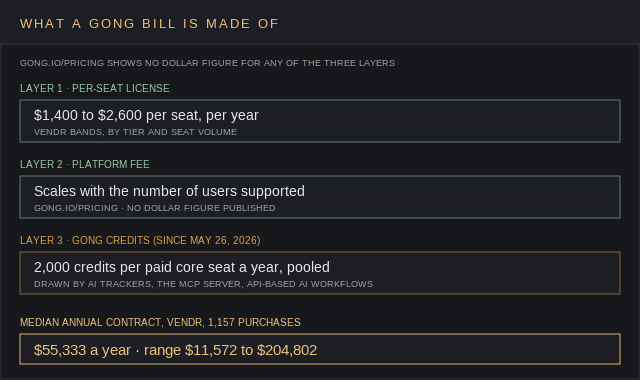
Gong.io's pricing page is short. Licenses are priced per user, a platform fee scales with seats, and "You can integrate your existing tech stack for free." No dollar amount appears. The form asks for team size in four bands, "1 - 50" up to "10,000+," and ends in a sales call. The same page shows Gong's G2 score as 4.8, while G2's own page read 4.7 from 6,784 reviews on November 4, 2026.
Vendr's marketplace data cuts to the chase. Across 1,157 tracked purchases, the median Gong contract is $55,333 a year, the low end is $11,572, and the high end is $204,802, with buyers saving 14% on average during negotiation. Vendr's per-seat bands run $1,400 to $2,000 on the standard tier for 25 to 75 seats, and $1,800 to $2,600 on the advanced tier for 50 to 150 seats.
Our Gong pricing report breaks the per-user license, the platform fee and the AI credits down line by line.
The important number is the per-seat band. Run the arithmetic on a 50-seat team. At Vendr's $1,400 to $2,600 per-seat range, seat licenses alone come to $70,000 to $130,000 a year, before the platform fee and any sales tax. Vendr's medians reflect negotiated prices, so list quotes start higher. That's serious money and no drop in the bucket for a mid-market sales org, which is why the per seat figure matters more than the headline median.
Review-site complaints line up with those numbers. Alex M., a sales operations manager in IT services, rated Gong 5 stars on Capterra in March 2025 and still wrote: "Even though we are paying a lot to have Gong there are many features that are hidden behind additional seats." Thomas L., a COO at an 11-to-50-employee software company, put it in one line in June 2024: "Gong is a bit expensive compared to similar products."
Gong Credits arrived through a May 26, 2026 blog post by Eilon Reshef, hot off the press for anyone renewing that summer. Credits don't replace the seat model. They meter background work done by Gong agents, "consumed based on the volume of data Gong agents process." Writing emails, preparing for meetings, and using Gong Assistant stay inside the seat license.
Gong's help article on the new AI usage model, published June 9, 2026, names what draws credits: AI Trackers, the MCP server, and API-based AI workflows. It lists what stays included: calls and call analysis, conversation insights, deal intelligence, forecasting, coaching, revenue and deal predictions, and Gong Agents used by individual users.
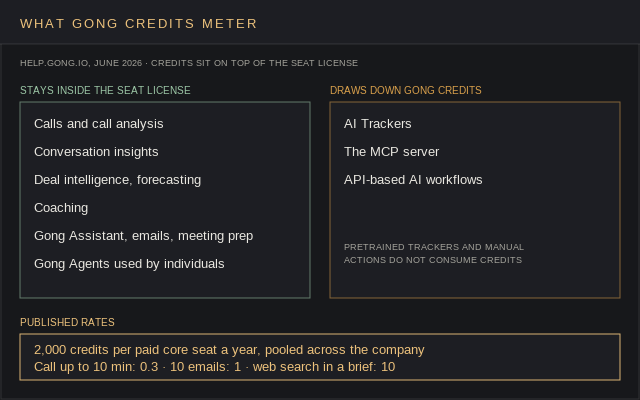
The rates live in a separate help article, About Gong credits. "Each paid, core seat includes 2,000 credits annually," pooled across the company. "Calls up to 10 minutes consume 0.3 credits," "10 emails consume 1 credit," and "Each web search carried out when generating a brief consumes 10 credits."
Pretrained trackers and manual actions don't consume credits, which gives an admin more control over spend. The credit math gets confusing fast: a team with 20 core seats gets a 40,000-credit pool, and active users running question-based trackers draw it down for everyone.
The rules around the pool matter at renewal. Default credits reset "at the start of each contract year." Purchased credits last until the end of the contract term, and "Purchased credits do not roll over into a new contract term." When the pool runs dry, "Data processing stops for credit-based features." Gong's blog says credits are priced to be "usually cheaper" than running the same processing through Anthropic or OpenAI directly, with no figures or method attached.
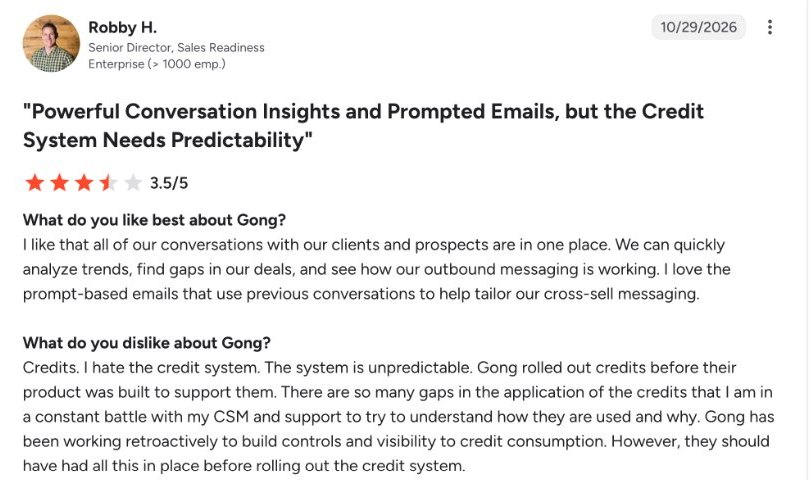
Users have started to notice. Robby H., a senior director of sales readiness at an enterprise customer, rated Gong 3.5 out of 5 on G2 on October 29, 2026, under the title "Powerful Conversation Insights and Prompted Emails, but the Credit System Needs Predictability."
"Credits. I hate the credit system. The system is unpredictable. Gong rolled out credits before their product was built to support them."
So ask two questions at renewal: how did last year's AI Tracker and agent usage compare against 2,000 credits per seat, and what does a purchased credit cost per unit. Gong's public materials don't publish a per-credit dollar price, so get it in writing before you sign. A stitch in time saves nine here, because a tracker that stops processing mid-quarter leaves a hole in every dashboard built on it.
Hidden costs and contract terms
Vendr's data shows Gong deals skew long. Sixty to 70% of tracked contracts run multi-year, and the Vendr page says those deals often carry auto-renewal clauses with price escalation of 5 to 10% a year.
A three-year deal signed at $55,333 lands between $61,000 and $67,000 by year three on escalation alone, before any seat growth. Escalation becomes an increasing share of the bill every year, so expect the first renewal quote to land above the original and set expectations with finance early.
Gong's own terms and conditions add the mechanics. Section 3.3 says subscriptions "will automatically renew for additional one-year periods" unless either side gives written notice "at least 60 days before the end of the relevant subscription term." Promotional pricing renews "at Gong's applicable list price in effect at the time of the applicable renewal."
The clause that bites a shrinking team sits in the same section. Cutting seats or term length "will result in re-pricing at renewal without regard to the prior term's per-unit pricing." Drop from 50 seats to 30 and the per-seat discount you negotiated can break apart at renewal. Section 3.4 adds insult to injury: "Payment obligations are noncancelable and fees are non-refundable," due within 30 days of the order form.
That's the most powerful lever a buyer has, and it's a calendar entry. Put the 60-day notice date in the calendar on signing day, because missing it rolls the contract for a year at whatever terms apply. Annual contracts are the floor here: even a multi-year deal renews into one-year periods. Before you commit to a longer term, read sections 3.3, 3.4, and 9.4 in full, because the devil's in the details.
Module sprawl is the second hidden cost. Gong's FY27 professional services page lists ten separate implementation packages, from "Implementation: Call Intelligence" to "Implementation: Forecast Professional," plus data migration, tailored training, and Gong Certification. It publishes no prices for any of them and states that "The Services below are non-refundable." The module list gets complicated fast, and each package is one more line a team has to justify.
Competitor write-ups fill the gap with anecdotes. Sybill's Gong review cites a G2 reviewer describing "high upfront platform fees (often $5,000+)" before per-seat costs. Higher onboarding and platform-fee ranges circulate in AI answers, but none of them trace to Gong or Vendr, so treat any figure like that as an opening position for the negotiation and get the real one quoted on the order form.
Data portability is the third cost line. Section 9.4 of the terms gives a customer 30 days after termination to request its data, after which Gong has no obligation to keep it. Gong's security page says "all data is permanently deleted 30 days after contract termination." That 30-day window is the date to plan an export around, before the cancellation letter goes out.
A TrustRadius reviewer who renewed anyway described the trade plainly in a December 2024 review: "Gong was more expensive by far," and while "there were many more affordable options on the market," the team "also considered switching costs and decided to stay with Gong." That team sat between a rock and a hard place and paid up.
Switching costs are the moat, and Gong prices like it knows that. In one respect that's honest: the most valuable clause in a Gong contract may be the export clause, because it decides how hard leaving will be.
Setup and onboarding
Neither Vendr nor Gong publishes an onboarding timeline. Oliv's Gong review tells buyers to budget "several weeks of their time" for a named internal owner across six workstreams: CRM field mapping, recording rules, tracker design, manager scorecards, integration testing, and change management. That's weeks of dedicated RevOps support, so ask the sales rep to write the timeline into the order form.
The closest public benchmark is G2's Value at a Glance panel, which averages user reviews and puts Gong's time to implement at 1 month.
What the review record supports is a learning curve after go-live. Dustin A., a director at a small events services company, gave Gong 5 out of 5 on G2 in April 2026 and named "the learning curve during onboarding" as his first dislike. His second was cost: "The pricing is fair, but it could get a little expensive if you are adding a bunch of seats."
Sarah K., a financial services sales rep at a 51-to-200-employee firm, wrote on Capterra in March 2025: "There are a lot of features available on the app that I definitely do not utilize."
Recording and search work out of the box, and coaching, forecasting, and tracker setup take time a small team without RevOps capacity may not have. In practice, the benefits show up first in coaching, where the needed setup is lightest, and teams that hit the ground running there tend to adopt the rest.
Outsourcing is the other onboarding delay buyers report. Sybill's review quotes a G2 reviewer saying "Onboarding is done by an outsourced vendor" and that tickets can take weeks to resolve. Gong's services page lists "Managed Services" next to its own packages, so ask who staffs the project before the contract goes out, and get that team's timeline in writing too.
Recording reliability issues are the other first-month problem. Freesia D., an account executive in events services, rated Gong 5 stars in October 2025 and still wrote: "Sometimes the recorder doesn't join the meeting right away and will randomly join a few minutes in."
Integrating Gong with your stack
Gong integrates natively with the three CRMs that carry most of the market: Salesforce, HubSpot, and Microsoft Dynamics, with two-way sync per the Revenue Graph page. On the conferencing side, Zoom, Microsoft Teams, and Google Meet all connect for automatic call capture, and calendar access through Google Workspace or Outlook drives the recorder's schedule.
Beyond the point integrations, the Revenue Graph page lists "Open APIs, webhooks, and Gong Data Cloud exports to a data warehouse." The Gong Engage page names Salesforce, HubSpot, Microsoft Dynamics 365, ZoomInfo, LeadIQ, Nooks, Orum, 6sense, G2, LinkedIn, Dealroom, Chili Piper, and Calendly as integrations.
Webhooks push Gong data into other tools, and integrating Gong with a stack outside that list runs through the API, where someone has to iron out the details in code, which turns a point-and-click setup into an engineering task.
The July 2026 Microsoft partnership adds Dynamics 365 sync of calls, emails, and meetings with AI-generated summaries, key topics, and next steps, and the MCP server connection to Microsoft 365 Copilot. An enterprise customer can buy Gong against an existing Azure MACC commitment through the Marketplace, which takes a separate purchase order off the table.
For a RevOps lead, the practical question is which CRM fields sync automatically and which need an agent or a Zapier-style bridge. Standard deal and activity fields sync natively into Salesforce, HubSpot, and Dynamics. Anything custom deserves a test during the trial, since an agent that writes CRM fields through the API now draws Gong Credits.
Post-call analysis is a design choice reviewers notice. An analyst in R&D at a 201-to-500-employee telecom company rated Gong 9 out of 10 on TrustRadius in August 2026 and praised the interface as "quick and easy to access," while asking for more: "I think the natural next step is real time coaching instead of post call only." The reviewer wants Gong to push the envelope on live coaching, since its analysis still runs mostly after the call ends.
What users complain about most
To get past cherry-picked quotes, we counted. Capterra lists Gong at 4.8 from 561 reviews. Of the 25 reviews Capterra sorts as "most helpful," read on November 4, 2026, 21 rate Gong 5 stars, three rate it 4, and one rates it 3.
Their cons sections split like this: seven name AI, speech recognition, or analytics accuracy, seven say they have no real complaint, two flag internal privacy, two flag recording or consent friction, two flag the interface, one names price, and four name narrower feature gaps such as clip stitching or customer success reporting.
G2's distribution is even more lopsided. Of 6,784 reviews, 5,942 are five stars, 758 are four, 65 are three, and 19 are one or two stars. That's 87.6% five-star and 0.3% one- or two-star. A one-star review is rare: 14 of 6,784. In a nutshell, reviews suggest a product most users like, with complaints that cluster tightly around three themes: price, AI and search accuracy, and the feeling of being recorded.
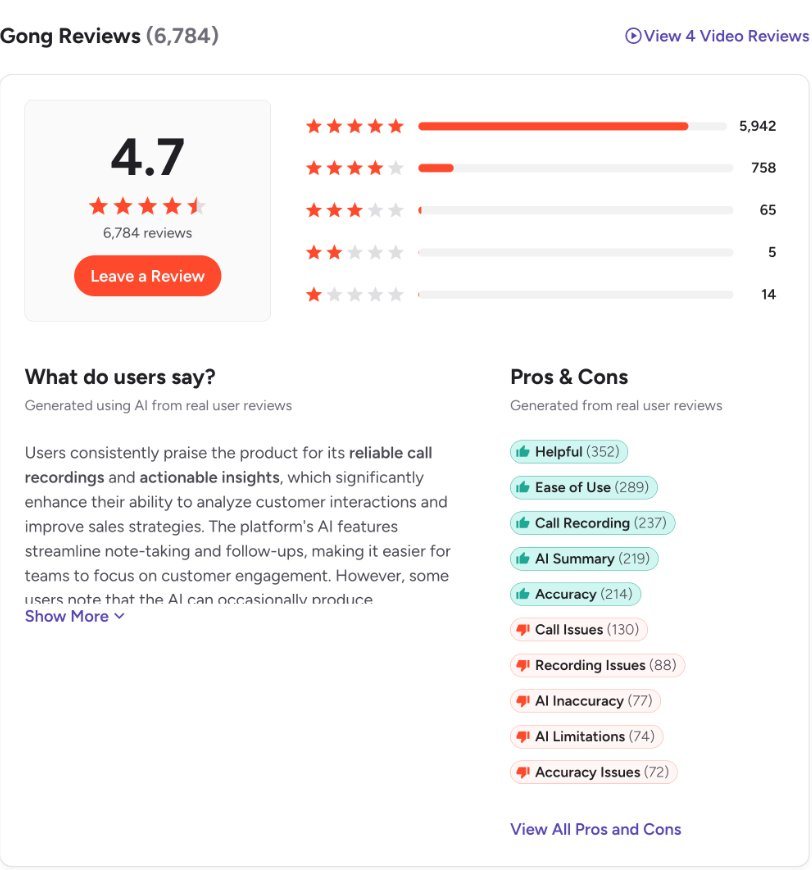
Pricing complaints (Alex M., Thomas L., Dustin A., the G2 product manager) center on the seat-plus-platform-fee structure and modules sold separately. Accuracy complaints (Grant N., Angie P., Marissa W., Juanma R.) center on retrieval, transcription, and AI recaps. Reviewers mostly agree the recording works. Nobody in this set faulted the core recording function, and none mentioned losing a recording outright, though Freesia D. flagged a late-joining recorder.
The third complaint is about how recording feels. Megan H., a product manager in hospital and health care, gave Gong 4 stars in November 2024 and listed as a con: "Lack of privacy within the organization with all calls related to the business in one place." A senior SDR at a software company put it more bluntly back in 2018: "anyone at your company can listen to the call/recording."
Internal visibility is the elephant in the room. Gong's security page answers a different question, the AI-training one, with "Your data is never used to train generative AI models." That covers what Gong does with the contents of a recording.
Who inside the customer's own company can hear a given call is a separate question, the one Megan H. raised, and the answer is a permissions setting an admin has to configure on purpose.
What users praise most
The strongest praise comes from reps who describe a specific workflow change. Darby C., an account executive in banking, titled a November 2025 Capterra review "Amazing B2B Sales Tool" and wrote: "Gong is an amazing tool for sales process management." Even then, the con was the AI: "I wish the AI functionality provided more in-depth summaries."
The day-to-day experience draws praise from the same critics. Angie P., the 3-star reviewer, conceded in her pros: "Everyone is familiar with how it works, and it's not too hard to set up for a new rep on the team to get them started." Dustin A. also wrote that "Gong's performance is stable and consistent," the kind of impressive reliability note the recording side earns.
Alex M., who complained about seat-gated features, opened his review with: "The insights and the AI are so useful in capturing what was discussed on a call." The telecom analyst on TrustRadius praised Gong's "Great cadence between resolution of any problems that come up," which runs against the slow ticket resolution that comparison sites report.
G2's positive tags carry the same pattern in numbers: "Helpful" 352, "Ease of Use" 289, "Call Recording" 237, "AI Summary" 219, and "Accuracy" 214. "Accuracy" appearing on both the praise and complaint lists gives the clearer picture of where Gong sits: good enough on English sales calls that most reviewers love it, and inconsistent enough on accents, jargon, and search to collect 77 "AI Inaccuracy" and 74 "AI Limitations" tags on G2.
Security, compliance, and the call-recording question
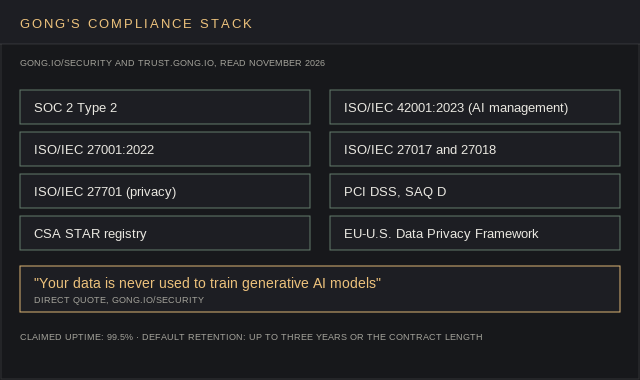
Gong's security page lists a stack armed to the teeth for enterprise procurement: SOC 2 Type 2, ISO/IEC 42001:2023 for AI management, ISO/IEC 27001:2022, ISO/IEC 27017 and 27018 for cloud and PII controls, ISO/IEC 27701 for privacy, PCI DSS at SAQ D, a health information privacy entry, the CSA STAR registry, and the EU-U.S. Data Privacy Framework. Gong's separate trust center also lists TX-RAMP Level 2.
Default retention runs "up to three years or the duration of your contract," whichever is shorter, per the security page FAQ, with custom periods on request. Calls, emails, and transcripts older than that age out unless the customer negotiated otherwise, so a team that wants a five-year call library has to ask for it in the order form.
Gong claims 99.5% uptime, and its status page shows what that looks like day by day. Between July and October 2026 the calendar marked incidents on 20 days. The page tags each day by impact: 16 as degraded performance, three as full outages (July 12, 13 and 27) and one, October 5, as a partial outage.
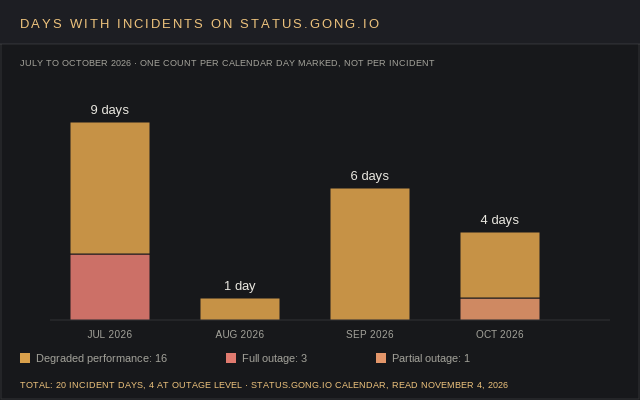
July carried nine of the 20 days, August one, September six and October four. A marked day says nothing about how long an incident lasted or how many customers it touched, so the 99.5% claim can't be checked from this calendar alone. Ask which uptime figure Gong will commit to in the order form.
Now the legal exposure. Recording a sales call means recording a buyer, and two-party consent states such as California make that a compliance question. Gong's help article says only that consent requirements "vary by country and, in some cases, by state," and leaves the settings to the workspace admin, who decides "whether recording starts automatically or only after consent is given."
The category already has a test case. In August 2025, a California plaintiff filed a proposed class action against Otter.ai in the Northern District of California, NPR reported, alleging its notetaker "may join the meeting without obtaining the affirmative consent from any meeting participant" when the host has linked Zoom, Google Meet, or Microsoft Teams. That's the same bot-joins-from-the-calendar mechanism Gong uses.
A search of federal dockets for this review found no class action naming Gong as a defendant over call recording. The one 2025 federal case with Gong's name on it runs the other way: Gong.io, Inc. v. Hyperdoc, Inc., a patent infringement suit Gong filed on January 31, 2025, in the Northern District of California, case 5:25-cv-01026.
The absence of a suit is no shield for the customer. Under Gong's model, the admins who manage the customer's workspace set the consent behavior, so a misconfigured workspace in a two-party-consent state puts the risk on the customer's side of the table. Keep an eye on the Otter case, and have legal sign off on the consent settings before the first recorded call.
Customer success, forecasting, and roles beyond sales
Gong's Revenue AI OS framing covers customer success and revenue operations next to prospecting. Its case study library includes "GHX reduced rep ramp time by 85% with Gong," another vendor-published headline with no outside audit. Gong's May 2026 release adds that 50% of customers run multiple products on the platform.
For customer success, the same signal detection that flags deal risks during a sales cycle applies to renewal and expansion calls after close, surfacing objection language or competitor mentions in a CS call. Sales leaders get the pipeline view, and CS and RevOps teams benefit from the same layer pointed at renewal risk. Gong doesn't publish a separate rate card for CS seats; they draw from the same per-seat pricing.
Forecasting is a named product with its own implementation packages ("Forecast Quickstart" and "Forecast Professional"), and Gong Forecast appears as its own component on the status page.
Forecast accuracy in Gong comes from the same conversation signals that feed deal-risk scoring, run through the Revenue Graph, which gives a team full visibility into what was said on calls that roll up into a stage change. A RevOps lead who wants to forecast pipeline from conversation data gets forecasting signals that flag a deal where the buyer went quiet.
Gong helps most where the forecast problem is a visibility problem: a manager who can't see what's happening on calls. For a team whose problem is calibration across managers who see the calls and still grade deals inconsistently, leaning on Gong's forecast is barking up the wrong tree, and our predictive sales analytics rankings cover tools built for that job. That's the use case Clari was built around, covered in the comparison below.
What changed in the last 12 months
On December 2, 2025, Gong announced it had acquired RightBound to add account and contact data, financial data, news, and buying-group signals to the Revenue Graph, with no deal terms disclosed.
On May 12, 2026, Gong said ARR had "surpassed $500 million," with growth above 55% in the most recent quarter and a "tenth straight quarter of accelerating growth rate." The same release said Gong added more $1M+ customers in the last two quarters than in the previous six combined.
When it rains it pours: Gong Credits arrived on May 26, Mission Big Dipper on June 24, and the Microsoft partnership on July 1. On September 30, 2026, Gong announced Mission Callisto and Gong Enrich, a sales enrichment layer that adds third-party account and contact data to the Revenue Graph, and on October 16, 2026, its newsroom announced a Leader placement in the 2026 Gartner Magic Quadrant for Revenue Action Orchestration for the second consecutive year.
Today, Gong sells recording, engagement, forecasting, enablement, and data, and Gong's obsession with owning every revenue signal is the thread running through all of it. A buyer who wants predictable spend should price the next renewal before signing this one.
Company stability
Gong's last primary round was a $250 million Series E on June 3, 2021, at a $7.25 billion valuation, TechCrunch reported, led by Franklin Templeton with Coatue, Salesforce Ventures, Sequoia, Thrive Capital, and Tiger Global. Total funding stands at about $584 million.
The headline number hides a markdown. On November 17, 2025, Calcalist reported that Gong was running a secondary round for employees and investors on Nasdaq's private market at roughly $4.5 billion, about 38% below the 2021 price, a bitter pill to swallow for anyone holding 2021-era equity. The same report put Gong at about 1,300 employees, 380 of them in Israel.
Is Gong worth it for small teams
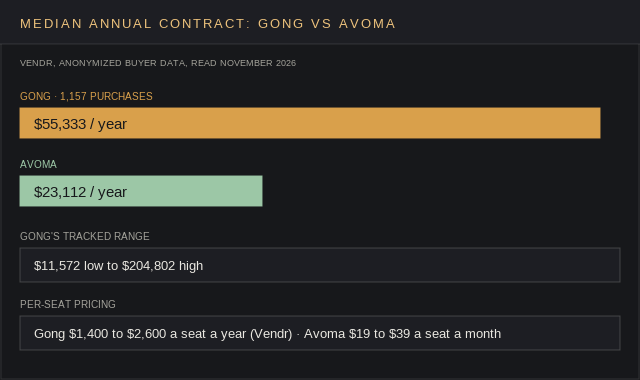
Vendr's data answers this one. Gong's typical minimum is 10 to 15 seats, sold through a sales-managed quote, with no free tier and no self-serve signup. A five-person sales team asking for a quote is asking a vendor built for a bigger buyer, and helping a five-seat team past a 10-seat minimum takes a creative quote.
It gets worse for a small team: at the low end of Vendr's $11,572-to-$204,802 range it still pays more than $11,000 a year, before any separate platform fee and before Gong Credits. For small teams, that floor can cost an arm and a leg next to tools with published prices.
Compare that against Avoma's pricing page: Startup at $19 per recorder seat a month billed annually ($29 monthly) for up to 25 paid seats, Organization at $29 annually ($39 monthly) for up to 100 seats, and Enterprise at $39 billed annually only with a 10-seat minimum.
Avoma offers a free 14-day trial with no credit card, so a team can explore before talking to sales. Conversation Intelligence and Revenue Intelligence are $29-a-seat add-ons each. Vendr puts the median Avoma buyer at $23,112 a year, under half of Gong's $55,333.
It's near impossible to compare Gong's price against a rival's without a quote from both, and that alone makes Gong harder to buy for a small team. Large teams get the most from the compliance stack, while many teams below the minimum never get a quote, and most teams that size are better served by a published rate card.
Gong FAQs
How much does Gong cost per month? Gong publishes no monthly figure. Vendr's median annual contract of $55,333 works out to about $4,611 a month, with per-seat bands of $1,400 to $2,600 a year by tier, plus a separate platform fee.
What is Gong.io used for? Recording and transcribing sales calls, flagging deal risk and coaching moments through trackers, syncing call outcomes into a CRM, running outbound sequences through Gong Engage, and, as of 2026, running AI agents against that conversation data through the Gong Revenue Harness.
Is Gong considered AI? Yes. Gong calls itself a "Revenue AI OS" and runs ASR, natural language processing, question-based trackers, Gong Assistant, and, since June 2026, no-code Custom Agents on top of its recordings.
Does Gong work for phone calls? Yes. Gong records and analyzes phone calls as well as video meetings in Zoom, Teams, or Google Meet, and Gong Engage includes a dialer for web and mobile calls.
Is Gong a reputable company? It's well funded and well documented: about $584 million raised, ARR above $500 million as of May 2026, more than 5,000 customers, and SOC 2 Type 2 plus five ISO certifications. G2 rates it 4.7 from 6,784 reviews.
Is Gong an Israeli company? Gong lists San Francisco first among eight offices and runs a large R&D center in Israel, home to about 380 of its roughly 1,300 employees as of November 2025, per Calcalist.
Why is Gong so expensive? It prices per seat plus a platform fee, sells only through a sales-managed process with a typical 10-to-15-seat minimum, sells forecasting and engagement as separate modules, and now adds usage-based Gong Credits for agent processing. That's par for the course in enterprise software, and switching costs keep renewals sticky, as the TrustRadius reviewer above admitted.
Is Gong like Salesforce? No. Salesforce is a CRM system of record, and Gong is a conversation intelligence layer that writes into a CRM. Salesforce Ventures invested in Gong's Series E, and Salesforce is one of Gong's three native CRM integrations.
Gong vs the alternatives
Four names come up most often against Gong: Chorus, Clari, Avoma, and ZoomInfo. Gong users who leave usually leave over cost, and the best alternatives depend on which part of Gong a team uses. Our conversation intelligence software rankings and revenue intelligence software rankings cover the wider field.
Chorus, by ZoomInfo. ZoomInfo agreed to buy Chorus.ai for about $575 million in cash, per its July 13, 2021 SEC filing. Chorus has no standalone rate card. ZoomInfo sells it inside a broader contract, so its price folds into the ZoomInfo quote covered in our ZoomInfo pricing report.
Chorus wins for a team already running ZoomInfo for prospecting that wants call intelligence on the same bill. It loses for a team that wants conversation intelligence as its main tool, since Chorus is scoped as an add-on to ZoomInfo's data business. Our ZoomInfo review covers that parent product.
Clari, now Clari + Salesloft. Clari and Salesloft completed their merger on December 3, 2025 and named Steve Cox CEO of the combined company, which also claims more than 5,000 customers. Clari publishes no price either, so every Clari quote starts from scratch.
Vendr's Clari data shows a $76,000 median across 291 purchases, from $19,065 to $415,001, $20,667 above Gong's $55,333. G2 has retired Clari's standalone listing: on November 4, 2026, its Clari reviews page redirected to G2's revenue operations category with a notice that the product "is no longer valid."
Clari's positioning is forecasting-first. It wins for a revenue operations team whose main pain is forecast calibration across many managers. It loses for a team whose main need is call coaching and rep-level conversation review, which sits closer to Gong's original product. With Salesloft in the same company, Clari now also competes with Gong Engage on sequences and outreach.
Avoma. Avoma is the only tool in this set with a public rate card, priced above. Its $19 Startup tier for up to 25 seats and a 14-day trial with no credit card make it the cheapest place to test conversation intelligence before talking to Gong.
Avoma rates 4.6 out of 5 from 1,366 reviews on G2, read November 4, 2026, against Gong's 4.7 from 6,784.
Gong charges a premium over Avoma, and Avoma is a strong fit for a team under 25 to 30 seats that wants published pricing and no sales cycle. It loses for an enterprise buyer that needs Gong's agent tooling, Microsoft Copilot connection, and compliance stack.
ZoomInfo, as the adjacent purchase. ZoomInfo is a prospecting and contact database, ranked in our sales intelligence rankings, and the real choice is which problem a team is solving: analyzing calls it already has, or finding accounts to call.
Gong wins when the pipeline exists and the problem is call quality; ZoomInfo wins when the problem is pipeline volume. Gong Enrich, launched in September 2026, makes waves on ZoomInfo's side of that line, and our ZoomInfo alternatives guide covers the data side.
AI search answers on Gong name Chorus, Avoma, and Salesloft as cheaper Gong alternatives, and Oliv and Sybill both publish Gong reviews that pitch their own products as the replacement. Of the three, only Avoma publishes pricing that lines up against Gong's per-seat-plus-platform-fee structure.
Demand for that exit is measurable. Google Ads data pulled through DataForSEO on November 4, 2026, shows "gong alternatives" at 210 US searches a month with a $143.68 average cost per click, against 720 for "gong pricing" and 70 for "gong review." The "gong alternatives" volume ran 110 to 140 a month through late 2025 and peaked at 390 in July 2026, a month after Mission Big Dipper and two after Gong Credits.
AI answers lean on Gong's own copy. In DataForSEO's index of ChatGPT responses for the US, 71 answers mention gong.io, and gong.io's own pages are the cited source in 51 of them, against six for G2 and five for Reddit. A buyer asking ChatGPT about Gong mostly reads Gong's marketing back, the same failure our software pricing errors report tested on AI answers, which is one more reason to check the revenue intelligence pricing numbers yourself.
Verdict
Gong presents a clear trade for an enterprise buyer: procurement-grade compliance and 2026's agent tooling, against a contract with no published price and terms that favor the vendor at renewal. Gong is right for a revenue team of 25 seats or more with budget approval for a sales-managed process, most calls in Zoom, Teams, or Google Meet, and Salesforce, HubSpot, or Dynamics as the CRM.
It's the wrong fit for a team under 10 to 15 seats that wants self-serve signup and a published price, since Vendr's data and Gong's own pricing page confirm neither exists. A mid-size team weighing its first purchase against Avoma should pick Gong only if it values the agent roadmap and the Microsoft connection enough to pay more than twice Avoma's $23,112 median.
Gong helps most when a team already records every call and wants that data making coaching and forecasting decisions. A team that clears that bar should bite the bullet on price and fight over terms. Before signing, do three things: calendar the 60-day notice date, get the per-credit price and the 2,000-credit-per-seat pool in writing, and plan an export inside the 30-day post-termination window.
Every claim above traces to a figure or a named review in this piece: Vendr's $55,333 median and 10-to-15-seat minimum, Gong's own terms and help center, and the AI and pricing complaints from Grant N., Angie P., Marissa W., Alex M., and Dustin A. Going forward, every new agent Gong ships will draw on the same credit pool, so the renewal conversation needs those numbers fully worked out in advance.