Cold calling statistics for 2025 and 2026: connect rates, success rates and where publishers disagree
 By Jan Suski. I go deep on every review, checking every number against its source and digging up details other coverage misses, a habit from six years of SEO and link building for tech companies. Bylines at Surfer, Brand24, and Senuto. How the scoring works.
Cold calling statistics come from three kinds of publisher: dialer and sales-tool vendors counting their own calls, survey houses asking sales reps what they see, and regulators counting complaints. Each one measures a different step of the same phone call, which is why a cold call success rate can read 0.3%, 2.7% or 16.7% depending on who did the counting.
This page collects the most recent cold calling statistics from the body that produced each number, dated and linked, as checked on 4 October 2026. B2B calling figures come first, then consumer (B2C) calling, then insurance, where cold calling runs into the tightest rules.
The numbers B2B, B2C and insurance cold calling, checked 4 October 2026
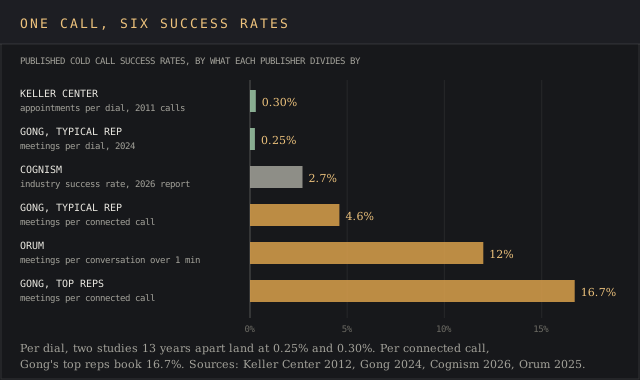
The 2.7%, 4.6% and 12% figures divide by three different denominators, so all three can be accurate at once.
Gong's top sales reps book 18 meetings from 800 dials. A typical rep books 2.
On consumer lines, 86% of calls from unknown numbers go unanswered in Hiya's 2026 data, so most B2C cold calls end at the ring.
B2B cold calling statistics
Cold calling is a standard channel in B2B sales. In HubSpot's April 2025 survey of 379 sales professionals, 68% worked for an organization that uses cold calling in some capacity, 24% called it a primary sales channel and 25% a secondary one. Asked how effective cold calling is as a 2025 sales strategy, 16% of respondents picked the top rating on HubSpot's scale and 52% picked "somewhat effective".
Time is the binding constraint. Salesforce's State of Sales, seventh edition (4,050 sales professionals in 22 countries, surveyed August to September 2025) found sales reps spend 40% of their working week selling, and the lion's share, 60%, goes to non-selling tasks. In the same survey 47% of sellers named cold outreach one of the worst parts of a sales job. Bandwidth is a second challenge, with 47% saying their team lacks the capacity for those cold outreach efforts.
How sales teams run cold calling
Among HubSpot's respondents who make cold calling a major daily activity, 59% run their calls through CRM systems and 52% work from a script they adapt for each call. Forty-nine percent of these cold callers use AI tools occasionally to support their calling.
Volume is rising at companies that depend on the phone. Of sales professionals at companies where cold calling is a primary channel, 25% said their cold call volume grew sharply year over year from 2024 and 38% said it grew slightly. Thirty-six percent expect cold calling to stay about as important in 2026 as it is now.
Connect rate and call attempts per prospect
Gong analyzed more than 300 million cold calls for its July 2024 study. The average rep connected with 5.4% of prospects and the top quartile with 13.3%, a gap of 2.5x before anyone has said a word about the product. Of every 100 prospects on a list, the typical rep reaches about 5 and the top quartile about 13. Salespeople in the top quartile reach more than twice as many prospects from the same calling list.
The surprise in Cognism's figures is the drop in attempts. Its 2026 report, produced with WHAM, puts the average at 1.55 calls to reach a prospect, down from 2.9 call attempts in the previous edition. Persistence is par for the course in surveys too, with 55% of the salespeople HubSpot surveyed making 3 to 5 attempts before moving on to other prospects.
Reaching busy buyers takes several touches and follow up. RAIN Group's Top Performance in Sales Prospecting study (fielded June to July 2017) found top performers average 5 touches to convert a new account and 3 with existing customers.
Dialer vendors publish their own calling volume. Orum's customers logged 7.4 million connections in 2024, with call volume on its platform up 105% year over year. Orum sells a parallel dialer, and the costs of dialers & sequencing tools are broken out in the sales engagement pricing report.
Cold call conversion rate and meetings booked
Once a call connects, Gong's typical rep books a meeting 4.6% of the time and its top reps 16.7% of the time. Over a month of 200 dials a week, 800 dials in total, that difference compounds into 2 meetings for the typical rep and 18 for the top rep, which works out to 0.25% and 2.25% of dials.
Orum reports the cold call conversion rate one step further down the funnel. Of conversations lasting longer than one minute on its platform in 2024, 12% became meetings, up from an all-time figure of 11%, and users booked close to half a million meetings across the year. Self-reported numbers sit lower, with 35% of HubSpot's respondents reporting a 2% to 5% conversion rate from call to appointment.
- Typical rep, per dial: 0.25% (Gong, 2 meetings per 800 dials)
- Industry success rate: 2.7% (Cognism, 2026 report)
- Typical rep, per connect: 4.6% (Gong)
- Per conversation over one minute: 12% (Orum, 2024 data)
- Top reps, per connect: 16.7% (Gong)
What successful cold calls sound like
Gong's earlier study of cold call statistics, published in August 2021, timed successful cold calls at 5 minutes 50 seconds, nearly twice the length of unsuccessful ones. Cognism's 2026 report puts the average cold call at 82 seconds, so a caller has to cut to the chase. HubSpot's daily cold callers report shorter wins, with 49% saying a successful call usually lasts 2 to 5 minutes.
Openers matter in Gong's analysis. "How've you been?" performed 6.6x better than calls without it. Gong discovered that opening with "Did I catch you at a bad time" made sales reps 40% less likely to book a meeting, and salespeople who stated a reason for the call had a 2.1x higher success rate.
In successful calls sellers talked 55% of the time, with a mean monologue of 53 seconds against 25 seconds in unsuccessful ones. Gong collects these patterns from call recordings, the core function of conversation intelligence software.
Cold calling with cold emails and callbacks
Calling creates replies in other channels, killing two birds with one stone. Gong's 300 million call study found that cold calling nearly doubles the reply rate on cold emails, 3.44% against 1.81%, even when the call doesn't connect live.
The reply lift covers dials that rang out or went to voicemail, and it's the clearest number in this set on how cold calling works inside a multichannel sales process. Sales teams that send cold emails through tools such as lemlist or Amplemarket can sequence a call before the first email to prospects as part of a multichannel strategy.
Callbacks are the warm end of cold calling. Orum's users received 2.5 million callbacks in 2024, and Orum reports a rep is 4x more likely to book a meeting on a callback than on the first call. A follow up call the prospect returns is warm by definition, because prospects who call back chose to talk.
What B2B buyers say about sales calls
Buyers give mixed signals. RAIN Group found 82% of buyers accept meetings at least sometimes with sellers who proactively reach out, and 71% of those buyers want to hear from sellers early in the buying process.
Phone preference rises with seniority, from 47% of managers and 51% of directors to 57% of C-level and VP buyers who prefer to be contacted by phone. Those figures date from a 2017 survey of 488 buyers and 489 sellers, so they describe buyers before the rise of AI research tools.
Gartner's newer surveys of B2B buyers, fielded August to September 2025, point the other way on preference. In a March 2026 release, 67% of 646 buyers said they prefer a rep-free experience. A May 2026 release from the same fieldwork found 69% prefer to validate AI-generated insights with sales reps. Read between the lines and the two Gartner figures describe the same decision makers, who research alone and then bring in a rep to check what the AI told them.
Why cold call success rates disagree
Publishers disagree on cold call success rates because each one divides by something different, and the denominator matters for every cold calling statistic on this page.
Gong divides meetings by connected calls, Orum divides by conversations over one minute, Baylor University's Keller Center divided by every number dialed, and Cognism states its 2.7% without a formula. That leaves a reader without enough information to tell if Cognism's base is dials, connects or conversations.
| Publisher and date | Rate | Numerator | Denominator | Data |
|---|---|---|---|---|
| Keller Center, September 2012 | 0.30% | 19 appointments | 6,264 dials | 50 real estate agents, November 2011 |
| Gong, July 2024 | 0.25% | 2 meetings | 800 dials | Typical rep, from 300M+ calls |
| Cognism, 2026 report | 2.7% | Successful calls | Not stated in the report | Cognism and WHAM call data |
| Gong, July 2024 | 4.6% | Meetings | Connected calls | Typical rep |
| Orum, January 2025 | 12% | Meetings | Conversations over one minute | 2024 platform data |
| Gong, July 2024 | 16.7% | Meetings | Connected calls | Top reps |
Connect rate statistics in cold calling have the same problem. The per-dial rates from the Keller Center and Gong land within 0.05 points of each other, a surprise given the 13 years between the two studies. Gong's 5.4% is connects per prospect, the Keller Center's 28% counts every dial a person picked up, and Cognism's 1.55 calls per prospect reached is an attempts figure. Quote any of these numbers with its denominator attached or the comparison is wrong.
On the best day for calling prospects, the four publishers are at sixes and sevens.
| Publisher | Best day | Best time | Basis |
|---|---|---|---|
| HubSpot, April 2025 | Tuesday (30% of respondents), Wednesday 27% | 10 am to 12 pm (38%) | Survey of 379 sales professionals |
| Cognism, 2026 report | Thursday | 10 am to 11 am, with 2 pm to 3 pm also solid for connects | Call outcomes |
| Orum, January 2025 | Tuesday and Wednesday | Connect rate peaks at 10 am local | 2024 platform calls |
| Gong, August 2021 | Wednesday and Thursday | No time-of-day figure | Gong call data |
Every source that reports a time puts the best results in the morning, between 10 am and noon, and Orum discovered its connect rate peaks in the 10 am hour. Cognism adds a mid-afternoon window, 2 pm to 3 pm, for connection rates. Friday trails in Cognism's call data and drew 12% of HubSpot's votes against 30% for Tuesday, so Friday afternoons carry little support in either source.
B2C cold calling statistics
Consumer calling starts from a screened line. A Pew Research Center survey of 10,211 US adults in July 2020 found 80% don't generally answer their cellphone when an unknown number calls, and 19% do. Sixty-seven percent let the call go and check voicemail, and 14% ignore both.
Hiya, a caller ID & spam-blocking service, puts the share of unidentified calls that go unanswered at 86% in its 2026 State of the Call report, based on a survey of more than 12,000 consumers in six countries. Hiya's figure leaves 14 of every 100 unidentified calls answered before a caller has said a word, and one in three respondents said they had received a deepfake call.
The noise those people filter is measurable. The YouMail Robocall Index counted 52.5 billion robocalls to US consumers in 2025, against 52.8 billion in 2024, a decline that's a drop in the bucket at 0.3 billion calls. Telemarketing and scam calls made up 29.6 billion of them, 57% of the total, up 15.4%.
Opt-outs keep growing among people who don't want to be contacted by telemarketers. The FTC's Do Not Call Data Book for fiscal 2025 counted about 258.5 million active registrations at 30 September 2025, up roughly 1.9% on fiscal 2024, after more than 4.7 million numbers were added during the year.
Complaints rose in fiscal 2025 but stayed about 48% below fiscal 2021, when the FTC received roughly five million reports, and robocalls still made up most DNC violation complaints.
The best field data on B2C calling by a person is older. Baylor University's Keller Center research report of September 2012 followed 50 Keller Williams agents who made 6,264 cold calls in two weeks of November 2011. The agents dialed prospects from a random list of numbers in regions not previously marketed to.
Of those calls, 28% were answered, 55% went unanswered and 17% reached dead or non-working numbers. The agents set 19 appointments and received 11 referrals, one appointment or referral for every 209 calls, at about 7.5 hours of calling per result. Each dial was a long shot, with one appointment for every 330 calls.
Insurance cold calling statistics
Insurance carries the most specific cold calling rules of any sector on this page. Section 103 of the Medicare Improvements for Patients and Providers Act of 2008 bars Medicare Advantage and Part D plans from cold calling beneficiaries, and the complaint data shows the marketing that still reaches seniors.
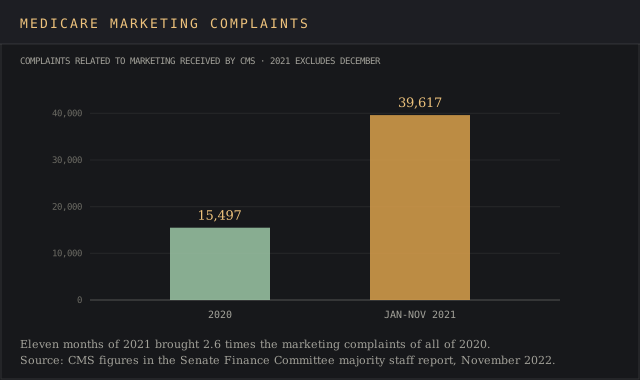
CMS received 15,497 complaints related to marketing in 2020 and 39,617 in 2021, excluding December, 2.6 times the 2020 total in eleven months, figures it published and the Senate Finance Committee majority staff repeated in a November 2022 report on deceptive Medicare Advantage marketing.
The ban lifts once a beneficiary reaches out first. The same report notes that after a beneficiary responds to an advertisement, the cold calling prohibitions no longer apply under CMS rules, so third-party marketing organizations use mailers and ads to generate inbound leads and calls from people who asked to be contacted.
Health insurance also sits behind the largest robocall penalty on record. On 17 March 2021 the FCC fined Texas-based telemarketers $225 million, the largest fine in FCC history at the time, for transmitting about 1 billion robocalls in the first four and a half months of 2019 to sell short-term, limited-duration health insurance plans. The calls falsely claimed to offer plans from Blue Cross Blue Shield and Cigna.
Insurance lead generation shaped the consent rules too. The FCC's 2023 one-to-one consent rule would have limited a shopper's consent on a comparison-shopping web form to one seller at a time.
On 24 January 2025 the Eleventh Circuit vacated it in Insurance Marketing Coalition v. FCC, a case brought by a group of more than twenty insurance industry entities, lead generators among them. The ruling leaves lead generators working under the TCPA's prior express consent standard without the one-seller limit.
Demand for coverage is large. LIMRA and Life Happens' 2026 Insurance Barometer Study, a survey of more than 5,200 US adults aged 18 to 75, found 38%, roughly 92 million adults, say they need life coverage or more than they have. That is the pool of prospects insurance companies and their agents compete to reach by phone, mail and web form leads. For wider market figures, the site's insurance statistics report covers premiums, ownership and the protection gap.
Better data and faster follow up
A wrong number costs a dial, and contact records go stale on a measurable schedule. Lusha says it found no original study behind the 30% annual decay figure that data vendors repeat, so it measured role changes in its own database across 140,284 US sales leaders at VP and C-suite level in September 2026. Of those, 12.25% changed roles within 12 months and 25.67% within 24 months, with UK sales leaders changing roles at 1.75 times the US rate.
A job title or desk line that was right last year points to the wrong person for roughly one in eight prospects at that level this year. Lists that sales teams create for calling from old records carry that decay, and each stale record sends a rep on a wild goose chase.
Clean data is a purchasing decision. Teams comparing new providers can start with the B2B data providers ranking, the reviews of Cognism, Lusha and Seamless.AI, or the head-to-head on Cognism vs ZoomInfo for phone-verified mobile numbers.
Inbound leads go cold on the vendor's side too. RevenueHero tested the demo-request web form on 1,000 B2B websites in 2022, posing as potential customers, and received 365 responses. The average response time was 1 day, 5 hours and 17 minutes, and 635 of the companies never replied, dropping the ball on a prospect who had asked for contact. A response time measured in days turns warm leads into cold calling prospects.
A prospect who fills in a web form has asked to be contacted, so a follow up phone call to that lead skips the cold part of cold calling. Teams that route inbound leads to the same sales reps who run outbound calling can use the follow up call to qualify the lead on the initial contact.
How these cold calling statistics were collected
Every figure on this page links to the body that produced it: the vendor that ran the call analysis (Gong, Orum, Cognism, Lusha, RevenueHero, Hiya, YouMail), the research house or survey publisher (HubSpot, Salesforce, Gartner, RAIN Group, Pew Research Center, LIMRA and Life Happens, Baylor's Keller Center), or the regulator and court (FTC, FCC, CMS through the Senate Finance Committee, the Eleventh Circuit).
Secondary roundups that restate these numbers were traced back to the original publisher, which is the source cited here.
Vendor calling datasets come with a selection effect worth stating. Gong, Orum and Cognism count calls made inside their own systems by teams that pay for dialing systems & coaching software, so their cold calling statistics describe equipped sales teams.
Survey figures from HubSpot and Salesforce are self-reported. For context on the calling tools those numbers come from, see the sales intelligence market report and what revenue intelligence pricing looks like for Gong-style platforms.
Who published each cold calling figure, and the denominators left unpublished
Vendor call data: cognism.com (Cold Calling Report 2026, produced with WHAM), gong.io (300M+ cold call study of July 2024, cold call statistics of August 2021), orum.com (2024 platform data, January 2025), lusha.com (role-change measurement, September 2026), revenuehero.io (lead response test, 2022), hiya.com (State of the Call 2026) and prnewswire.com (YouMail Robocall Index, 2025 totals).
Surveys: blog.hubspot.com (2025 State of Cold Calling Report, April 2025), salesforce.com (State of Sales, seventh edition, fielded August to September 2025), gartner.com (releases of 9 March 2026 and 20 May 2026), rainsalestraining.com (Top Performance in Sales Prospecting, fielded June to July 2017), pewresearch.org (14 December 2020), limra.com (2026 Insurance Barometer Study) and kellercenter.hankamer.baylor.edu (Keller Center research report, September 2012).
Regulators and courts: ftc.gov (Do Not Call Data Book release of December 2025, Telemarketing Sales Rule guidance, B2B telemarketing release of March 2024), finance.senate.gov (Senate Finance Committee majority staff report, November 2022), docs.fcc.gov (fine announced 17 March 2021) and law.justia.com (Insurance Marketing Coalition v. FCC, 24 January 2025).
Every figure was checked against its source on 4 October 2026. Cognism's report gives its 2.7% success rate without the denominator behind it, and the only field study of person-to-person consumer calling cited here is the Keller Center's November 2011 sample, so no publisher on this page releases a per-dial B2C success rate newer than 2012.
Frequently asked questions
What's the success rate of cold calling?
Cognism's 2026 report puts the industry average at 2.7%. Per dial, a typical Gong rep books 0.25% and the Keller Center's agents booked 0.30%. Per connected call the cold call conversion rate is 4.6% for a typical rep and 16.7% for top reps.
How often do cold calls work?
A typical rep in Gong's study connects with 5.4% of prospects and books 2 meetings from 800 dials a month. The top rep books 18 from the same 800 dials on the same channel.
Is 200 cold calls a day a lot?
Yes, by survey standards. Among HubSpot's respondents who make cold calling a major daily activity, 30% place 20 to 50 calls weekly and 22% place 51 to 100. Gong's monthly model assumes 800 dials. Two hundred a day is 1,000 over five working days, ten times the top HubSpot band, and works out to one dial every 2.4 minutes across an eight-hour calling day, less than half the 5 minutes 50 seconds Gong measured for a successful call.
Is B2B cold calling illegal?
B2B cold calling is legal in the US when it's done by the book. Under the FTC's Telemarketing Sales Rule, most business-to-business calls are exempt, except calls selling nondurable office or cleaning supplies. In March 2024 the FTC voted 3-0 to extend its ban on misrepresentations to B2B telemarketing. Calls to households are covered by the Do Not Call Registry and by the rule's calling hours, which ban calls before 8 am or after 9 pm.
Is cold calling B2B dead?
The 2025 and 2026 data describes a working channel. In HubSpot's April 2025 survey 68% of sales professionals worked at companies that cold call, Orum's users booked close to half a million meetings by phone in 2024, and Cognism's industry success rate rose from 2.3% to 2.7% between its two latest reports.
Is cold calling the most effective sales tool?
Sixteen percent of HubSpot's 2025 respondents gave cold calling the top effectiveness rating and 52% rated it somewhat effective. Gong's numbers support it as an effective sales tool inside a sequence, where a call nearly doubles cold email replies, 3.44% against 1.81%.
What are the biggest mistakes in cold calling?
Gong's calling data names three: opening with "Did I catch you at a bad time" cuts the booking rate by 40%, skipping the reason for the call forfeits a 2.1x higher success rate, and short monologues go with failed calls (25 seconds against 53 in successful ones). Among HubSpot's daily callers, 40% named getting past gatekeepers as a challenge and 44% named overcoming initial rejection.
Is cold calling still effective in real estate?
The Keller Center's study of Keller Williams agents is the main published measurement, with 6,264 calls, 28% answered and one appointment or referral per 209 dials, roughly 7.5 hours of calling for each result.
What is the 80/20 rule in cold calling?
It's the Pareto idea that a minority of sellers produce most of the meetings. In Gong's study the top rep books 18 meetings from 800 dials and the typical rep books 2, a 9x gap. Gong also found top performers can generate nearly one meeting per hour of calling.
Bottom line
The cold calling statistics with the most weight are the vendor datasets counted in hundreds of millions of calls. Gong's typical rep connects with 5.4% of prospects and books 4.6% of connects, Orum's users turned 12% of real conversations into meetings, and Cognism's industry success rate sits at 2.7%. Read each calling figure with its denominator, because the devil's in the details.
B2B buyers still take meetings from sellers who reach out, 82% at least sometimes in RAIN Group's survey.
Consumer and insurance calling run on different arithmetic. On consumer lines 86% of unknown calls go unanswered, 258.5 million numbers sit on the Do Not Call Registry, and Medicare plans have been barred from cold calling since 2008. A calling strategy for B2B prospects should spend first on contact data and follow up speed, and track meetings per dial with a win rate calculator once those calls turn into deals.