Sales engagement pricing in 2026: what 14 vendors charge per seat
 By Jan Suski. I go deep on every review, checking every number against its source and digging up details other coverage misses, a habit from six years of SEO and link building for tech companies. Bylines at Surfer, Brand24, and Senuto. How the scoring works.
The numbers 14 vendors, checked 1 October 2026
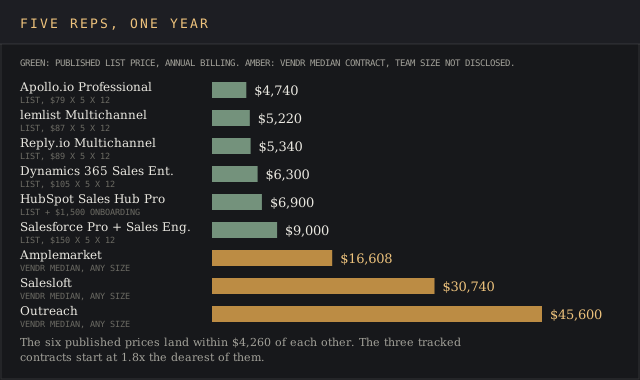
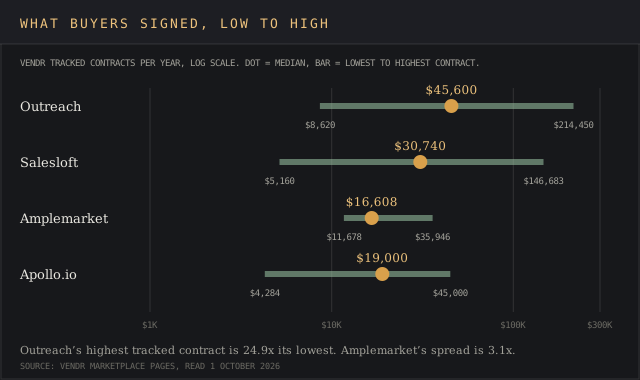
Outreach's tracked median is 2.4x Apollo.io's, and Salesloft's is 1.6x.
Five sales reps on any of six published rate cards run between $4,740 and $9,000 in year one, and the $50 Sales Cloud add-on accounts for a third of that top figure.
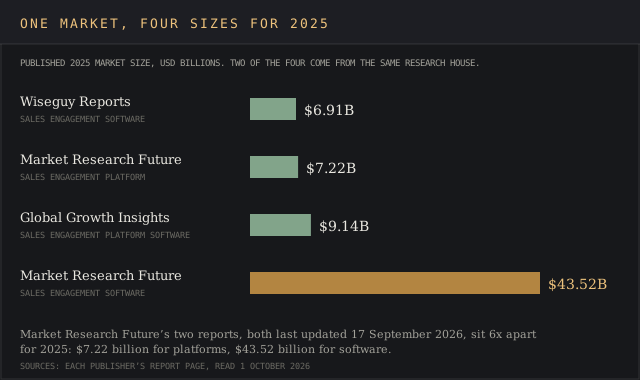
The four 2025 market estimates sit 6.3x apart, and the high one and a low one come from the same research house.
Outreach's median contract runs $45,600 a year across the purchases Vendr tracks for Outreach, and Outreach's own pricing page puts a "Request pricing" button on all four of its packages. Apollo.io sells a seat with sequences, a dialer and contact data for $49 a month on annual billing. Both tools get filed under the same software category.
I checked the pricing pages of 14 vendors on 1 October 2026 and sorted them into three groups: standalone sales tools with a published rate card, quote-only platforms priced through Vendr's purchase data, and CRMs that sell sequencing as a tier or an add-on. Every price links to the page it came from, straight from the horse's mouth where the vendor publishes one.
It's written for sales leaders, RevOps and go-to-market managers and founders setting a first budget for an engagement platform, or pricing a renewal against the rest of the market. The sales intelligence platforms ranking covers the contact data side of the same stack.
What a go-to-market team buys from an engagement platform
An engagement platform runs the repetitive half of the sales process. It sends sequences and follow-ups to prospects, queues tasks for sales reps, places phone calls and books meetings, then logs all of it to the CRM so the sales pipeline reflects what happened. The pricing differences come down to how much of that automation each tier includes and how many prospects it lets sales reps touch.
The customers are usually sales teams that want reps to focus on conversations with prospects and leads, with the admin work of logging calls, emails and tasks handled by the software. Sales leaders get the reporting on top: which sequences produce meetings, which reps convert leads into deals, and where deals stall in the pipeline.
Sequences are the core feature. Apollo.io's Free plan allows 2 sequences, and every paid Apollo.io plan lists unlimited sequences, so automated follow-ups stop being the gated feature once a team pays $49 a seat. Apollo.io lists meeting events the same way: 1 on Free, 3 on Basic, 6 on Professional and unlimited on Organization.
Calls are metered harder than email automation. Apollo.io includes 150 minutes of call recording on Basic, 4,000 on Professional and 8,000 on Organization, and its US dialer places calls on credits.
Outplay keeps its power dialer and voicemail for the $139 Enterprise seat, and Reply.io sells calls and SMS at $29 a month per account. Sales teams whose reps live on sales calls pay for the dialer one way or another, and the price of calls to prospects scales with headcount on all three.
Tasks and lead handling sit in the middle tiers:
- HubSpot's Starter features include task queues, calling, a prospecting agent and intent signals.
- Apollo.io caps lead scoring at 2 scores on Basic and makes it unlimited on Professional.
- Sales Cloud's Sales Engagement add-on bundles cadences, a work queue and lead scoring.
- Outreach lists "Deal & Pipeline Management" in its Essentials, Core and Plus packages.
AI messaging is the newest layer of automation. Outplay's Free plan includes an AI mail writer, Reply.io's Jason AI SDR writes messaging with "AI personalization" and "AI-generated responses" from $500 a month, and Outreach meters its agents in AI credits. The trade at the top is the human touch on first-contact messaging, and customers who want to keep the human touch can stay on the seat-only tiers and write their own messaging templates.
Together, those features replace a legacy tech stack of separate dialer, sequencer and data tools. Apollo.io's pricing page pitches its seat as a way to "close deals faster, and unify your tech stack", and the price of consolidating into one platform depends on which of those tools the team already owns. Sales teams that keep a legacy tech stack running beside a new platform pay for the overlap twice.
How sales engagement is priced: seats, sends, prospects and AI credits
Ten of the 14 tools here charge per seat on at least one plan, so spend grows with every hire and scales with headcount, and adding more sales reps is the fastest way to double a bill. Apollo.io, HubSpot, Salesforce, Microsoft and Zoho all quote a price per seat per month, and Outreach describes its own model as "a combination of seat-based pricing and consumption-based pricing powered by AI credits" on its pricing page.
Per-seat pricing is the industry default, and the other four meters make two quotes hard to compare. Five meters run side by side in this industry:
- Per seat: Apollo.io's Basic plan at $49, HubSpot Sales Hub Professional at $90, Dynamics 365 Sales Enterprise at $105.
- Per send volume: Instantly's Growth plan covers 5,000 emails and 1,000 uploaded contacts a month for $47.
- Per contacted prospect: Woodpecker bills per 100 prospects contacted and gives unlimited team members.
- Per credit: Apollo.io grants 30,000 credits per Basic seat a year, and Outreach's four packages carry 10,000 to 100,000 AI credits for agent automation.
- Per connected account: Reply.io charges $69 a month for each LinkedIn account and $29 for each calls and SMS account.
Those map onto the tiered, usage-based and flat-rate models that pricing guides list, and flat-rate plans exist at the low end. lemlist's Email plan costs $69 a month, or $55 on annual billing, with unlimited users, and Instantly's plans include unlimited email accounts.
Features set the tier. Apollo.io keeps "Analytics & Pre-built Reports" on its $79 Professional plan, a step above the $49 Basic plan, and Outreach lists conversation intelligence in its Essentials, Core and Plus packages. Gating reports and AI features one tier above the entry plan is par for the course in this category, and the features list on each pricing card is the fastest way to see what the next tier buys.
Published engagement platform prices, tool by tool
Twelve plans from ten tools carry a dollar or euro figure you can read without a sales call. The table compares the tools on the unit each one meters, because a $47 workspace and an $89 seat buy different things for sales teams of five.
| Vendor and plan | Published price | Billing | What the price covers |
|---|---|---|---|
| Apollo.io Basic | $49/seat/mo ($65 monthly) | Annual | 30,000 credits per seat a year, unlimited sequences |
| Apollo.io Professional | $79/seat/mo ($99 monthly) | Annual | 48,000 credits, 4,000 call recording minutes |
| Reply.io Multichannel | from $89/seat/mo | Annual | Email, LinkedIn, SMS and calls |
| Outplay Growth | $89/seat/mo | Annual | Email, phone, social and SMS |
| lemlist Email | $55/mo ($69 monthly) | Annual | Unlimited users, 50,000 emails a month |
| lemlist Multichannel | $87/seat/mo ($109 monthly) | Annual | Email plus LinkedIn and calls |
| Instantly Growth | $47/mo | Monthly | 5,000 emails, 1,000 uploaded contacts |
| Amplemarket Startup | $600/mo | Annual term | 2 seats, 27,000 contacts |
| HubSpot Sales Hub Professional | $90/seat/mo ($100 monthly) | Annual | Plus $1,500 one-time onboarding |
| Sales Cloud Sales Engagement | $50/seat/mo | Annual | Add-on on top of a CRM seat |
| Dynamics 365 Sales Enterprise | $105/seat/mo | Annual | CRM seat with sales accelerator |
| Zoho CRM Standard | €14/seat/mo (€20 monthly)* | Annual | CRM seat with cadences |
Every price in this table is the vendor's own list price, linked to its pricing page and checked 1 October 2026. *Zoho's European price list, in euros. At the ECB reference rate of 1.1355 for 30 September 2026, €14 is about $15.90 and €20 about $22.71.
Apollo.io: $49 to $119 a seat, with credits that expire
Apollo.io publishes four platform tiers. Free costs $0 with 900 credits per seat a year, Basic is $49, Professional is $79 and Organization is $119 a seat on annual billing, with a three-seat minimum on Organization. Billed month to month, the same three paid plans come to $65, $99 and $149.
Each paid tier also routes leads. Basic includes 3 inbound routers, website visitor identification that turns visits from 100 companies a month into leads and 5 automated workflows, and Professional adds unlimited lead scoring, so inbound leads and outbound prospects land in the same deal pipeline.
The price includes Apollo's own database, which Apollo puts at 240M+ contacts and 30M+ companies, and Apollo says more than 600,000 companies are customers. That bundled prospect data means the prospects a team emails come with the seat.
Custom integrations through the API need the Custom plan, and Apollo's terms limit the data to internal use, so building products for customers on it takes a separate agreement. The Apollo vs ZoomInfo comparison covers what that database holds against a dedicated data vendor.
The devil's in the details on credits. Apollo's FAQ says credits pay for emails, phone numbers, email warmup, domains and mailboxes and AI-researched data. Unused credits "expire at the end of each billing cycle and do not carry over", and add-on credits renew automatically each cycle until a team drags the slider back to zero.
One G2 reviewer, a founder at a small software company, wrote on 22 August 2026 that "credit consumption and filtering limits on lower-tier plans could be more generous" (G2 review). The full Apollo.io review tests the data accuracy behind those credits.
Reply.io and Outplay: $89 a seat for multi-channel outreach
Reply.io and Outplay land on the same $89 per seat a month, billed annually, for their multi-channel tiers. Reply.io's cheaper Email Volume plan starts from $49 per seat with 1,000 active contacts a month, then sells channels per account: reps who engage prospects on LinkedIn add $69 a month each, and calls and SMS add $29. Its Jason AI SDR, an automated agent that runs prospecting & follow-ups, starts from $500 a month.
Outplay's ladder runs Free at $0, Starter at $39 a month, Growth at $89 a seat and Enterprise at $139 a seat, all billed annually. Growth's features include email, phone, social & SMS channels, CRM integrations and a Chrome extension, and Enterprise adds a power dialer and voicemail for calls.
Reply.io prices its jump from email-only to multi-channel outreach at 1.8x the entry seat, and Outplay's Growth seat is the best of both worlds for a team that wants email and phone on one license.
lemlist and Amplemarket: plans priced around a team, and where they cost extra
Market Intelligence Tools earns an affiliate commission from lemlist and Amplemarket. The figures below come from their own pages and from Vendr, same as every other vendor in this report.
lemlist charges $109 per seat a month for Multichannel, or $87 on annual billing, and $69 or $55 for the Email plan with unlimited users. lemlist says 20,000+ sales teams run their outbound on it. Contact data is extra: the lead data enrichment add-on costs $20 a month ($16 annually) for 2,000 credits, which finds emails for 400 prospects or 100 phone numbers.
A CEO at a small business called out that meter on G2 on 6 August 2026, writing that "enrichment credits are quickly consumed on large volumes" (G2 review). The lemlist review carries the deliverability, support and cancellation complaints in full.
Amplemarket publishes one price: Startup at $600 a month on an annual term, with 2 seats and 27,000 contacts included. Startup also includes AI intent signals for spotting warm leads. Growth and Elite are custom.
Vendr's Amplemarket page shows a $16,608 median contract across its tracked customers, with the lowest tracked deal at $11,678, above the $7,200 a year Startup costs at list. The Amplemarket pricing report covers that gap and what drives a custom quote, and the Amplemarket review covers Duo Copilot and the rest of the product.
Instantly and Woodpecker: volume-priced tools for cold outreach
Instantly prices the platform by workspace. Growth costs $47 a month for 5,000 emails and 1,000 uploaded contacts, Hypergrowth $97 for 125,000 emails and 25,000 contacts, and Light Speed $358 for 500,000 emails, all with unlimited email accounts and warmup. A one-person shop emailing prospects at volume gets Instantly's sending tools for $47, about half of one Professional seat on HubSpot.
Woodpecker's platform meters contacted prospects in blocks of 100, with unlimited team members and email accounts, so sales teams that add reps without adding prospects pay nothing extra. It sells integrations, API access, webhooks and its MCP server as a separate add-on. The Woodpecker review covers the support complaints that come with that price.
Outreach and Salesloft: quote-only, with $30,740 to $45,600 median contracts
Outreach sells its platform in four Amplify packages: Essentials with 10,000 AI credits, Core with 25,000, Plus with 50,000 and Pro with 100,000. Each card shows an AI credit count and a "Request pricing" button. The Plus card promises customers can "Predict deal outcomes with 81% accuracy" and "Ramp reps 3x faster", both Outreach's own marketing claims with no method attached, and talk is cheap until a vendor shows how reps learn the tool that fast.
Outreach's description of Plus reads like a list of the tasks it takes off reps: AI agents that "guide reps live in meetings, automate follow-ups and pipeline updates, flag risks, and coach reps continuously." Its FAQ says price depends on factors including "Team size and usage volume" and the "Number of AI workflows activated", so two sales teams of the same size can get different quotes depending on how much automation they switch on.
Vendr fills the gap. Its Outreach page shows a $45,600 median contract across the deals it tracks, a low of $8,620 and a high of $214,450, with customers saving 12.44% on average. Outreach's G2 vendor profile names SAP, Siemens, Snowflake and Verizon among the organizations using it to "power their revenue teams", which helps read between the lines of a six-figure high end. A mid-market sales leader in the UK put the price problem plainly:
"Yeah. I mean, for me, it was primarily just the cost. So for a large multinational organization, the cost was okay. But as you move into smaller headcount organizations, it was just too expensive."
A.J. A., SMB & MM Sales Leader, mid-market, G2 review, 7 April 2026
Salesloft goes one step further. Its /pricing URL redirects to a talk-to-sales form at salesloft.com/see-it-live. Vendr's Salesloft data puts the median at $30,740, with tracked deals from $5,160 to $146,683 and customers saving 17.5% on average.
Two events since 2025 change what a Salesloft contract buys. Clari and Salesloft announced their merger on 3 December 2025, with Steve Cox as CEO of the combined company, a stated aim of building a "Predictive Revenue System" and "more than 4,000 organizations" as customers, per Salesloft's newsroom. Pipeline forecasting now sits under the same roof as cadences, which matters for anyone also pricing revenue intelligence software separately.
The second is a warning sign about integration risk. Google's Threat Intelligence Group reported on 26 August 2025 that an actor it tracks as UNC6395 used compromised OAuth tokens from the Salesloft Drift app to export data from Salesforce customer instances between 8 and 18 August 2025, then searched it for AWS keys, passwords and Snowflake tokens.
Engagement tools connect to the same CRM and inbox accounts, so a security review belongs in the evaluation budget, and teams that skip it are skating on thin ice.
Sequencing inside the CRM: Salesforce, HubSpot, Microsoft Dynamics and Zoho
CRM vendors sell sequencing as a tier or an add-on, which kills two birds with one stone for businesses that already pay for the CRM seat. The pricing math changes, because the engagement layer becomes a delta on a license the company already holds.
Sales Cloud's Sales Engagement: a $50 add-on on the CRM seat
Salesforce prices Sales Engagement at $50 per seat a month, billed annually, and its FAQ says the product comes bundled in the Unlimited and Agentforce 1 Sales editions or "can be purchased as an individual add-on" for other editions. Salesforce's list of top features for the add-on covers the outbound side of the sales process: cadences, a work queue, lead scoring that ranks leads, and Einstein Activity Capture.
The seat underneath costs $25 a month on Starter Suite, $100 on Pro Suite, $195 on Core, $395 on Advanced and $550 on Max, per the Sales Cloud pricing page. A Pro Suite seat plus the add-on comes to $150 a month on a Salesforce CRM contract, and the FAQ notes that "Most Salesforce products use annual contracts".
HubSpot Sales Hub: $90 a seat plus a required $1,500 onboarding
HubSpot's Sales Hub is free for up to 2 users, which suits small businesses testing sequences. Starter starts at $7 a seat a month on annual billing and $20 month to month, Professional costs $90 a seat annually or $100 monthly, and Enterprise starts at $150 a seat. Professional carries a required one-time onboarding fee of $1,500, and Enterprise one of $3,500.
That onboarding fee is the price tag implementation and training put on any of these tools, published by one vendor. For five reps, it raises year one on Professional from $5,400 to $6,900, a 28% markup before a single email goes out or a deal enters the pipeline. The fee pays for HubSpot's onboarding, which is meant to help a team hit the ground running.
Microsoft Dynamics 365 Sales: $65 to $150 a seat, paid yearly
Microsoft lists Dynamics 365 Sales Professional at $65, Enterprise at $105 and Premium at $150 per seat a month, paid yearly. The Enterprise capacity footnote includes sales accelerator, Microsoft's sequencing and work-list feature, and Premium adds "Advanced sales engagement".
Professional lists "Core sales force automation, Microsoft 365 interoperation, reporting, and dashboards". For a company already on Microsoft 365, the Enterprise seat undercuts a Pro Suite seat plus Sales Engagement by $45 a month.
Zoho CRM: cadences on the €14 Standard edition
Zoho CRM puts cadences, its name for multi-step follow-up sequences, in the Standard edition at €14 a seat a month on annual billing or €20 monthly. Professional is €23, Enterprise €40 and Ultimate €52 annually, and a free edition covers 3 users.
That makes it the cheapest CRM seat with built-in sequencing in this report for European businesses, at about $15.90 a month. Its Standard card lists six items (workflows and assignment rules, AI agents, cadences, reports and dashboards, sales forecasting, self-service kiosks), fewer features than the 25 features on Apollo.io's Basic card.
Add ons and fees priced outside the platform fee
Total spend runs past the subscription on every one of these tools that sells by the seat. The extras with a published price:
- HubSpot: $1,500 onboarding on Professional, $3,500 on Enterprise, both one-time and required.
- Reply.io: $69 a month per LinkedIn account, $29 per calls and SMS account, Jason AI SDR from $500 a month.
- lemlist: lead data enrichment from $20 a month for 2,000 credits, buying intent signals from $29 a month for 100 signals on leads showing interest.
- Apollo.io: add-on credits, charged the moment they're added and renewed every billing cycle until removed.
- Sales Cloud: Sales Engagement itself, $50 a seat a month below the Unlimited edition.
A $29 calls add-on looks like a drop in the bucket next to a $90 seat. Across 20 reps it's $6,960 a year, and Apollo.io's recurring add-on credits can sit under the radar on the invoice for months.
Support is tiered as well. Instantly gives Growth chat support and Hypergrowth premium live support. Amplemarket pairs Startup with its scaled customer success team and weekly expert sessions, then assigns a dedicated CSM on Growth. lemlist reserves a dedicated account manager and priority support for Enterprise, and Apollo.io lists dedicated support on its Custom plan. Businesses that need a named contact for support pay for it in the tier.
Two expenses sit off the rate card. The first is admin work. Someone has to build sequences, maintain the processes behind them, keep CRM integration mappings current and clean the bounce list, and those tasks usually land on a RevOps manager. Salesloft sells "Consulting Services" for implementation, onboarding and optimization without publishing a price.
The second is the training time it takes before reps learn the tool well enough to book meetings from it. A stitch in time saves nine here, and a two-week pilot with real sequences surfaces both before the contract does.
Intent data is a third line for some sales teams. lemlist's signals add-on is the only published price for intent data in this group, and dedicated intent data providers sell it on their own contracts.
What a full seat costs once Sales Navigator and a CRM join the stack
The engagement platform is one line on a rep's tooling bill. Jeff Ignacio, a revenue operations leader, wrote in a 17 January 2025 LinkedIn post that "Stacks can run anywhere between $500-$800 per month in tools", counting a CRM license, Sales Navigator, enrichment, a sales engagement tool and conversation intelligence per seller.
Published list prices let a buyer test that range. LinkedIn lists Sales Navigator Core, the tool reps use to find prospects on LinkedIn, at $119.99 a month or $1,079.88 a year per license, and Advanced at $159.99 a month or $1,799.88 a year. Advanced Plus is quoted.
| Per-seat stack | CRM and sequencing | Sales Navigator (annual) | Monthly total per seat |
|---|---|---|---|
| Apollo.io Professional + Core | $79 | $89.99 | $168.99 |
| HubSpot Professional + Core | $90 | $89.99 | $179.99 |
| Pro Suite + Sales Engagement + Core | $150 | $89.99 | $239.99 |
| Dynamics 365 Sales Enterprise + Advanced | $105 | $149.99 | $254.99 |
List prices on annual billing. The LinkedIn column divides each license's annual price by 12.
All four stay under $500 before conversation intelligence and a dedicated enrichment license join the bill, so those two lines carry the lion's share of the gap to Ignacio's range. The LinkedIn Sales Navigator review covers what each license tier unlocks, and the conversation intelligence software ranking prices the call-recording layer.
Deliverability: the cost a seat price leaves out
A sequence that lands in spam costs the same per seat as one that lands in the inbox and adds nothing to the pipeline, and that's the elephant in the room on every rate card.
Google's email sender guidelines say that starting in 2024, senders must meet its requirements to reach personal Gmail accounts, that anyone sending 5,000 or more messages a day needs SPF, DKIM, DMARC and one-click unsubscribe, and that spam rates should stay "below 0.10%" and never reach "0.30% or higher".
The arithmetic is short. For example, at 70% inbox placement, 30 of every 100 emails to prospects go unseen, and on Instantly's Hypergrowth volume of 125,000 emails a month that's 37,500 messages prospects never read. The effort a rep puts into the body copy and messaging of those emails buys no meetings booked, and reps can't close deals from emails nobody opened.
Shared sending infrastructure carries its own risk. A neighbour's bad sending can get a shared IP throttled, and then the prospects a rep wanted to engage never see the email.
Twilio SendGrid's documentation says that on a shared IP, if anyone sharing that address violates an inbox provider's standards, "your reputation changes as well", while on a dedicated IP "your sending practices determine your Reputation Score". Instantly reserves its "Private Deliverability Network" for the Enterprise tier, and Apollo.io includes a "Deliverability Suite & Email Warmup" from the $49 Basic plan up.
The top-ranking guide on this topic sets 85% deliverability as a floor and reports 94% for Outreach after Gmail's 2024 changes. Both numbers come from the same unlinked study. Google's published thresholds are the ones that decide placement, so they're the ones to focus on in the demo, and sales teams that cut corners on domain setup pay for it in a sales pipeline that never fills.
Seven pricing and performance claims from the top-ranking guide, checked
SaaSRadar Pro's sales engagement guide, last updated 22 April 2026, ranks near the top of the search results for this topic. It reports a 28-month test of 34 platforms and a $318,000 testing budget, and the page carries zero links to any outside source. Here's how its figures hold up against the vendors' own pages.
| Claim in the guide | What the primary source shows | Verdict |
|---|---|---|
| Outreach costs $100 to $150 a seat a month | Four Amplify packages, each marked "Request pricing"; Vendr median $45,600 | No published price exists |
| Salesloft costs $125 to $175 a seat a month | salesloft.com/pricing redirects to a sales form; Vendr median $30,740 | No published price exists |
| Apollo.io costs $49 a seat a month | Basic is $49 on annual billing, $65 monthly | Matches, annual billing only |
| Apollo.io has 275M contacts built in | Apollo states 240M+ contacts and 30M+ companies | Apollo's own figure is 240M+ |
| Outreach hit a 23.4% reply rate across 28,547 reps | No dataset or method linked | Unverifiable |
| Salesloft gives 31% faster deal velocity for enterprise sellers | No dataset or method linked | Unverifiable |
| A wrong platform costs a 20-rep team $127,000 a year in lost deals | No dataset or method linked | Unverifiable |
To call a spade a spade, a price range for a vendor that publishes no price is a red flag on any page. The same guide reports that 48% of platforms fell below 70% deliverability within 90 days of Gmail's policy enforcement, and that a 73% rate cost one team 505 meetings over four months. Both sit in the same unlinked study.
The software pricing errors report tested how AI answers handle unsourced price figures like the first two rows above.
Sales engagement market size, and why four estimates disagree
Four industry research houses publish a 2025 figure for this market, and they disagree by a factor of 6.3. Two of the four come from Market Research Future, which runs separate reports on "sales engagement platform" and "sales engagement software".
| Publisher | Report scope | 2025 size | 2035 forecast | CAGR |
|---|---|---|---|---|
| Wiseguy Reports | Sales engagement software | $6.91B | $25B | 13.7% (2026 to 2035) |
| Market Research Future | Engagement platform market | $7.22B | $16.82B | 8.82% (2025 to 2035) |
| Global Growth Insights | Platform software | $9.14B | $21.96B | 9.16% (2026 to 2035) |
| Market Research Future | Engagement software market | $43.52B | $839.45B | 34.44% (2025 to 2035) |
Scope is the only visible difference between the two Market Research Future reports. One is titled for the "platform" market and one for the "software" market, both pages were last updated on 17 September 2026, and their 2025 figures sit 6x apart.
The growth rates diverge even more than the base years. Compounding 34.44% for ten years multiplies a market about 19x, while 8.82% multiplies it about 2.3x.
Three of the four estimates cluster between $6.91 billion and $9.14 billion, and that cluster is the defensible planning range for revenue forecasts. For the $43.52 billion software scope, the jury's still out until a second house publishes a figure near it. The sales intelligence market report sets four analyst houses side by side one category over, on the data side of the stack.
Which pricing model fits which sales team
The right meter depends on what the reps spend their day doing. Go-to-market teams in this industry fall into four rough profiles, and each one points at a different pricing model:
- SDR teams running cold outreach to large lists of prospects, where most tasks are emails and calls: per-send or per-prospect tools such as Instantly, Woodpecker and lemlist's Email plan keep the bill flat while volume scales.
- Account executives who close deals through a longer sales cycle, with more phone calls and meetings behind each of their deals: a CRM-native seat keeps calls, tasks, messaging and deals in one record and one set of processes.
- Founder-led sales at small businesses with no CRM yet: Apollo.io's $49 Basic seat bundles prospect data, sequences, a dialer and a deal pipeline.
- Larger sales teams that need SSO and custom security terms: Apollo.io's FAQ points them to its Custom plan, and the upper tiers of Outreach, Salesloft and Amplemarket sit behind a sales call.
Integration depth is the next test. A platform that writes calls, emails, tasks and meetings booked back to the CRM saves reps from updating the sales pipeline by hand every day. Apollo.io, for example, lists integrations with other tools such as HubSpot, Outreach, SalesLoft, Marketo and LinkedIn plus every major email provider, so it can sit beside an existing engagement platform as a data source.
Data is the third. Tools that bundle prospect data, such as Apollo.io with 240M+ contacts or Amplemarket with 27,000 contacts on Startup, save a second contract. Outreach's package cards name agents, sequencing, account planning, conversation intelligence and pipeline management, with no contact database among the features, so customers pricing it should add a data line from the data enrichment tools ranking.
Sales and revenue leaders comparing quotes can focus the evaluation on the processes each tool will own: which prospects reps engage and on which channels, what messaging they send, how follow-ups trigger, and how replies route back into the sales process. Tools that let reps engage more prospects and leads with the same effort produce more sales conversations, and a pilot shows if more deals follow, measured in meetings booked and deals opened.
A worked example: ten SDRs on four rate cards
Per-seat prices only mean something once they're divided by the prospects a team reaches. Take, for example, a SaaS company with 10 SDRs, each adding 50 new prospects to sequences on each of 21 working days a month. That's 10,500 new prospects a month and 126,000 a year. The volume is an assumption for the arithmetic.
| Platform, 10 seats, annual billing | Year-one price | Per 1,000 prospects |
|---|---|---|
| Apollo.io Professional | $9,480 | $75.24 |
| Reply.io Multichannel | $10,680 | $84.76 |
| HubSpot Sales Hub Professional, with onboarding | $12,300 | $97.62 |
| Pro Suite + Sales Engagement | $18,000 | $142.86 |
List prices on annual billing for ten seats. The prospect count is the assumption stated above.
To cut to the chase, the spread between the cheapest and dearest stack is $8,520 a year for the same 126,000 prospects. For businesses where one closed deal's revenue covers that difference, the CRM fit matters more than the seat price. For a team selling a $5,000 product, it's two deals, and the cheaper tools win the math against the revenue each deal brings.
Meetings are the better unit to focus on. Divide the year-one price by meetings booked to get a cost per meeting, then by deals won to get a cost per closed deal. At an assumed 1 meeting per 100 prospects, Apollo.io Professional works out to $7.52 per meeting and the Pro Suite stack to $14.29, before any rep salary.
The same math works for all the tools in this report, and it's the number to bring to a renewal. A higher seat price earns its place only when the platform books more meetings and more deals from the same leads, and the cost per meeting shows that within one pilot. Anything else is spend the sales pipeline has to carry.
How to budget for sales teams of 1, 5 and 20 reps
For sales teams, headcount decides which pricing model wins, because per-seat costs multiply with every hire. The spend below uses annual billing and published list prices, with Vendr figures as the quote-only reference.
| Team | Low published option | CRM-native option | Quote-only reference |
|---|---|---|---|
| 1 founder | Apollo.io Basic, $588/yr | HubSpot Free, $0 for up to 2 users | Outreach Vendr low, $8,620* |
| 5 reps | Apollo.io Professional, $4,740/yr | HubSpot Professional, $6,900 with onboarding | Salesloft Vendr median, $30,740* |
| 20 reps | Apollo.io Professional, $18,960/yr | HubSpot Professional, $23,100 with onboarding | Outreach Vendr median, $45,600* |
The first two columns are published list prices on annual billing. Figures marked * are Vendr's tracked contract values from anonymized buyer data, since Outreach and Salesloft publish no list price.
For a founder, the decision is about how many prospects get emailed. Instantly's $47 Growth plan or lemlist's $55 Email plan covers it, and a dialer or a meeting scheduling add-on can wait until call volume justifies it. A SaaS company with one founder selling can run its first sequences on Apollo.io Free and its 2 sequences, then pay $588 a year once it needs more.
At 5 reps, focus on the CRM, because it decides the budget and the processes around it. A company already on Sales Cloud pays $50 a seat to add sequencing, while a company with no CRM can buy Apollo.io Professional or HubSpot Professional and get both.
A Pro Suite seat plus the add-on brings five reps to $9,000 a year, and a company planning to hire more sales reps should price the seat count it'll reach by month 12. Vendr doesn't publish team size next to its medians, so most teams can't map a tracked contract to their own seat count.
At 20 reps, a quote-only platform enters the conversation, and the published options still come in under the Outreach median: Apollo.io Professional at $18,960 and HubSpot Professional at $23,100. The G2 reviewer quoted above found Outreach's price workable at multinational scale and too expensive at smaller headcounts. Put all your eggs in one basket only after a pilot proves the platform helps your reps close deals from your own leads.
The budget test for any of these sales tools is the sales cycle. A seat that costs $90 a month has to produce more deals than its price inside the time it takes those deals to close, so a team with a 90-day sales cycle should judge a pilot on pipeline created, then on closed revenue.
How to negotiate a sales engagement contract
Vendr's average savings give a sense of how much room each quote carries: 30.17% on Apollo.io, 17.5% on Salesloft and 12.44% on Outreach, on the deals Vendr reports handling. Those are averages across contract sizes, and the spread of deals on each vendor runs from four figures to six.
The Apollo.io FAQ spells out terms worth checking on any annual deal. Switching from monthly to annual is allowed any time, switching from annual to monthly means waiting for the annual term to expire, and downgrades take effect immediately with no refund for unused time. Cancellations take effect at the end of the current plan term, so a team that cancels in month two still pays for the year.
A team that wants monthly flexibility has to bite the bullet on monthly rates, $65 against $49 for Apollo.io Basic.
- Ask for the per-seat price at the seat count you'll reach in month 12, written into today's quote.
- Get credit and AI-credit allowances for messaging and agents in writing, with the overage price stated.
- Price the CRM integration, data, training and onboarding lines separately, so each one can be cut.
- Write a renewal cap into the first contract, with a percentage attached.
For sales teams holding a quote from a quote-only vendor, the published rate cards in this report are the counter-offer. A $49 Apollo.io seat or a $50 Sales Cloud add-on is a price any rep can read, and the competitive intelligence pricing report shows the same published-versus-quoted split playing out in a neighbouring category.
Frequently asked questions
How much does Salesforce sales engagement cost?
Sales Engagement costs $50 per seat a month, billed annually, as an add-on to Sales Cloud. It comes bundled in the Unlimited and Agentforce 1 Sales editions. On a $100 Pro Suite seat, the combined cost is $150 per seat a month.
How much does a CRM cost per month?
Published CRM seats in this report run from $0 to $550 a month. HubSpot Sales Hub is free for 2 users and runs $7 to $150 a seat on paid tiers, Sales Cloud runs from a $0 Free Suite to $550 on Max, Dynamics 365 Sales runs $65 to $150 paid yearly, and Zoho CRM runs €14 to €52 on annual billing.
Who is Salesforce's biggest competitor?
For customers comparing the same seat-plus-sequencing bundle on price, Microsoft Dynamics 365 Sales Enterprise is the closest rival in this report at $105 a seat a month, against $150 for a Pro Suite seat with Sales Engagement. HubSpot Sales Hub Professional sits at $90 plus onboarding.
What are some sales engagement tools?
Outreach, Salesloft, Apollo.io, Reply.io, Outplay, lemlist, Amplemarket, Instantly and Woodpecker are standalone tools, and Salesforce, HubSpot, Microsoft and Zoho build sequencing into the CRM. Published entry prices run from $0 on Apollo.io Free to $600 a month for Amplemarket Startup.
Is there a free engagement platform?
Four tools have a free tier for customers testing sequences before paying. Apollo.io Free gives 900 credits per seat a year and 2 sequences, HubSpot Sales Hub is free for up to 2 users, and Outplay offers a Free Forever plan. Zoho's free CRM edition covers 3 users.
Which sales engagement tools publish their prices?
Apollo.io, Reply.io, Outplay, lemlist, Instantly, Woodpecker, HubSpot, Microsoft, Zoho, LinkedIn and Sales Cloud publish prices for at least one plan, and Amplemarket publishes its Startup tier only. Outreach and Salesloft are quote-only, so Vendr's tracked contracts are the reference for those two tools.
Which tools price without seats?
Instantly prices by workspace with unlimited email accounts, Woodpecker by contacted prospects with unlimited team members, and lemlist's Email plan by plan with unlimited users. Those tools suit sales teams adding reps faster than send volume, and they keep spend flat while the team scales.
Bottom line
This software category splits into two markets that share a name. One publishes a rate card, from Apollo.io's $49 seat to Amplemarket's $600 team plan, and five reps can price a year in an afternoon. The other publishes a contact form, and Vendr's medians of $30,740 and $45,600 are the closest thing to a list price Salesloft and Outreach have.
The seat price is one line of the bill. Credits, channel add-ons, onboarding fees, Sales Navigator licenses and deliverability all sit outside it, and the top-ranking guide's per-seat figures for the quote-only vendors leave all of them out.
Price the stack at the seat count you'll have in a year, check every figure for these tools against the vendor's own page, and treat the quote-only platforms as a negotiation that starts from the published rate cards, judged on the deals each one opens.
Sources, and the two price lists Outreach and Salesloft keep behind a form
Every figure and quote on this page was checked against its origin on 1 October 2026, and each links to its source on first use.
Sources in order of first use are vendr.com, apollo.io, salesforce.com, hubspot.com, amplemarket.com, wiseguyreports.com, marketresearchfuture.com, outreach.ai, woodpecker.co, reply.io, outplay.ai, lemlist.com, instantly.ai, microsoft.com, zoho.com, g2.com, salesloft.com, cloud.google.com, linkedin.com, business.linkedin.com, support.google.com, twilio.com and globalgrowthinsights.com.
Tracked-contract figures are the header stat blocks on vendr.com/marketplace. The euro conversion uses the ECB reference rate for 30 September 2026.
Outreach and Salesloft publish no dollar figure, Amplemarket prices only its Startup tier, and SaaSRadar Pro's guide links to no dataset behind any of its performance figures.