Data enrichment tools: 10 B2B platforms ranked for 2026
 By Jan Suski. I go deep on every review, checking every number against its source and digging up details other coverage misses, a habit from six years of SEO and link building for tech companies. Bylines at Surfer, Brand24, and Senuto. How the scoring works.
· Prefer this source on Google
Quick comparison of the best data enrichment tools
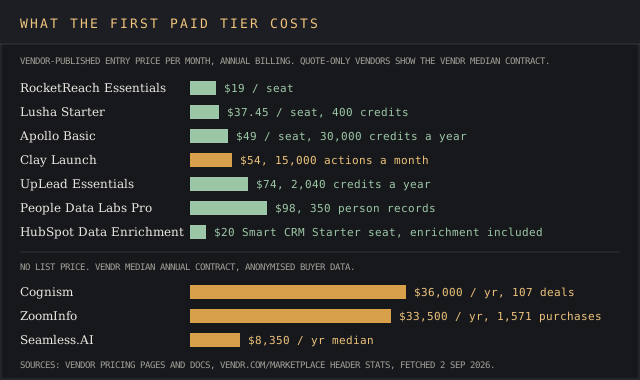
The table below orders all ten B2B data enrichment tools by final position. Coverage figures are each vendor's own published number, read on 2 September 2026; entry price is the first paid tier on annual billing where the vendor publishes one, and the Vendr median contract for the three quote-only vendors.
| # | Provider | Coverage figure | Entry price | Best fit |
|---|---|---|---|---|
| 1 | Clay | 150+ data providers in one waterfall | $54/mo annual (Launch); free tier, 100 data credits | RevOps teams that want fill rate over any single database |
| 2 | ZoomInfo | 500M+ profiles, 300M+ verified emails | $33,500/yr median* | Enterprise sales teams enriching Salesforce at scale |
| 3 | Apollo.io | 240M+ contacts, 30M+ companies | $49/user/mo annual; free plan, 75 credits/mo | Small sales teams that want data & outreach in one seat |
| 4 | Cognism | Phone-verified Diamond Data, 87% of lists connect | $36,000/yr median*; CRM Enrichment from $12,000/yr | EMEA teams that prospect by mobile phone |
| 5 | HubSpot Data Enrichment | 200M+ company & buyer profiles | Included in every paid Hub; Smart CRM Starter $20/seat | HubSpot customers with empty firmographic fields |
| 6 | Lusha | 290M+ contacts, 28M+ companies | $37.45/seat/mo annual (Starter); free plan, 40 credits | Individual reps pulling phone numbers from LinkedIn |
| 7 | People Data Labs | 2.47 billion person records (v35.1) | $98/mo Pro, 350 records; free 100 records/mo | Developers building enrichment into their own product |
| 8 | UpLead | 200M+ contacts, 95% accuracy guarantee | $74/mo annual (Essentials), 2,040 credits/yr | Solo operators who want refunds on bad emails |
| 9 | Seamless.AI | 1.3B+ contacts, 414M+ mobile numbers | $8,350/yr median*; free plan, 50 credits | Outbound teams on annual contracts who prospect by volume |
| 10 | RocketReach | 700M+ professionals, 60M+ companies | $19/seat/mo annual (Essentials) | Recruiters & researchers doing one-way lookups |
Medians marked * are anonymised buyer-reported contract values published by Vendr. Everything else is the price the vendor publishes itself, on annual billing, read 2 September 2026.
Where these figures come from
Coverage counts are each vendor's own data page, pricing page or API documentation, read 2 September 2026: clay.com/pricing for the 150+ provider count, zoominfo.com/data, lusha.com/data, docs.peopledatalabs.com/docs/stats, uplead.com/our-data and the equivalents named in each entry.
Medians marked * are the header stats on vendr.com/marketplace, anonymised buyer-reported contract values; the Seamless.AI figure appears in the comparison header of Vendr's RocketReach page, since Vendr publishes no Seamless.AI page of its own. RocketReach's pricing page renders client-side and was read in a browser on 3 September 2026.
Cognism publishes no database size, Clay and People Data Labs publish no accuracy percentage, and Seamless.AI publishes neither a price nor a percentage, so no row claims one.
Seven of these ten vendors also appear in our B2B data providers ranking and sales intelligence ranking, ranked there on database size and outreach tooling over fill rate per enrichment call. The company data providers ranking and firmographic data providers ranking cover the account-level specialists this page leaves out.
Data enrichment tools take a record you already hold, a name, an email, a company domain, and append what's missing: a job title, a direct dial, an employee count, the tech stack, an intent signal. The ten B2B data enrichment tools ranked here all do that, and they do it at prices that run from $0 to a $36,000 median annual contract.
This page ranks them against six testable criteria, set out before the list, so a reader can check the order. Every figure links to the vendor page or the Vendr header stat it came from. Every entry carries at least one verbatim user quote, linked to its thread.
It's written for sales teams, marketing teams & RevOps groups that own a CRM with gaps in it, and for the developer who's been told to fill those gaps with an API. The category changed shape in 2025 and 2026: Clay crossed $100M ARR by reselling everyone else's data through waterfall enrichment, and HubSpot folded Clearbit into its CRM at no extra charge.
ZoomInfo answered with a 40-source parallel waterfall of its own in February 2026. The old question, which single database is biggest, matters less than it did. The new one is how many data sources a single enrichment call can draw on, and what each filled record costs.
Evaluation criteria for data enrichment tools
Six criteria decide the shortlist, and the ranking below applies them in this order. Each one produces a number or a yes/no a buyer can check on a vendor page or in a 50-record trial. Data quality claims that fail that test carry no weight here.
Number of data sources one enrichment call can draw on
A single-source tool fills a field if its own database has it. A waterfall tool asks provider one, then provider two, until something returns. Clay publishes 150+ data partners; ZoomInfo's GTM Studio waterfall evaluates 40+ sources; Apollo says "dozens"; the other seven query one database. This is the criterion that decides #1.
Published accuracy rate with a method behind it
A percentage with no method is marketing. Data accuracy is the claim vendors market hardest and document least. ZoomInfo publishes 96% email deliverability and 87% mobile accuracy and names the SMTP handshake, confidence scoring and human review behind them. Four of the ten publish no percentage at all.
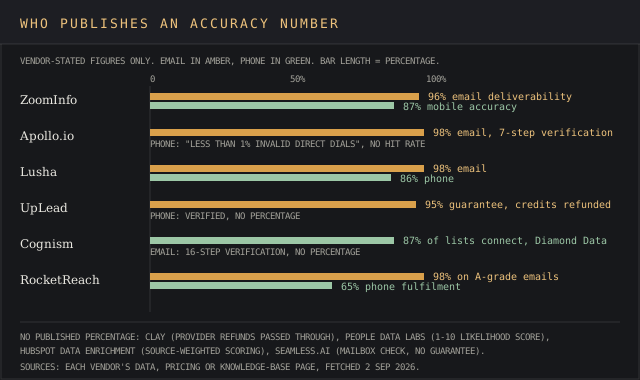
Vendors on this list that publish no accuracy percentage at all: Clay, People Data Labs, HubSpot Data Enrichment and Seamless.AI. Two of them hold the largest record counts in the ranking.
Native CRM auto-enrichment for Salesforce or HubSpot
The test is a checkbox in the vendor's docs: can the tool watch the CRM and write back to new records on a schedule, without a Zapier hop. Apollo polls every 15 to 30 minutes; Lusha's scheduled Salesforce workflow is legacy-plan only; RocketReach's integrations are one-way exports.
Cost of one fully enriched record at the entry tier
Vendors price by seat, by credit, by action, by lookup and by export, and no two units match. The comparison that survives is what an email plus a phone number costs on the cheapest paid tier. Lusha charges 1 credit for an email & 5 for a phone; Clay says a full record runs 6 to 20 data credits at $0.05 each.
Bulk enrichment limit per run
CSV and bulk enrichment capabilities are where cheap tiers hit a wall. Lusha caps a Pro upload at 300 rows; Apollo takes 100,000 rows per file; HubSpot enrols 100 records at a time from an index page. A team with 40,000 CRM records needs the number, and the vendor's docs page usually has it.
Exit terms in the contract
Read the renewal clause before the demo. Seamless.AI and UpLead both require 60 days' notice before an annual renewal or the contract rolls another 12 months; ZoomInfo's licence terms state the agreement "is not cancellable"; Clay renews "at Clay's most-up-to-date-rates". The number that matters is the notice window in days.
Five of the ten vendors here write auto-renewal, non-cancellation or a 60-day notice window into their terms. Diary the notice date the day you sign; the one-star reviews on every platform below are about billing before they're about data.
The 10 best B2B data enrichment tools, ranked
Ranked on source count per call, published accuracy with a method, native CRM auto-enrichment, entry-tier record cost, bulk limit per run, and exit terms, in that order.
Clay
Best fit
RevOps & growth teams that care about fill rate across a whole list and will trade a learning curve for it.
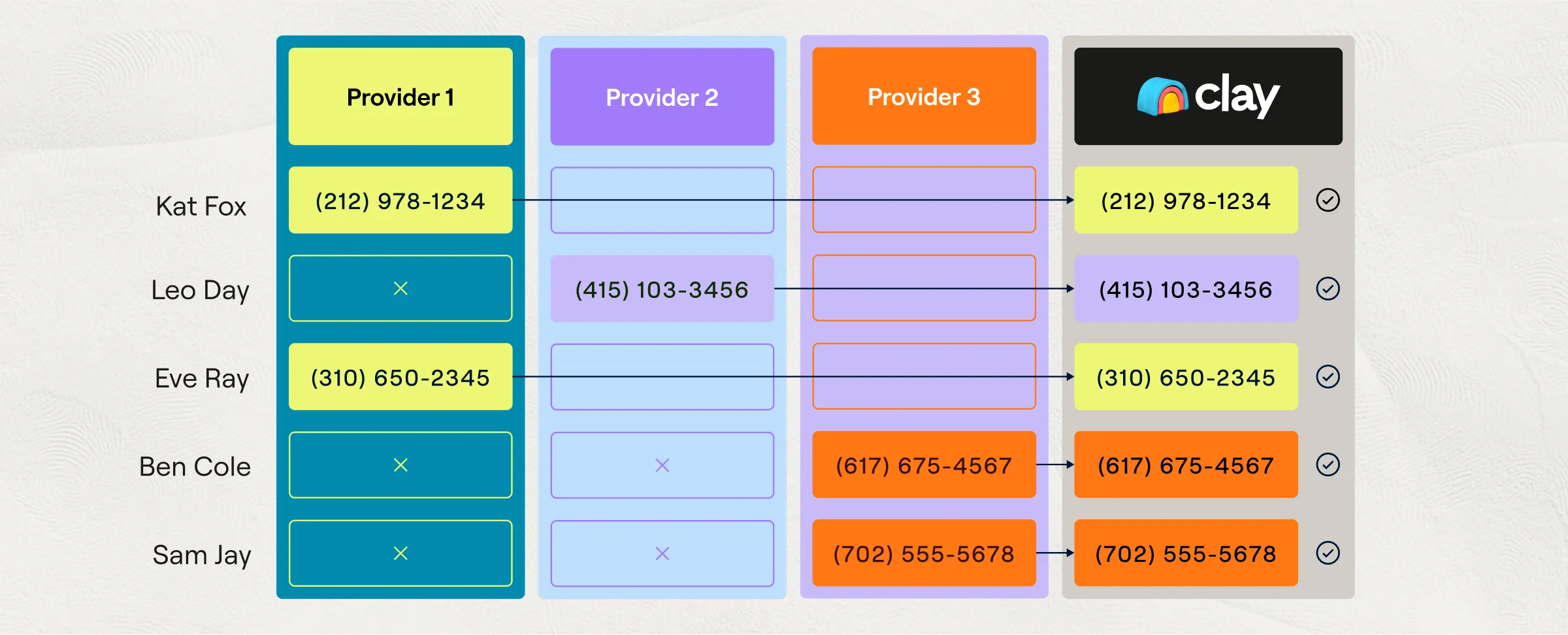
Clay is a spreadsheet that calls other people's data. Each column runs a waterfall enrichment across its marketplace of 150+ data providers, stopping at the first one that returns a match, so the work email column might hit Prospeo, then Dropcontact, then Hunter, then People Data Labs.
Clay Labs raised a $100M Series C at a $3.1B valuation and reports $100M ARR as of December 2025. The vendor's own case numbers show why the model wins on coverage. OpenAI doubled inbound enrichment coverage from 40% to 80% by stacking providers, and the waterfall page claims the approach "routinely triples" coverage. Claygent, the AI research agent, is on every tier including Free.
Key features
- Waterfall enrichment across 150+ providers, with named work-email sources Prospeo, Dropcontact, Datagma, Hunter, People Data Labs, Apollo, Lusha and Snov.
- Claygent AI web research on every plan, including Free.
- CRM auto-sync & enrichment for Salesforce and HubSpot on Growth and Enterprise, with 15-minute source sync on Enterprise.
- Bring-your-own API keys on all tiers, with Actions still charged for orchestration.
- Public API, CLI and agent plugin at developers.clay.com; Tables endpoints are Enterprise only.
- Bulk runs to 50,000 rows per table on Launch, and above 50,000 on Enterprise.
Pricing
Free gives 500 actions and 100 data credits a month with unlimited seats and a 200-row cap per table. Launch starts at $54 a month on annual billing ($60 monthly) for 15,000 actions; Growth starts at $185 ($205 monthly) for 40,000 actions and unlocks CRM auto-enrichment. Data credits start at $0.05 each, and one-time top-ups carry a 30% premium.
Vendr's anonymised buyer data puts the median contract at $40,500 a year across 81 purchases, from $16,200 to $135,000. Our Clay pricing teardown walks the Actions and Data Credits meters tier by tier.
Pros
- Highest source count of any tool on this list, 150+ against ZoomInfo's 40+.
- No charge when an enrichment returns nothing, and provider refunds for bad data are passed back as credits.
- Unlimited seats on every tier, since billing never touched the seat count.
- Rollover: monthly plans keep up to 2x the monthly credit limit.
Cons
- Actions are billed even when you bring your own provider keys.
- Phone number enrichment is off on the Free plan.
- Full CRM auto-enrichment starts at Growth, $185 a month annual.
- Renewals reprice to current rates automatically.
The Actions meter is the complaint that recurs. A Reddit user on r/gtmengineering running 3,000 to 4,000 enrichments a month wrote in April 2026:
"We were already using our own API keys to avoid the data credit markup that math worked. But now every HTTP call, every CRM push, every enrichment step burns Actions regardless. BYOK doesn't feel as straightforward as it used to."
Reddit user, r/gtmengineering, April 2026
The match-rate side shows up in the same forums. A RevOps poster on r/CRM in May 2026 reported that after deduplicating the CRM, "Clay lookup success rate went from ~58% to ~91%. Same settings, same waterfall."
Why it’s ranked #1. Clay wins the first criterion outright: 150+ data sources per call against ZoomInfo's 40+, the widest fill rate on the list. It loses to ZoomInfo on published accuracy, where Clay states no percentage and ZoomInfo states two.
ZoomInfo
Best fit
Enterprise sales teams enriching a Salesforce or HubSpot instance with hundreds of thousands of records, on a budget that starts in five figures.
ZoomInfo holds the largest single proprietary database in the category: 500M+ professional profiles, 122M+ company records, 300M+ verified emails and 135M+ direct dial numbers. It changed its Nasdaq ticker from ZI to GTM on 12 May 2025 and now sells itself as a go-to-market intelligence platform, with Copilot as the AI layer on top of the data.
The enrichment product runs on demand or on a schedule. New CRM records trigger enrichment on arrival, and ongoing refreshes update emails, direct dials, job titles, seniority, company attributes, hierarchy and technographics. In February 2026 ZoomInfo added a waterfall that evaluates 40+ third-party sources in parallel, returns the highest-confidence result with source attribution, and consumes no credits for GTM Studio customers.
Key features
- 500M+ profiles, 122M+ companies, 4,500+ intent topics from one vendor.
- Scheduled and triggered CRM enrichment for Salesforce, HubSpot, Marketo, Dynamics, Outreach and Salesloft.
- Parallel waterfall across 40+ sources inside GTM Studio, at no credit cost.
- Real-time streaming API to CRM, MAP and data warehouse, plus a REST API rated at 25 requests per second.
- A contractual 95% employment-accuracy guarantee with a 30-day cure period.
- Chrome extension (ReachOut) and the ZoomInfo Copilot chat interface.
Pricing
No list price. ZoomInfo's pricing page says cost depends on "features and functionality, number of licenses, credit usage", and each export costs one credit. Vendr's anonymised buyer data shows a median of $33,500 a year across 1,571 purchases, from $7,200 to $156,000, with buyers negotiating 22% off on average.
Pros
- Published hit rates by field: 96% business email, 87% mobile, 94% LinkedIn URL.
- The 95% accuracy guarantee in the licence terms comes with a prorated refund if ZoomInfo misses it after 30 days.
- Bulk enrichment handles millions of records per job.
- 15 to 20 million job-change events processed monthly, which is where CRM decay gets caught.
Cons
- The licence agreement is "not cancellable" for its term, and late payment carries 1.5% interest per month.
- Direct-dial hit rate is the weakest published figure at 72%.
- Every search counts against credits, including searches that return nothing, according to users.
- Entry cost is around 600x Apollo's.
The price is what users lead with. A poster running three SDRs wrote on r/DigitalMarketing in June 2026:
"our renewal came up and zoominfo wants 36k for 3 seats. thats more than our entire martech stack combined [...] we're seeing maybe 70% accuracy on direct dials, and their mobile numbers are hit or miss. plus they count every single search against our credits even when nothing comes back"
Reddit user, r/DigitalMarketing, June 2026
The enrichment itself gets credit. Nathan Sultemeier, Director of Revenue Operations at Zerofox, wrote on TrustRadius in April 2026 that the tool "has some of the best personal contact data in the industry" and is "really nice for enriching data in someone's CRM, too", describing a flow where a web lead lands in Marketo, passes to LeanData and gets enriched on the way. His score was 6 of 10, with "price, it is expensive" as the first con.
Why it’s ranked #2. ZoomInfo beats Apollo on the second criterion with a contractual 95% guarantee and bulk jobs in the millions, where Apollo tops out at 100,000 rows. It loses to Clay on source count, 40+ against 150+, and on a median contract that starts where Clay's free tier ends. See the full Apollo vs ZoomInfo comparison for how the two handle CRM write-back.
Apollo.io
Best fit
Small and mid-market sales teams that want contact data, CRM enrichment and email sequencing under one $49 seat.
Apollo.io combines a database of 240M+ contacts at 30M+ companies with the outreach tools that consume it. The data page claims a 98% email accuracy rate from a 7-step verification process and fewer than 1% invalid direct dials, and says 150M contacts are refreshed each month.
Apollo added its own waterfall in 2025. It runs across "dozens of data providers one after another", handles up to 10,000 contacts per run, and charges credits only when a source returns data. Beta customers saw 5% more email coverage, 7% more phone numbers and a 45% lower bounce rate over two months, by Apollo's own count.
Key features
- Native CRM enrichment for Salesforce and HubSpot in three modes: manual (1,000 records at a time), real-time polling every 15 to 30 minutes, and scheduled weekly or monthly.
- CSV enrichment to 100,000 rows per 50MB file; waterfall switches off above 50,000 rows.
- Waterfall enrichment across dozens of providers, 10,000 contacts per run.
- Chrome extension on every plan, including Free, covering LinkedIn, Gmail, Salesforce and HubSpot.
- Documented API with enrichment endpoints rated at 1,000 requests a minute on paid plans.
- Sequencing, dialer and buyer intent in the same seat.
Pricing
Basic is $49 per user a month on annual billing with 30,000 credits a year; Professional is $79 with 48,000; Organization is $119 with 72,000 and a three-user minimum. The free plan carries 75 credits a month and 100 CRM-enriched contacts every 30 days. A mobile number adds 8 credits on top of the 1-credit base.
Vendr's anonymised data shows a median of $19,004 a year across 87 purchases, from $4,284 to $45,128.
Pros
- Cheapest per credit of any tool here: $588 a year buys 30,000 credits.
- Published prices at every tier, and a free plan that includes CRM enrichment.
- Real-time CRM polling is the fastest documented cadence on the list after ZoomInfo's streaming API.
- Waterfall on a $49 seat, which no other bundled platform offers.
Cons
- Unused credits expire at the end of each billing cycle with no rollover.
- Apollo's terms let it use customer data to "grow, enrich, and verify the Contributor Database".
- DNC-listed phone numbers still consume credits.
- Subscriptions are non-cancelable during the term and renew automatically.
The 2025 credit migration is the loudest complaint. A verified G2 reviewer in marketing wrote in January 2026:
"The monthly credits have dropped from 10,000 to just 4,000, which is a significant reduction. What makes it even worse is that unused credits no longer roll over to the next month."
Verified user in marketing and advertising, mid-market, G2, January 2026
Mohammad R., a business development manager, gave the enrichment side its due on G2 in August 2026: "The real-time enrichment of CRM records with direct dials, verified email addresses, updated job titles, and company growth metrics is great for keeping our data current." He added that bounce rates run "around 15% to 25%" if he skips verification before sending.
Why it’s ranked #3. Apollo beats Cognism on the fourth criterion, $49 a seat against a $36,000 median contract, and on waterfall breadth, where Cognism queries one database. It loses to ZoomInfo on bulk scale, 100,000 rows against millions, and on a contractual accuracy guarantee.
Cognism
Best fit
Sales teams selling into the UK & EU by phone, where mobile connect rates and GDPR screening decide the tool.
Cognism sells one thing the others can't: mobile numbers a human researcher has called. Diamond Data is that phone-verified subset, and Cognism claims teams using it "connect with 87% of prospecting lists". Email goes through a 16-step verification process, and 95% of senior contacts are refreshed every 30 days.
Cognism declines to publish a database size. Its FAQ says the company holds "hundreds of millions" of profiles and doesn't "usually make general coverage claims". The Cognism vs ZoomInfo comparison tests that silence against ZoomInfo's numbers.
Key features
- Diamond Data phone-verified mobiles, plus Diamonds-on-Demand verification requests on Pro.
- Cognism Enrich for Salesforce, HubSpot, Pipedrive and Dynamics, running real-time, scheduled or one-off jobs with field-level rules.
- DNC screening against 15 lists across the UK, US, Australia, Germany, France and eight more countries.
- Bombora intent data on Pro, 12 topics per account.
- Chrome extension over LinkedIn, Sales Navigator, Salesforce, HubSpot and Outreach.
- Search, Enrich and Redeem APIs; preview calls consume no credits.
Pricing
Standard and Pro packages, each with 5 seats included, quoted by sales. The one published figure is CRM Enrichment from $12,000 a year. A credit is one revealed contact, and Cognism only charges again when that contact changes jobs.
Vendr's anonymised data puts the median at $36,000 a year across 107 deals, $18,350 to $93,886, with buyers negotiating 25.91% off. The Cognism pricing report tracks the package renamings.
Pros
- Phone-verified mobiles with a stated connect figure; ZoomInfo states an accuracy figure, Apollo states neither for mobiles.
- Suppressed DNC numbers consume no credits, where Apollo charges for them.
- Enrich a contact once and updates are free until a job change.
- ISO 27001, ISO 27701 and SOC 2 Type II, with GDPR legitimate-interest documentation published.
Cons
- No waterfall: one database, one fill rate.
- No published seat price, no free plan, and a 5-seat minimum per package.
- Bulk CSV row limits are undocumented.
- Auto-renewal disputes recur in one-star reviews.
Jessylyn Jonsay, an SDR at Stream, ran Cognism against two rivals and wrote on TrustRadius:
"I've used Lusha and LeadIQ in the past, and they don't give insights on DNC as Cognism does. They also don't give a headsup on [...] the phone number [being] direct, mobile, or office."
Jessylyn Jonsay, SDR at Stream, TrustRadius, December 2022
The critical side is about renewals. A verified G2 reviewer in marketing wrote in May 2025: "The company didn't inform us of our renewal and when we inquired about cancelling -- they told us it autorenewed and it was too late to cancel even though it was only a week later."
Why it’s ranked #4. Cognism beats HubSpot Data Enrichment on phone data outright: HubSpot appends no contact phone numbers at all, Cognism appends human-verified ones. It loses to Apollo on price, $12,000 minimum for Enrich against $588 a year, and on source count.
HubSpot Data Enrichment (formerly Clearbit and Breeze Intelligence)
Best fit
HubSpot customers on any paid Hub whose contact and company records have empty industry, revenue and headcount fields.
HubSpot closed its Clearbit acquisition on 4 December 2023, relaunched it as Breeze Intelligence in September 2024, and in 2026 dropped the credit charge: data enrichment is now "included in all paid plans with HubSpot's Smart CRM". The dataset covers 200M+ company and buyer profiles, or by another HubSpot count, 100M company domains and 380M email addresses, with 40+ data points.
Our Breeze Intelligence review predates the pricing change. Enrichment runs four ways: automatically on new records, continuously with monthly refreshes, manually per record, and in bulk from a segment, an import or a workflow action. Contacts need a first name, last name and work email to match; Gmail and Yahoo addresses are skipped.
Enriched data is "dynamically weighed and scored against its data sources" and reviewed by a human QA team, per HubSpot's own docs.
Key features
- Company & contact enrichment for firmographic, demographic and technographic fields, with per-property overwrite rules.
- Form shortening that hides fields the dataset can already fill, free since 3 September 2025.
- Buyer intent from HubSpot's tracking code, 90-day window, 10 credits to add a company.
- Continuous enrichment that re-checks previously enriched records monthly.
- Included HubSpot Credits: 500 on Starter, 3,000 on Professional, 5,000 on Enterprise per month.
Pricing
Zero incremental cost for enrichment on any paid Hub. Smart CRM seats run $20 Starter, $50 Professional, $75 Enterprise per month. Extra HubSpot Credits for intent and agents cost $10 per 1,000, or $0.010 each pay-as-you-go. The legacy Breeze credit packs were converted to HubSpot Credits in June 2025, at 3,000 HubSpot Credits per 100 old Breeze credits.
Pros
- $0 for enrichment on a $20 seat, the lowest marginal cost on the list.
- Monthly continuous refresh with no credit consumption.
- Form shortening lifts conversion on the fields it hides, and it's free.
- Field-level overwrite control: fill empty only, overwrite, or skip.
Cons
- No contact phone numbers or mobile numbers appended, only a company phone.
- HubSpot only: no Salesforce, no standalone purchase, no public enrichment API.
- Index-page bulk actions cap at 100 records at a time.
- Exceeding a credit limit auto-upgrades the tier for the rest of the contract.
The credit overrun is documented by a user who hit it. u/TreeCalledPaul wrote on r/hubspot in June 2025, under the old credit model:
"Might have just cost my company $11k this year because the credit system just lets you blow past what you've paid for. Even if you turn off automatic enrichment, if you mistakenly manually enrich a list of say 10,000 contacts, you'll blow through 100k+ credits in minutes and you won't be able to stop it."
u/TreeCalledPaul, r/hubspot, June 2025
Erin S., a senior marketing manager, took the other side on G2 in June 2026: "The most helpful thing about Breeze is that it is fully connected with our CRM data. Everything is contained in the system and the answers stay relevant. The fact that it is included in the our current pricing plan is also great."
Why it’s ranked #5. HubSpot beats Lusha on the fourth criterion with a $0 marginal record cost against Lusha's 1-credit emails and 5-credit phones, and on monthly continuous refresh. It loses to Cognism on phone data, where it appends none, and to every tool above it on CRM reach, being HubSpot-only.
Lusha
Best fit
Individual reps and small teams pulling direct dials from LinkedIn profiles through a Chrome extension.
Lusha publishes 290M+ contacts, 28M+ companies, 98% email accuracy and 86% phone accuracy, and says it checks every record across multiple independent sources without scraping professional networks.
Italy's data protection authority found otherwise in July 2026, citing scraping from social networks and records bought from other brokers, and fined Lusha €2 million; Lusha is contesting the decision in the Court of Rome. The Lusha vs ZoomInfo comparison covers where 290M and 500M diverge in practice.
Lusha rebuilt its pricing in August 2025 into five plans and four credit categories. The API now comes with every plan including Free, at 40 requests a minute and 100 a day on the free tier, rising to 300 a minute and 50,000 a day on Scale. A data waterfall through third-party providers exists, but only via the API and MCP.
Key features
- Chrome extension revealing emails at 1 credit and phone numbers at 5 credits.
- CSV enrichment capped at 100 rows on Free, 300 on Pro, 500 on Premium and 10,000 on Scale.
- Native push to Salesforce (150 at a time), HubSpot (100), Zoho, Pipedrive, Outreach and Salesloft.
- Person, Company, Bulk Person (100 per request), Signals and Website Visitors API endpoints.
- 26 real-time signals including job changes and funding events.
- SOC 2 Type II, ISO 27001, ISO 27701 and a 99.95% uptime SLA on the trust centre.
Pricing
Free carries 40 credits a month. Starter is $37.45 a month annual ($49.90 monthly) with 400 credits and one seat; Pro is $52 annual with 600 credits and two seats; Premium is $300 annual with 3,400 credits and five seats; Scale is quoted. Annual credits never roll over. On the sixth criterion, Lusha's terms renew every plan automatically at the then-current price, need 14 days' notice before renewal, and state that "all payments under these Terms are non-refundable."
Vendr's anonymised data shows a median of $15,999 a year across 147 purchases, $6,000 to $70,403. Our Lusha pricing report covers the 2025 plan migration.
Ranked #6 in this guide
Try Lusha's free plan
40 free credits a month, then Starter at $37.45 a seat on annual billing with 400 credits: 1 credit per email, 5 per phone.
 Visit Lusha →
May earn a commission if you sign up through this link, at no extra cost to you. Full affiliate disclosure.
Pros
- Published phone accuracy at 86%, one of three vendors here to state a phone figure, though Lusha calls it an internal benchmark and no third party has audited it.
- API on the free plan, which Apollo and UpLead gate.
- Published seat prices from $37.45.
- Monthly plans roll over up to 2x the monthly credit limit.
Cons
- Scheduled Salesforce enrichment workflows are restricted to legacy plans.
- Every API request costs at least 1 credit, even with zero results.
- CSV cap of 300 rows on Pro makes bulk enrichment a Scale feature.
- TrustRadius's synthesis of 21 reviews found 67% citing outdated or missing information.
- Non-refundable plans that auto-renew at the then-current price, and stored credits that reset on a downgrade to Free.
- Two pending US class actions over its contact data, in California and Colorado; the Lusha review lists every case.
Deboleena Majumder, Associate Director of Sales at Calsoft, rated Lusha 10 of 10 on TrustRadius in June 2026 and still drew the boundary:
"It is less appropriate when we need very broad coverage for niche roles, smaller companies, or high-volume enrichment at scale, where we have found incorrect data, faster credit burn, and hence a weaker ROI."
Deboleena Majumder, Associate Director of Sales, Calsoft, TrustRadius, June 2026
A marketing manager at a 51-to-200-person firm wrote on TrustRadius in August 2026: "Many providers give out email addresses but getting contact numbers is hard but Lusha has properly nailed it", adding that the team also runs it over CRM contacts whose stored details have stopped working.
Why it’s ranked #6. Lusha beats People Data Labs on the third criterion, with native CRM push, a Chrome extension and an 86% phone figure where PDL publishes no accuracy number. It loses to HubSpot on record cost and on scheduled CRM refresh, which Lusha restricts to legacy Salesforce plans.
The 86% figure earns less credit now that Lusha itself calls it an internal benchmark with too little third-party testing behind it, and its exit terms, non-refundable with a 14-day notice window, sit with the strict half of this list. Neither point moves it below PDL, which publishes no accuracy percentage at all.
People Data Labs
Best fit
Engineering teams building enrichment into a product or data warehouse, at 10,000 records and up.
People Data Labs sells the data layer with no CRM, no extension and no sales UI. Its versioned stats page lists 2,465,457,822 person records in build v35.1, with 498M mobile phones and 772M LinkedIn URLs. The marketing line says 1.5 billion unique individuals; the API docs say nearly three billion profiles. The stats page is the one with a version stamp, so that's the number used here.
PDL matches one-to-one and returns a likelihood score from 1 to 10, logarithmic, where a 2 means a 10 to 30% chance the record is the person requested. You set the floor with min_likelihood and pay only on a 200 response. The company dataset holds 74.8M records.
Key features
- Person, Company, IP and Job Posting datasets, plus Skill, Job Title, Autocomplete and Cleaner APIs.
- Bulk enrichment of 100 persons per request; PDL's own docs advise 80 to avoid a 502.
- Rate limits of 100 requests a minute on Free and 1,000 a minute on paid plans.
- Monthly data releases on the third Tuesday; v35.1 detected 2.7M job changes in August 2026.
- Salesforce, Snowflake and Databricks integrations, plus Zapier and Make.
- Technology data in beta since July 2026, tracking 25,566 technologies.
Pricing
Free gives 100 records a month per dataset. Pro starts at $98 a month for 350 person records, which is $0.28 per credit, falling to $0.20 on annual plans above 60,000 credits. Company enrichment runs from $0.10. Vendr's anonymised data shows a median of $12,500 a year, $9,858 to $27,800.
Pros
- Largest published record count on the list, with a version number attached.
- Free tier unlocks the API, and rollover credits carry up to 100% of the next period's limit.
- Per-record pricing published to the cent.
- Deletions and opt-outs apply to the API immediately.
Cons
- Work email fill rate across the full dataset is 3.5%, 85,278,047 records.
- No published accuracy percentage; the likelihood score is the only quality signal.
- No Chrome extension and no native HubSpot connector.
- The no-code Batch Enrich tool bills separately at a $50 minimum per list and can't draw on subscription credits.
A verified G2 reviewer in venture capital described the LinkedIn dependency in February 2022: "the data seems to trust LinkedIn a bit much. I have found cases in which random LinkedIn profiles would say they are the company's CEO, but that doesn't match public sources", and that a person absent from LinkedIn is absent from PDL's search results too. The same reviewer's positive: "The API is well documented and relatively easy to use."
Why it’s ranked #7. PDL beats UpLead on scale, 1,000 API requests a minute against UpLead's 500 and a 2.47-billion dataset against 200M, at $0.28 a record against UpLead's $0.60 overage. It loses to Lusha on the third criterion: no extension, no HubSpot connector, no accuracy figure.
UpLead
Best fit
Solo sellers and single-user accounts that want verified emails with a refund on bounces, at published prices.
UpLead publishes 200M+ contacts, 19M+ company profiles and a 95% accuracy guarantee, verifying emails at the moment of export. A Valid status means the mail server allowed verification and the address was 97%+ verified at download. Invalid addresses go to a manual research team. Bounces get credits back under what UpLead calls Friendly Credits.
Data Enrichment is a Plus-and-above feature that takes a CSV of names plus domains, domains alone, or emails alone, shows the match count before you export, and appends 50+ data points. UpLead tracks 16,000+ technologies for technographic filters and sells intent data on the same seat.
Key features
- Real-time email verification at export, with credits refunded on Invalid results.
- CSV enrichment in three modes, with match counts shown before spending a credit.
- Chrome extension for LinkedIn and company pages, included on the free trial.
- Integrations with Salesforce, HubSpot, Zoho, Pipedrive, Dynamics 365, Outreach, Salesloft and 1,500+ apps through Zapier.
- API at 500 requests a minute, on Professional only.
- Free logo API with attribution.
Pricing
Essentials is $99 a month for 170 credits, or $74 a month on annual billing for 2,040 credits; Plus is $199 ($149 annual) for 400 credits a month; Professional is annual-only and quoted. Extra credits cost $0.60 on Essentials and $0.50 on Plus. One credit is one contact or one company. The free trial runs 7 days with 5 credits. Vendr lists UpLead but publishes no header stats.
Pros
- A written accuracy guarantee backed by credit refunds, which only Apollo and ZoomInfo match in different forms.
- Published prices at two tiers, with the annual discount stated.
- Validating contacts you already hold costs zero credits.
- Match count shown before export, so no credit is spent on a blank row.
Cons
- Free, Essentials and Plus are single-user accounts.
- Annual renewal requires 60 days' notice, and all fees are non-refundable under the terms.
- Credits are use-it-or-lose-it at term end, and a changed company record costs a second credit.
- No SOC 2 or ISO 27001 statement on the vendor domain.
Aaron E., a VP of business development, wrote on G2 in December 2021:
"You generate a lead list of 100 and only 30-40 are verified....so if you have 100 credits, you have to go through the process 10 times to use up your credits. The billing, terms are obnoxious. You have to cancel early and lose credits. Avoid the annual term at all costs."
Aaron E., VP Business Development & Marketing, mid-market, G2, December 2021
A C-level reviewer at a 201-to-500-person company wrote on TrustRadius in February 2025: "I am blow away how many mobile numbers I am able to get using their program", with the caveat that "Emails are functional about 80% of the time. Could be better".
Why it’s ranked #8. UpLead beats Seamless.AI on the second and sixth criteria: a published 95% guarantee against Seamless.AI's no-guarantee disclaimer, and $74 a month in print against a contact-sales page. It loses to People Data Labs on scale, 500 API requests a minute against 1,000, and on a single-seat cap below Professional.
Seamless.AI
Best fit
Outbound teams that prospect by volume, will sign an annual contract, and want a CRM Enrich add-on inside the same tool.
Seamless.AI describes itself as a real-time search engine and claims 1.3B+ verified contacts and 414M+ verified mobile numbers, the largest mobile count stated by any vendor here. Its Data Enrichment product takes a CSV or XLSX and charges 1 credit per enriched contact, company or email record, so a 2,500-row list costs 2,500 credits. CRM Enrich scans Salesforce or HubSpot on a set interval and writes back with logs and rollback.
Accuracy is where the vendor page and the legal page part company. The email check "simulates an email check by querying the recipient's mail server", and the same page states that Seamless.AI offers no guarantee of "deliverability, accuracy, response rates, or ongoing validity of any email address". Credits come back for emails that fail that check; phones and company data are excluded.
Key features
- Four enrichment jobs: contact list, company list, job changes and email list.
- CRM Enrich add-on for Salesforce, HubSpot and Dynamics with interval scheduling and rollback.
- Chrome extension that finds emails, direct dials and mobiles on any website.
- Buyer Intent and Autopilot as paid add-ons; Job Changes filter on every tier including Free.
- REST API at roughly 100 requests per 60 seconds per endpoint, with a credits-remaining header.
- SOC 2 Type 2 across all tiers, per the pricing page.
Pricing
The pricing page carries no dollar figures. Free has one user and 50 credits. Pro starts at 10,000 annual credits, per user, contact sales; Enterprise has unlimited users and custom packages. Data Enrichment, Autopilot, Buyer Intent and AI Assistant are all add-ons.
Vendr's RocketReach page lists a Seamless.AI median contract of $8,350 in its comparison header. Our Seamless.AI pricing report collects what buyers have paid.
Ranked #9 in this guide
Start on Seamless.AI's free tier
50 credits and one user at $0, no card required. Data Enrichment bills 1 credit per enriched contact, company or email record; Pro and Enterprise route through a sales call.
 Visit Seamless.AI →
May earn a commission if you sign up through this link, at no extra cost to you. Full affiliate disclosure.
Pros
- 414M+ mobile numbers claimed, ahead of ZoomInfo's 135M+ direct dials.
- CRM Enrich writes back with rollback, which RocketReach's one-way sync lacks.
- Credit-back on emails that fail the mailbox check.
- Free plan with 50 credits and API access.
Cons
- All subscriptions are annual; cancellation must happen in-platform 60 days before renewal or the contract rolls 12 months.
- Uploaded contacts become Seamless.AI inventory under section 8 of the terms.
- Aggregate liability is capped at $100.
- No accuracy percentage and no published price.
The renewal mechanics dominate the reviews. A business owner in IT services who'd used the product for two years wrote on Capterra in August 2026:
"Customer service is horrible. They send renewal notices out so that they get caught by most reputable spam filters as a result you don't get a notice that you are getting ready to auto renew. Their staff then blames you and says there is nothing they can do about it."
Verified reviewer, owner, IT and services, Capterra, August 2026
AJ P., Director of Business Systems at a building-materials company, wrote on Capterra in June 2026: "Ease of use, chrome extension is fantastic. The ability to enrich contacts has helped us keep our customer database up to date, especially as our industry has a lot of movement between companies." His con was the integration: "it's more of a one-way street."
Why it’s ranked #9. Seamless.AI beats RocketReach on the third criterion, a scheduled CRM Enrich with write-back against one-way exports, and on stated mobile count, 414M against RocketReach's unpublished phone total. It loses to UpLead on a published price and a published accuracy guarantee, having neither.
RocketReach
Best fit
Recruiters, researchers & founders doing one-way lookups from LinkedIn at the lowest seat price on the list.
RocketReach covers 700M+ professionals and 60M+ companies and runs email prediction plus verification at lookup time. Its A-grade emails carry a claimed 98% deliverability rate; the knowledge base is blunter, quoting 80 to 85% fulfilment on email and about 65% on phone. The RocketReach vs ZoomInfo comparison sets those numbers against ZoomInfo's.
The billing model splits lookups from exports. A lookup reveals a contact inside RocketReach and costs one credit only when a verified email or phone comes back. Every route out, CSV download, Salesforce sync, API call or MCP query, spends an export credit. Annual plans give unlimited lookups under a 10,000-a-month fair-use rule and a fixed yearly export pool that doesn't refill.
Key features
- Person and company lookups with real-time email verification, one credit per successful lookup.
- Native one-way sync to Salesforce, HubSpot and Bullhorn on Pro and above, with dedup and auto-export on lookup.
- Intent data from a 5x5 Data feed, 35,000+ topics since February 2026.
- API with per-plan limits: Essentials 5,000 lookups a month, Pro 20,000, Ultimate 50,000, Custom 200,000.
- Universal API credits: 2 for a work email, 6 for a phone, 1 per search page.
- SOC 2 Type II and ISO 27001, SAML SSO on Ultimate and Custom.
Pricing
The pricing page renders client-side; read in a browser on 3 September 2026, it lists Essentials at $19 a seat a month on annual billing ($229 a year, email only, 1,200 exports), Pro at $52 ($619, email and phone, 3,600 exports) and Ultimate at $115 ($1,379, 20,000 exports a year). Team plans start at $6,000 a year, and intent plus contacts starts at $175 a month.
Vendr's anonymised data shows a median of $6,750 a year, $1,800 to $13,340. Our RocketReach pricing report covers the lookup-versus-export split.
Pros
- $19 a seat, the lowest published entry price here.
- No credit spent on a lookup that returns nothing verified.
- Repeat lookups on the same person are free.
- Published API rate limits per plan, down to the minute.
Cons
- Integrations are one-way exports; no scheduled CRM enrichment exists.
- Exports on annual plans are a finite yearly pool, and CSV enrichment draws from it.
- All payments are non-cancelable and non-refundable under the subscriber terms.
- Phone fulfilment of 65% is the lowest figure a vendor on this list admits to.
Brendan C., a business development rep in IT services, gave both sides in one Capterra review in January 2025: "RocketReach is and was 10 times cheaper than the other platform that we were using while producing the same results", and, in the same review, that once the contacts came back "some or most of them" fell short on accuracy.
Ryan D., a founder in utilities, titled his July 2025 Capterra review "Don't sign up - will be a major headache and they will charge you on the way out" and wrote: "I can't oversee the fact they're nick and diming our early stage startup. Use Apollo. It's much better."
Why it’s ranked #10. RocketReach wins on price, $19 a seat against every other published rate, and loses to Seamless.AI on the third criterion: one-way exports with no scheduled write-back, and a 65% phone fulfilment rate the vendor itself publishes.
What data enrichment tools do
Data enrichment appends third-party attributes to first-party records. Vendors sell the same operation as lead enrichment when it runs on inbound form fills and as CRM enrichment when it runs on existing records.
A CRM row holds a name and a work email; the enrichment tool matches that row against its database or its provider network and writes back the job title, seniority, company size, revenue band, industry, location, tech stack and, where licensed, the mobile number. HubSpot's docs describe the match keys plainly: first name, last name and work email for a contact, a domain for a company.
The process runs in four steps across every vendor here. Ingestion takes the record from a CSV, a CRM object or an API call. Matching finds the candidate in the database, which is where PDL's likelihood score and UpLead's Valid status live. Appending writes the fields. Syncing pushes them back, in real time for ZoomInfo's streaming API, every 15 to 30 minutes for Apollo, monthly for HubSpot's continuous mode.
Job-change events ZoomInfo processes each month, per its data page. People Data Labs detected 2.7 million in its August 2026 build alone, and Cognism refreshes 95% of senior contacts every 30 days.
Existing data decays because people change jobs. ZoomInfo processes 15 to 20 million job-change events a month; People Data Labs detected 2.7 million in its August 2026 build alone; Cognism refreshes 95% of senior contacts every 30 days. A CRM that gets re-enriched on no schedule is a CRM full of people who've left.
Four kinds of enrichment data, and which tools carry each
Contact data enrichment adds emails, phone numbers and other contact details to a person. Every ranked tool does this except HubSpot Data Enrichment, which appends no contact phone. Phone data is the expensive half: Apollo charges 8 extra credits for a mobile, Lusha 5, RocketReach's API 6 against 2 for a work email.
Firmographic enrichment fills company size, industry, revenue and location. ZoomInfo publishes 20+ firmographic data points per company; Lusha lists 72 company firmographics; HubSpot appends 40+ data points. The firmographic data providers ranking linked above compares the specialists.
Technographic enrichment reveals what software a company runs. UpLead tracks 16,000+ technologies, Cognism 20,000+, People Data Labs 25,566 in beta, and ZoomInfo refreshes tech-stack detection on a 60-day cycle. Specialists like BuiltWith and HG Insights sit in the technographic data providers ranking.
Intent enrichment appends intent signals: which accounts are researching a topic, visiting a site, or hiring for a role. ZoomInfo offers 4,500+ intent topics, Cognism 12 Bombora topics per account, RocketReach 35,000+ topics through 5x5 Data, HubSpot a 90-day window from its own tracking code. Behavioral signals like these drive timing; the intent data providers ranking covers the feeds themselves.
Where the data comes from
Single-source tools build their own database and query it. Apollo names four collection methods: a 2M-inbox contributor network, bounce tracking from its engagement suite, public web crawling, and third-party providers it processes 230 million records a month from. ZoomInfo crawls 10M+ pages a day and buys job-posting data from PredictLeads. Lusha says it never scrapes professional networks.
Two of the ten, Apollo and Seamless.AI, write into their terms that customer uploads may feed the shared database. A CRM export pushed through either one becomes inventory the vendor can sell to the next customer, under section 8 of the Seamless.AI terms and the Contributor Database clause in Apollo's.
Waterfall enrichment queries multiple data providers in sequence. Clay's marketplace resells 150+ of them, including four tools ranked on this page: Apollo, Lusha, Snov and People Data Labs. That's the structural fact of the category in 2026: Clay owns the routing and rents the contact data. ZoomInfo's February 2026 answer runs 40+ sources in parallel and picks the highest-confidence result, which is a different mechanism with the same goal.
The choice between the two decides your fill rate and your compliance exposure at once. A waterfall that hits five providers for one contact has five processors in the chain, and Cognism's compliance page notes it acts as controller for its own data and processor only for uploads. Ask each provider in a waterfall which one it is.
Pricing across the category
Ten tools, five billing units. Clay meters Actions and Data Credits. Apollo, Lusha, UpLead, Seamless.AI and Cognism sell credits per revealed contact. RocketReach splits lookups from exports. People Data Labs prices per matched record. HubSpot charges nothing for enrichment and meters intent separately. ZoomInfo quotes.
The published floor runs from $19 a seat (RocketReach) through $37.45 (Lusha), $49 (Apollo), $54 (Clay), $74 (UpLead) to $98 (People Data Labs), all on annual billing. Custom pricing covers ZoomInfo, Cognism and Seamless.AI, where the Vendr medians are $33,500, $36,000 and $8,350. That's a spread of over 1,000x between the cheapest published seat and the median enterprise contract, and the reason a 50-record trial is worth running before a demo.
A year of RocketReach Essentials billed annually against Cognism's Vendr median contract: the two ends of the price range on this list, 157x apart before any negotiation.
Hidden costs sit in three places. Credit expiry: Apollo and UpLead forfeit unused credits at cycle end, Lusha forfeits annual credits, Clay caps rollover at 15% on annual plans. Overage: HubSpot auto-upgrades the tier for the rest of the contract when a credit cap is exceeded; Clay's top-ups cost 30% more than plan credits; UpLead's extra credits run $0.60. Seat minimums: Cognism packages include 5 seats, Apollo's Organization tier needs 3, UpLead's lower tiers allow 1.
Contract traps are the fourth. Seamless.AI and UpLead need 60 days' written notice; ZoomInfo's licence is non-cancellable for its term; Apollo and RocketReach state all fees are non-refundable. Auto-renewal at current rates is Clay's clause. The B2B data providers ranking linked under the comparison table tracks the same clauses across the wider database market.
Clay vs ZoomInfo for enrichment
The pair most buyers weigh in 2026 is the routing layer against the database. Clay wins on sources (150+ vs 40+), on price floor ($0 vs a $33,500 median), on seats (unlimited vs per-licence) and on refunds (provider refunds pass through as credits). ZoomInfo wins on published accuracy (96% email, 87% mobile vs none), on a contractual 95% guarantee, on bulk scale (millions per job vs 50,000 rows per Launch table) and on a single throat to choke when a record is wrong.
Cost per record inverts at volume. Clay's 6 to 20 data credits per full record at $0.05 is $0.30 to $1.00 before Actions; ZoomInfo's $33,500 median across a 100,000-record CRM is $0.34 a record with the waterfall thrown in free. A 5,000-record team pays Clay pennies and ZoomInfo dollars per row. The ZoomInfo alternatives page runs the same maths for the rest of the field.
Free plans and cheap options, and what they can't do
Five ranked tools have a free plan. Clay's gives 500 actions and 100 data credits with no phone enrichment. Apollo's gives 75 credits a month and drops to one seat after 100 days. Lusha's gives 40 credits and API access at 100 calls a day. People Data Labs gives 100 records a month per dataset. Seamless.AI gives 50 credits and one user. RocketReach issues three one-off sets of lookups and then stops.
Five free plans add up to roughly 365 free enrichments a month across Clay, Apollo, Lusha, People Data Labs and Seamless.AI, enough to run the same 50-record file through every one of them before spending a dollar.
Two tools outside the ranking anchor the cheap end. Snov.io's Starter plan is $39 a month for 1,000 credits, with a free trial of 50 credits that renews every 30 days, and phone enrichment sold separately at $0.02 a token.
Cleanlist's Starter is $79 a month for 1,500 credits, a free tier of 30 credits a month, a 25-provider waterfall on every plan, and a stated 98% email and 85% direct-dial result on its own 500-lead test. Both are cheaper than Clay's Launch tier and narrower than its marketplace.
What free tiers can't do is bulk enrichment. Clay's Free caps a table at 200 rows; Lusha's at 100 rows per CSV; HubSpot's free CRM gets no enrichment at all; Apollo's free CRM enrichment stops at 100 contacts per 30 days. A free plan tests match rate on a sample of 100 to 200 rows, and cleaning a whole database starts at the paid tiers.
How to run a 50-record enrichment trial
Lead enrichment tools are cheap to test and expensive to trust. Pull 50 records you already know are correct: current customers, colleagues, people you emailed last week. Strip everything except name and company domain.
Run the same file through three candidate tools on their free or trial tiers and count four things: rows matched, emails returned, phones returned, and fields that came back wrong against what you know. That's your fill rate and your false-positive rate for your ICP, and no vendor page can supply either.
Check coverage for your ideal customer profile before anything else. A tool that fills 90% of US SaaS directors may fill 40% of German manufacturing plant managers; PDL's stats page shows a 3.5% work-email fill across its whole dataset, and Cognism refuses to state a global count at all. Then compare the fields you need for qualification, since a tool that returns 72 firmographics is useless if the one you route on is missing.
Dedupe before the trial. The r/CRM poster who removed 23% duplicate contacts before re-running Clay saw match rates go from 58% to 91% on the same waterfall, same settings.
Verification controls come third. Ask what a Valid, an A-grade or a Diamond label means in the vendor's own docs, and what happens to a credit when the record is wrong. UpLead refunds. Clay passes provider refunds through. ZoomInfo cures within 30 days or refunds pro rata. Seamless.AI refunds emails only.
Stack fit comes last, and it's a yes/no. Native Salesforce or HubSpot write-back on a schedule, or a Zapier hop. API access on the tier you'll buy, or the one above it. Apollo's docs publish rate limits per plan; so do Lusha's and RocketReach's. Read them before the demo.
Common buying mistakes
Buying database size. A 1.3B-contact claim tells you nothing about data quality for the 4,000 accounts you sell to. Two of the three largest published counts on this list, Seamless.AI's 1.3B and PDL's 2.47B, come from vendors that publish no accuracy percentage.
Buying a seat when you needed a meter. Cognism and ZoomInfo price per licence; a two-person RevOps team enriching 200,000 records pays for the records, and Clay, PDL or Apollo's credit model fits that shape. The reverse holds for a 30-rep floor doing single lookups, where Lusha's $37.45 seat or RocketReach's $19 seat beats any per-record rate.
Seamless.AI and UpLead need written notice 60 days before an annual renewal or the contract rolls another 12 months. ZoomInfo's licence is non-cancellable for its term. The cancellation date belongs in the calendar the same day the contract is signed.
Ignoring the renewal clause. Five of the ten tools here describe auto-renewal, non-cancellation or a 60-day notice window in their terms, and the one-star reviews on every platform are about billing first and data second. Diary the notice date the day you sign.
Enriching duplicates. The r/CRM poster who cleaned 23% duplicate contacts before re-running Clay saw match rates go from 58% to 91% on the same waterfall. Dedupe first, enrich second, or you pay twice for the same person and get two different answers.
Data enrichment tools FAQ
What is the best data enrichment tool?
For fill rate across a list, Clay, on the strength of 150+ data sources per call. For a single vendor with published accuracy and a contractual guarantee, ZoomInfo. For a $49 seat that does data and outreach, Apollo. The best B2B data enrichment tools for your CRM depend on which of the six criteria above you weight first.
What are some free data enrichment tools?
Clay (500 actions, 100 data credits), Apollo (75 credits a month), Lusha (40 credits), People Data Labs (100 records a month per dataset) and Seamless.AI (50 credits) all have free plans. HubSpot Data Enrichment is free with any paid Hub but absent from the free CRM.
What is CRM data enrichment?
Scheduled or triggered enrichment of records already in Salesforce, HubSpot or another CRM, written back to the same object. Apollo polls every 15 to 30 minutes, Cognism Enrich runs real-time, scheduled or one-off jobs, HubSpot refreshes monthly, ZoomInfo streams updates. RocketReach exports one way and falls outside the definition.
What is email enrichment?
Appending or verifying a work email for a known person. Every ranked tool does it; the differences are verification (UpLead verifies at export, Apollo runs 7 steps, Cognism 16), the cost (1 credit at Lusha, 2 at RocketReach's API, 0.5 at Clay) and what happens on a bounce.
Can AI be used for data enrichment?
Clay's Claygent runs web research per row on every tier, HubSpot's Data Agent costs 10 credits a prompt, ZoomInfo's Copilot sits on top of the database, and Cleanlist charges 5 credits for AI qualification. The AI layer generates custom data points; the underlying email and phone still come from a licensed database.
Which data enrichment tool has the best accuracy?
Among published figures, Apollo, Lusha and RocketReach all claim 98% on email, ZoomInfo 96%. On phone, ZoomInfo's 87% mobile accuracy and Cognism's 87% list-connect rate lead; RocketReach admits 65% fulfilment. Four vendors publish nothing. Run the 50-record test above to get your own number.
Bottom line
Clay is the pick for any team whose problem is fill rate: 150+ providers per call, a free tier with unlimited seats, and a per-record cost that starts at pennies. ZoomInfo is the pick for an enterprise CRM with six-figure record counts and a budget that starts at Vendr's $33,500 median, because it's the only vendor here that puts a 95% accuracy guarantee in the contract.
Apollo takes the $49 seat, Cognism takes the EMEA phone floor, HubSpot takes any HubSpot customer who hasn't turned enrichment on yet. Lusha, People Data Labs and UpLead each win one buyer profile: the rep with an extension, the developer with an API, the solo seller who wants refunds. Seamless.AI and RocketReach close the list on volume and price, with contract terms worth reading twice.
Whichever tool you shortlist, the 50-record trial costs an afternoon and beats every number on this page for your own accounts.