Cognism pricing in 2026: Standard and Pro plans, credits, and real contract costs
 By Jan Suski. I go deep on every review, checking every number against its source and digging up details other coverage misses, a habit from six years of SEO and link building for tech companies. Bylines at Surfer, Brand24, and Senuto. How the scoring works.
· Prefer this source on Google
Cognism's plans have carried three names since launch: Platinum and Diamond, then Grow and Elevate, and now Standard and Pro, according to Salesmotion's pricing guide, updated 11 June 2026. A separate guide from Landbase, published 31 March 2026, still calls them Grow and Elevate and prices them accordingly, a naming generation Cognism's own site already retired.
Cognism publishes no dollar figure of its own. Every plan card on its pricing page ends in "talk to sales," and Vendr's Cognism marketplace page, the one procurement dataset that published Cognism contract values, returned a 404 when checked on 1 October 2026. A quote from Cognism's sales team is now the only live price a buyer can get.
This report works from Cognism's own pricing page, G2's buyer-reported pricing data, and G2 and Capterra reviews, for a sales or revenue operations buyer sizing a Cognism contract, comparing it against ZoomInfo, Apollo, and Lusha, or heading into a renewal call. Knowing which plan name maps to which package is most of the work before any of those numbers matter.
The numbers Cognism pricing, checked 1 October 2026
Vendr's Cognism page went offline by 1 October 2026, which leaves a sales quote as the only Cognism price a buyer can get.
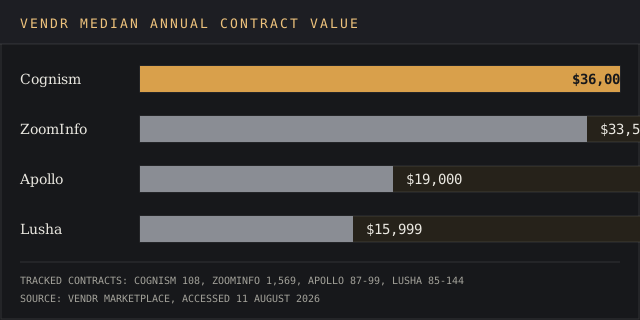
ZoomInfo's $33,500 Vendr median, across 1,574 purchases, is the closest live benchmark a Cognism buyer can bring to the negotiation.
Both review platforms put Cognism above 4.5 out of 5, a figure that sits oddly next to the standalone renewal complaints documented further down.
B2B data buyers compare seats, credits and intent add-ons on every call. Send the vendor and I'll source a version you own.
How much Cognism costs
Cognism's own pricing page, checked on 1 October 2026, lists no dollar figures anywhere. Every plan card ends in "Talk to sales" or "Talk to an expert," and the page's FAQ confirms the model is quote-only, tailored to team setup and usage. That leaves procurement data as the only independent check on what a contract costs.
Vendr's Cognism marketplace page, which used to publish a median, a range and an average saving, returned a 404 when checked on 1 October 2026, and its figures have no other live source. Any Cognism median quoted from it is now unverifiable.
G2's aggregated pricing data, built from buyer-reported figures, gives a read on negotiation room: reviewers there report an average discount of 15%, a nine-month return-on-investment window, and roughly a month to get the platform implemented.
The two packages: Standard and Pro
Cognism sells sales prospecting access as two packages, both listing 5 seats included and running on a credit system: one credit reveals one contact, previously revealed contacts stay visible at no extra cost, and the same credit pool covers the prospecting platform, CRM Enrichment, and API access.
Standard
Standard is built for what Cognism's pricing page calls "core prospecting workflows." It covers company revenue, headcount and HQ data, emails, mobile numbers, job titles and work history, technology usage, and hiring, funding and job-change signals. AI research, persona building and search, CSV enrichment, MCP and API access, SSO, live chat and an account manager come with it too. CRM enrichment and Data-as-a-Service are paid add-ons on both tiers.
Pro
Pro is marked "Most popular" on Cognism's pricing page and adds three features Standard lacks: a premium mobile filter, on-demand mobile verification, and Bombora-powered intent data, with administrators able to select up to 12 topics from a library of 11,000+. Everything else on Cognism's comparison, SSO and the account manager included, sits on both packages.
The premium mobile numbers, branded Diamond Data, are the feature most third-party pricing guides point to when explaining why Pro costs more. Salesmotion's pricing guide reports Cognism's own claim of a threefold improvement in connect rates over standard mobile data, and G2 reviewers it cites back that up, particularly for UK and EMEA contacts.
That gap justifies the jump from Standard to Pro mainly for teams whose outbound motion runs through cold calling, or who want intent data. The rest of the feature set, from company data and signals to SSO and the account manager, is identical between the two tiers.
The names Standard and Pro are recent. Cognism's plans started as Platinum and Diamond, were renamed Grow and Elevate, and now sell as Standard and Pro, according to Salesmotion's pricing guide, updated 11 June 2026, which tracks the same lineage Cognism's help centre still partly reflects.
A separate guide from Landbase, published 31 March 2026, still calls the plans Grow and Elevate and prices them accordingly, meaning it's describing a naming generation Cognism has already retired. Anyone quoting a "Grow" or "Elevate" price today is quoting a name Cognism's own site no longer uses.
| Feature | Standard | Pro |
|---|---|---|
| Seats included | 5 | 5 |
| Company revenue, headcount, HQ | Included | Included |
| Emails, mobiles, job titles, work history | Included | Included |
| Technology usage data | Included | Included |
| Premium mobile filter | Not included | Included |
| Mobile verification on demand | Not included | Included |
| Hiring, funding/M&A, job-change signals | Included | Included |
| Intent data (Bombora, 12 topics) | Not included | Included |
| AI company research, persona builder, search | Included | Included |
| MCP and API access | Included | Included |
| SSO | Included | Included |
| CRM enrichment | Add-on | Add-on |
| Live chat support | Included | Included |
| Account manager | Included | Included |
Copy these lines into an email, fill them in and send. I reply with scope and a price within 2 to 3 business days.
Open the emailFeature gating is Cognism's own published comparison, checked 1 October 2026.
Add-ons priced outside the platform fee
CRM Enrichment can be bought standalone or bolted onto either package. It uses the same credit pool, enriches a contact once, and only spends a credit again when that person changes jobs, according to Cognism's pricing FAQ.
Data-as-a-Service delivers Cognism data by API or bulk file. API access requires an existing prospecting seat; bulk delivery can stand alone. Cognism's own FAQ declines to price it in public, saying only that DaaS pricing "depends on how you want data delivered, the volume you need and the types of data fields required," and directs buyers to sales for a number.
What drives a Cognism quote
Seat count sets the floor: Cognism's SMB-focused page states that teams "with at least 5 salespeople often see the most value," which lines up with the 5-seat minimum baked into both packages. Four more variables move the number from there.
- Credit consumption: the volume of contacts a team reveals each year moves the price as much as headcount does.
- Package choice, Standard versus Pro: Pro's Diamond Data and intent-data additions carry a real cost gap that Cognism won't state in public.
- Geographic coverage, since global data access tends to cost more than region-specific coverage.
- Contract term length, since multi-year commitments typically unlock a lower annual rate.
Hidden costs to plan for
Cognism's own SMB FAQ claims there's "no hidden cost associated with access to the platform, keeping your outgoings predictable." A Capterra review shows where that promise breaks down: renewal control. Derek S., CMO at an 11 to 50-employee freight and package delivery company, described the experience after his team tried to leave:
"Cognism's backend does not give uses the control of their account, which credit cards to use, or executing renewals. Therefore, we had changed our sales model, and they notified me I could not cancel our subscription and we were auto renewed and notified via an email from our rep that went to the spam filter."Derek S., CMO, Capterra, 26 September 2025
The mechanism matters more than the sentiment: the account admin had no self-serve control over renewal or payment method, and cancellation had to route through a rep, since the product offered no dashboard toggle for it. That's a contract term to negotiate before signing.
Credit overage is the other cost to plan for. Cognism says each seat includes an allocation of credits and extra credits can be bought at any point, but it publishes no per-credit rate, so negotiate the top-up price before signing.
How to negotiate Cognism pricing
Never accept the first number. Credit volume and package choice move the price the most, so size both before the call. Bringing a competing quote works because reviewers say it worked for them:
"Quality of the data provided and pricing."Diogo S., Business Development Manager, machinery sector, on switching from ZoomInfo Sales, Capterra, 19 February 2025
"We switched to Cognism for better data accuracy, price, reliability, and an overall more effective prospecting experience."Melissa A., Sales Operations, information technology sector, on switching from Lusha, Capterra, 22 April 2026
Two more reviewers frame the cost as justified once volume and ROI are accounted for, which is worth reading before a negotiation:
"Can be expensive for the company, but given the ROI and time saved, the investment is well worth it."Naiya K., Senior Project Manager, events services sector, Capterra, 3 April 2025
"Credits can run out quickly if you are doing extensive list enrichment, but given the high accuracy of the data, the investment is well worth it."Yeray C., Director of Technology, international trade sector, Capterra, 16 June 2026
Lock renewal terms into the initial contract, before the renewal conversation starts. Given the documented gap in admin-level payment and cancellation control, ask for a capped annual increase and confirm in writing who on your team can execute a non-renewal before the notice window closes.
Who Cognism's pricing is built for
Cognism's SMB page targets teams of 5 or more salespeople, matching the seat floor on both packages, and pitches itself on European coverage and GDPR-first compliance.
The mid-market and enterprise pages don't publish a different pricing structure, but they add compliance language, ISO 27001 and SOC 2 alignment, and governance features that only make sense once a deployment crosses into dozens of seats. Cognism publishes no enterprise floor, and SSO and an account manager now come with both packages, so intent data and mobile verification decide the tier.
The enterprise page adds one more figure worth budgeting around: Cognism cross-references contact records against 15 global do-not-call lists and refreshes 95% of its director-level and above European contacts every 30 days.
Neither number changes the quote directly, but both carry weight with a compliance-heavy enterprise buyer during procurement.
Cognism against its alternatives
Apollo and Lusha both publish list prices, and Cognism and ZoomInfo don't. ZoomInfo carries the highest live Vendr median of the four, and Cognism has no live Vendr figure at all.
| Provider | Vendr median ACV | Tracked range | Published list price | Avg. savings off first quote |
|---|---|---|---|---|
| Cognism | No live Vendr data | No live Vendr data | None published | No live Vendr data |
| ZoomInfo | $33,500 | $7,220-$155,730 | None published | 21.81% |
| Apollo | $19,000 | $4,284-$45,000 | $0-$119/user/month | 30.17% |
| Lusha | $15,999 | $6,000-$70,403 | $0-$129+/user/month (custom above) | 10.93% |
Vendr medians, ranges and average savings from the stat block on each provider's Vendr marketplace page, accessed 1 October 2026. Vendr's Cognism page returned a 404 that day. Apollo and Lusha list prices from each vendor's own pricing page.
Apollo's published tiers run Free, Basic at $49 per user monthly, Professional at $79, and Organization at $119, all billed annually, yet its Vendr median still lands at $19,000 across 101 purchases.
Lusha's published range runs from a free plan to roughly $129 per user monthly on Premium, with Scale and Enterprise priced custom above that, and its Vendr median of $15,999 across 147 purchases is the lowest of the three with live Vendr data. Lusha's average savings of 10.93% is also the smallest gap on the table, which suggests its list price already sits closer to what buyers pay than Apollo's does.
Try it yourself
Sign up for Lusha
Free plan available, credit-based pricing after that.
 Visit Lusha →
May earn a commission if you sign up through this link, at no extra cost to you. Full affiliate disclosure.
Review ratings track roughly with price. G2 puts Apollo at 4.7 out of 5 across 9,713 reviews, ZoomInfo's GTM Workspace at 4.5 across 9,106, and Lusha at 4.3 across 1,665, against Cognism's 4.5 across 1,355. None of the four vendors separates itself on satisfaction alone, so the deciding factor for most buyers ends up being data coverage by region and the pricing model, credits versus flat per-seat licences.
What to budget
Budget from a written quote for a standard 5-seat Standard or Pro deployment, since Cognism publishes no price and Vendr's Cognism data is offline. Use ZoomInfo's $33,500 Vendr median as the nearest live benchmark, and expect a larger Pro rollout with Diamond Data and intent data to price above a 5-seat Standard deal.
Add CRM Enrichment or Data-as-a-Service on top if either is needed, since neither is bundled into the base quote, and keep headroom in the budget for a first quote that comes back high.
Frequently asked questions
How does Cognism pricing work?
Cognism prices every deal by quote. Its own FAQ states pricing is "tailored based on the product you need, your team setup and how you plan to use the platform," covering the Standard and Pro sales-prospecting packages plus separate CRM Enrichment and Data-as-a-Service pricing.
What's the difference between Standard and Pro?
Standard covers contact and company data, hiring, funding and job-change signals, AI research tools, CSV enrichment, MCP and API access, SSO and an account manager. Pro adds a premium mobile filter, on-demand mobile verification and Bombora intent data across up to 12 topics.
Does Cognism offer a free trial?
No. Cognism doesn't list a self-serve free tier or a time-limited trial on its pricing page. The closest option is a free data sample of 25 enriched leads, delivered within roughly 72 hours, offered through its SMB page.
Can I get a monthly Cognism subscription?
Cognism's pricing page doesn't state billing cadence, and Salesmotion's pricing guide reports Cognism contracts run annual and prepaid with no monthly option. Confirm the billing terms directly with sales before signing.
How is Data-as-a-Service priced?
Cognism doesn't publish DaaS pricing. Its FAQ says the cost depends on delivery method, data volume, and the specific fields required, and directs buyers to a sales conversation for a number.
How much does Cognism cost per user?
Cognism doesn't sell a per-user list price. Both packages include 5 seats, and the contract price comes only from a sales quote.
Bottom line
Cognism's pricing page will not give a shopper a number, and that's by design: every plan card ends in a sales conversation. Vendr's Cognism page, the one source of tracked contract values, went offline by 1 October 2026, so a buyer's own negotiation sets the price.
Verify the tier names before trusting any third-party price guide. Cognism has renamed its packages twice, and a guide still quoting "Grow" or "Elevate" pricing is describing a version of the product Cognism's own site no longer sells under those names.
Treat the renewal terms as a negotiating point up front. One documented review describes losing the ability to cancel or control payment methods after a sales-model change, the kind of contract clause worth resolving before signature.
Data vendors, outbound agencies and sales ops teams use reports like this one in competitive decks and renewal talks.
A report on your topic for a blog page, gated content or a lead magnet.
Written for your client and published under their brand, with my name left off.
Your report on marketintelligencetools.com, with 2 to 3 CTAs carrying your sponsored links.
Default terms: the report is yours to publish, and I keep the right to republish it on this site behind a gate, outside Google's index.
Sources
Package features and add-on descriptions are Cognism's own published figures, read off cognism.com/pricing, checked 1 October 2026. Vendr's Cognism page, vendr.com/marketplace/cognism, returned a 404 on 1 October 2026, so its contract figures were removed from this report. ZoomInfo, Apollo and Lusha figures are read off each vendor's Vendr marketplace stat block on 1 October 2026.
Plan-name history is from Salesmotion's and Landbase's pricing guides. Buyer quotes are verbatim from named Capterra reviewers.
Disclaimer
This page includes one or more affiliate links. If you sign up for a product through one of them, this site may earn a commission at no extra cost to you.