Amplemarket pricing: what the Startup, Growth and Elite tiers cost
 By Jan Suski. I go deep on every review, checking every number against its source and digging up details other coverage misses, a habit from six years of SEO and link building for tech companies. Bylines at Surfer, Brand24, and Senuto. How the scoring works.
· Prefer this source on Google
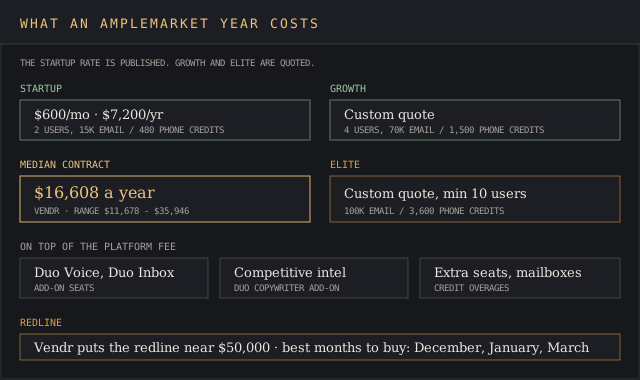
Amplemarket’s cheapest tracked contract, $11,678 a year per Vendr’s marketplace data, already runs above the $7,200 two seats cost on the published Startup plan. The high end, $35,946, is more than triple that. Amplemarket prices exactly one tier in public: $600 a month for Startup, with two users included, and quotes Growth and Elite entirely through a sales call built around seat count, contact targets and monthly data volume.
This report covers what the $600 Startup price buys, what the unpriced Growth and Elite tiers gate behind a form, and how Amplemarket compares against Apollo and Outreach. It’s built for a sales or ops lead who needs a real budget number before the first call. Amplemarket’s own pricing page lists credit counts and seat minimums, but drops the dollar sign the moment a buyer needs Growth or Elite.
The numbers Amplemarket pricing, checked 13 August 2026
A team of two can start Amplemarket for a known $7,200 a year; everything past ten users runs through an unpublished quote.
Vendr's tracked median sits well above the Startup sticker price, so most closed deals land inside Growth, above the entry rate.
Past that $50,000 redline, further discounting gets harder to secure.
Elite's 10-user floor gates dedicated support and single sign-on by headcount alone, with no lower-seat path to either.
How much Amplemarket costs
Amplemarket runs three tiers, and only the Startup plan carries a published price. Startup costs $600 a month, billed annually, and covers two users; that's the only exact pricing on the page, and it anchors the rest of Amplemarket pricing against a number nobody has to negotiate.
The Growth plan and Elite plan both require a sales conversation, with Amplemarket's own pricing page stating plainly that the custom pricing scales with the number of users, the contacts targeted and how much data a team pulls each month.
Every plan bills annually. There's no monthly billing flexibility at any tier, and the free trial Amplemarket's pricing page now advertises comes with no stated length, so a team should confirm the window directly before treating it as a real test period against a full year of commitment.
That annual lock-in raises the stakes on the first purchase far more than it would for a tool with real monthly plans, and it's the single biggest gap in Amplemarket's pricing transparency. The Startup plan is the entry point; everything past it runs through a sales conversation, with no published rate card a buyer can check alone. Amplemarket pricing is published for two users and disclosed only through a sales conversation for everyone past that.
The plan tiers
Startup plan
The Startup plan is built for founders and small teams kicking off an outbound strategy. It includes 2 users, 13,500 email credits per user per year, 600 phone credits per user and 2 mailboxes.
Searcher filters are the basic tier. Buyer intent signals and job change alerts, capped at 500 tracked contacts, now come included on Startup, both paid add-ons when this report first published. Startup is also the only tier where the contact data volume, the credit consumption ceiling and the seat count are all fixed numbers.
Growth plan
The Growth plan is priced for scaling sales teams and includes 4 users, 35,000 email credits per user per year, 5,000 phone credits per user and 4 mailboxes. Growth unlocks advanced searcher filters, 4 custom data requests, and adds Duo Voice, Amplemarket's AI voice feature, to the multichannel sequences already on Startup.
Buyer intent signals, job change alerts capped at 1,000 contacts, and single sign-on are now included at this tier too, all three either paid add-ons or Elite-only when this report first published.
Growth is also where linkedin automation and phone-based outreach channels get real credit headroom, well past the tighter Startup ceiling. Additional users beyond the included 4 go back into the same custom-pricing conversation as the base quote.
Elite plan
The Elite plan requires a minimum of 10 users, the only tier with a floor on headcount. It includes 40,000 email credits per user per year, 9,600 phone credits, 8 mailboxes and up to 1,000,000 exportable contacts, plus 12 custom data requests, job change alerts capped at 2,000 contacts, dedicated customer support and single sign-on.
Elite is built for a B2B sales team running Amplemarket across a full revenue org, drawing against Amplemarket's full database of more than 200 million AI-verified contacts, refreshed on a rolling weekly basis.
Compare the tiers yourself
See Amplemarket's plans firsthand
Startup includes 2 users and 15,000 email credits per user a year, starting at $600/mo.
May earn a commission if you sign up through this link, at no extra cost to you. Full affiliate disclosure.
Key features included in the subscription
The gap between tiers goes beyond credits. Several features move from unavailable to add-on to included as a team steps up, and a buyer comparing quotes should check each row. Credit counts alone don't tell the whole story. Data quality and data accuracy don't change across tiers, since every plan reads from the same contact data and the same CRM data sync; what changes is volume, seats and support depth.
| Feature | Startup | Growth | Elite |
|---|---|---|---|
| Searcher filters | Basic | Advanced | Advanced |
| Custom data requests | 0 | 4 | 12 |
| Buying intent signals | Included | Included | Included |
| Job change alerts | Included (500) | Included (1,000) | Included (2,000) |
| Duo Voice (AI voice) | Not included | Included | Included |
| Mailboxes per user (from) | 2 | 4 | 8 |
| Customer success manager | Community | Personalised | Dedicated |
| Single sign-on (SSO) | Not included | Included | Included |
Duo Copywriter and Duo Competitive Intelligence sit outside the seat-and-credit ladder; both now show as standard included features on every tier's card, a change from the paid add-ons Vendr's contract data recorded when this report first published. Duo Inbox is the one still gated: Amplemarket labels it Add-On on Startup, doesn't list it on the Growth card at all, and includes it standard on Elite.
A long list of features doesn't move at all between Startup, Growth and Elite, and a buyer comparing quotes shouldn't pay a premium expecting to unlock them at a higher tier. Amplemarket's own plan-comparison page lists these as standard across all three:
- Contact and company search against Amplemarket's B2B database, plus LinkedIn prospecting through its Chrome extension.
- Data enrichment and calendar enrichment.
- Email validation, integrations with tools like Salesforce and HubSpot, and multichannel sequences spanning email, LinkedIn and calls.
- Automatic LinkedIn sequences, workflows for automating repetitive tasks, and analytics covering the outbound funnel.
- An outbound dialer plus deliverability tooling built to protect inbox placement, from a Domain Health Center to a Deliverability Booster.
- Onboarding and support, scaling from a community track on Startup to a dedicated customer success manager on Elite.
That list is the argument behind Amplemarket's consolidation pitch: a team buying the Startup plan already gets the dialer, the deliverability stack CRM integrations, and account for the entry-level credit count. What gates a tier upgrade is credits, seats, custom data requests and support depth. The core feature list stays fixed across every tier.
Lead generation and account research both draw on the same underlying database at every tier, and an Amplemarket account provisioned on Startup runs the same automatic LinkedIn sequences and linkedin automation as one on Elite.
A team relying mostly on linkedin outreach still pays the same platform fee, since Amplemarket doesn't price by channel. What a lower tier can't do is run those multi channel sequences at volume before hitting its credit ceiling.
Add-ons priced outside the platform fee
Vendr's tracking of Amplemarket's own packaging lists a set of add-ons sold separately from the base platform fee, priced apart from the seat and credit bundle:
- Duo Voice
- Duo Inbox
- Competitive Intelligence
- Duo Copywriter
- A Deliverability Seat
- An Engagement Seat
- Buyer intent signals and job change alerts, on the Startup and Growth plans
Amplemarket's pricing page, rechecked 9 September 2026, now shows buyer intent signals, job change alerts, Duo Copywriter and Duo Competitive Intelligence as standard included features on the tiers this report compares. Vendr's list above reflects packaging as recorded when this report first published, so a buyer should confirm current line items directly before signing.
A team already paying for LinkedIn Sales Navigator or a separate cold email tool should count that spend against Amplemarket's bundle, since Sales Navigator access isn't included at any tier.
A buyer modeling total cost should ask which add-ons a Growth plan or Elite plan quote already bundles in, since Amplemarket's sales team can fold some of this list into custom pricing without listing it as a separate line item. Specialized AI agents, including Duo's AI account summaries and Duo's outreach drafts, ride on top of the base seat price.
What drives a custom quote
Growth and Elite pricing moves on three inputs: the number of users, the contacts targeted and the monthly data volume a team pulls. None of those three is fixed the way the Startup plan's 2-user, 15,000-credit structure is, so two companies buying Growth can land on meaningfully different annual numbers depending on how aggressively they prospect.
Elite adds a floor on top of those variables: a minimum of 10 users before Amplemarket will quote the tier at all, which pushes Elite out of reach for teams that want the tier's features (dedicated support, SSO, the deepest credit allotment) without the headcount to justify it.
Amplemarket doesn't publish what those custom quotes land on, but third-party pricing tracker marketbetter.ai estimates Growth quotes in the $2,000 to $5,000 a month range and Elite quotes between $10,000 and $50,000 a month; Amplemarket has confirmed neither figure, and Vendr's tracked median of $16,608 a year (roughly $1,384 a month) sits well inside that Growth estimate.
Get a real quote
Request Amplemarket pricing
Vendr's tracked median contract runs $16,608 a year, about $1,384 a month.
May earn a commission if you sign up through this link, at no extra cost to you. Full affiliate disclosure.
Hidden costs that sit outside the subscription
The annual-only billing structure is the first hidden cost, since it converts what looks like a monthly decision into a full-year commitment before a team has run a single quarter of sequences. There's no monthly option to fall back to if the platform turns out to be the wrong fit three months in.
Credit overages are the second. One G2 reviewer described the mechanics directly:
"The credit expense can easily go high when you enroll contacts in a sequence. So without a strategy, it can get a little expensive. You need to make sure you are spreading those credits throughout the month so you don't run short on it."
Gloriana Z., G2 review, May 15, 2026
Amplemarket doesn't publish an overage rate, so a team that burns through its annual credit allotment early needs to ask what a top-up costs before it happens.
Additional users work the same way: Startup and Growth both list a specific included-user count, and adding headcount beyond it means going back to Amplemarket for a revised quote. Pricing tracker marketbetter.ai estimates roughly $300 to $400 a month per extra seat, a figure Amplemarket itself has never confirmed.
None of this is disclosed on Amplemarket's pricing page itself. The credit system outweighs the seat price as the real hidden cost in the contract. A domain protection stack that runs alongside outbound efforts also draws from the same credit system, so heavy warm-up usage competes with sequencing credits inside one shared pool.
What buyers pay in practice
Vendr's tracked purchase data puts the median Amplemarket contract at $16,608 a year, with a low of $11,678 and a high of $35,946. That spread sits well above the $7,200 a team would pay for two Startup seats, which means most tracked contracts include either a Growth-tier quote, additional seats on Startup, or both.
Vendr estimates the redline threshold, the point past which further discounting gets harder to secure, near $50,000. It also flags December, January and March as the strongest months to buy, timing that lines up with Amplemarket's fiscal year-end on December 31 and the kind of quota-driven urgency that shows up around close periods.
Vendr's data also notes that Amplemarket allows only upgrades once a contract is signed. A team that overbuys Elite seats to hit the 10-user minimum can't drop back to Growth mid-contract if headcount shrinks, which makes the initial seat estimate worth getting right.
That published price gap, one real number against two custom quotes, is exactly why Vendr's tracked range is worth reading before the first sales conversation.
Who Amplemarket is priced for
The Startup plan targets a team of two just starting outbound, but at $600 a month on a required annual contract, it's a steep entry price for a founder who hasn't proven outbound works yet. Growth and Elite are built for teams that already know they'll use the seat count and credit volume they're quoting, since the custom-pricing structure only makes sense once usage is predictable.
A solo marketer or an early-stage founder testing outbound for the first time is better served by a lower-commitment tool, since Amplemarket's annual lock-in is a significant commitment against a strategy that hasn't been tested yet. A revenue team consolidating multiple point solutions into one platform, and confident it'll run the seats and credits it buys, is the buyer Amplemarket's tier structure is built around.
Sales leaders evaluating Amplemarket against a stack of other tools should also weigh support depth: Startup gets community support, while Elite gets a dedicated customer success manager who can flag credit consumption issues before they become an overage bill.
Team size is the clearest signal of fit. Two users map cleanly to Startup, four map to Growth's included count, and anything below the 10-user Elite floor means a team either overpays for Elite's per-seat allocation or stays on a Growth quote that keeps scaling as headcount grows. Mapping a hiring plan against those three breakpoints before signing is worth the ten minutes it takes.
Find your tier
Start with Amplemarket's Startup plan
Built for a two-person team at $600 a month before scaling into Growth or Elite.
May earn a commission if you sign up through this link, at no extra cost to you. Full affiliate disclosure.
How to negotiate Amplemarket pricing
Vendr's own negotiation guidance for Amplemarket centers on competition and growth as levers: naming alternatives under evaluation, stating a budget ceiling explicitly, and using a planned increase in seats as a reason to ask for a lower per-user rate. Vendr also recommends pushing to strip auto-renewal clauses out of the contract, so a team isn't locked into a second year on terms it never re-negotiated.
User reports back up the idea that Amplemarket's pricing lands reasonably once a team is using the bundle. One reviewer wrote plainly:
"Pricing seems very reasonable for the amount of product you get, so much potential and strongly believe the product is only going to get better and better."
Verified User in Computer Software, G2 review, July 15, 2026
Another framed the value as what it replaced:
"Cost - reduced our tool spend by 56%"
Verified User in Translation and Localization, G2 review, June 10, 2026
A third reviewer put it in blunter terms after a multi-year contract:
"Best cash we've put into a sales software to date."
Jessica W., Capterra review, September 9, 2019
And one reviewer summed up the entry-tier calculation directly:
"It's good value for the price."
Lewis B., Account Executive, Mid-Market, G2 review, August 11, 2026
None of those four quotes name a negotiated figure, which fits the pattern: Amplemarket's published pricing gives buyers exactly one number to react to, and everything past it happens in a sales conversation that doesn't leave a public paper trail. Vendr's tracked contract range is the closest thing to that missing trail, and asking for volume discounts as headcount grows is the lever Vendr's own guidance points to first.
A buyer who wants a second opinion before that sales conversation can check our Amplemarket review for the full pricing breakdown, alongside G2 and Capterra for pricing mentions specifically, since most reviewers write about ease of use and data accuracy without touching cost at all.
The pricing-specific comments that do exist skew toward "good value," which is a weaker signal than a published rate card but still worth weighing against a first quote that feels high.
Amplemarket pricing against competitors
How Amplemarket compares to a cold email tool, a linkedin outreach point tool, or a single-channel outreach product depends on what a team already owns. An Amplemarket alternative that only handles email or LinkedIn, like a pure cold outreach sender running lighter AI agents than Duo, will always look cheaper on a per-seat basis because it isn't bundling contact data, a dialer and deliverability tooling into the same bill.
The competitive set splits into three sales engagement price bands. Outreach and Salesloft sit alongside Amplemarket in the enterprise engagement tier, typically four figures a month on custom terms. Apollo, Reply.io and Clay occupy the mid-market band at roughly $49 to $150 per seat per month. Salesforge and SalesRobot compete as small-team point tools, with SalesRobot starting at $59 a month and no annual contract required.
| Tool | Entry price | Billing | Where it fits |
|---|---|---|---|
| Amplemarket | $600/mo (Startup)* | Annual only | Bundled data, outreach and AI signals |
| Outreach | Four figures/mo | Annual, custom | Enterprise sales engagement |
| Salesloft | Four figures/mo | Annual, custom | Enterprise sales engagement |
| Apollo | ~$49-$150/seat/mo | Monthly or annual | Mid-market prospecting and outreach |
| Reply.io | ~$49-$150/seat/mo | Monthly or annual | Mid-market multichannel outreach |
| Clay | ~$49-$150/seat/mo | Monthly or annual | Data enrichment and workflow automation |
| SalesRobot | $59/mo | No contract required | Small-team point tool |
*Vendr's tracked median for Amplemarket is $16,608/yr; list price shown is Amplemarket's published Startup rate.
Amplemarket's pitch against that field is consolidation: one bill, replacing a data provider, an outreach tool and a deliverability tool bought separately. That pitch holds up better for a team already spending across several of those categories than for one comparing sticker prices line by line.
The comparison also cuts the other way. Apollo, Reply.io and Clay publish per-seat rates a buyer can add up without needing to contact sales, while Amplemarket asks a team to trade that transparency for a bundle it has to trust is worth the premium. A team that only needs outreach and already owns a data provider is paying for capability it won't use inside Amplemarket's bundle.
ZoomInfo's permanent free tier is the sharpest contrast: it costs nothing to start and includes 10 export credits a month, against Amplemarket's $600 Startup floor and required annual contract. The free tier caps out fast against ZoomInfo's own paid database of 500 million contacts and 100 million companies (its Sales Professional tier alone carries 120 million direct-dial phone numbers) and skips the multichannel engagement Amplemarket bundles in from day one.
Outreach and Salesloft compete on multichannel outreach depth, and neither publishes a rate any more transparently than Amplemarket's own Growth and Elite plans do. Apollo pairs a lower entry price with lighter multichannel outreach and AI voice coverage than Amplemarket's Growth tier.
Customer support depth is another axis worth pricing in. Amplemarket's dedicated support only shows up on Elite, while Outreach and Salesloft typically bundle a named customer support contact into enterprise deals from the first contract, custom pricing or not.
A team weighing a data-first alternative can check the Crunchbase pricing report, the Cognism pricing report, or the Lusha pricing report for how those vendors structure the same tradeoff between a published rate and a custom quote.
See the bundle live
Sign up for Amplemarket
Startup plan starts at $600/mo, billed annually.
May earn a commission if you sign up through this link, at no extra cost to you. Full affiliate disclosure.
Common questions about Amplemarket pricing
What is Amplemarket's annual revenue?
Third-party trackers put Amplemarket's estimated annual recurring revenue near $14.9 million for 2024, up from about $4.1 million in 2022. Those are external estimates, since Amplemarket is privately held and hasn't published revenue directly.
Who is the CEO of Amplemarket?
João Batalha is CEO and co-founder of Amplemarket, alongside Luís Batalha as chief product officer and Micael Oliveira as chief revenue officer. All three founded the company toward the end of 2019 and still run it day to day.
Does Amplemarket offer a free trial?
Amplemarket's pricing page now advertises a free trial across every plan, a change from when this report first published, though it doesn't state a length anywhere on the page. Every plan still requires signing an annual contract. The advertised trial sits inside that annual term; it doesn't waive the commitment.
Is there a monthly billing option?
No. All three tiers bill annually, with no standalone monthly billing option available. Vendr lists Amplemarket's payment terms as annual billing with a monthly payment option, meaning the contract term is still a year even where the invoice arrives monthly.
What are Amplemarket's pros on pricing, and what should a buyer watch for?
Amplemarket pros on the pricing side are a published Startup rate, a feature set that doesn't gate core sales operations tools behind higher tiers, and a Vendr-tracked contract range that gives buyers a real benchmark.
The watch-outs are the annual-only billing, the unpublished credit-overage rate and the 10-user floor on Elite. Amplemarket reviews that touch pricing directly are rare enough that Amplemarket pricing research still leans on Vendr's contract data more than on review-site commentary.
What to budget
A team of two testing outbound should budget the known $7,200 a year for Startup and plan for at least one round of credit top-ups if sequencing volume runs high. A team past ten users should budget toward Vendr's tracked median of $16,608 as a starting assumption, and treat anything quoted near or above the $50,000 redline as a number worth pushing back on using the competition and growth levers above.
Whatever the tier, the annual-only billing means the number budgeted has to be right the first time. There's no scaled-down monthly option to fall back to if the estimate runs short. How many contacts a team plans to target each month is the single number that should drive that budget conversation, since it's the input Amplemarket's own custom pricing scales against.
Budget the real number
Try Amplemarket's Startup plan
A two-user Startup contract runs $7,200 a year before any add-ons.
May earn a commission if you sign up through this link, at no extra cost to you. Full affiliate disclosure.
Bottom line
Amplemarket pricing is published at the bottom and disclosed only through the sales process everywhere above it. The $600 Startup rate answers the question for a two-person team; Growth and Elite answer it only after a sales call, and Vendr's tracked contract data, a $16,608 median against an $11,678 to $35,946 range, is the best public evidence of where those conversations land. Only the Startup plan gives a buyer a number to check before that call ever happens.
The annual-only billing structure raises the cost of getting the decision wrong, since there's no monthly billing fallback if usage doesn't match the quote.
A buyer walking into that sales call with Vendr's numbers, the redline estimate and a stated budget ceiling is negotiating Amplemarket pricing from a stronger position than one reacting to Amplemarket's first offer, if the goal is cold outreach at small scale or a full multichannel sequences rollout across a ten-person floor on Elite.
Sources, and what Amplemarket doesn't publish
Plan pricing, credit allotments and feature gating from amplemarket.com/pricing and Amplemarket's plan-comparison page. Contract value, purchase-count, low-high spread, redline estimate, buy-timing and negotiation guidance from vendr.com/marketplace/amplemarket. Revenue estimates from third-party trackers, since Amplemarket doesn't publish revenue directly.
Growth- and Elite-tier dollar ranges and per-seat overage estimates from marketbetter.ai, a third-party pricing tracker Amplemarket has not confirmed. Reviewer quotes from G2 and Capterra, dated individually in the text. All URLs accessed 13 August 2026.
Amplemarket does not publish what a Growth or Elite quote costs, what a credit top-up or an added seat costs beyond the included count, or a rate card past the Startup tier.
Disclaimer
This page includes one or more affiliate links. If you sign up for a product through one of them, this site may earn a commission at no extra cost to you.
Changelog
9 September 2026: Amplemarket's own pricing page moved since this report's 30 August update, and the figures below now match what's live today.
Startup credits changed to 13,500 email and 600 phone credits per user a year, previously 15,000 and 480. Growth credits changed to 35,000 email and 5,000 phone credits per user a year, previously 70,000 and 1,500.
Elite credits changed to 40,000 email and 9,600 phone credits per user a year, with 8 mailboxes, previously 100,000, 3,600 and 6.
Buyer intent signals and job change alerts now come included at every tier; both were paid add-ons before, with job change alerts capped at 500 tracked contacts on Startup, 1,000 on Growth and 2,000 on Elite.
Single sign-on is now included at Growth. It was Elite-only before. Duo Copywriter and Duo Competitive Intelligence now show as standard included features; Vendr's contract data recorded both as separately priced add-ons when this report first published.
Amplemarket's pricing page also now advertises a free trial across every plan, without stating a length, where none was published before.
Figures corrected against amplemarket.com/pricing, fetched live 9 September 2026. Vendr's tracked contract data (median, low, high, redline) and the competitor comparison table weren't rechecked in this pass and stay unchanged from the 30 August update.