Go-to-Market Plan Template
 By Jan Suski. I go deep on every review, checking every number against its source and digging up details other coverage misses, a habit from six years of SEO and link building for tech companies. Bylines at Surfer, Brand24, and Senuto. How the scoring works.
· Prefer this source on Google
A go to market plan is a roadmap for bringing a product or service to customers: who it's for, how it's priced, which channels carry it to target customers, and how the team will know it worked. A go to market strategy is a step-by-step launch plan, and this go-to-market plan template walks through every section a real GTM strategy needs before a launch date gets set.
A GTM strategy aligns product, marketing, sales, customer support, and operations teams around the same plan, which is the part a rushed launch usually skips: everyone agreeing on the target audience and the pricing strategy before any marketing campaigns go live.
Download the Free Go-to-Market Plan Template
Download the go-to-market plan template (XLSX)Target market and customer segment, value proposition, pricing strategy, distribution and sales channels, and KPI tracking, plus a worked example filled in.
Go-to-Market Strategy vs Marketing Plan
A go to market strategy and a marketing plan are not the same document, even though they overlap. A go to market strategy covers the full path from product to revenue: pricing strategy, sales strategy, distribution channels, and the sales team's role, alongside the marketing plan. A marketing plan covers awareness and demand generation specifically: marketing channels, marketing campaigns, and the marketing costs behind them.
Marketing plans should build awareness and coordinate messaging across all channels, but a go to market strategy has to answer a wider set of questions: how the sales process will work, what the business model assumes about margins, and what distribution channels get the product in front of prospective customers in the first place.
A complete go-to-market strategy therefore contains a marketing plan as one section among several. The nesting runs that way round. Confusing the two is a common early-stage mistake: a startup that writes only a marketing plan has a go to market process for awareness, but no answer for pricing, sales enablement, or distribution.
The four Ps of marketing are product, price, place, and promotion, and every go to market strategy answers a version of all four even when it doesn't use that exact language.
Why a GTM Strategy Matters
A strong GTM strategy can accelerate revenue growth by reducing the time a product spends finding its market on its own. GTM strategies help businesses understand market demands and customer needs before committing marketing costs to a launch that hasn't been validated.
Effective GTM strategies can reduce time to market for new products by resolving pricing, positioning, and channel decisions ahead of launch day, before every unresolved question becomes a fire the sales team has to fight live with a prospective customer on the phone.
A solid GTM strategy also protects against the most expensive mistake in a product launch: building the right product for the wrong target market, or the right target market with a business model that doesn't cover customer acquisition cost.
Key Elements of a Go-to-Market Strategy
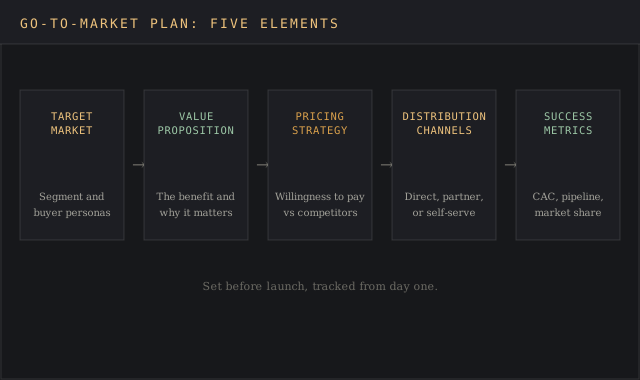
A complete go-to-market strategy defines five elements before launch:
- Target market and target customers
- Value proposition
- Pricing strategy
- Distribution and sales channels
- Key performance indicators
Target Market and Target Customers
A target audience is a group with shared characteristics: industry, company size, role, or behavior, that make target customers more likely to buy. Identifying target customers involves creating Ideal Customer Profiles and buyer personas, so a go to market strategy pursues one defined segment first.
Value Proposition
A value proposition defines the benefit of a product or service, and a strong value proposition addresses customer pain points directly. Value propositions should be tailored to specific target audiences, since the same product often solves a different problem for a different customer segment.
Pricing Strategy
The pricing strategy should reflect customer willingness to pay and competitive positioning on top of internal cost-plus math. The monetization strategy template scores candidate revenue models and prices the tiers before this field gets filled in. A pricing strategy set without competitive analysis often either leaves revenue on the table or prices the product out of the target market it was built for.
Distribution and Sales Channels
Sales channels include direct and indirect sales methods, and distribution channels can involve wholesalers and retailers depending on the product. Choosing sales channels depends on product nature and customer needs: a high-touch enterprise sale needs direct sales and a dedicated sales team, while a self-serve product can rely on digital marketing channels alone.
Key Performance Indicators
Key performance indicators include conversion rates and customer acquisition costs, tracked from day one so a GTM strategy can be measured against real numbers, the same discipline an OKR tracker applies to broader company goals. Success metrics should be agreed before launch. Assembled afterward, they justify whatever happened.
How to Build a Go-to-Market Strategy
Step 1: Conduct Market Research
Confirm real demand before spending a launch budget. Market research has to confirm real market demand exists before committing further resources to the go to market plan.
Step 2: Define Target Market and Target Customers
Build buyer personas from real customer insights. Define the target market and target customers precisely.
Step 3: Craft the Value Proposition and Key Messaging
Get marketing and sales describing the product the same way. Craft the value proposition and key messaging, making sure the marketing strategy and the sales strategy use identical language.
Step 4: Set the Pricing Strategy
Price against competitive analysis. Set the pricing strategy informed by competitive analysis and customer feedback on willingness to pay.
Step 5: Choose Distribution and Sales Channels
Match channels to how customers buy today. Choose distribution channels and sales channels that fit how target customers prefer to buy.
Step 6: Set Success Metrics and KPIs
Agree on numbers before launch. Set success metrics and key performance indicators the whole team will track once the launch is live.
Step 7: Prepare Internal Teams for Launch
Brief every team before launch week. Prepare internal teams, sales enablement materials, support scripts, and marketing collateral ahead of the launch date.
Run competitive analysis before finalizing the pricing strategy. A go to market strategy priced without a clear view of competitors' offerings tends to guess wrong in one direction or the other.
Business-to-Business vs Business-to-Consumer GTM Strategy
B2B strategies focus on long-term relationships and return on investment: business to business sales processes involve multiple decision-makers (economic buyer, technical evaluator, and end user) and longer sales cycles, so a B2B go to market strategy leans on sales enablement, account-based marketing, and a sales team trained to work through a multi-step approval process.
B2C strategies emphasize emotional appeal and lifestyle fit: business to consumer sales are typically more transactional with a single decision-maker, so a B2C go to market strategy leans harder on marketing channels like social media and search engine marketing to reach a broad customer base directly.
B2B marketing often uses email campaigns and webinars to nurture a long sales process, while B2C marketing relies heavily on social platforms and paid marketing campaigns built for faster, higher-volume decisions. A go to market strategy that borrows tactics from the wrong model, running a B2C-style awareness campaign against a committee-driven B2B sales process, tends to generate interest that the sales team can't convert.
Product Launch and Product-Market Fit
A go to market strategy for a product launch depends on product market fit already being established, at least directionally, before the launch budget gets spent. Launching into a market that hasn't confirmed real demand turns the go to market plan into an expensive research project. It stops being a revenue driver.
Product launch timing should follow market research and competitive analysis. A date set months earlier for internal reasons is the usual reason a launch misses. A product launch pushed forward because a marketing plan promised a specific quarter is one of the most common ways a go to market strategy underperforms its own targets.
Sales enablement has to be ready by launch day: a sales team that only learns the messaging the week of launch can't answer basic questions from potential customers, costing the business deals a better-prepared sales process would have closed.
Sales Strategy and the Sales Funnel
A sales strategy defines how the sales team moves a prospect through the sales funnel: from initial awareness, through the sales process, to a closed deal. Direct sales works well for high-value customers who need a relationship built over multiple calls; self-serve sales works for lower-price products where the sales funnel needs to move fast without a dedicated rep.
Sales and marketing teams have to agree on where marketing's job ends and the sales team's job begins in the funnel. A go to market strategy that doesn't define this handoff produces exactly the finger-pointing a business plan is supposed to prevent: marketing blaming sales for weak follow-up, and sales blaming marketing for weak lead quality.
Customer pain points identified during market research should show up again here, in the sales script and the objection-handling material the sales team uses live. A sales strategy built without that continuity forces prospects to re-explain their own problem partway through the sales process.
Marketing Strategy Within the GTM Plan
The marketing strategy inside a go to market strategy covers the channels, campaigns, and messaging that build awareness and drive demand: content marketing, search engine marketing, paid marketing campaigns, and the marketing channels a target audience uses day to day.
A marketing strategy includes clear goals tied to the same key performance indicators as the rest of the go to market strategy: customer acquisition cost, new customers acquired, market share gained.
Raise brand awareness early in the go to market process, since a marketing strategy that only starts generating demand the week of launch has no runway to build the audience a sales team will need to sell into.
Customer Acquisition, Retention, and Revenue Growth
Customer Acquisition Cost
Customer acquisition cost measures the cost to acquire a customer, and a go to market strategy has to keep that number below what a customer's lifetime value can support, or revenue growth becomes structurally unprofitable no matter how well the marketing strategy performs.
Customer Retention
Customer retention matters as much as customer acquisition to a go to market strategy's long-run economics: existing customers cost less to keep than new customers cost to win, and customer satisfaction data from the existing customer base often reveals gaps a go to market plan aimed only at new customers would miss.
Feedback Loops
Customer engagement after the sale, onboarding, support response time, renewal outreach, feeds back into customer insights that shape the next go-to-market cycle. A go to market strategy that treats the sale as the finish line loses the feedback loop that makes the second launch better than the first.
Competitive Analysis and Market Share
Competitive analysis identifies strengths and weaknesses of competitors, informing both the pricing strategy and the messaging a go to market strategy leans on. A multitiered approach improves competitive analysis effectiveness: direct competitors, adjacent alternatives, and the status quo a prospect might just keep doing.
Competitive analysis informs product positioning and messaging strategies, and understanding competitors helps in crafting a unique value proposition. Effective competitive analysis can reduce marketing costs by targeting the audience segment a competitor has left underserved, an easier win than competing head-on for the same customer base everyone else is already chasing.
Market share goals should be realistic against the competitive field a market analysis surfaces. A go to market strategy chasing an aggressive market share target in a market dominated by one entrenched competitor needs a different playbook than one entering a fragmented market with no clear leader.
Entering a New Market
A go to market strategy for a new market needs its own market research pass. A copy of the plan that worked in an existing market rarely survives contact. Customer segment definitions, pricing strategy, and even the value proposition itself often need real adjustment once local competitive analysis and industry trends are factored in.
Business objectives for a new market entry should stay modest in year one: proving product market fit in the new market matters more than hitting the same revenue growth targets the business model achieved in its home market. A go to market plan that overcommits on new-market revenue in year one usually pulls resources away from the fixes the new market needs most.
If the new-market entry is one of several growth bets on the table, score it against the others first in the Ansoff matrix template, which weighs each idea on revenue, investment and confidence.
Aligning Marketing Strategy and Sales Efforts
Sales and Marketing Handoff
A go to market strategy fails more often from a weak handoff between marketing strategy and sales efforts than from a weak product. Marketing and sales teams need a sales and marketing plan that names, in writing, where marketing strategy work ends and sales efforts begin.
Coordinating Messaging
Develop key messaging once, at the marketing strategy stage, and hand it to sales efforts unchanged. A marketing strategy that produces one message and a sales strategy that produces a different one is the single fastest way to lose a prospect's trust mid-funnel, since a buyer who hears two conflicting stories from the same company starts questioning both.
Aligning on the Customer Journey
Sales and marketing efforts stay coordinated best when they share the same view of the customer's path: what marketing strategy content a prospect saw before the first sales call, and what customer experience that prospect expects based on it. A marketing strategy promising fast onboarding, followed by a sales process that quotes a six-week implementation, breaks the customer experience before the deal even closes.
Reviewing Lost Deals Together
Customer experience feedback should flow back into the marketing strategy on a fixed schedule, and a lost deal should not be the trigger. Sales and marketing teams that review lost-deal notes together monthly catch a mismatched marketing strategy claim faster than a full go to market strategy postmortem run once a year would.
Building a Successful GTM Strategy Step by Step
A successful GTM strategy rarely comes from one department working alone. The go to market GTM process works best as a joint exercise between product, marketing, and sales, since a market GTM strategy written by marketing alone tends to underweight what the sales team already knows about ideal customer objections.
Gathering Market Feedback
A strong GTM strategy starts with the same market research used everywhere else in the plan, then adds one more layer: market feedback gathered directly from the ideal customer profile the plan is targeting, on top of secondary research. Ideal customer interviews surface objections a market analysis alone won't catch, and potential customers are often more candid in a live conversation than in a survey.
Protecting Competitive Advantage
A solid GTM strategy protects a competitive advantage by moving fast enough that a competitor doesn't close the same gap first. High value customers in particular respond to a go to market GTM plan that demonstrates understanding of their specific situation. A generic pitch aimed at the broadest possible list loses them.
Tracking Progress
Track the GTM strategy's progress the same way a team would track any other cross-functional initiative: a shared project management tool where marketing, sales, and product can all see the same timeline.
A market GTM strategy reviewed weekly against that shared timeline catches a slipping deliverable while there's still time to recover the launch date.
Common Go-to-Market Strategy Mistakes
Skipping market research is the most common mistake, usually under pressure from an internal deadline that has nothing to do with confirmed market demand. A go to market strategy built on assumption, with no market research behind it, tends to discover its target market was wrong only after the launch budget is already spent.
Treating the marketing plan as the entire go to market strategy is the second mistake. A business plan needs to define pricing strategy, sales strategy, and distribution channels alongside the marketing plan, or the launch has demand with no coherent way to convert it.
Ignoring sales enablement is the third mistake. A go to market strategy that invests heavily in marketing channels but leaves the sales team unprepared converts less of the demand it generates than a leaner marketing plan paired with a well-trained sales process would.
Choosing Marketing Strategy Channels and Tactics
A marketing strategy inside a go to market GTM plan has to pick channels deliberately. A marketing strategy built around content and search engine marketing suits a longer sales cycle where a target audience researches before buying; a marketing strategy leaning on paid social and display suits a shorter, more impulse-driven purchase.
Buyer personas should drive marketing strategy channel choices directly. A marketing strategy aimed at a technical buyer persona needs different marketing efforts than one aimed at an executive buyer persona: the technical persona reads documentation and community forums, while the executive persona responds to a marketing strategy built around case studies and peer references.
A marketing strategy also needs a competitive advantage angle: what a competitor's own marketing strategy leaves unaddressed, an underserved target audience, an ignored pain point, a channel a competitor hasn't invested in yet. Building the marketing strategy around that gap gives a market GTM strategy a clearer shot at cutting through than a marketing strategy that copies what every other player in the category already runs.
Budget allocation across the marketing strategy should track back to the pain points identified in market research, spending more where a target audience's stated pain points are most acute and where the strategy has the clearest path to prospective customers already showing buying intent.
A marketing strategy spread evenly across channels regardless of where the target audience spends its attention wastes budget on the channels that were never going to convert.
Review the marketing strategy against the same success metrics as the rest of the go to market GTM plan: cost per lead by channel, conversion rate by buyer persona, and how each marketing strategy tactic contributes to the pipeline the sales team is working. A marketing strategy that can't be measured against those numbers is a set of activities. A go to market strategy needs more than that.
A Worked Example
A B2B software company preparing to enter a new market segment starts with market research confirming demand among mid-size logistics companies, a customer segment its existing product hadn't targeted directly.
The team builds a go to market plan around that customer segment: a value proposition centered on reducing dispatch errors, a pricing strategy tiered by fleet size, and a sales strategy combining inbound content marketing with a direct sales team for larger accounts. Distribution runs through the company's existing sales channels, supplemented with a new partner channel serving fleet management resellers.
Success metrics get set before launch: a target customer acquisition cost, a 90-day pipeline goal, and a market share target for the new segment within twelve months. Sales enablement material ships two weeks before the public launch date, so the sales team is fully briefed before the first marketing campaign drives any inbound interest.
Documenting the Plan for the Whole Team
A go to market strategy and its underlying marketing strategy only help the business if they're written down somewhere every function can reference. Held in one planner's head, it helps nobody. A shared document naming the GTM strategy's owner, its success metrics, and its review cadence keeps the marketing strategy from drifting the moment the person who wrote it gets pulled onto something else.
Revisit the GTM strategy on the same cadence as the marketing strategy itself, since market conditions that justified one channel mix at launch can shift within two quarters. A GTM strategy treated as a static document ages the same way an unmaintained marketing strategy does: quietly, until someone notices the numbers no longer match the plan.
FAQ
What are the 4 Ps of GTM?
Product, price, place, and promotion, the same four categories every go to market strategy has to address, say the plan calls them that directly or organizes them under different section headings.
What is an example of a GTM strategy?
A B2B software company launching into a new customer segment with a tailored value proposition, tiered pricing strategy, a mix of direct sales and inbound marketing, and success metrics tracked from day one is a typical example of a working go to market strategy.
What are the 5 pillars of go-to-market strategy?
The five pillars a complete go to market strategy has to define before launch:
- Target market and customer segment
- Value proposition
- Pricing strategy
- Distribution and sales channels
- Success metrics
What is the difference between a marketing plan and a go-to-market plan?
A marketing plan covers awareness, messaging, and marketing channels; a go to market plan covers that plus pricing strategy, sales strategy, and distribution, the full path from product to revenue. Demand generation alone won't close deals..
Bottom Line
A go-to-market plan works when a launch date arrives with pricing, distribution & sales enablement already locked. The worked example above ships sales material two weeks ahead of launch and sets a 90-day pipeline goal before the first campaign runs, the same sequencing any plan pulled from the templates hub should follow.
Confirm real market demand first, define the target market and value proposition precisely, set pricing and distribution deliberately, and track success metrics from day one.