Procurement intelligence tools: an AI-native buyer's guide for 2026
 By Jan Suski. I go deep on every review, checking every number against its source and digging up details other coverage misses, a habit from six years of SEO and link building for tech companies. Bylines at Surfer, Brand24, and Senuto. How the scoring works.
· Prefer this source on Google
Quick comparison of AI-native procurement intelligence tools
Columns carry only dimensions where these platforms measurably differ: primary job and if the AI is native or bolted on, and how much independent review evidence backs each one.
| # | Tool | Primary job | AI-native or specialist | Published pricing | Independent review base |
|---|---|---|---|---|---|
| 1 | Suplari | Spend and supplier intelligence | AI-native | No | Thin (1 review) |
| 2 | Beroe | Category intelligence | Analyst-led, adding AI | No | Thin (1 review) |
| 3 | D&B Ask Procurement | Conversational supplier risk | AI-native add-on | No | None found |
| 4 | Veridion | Supplier discovery, ESG | AI-native | No | None found |
| 5 | Supplier.io | Diverse and local suppliers | Specialist | No (3 named tiers) | Thin (1 review) |
| 6 | EcoVadis | Sustainability ratings | Specialist | No (est. $500-$11,000/yr) | Established |
| 7 | Coupa | Full spend management | Specialist + agentic AI | No (est. from ~$2,500/mo) | Established (569 reviews) |
| 8 | Thomasnet | Industrial supplier discovery | Specialist | Free directory, paid listings | Established |
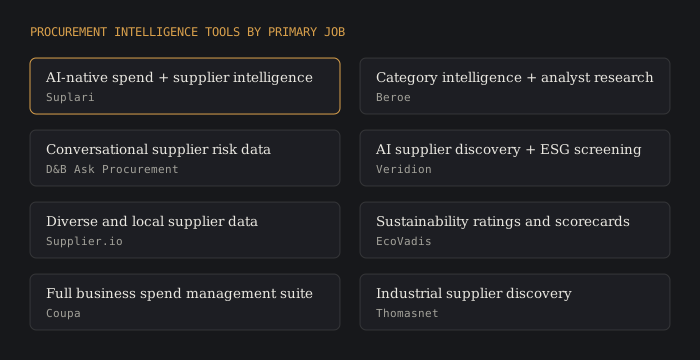
Market intelligence tools for procurement collect supplier data, spend patterns, and external risk signals, then feed the result through an AI layer built to flag what a category manager should act on this week. This guide ranks 8 of them, with a full features, pricing, and limits breakdown for each.
Most of these vendors don't publish a price list. Suplari, Beroe, Veridion, EcoVadis, and Coupa all sell through a custom quote, so a buyer comparing this category on sticker price alone is comparing five blank fields against three that at least name a tier structure.
The category also splits by ambition in a way that matters more than feature-count. Some tools, Beroe and Thomasnet, are built around a specific job (analyst-driven category research, industrial supplier discovery). Others, Coupa and Suplari, aim at the full spend-and-supplier picture. A buyer who names the job first narrows the shortlist faster than one who starts from a feature checklist.
Buyers researching AI for procurement, or AI in procurement more broadly, tend to land on this same shortlist regardless of which phrase brought them here. The eight tools below cover the range from fully AI-native platforms to established specialists layering AI features on top of an existing product.
Tool facts, funding figures, and ownership status were verified on 26 July 2026. Two facts in this guide have genuine source conflicts that couldn't be resolved; both are flagged where they appear. For the vertical-wide picture beyond these eight tools, our procurement market intelligence guide covers the full spend-and-supplier market.
Software that runs the buying process itself, intake, sourcing execution, invoice matching, is a separate category ranked on our AI procurement software page.
Where AI adoption in procurement stands
80% of chief procurement officers plan to deploy generative AI in some capacity over the next three years, per EY's Global CPO Survey: 2025 Outlook, published February 2025. Adoption today falls well short of that ambition: only 36% of procurement organizations report a meaningful AI implementation in place right now.
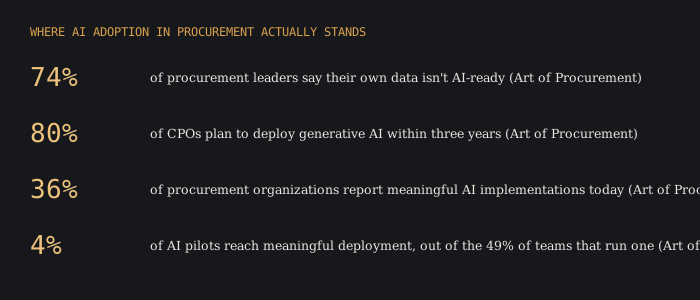
The gap between pilot and production is the real story. 49% of procurement teams run an AI pilot, and only 4% of those reach meaningful deployment. Data quality is the reason most often cited: 74% of procurement leaders say their own spend and supplier data isn't AI-ready, per Gartner's 2025 Leadership Vision for Chief Procurement Officers, and integration complexity compounds the problem once a pilot tries to reach production scale.
That gap is exactly why this guide separates AI-native tools, built from the ground up on procurement datasets, from specialist platforms that added a generative-AI layer on top of an existing data business.
Neither approach is automatically better; the right one depends on how clean internal data already is. Clean enough, and an AI-native tool can work directly against it. Not clean enough, and a specialist's curated external research closes the gap faster.
Adoption moved fast in the past year. The Hackett Group's 2026 Procurement Key Issues Study, published 17 March 2026, found 43% of organizations actively pursuing AI deployment, close to double the level reported the year before, while only 12% report large-scale implementation.
The same study reports 80% of procurement executives naming AI as the most transformational trend affecting the function over the next five years. Hackett describes the early gains as cycle time reduction and productivity without attaching a percentage to either.
Deloitte's 2025 Chief Procurement Officer Survey, covering more than 250 CPOs across 40 countries, puts a number on the payoff gap: its Digital Masters average a 3.2x return on generative AI investment against slightly above 1.5x for Followers.
Evaluation criteria for procurement market intelligence tools
Six factors separate a platform worth a pilot from one that produces a confident-looking dashboard nobody trusts.
- Spend analytics depth. Automated classification, drilldown by category and supplier, and savings-tracking against a baseline in place of a static export.
- Supplier intelligence and external market feed integration. Continuous news, financial, and risk-signal ingestion layered against your own supplier master, run well past a one-time enrichment pass.
- AI-native architecture and natural language processing. A model trained on procurement-shaped data, with real natural-language querying against contracts and spend.
- Deployment speed and integration fit. How the tool connects to your ERP, source-to-pay suite, and contract repository, and how long that connection realistically takes.
- Scalability across categories. How the tool holds up once it's covering fifty spend categories, up from the five used in the demo.
- Commercial terms and support. Published pricing versus a quote, contract length, and what implementation and ongoing support cost on top of the license.
Test any AI-native claim against your own contracts and spend data during the pilot. A model trained on clean demo data can look sharp and still choke on your actual spend taxonomy.
What procurement professionals need from these platforms
Procurement professionals evaluating this category are rarely starting from zero. Most already run procurement software for the transactional side of the procurement process, purchase orders, approvals, basic reporting, and want a layer that turns procurement operations into strategic initiatives.
The best procurement intelligence platforms earn a place in that stack by feeding data driven insights straight into the procurement workflows a team already runs.
Procurement performance improves fastest when strategic sourcing and day-to-day procurement operations pull from the same numbers. Building optimal sourcing strategies means knowing which categories are volatile and which suppliers are gaining share, and a procurement function stuck comparing spreadsheets can't answer that in time to matter.
None of the eight tools here is a full spend management platform, a discovery engine, and a risk monitor rolled into one unified system, which is why naming the specific gap in your procurement initiatives comes before picking a vendor.
Top market intelligence tools for procurement, ranked
Eight tools, ranked by how completely they cover the six criteria above, each with a full features, pricing, and limits breakdown.
 ESG data providers ranking for how it compares to investment-grade raters), Coupa for full spend management, and Thomasnet for industrial supplier discovery" style="width:100%;height:auto" loading="lazy">
Suplari
·top pick·Built AI-native from the start, then spent two years inside Microsoft before its founders bought it back.
Suplari's founder Jeff Gerber has described starting the company in 2017; an earlier press account tied to Microsoft's acquisition puts the founding at 2016, alongside co-founders Brian White and Nikesh Parekh.
Either way, the company raised roughly $18 to 19 million from Amplify Partners, Madrona Venture Group, Shasta Ventures, Two Sigma Ventures, and Workday Ventures before Microsoft acquired it on 28 July 2021 to fold into Dynamics 365.
On 12 December 2023, Suplari's original founders completed a divestiture from Microsoft and relaunched as an independent company, with Microsoft retaining a minor equity stake. Named customers include BT Group, MediaNews Group, Nordstrom, and the New York Public Library.
Why it's ranked #1. Suplari is the platform in this ranking built AI-native from day one, and its buyback from Microsoft gave it back the independence to move fast on procurement-specific AI agents without a parent company's roadmap competing for attention.
Features
- Automated spend classification and category-level analytics.
- Continuous supplier intelligence and contract intelligence.
- Value orchestration and savings tracking against a baseline.
- An AI agents layer for recurring procurement monitoring tasks.
- 175-plus prebuilt insights covering common spend and supplier questions out of the box.
Pricing and limits
Pricing is quote-based with no published rate card. Third-party pricing-benchmark data from Vendr cites an average contract value around $46,000 and a proposed price near $138,000, though neither figure is confirmed directly by Suplari.
Who should skip it
Buyers who need a large, independently verified review base before committing. Suplari's public G2 presence is thin, a single review dated January 2019, so a shortlist built on peer sentiment has little to go on here beyond the vendor's own case studies.
Switching trigger. Once a spend program outgrows Suplari's more predefined insight templates and needs deep category-specific research, Beroe's analyst-driven model covers that gap.
Beroe
Analyst-backed category intelligence, now adding acquired AI agents for negotiation.
Beroe was founded at North Carolina State University by Vel Dhinagaravel, with Robert Handfield and Mitch Javidi, sometime around 2005 to 2006 depending on the source. It now runs from Raleigh, North Carolina, and Chennai, India.
A $34 million round closed on 25 September 2025, led by the Relativity Resilience Fund alongside Mukul Agrawal, Ashish Kacholia, Lashit Sanghvi, and the Alchemy Long Term Ventures Fund; a separate aggregator lists $45.2 million in cumulative funding across four rounds, a figure not confirmed against Beroe's own disclosures.
Five of the eight tools in this ranking, Suplari, Beroe, Veridion, EcoVadis, and Coupa, publish no price list at all. Budget for a sales-led negotiation, and use third-party benchmarks (Vendr's Suplari estimate, a G2 reviewer's reported $8,550 EcoVadis quote) as a starting anchor, well short of a final number. The procurement software pricing report sets 18 vendors' published plans and Vendr contracts side by side.
Beroe states it serves more than 1,000 global enterprise customers, including over 300 of the Fortune 500, in its own September 2025 release; a separate third-party summary claims 10,000 companies, a figure the company's own materials don't support. Beroe acquired Forestreet (supplier and innovation scouting) and nnamu (autonomous negotiation) in September 2025 and March 2025.
Why it's ranked #2. Beroe's category intelligence is built on named human analysts, which matters most for complex direct-materials categories where an algorithm alone misreads context. It trails Suplari on native AI depth despite the recent nnamu acquisition.
Features
- Category intelligence and market forecasts backed by named analysts.
- Supplier risk and watch alerts across a category's full vendor base.
- Commodity analytics and geopolitical risk insights.
- Autonomous negotiation support, added via the nnamu acquisition.
Pricing and limits
Quote-based, no published pricing. A single G2 reviewer described the platform as "quite costly for bootstrapped startups," better suited to established, well-funded buyers.
Who should skip it
Smaller or early-stage procurement teams on a tight budget. The one public review of Beroe LiVE.Ai names cost as the specific barrier for exactly that buyer profile.
Switching trigger. A team that needs conversational, ad hoc supplier-risk lookups moves to D&B Ask Procurement instead.
Dun & Bradstreet: Ask Procurement
A generative-AI chat layer over D&B's supplier risk data, short of a standalone platform.
Ask Procurement is a real, live product built on IBM watsonx Orchestrate, first announced by IBM and D&B on 13 December 2023 and reaching general availability on 19 November 2024. It sells as an add-on to D&B Risk Analytics: Supplier Intelligence, and it integrates into an existing ERP or CRM.
Entities in D&B's data set as of 2026, per D&B's own published data page, which D&B claims exceeds any other B2B data provider. An older or region-specific figure of 580M+ appears in some secondary material but isn't current.
Why it's ranked #3. The underlying data set behind Ask Procurement is the largest in this ranking by a wide margin, and the conversational interface answers research-intensive supplier questions faster than a static report. It ranks below Suplari and Beroe because it isn't a full procurement intelligence platform on its own; it's an AI front end on top of an existing D&B risk product.
Features
- Conversational, natural-language querying against supplier firmographic and risk data.
- Combined SER, SSI, ESG, PAYDEX, and Cyber Risk scoring in one screen.
- Real-time answers to ad hoc supplier questions, replacing a manual report request.
- ERP and CRM integration for surfacing risk data inside an existing workflow.
Pricing and limits
No public pricing found; it's gated behind a sales conversation as an add-on to D&B Risk Analytics: Supplier Intelligence.
Who should skip it
Anyone expecting a standalone procurement intelligence platform. Ask Procurement has no independent review base yet, since it's a narrow add-on, so a buyer evaluating it has little third-party feedback to check against D&B's own claims.
Switching trigger. A team that needs supplier discovery moves to Veridion, which is built for finding new suppliers.
Veridion
A Romanian data company that grew its indexed company count from 500,000 to nearly 700 million in six years.
Founded in 2019 in Bucharest as Soleadify before rebranding to Veridion, the company is led by Florin Tufan alongside co-founders Mihai Vinaga and Sorina Vlasceanu. A confirmed $6 million round closed on 21 February 2023 from LAUNCHub Ventures, OTB Ventures, Underline Ventures, Day One Capital, and GapMinder Venture Partners; a separate aggregator cites $7.5 million cumulative, a figure that isn't independently confirmed.
Veridion's own company page reports 693 million companies indexed as of 2026, up from 500,000 in 2020, 5 million in 2021, and 80 million in 2023. Named customer Temus appears in a published Veridion case study on supplier network data.
Why it's ranked #4. Veridion's natural-language supplier search and ESG/controversy screening are purpose-built for discovering new suppliers fast, a job D&B Ask Procurement doesn't do since it screens suppliers you already know about. It ranks below the top three because it has no independent review base at all on G2, making buyer diligence harder.
Features
- Natural-language and API-based supplier search and discovery.
- ESG and controversy/reputational-risk screening per supplier.
- Weekly-refreshed company profiles across 320-plus attributes.
- Entity resolution and company data enrichment services.
Pricing and limits
No published pricing; sales-led quote only, with no self-serve tier.
Who should skip it
Buyers who want to check independent reviews before a pilot. No G2 product page for Veridion turned up in this research, so third-party sentiment can't be verified either way.
Switching trigger. Once discovery is done and the priority shifts to supplier diversity mapping and impact reporting on suppliers already onboarded, Supplier.io covers that job specifically.
Supplier.io
Just acquired TealBook, pairing its diversity data with vendor master data management.
Founded in 2011 by Neeraj Shah and based in the Chicago area, Supplier.io acquired CVM Solutions from Kroll in 2019, and on 2 April 2026 acquired TealBook, the Toronto-based vendor master data provider covering 225 million global profiles, launching a new product called Atlas on top of the combined data.
Named customers on its own pricing page include Apollo, Eaton, Hyatt, Aramark, PG&E, CVS Health, and Unilever, with the company stating it's used by 58% of the Fortune 100.
Why it's ranked #5. Supplier.io's diversity, local-supplier, and Scope 3 carbon data are the deepest in this ranking for that specific job, and the TealBook acquisition adds vendor master data management on top. It ranks mid-table because that specialization narrows its fit outside supplier diversity and impact reporting specifically.
Features
- Supplier data enrichment from 450-plus data sources.
- Supplier Explorer for sourcing 20 million-plus local, diverse, and sustainable suppliers.
- Economic-impact and Scope 3 carbon analytics, plus Tier 2 spend reporting.
- Vendor master data management via the new Atlas product, post-TealBook.
Pricing and limits
Three published tiers, Basics, Base Platform, and Advanced Platform, all gated behind a quote request.
Who should skip it
Teams wanting a free trial before committing. Supplier.io offers none, and reviewers describe onboarding as overwhelming for new users on top of the sales-led pricing process.
Switching trigger. A buyer whose priority is sustainability scoring across the full supplier base, past diverse and local suppliers specifically, needs EcoVadis instead.
EcoVadis
Nearly two decades of sustainability scorecards, now covering 150,000-plus rated companies.
Founded in 2007 in Paris by Pierre-François Thaler and Frédéric Trinel, EcoVadis took Partech funding in 2016, a €200 million round from CVC with a minority investment from Bain & Company in 2020, and €500 million from General Atlantic and Astorg in 2022.
Separate aggregator figures of $732 million and $237.6 million in cumulative funding conflict with each other and with the round-level figures above; neither is independently confirmed.
EcoVadis reports more than 150,000 rated companies on its network as of 2026 and over 100,000 active rated subscribers as of 2024, up from 20,000 rated companies and 50 enterprise clients between 2007 and 2013. It acquired Ulula, a worker-voice supply-chain transparency tool, in 2024.
Why it's ranked #6. EcoVadis is the deepest sustainability-specific scoring system in this ranking, with regulatory modules built for CSRD, CS3D, and Germany's LkSG. It ranks below the discovery and spend-analytics tools here because ESG scoring is a narrower job than full market intelligence.
Features
- Sustainability scorecards across 21 indicators in four themes: environment, labor and human rights, ethics, and sustainable procurement.
- Scope 3 carbon management through its Carbon Action Manager.
- Corrective action plans and benchmarking across 250-plus spend categories in 185-plus countries.
- Regulatory-compliance modules for CSRD, CS3D, and modern slavery legislation.
Pricing and limits
Tiered annual subscription; the rate card itself stays unpublished. A third-party estimate puts US pricing in a $500 to $11,000 annual range depending on company size and scope; one G2 reviewer reported being quoted $8,550 after completing an assessment.
Who should skip it
Suppliers on the smaller end, and any buyer expecting fast support. Reviewers describe long, sometimes irrelevant questionnaires, limited document-upload allowances, and support response times reported at three weeks or more.
Switching trigger. A buyer that needs sustainability scoring folded into a broader spend-management suite moves to Coupa.
Coupa
Thoma Bravo's $8 billion buyout, three years and 20-plus AI agents later.
Thoma Bravo completed its all-cash acquisition of Coupa on 28 February 2023, valued at roughly $8 billion at $81.00 per share, with a minority investment from a subsidiary of the Abu Dhabi Investment Authority. Coupa remains a Thoma Bravo portfolio company as of this research. Named customers include Jabil, Pearson, Casey's, and AstraZeneca, with Coupa stating more than 500 customers across over 100 countries.
Spend Coupa customers managed through the platform in fiscal Q3 2026 alone, per Coupa's own release, with nearly $15 billion in savings realized that quarter.
Coupa's November 2025 platform release added agentic AI, including Smart Intake and Orchestration and Navi Connect for linking Coupa agents to third-party systems. On 12 May 2026, Coupa acquired Rossum, an AI document-processing company it had already been partnering with since 2024, to extend document intelligence across the platform. Coupa states it has deployed more than 20 specialized agents across the platform.
Coupa's own figures claim 20-plus deployed AI agents platform-wide.
A G2 reviewer posting after the Thoma Bravo acquisition wrote the opposite: "Since going private under Thoma Bravo they have given up on any semblance of innovation... zero AI or intelligence embedded." Both claims are real and neither is independently adjudicated here; verify current AI functionality against your own use case during a demo.
Why it's ranked #7. Coupa covers the widest operational surface in this ranking, procure-to-pay, invoicing, contracts, sourcing, and supplier risk, in one suite. It ranks behind the more focused intelligence tools here because 569 G2 reviews put it at 4.2 out of 5, with complexity, a dated interface, and missing features among the most-cited complaints. Our full Coupa review covers implementation scope in more depth.
Features
- Modular business spend management: procure-to-pay, invoicing and AP automation, contract lifecycle management, sourcing, and supplier risk.
- Agentic AI layered across sourcing, accounts payable, and treasury workflows.
- Coupa Compose for building and orchestrating custom AI agents.
- Rossum-powered intelligent document processing across the platform.
Pricing and limits
Quote-based enterprise pricing with no free tier. Third-party estimates suggest packages starting near $2,500 a month for basic deployments, scaling well beyond that for full enterprise rollouts, with add-on modules priced separately.
Who should skip it
Teams that find the interface and configuration overhead heavier than their process needs. Reviewers most often cite a steep learning curve, missing travel-expense functionality, and an interface several described as dated.
Switching trigger. A buyer whose need is narrow industrial supplier discovery is buying far more platform than the job requires; Thomasnet fits that narrower job instead.
Thomasnet
The narrowest tool in this ranking, and the right one when the job is finding a North American industrial supplier.
Thomasnet is a supplier discovery directory and compliance-data source focused on North American manufacturing and MRO categories, offering certification filters and CAD model access for sourcing physical parts and materials.
Why it's ranked #8. Thomasnet does one job well, industrial supplier discovery, but it doesn't touch spend analytics, AI-native querying, or ESG scoring, the criteria most of this ranking is built around. It's ranked last because it's a specialist directory measured against this ranking's market intelligence platform criteria; the specialty itself holds up fine.
Features
- Industrial and MRO supplier discovery across North America.
- Certification and compliance filters for sourcing decisions.
- CAD model access tied to supplier listings.
- Deep category coverage specific to manufacturing and industrial buyers.
Pricing and limits
Free directory search for basic supplier discovery, with paid supplier-side listing plans; buyer-side procurement intelligence features are limited compared to the other seven tools here. See our ThomasNet pricing breakdown for what those supplier-side plans cost.
Who should skip it
Any team that needs spend analytics, AI-native querying, or a broad supplier-risk feed. Thomasnet's coverage is limited to indirect and industrial-category discovery.
Switching trigger. Once discovery moves past sourcing a single part and into ongoing spend visibility across categories, Suplari or Coupa cover that broader job.
Supplier management, relationships, and financial health
Supplier management is the layer where most of these platforms differentiate. Tracking supplier performance over time, on-time delivery, quality, responsiveness, is what turns a one-time vetting decision into the kind of supplier relationships worth maintaining.
Supplier financial health specifically deserves its own check. D&B Ask Procurement and Veridion both screen for it directly, and EcoVadis adds the sustainability side suppliers increasingly get scored on.
A platform that surfaces declining financial health early gives a category manager time to qualify a backup before the primary supplier misses an order, and the same data that flags risk can drive a supplier improvement conversation ahead of a termination decision.
How to choose based on your priorities
Choose based on data maturity first. A team with clean internal spend data gets more out of an AI-native platform like Suplari or Veridion on day one; a team whose data is still messy gets more initial value from a specialist with curated external research, Beroe for category depth or D&B Ask Procurement for supplier risk lookups, while the internal data program catches up.
The sourcing job itself narrows the list. Category specialists like Beroe fit complex direct-materials categories where context matters more than raw data volume. Discovery tools like Veridion and Thomasnet fit rapid supplier diversification, one aimed at general AI-driven search, the other at a specific North American industrial directory.
Choose based on procurement AI ambition. Pick an AI-native vendor when the goal is autonomous, continuous insight generation. Pick a modular platform like Coupa when a phased rollout across procure-to-pay, sourcing, and supplier risk outweighs any single AI feature.
Automating manual processes and closing data silos
Procurement automation is what replaces the manual processes still common in this category, someone exporting a spend report, someone else emailing a supplier for a certificate that expired last quarter. Automation tools that pull from historical data and current spending patterns catch what a quarterly manual review misses.
Data analytics is only as good as what feeds it. Analyzing data means combining internal and external data, spend records next to supplier and market conditions, and that combination is what separates a platform doing real data analysis from one repackaging a spreadsheet.
Predictive analytics goes a step further, using historical data to flag where a category is headed. That replaces reporting where it has been, and that shift, from a report to a recommendation, is what makes AI powered tools worth the switch over a basic dashboard.
The generative AI capabilities showing up across this category, chat-based supplier lookups, natural-language spend queries, work only when the underlying data analytics are already clean, which loops back to informed decisions depending on data quality more than model quality.
Implementing market intelligence into procurement
Data preparation comes first. Inventory every spend and supplier data source, assign ownership, and standardize category and supplier taxonomies before a pilot starts, following the same groundwork our guide to gathering market intelligence lays out, since 74% of procurement leaders report their data isn't AI-ready in the first place.
Pilot narrow, then scale. Run a short pilot on one bounded use case, spend classification or supplier risk scoring, and measure time-to-value before expanding. The 49%-to-4% pilot-to-deployment gap in this category is largely an integration and data-quality problem ahead of a model-quality one, so a narrow, well-instrumented pilot catches the gap before a full rollout does.
Change management is what determines if a tool gets used at all. Train category teams on insight-driven sourcing, and appoint a clear AI governance and procurement-IT liaison so a new supplier alert or spend anomaly has an owner, ahead of landing in a dashboard nobody checks.
AI agents, natural language processing, and supply chain resilience
AI agents in this category increasingly automate the recurring monitoring tasks a human analyst used to run manually, a daily supplier-risk scan or a weekly spend-anomaly check, freeing category managers for negotiation and strategy work instead.
Natural language processing is what makes a tool like Suplari's agents or D&B's Ask Procurement usable without a data-analyst intermediary: a category manager can ask a plain-language question about a supplier or a spend category and get an answer sourced directly from the underlying data.
None of this replaces a supply chain contingency plan. Market intelligence tools flag the disruption; the contingency plan, alternate suppliers pre-qualified, safety stock positioned, contract clauses for force majeure, is what keeps operations running once the flag fires.
Risk management, contracts, and market signals
Risk management in this category means watching risk factors before they become a problem: a single-source supplier's financial health slipping, a raw material's pricing trends spiking, a region's market trends turning against a contract renewal.
Platforms that identify potential risks early do it by tracking external market signals continuously.
Contract management and contract compliance sit next to risk management for a reason: a market signal is only useful if it reaches the contract before the renewal date does.
Data silos are what usually stop that handoff, spend data in one system, contract terms in another, supplier risk scores in a third, none talking to each other. Closing that gap usually means making the tools already in place share data, ahead of buying another one.
Where these platforms fit alongside spend analysis and competitive intelligence
Spend analysis and spend intelligence are the foundation every platform here builds on, Suplari's automated classification and Coupa's built-in reporting alike, each sitting inside a broader procurement systems stack.
Layering supply market intelligence and competitive intelligence on top of that spend picture is what helps procurement teams move from reporting what was bought to recommending what to buy next and at what price.
Procurement solutions that stop at spend analysis leave savings opportunities on the table: a supplier price increase invisible in last month's invoice processing, a category where a competitor is negotiating better terms. Tools built to identify cost saving opportunities close that gap by pairing internal spend data with the external signals covered earlier in this guide.
What separates a procurement intelligence platform from basic reporting
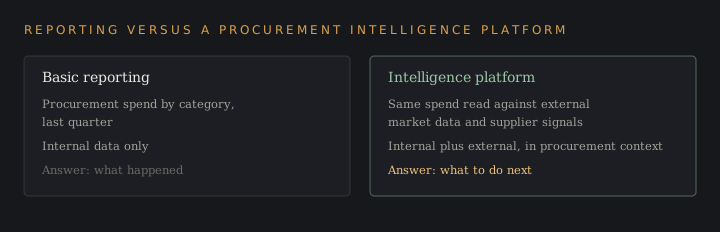
Procurement technology splits on one line. Systems that report what happened, and systems that recommend what to do next.
Basic reporting shows procurement spend by category for last quarter. A true procurement intelligence platform reads that same spend against external market data and supplier signals, puts it in procurement context, and names the action.
Procurement analytics is the machinery underneath both. The difference is what comes out the other end: a chart, or a decision somebody can defend at an award meeting.
Coverage across procurement categories
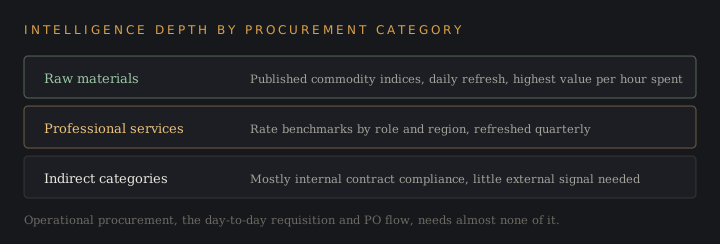
Procurement categories differ in what intelligence they need. Raw materials track to published commodity indices; professional services track to rate benchmarks; indirect categories track mostly to internal contract compliance.
Operational procurement, the day-to-day requisition and purchase order flow, needs almost none of it. Value concentrates in the strategic categories where a price move is worth six figures.
A platform priced for full coverage across every category will cost more than the tail spend it monitors returns. Scope the licence to the categories that move.
Workflow automation and where cost reduction shows up
Workflow automation is where cost reduction appears in a business case that survives review. Platforms that automate manual tasks, spend classification, supplier onboarding checks, contract date tracking, return hours. Before automating a procure-to-pay step, process intelligence tools show where it stalls.
Hours are easier to defend at budget time than insight quality. Automation that enables procurement teams to drop a reconciliation step beats a dashboard nobody opens.
Risk coverage
Supply chain risk and supply chain visibility are separate purchases in most stacks. A platform that maps supplier sites, watches financial signals, and pushes the alert into the sourcing queue covers both.
That routing is the part worth testing in a pilot, because routing the alert into a queue with an owner is what ends up allowing procurement teams to mitigate risks before a delivery slips. An alert arriving in an inbox nobody owns changes nothing.
Policy, responsible sourcing, and reporting
Procurement policies get enforced by systems. Responsible sourcing commitments, supplier diversity targets, and ESG screening hold only when the platform checks them at the point of award.
Economic impact analysis sits on top as the reporting layer: which regions the spend reached, which supplier types won work, and what that did locally. It is the output a public-sector or listed buyer gets asked for, and the one most platforms treat as an afterthought.
Actionable insights is the phrase every vendor in this category uses. The test is narrow: does the output name a supplier, a category, and a date, or does it name a trend.
Other procurement intelligence tools worth a shortlist mention
Three more names come up often enough in this category to name directly, even outside the eight ranked above. GEP SMART processes the entire source-to-pay cycle in one platform, positioning it closer to Coupa's full-suite approach than to a standalone intelligence layer.
Ivalua supports all spend categories and supplier types, another full-suite Coupa competitor. Sievo processes over 2% of global GDP annually through its spend analytics platform, a scale claim worth noting even though it wasn't researched deeply enough here for a full ranked slot.
SpendHQ and JAGGAER round out the wider shortlist, both covered in more depth in our SpendHQ review and JAGGAER review. SpendHQ reports 97% spend visibility through AI classification, and JAGGAER positions its platform around real-time tracking of supplier metrics.
Volza sits a step removed from spend analytics: a customs-shipment database covering 200-plus countries, useful to a sourcing team checking an overseas supplier's actual export volume and buyer list before an award. It doesn't classify spend or automate a sourcing workflow the way the tools above do.
Verify a supplier's trade record
Try Volza's free trial
7 days, unlimited searches, no card required.
May earn a commission if you sign up through this link, at no extra cost to you. Full affiliate disclosure.
Procurement market intelligence tools FAQ
What is market intelligence for procurement?
It's the practice of collecting spend data, supplier signals, and external market data, then using AI or analyst research to turn that feed into decisions a sourcing team can act on: which supplier to flag, which category to renegotiate, and which market shift to watch before it hits a contract.
What's the difference between an AI-native tool and a specialist platform?
An AI-native tool, like Suplari or Veridion, is built from the ground up on procurement-shaped data and machine learning models. A specialist platform, like Beroe or EcoVadis, built its data and process first and is layering AI features on top of an established research or scoring business.
How much do procurement intelligence tools cost?
Most of this category doesn't publish pricing. Third-party estimates put Suplari's average contract value near $46,000, EcoVadis around $500 to $11,000 a year depending on scope, and Coupa starting near $2,500 a month for basic deployments; all three require a sales conversation to get an actual quote.
Which tool is best for supplier diversity and ESG?
Supplier.io leads on diverse and local supplier data with economic-impact and Scope 3 reporting. EcoVadis leads on sustainability scorecards and regulatory-compliance modules across a supplier's full ESG profile, past diversity status alone.
Which tool is best for a small or early-stage procurement team?
None of the eight here publish an entry-level self-serve tier, but Thomasnet's free directory search is the lowest floor for basic supplier discovery. For AI-native intelligence specifically, expect a sales-led process regardless of company size.
Does Coupa still invest in AI after going private?
Coupa's own materials describe more than 20 deployed AI agents and a November 2025 agentic-AI platform release. At least one G2 reviewer disputes that characterization directly. Verify current AI functionality in a live demo.
What is D&B Ask Procurement?
A generative-AI chat assistant, built on IBM watsonx Orchestrate, that answers natural-language questions against D&B's supplier risk and firmographic data. It's an add-on to D&B Risk Analytics: Supplier Intelligence.
Can these tools integrate with an existing source-to-pay system?
Most connect via API or native integration to an ERP or source-to-pay suite; Coupa is itself a full source-to-pay platform, so the integration question there is about which modules to switch on.
Bottom line
No single tool in this ranking covers spend analytics, supplier risk, ESG scoring, and full source-to-pay execution at equal depth, which is why naming the job first narrows the shortlist faster than a feature-by-feature comparison does.
Suplari and Veridion fit a team with clean internal data and AI-native ambition. Beroe and D&B Ask Procurement fit a team that needs curated external research or supplier risk lookups while its own data program matures.
Supplier.io and EcoVadis fit a team whose priority is supplier diversity or sustainability specifically, and Coupa fits a team that wants market intelligence folded into a full spend-management suite.
Pilot narrow before rolling out wide. The 49%-to-4% pilot-to-deployment gap in this category traces back to data quality and integration complexity more than to any vendor's model quality, and that gap closes with a bounded pilot on real spend and supplier data, ahead of a wider rollout.
The same job-first logic applies in adjacent categories: see our sales intelligence and pricing intelligence rankings for how it plays out elsewhere.