ThomasNet pricing (2026): what suppliers pay for listings and marketing services
 By Jan Suski. I go deep on every review, checking every number against its source and digging up details other coverage misses, a habit from six years of SEO and link building for tech companies. Bylines at Surfer, Brand24, and Senuto. How the scoring works.
· Prefer this source on Google
The numbers Vendor pricing and user-reported invoices, checked 13 August 2026
Thomas publishes no rate card, so every number above a free profile is a category-specific quote.
Real invoices on Trustpilot and Reddit cluster below WebFX's reported average, pointing to tiers neither company names.
ThomasNet's own traffic decline is the argument suppliers hear most often for spending on their own site instead.
Industrial marketers get asked what supplier listings cost on every call. Send the platform and I'll source a version you own.
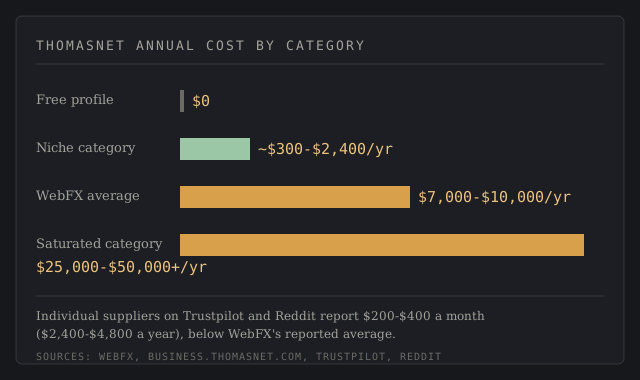
WebFX prices the average ThomasNet listing at $7,000 to $10,000 a year, climbing past $25,000 in saturated categories like washers. Real invoices posted on Trustpilot and Reddit run $200 to $400 a month, $2,400 to $4,800 a year, under half WebFX's floor. Neither company publishes the tiers that would close that gap. A supplier has to read between the lines of both numbers to guess where its own category lands.
Thomas charges nothing for a basic company profile. Everything above it prices by category competition, with no fixed rate card, so a niche fastener maker and a saturated washer manufacturer can sign contracts thousands of dollars apart for the same size business.
This report pulls together what Thomas publishes about its advertising programs, what WebFX priced for its manufacturing clients, and what suppliers report paying on Trustpilot and Reddit. It pairs with our ThomasNet review on sourcing and lead quality.
It's built for a supplier weighing a free profile against a paid listing or Thomas's SEO and website add-ons. The platform's 2.2 million registered buyers, largely procurement professionals and engineers, search it for free and never see this side of the invoice.
How much ThomasNet costs, and why there's no set number
Thomas doesn't charge a flat or fixed price for a listing, unlike the flat-fee directory listings some smaller competitors sell. Instead, suppliers pay an annual listing fee tied to how competitive their category is, since the same dollar buys a different amount of visibility depending on how many other companies want the same search terms.
A supplier in a category with a handful of competitors can pay a few hundred dollars a year for a top spot; a company chasing "washers," a category with more than 2,000 listed suppliers, pays far more to hold the same position in front of the same industrial buyers.
A washer manufacturer is one example of the saturated end of that range; a company in a barely contested category sits at the other. Suppliers in a category like that are a dime a dozen, and the price for the top spot climbs accordingly.
WebFX, a digital marketing agency that has priced ThomasNet listings for its manufacturing clients, puts the average annual cost between $7,000 and $10,000, climbing to $25,000 and beyond in saturated industries. That sits well above the $200 to $400 monthly invoices several suppliers report on Trustpilot and Reddit, meaning $2,400 to $4,800 a year, pointing to real tiers below the reported average that neither company publishes.
That tracks with guidance reported across ThomasNet's own advertising materials and third-party research: niche categories on ThomasNet may cost only a few hundred to a couple thousand dollars annually, before competition pushes a category toward WebFX's $7,000 floor. Deciding how much of that money to commit starts with checking search volume for the specific category.
Copy these lines into an email, fill them in and send. I reply with scope and a price within 2 to 3 business days.
Open the emailThomasNet pricing at a glance
Four cost lines, only one of them free and none of them fixed once a supplier goes past it.
| Tier | Cost | What it includes |
|---|---|---|
| Free company profile | $0 | Profile content, team members, basic activity metrics, limited core categories |
| Premium listing | $2,400-$50,000+/yr* | RFQs and RFIs delivered directly, buyer identification, Supplier Analytics Dashboard |
| Thomas WebTrax | Priced separately | Detailed visitor and lead reporting beyond the base dashboard |
| Thomas Marketing Services | Priced per client | SEO, website design, content marketing, PPC campaign management |
*Premium listing range reflects WebFX's published client pricing data and individual supplier invoices reported on Trustpilot and Reddit; ThomasNet publishes no fixed rate card.
Free company profile vs a paid listing
Every supplier, including small B2B industrial companies with no marketing staff, can claim a free company profile. A supplier on the fence about paying can start there for nothing and decide later. Thomas confirms this directly on its own FAQ: a free subscription lets a company manage its profile content, add team members, view basic activity metrics, and appear in a limited set of core categories with basic positioning.
The free company profile
A free profile is a plain listing. It shows up in search results, but carries none of the bidding, sponsored positioning, or buyer-identification tools that come with a paid account. For a small supplier just establishing a presence, it costs nothing and takes basic company details, though it won't compete for the top spots in a crowded category.
The premium listing
A premium subscription unlocks the features suppliers pay for: receiving RFQs and RFIs directly from buyers, assigning those requests to specific team members, and identifying which named companies viewed a profile, in effect a prospect list handed to a sales team. This is also where the annual contract and category-based pricing start.
What a premium listing gets you inside the company profile
A paid account adds a Supplier Analytics Dashboard, tracking impressions, profile views, website views, catalog views, video views, in-market buyers and leads generated through RFQs, RFIs, phone calls and content downloads, defaulted to a 90-day window. Checking it regularly keeps a supplier up to speed on which categories are pulling buyers.
It also unlocks sourcing-activity comparisons against a supplier's top five competitors and a category market-share breakdown, both built to show if a supplier in a busier category is pulling more leads for the same spend.
Video is one of the few upgrades Thomas quantifies directly: a profile with video sees a 34% increase in overall activity, part of what Thomas markets as a way to increase traffic and drive more leads without a higher bid. Full company details, capabilities, phone number and website links round out what a completed profile carries.
Thomas says a profile with video sees a 34% increase in overall activity, one of the few upgrades it quantifies directly.
Activity lift Thomas claims for profiles with video
Source: Thomase.g. what listing upgrades return on your marketplace
Source: linked, checked, datedSearch filters on the buyer side cover certification, location and diversity status, the same fields a completed profile needs filled in to get shortlisted, and an RFQ Summarizer is built to speed the sourcing process once a buyer sends one.
Add-ons priced outside the listing fee
Thomas WebTrax, the platform's paid analytics tool, costs extra on top of a premium listing. WebFX flags this directly: WebTrax reports views, clicks and leads, but the metrics aren't especially detailed, and Thomas charges for it while Google Analytics does the same basic job for free. Paying for a tool that does less than a free alternative can cost an arm and a leg without adding much in return.
It positions WebTrax and the paid tiers above it as tools to promote a listing and build online visibility beyond the free profile.
Thomas Marketing Services is the separate digital marketing agency arm, built for industrial companies with no in-house digital marketing team, and it's priced per client. The full menu covers search engine optimization, website development, content marketing, inbound marketing, email marketing, social media management and PPC campaign management, including Google Ads work.
A manufacturer buying an SEO campaign or a new website from Thomas is buying a second, uncapped line item that sits on top of whatever the listing itself costs. Video advertising, display advertising and newsletter sponsorships price the same way: quoted individually, with no standard bundle covering them.
What drives a ThomasNet quote
Category competition sets the price before anything else does. A category with a handful of suppliers costs little to lead; a category with thousands, like general industrial washers or fasteners, turns the same top spot into a much larger annual number, since suppliers are effectively bidding against each other for placement.
Bidding for the top slot compounds the cost. Thomas's own advertising page describes sponsored listings as moving a company "to the priority positions, ahead of organic listings," and staying there means outbidding whoever else wants the same keywords. WebFX makes the same point: a supplier "may find yourself having to frequently outbid a competitor to retain the top spot," and that repeated outbidding pushes categories from the low thousands into the tens of thousands.
That leaves a supplier between a rock and a hard place, paying more to hold the spot or stepping aside for a competitor with a bigger budget.
Ranking itself works differently from a search engine. WebFX is direct about the mechanism: on ThomasNet, "rankings are based on payment." A supplier with the best product can still lose the top spot to a competitor with a bigger budget, which is the core reason Thomas markets search engine optimization as a companion purchase alongside the listing.
The annual contract and the hidden costs
Every paid ThomasNet account runs on a 12-month contract, and multiple customers describe the same experience: results don't show up quickly, but the invoice does every month regardless. Signing means biting the bullet on a full year before the category has a chance to prove itself. One Reddit user detailed it plainly:
"They want $200 per month. The thing is one big order could offset this but that's the case for all my marketing. It doesn't sound like much but it's a 12month contract so it's really a $2,400 investment."
u/floridamano, r/smallbusiness
Another user reported reaching month seven with nothing to show for the spend:
"I am at month 7 of contract. Nothing to show for it. ZERO inquiries, ZERO sales. Will be out $2400 at end of year."
u/TresGeo1166, r/smallbusiness
A Trustpilot reviewer described trying to exit early and being told the full year was owed regardless of results:
"I am currently paying $400 per month for a service that has produced no measurable return."
jason cummins, Trustpilot, April 9, 2026
A second Trustpilot review names a different monthly figure entirely:
"Insane to pay over 250 bucks a month for a 'listing' on a website very few people use anymore."
Daniel Stahl, Trustpilot
A supplier who bought Thomas's separately priced lead-generation eBook program did the math on cost per lead:
"You pay up front but if you break it down, each lead ends up costing almost $100 if memory serves me right."
Patrick, Trustpilot, May 24, 2022
The consistent thread across all of these accounts is the contract term: a year, locked in, whatever the dollar amount. A supplier who signs on the hope that results improve by month seven, the point where one Reddit user above logged zero inquiries, learns instead that the invoice keeps arriving on schedule. A supplier learns if the category and the platform match its buyers only after that year runs. That invoice keeps arriving come rain or shine, leads or no leads.
What buyers say about the return
Results split sharply: some suppliers report high quality leads while others on the same platform get none. WebFX's own client data shows the imbalance directly: one client received 46 qualified contact-form views from a ThomasNet listing over 12 months, against 143 views from other channels in the same time period.
A second WebFX client saw 478 information requests in a year, and exactly one came through ThomasNet, a needle in a haystack of leads. A third client running an SEO campaign alongside its listing pulled 1,900 visits and 140 engaged users from search, compared with 57 referrals and 9 engaged users from ThomasNet, in the same 12 months.
Thomas's own published case study runs the other direction. Allied Sinterings, the company Thomas features most prominently, saw a 41.7% increase in conversion rate, with 40% of its new contacts coming directly from ThomasNet.
A separate case study on Thomas's own advertising page features OSE Optics, whose CEO credited a six-figure opportunity to a lead that came directly through Thomas, the kind of result that explains why some suppliers keep paying even after reading the complaints above. Both are real, and neither cancels the other out.
A more recent Reddit review, posted within the past three months of this report, described a similar zero-return outcome: most inbound contact was competing suppliers doing research or spam, and the company's usual point of contact stopped responding after the concern was raised.
Ask for category-specific search volume and evaluation counts before committing. A $200-a-month niche category and a $25,000-a-year saturated one are different products under the same brand, and the 12-month term means a wrong guess costs a full year.
ThomasNet alternatives and how they price
Suppliers researching ThomasNet alternatives usually land on a short list of other industrial directories: IHS GlobalSpec, Metoree, IndustryNet and IQS Directory, comparing each against Thomas's own directory listings. ThomasNet itself ranks eighth on our procurement intelligence tools ranking, behind platforms built for spend analytics.
A supplier weighing broader data-provider budgets can check our B2B data providers ranking or the wider data providers category. None of the common ThomasNet alternatives publish a public rate card either, so a direct price comparison isn't possible from published sources, and none report a user base close to Thomas's more than 2.2 million registered accounts.
The more common alternative isn't another directory at all. WebFX and multiple Reddit commenters point the same direction: put the ThomasNet budget, or part of it, into search engine optimization for the company's own website instead, to drive more qualified traffic to a domain the company owns outright. Owning that traffic puts a company in the driver's seat, in control of a channel no category price can take away.
One competing agency's published analysis put ThomasNet's own organic traffic decline at 88% from 2023 to 2025, a loss of roughly 700,000 monthly visitors, an argument for owning traffic on a domain a supplier controls. Search engine optimization for a website compounds over time and doesn't disappear if a company stops paying for a single category, the way a ThomasNet listing does the day the contract lapses.
Suppliers building a broader supplier-research process alongside their own SEO work can start with our guide on how to gather market intelligence.
What to budget as a supplier
A realistic ThomasNet budget starts with the category. A target dollar figure comes second. A supplier in a lightly contested category should budget in the low thousands and expect Thomas's sales rep to quote near that range; a supplier in a saturated one should plan for $25,000 or more before touching WebTrax add-ons. Once the category numbers are in hand, the ball is in the supplier's court to decide how much of that budget the listing deserves.
Add $1,000 to a few thousand more if Thomas WebTrax or any Marketing Services line item gets added on top, since neither is included in the base listing price.
Budget for the full 12 months regardless of early results, because the contract doesn't allow an exit based on lead quality. A supplier that has already priced ThomasNet alternatives and still prefers Thomas is usually paying for buyer volume.
Compare that spend against our market intelligence platform pricing report before splitting budget across tools, and check how we score vendor pricing before weighing any single figure in this report over another.
Delivered for your site and your byline. Hosting here is optional.
Frequently asked questions
How much does ThomasNet cost?
Free for a basic company profile, the option most companies start with. Paid ThomasNet listings run from about $2,400 to $50,000-plus a year depending on category competition, per WebFX's pricing data and supplier-reported invoices. Thomas WebTrax analytics and Marketing Services work cost extra.
Is ThomasNet free to use?
For buyers, yes entirely: searching, viewing profiles, downloading CAD data and sending RFQs cost nothing. For suppliers, a basic company profile is free; premium placement, WebTrax analytics and marketing services all carry separate fees.
What are the benefits of using ThomasNet?
Suppliers get access to more than 1.4 million active buyers and 2.2 million-plus registered users searching more than 80,000 industrial categories, which Thomas markets as a path to more qualified leads through 25 times more buyer evaluations for advertisers than free accounts. Buyers get a free, specialized search engine for industrial suppliers with certification filters, CAD downloads and direct RFQs.
Is ThomasNet reliable?
For buyers, the supplier database is Thomas's core product and has run for decades, though listing completeness varies by company and Thomas itself recommends verifying supplier details independently. For suppliers evaluating ROI, results vary enough by category that the same spend produces a 41.7% conversion lift for one company and zero qualified leads for another.
Who uses ThomasNet?
Over 1.4 million active buyers, including procurement professionals, engineers and MRO teams, plus more than 500,000 supplier companies, from manufacturers to distributors. At the time of the 2021 Xometry acquisition, registered users included 93% of the Fortune 1000.
Is ThomasNet worth it, and does ThomasNet work as advertised?
The ThomasNet worth verdict depends on the category's real buyer demand more than the sales pitch. Does ThomasNet work for every supplier is the wrong question to ask: it works for the ones whose category carries real search volume, and it doesn't for the rest.
Bottom line
ThomasNet's pricing model rewards suppliers who match a lightly contested category and punishes suppliers who buy into a saturated one without checking search volume first. The devil's in the details of each category's evaluation counts, numbers WebFX and Thomas both leave out of their published averages.
The published averages from WebFX and the real invoices suppliers report on Trustpilot and Reddit both point to the same conclusion: the category decides the cost. The 12-month contract means that decision gets made once a year.
A supplier that treats a listing as one channel among broader digital marketing efforts, alongside its own website and search engine optimization work, builds long term relationships with buyers and reports better outcomes than one that treats ThomasNet as a replacement for a marketing strategy entirely. Get category-level evaluation numbers in writing before signing, and budget for the full annual term regardless of how quickly leads show up.
Manufacturing agencies, B2B marketplaces and industrial SEO firms use reports like this one in proposals and budget talks.
A report on your topic for a blog page, gated content or a lead magnet.
Written for your client and published under their brand, with my name left off.
Your report on marketintelligencetools.com, with 2 to 3 CTAs carrying your sponsored links.
Default terms: the report is yours to publish, and I keep the right to republish it on this site behind a gate, outside Google's index.
Sources, and what ThomasNet doesn't publish
The $7,000-$10,000 average and the $25,000-plus saturated-category figure are WebFX's own client pricing data, published on webfx.com and last updated 27 May 2026. Thomas's own registered-user count, the 25x evaluation figure, the video-activity lift and the FAQ terms for free versus premium profiles come from business.thomasnet.com/programs, help.thomasnet.com and thomasnet.com.
Named Trustpilot reviews (trustpilot.com/review/www.thomasnet.com) dated April 2026, 2025 and May 2022, and a Reddit thread on r/smallbusiness, cite the $200-$400 monthly invoices verbatim. The 88% organic traffic decline and the roughly 700,000 lost monthly visitors are a competing agency's published analysis of ThomasNet's own traffic.
The $300 million acquisition price is Xometry's own disclosure of the December 2021 deal. All figures were checked 13 August 2026. ThomasNet publishes no fixed rate card, no public tier list and no category-level ad-spend data beyond what WebFX's client averages disclose.