PitchBook pricing in 2026: what a seat costs, from order forms and filings
 By Jan Suski. I go deep on every review, checking every number against its source and digging up details other coverage misses, a habit from six years of SEO and link building for tech companies. Bylines at Surfer, Brand24, and Senuto. How the scoring works.
A PitchBook seat listed at $7,000 a year on UK government order forms signed in 2022, and an 18-user order closed at $5,600 each after a 20% cut. PitchBook doesn't publicly list its prices, and its own pricing page prints no figure at all, so those signed forms, published on the UK's Contracts Finder, are the closest thing to a rate card in the public record.
This report builds the PitchBook price from three primary sources: the order forms and award notices, Morningstar's 2025 annual filing and results, and PitchBook's own product pages. It covers what a license buys, the add-ons, renewal terms, user complaints and six alternatives, from Crunchbase to Bloomberg.
It's written for investors, corporate development teams, founders and sales teams sizing a first deal or checking a renewal quote. PitchBook sets fees account by account, and a buyer without a reference number negotiates against a company with 10,200 other client accounts to compare against.
The numbers PitchBook pricing, checked 6 October 2026
A seat on paper runs $7,000 a year, and an order of 18 users brought the effective rate to $5,600.
Dividing $671.8M of revenue by 113,451 licensed users gives about $5,920 a user, a ceiling that also counts non-seat Direct Data revenue.
The renewal rate fell five points in one year, which Morningstar tied to churn among corporate clients.
How much does PitchBook cost per user
The base rate runs about $7,000 a user a year, and the government paperwork shows it in detail. A Department for International Trade order for its North America team covering January to March 2022 listed 14 platform authorized users at an annual contract value of $98,000. That's $7,000 each, with no volume break on 14 users.
The same team's renewal looks different. The April 2022 order listed 18 users at $126,000 and closed at a grand total commitment of $100,800, or $5,600 each. Both forms carry the same clause for growth mid-term: added users come at "an annualized cost of $7,000 per seat."
Read between the lines and the pattern is plain. The list rate holds for anyone adding one login mid-term, and the discount arrives when a buyer commits a block of users for a full year at renewal.
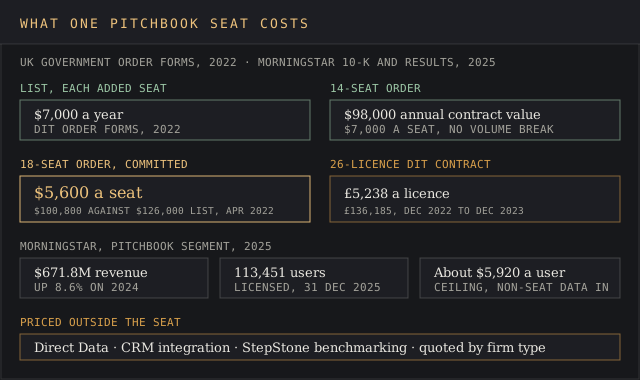
Those orders date from 2022, and fee rises since then have come in under the radar, at renewal. Morningstar told shareholders in March 2026 that PitchBook "seeks expansion at renewal, including price increases where appropriate," and that revenue per client rose in 2025 over 2024. Treat $7,000 as a 2022 floor and budget for a 2026 quote above it.
How the PitchBook platform is sold
PitchBook quotes on three inputs, and its website names all of them: "how many seats you need and your firm type," plus premium offerings such as Direct Data or CRM integration. Morningstar's 10-K says the same in filing language: pricing "is primarily based on the number of licensed users, with customized pricing available for large enterprises, boutique firms, and startup clients."
Users
Every license belongs to a named person. The DIT order forms state that "User IDs are not permitted to be shared," and PitchBook's subscription agreement requires each user to sign in through SSO or a business email address at the subscriber's own domain. Two analysts sharing one login breach the agreement, which makes headcount the first lever on the bill.
Firm type
Firm type here means industry. A private equity fund, a venture capital firm, an investment bank, a law firm and a corporate strategy team each get a different quote for the same product. PitchBook keeps the bands private. The 10-K's three named categories (large enterprises, boutique firms and startup clients) are the closest public description of how the rate card splits. Startups get customized pricing of their own, quoted privately.
Add-ons billed outside the license
PitchBook's integrations page states that Excel, PowerPoint and Chrome integrations are free to all clients, while "Direct Data and CRM integrations are premium additions priced according to seats and firm type." The DIT forms list "CRM PitchBook Plugin" and "Morningstar Equity Research Entitlement" as separate lines, both marked "Not Included."
- Direct Data: bulk files through the Data Feed or live queries through the API, for warehouses, automation and quant models. Morningstar notes it "is not seat based."
- CRM integration: PitchBook data inside Salesforce, Microsoft Dynamics or HubSpot for sales teams running outreach.
- StepStone benchmarking: anonymized deal-level data on about 2,300 general partners and 127,000 deals, "priced as a separate offering," per Morningstar's May 2026 investor answers.
- LCD: Leveraged Commentary & Data, which Morningstar acquired from S&P Global on 1 June 2022 and folded into PitchBook. The Bank of England licenses it under its own award.
What comes with every license
The pricing page lists complimentary desktop access, the PitchBook Mobile app, the Excel and PowerPoint plugins and the Chrome extension, five tools included in the fee. The same page promises always-on customer support through live chat and a self-service help center. Subscribers also get research reports and can consult PitchBook's analysts directly, with emerging technology research split into more than 80 niche segments.
Renewal terms, price notice and export caps
The subscription agreement filed with UK buyers sets the renewal mechanics. An order "will be renewed for successive renewal terms of one year unless either party provides the other with written notice of non-renewal at least 30 days prior to the expiration." PitchBook can change fees for a renewal term with notice "no later than 45 days prior" to the anniversary.
That leaves a 15-day window, and it's the red flag in the paperwork. A buyer who hears about an increase on day 45 has two weeks to act before the 30-day cancellation deadline passes and the subscription rolls into another year.
The devil's in the details on exports, too. The 2022 forms cap each authorized user at 1,000 daily rows of company, deal or fund data and 500 daily rows of people data, with monthly caps of 2,000 and 1,000 rows. A 2024 DBT order form repeats the 1,000-row daily cap and bars using downloads "to compile a quantity of data that has significant independent commercial value," so the database can't be rebuilt row by row.
Terms in the public record run one year at a time, with one exception: the Bank of England's LCD licence ran four years, from 1 June 2022 to 31 May 2026. Multi-year terms exist, so a buyer can ask for a renewal cap in exchange for committing a second or third year.
What UK public bodies paid for PitchBook
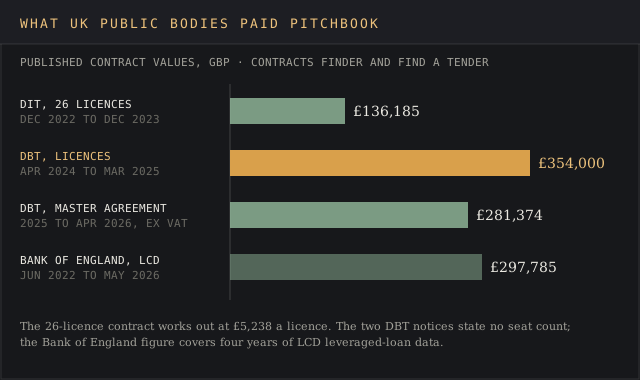
UK procurement rules force publication of award values, which gives the only time series of real PitchBook spend outside a business's own books. Transparency on the vendor's rates comes from procurement law. The Department for Business and Trade bought its 2024 licences by single tender action and its 2025 licences by direct award, citing a single supplier for technical reasons.
| Buyer | Term | Users | Value | Source |
|---|---|---|---|---|
| DIT North America | Jan to Mar 2022 | 14 | $19,600 after a $4,900 one-time discount ($98,000 annual value) | Order form |
| DIT North America | Apr 2022 to Mar 2023 | 18 | $100,800 ($126,000 list) | Order form |
| Department for International Trade | Dec 2022 to Dec 2023 | 26 | £136,185 | Award notice |
| Department for Business and Trade | Apr 2024 to Mar 2025 | Not stated | £354,000 | Award notice |
| Department for Business and Trade | 2025 to Apr 2026 | Not stated | £281,374 excluding VAT | Award notice |
| Bank of England (LCD) | Jun 2022 to May 2026 | Not stated | £297,785 | Award notice |
Every value is a signed contract amount, taken from the UK order form or award notice named in the Source column.
The 26-licence award works out at £5,238 a licence. Departmental spend then reached £354,000 for the year from April 2024 and £281,374 for a following term of just under a year. Against $671.8 million of PitchBook revenue, either award is a drop in the bucket.
What Morningstar's filings show about PitchBook revenue
Morningstar runs PitchBook as its own business segment. It acquired the rest of PitchBook in December 2016 at a net cost of about $188 million, after holding roughly 20% since 2009. The 2016 annual report counted "more than 8,000 professionals" on the platform at the time. By 31 December 2025 the count stood at 113,451 licensed users across about 10,200 client accounts.
Revenue reached $671.8 million in 2025, up 8.6%, with an adjusted operating margin of 31.3%. Spread across 10,200 accounts, that's about $65,900 a client a year, so the typical account spends tens of thousands of dollars annually. The average hides a long tail: one UK department's £281,374 award and a 14-user team's $98,000 both fit inside it.
Investors and advisors brought in the lion's share of growth. Morningstar's results credit "PitchBook's core investor and advisor client segments" and the Direct Data business, and name "continued softness in the corporate client segment, especially among smaller firms with more limited use cases."
Licensed user counts were flat on the year. The 10-K lists the client base as buyout and venture firms, asset managers, limited partners, banks, private credit investors, corporations and professional service providers.
Flat headcount and rising revenue point one way. In a 25 March 2026 investor answer, Morningstar said those decisions "are made on a contract-by-contract basis" and declined to put a figure on what increases added. Straight from the horse's mouth, every renewal quote is set account by account.
Morningstar names expansion with existing accounts, especially large global firms, as the most durable growth driver, so the investors already under contract are the ones the next increase lands on.
Acquisitions continue: the 10-K records Lumonic, a portfolio monitoring tool for institutional investors, acquired in 2025, after LCD in 2022.
What users say about the PitchBook price
Review sites count the complaints. G2's PitchBook page, rated 4.5 out of 5 from 261 reviews, tags 20 mentions under "Expensive." TrustRadius scores it 8.5 out of 10 across 188 reviews. Price is the one theme that turns up in otherwise glowing write-ups. Support quality varies by account: G2 logs 45 mentions praising its support, and the Vendr story below runs the other way.
License limits come up most. A verified G2 reviewer in the computer software industry, in a 7 June 2024 review titled "Pricey but necessary tool for M&A," wrote:
"I wish I was able to afford more seats on pitchbook, more people using the tool would greatly help us."
G2, Verified User in Computer Software, 7 June 2024
Shreyans Parekh, managing director at JLL Technologies, wrote on TrustRadius on 11 July 2022 that "User license seats can get expensive as PitchBook is scaled across the enterprise." A verified G2 reviewer in venture capital and private equity said the same on 22 May 2026: "High cost - would like more licences for a growing team."
Another reviewer, in the financial services industry, named "only the price as my firm limits the accounts" on the same day. Small firms put it bluntly. Mark R. asked on G2 for a cheaper entry point:
"Cost. For a small team, there should be a one / two user option"
Arnaud Viviers, managing director at Kensington Park Capital, wrote on TrustRadius on 20 May 2025 that "Pricing of the subscription is still prohibitively high."
The sharpest account is secondhand. Vendr's Crunchbase vs PitchBook comparison, updated 2 December 2024, describes a buyer whose account executive turned combative after signing, "demanding 50-100% increases on what had already been paid." It's one story with no named source, and it lines up with the 45-day fee-change clause in the agreement.
Data accuracy and what the license buys
PitchBook's database, per its data page, lists 12.9 million companies around the world, 3.2 million deals, 657,000 investors, 171,000 funds, 66,000 limited partners and more than 5 million professionals. The database is built by a Data Operations Team of more than 1,800 people, who pull from survey requests, regulatory filings and FOIA responses and analyze more than a million news events every week.
PitchBook's differentiators page says its research teams in Seattle and London hold conversations "directly with the people involved in deals" to verify transactions, and its quality team runs "preventative validations, corrective validations and manual reviews" alongside machine learning tools.
That process is the business PitchBook sells. Its homepage promises "the most accurate private capital market analysis," and the same page says specialized teams gather "hard-to-find details."
Data accuracy is still the most common complaint after price. G2 logs 44 mentions crediting its company research and 44 for ease of use, against 36 citing outdated information and 20 citing data inaccuracy. Kathleen B. described the workaround in a 16 March 2026 review:
"The data can sometimes be a bit dated and therefore less relevant. For example, a private equity firm's ownership of a company may be listed even though it was sold a couple of years ago."
G2, Kathleen B., 16 March 2026
Buyers who need accurate ownership records for a deal still check them against a second source.
The data-packed interface carries real complexity, and the vendor's own onboarding shows it. The Core Foundations certification for new users runs 4.5 hours across eight courses, from deal sourcing to Excel plugin training. Elias M. on G2 in August 2024 asked the vendor to "Make it even easier, new users go through learning curves." G2's review summary still credits a user-friendly interface, based on those 44 ease-of-use mentions.
Crunchbase, with a self-serve trial and an AI search box built for quick lists, has the gentler learning curve of the two.
PitchBook vs Crunchbase, Preqin, CB Insights and other tools
Crunchbase is the only direct rival that prints a rate. Crunchbase Pro costs $49 a month billed annually or $99 billed monthly, and Business starts at $199 a month billed annually, per Crunchbase's plan page. Quote-only selling is par for the course in this tier, so the comparison below uses Vendr's tracked medians where Vendr publishes one.
| Platform | Published rate | Tracked annual spend | Owner |
|---|---|---|---|
| PitchBook | Quote only; $7,000 a user on 2022 UK order forms | About $65,900 revenue per client account, 2025 | Morningstar since 2016 |
| Crunchbase | $49 a month (Pro, annual); $199 a month (Business) | $20,000 median, 71 purchases* | Independent |
| Preqin | Quote only | $49,334 median*, range $27,674 to $77,221 | BlackRock since 3 March 2025 |
| CB Insights | Quote only | $46,984 median*, range $24,748 to $184,986 | Independent |
| FactSet | Quote only | $25,160 median* | Public company |
| Bloomberg Terminal | Quote only | $31,980 a single terminal on 2025 renewals | Bloomberg LP |
| SourceScrub | Quote only | $14,569 median* | Private |
Figures marked * are Vendr median annual contract values drawn from anonymized buyer data. Published rates are vendor list prices; the PitchBook spend figure is Morningstar's 2025 PitchBook revenue divided by client accounts, and the Bloomberg figure is a 2025 renewal price reported by NeuGroup.
Crunchbase sells a self-serve plan with a free trial, built for quick searches, list building and outreach, with AI search, saved lists and exports in Pro. Crunchbase's database, per its site, is fed by "aggregated engagement signals from 80M+ users" plus analyst validation, and logs 30M+ verified updates per year.
On G2, Crunchbase holds 4.4 out of 5 from 413 reviews, a close comparison with the 4.5 from 261 reviews above. Crunchbase Business, the team plan, adds CRM and workflow integrations, more exports and SSO. Transparency is its selling point against PitchBook's quote-only model.
PitchBook's higher fee buys the 1,800-person research operation plus fund, LP and valuation data. The Crunchbase pricing breakdown and the Crunchbase review cover the cheaper side of the comparison.
For public-market depth, the FactSet pricing and Bloomberg Terminal pricing reports price the terminals, and the FactSet vs Bloomberg comparison sets them side by side. AlphaSense pricing covers research search. The wider ladder of tools, up to $70,000 a seat, sits in the market intelligence platform pricing report, and the investment research platforms ranking scores ten tools on the same criteria.
How to negotiate a PitchBook renewal
The order forms and the agreement give a buyer four levers. Each one comes from a clause or a figure already on the public record.
- Anchor on $7,000 a user. Discounts scale with commitment. It's the documented 2022 rate for an added login, and the 18-user DIT order shows a 20% break from it on a committed block.
- Keep an eye on the 45-day and 30-day dates. Fee notice comes 45 days before the anniversary and non-renewal notice must land 30 days before. Send written notice early if the quote moves, and build the business case around licenses people log into.
- Ask for a one-time discount on a stub period. The 14-user DIT form carried a $4,900 one-time discount on a three-month term.
- Quote the add-ons separately. Direct Data and the CRM plugin carry their own fees; buy the platform first and add them once the team works out a use for them.
Name an alternative under active evaluation. PitchBook's 103% renewal rate and the corporate-segment churn Morningstar disclosed both give the seller a reason to hold an account. Bite the bullet and walk if the quote clears your budget; a one-year term means the door reopens 12 months later.
Who PitchBook is built for
PitchBook is built for private equity and venture capital investors, investment banks, limited partners and private credit funds working in private markets. Those investors run fundraising, due diligence and portfolio work through it every week, and the deal, fund and valuation data covers the key metrics a fund screens on, which is the daily job of a deal-sourcing associate.
Founders and early stage VC funds are where the math stops working. A two-person fund buying one login is charged the same list rate as a bank. TrustRadius reviewer Jason Kraus, CEO of EQx Fund, wrote in 2019 that "we just didn't see a big enough ROI as a small firm to justify a continued subscription."
Startups looking for investors before a raise get more from university access, a cheaper rival, or a dilution calculator and a spreadsheet. Founders in the middle of fundraising need a list of investors, and Crunchbase sells that list to a one-person business for $49 a month.
Corporate and business development teams sit in between. Sales teams comparing prospecting tools and using PitchBook for outreach and mapping of funded accounts can justify a license when the CRM integration feeds pipeline. Corporate development analysts screening acquisitions get the most from the M&A and fund data when sizing targets. Morningstar's filing shows corporate clients churned most in 2025, so that's also where a buyer holds the strongest hand.
Frequently asked questions
Is PitchBook free?
PitchBook sells every license by quote, and a free trial is available on request through its website. Many business schools license it for students: MIT Sloan provides it through its Career Development Office from September to May. Free company profile pages on pitchbook.com show a limited slice of the database, accessible without a login.
Is there a free alternative to PitchBook?
Crunchbase Pro comes with a free trial, then $49 a month billed annually. SEC public filings, Form D notices and company press releases cover some funding rounds at no charge. PitchBook's fund performance and LP commitment data stay behind its subscription.
Can ChatGPT access PitchBook?
Yes, through connectors. PitchBook's data page lists connectors in Claude, ChatGPT, Microsoft 365 Copilot, Perplexity and Hebbia. The Premium Connector brings the full set of companies, deals and investors into the chat and needs a PitchBook license, an enterprise license with the AI provider and SSO.
The Essential Connector gives a "limited, narrowly focused dataset" with no PitchBook license, and Morningstar says non-subscribers on Perplexity get basic company and deal data subject to monthly limits.
Is PitchBook worth it?
For a buyout or venture firm running several deals a year, yes: $7,000 a user buys a database of 12.9 million company records maintained by an 1,800-person team. For a solo founder or a small business team, the G2 and TrustRadius reviews quoted above say the bill outruns the use.
Is Crunchbase or PitchBook better?
Crunchbase is the right tool for prospecting startups and finding angel investors at $49 to $199 a month. PitchBook is the industry standard for private markets research, fund data, valuation multiples and LP data. A $7,000 login runs about 12 times a $588 year of Crunchbase Pro, so the choice comes down to which data the job needs.
How much did Morningstar pay for PitchBook?
Morningstar paid a net cost of about $188 million in December 2016 for the roughly 80% of PitchBook it didn't already own, after investing first in 2009. It booked a $37.1 million holding gain on its earlier stake.
What is the PitchBook platform used for?
Investors use it for deal sourcing, due diligence, fundraising, benchmarking, market analysis, business development and portfolio monitoring across private equity, venture capital, M&A and private credit. PitchBook updates its data several times a day, and alerts in the mobile app surface new deals at that speed.
What are some good alternatives to PitchBook?
Preqin (acquired by BlackRock in March 2025) for the fund and LP data institutional investors use, CB Insights for emerging technology research, Crunchbase for data on startups, SourceScrub for deal sourcing, and FactSet or S&P Capital IQ for public company data. The financial data providers and company data providers rankings compare the field's tools on coverage, accuracy and price.
Bottom line
PitchBook pricing is a quote, and the public record gives buyers a solid starting figure: $7,000 a user a year on 2022 UK order forms, $5,600 when 18 users were committed together, and about $65,900 of revenue per client account across Morningstar's 2025 books.
The renewal mechanics matter as much as the rate. One-year auto-renewal, a 45-day fee notice, a 30-day exit window, named-user licenses and daily export caps all sit in the paperwork.
Investors and deal teams who use it daily will find the license earns its keep. Small funds, founders and any small business with occasional needs should gauge Crunchbase and university access first, and go into a PitchBook renewal with the clause dates already in the calendar.
Where these PitchBook figures come from, and what PitchBook keeps private
Seat prices, user counts, export caps and renewal clauses come from PitchBook order forms and the subscription agreement published on contractsfinder.service.gov.uk, dated 2022 and 2024. Award values come from Contracts Finder and find-tender.service.gov.uk.
Revenue, licensed users, client accounts and the renewal rate are from Morningstar's 2025 10-K on sec.gov and its full-year 2025 results; the 2016 purchase cost is from Morningstar's 2016 annual report, and the pricing answers from its March and May 2026 investor answers.
Product, data and connector details were read off pitchbook.com. Competitor medians are the header figures on each vendor's vendr.com marketplace page, Crunchbase's rates are from crunchbase.com, and the Bloomberg renewal price is NeuGroup's. Review counts and quotes are from G2 and TrustRadius, dated in the text. Figures checked 6 October 2026.
PitchBook publishes no rate card, no firm-type price bands, no add-on prices for Direct Data, CRM integration or StepStone benchmarking, and no figure for its 2026 price increases.