Investment research platforms: 10 ranked for 2026
 By Jan Suski. I go deep on every review, checking every number against its source and digging up details other coverage misses, a habit from six years of SEO and link building for tech companies. Bylines at Surfer, Brand24, and Senuto. How the scoring works.
· Prefer this source on Google
Quick comparison of the best investment research platforms
The table orders all ten investment research platforms by final position. Coverage figures are each vendor's own published number, read on 24 September 2026; entry price is the first paid tier on annual billing where the vendor publishes one, and the Vendr median for AlphaSense, which publishes no rate card.
| # | Provider | Coverage figure | Entry price | Best fit |
|---|---|---|---|---|
| 1 | AlphaSense | 500M+ documents, 1,700+ broker sources | No rate card; $18,375/yr median* | Buy-side and corporate research teams |
| 2 | TIKR | 100,000+ stocks, 92 countries | Free; Plus $17.95/mo billed annually | Global fundamentals on a retail budget |
| 3 | Koyfin | 80,000+ companies | Free; Plus $39/mo billed annually | Financial advisors and charting-first analysts |
| 4 | Seeking Alpha | About 5,600 stocks with Quant Ratings | Premium $299/yr | US stock research with analyst commentary |
| 5 | GuruFocus | 100,000 stocks in 100 markets | Premium $549/yr (USA region) | Value investors tracking 13F holdings |
| 6 | Stock Analysis | 130,000+ stocks and funds | Free; Pro $79/yr | Cheapest paid fundamentals |
| 7 | Morningstar Investor | 200+ screener data points | $249/yr or $34.95/mo | Fund investors wanting analyst fair values |
| 8 | Stockopedia | 30,000+ stocks ranked daily | From £295/yr (UK) | UK and European factor investors |
| 9 | Finviz | 11,666 US tickers | Free; Elite $299.50/yr | Fast US screening and heat maps |
| 10 | Stock Rover | 8,500 stocks, 7,000+ ETFs, 40,000+ funds | Premium $348/yr | Portfolio management with broker sync |
Medians marked * are anonymised buyer-reported contract values published by Vendr. Everything else is the price the vendor publishes itself, read 24 September 2026.
Where these figures come from
Coverage counts come from each vendor's own site, read 24 September 2026: tikr.com, koyfin.com/data-coverage, gurufocus.com/about, stockanalysis.com/pro, stockopedia.com/stockranks and the equivalents linked in each entry. The Finviz count is the ticker total its screener showed that day.
The AlphaSense median marked * is the header stat on vendr.com/marketplace/alphasense, across 40 purchases. Stockopedia is priced in pounds because its plans page bills by region. Morningstar publishes no count of analyst-rated stocks and AlphaSense publishes no price, so no row claims either.
AlphaSense also appears in our financial data providers ranking and alternative data providers ranking, judged there on dataset breadth next to Bloomberg, FactSet, LSEG and S&P Global. This page ranks the research tools a single analyst or investor can buy.
Investment research platforms put market data, financial statements, earnings call transcripts and a stock screener behind one login. The price spread is wide: Stock Analysis Pro costs $79 a year, while Vendr's tracked AlphaSense contracts sit at an $18,375 median. Next to a $79 plan, that costs an arm and a leg.
This ranking covers ten investment research tools. One is a professional document-search platform built for hedge funds, asset managers and corporate market intelligence teams; nine are stock research tools that retail investors, analysts and financial advisors can buy with a card to make informed decisions on their investments.
Every price, count and year of history below comes from the vendor's own site or from Vendr's anonymised buyer data, linked where it appears and checked on 24 September 2026. User quotes come from Capterra, TrustRadius, Trustpilot, Reddit and Hacker News, never from vendor testimonials.
Three of the retail platforms below license fundamentals from S&P Global, the data house behind the Capital IQ terminal. A Bloomberg terminal renewed at $31,980 a seat from January 2025, the figure our Bloomberg Terminal pricing report traces to the renewal notice. TIKR's top plan costs $959.40 a year.
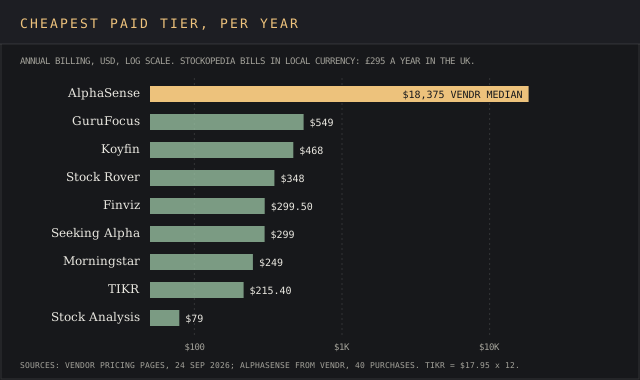
The gap between AlphaSense's $18,375 Vendr median and TIKR's $215.40 Plus plan, the two top-ranked platforms.
Evaluation criteria for investment research tools
Five criteria decide the order, weighted in the sequence below. Each one is a test a buyer can run in a free trial and get a count, a yes or a no.
1. Primary sources listed on the plan page
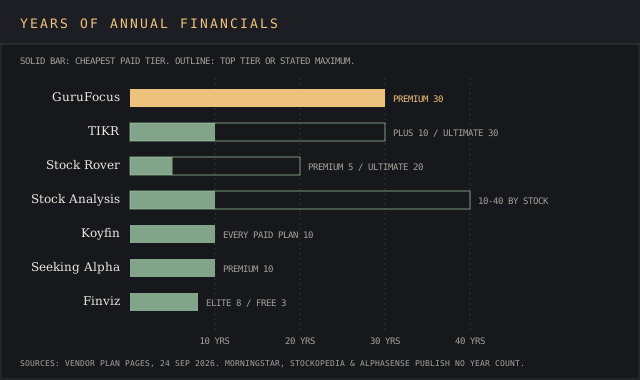
Count the source types a paid plan lists: SEC filings, earnings call transcripts, broker research, expert interviews. Then read the transcript history in years. TIKR's Plus plan keeps 1 year of transcripts and its Ultimate plan keeps the full archive. A source the plan page doesn't list scores zero.
2. Years of financial statements on the cheapest paid tier
Open any company's income statement and count the annual columns. Finviz Elite shows 8 years; GuruFocus Premium shows 30. Top-tier maximums don't count here, since most individual investors buy the entry plan and stay on it.
3. Global coverage in named units
Write down the vendor's published count of companies or stocks and the exchanges behind it; a wide range of markets matters for anyone investing outside the US. Finviz covers NASDAQ, NYSE and AMEX only. TIKR lists 100,000+ stocks across 92 countries and 136 exchanges. A count with no unit, like "thousands of securities", is a red flag and fails.
4. Screener depth and data export
Count the filterable metrics the vendor publishes, then check the export path to Excel or CSV. Stock Analysis publishes 300+ indicators. Koyfin's help center says its data vendor, Capital IQ, blocks export of equity financials, valuation metrics, estimates and growth rates.
5. Published price and refund terms
A rate card on the vendor's own site passes; a sales form fails. Then read the refund clause. Stock Analysis offers 60 days, and Stock Rover's FAQ says "we do not issue refunds."
Three of the ten keep your money once billed: GuruFocus, Seeking Alpha on standard subscriptions, and Stock Rover. Set a reminder two days before each trial converts.
The 10 best investment research platforms, ranked
Ranked on primary sources, years of statements, global coverage, screener depth and refund terms, weighted in that order.
AlphaSense
Best fit
Buy-side and corporate research teams that read broker research, filings and expert calls every day and can budget five figures a seat.
AlphaSense is a search engine over 500 million-plus business documents, and its equity research collection carries more than 1,700 broker sources, Goldman Sachs, Morgan Stanley, Bank of America and Citi among them. The 2024 Tegus deal added expert calls: AlphaSense counts 300,000+ interviews with pre-qualified experts. Our AlphaSense review covers the ownership history.
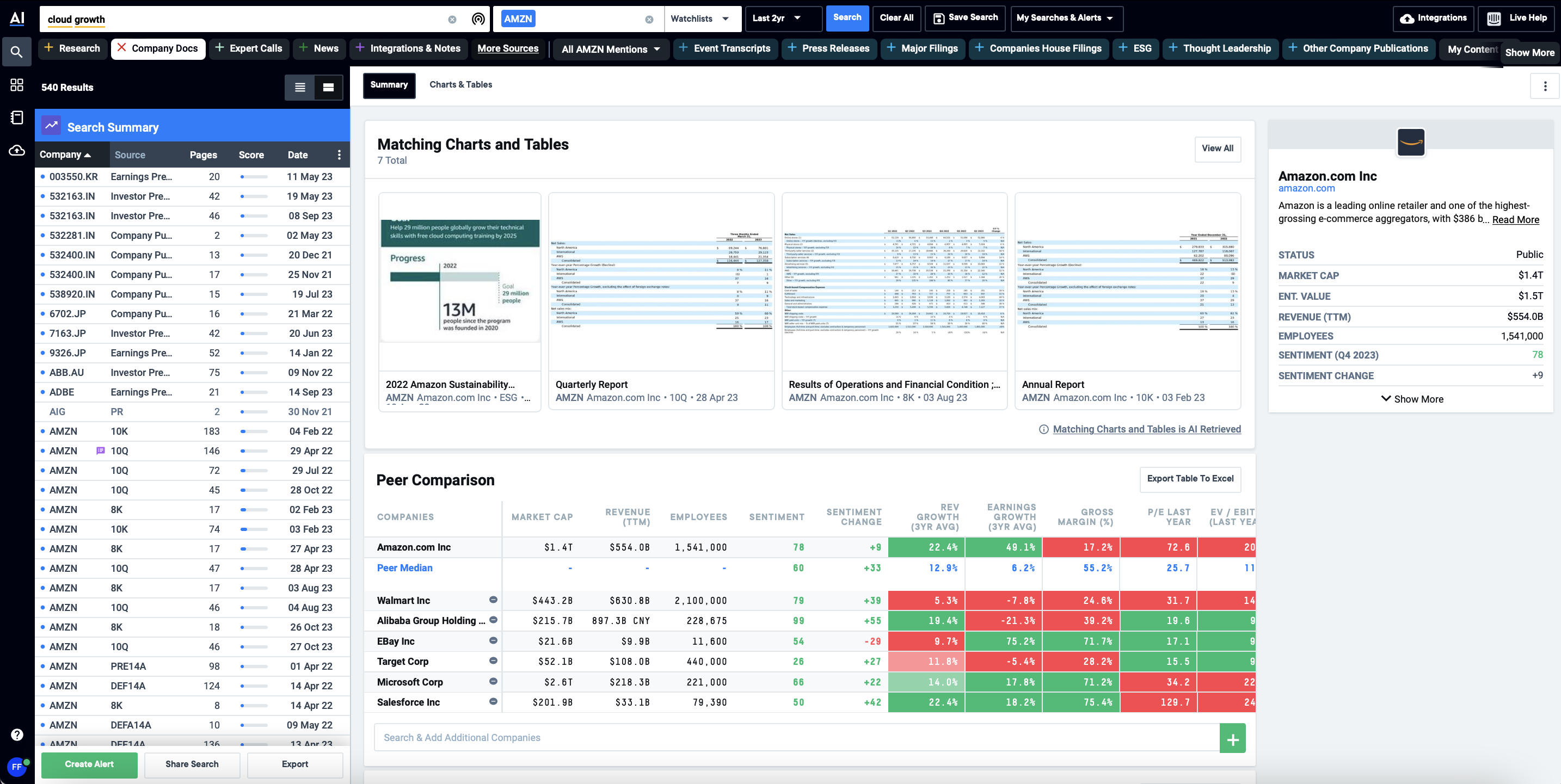
The AI layer does the first read. Generative Search returns a citation-backed answer across filings, transcripts and research reports; Smart Summaries condense an earnings call; Sentiment Analysis tags positive and negative tone line by line. It's the only platform here that covers private companies as well as publicly traded companies.
Key features
- Generative Search with Deep Research, answering across filings, transcripts and broker research with citations
- Smart Summaries and Sentiment Analysis on earnings calls and expert transcripts
- 1,700+ broker research sources, including Goldman Sachs and Morgan Stanley
- Tegus expert transcript library of 300,000+ interviews
- AlphaSense for Excel and PowerPoint add-ins, with each figure traceable to its source
- Channel Checks: AI-led interviews with validated industry experts
Pricing
AlphaSense publishes no rate card; its pricing page lists Market Intelligence and Enterprise Intelligence plans with no figures. Vendr's anonymised buyer data puts the median at $18,375 a year across 40 purchases, from $9,750 to $51,300. The free trial needs no credit card, and our AlphaSense pricing report breaks the range down.
Pros
- The only ranked platform with broker research and expert calls under one search box
- 500M+ documents reach private companies that filings-based tools can't see
- The Excel add-in keeps each cell tied to its source document
Cons
- No published price, and the tracked range spans $9,750 to $51,300
- No retail tier: the cheapest contract Vendr has logged still runs $9,750
- AI answers weaken across long time windows, per a Motley Fool analyst
Tim Beyers, Senior Analyst and Lead Advisor at The Motley Fool, rated AlphaSense 9 out of 10 on TrustRadius on 18 June 2025 and still flagged the time-window limit:
"The AI does a good job of handling one document at a time but often delivers ineffective results if searching for insights over a longer timeframe -- say, a trailing 12 month period."
TrustRadius, verified user, June 2025
Why it’s ranked #1. AlphaSense wins the first criterion outright: 500 million-plus documents and 1,700+ broker sources against TIKR's transcripts alone. It costs about 85 times TIKR's $215.40 Plus plan, the one axis where #2 wins.
TIKR
Best fit
Individual investors and small funds that want Capital IQ fundamentals on global stocks for under $1,000 a year.
TIKR runs on S&P Global Capital IQ data for 100,000+ stocks across 92 countries and 136 exchanges. Its Ultimate plan carries 30 years of financials and the full transcript archive, the kind of historical data a terminal desk pays $31,980 a seat for.
The devil's in the details on export. TIKR's help center says it doesn't offer an API or Excel plug-in "given agreements with our various data providers." The free plan covers U.S. stocks only.
Key features
- Global Screener across 100,000+ stocks; Ultimate adds 50+ exclusive factors and 300+ columns
- Valuation Model Builder for your own price targets
- Superinvestor tracking: top 40 funds on Free, 10,000+ funds on Ultimate
- Transcript search with earnings-call audio and slides
- Catalyst Tracker on the Ultimate plan
Pricing: TIKR's pricing page lists Free with no credit card, then Plus at $24.95 a month or $17.95 billed annually, Pro at $54.95 or $37.95, and Ultimate at $119.95 or $79.95. History runs 5 years on Free, 10 on Plus and Pro, 30 on Ultimate. New subscribers get a 14-day money-back guarantee.
Pick annual billing. TIKR Plus drops from $24.95 to $17.95 a month, which saves $84 a year before any upgrade.
Pros
- Capital IQ fundamentals on 92 countries for $215.40 a year
- 30 years of financial statements on Ultimate
- Transcript archive: 1 year on Plus, 10 on Pro, full history on Ultimate
Cons
- No API and no Excel plug-in
- The free tier stops at U.S. companies
- Excel export starts at Pro, $455.40 a year on annual billing
A private investor in venture capital and private equity, Miguel G., wrote on Capterra on 19 May 2025: "Definitely the best B2C investment tool out there." His listed con was cost for a private investor who doesn't log in often: "it can be a bit pricey."
Why it’s ranked #2. TIKR's 100,000+ stocks across 92 countries beat Koyfin's 80,000 companies, and its top plan holds 30 years of statements to Koyfin's 10. It carries no broker research, the 1,700-source gap that keeps it behind AlphaSense.
Koyfin
Best fit
Financial advisors and analysts who want a charting-first research platform, model portfolios and custodian links for under $3,600 a year.
Koyfin covers 80,000+ companies worldwide and draws its fundamentals from Capital IQ. Every paid plan gets 10 years and 40 quarters of financial statements plus 10 years of analyst estimates; the free plan stops at 2 years and 12 quarters. Rob Koyfman founded the company in 2016.
For advisors, Koyfin kills two birds with one stone: Advisor Core and Advisor Pro add client proposals, 10 or 200 reports a month, and custodian integrations with Schwab, Fidelity Wealthscape, Interactive Brokers, Altruist, Orion and Addepar. The licence limit bites on export: equity financials, valuation and estimates can't be downloaded.
Key features
- Custom dashboards and advanced charting, 5 graphs on Free
- Equity screener with saved screens, 2 on Free
- Model Portfolios and client proposals on Advisor plans
- Custodian links: Schwab, Altruist, Interactive Brokers, Fidelity Wealthscape, Orion, Addepar
- Alerts on price movement: 5 on Free, 50 on Plus, 500 on Premium and up
Pricing: Koyfin's pricing page lists Free, Plus at $39 a month billed annually ($49 monthly), Premium at $79 ($110), Advisor Core at $209 ($239) and Advisor Pro at $299 ($349). A 100% satisfaction guarantee refunds any plan within 30 days.
Pros
- 10 years of statements on the cheapest paid plan
- Advisor tiers connect to 6 named custodians and portfolio systems
- Published prices on all five tiers, plus a 30-day refund
Cons
- Capital IQ terms block export of financials and valuation data
- 80,000 companies against TIKR's 100,000+ stocks
- International data refreshes once a day, per the same reviewer
Conor M., a director in media production who moved over from YCharts, reviewed Koyfin on Capterra on 14 December 2023:
"When you look at the market of Factset, Bloomberg, Ycharts, all costing upwards of $5k to $30k per year, you can do everything they can for less than $1k."
Capterra, 14 December 2023
Why it’s ranked #3. Koyfin lists transcripts on every plan, which Seeking Alpha matches, but it covers 80,000 companies worldwide against Seeking Alpha's US-listed universe. It trails TIKR on reach, 80,000 companies to 100,000+ stocks.
Seeking Alpha
Best fit
US stock investors who want quant grades, earnings transcripts and crowd-sourced market commentary in one subscription.
Seeking Alpha Premium costs $299 a year and bundles 10 years of financials for every stock with unlimited access to transcripts. Its Quant Ratings cover about 5,600 stocks, scoring each on over 100 metrics against its sector and refreshing once a day before the open.
The second layer is people. Seeking Alpha says 18,000+ contributing analysts write on the site, and Premium puts their analyst ratings next to the quant score and Wall Street sell-side ratings on each ticker.
Key features
- Quant Ratings from 1.0 to 5.0, with Value, Growth, Profitability, Momentum and EPS Revisions grades from A+ to F
- Three rating sets per ticker: Quant, SA Authors and Wall Street
- Side-by-side comparing stocks, six at a time
- Portfolio Health Score with broker sync
- Price and ratings alerts on every holding
Pricing
Premium is $299 a year. PRO costs $299.99 a month, or $199.99 a month on annual billing, with a $99 first month renewing at $2,400 a year, a bitter pill to swallow for anyone who misses the renewal date. Alpha Picks sells separately with no free trial. Subscription fees are non-refundable unless stated otherwise in writing.
Pros
- Unlimited transcripts on the $299 Premium plan
- Quant grades on about 5,600 stocks, updated daily
- Three rating sources shown side by side on each ticker
Cons
- Foreign companies appear only when they trade on a US exchange
- No refunds on standard subscriptions
- PRO jumps to $2,400 a year after the first month
A five-star reviewer, Andy Grossman, wrote on Trustpilot on 26 June 2026 that it "is U.S. based and does not deal with foreign stocks unless traded on a U.S. exchange." A three-year subscriber posted on 22 September 2026:
"Only investment subscription service I've ever seen who wouldn't reimburse an accidental resub. I reached out SAME DAY to cancel and they refused. I was a subscriber for 3 years, never again."
Trustpilot, one-star review, 22 September 2026
Why it’s ranked #4. Seeking Alpha lists unlimited transcripts on a $299 plan, a source GuruFocus's $549 plan page doesn't list. It loses to Koyfin on reach: about 5,600 rated US-listed stocks against 80,000 companies worldwide.
GuruFocus
Best fit
Value investors who screen on long financial histories and follow what superinvestors hold.
GuruFocus gives its Premium plan 30 years of financial data, the deepest entry-tier history in this ranking, and covers 100,000 stocks in 100 markets. Charlie Tian founded it in Texas in 2004; its pricing page says 40,946 investors hold a premium membership.
The guru layer is the draw, and the data comes straight from the horse's mouth: Premium tracks 13F holdings for 140+ premium gurus, and Premium Plus widens that to 8,000+ plus 15,000+ mutual funds. GF Value estimates intrinsic value from historical multiples, next to DCF and WACC calculators.
Key features
- All-in-One Screener, 1,000 downloadable rows on Premium, 5,000 on Premium Plus
- Screener backtesting: 5 years on Premium, back to 2006 on Premium Plus
- GF Value, DCF and WACC valuation metrics
- Guru, insider and politician trade tracking
- Excel add-in: 2,000 queries a month on Premium
Pricing
The USA region costs $549 a year for Premium, $1,398 for Premium Plus and $2,448 for Professional. Six other regions, Canada and UK/Ireland among them, cost $369 a year each on Premium. A 7-day trial precedes billing, and once billed, subscriptions are final and non-refundable.
Pros
- 30 years of statements on the entry plan
- 100,000 stocks across 100 markets
- 13F holdings for 140+ gurus on Premium
Cons
- Priced per region, so a second region adds cost
- No refunds after billing
- Subscribers report financial data errors
A four-year Premium customer, Davide Rattin, wrote on Trustpilot on 22 March 2026: "Some of the financial data is buggy or inaccurate. I've reported these errors multiple times through their complaint system."
Why it’s ranked #5. GuruFocus puts a fixed 30 years of statements on its $549 entry plan, where Stock Analysis promises 10 to 40 depending on the company. Its plan page lists no transcripts, which Seeking Alpha includes for $250 less a year.
Stock Analysis
Best fit
Self directed investors who want clean financial statements on global stocks for the price of two lunches a year.
Stock Analysis covers 130,000+ global stocks and funds with 10 to 40 years of financial history depending on the company, and its screener runs 300+ indicators. Fundamentals come from S&P Global Market Intelligence. A team of nine runs the site from Kópavogur, Iceland, according to its about page. For a buyer who only needs the statements, a penny saved is a penny earned.
Key features
- Stock screener with 300+ indicators and up to 1,000 rows
- Business-metric history for 50,000+ stocks
- Dividend history of 10 to 50 years
- Watchlists, portfolios and up to 100 active alerts on Pro
- Analyst ratings with up to 25 followed analysts on Pro
Pricing
Free forever, then Pro at $79 a year or $9.99 a month. Unlimited costs $16.58 a month billed annually. A 60-day money-back guarantee covers both.
Pros
- $79 a year, the cheapest paid plan here
- 130,000+ stocks and funds
- 60-day refund window, the longest in the ranking
Cons
- Pro allows 1 download a day to Excel, CSV or Google Sheets
- History depth varies by stock, from 10 to 40 years
- No transcripts listed on the Pro page
Ian Hocking wrote on Trustpilot on 16 September 2026:
"Good basic data across a wide range of assets over a long time frame. But if you are doing some in-depth analysis, don't bother with the 1 download per day subscription; get the unlimited version"
Trustpilot, verified review, September 2026
Why it’s ranked #6. Stock Analysis publishes 10 to 40 years of history on 130,000+ stocks and funds for $79, where Morningstar publishes no year count. GuruFocus's flat 30 years on every stock keeps it ahead.
Morningstar Investor
Best fit
Fund and ETF investors who want analyst-written fair values, moat ratings and portfolio X-rays.
Morningstar Investor costs $249 a year or $34.95 a month after a seven-day trial, and its screener works across more than 200 unique data points. The star rating for stocks compares current price with an analyst's fair value estimate, adjusted for an uncertainty rating, and recalculates daily.
The independent research is the product. Morningstar markets its licensed research as "like adding 240 independent analysts to your team", and Investor subscribers get the full company reports with Bulls Say and Bears Say sections. Morningstar, listed on Nasdaq as MORN, says 4.2 million individual investors use it.
Key features
- Star ratings, fair value estimates and Economic Moat ratings (wide, narrow, none)
- Portfolio X-Ray across asset class, 12 sectors, regions, fees and style boxes
- Stock Intersection, showing where holdings overlap across mutual funds
- Full company reports with Bulls Say and Bears Say
- Watchlists, custom views and alerts
Pricing: $249 a year, $20.75 a month equivalent, or $34.95 billed monthly. The trial ends seven days after it begins, one per person.
Pros
- Analyst-written fair values and moat ratings, which quant-only tools lack
- Portfolio X-Ray reads fees and overlap across mutual funds
- $249 a year, below Seeking Alpha's $299
Cons
- No published years of financial history
- Screener runs on 200+ data points, against Stock Analysis's 300+
- Fair value calls can miss the mark, as one investor found
A Reddit user in r/investingforbeginners posted on 12 February 2025:
"I invested about $5,000 in Biogen (BIIB) at $190 a share. Morningstar had it rated as undervalued with a fair value estimate of around $300."
Reddit, r/investingforbeginners, February 2025. The post reports the stock near $140 at the time of writing.
Why it’s ranked #7. Morningstar's analyst fair values beat Stockopedia's formula scores for a buyer who wants a written thesis, and it costs $249 against £295. It loses to Stock Analysis on published history: zero stated years to 10-to-40.
Stockopedia
Best fit
UK and European investors who run a systematic approach built on factor scores.
Stockopedia scores 30,000+ stocks daily from 0 to 100 on Quality, Value and Momentum, and blends the three into a StockRank. Coverage goes off the beaten path for US-built tools, spanning the UK, 32 European countries, the US, Canada, Australia, India and five Asian markets from Hong Kong to Japan. Ed Croft and David Brickell founded it in 2012.
Key features
- StockRanks from 0 to 100 on Quality, Value and Momentum
- Screener with 350+ financial ratios
- 65 GuruScreens modelled on named strategies
- Folios for portfolio performance tracking
- A daily market report on UK stocks
Pricing
Plans start at £295 a year in the UK, and price by region elsewhere. A 30-day money-back guarantee applies; Stockopedia says 1.9% of 5,649 investors who tried it between January 2023 and April 2024 took a refund.
Pros
- One 0-to-100 score per factor lets you filter stocks based on three numbers
- Coverage across 32 European countries, where US tools go thin
- 30-day refund with a published take-up rate
Cons
- The StockRank weighting isn't published
- Regional pricing, so each added market costs extra
- Pricing-data changes have hit tracked portfolio figures
Alister Esam, a user of several years, wrote on Trustpilot on 3 September 2025 that the firm "applied some retrospective changes to pricing which totally messed up my portfolio performance across 10 portfolios." A Hacker News user who built a fund wrote in October 2020 that "to assign the weights I used the Quality/Value Rank from Stockopedia."
Why it’s ranked #8. Stockopedia ranks 30,000+ stocks across 32 European countries plus the US and Asia, against Finviz's 11,666 US tickers. It loses to Morningstar on independent research: formula scores, no analyst-written fair values.
Finviz
Best fit
US traders who want a fast free screener, heat maps and real time quotes for under $300 a year.
Finviz screens 11,666 tickers from NASDAQ, NYSE and AMEX, and its Elite FAQ says there are no plans to add other markets, so the US-only scope looks set in stone. The free tier shows 3 years of financial statements on 1-minute delayed quotes; Elite raises that to 8 years with real-time, premarket and after-hours data.
Key features
- Stock screener with saved presets, 50 free and unlimited on Elite
- Market heat maps across sectors and industries
- Advanced charting with 12-chart layouts on Elite
- Compare tool for up to 25 stocks on Elite
- Export to Excel and CSV on Elite
Pricing
Free when registered, or Elite at $39.50 a month or $299.50 a year. The trial needs a credit card, and refunds are available on written request within 30 days.
Pros
- The free screener covers 11,666 tickers on three US exchanges
- 8 years of statements and real-time quotes for $299.50 a year
- Unlimited alerts on Elite
Cons
- US exchanges only
- No transcripts or analyst research
- Interface changes draw complaints from long-time users
John Earp wrote on Trustpilot on 28 March 2026: "Finviz UI just gets worse with each update." A user named Roka wrote in June 2026 that after emailing suggestions, Finviz "ended up adding every one of those features in a later update".
Why it’s ranked #9. Finviz Elite shows 8 years of statements for $299.50, against Stock Rover Premium's 5 years for $348. It loses to Stockopedia on coverage: three US exchanges against 30,000+ stocks worldwide.
Stock Rover
Best fit
North American investors who want portfolio management with broker sync alongside screening and charts.
Stock Rover covers 8,500 stocks, 7,000+ ETFs and 40,000+ funds on every plan. Premium gets 400+ metrics and 5-year fundamentals; Ultimate lifts that to 800+ metrics and 20 years. Founded in 2008, it says brokerage-linked portfolios held $37.5 billion in 2026.
Broker sync is the feather in its cap, running through Yodlee for Schwab, E*TRADE, Fidelity, Merrill Edge, T. Rowe Price, Vanguard and Wells Fargo, with a direct link for Interactive Brokers.
Key features
- Equation-based, historical and ranked stock screening across 300+ metrics
- Research reports on 7,000+ stocks
- Portfolio management with brokerage import
- Real-time email alerts
- Options metrics and full chains on Ultimate
Pricing
Premium costs $348 a year, Premium Plus $588, Ultimate $948 and Ultimate Pro $1,788, with deeper discounts on 2-year billing. The trial runs 14 days, and the FAQ says "we do not issue refunds."
Pros
- 47,000+ ETFs and funds next to 8,500 stocks
- Broker sync with 8 named brokerages
- 20 years of fundamentals on Ultimate
Cons
- 5 years of fundamentals on the $348 entry plan
- No refunds
- An interface reviewers call dated
Fernando Berlanga wrote on Trustpilot on 24 July 2026: "The site is like 15 years behind. The UI/UX is very old and slow. They do have tons of metrics, but it's a pain to do anything." A Hacker News user wrote in October 2017 that Stock Rover "has the most functionality I could find at a reasonable price."
Why it’s ranked #10. Stock Rover pairs 47,000+ ETFs and funds with broker sync from 8 brokerages, the reason it makes the list. Its $348 entry plan carries 5 years of fundamentals against Finviz Elite's 8 at $299.50.
What investment research platforms do
Centralised access is the core job. A platform combines price data, company fundamentals, charts and analysis in one place, so an investor stops cross-checking a broker quote against SEC filings, other financial documents and a hand-built spreadsheet of key ratios. Free sites, broker portals and other resources cover pieces of this; paid research tools put the pieces behind one search box, with charts on every ticker.
Screening and financial ratios
A stock screener is the entry point on nine of the ten platforms. It lets a buyer filter stocks based on valuation metrics, profitability and momentum across stocks, ETFs and funds, then run a detailed analysis of a company's financial health through its financial statements. Key ratios like P/E and debt to equity sit on every one of them; the difference is how many years back each ratio runs.
Portfolio management, charts and alerts
Watchlists, alerts and broker sync turn research into ongoing monitoring of your investments. Koyfin allows 500 alerts on Premium, Stock Rover imports holdings from 8 brokerages, and Seeking Alpha's alerts fire on ratings changes and price movement. Earnings calendars and news feeds flag each earnings release before it lands.
Market insights and research reports
Research content splits three ways: analyst research written in-house (Morningstar), crowd-written market commentary (Seeking Alpha) and third-party broker research (AlphaSense, and free through brokers). Morningstar and Seeking Alpha also carry educational resources for newer investors learning an investment strategy. Our financial market intelligence guide covers how funds and banks use the same sources.
Peer comparisons and scenario testing on valuation models turn raw data into actionable insights. A buyer checks a thesis against the peer group, then makes the investment decision with the numbers in view.
Professional terminals and financial data platforms
Terminals sit a price tier above this ranking. Bloomberg renewed at $31,980 a seat, and Vendr's tracked FactSet contracts run to a $25,160 median, per our FactSet pricing report. Bloomberg adds real time market data, fixed income pricing and messaging that none of the ten above match; for a trading desk, that bill is par for the course.
Those vendors are ranked on data breadth in our financial data providers ranking, alongside LSEG Workspace. The FactSet vs Bloomberg comparison covers the head-to-head, and our FactSet review covers the workstation in depth.
Free stock research from brokers
A brokerage account unlocks independent research that retail platforms charge for, and investing through one of the big brokers gives access to it at no extra cost. Schwab's investment research includes reports from Morningstar and Argus, plus Schwab Equity Ratings that grade approximately 3,000 US-traded stocks from A to F. Fidelity's research firms list names third party providers including Argus, CFRA, Morningstar, Zacks and LSEG StarMine.
US-traded stocks that Schwab Equity Ratings grade from A to F, next to its Morningstar and Argus reports.
Broker research on UK small caps flies under the radar. Research Tree aggregates reports from 150 providers; its free plan opens 37 of them and its All Research plan costs £25 a month. Many investors hold one of these accounts already, which makes a paid platform a top-up to research they can access for free.
AI tools for stock research and what they cost
AI now reads the documents a human analyst skimmed, which lets investors reach informed decisions on filings and calls faster. AlphaSense's Smart Summaries and Sentiment Analysis run across transcripts, and Seeking Alpha Premium generates Virtual Analyst Reports. A second wave of cheaper tools sells the same idea to retail investors:
- ValueInvesting.io: DCF, WACC and intrinsic value on 45,000+ stocks across 60 exchanges; Regional plan $14.99 a month billed annually, Global $42.99
- Neyman AI: an AI stock research platform with a Basic plan at $20 a month and a 3-day free trial
- Finsheet: stock data inside Excel and Google Sheets, from $20 a month
- AlphaResearch: extraction from filings and earnings call transcripts, Basic at $49.99 a month billed quarterly
None of the four publish the coverage counts and history depth the ranked ten do, so they sit outside the list. Treat an advanced AI summary as a lead and check it against the source filing before any investment decision, since the jury's still out on long-window answers; the Motley Fool quote under AlphaSense shows where the models slip.
Investment research platform pricing across the category
The entry price runs from $79 to $549 a year across the nine retail tools, then jumps 33-fold to AlphaSense's median. Annual billing saves between 25% and 41% on the tools that publish both rates. Our market intelligence platform pricing report tracks the same spread across the wider category.
Hidden costs sit in four places, and finding them means reading between the lines of each plan page. GuruFocus prices by region, so a second market adds to the bill. Seeking Alpha PRO jumps from a $99 first payment to $2,400 a year. TIKR keeps Excel export for Pro and above, and Koyfin can't export Capital IQ financials at any price. GuruFocus, Seeking Alpha and Stock Rover don't refund.
How to run a trial before you pay
A trial answers questions a review can't. Build one list of 20 holdings, including two non-US companies and one small cap, and run it through each shortlisted stock research tool:
Four platforms here run a free plan you can test on first: TIKR, Koyfin, Stock Analysis and Finviz.
- Count the years of annual statements shown for each holding on the plan you'd buy.
- Search for the latest earnings call transcript on each and note which are missing.
- Rebuild one saved screen, compare the output with other platforms on your shortlist, and try to export the result to CSV.
- Set a price alert, open the charts on two holdings and check that both work.
- Write down the refund window before entering card details.
Match the result to your investment objectives and risk tolerance, since the right research tools for long-term investing differ from those for trading. A buy-and-hold fund investor and an active trader need different tools, and successful investors often start on a free tier plus a broker's research until a gap shows up.
Investment research platforms FAQ
What is the best investment research platform?
It depends on the investing style and budget behind the question. AlphaSense for professional teams that read broker research and filings daily; TIKR for individual investors who want Capital IQ fundamentals on 100,000+ stocks for $215.40 a year. Koyfin is the pick for financial advisors who need custodian links.
Where can I find free stock research?
Brokers first, since the account opens their research for free: Schwab carries Morningstar and Argus reports, and Fidelity lists research from firms including CFRA and Zacks. For data, the free tiers of TIKR, Koyfin, Stock Analysis and Finviz cover US stocks at no cost.
Can AI do equity research?
AI can summarise transcripts, score sentiment and draft a first pass of a report; AlphaSense, Seeking Alpha and Neyman AI all ship these powerful tools today. It still misreads long time windows, so the analyst checks the numbers against the source document.
Are stock picking services worth it?
Seeking Alpha claims its PRO ratings "beat the market 4-to-1"; the Biogen post under Morningstar shows a fair value of around $300 on a stock that fell to $140. A picks service works best as one input among several, with the thesis checked against the financial statements.
What is the best stock analysis site?
For price per data point, Stock Analysis: $79 a year for 130,000+ stocks and funds with 10 to 40 years of history. For global Capital IQ fundamentals, TIKR at $215.40 a year. For analyst-written fair values, Morningstar Investor at $249.
Which is the best site for stock chart analysis?
Koyfin, built charting-first with custom dashboards on every plan, and Finviz Elite, which lays out 12 charts at once for $299.50 a year. Finviz's free tier runs on 1-minute delayed quotes, so traders who chart intraday pay for Elite.
Bottom line
AlphaSense is the platform for institutional investors, hedge funds and corporate research teams whose budget runs to five figures a seat and whose work runs on broker research and expert calls. Nothing else here reads 500 million documents to surface investment opportunities.
For investing on your own account, TIKR is the default at $215.40 a year, Koyfin is the pick for financial advisors, and Seeking Alpha earns its $299 for US stock research with transcripts. Stock Analysis at $79 is the cheapest paid tier worth buying for a portfolio of long-term investments; Morningstar Investor suits fund investors who want an analyst's written view.