FactSet pricing: what a seat costs in 2026
 By Jan Suski. I go deep on every review, checking every number against its source and digging up details other coverage misses, a habit from six years of SEO and link building for tech companies. Bylines at Surfer, Brand24, and Senuto. How the scoring works.
· Prefer this source on Google
FactSet, one of the largest financial data providers serving Wall Street, doesn't publish a rate card. The company's own pricing page tells visitors to "contact us today for a customized solution," and TrustRadius's listing for FactSet Workstation confirms there's no plan comparison to show: pricing isn't posted anywhere public.
Every buyer starts a FactSet subscription the same way, with a sales-led scoped demonstration and a quote built around their specific seat count and data coverage needs.
That opacity is why aggregated purchase data matters more here than on most financial data pricing pages. Vendr's marketplace tracks what companies paid for FactSet, a number a salesperson's opening quote never shows, and that dataset is the closest thing to a public price this financial data platform has. This report walks through what buyers report spending, what FactSet says drives the per user number up or down, and where the deal usually gets negotiated.
It's built for financial and investment professionals sizing a FactSet purchase against Bloomberg Terminal, LSEG's Workspace, or Capital IQ, three of the financial data providers that show up in nearly every evaluation, and for anyone renewing a FactSet subscription who wants a market reference point before the call with their account rep.
The gap between FactSet's list-free pricing model and what research analysts, portfolio managers, and investment bankers end up spending is wide enough that going in without a number costs real money. Bankers on a live deal also budget for a data room, and virtual data room pricing runs from $52 a month to six figures a year.
The numbers Vendor pricing data, checked 13 August 2026
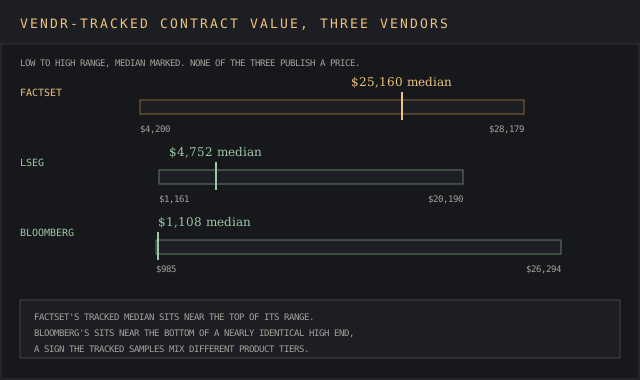
FactSet's tracked median runs roughly double Bloomberg's, even though Bloomberg carries the pricier reputation.
Neither vendor publishes a rate card, so the figures above are the closest thing either has to a public price.
FactSet's user count is growing faster than its client count, meaning existing accounts are adding seats.
Check the $25,160 median against any quote, and ask what a 95%-plus retention rate is buying before renewing.
Data vendors and resellers answer pricing questions in every deal. Send the vendor and I'll source a version you own.
How much FactSet costs
There's no FactSet price list to quote from. Search "FactSet pricing" and the result is a marketing page: the site's own pricing URL exists purely to route a visitor into a sales conversation.
TrustRadius, which lists starting prices for hundreds of comparable products, has a blank field where FactSet Workstation's plans should be, noting only that "for the latest pricing information, visit the official pricing page" and pointing back to the same contact form.
That's a deliberate structure. FactSet is a quote-based, per user financial data subscription built from a combination of user type, data feeds, analytics modules, research and workflow tools, and contract term.
FactSet's own investor materials cite more than 800 data sources feeding the platform, giving buyers data coverage across equities, fixed income, and other sectors before a single premium module gets added. Two firms with the same headcount can land on different annual numbers depending on how many of those levers they pull, and FactSet doesn't standardize any of them into a public menu a budget owner could check in advance.
Where the $12,000 number comes from
Search "FactSet pricing" long enough and a specific figure starts repeating across finance-education sites. Wall Street Prep puts FactSet's subscription at $12,000 a year for full access, the Corporate Finance Institute puts Capital IQ pricing data at $10,000 to $30,000 annually and Refinitiv Eikon at $20,000 to $50,000, and Wall Street Prep separately credits Bloomberg with more than 33% of the financial data market.
None of those figures come from the vendors themselves, and none of them match what Vendr's tracked purchase data shows for the same three platforms.
That $12,000 number is worth treating as a floor. It lines up with the low end of Vendr's own $4,200 to $28,179 FactSet range, not the $25,160 median, and neither education site discloses where its number originated or when it was last checked against a live quote.
A budget built on $12,000 is a budget built for the cheapest deal Vendr has tracked; most firms sign closer to the $25,160 median. A $10,000 to $30,000 Capital IQ estimate spans the entire market.
What buyers pay
Vendr's tracked purchase data shows a median FactSet contract of $25,160 a year, with observed deals ranging from $4,200 at the low end to $28,179 at the high end.
That spread is wide even by the standards of quote-based financial data platforms, because it's blending different buyers: a two-seat boutique research shop and a twenty-five-seat asset manager both show up in the same dataset, and FactSet prices them on completely different assumptions about data coverage and per user access.
Contrast that with Bloomberg, FactSet's most-cited comparison point. Vendr's own tracked median for Bloomberg contracts is $1,108 a year, with a range running from $985 up to $26,294.
Bloomberg's reputation as the pricier terminal is well established in the industry, and Bloomberg's own marketing describes the Terminal as a premium, standardized product. But the number Vendr's purchase database tracks for Bloomberg sits far below what a full terminal license is understood to cost.
The likeliest explanation is a sample-composition problem: Vendr's Bloomberg contracts blend lower-cost products, data feeds, news access, smaller add-ons, alongside full terminal seats, pulling the median down from what a single Terminal license runs. Treat any vendor-tracked median as a signal about deal mix, separate from any specific product's list price, and confirm what SKU a quote is pricing before comparing it to either number.
LSEG, the third name that comes up in every FactSet evaluation, tracks at a $4,752 median with a $1,161 to $20,190 range on Vendr. That's the widest gap of the three vendors between low and high, consistent with LSEG's Workspace platform pricing separately for named-user licenses and data entitlements.
| Vendor | Vendr tracked median | Vendr tracked range | Public rate card |
|---|---|---|---|
| FactSet | $25,160/year* | $4,200 – $28,179* | No |
| LSEG (Workspace/Datastream) | $4,752/year* | $1,161 – $20,190* | No |
| Bloomberg | $1,108/year* | $985 – $26,294* | No |
Copy these lines into an email, fill them in and send. I reply with scope and a price within 2 to 3 business days.
Open the emailFigures marked * are Vendr median and range annual contract values from anonymized buyer data. FactSet, LSEG, and Bloomberg each publish no public rate card.
None of the three financial data platforms FactSet competes against most directly post a price, and none of the three treat Capital IQ, the fourth name that comes up almost as often, any differently: S&P's Capital IQ platform is also quote-based, with no basic price listed for research analysts or buy side analysts to check in advance.
That alone tells buyers something: in this category, the negotiation is the pricing model, and skipping it means accepting whatever number a salesperson opens with.
What drives the quote
FactSet's own account teams build a quote around six variables, and none of them are secret; they're just not priced individually anywhere public.
- User count and user type. A full workstation license, with real time market data, screening, advanced analytics, and the Excel add in, sits in a different pricing tier than a limited or read-only seat aimed at someone who reads a dashboard.
- Financial data feeds and content depth. Core data, fundamentals, estimates, and ownership records are typically bundled into the workstation price, but real time data, third party data sets, fixed income analytics, and private-company coverage are priced as add-on premium modules that can double or triple a base quote.
- Analytics modules. Portfolio analytics, risk models, factor analysis, and quantitative screening tools sit outside the core workstation for many accounts, so a portfolio manager's seat and a junior research analyst's seat can carry different total costs even inside the same firm.
- Research and workflow tools.
- Contract term length.
- Geographic or market data coverage.
FactSet also quotes specialized implementation and integration services separately for larger deployments, according to the company's own case studies. Multi-year commitments and upfront payment structures reliably unlock better per user pricing than a one-year, quarterly-billed deal.
Hidden costs to plan for
The base subscription is rarely the whole bill. Real time market data licensed from exchanges like the NYSE, Nasdaq, and the London Stock Exchange Group carries separate exchange fees that get passed through to the buyer, on top of whatever FactSet itself charges for the feed. Alternative data, ESG data, private-company databases, company profiles, and specialized research reports are priced as add-ons.
API access is its own negotiation. One G2 reviewer using FactSet Data Feeds for portfolio screening put it bluntly: "It is really expensive. We want to download data from it and it's only possible using vb scripting. To get API access they want us to pay more." Anyone planning to integrate FactSet data into internal systems or redistribute third party data to non-FactSet users should expect that priced as its own separate line item, billed apart from the seat price.
Contracts typically carry an annual price escalation clause, often in the 3 to 5 percent range or tied to CPI, and mid-contract user additions can be priced differently than the rate locked in at signing. Buyers who don't negotiate a true-up provision upfront risk a premium on every seat added outside the original deal, raising total cost well past the number in the signed agreement.
Some buy side analysts also route part of their research spend through soft dollars, funding platforms like FactSet out of trading commissions, which changes who inside the firm feels the cost but not the total FactSet is charging.
What buyers say about the price
Verbatim feedback on FactSet's cost skews toward acceptance, which is notable for a platform with no published price. On TrustRadius, one verified user reviewing FactSet Workstation in October 2025 offered a comparison: "To be fair, I believe Bloomberg is more expensive."
That framing repeats across G2's review base. A Financial Services reviewer, writing in February 2022, positioned FactSet against the field: "There are other similar programs out there that vary from cheap to expensive. Bloomberg is extraordinarily robust but much pricier. Other options are more affordable but not as strong. Factset is an excellent middle ground for most of your needs at a manageable price."
An Investment Banking reviewer in June 2022 was shorter about it: "great product, good price point and easy to navigate interfface... use it. it is good alternative to bloomberg etc."
Not every review is that comfortable. The Data Feeds reviewer quoted above on API costs also flagged the scripting workaround required to pull data without paying for full access, a complaint that shows up in variations across FactSet's product lines whenever a buyer wants raw data out of the platform.
FactSet vs Bloomberg, LSEG, and Capital IQ
A side-by-side FactSet compare against Bloomberg, LSEG, and Capital IQ starts with three tracked numbers, none of them a list price, and every FactSet compare a buyer runs should start from that same gap.
| Comparison | Where the other platform leads | Where FactSet leads |
|---|---|---|
| FactSet vs Bloomberg | Real-time trading data, financial news, and messaging. Bloomberg's IB Chat network still pulls traders who need real-time chat more than research depth. | Flexible financial data integration, equity research aggregation, and the Excel add in that pulls live data into a model an analyst already built. |
| FactSet vs Capital IQ | Positioned as the low cost option for buyers focused on credit analysis, private-company research, and corporate development work. | Advanced analytics and portfolio tools for buy-side research and portfolio managers' use cases. |
| FactSet vs LSEG | Fixed income and foreign exchange depth, built from the old Refinitiv Eikon and, before that, Thomson Reuters' financial data business. | Modular pricing that lets a buyer skip content they don't need, though LSEG's platform-license-plus-data-entitlement structure permits something similar. |
- The platforms and seat counts to compare
- Regions, years and segments
- Where it runs: blog, white-label, gated or lead magnet
- Whose byline goes on it
- Deadline
- 2,500+ words, human-written
- Every figure linked to its source
- Yours to publish, under your name or none
- Hosting here for +$200, with your sponsored links
No two firms buy the same combination of modules, and each vendor prices around a client's specific needs, from a research desk to an investment banking team. FactSet and LSEG draw the line between what's bundled and what's an add-on in different places, which is why buyers evaluating both report using one vendor's quote as a bargaining chip against the other.
How to negotiate FactSet pricing
The single most repeated piece of advice across Vendr's anonymized FactSet transaction data is to start early and anchor to budget constraints before the first call. Engaging 90 to 120 days before a target start date or renewal deadline gives a buyer time to evaluate alternatives, define exactly which users need full workstation access versus limited access, and negotiate without the time pressure that lets a vendor hold firm on an opening number.
Multi-year commitments are the second lever. FactSet prefers them and typically offers better per-user pricing in exchange, but that only pays off if the buyer negotiates annual true-up provisions that allow adjusting user counts or data feeds without penalty, plus a cap on the annual price escalator, so a multi-year discount doesn't get erased by compounding increases.
Demonstrating active evaluation of Bloomberg, LSEG, or Capital IQ is the third lever and the one that shows up most consistently in negotiation outcomes: buyers don't need to switch. A documented quote from a competing financial data platform strengthens a buyer's position on its own, because FactSet's sales team only needs to believe they might.
The fine print matters as much as the headline number. Market data and exchange fees, API and redistribution terms, and mid-term user-addition pricing should all be requested as an itemized breakdown before signing. Leaving them out means discovering them for the first time on the invoice after go-live. Buyers who show up to a renewal with last year's invoice and a competing quote in hand negotiate from a stronger position than buyers who show up with neither.
Who FactSet pricing is built for
FactSet's own client metrics, kept far more up to date than its pricing page, point toward who its pricing structure is designed to serve. FactSet's investor relations pages are the best public resources for verifying those figures, even though pricing isn't among them.
A base of 9,130 clients running 247,766 users, growing user count faster than client count, describes a financial data platform expanding mostly inside firms it has already sold into. That's consistent with a quote-based model built around asset managers, investment banking teams, and institutional investors who need the full research, portfolio analytics, and workflow stack.
Smaller research shops and individual analysts who need less than the full workstation are the group most likely to find FactSet's pricing structure a poor fit, since the platform has no basic price to check against a budget before a sales call. For that segment, low cost data platforms with transparent pricing are frequently the better starting point, with FactSet evaluated later once the firm's data coverage and specific requirements justify a custom quote.
What to budget
A single full workstation seat, based on Vendr's tracked median, should be budgeted around $25,000 a year, with the understanding that actual quotes for otherwise-similar firms have landed anywhere from roughly $4,200 to $28,179 depending on user type, data feeds, and negotiated terms.
Multi-seat deployments should model per user cost declining with volume, consistent with how FactSet structures multi-year and larger-deployment discounts, while budgeting separately for real time market data licensing, any premium modules, API access if data needs to leave the platform, and an annual price escalator most contracts include by default.
The number worth defending in a budget review is total cost of ownership, built with the same Vendr-tracked-median approach behind this site's 6sense pricing teardown.
Delivered for your site and your byline. Hosting here is optional.
Frequently asked questions
How much does FactSet cost per year?
FactSet doesn't publish a price. Vendr's tracked purchase data puts the median contract at $25,160 a year, with observed deals ranging from $4,200 to $28,179 depending on user count, data feeds, and analytics modules included.
Can I use FactSet for free?
FactSet doesn't offer a self-serve free tier. TrustRadius notes a free trial is available for FactSet Workstation, but every evaluation runs through a sales-led scoped demonstration.
How much does the FactSet API cost?
API access is priced separately from a standard workstation seat. A G2 reviewer using FactSet for portfolio screening described needing to pay extra to move beyond scripted data pulls: "To get API access they want us to pay more."
Who is FactSet's biggest competitor?
Bloomberg Terminal is the comparison financial professionals reach for most often, followed by LSEG's Workspace platform and Capital IQ. G2 lists Bloomberg Terminal, AlphaSense, and Morningstar Direct among FactSet Workstation's top tracked alternatives, and buyers evaluating any of them commonly play one vendor's quote against the other two. The AlphaSense vs FactSet comparison sets Vendr's $25,160 FactSet median against AlphaSense's $18,375.
Is FactSet cheaper than Bloomberg?
Vendr's tracked medians show FactSet's typical contract higher than Bloomberg's, but the two datasets aren't pricing the same product mix. Multiple G2 and TrustRadius reviewers who have used both describe Bloomberg as the pricier platform in practice, which is why a Bloomberg quote remains a useful reference point even for a firm that expects to buy FactSet.
Bottom line
FactSet's pricing page won't tell a buyer anything a phone call wouldn't, and that's by design. The number that matters is the one tracked across real purchases: a $25,160 median contract, a range wide enough to include both boutique research shops and large asset managers, and a set of add-on costs, real-time data, analytics modules, API access, that rarely show up in the first quote a sales rep sends over.
Buyers who go in with that range, a clear list of which seats need full workstation access versus limited access, and a documented look at Bloomberg or LSEG pricing tend to land closer to the low end of what FactSet charges. Buyers who don't tend to find out where the high end of that range comes from the hard way, on a renewal invoice a year later.
Vendors publish reports like this one to show buyers the full cost before the first sales call.
A report on your topic for a blog page, gated content or a lead magnet.
Written for your client and published under their brand, with my name left off.
Your report on marketintelligencetools.com, with 2 to 3 CTAs carrying your sponsored links.
Default terms: the report is yours to publish, and I keep the right to republish it on this site behind a gate, outside Google's index.