LSEG review: pricing, Workspace, and where it beats or loses to Bloomberg
 By Jan Suski. I go deep on every review, checking every number against its source and digging up details other coverage misses, a habit from six years of SEO and link building for tech companies. Bylines at Surfer, Brand24, and Senuto. How the scoring works.
· Prefer this source on Google
Best for
Institutions already running fixed income, FX and equities workflows who want one vendor covering all three asset classes.
Not for
Teams that want a self-serve trial or a published price. LSEG Eikon carries no free trial and no freemium tier, and every path runs through a sales-led quote.
What it costs
No public rate card. Wall Street Prep tracked LSEG's Refinitiv Eikon seat at about $22,000 a year (7 April 2025), before exchange fees and add-on licensing.
- Delivery
- Workspace terminal, browser, streaming feed, API or file
- Datastream
- Ships as a native Excel add-in, not a bolt-on
- Reference Data Services
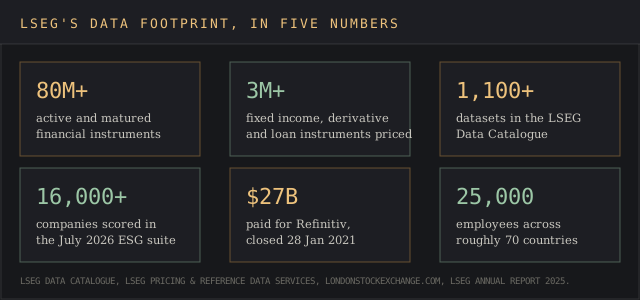
- 80 million-plus active and matured financial instruments
- LSEG Pricing Service
- 3 million-plus fixed income instruments, derivatives and bank loans
- Company Intelligence
- AI agent in Workspace since July 2026; generates company overviews in seconds
- Customer base
- 44,000-plus customers across 170-plus countries
- Refinitiv acquisition
- $27B all-share deal, closed 28 January 2021
- Refinitiv shareholders
- Hold ~37% of LSEG's economic interest, under 30% of voting rights
- Divisions
- Data & Analytics, FTSE Russell, Risk Intelligence, Markets
- Data & Analytics revenue
- About £4.0B in 2025
- Group revenue (TTM)
- £9.66B; net income £1.41B, ~14.6% margin
- Market cap
- ~£43.4B in early August 2026, ~32x trailing earnings
- Data Catalogue
- 1,100-plus datasets
- Headcount
- ~25,000 employees across ~70 countries
- FTSE Russell benchmarking
- Indices benchmark more than $16 trillion in assets
- ESG suite (relaunched July 2026)
- 16,000-plus companies, 99% of FTSE All-World Index by market cap
- ESG indicators
- 240-plus standardized indicators, 2,000-plus data points
- ESG fixed income coverage
- 1 million-plus instruments
- Public price
- None for Workspace or the ESG suite; quoted per seat and per feed
- Refinitiv Eikon
- About $22,000/yr, Wall Street Prep, 7 April 2025
- Trial and setup
- No free trial, no setup fee, per TrustRadius
- Review volume
- G2: 3.8/5 from 4 reviews. TrustRadius: 9.6/10 from 13, vs FactSet's 70
FactSet
Not forA desk that needs deep fixed income or FX coverage alongside equities; FactSet's strength skews toward equity research and company profiles.
Bloomberg Terminal
Not forA buyer whose main constraint is budget: LSEG or Capital IQ cover similar data breadth for less.
LSEG is what's left after the London Stock Exchange bought Thomson Reuters' data business and kept the parts that made money. The name on the door still says London Stock Exchange Group, but the business a research analyst or portfolio manager opens every morning is Workspace: the terminal Refinitiv built, now selling under a new owner's badge.
This review covers the two things a buyer evaluates: the data and the terminal it sits inside. LSEG's other divisions, FTSE Russell's indices, the London Stock Exchange itself, LCH's clearing business, matter more to issuers and index licensees than to the analyst comparing Workspace against Bloomberg or FactSet, so this piece stays focused on Data & Analytics and treats the rest as context.
Fit depends heavily on what a desk already runs. A shop juggling fixed income, FX and equities across three vendors has a real case for consolidating onto one. A shop that only needs equity research and company profiles has cheaper, narrower options that do that one job with less friction.
Everything below traces to a linked source: LSEG's own product pages, its annual report, and verified reviews on G2 and TrustRadius. The review flags every figure sourced from a buyer's own contract; LSEG publishes no public rate card.
What London Stock Exchange Group sells
Four divisions carry the London Stock Exchange Group name. Data & Analytics sells the feeds, the terminal and the reference data that this review evaluates. FTSE Russell sells indices and benchmarks, and Risk Intelligence sells screening and due-diligence tools, World-Check among them.
Markets runs the exchanges and venues themselves, the London Stock Exchange, AIM, Turquoise, FXall and Tradeweb, plus LCH's clearing and LSEG's post trade and regulatory reporting solutions. UnaVista, rebranded LSEG Regulatory Reporting Solutions, is a separate purchase inside that stack: an FCA- and ESMA-authorised Trade Repository that handles MiFID II/MiFIR, EMIR and SFTR reporting for thousands of firms, processing more than 8 billion transactions a year.
LSEG's own materials describe the whole group's remit as spanning data, indices and analytics, capital formation, trade execution, clearing and risk management, a wider scope than any single Workspace contract covers.
A buyer evaluating a market data terminal only touches the first division. The other three explain why LSEG shows up in unrelated conversations, an ESG data ranking, a clearing-house comparison, a regulatory reporting RFP, without competing on the same shortlist as Bloomberg or FactSet in most of them.
↑ FACT SHEETData analytics: where the financial data comes from
LSEG describes this division's own remit as "trusted data and actionable insights across trading, investing and risk management," aimed at letting financial institutions make trading and risk decisions with confidence. Reference Data Services covers 80 million-plus active and matured financial instruments, refreshed intraday.
LSEG Pricing Service independently evaluates 3 million-plus fixed income instruments, derivatives and hard-to-value bank loans, the kind of asset a vendor with only equity data can't price. The Data Catalogue behind all of it lists 1,100-plus individual datasets, per LSEG's own LinkedIn company page.
Jason K., a Global Market Data Leader at an enterprise account, put the day-to-day experience like this on G2 (4.0 of 5 stars, reviewed 4 November 2024):
Integrated excel add in experience including Datastream. Assemble various panels and tabs into easy to use and refer to combinations.
Datastream, the decades-old time-series archive Refinitiv inherited from its own earlier acquisitions, ships as a native add-in inside Workspace's Excel integration.
Coverage breadth was also the strongest praise in a separate review. A Consumer Goods buyer on the Enterprise tier wrote on G2 (4.5 of 5, 18 June 2023):
The best thing which i liked about refinitiv is its a one stop solution for industry analysis reports, pricing data and company wise reports. It is a very wide database that covers multiple industries, topics, regions etc.
In July 2026, LSEG added Company Intelligence, an AI agent inside Workspace that assembles price performance, financials, peer comparisons, analyst research and Reuters News into one exportable report. Nej D'Jelal, LSEG's Group Head of Workflows, described the intent on the company's own product update:
Company Intelligence helps financial professionals build a trusted view of a company faster. By combining AI, licensed content, proprietary LSEG data and exclusive sources, it delivers accurate and auditable insights directly into Workspace.
The claim worth checking on renewal: does "auditable" mean a citation trail back to the underlying feed, or a well-written paragraph with nothing behind it?
↑ FACT SHEETFTSE Russell and capital markets: the index business riding along
FTSE Russell's indices benchmark more than $16 trillion in assets, a scale figure that puts it in the same conversation as MSCI on pure index licensing. FTSE Russell's own description of the business is an index partner that informs asset allocation, portfolio construction and risk management, and helps investors with benchmarking across market cycles.
It relaunched its ESG scoring suite in July 2026, retiring the prior Refinitiv-era methodology. The new suite scores 16,000-plus companies against 240-plus standardized indicators and 2,000-plus underlying data points, covering 99% of the FTSE All-World Index by market capitalisation, per our own ESG data providers ranking.
None of this is a separate purchase for a Workspace buyer researching equities. It matters more to an asset manager licensing an index for a fund or an ETF, or to a corporate issuer courting inclusion in a FTSE benchmark, than to the analyst pulling up a company profile. It's worth knowing the index business exists mainly because it's the part of LSEG most likely to come up in an unrelated procurement conversation a year from now.
Risk intelligence and post trade: the parts most Workspace buyers never touch
Risk Intelligence runs World-Check screening, due-diligence reports and identity verification, sold separately from Workspace and aimed at compliance and onboarding teams.
Post trade sits inside the Markets division alongside LCH's clearing and settlement infrastructure, execution venues like Turquoise and FXall, and LSEG's own post trade services and regulatory reporting tools, built to help firms operate more efficiently on the trades they've already made; a Workspace seat doesn't include any of it.
The practical takeaway for a buyer comparing terminals: don't let LSEG's total headcount or total revenue figure imply that a Workspace contract touches all four divisions. It doesn't. Each division sells and prices independently, and a buyer only pays for what's provisioned.
↑ FACT SHEETPricing: what a seat on the London Stock Exchange Group's terminal costs
LSEG publishes no rate card for Workspace, Eikon or the ESG suite. The clearest third-party figure comes from Wall Street Prep, which tracked LSEG's Refinitiv Eikon seat at about $22,000 a year as of 7 April 2025, sitting between FactSet's roughly $20,500 Vendr-tracked median and Bloomberg Terminal's approximately $32,000 list price for a single seat.
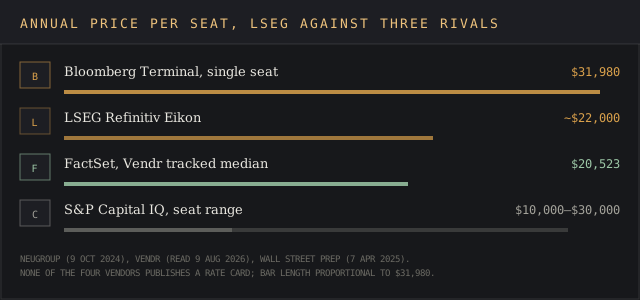
TrustRadius's pricing comparison lists no free trial and no freemium version for LSEG Eikon, and no entry-level setup fee either, unlike FactSet, which the same table marks as requiring one. That's a smaller barrier at signature, offset by less room to test-drive the product before committing.
The contract price is only part of the bill. A Small-Business Financial Services reviewer described what happens after signing, on G2 (2.0 of 5, 22 May 2025):
Our billing period was changed multiple times without our consent. This lead to confusion on our part, and Refinitiv maximizing what they could charge us. They never really met our expectations for stock and bond index valuations, as they require additional licensing agreements, despite paying over five figures annually.
Index valuations sit behind a second license, on top of a five-figure base contract, a detail a procurement team should confirm in writing before signing.
Where LSEG frustrates financial markets professionals
Search is the complaint that shows up most often across reviews. Jason K.'s G2 review, otherwise positive, listed:
Search capabilities are cumbersome. Search results limited to 10,000 results. News builder not intuitive. Best utilised with 1:1 training (in this way similar to S&P Cap IQ and BBG Terminal).
A TrustRadius reviewer, Ankit Gupta, an Assistant Manager in Insurance Insights, made the same point from a different angle (24 August 2022):
Not very easy to navigate - needs user to spend time. Should have an intelligent search option to enable targeted search. Should have more granular coverage in terms of financials.
Interface friction shows up in head-to-head comparisons too. Joseph Sroka, a Chief Investment Officer who switched vendors, wrote on TrustRadius:
FactSet has a much more robust platform with better excel integration. I used Eikon for many years. Once Thomson Reuters sold it to LSEG, the service went downhill. I am happy I made the switch to FactSet.
That's a single buyer's account. Still, it's a specific, dated data point: a multi-year Eikon user who left in the years after LSEG's January 2021 acquisition of Refinitiv.
Babu S., a Senior Consultant in an Enterprise IT Services account, split the difference on G2 (4.5 of 5, 11 April 2022):
Despite having the best interface for the product. The application lags tremendously in meeting customer satisfaction. The product also needs more user friendliness.
Read the four reviews together and a pattern holds: the underlying data earns praise close to unanimously, and the interface earns a caution close to unanimously.
What changed in the last 12 months
Two moves stand out from the past year, both landing in July 2026. The Company Intelligence AI agent, covered above, is the more visible one: it's a workflow shortcut built on data LSEG already had. The ESG suite relaunch is the more substantive change, since it replaces the scoring methodology entirely. That's a bigger swing than layering one more feature onto the old system.
A buyer who evaluated LSEG's ESG data before July 2026 is looking at a different product now, with a shorter public track record than MSCI's or Sustainalytics' longer-running methodologies, even though the underlying company coverage (16,000-plus names) is comparable in size.
The bigger structural bet is LSEG's cloud and AI push through its multi-year partnership with Microsoft. LSEG-licensed data now activates inside Microsoft 365 Copilot, including Teams and Excel, and connects to Microsoft Fabric for firms building their own AI agents on top of it.
Workspace itself sits at the center of that partnership, serving more than 350,000 users across 1,000-plus applications built on the platform, per LSEG's own reporting on the deal. A buyer evaluating LSEG today is buying into that Microsoft dependency as much as into the data itself.
↑ FACT SHEETCompany stability: who owns LSEG now
LSEG closed its $27 billion all-share purchase of Refinitiv on 28 January 2021, buying from a consortium led by Blackstone alongside Canada Pension Plan Investment Board and GIC, and from Thomson Reuters directly. The deal structure matters for a buyer thinking about vendor stability: Refinitiv's former shareholders didn't cash out entirely; they kept roughly 37% of LSEG's ongoing economic interest, while holding under 30% of voting rights.
That's a large, semi-permanent stakeholder group with financial exposure to LSEG's performance but limited board control, a structure built to keep Thomson Reuters and Blackstone aligned with the combined company's success without handing them a governing stake.
Four years on, the acquisition looks less like a live integration risk and more like settled corporate history. Data & Analytics, the division built on the Refinitiv purchase, generated about £4.0 billion of LSEG's revenue in 2025, per the company's own annual report, making it the company's core earner four years after the deal closed.
Our LSEG acquisition report covers the full deal chronology: the regulatory approvals in the US, EU and Asia-Pacific, the forced sale of Borsa Italiana, and what happened to Eikon and the Refinitiv brand after 2021.
The group-wide numbers back that up. LSEG's market cap sat around £43.4 billion in early August 2026, trading near 32 times trailing earnings, per StockAnalysis.com. Trailing twelve-month revenue was £9.66 billion against £1.41 billion in net income, a roughly 14.6% margin, and its H1 2026 results reported 8.4% organic revenue growth and 17% EPS growth, with full-year guidance raised on the back of it.
LSEG vs the alternatives
FactSet is the closest published comparison on this site, and the two vendors split on a familiar axis: FactSet wins on interface polish and Excel integration, LSEG wins on raw asset-class breadth, particularly in fixed income and FX. A Director comparing both, quoted on TrustRadius, put the three-way tradeoff plainly:
Bloomberg has the most data / content but is too expensive, while Eikon has the least. FactSet Workstation and Capital IQ were comparable in price but FactSet Workstation had broader data coverage.
That reviewer ranked Eikon behind both FactSet and Bloomberg on content depth, in one buyer's TrustRadius comparison.
Bloomberg Terminal remains the reference point on interface and trader workflow; multiple LSEG reviewers, including Jason K. above, measure LSEG's usability against it and find LSEG short of Bloomberg's "cachet," his word, even where LSEG matches or beats Bloomberg on coverage breadth for fixed income and FX.
Bloomberg's list price, around $32,000 a seat, also runs meaningfully above LSEG's roughly $22,000 Eikon figure, a gap worth weighing against the workflow difference.
S&P Capital IQ sits a step below both on price, $10,000 to $30,000 a year depending on seat configuration, and is the more common third choice for a lean corporate development team that doesn't need full trading-floor breadth.
Common questions
What does LSEG stand for?
London Stock Exchange Group. The name covers four divisions: Data & Analytics (the Workspace terminal and Refinitiv-era data this review focuses on), FTSE Russell (indices), Risk Intelligence (screening and due diligence) and Markets (the exchanges, clearing and post trade infrastructure).
What's the difference between the London Stock Exchange and London Stock Exchange Group?
The London Stock Exchange is one trading venue, part of LSEG's Markets division alongside AIM, Turquoise and Tradeweb. London Stock Exchange Group is the parent company. Data & Analytics generated about £4.0 billion of LSEG's roughly £9.66 billion in trailing twelve-month revenue, the largest share of any division.
Is LSEG's data reliable?
Reviewers rate the underlying data well above the interface built around it. Every G2 and TrustRadius review pulled for this piece praised coverage depth; the recurring complaints are about search, navigation and billing.
What does LSEG do, beyond the terminal?
It runs exchanges and trading venues, prices and clears fixed income and derivative instruments through LCH, builds FTSE Russell's benchmarks, and sells risk-screening tools through Risk Intelligence. Most reviews, this one included, focus on Data & Analytics because that's the division most buyers evaluate.
Verdict
LSEG suits financial institutions that already need fixed income, FX and equities data under one roof and are willing to run a sales-led procurement process to get there. Clients who rely on one vendor across asset classes get the strongest case for it. The $27 billion Refinitiv acquisition gave it the broadest asset-class coverage of any single platform in this category, and reviewers consistently credit the underlying data over the interface wrapped around it.
It doesn't suit teams that want to self-serve a trial, see a price before a sales call, or use a search bar without hitting the 10,000-result cap two G2 reviewers separately flagged. A billing-period complaint and a second-license requirement for index valuations, both from verified G2 reviews, are the kind of contract detail worth reading closely before signing.
It might suit a mid-sized asset manager weighing LSEG against FactSet or Capital IQ, provided procurement budgets time for a negotiated quote (LSEG has no published list price) and the team plans for the 1:1 training multiple reviewers said the platform needs before it clicks.