London Stock Exchange Group's acquisition of Refinitiv: deal terms and what changed
 By Jan Suski, six years working in digital. How the scoring works.
The numbers LSEG's acquisition of Refinitiv, updated August 2026
LSEG paid in its own stock, not cash, which is why the largest purchase in its history never shows up as a cash outflow.
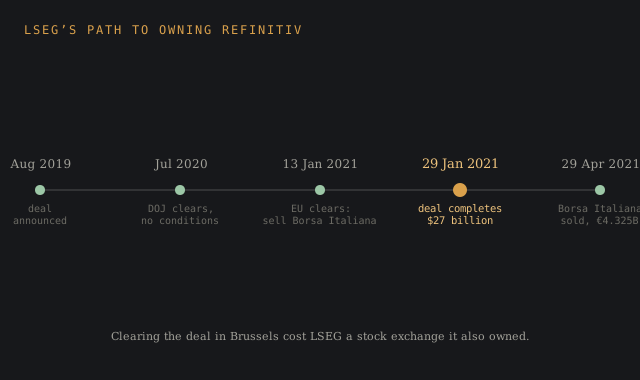
Clearing the file in Brussels cost LSEG a second exchange group: Borsa Italiana went to Euronext to close the EU's investigation.
Every 2021 seller has since cashed out or been replaced. Microsoft is now the strategic shareholder Refinitiv's old owners used to be.
London Stock Exchange Group plc closed its all-share purchase of Refinitiv on 29 January 2021, at a total enterprise value of $27 billion. Getting there cost LSEG a stock exchange it already owned: European regulators cleared the deal only after LSEG agreed to sell Borsa Italiana to Euronext.
This page covers the deal terms and the exchange mechanics, the regulatory approvals that took eighteen months to collect, the ownership churn that followed (Thomson Reuters is gone, Microsoft is in), and what happened to the Refinitiv brand and its flagship terminal, Eikon. It closes with what the acquisition changed for anyone comparing LSEG's data products against Bloomberg or FactSet.
The deal put a research-and-data business used by more than 40,000 institutions under a new owner, then rebuilt that owner's revenue around it. Five years on, the segment built substantially from Refinitiv is LSEG's largest by revenue, and the brand name it paid $27 billion for is retired.
The LSEG acquisition of Refinitiv: what was bought and for how much
LSEG announced the proposed acquisition in August 2019. The deal was structured as an all-share transaction: Refinitiv's owners received newly issued LSEG shares, not cash. The total enterprise value came to $27 billion, roughly £22 billion, which included about $11.8 billion of Refinitiv net debt that LSEG took on. LSEG's own completion announcement confirms the structure and the date.
The releases both companies issued that day opened with the same formula every completed merger uses: LSEG and Refinitiv today announced that completion of the previously announced transaction had occurred.
Before the sale, Refinitiv was owned 55%, a majority interest, by private equity funds affiliated with Blackstone's consortium, and 45% by Thomson Reuters, the two having carved it out of Thomson Reuters' financial and risk business in 2018.
What LSEG bought with the $27 billion wasn't a single terminal. Refinitiv's own 2019 disclosures put its footprint at more than 40,000 institutions across roughly 190 countries, spanning trading platforms, market data management, the Reuters global news service, and World-Check compliance screening.
Refinitiv's core business was business and financial information: real-time and historical pricing feeds, reference data on public and private companies, and the trading platforms banks and asset managers use to act on that data. LSEG bought a financial information company at industrial scale, not a single terminal brand.
Refinitiv also carried an ESG ratings and screening business, which LSEG still runs inside the same Data & Analytics segment tracked in our ESG data providers ranking.
David Craig, Refinitiv's chief executive at the time of the deal, joined the LSEG board once the acquisition closed. LSEG's announcement of the completion named that appointment alongside the deal terms; most of the rest of the paperwork reads as an exchange of shares between institutions, not people.
The Refinitiv deal wasn't LSEG's first attempt at buying its way into a bigger data and index business. The habit went back to 2007, when LSEG bought the Milan exchange, Borsa Italiana, for €1.6 billion. The deal let LSEG describe itself as "Europe's leading equities business," holding 48% of the FTSEurofirst 100 index by market capitalisation with, in its own words, "the most liquid order book by value and volume traded."
That same Borsa Italiana is the business LSEG sold back to Euronext in 2021 to get the Refinitiv deal past Brussels.
In 2014, LSEG paid £1.59 billion ($2.7 billion) for the index arm of the Frank Russell Company, merging it with its own FTSE business the following year to form FTSE Russell, whose Russell indexes track more than $6 trillion in US assets. At the time, that was the largest acquisition in LSEG's history.
Two years after that, in November 2016, LSEG announced it would buy Mergent Inc, a provider of business and financial information on public and private companies, adding another data business to the group years before Refinitiv was ever discussed.
In 2017, LSEG paid $685 million to buy the Yield Book and Citi Fixed Income Indices from Citigroup, adding fixed-income benchmarks to FTSE Russell's equity index business well before Refinitiv entered the picture.
Refinitiv broke LSEG's acquisition record within five years, at more than ten times the price of the Frank Russell deal.
LSEG's all-share acquisition of Refinitiv and what regulators demanded
Every regulator that opened a file on the LSEG transaction closed it inside eighteen months, and only one of them attached a condition.
The US Department of Justice's Antitrust Division ran an eight-month review. It closed its investigation in July 2020 without imposing a single condition, stating that the combination was unlikely to harm competition or American consumers. Australia's competition regulator and Singapore's competition commission both cleared the deal the same way: no remedies attached.
Brussels was a different fight. The European Commission opened a formal investigation over concerns that combining LSEG's trading venues with Refinitiv's bond-trading and market-data businesses would squeeze out rivals. On 13 January 2021, the Commission conditionally cleared the acquisition. LSEG had to divest the Borsa Italiana Group, including the MTS bond-trading platform, and keep certain Refinitiv data available to rivals on an open-access basis.
LSEG had already lined up the buyer. It agreed in October 2020 to sell Borsa Italiana to Euronext for €4.325 billion in cash. The two exchange operators completed that sale on 29 April 2021, three months after the Refinitiv deal itself closed. One acquisition bought a data business; the condition attached to it sold a stock exchange.
| Regulator | Date | Outcome |
|---|---|---|
| US Department of Justice | Jul 2020 | Investigation closed, no conditions |
| European Commission | 13 Jan 2021 | Conditional clearance: sell Borsa Italiana, open-access data commitments |
| LSEG-Refinitiv deal completion | 29 Jan 2021 | All-share acquisition closes, $27B enterprise value |
| Euronext-Borsa Italiana | 29 Apr 2021 | Sale completes, €4.325B cash |
Dates and outcomes as stated in each regulator's or party's own news release.
Thomson Reuters and Blackstone: who sold Refinitiv, and what they kept
When the deal closed, Refinitiv's former owners, Thomson Reuters and the Blackstone-led consortium, together held about 37% of LSEG's economic interest and just under 30% of its voting rights, according to Thomson Reuters' own SEC filing on the closing.
Thomson Reuters alone held roughly 82.5 million LSEG shares, with a market value of about $9.8 billion at LSEG's closing share price the day before completion. It held that stake through an entity jointly owned with the Blackstone consortium and a group of Refinitiv's own senior managers. Thomson Reuters itself remained a business information services company built on the same financial markets its former subsidiary sold data about.
Every LSEG or Thomson Reuters release about the deal carried the same forward-looking-statements disclaimer. Both companies warned that actual results could differ materially from current expectations. Readers shouldn't place undue reliance on projections tied to matters outside the company's control, including tax consequences and the timing of future sales of LSEG shares by Refinitiv's former owners.
Thomson Reuters' own version went further: it disclosed that Thomson Reuters expects its interest in LSEG to sit inside what it reports as the Thomson Reuters Corporates segment. The company also said those figures reflect expectations that may not hold, that past results give no guide to future performance, and that Thomson Reuters disclaims any obligation to update the statements once made. That boilerplate turned out to describe exactly what happened next.
The shares Thomson Reuters and Blackstone received carried a lock-up arrangement, with the restrictions fully expiring on 29 January 2025, four years after completion. They didn't wait that long.
That lock-up arrangement let Thomson Reuters and Blackstone's consortium sell up to an aggregate one third of their combined holding at each of several set dates. They couldn't sell enough LSEG shares to breach that cap, or sell any before the date each tranche unlocked.
Thomson Reuters structured its stake to be predominantly tax deferred. Taking LSEG shares instead of cash meant no immediate tax payment, with any tax due only once Thomson Reuters chose to generate net proceeds by selling.
In December 2022, LSEG signed a ten-year strategic partnership with Microsoft. Microsoft bought a near-4% equity stake in LSEG for $2 billion, sourced from the Blackstone and Thomson Reuters holdings. LSEG committed in turn to spend at least $2.8 billion on Microsoft's cloud over the following decade.
Thomson Reuters went further. In May 2024, Thomson Reuters and Blackstone-affiliated funds sold 17.3 million LSEG shares at £91.50 apiece. After that sale settled, Thomson Reuters held zero remaining interest in LSEG. Blackstone-affiliated funds retained a stake as of that same announcement. Every party that sold Refinitiv to LSEG in 2021 has since cashed out, been bought out by Microsoft, or both.
LSEG Workspace: what replaced Eikon and the Refinitiv brand
The Refinitiv name outlived the acquisition by two years. LSEG dropped it from its data and analytics products in 2023, renaming Refinitiv Workspace to LSEG Workspace and folding the rest of the Refinitiv-branded lineup into the LSEG name. The old refinitiv.com domain still resolves for some legacy links, but the brand itself no longer fronts a live product.
Eikon, Refinitiv's flagship terminal and Bloomberg's most direct rival, didn't survive the transition either. LSEG withdrew every Eikon variant from new sale on 1 January 2024, and, according to LSEG's own product page, the service for existing customers ceased at midnight GMT on 30 June 2025.
Customer settings and saved layouts migrated automatically into LSEG Workspace, which now runs on infrastructure built under the Microsoft partnership, with LSEG's data platform moving onto Microsoft Azure over the life of that ten-year deal.
What the acquisition did to LSEG's business
LSEG's own 2019 filing on the deal explained why a data business was worth buying: it targeted a combined adjusted EBITDA margin of about 50% in the medium term. That's the kind of margin a data feed can sustain once it's sold to thousands of customers without materially higher distribution cost per customer.
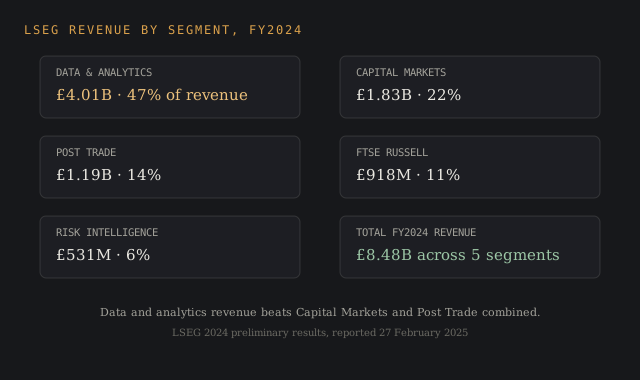
Refinitiv reset LSEG's revenue mix. In its 2024 preliminary results, LSEG reported Data & Analytics, the segment built substantially from the Refinitiv purchase, at £4.01 billion in revenue. That put it ahead of Capital Markets at £1.83 billion, Post Trade at £1.19 billion, FTSE Russell at £918 million, and Risk Intelligence at £531 million.
Data & Analytics alone generated more revenue than Capital Markets and Post Trade combined, on LSEG's own published segment figures.
The business kept growing after that. LSEG's 2025 preliminary results, reported 26 February 2026, put total group income at £8,986 million, up 5.8% on the year. Data & Analytics organic growth accelerated to around 5%, faster than it grew in 2024.
LSEG has said publicly that it's steering the same data business toward AI-ready partnerships, positioning the Refinitiv-derived platform as infrastructure for institutional AI workflows, not only a terminal product.
The same acquisition logic showed up elsewhere in financial data around the same period. Our MSCI acquisition report covers a comparable index-and-data deal, bought for the same reason: a data business scales without the distribution cost a trading venue carries.
What it means for a buyer choosing between LSEG, Bloomberg and FactSet
None of this changes what LSEG Workspace does day to day. It's still a market-data and analytics terminal competing with the Bloomberg Terminal and FactSet Workstation for the same seats on the same trading floors. Buyers evaluating LSEG against FactSet or Bloomberg should still price seats, data licences and API access the same way they'd price any of the three.
Buyers weighing all three against the wider field can start with our financial data providers ranking, which places LSEG Workspace alongside Bloomberg, FactSet and smaller specialists.
What the acquisition changes is who profits from the seat and where the roadmap points. LSEG owns the exchange, the index business (FTSE Russell), the clearing house, and the data terminal all under one balance sheet, which no other terminal vendor can say.
That gives LSEG a reason to bundle index licensing, post-trade services and Workspace access in ways Bloomberg and FactSet, neither of which run an exchange, cannot match.
It also means a buyer negotiating a LSEG Workspace contract is negotiating with a company whose largest profit centre is now that same data business, not a side project subsidized by trading revenue.
None of the three publish public seat pricing. Our own Bloomberg Terminal pricing and FactSet pricing reports work from third-party estimates, and our FactSet vs Bloomberg comparison covers those two head to head.
Frequently asked questions
Is Refinitiv the same as LSEG?
Refinitiv is a former company, now owned by and absorbed into London Stock Exchange Group. LSEG acquired Refinitiv on 29 January 2021 and, starting in 2023, retired the Refinitiv brand from its products, so Refinitiv itself no longer exists as an independent business.
Are Refinitiv and Thomson Reuters the same company?
No. Thomson Reuters carved its financial and risk business out into Refinitiv in 2018, selling 55% of it to funds affiliated with Blackstone while keeping a 45% stake. Thomson Reuters then sold its remaining Refinitiv-linked LSEG shares in May 2024 and holds no stake in LSEG today.
Who owns Refinitiv now?
London Stock Exchange Group owns what used to be Refinitiv outright, having bought it in an all-share deal that closed 29 January 2021. Refinitiv's former owners, Thomson Reuters and Blackstone-affiliated funds, hold LSEG shares instead of the business itself, and Thomson Reuters has sold all of those.
When did LSEG take over Refinitiv?
The acquisition completed on 29 January 2021, roughly eighteen months after LSEG first announced the deal in August 2019. The gap was regulatory: the European Commission didn't clear the deal until 13 January 2021, and only on the condition that LSEG sell Borsa Italiana.
Has LSEG Workspace replaced Eikon?
Yes. LSEG withdrew Eikon from sale on 1 January 2024 and ended service for existing customers at midnight GMT on 30 June 2025, migrating remaining users into LSEG Workspace, the renamed successor to Refinitiv Workspace.
What does LSEG stand for?
LSEG is the ticker-style abbreviation for London Stock Exchange Group plc, the company that owns the London Stock Exchange itself along with FTSE Russell, LCH clearing, and the data and analytics business built from the Refinitiv acquisition.
Bottom line
LSEG paid $27 billion for Refinitiv in 2021, settled in its own stock instead of cash, and gave up a stock exchange in Milan to get regulators out of the way. The business it bought is now the largest revenue engine LSEG runs. Every institution that sold Refinitiv to LSEG has since sold its way out of LSEG too, replaced by a cloud vendor that took a stake instead of a seat on the trading floor.
The Refinitiv name is gone and Eikon is switched off, but the product line both built is bigger than it was in 2021, and it now earns LSEG more than its exchange and clearing businesses combined. A buyer comparing terminals still compares seats, data coverage and price. What changed is which company cashes the check, and how much of its own business now depends on that single answer.
Sources, and what's confirmed where
Deal terms, dates and completion details are from LSEG's own newsroom press releases and Thomson Reuters' SEC filing on the transaction close. Regulatory outcomes are quoted from the US Department of Justice's own statement and the European Commission's press release. Figures on the Microsoft partnership are from Microsoft's own announcement, and the Thomson Reuters exit is dated from Thomson Reuters' own press release. All figures checked 27 August 2026.
LSEG's earlier acquisitions and their present-day status, including Borsa Italiana, the Frank Russell Company, Mergent Inc and the Yield Book, are dated from LSEG's own disclosures and public reporting, cross-checked against Wikipedia's summary of the company's acquisition history.