FactSet vs Bloomberg: Cost, Data Coverage and Which Desk Each One Fits
 By Jan Suski. I go deep on every review, checking every number against its source and digging up details other coverage misses, a habit from six years of SEO and link building for tech companies. Bylines at Surfer, Brand24, and Senuto. How the scoring works.
· Prefer this source on Google
| WHAT EACH ONE DOES | BLOOMBERG | FACTSET |
|---|---|---|
| Core job | Real-time pricing | Standardised models |
| Coverage unit | 70M+ instruments | 86,000+ companies |
| Fundamentals history | 20+ yrs, bulk feed | Annual from 1980 |
| Evaluated bond prices | BVAL, 2.7M secs | Not published |
| Messaging reach | 350,000+ network | Support IM only |
| Excel formulas | BQL, BDH, BDP | =FDS, ExcelConnect |
| PowerPoint plugin | None published | Pitch Creator |
| Named AI model | BloombergGPT, 50bn | Mercury, LLM agent |
| Ease of use, G2 | 7.7 on 58 | 8.6 on 22 |
| Skip it if | You never trade | You price bonds |
| WHAT YOU GET | BLOOMBERG | FACTSET |
|---|---|---|
| Single seat a year | $31,980 | $20,523 median |
| At two or more seats | $28,320 each | Modular, 300+ items |
| Lowest tracked deal | $985 (Vendr) | $4,200 (Vendr) |
| Contract seen on file | 4 years, Ofgem | Annual, 91% renew |
| Users disclosed | ~325,000, 2022 | 247,000+, Q3 FY26 |
| Owner | Private, MB 88% | NYSE: FDS |
| Accounts published | None filed | $2.32bn FY2025 |
| Support commitment | None published | 24/7/365 desk |
| Support score, G2 | 8.5 on 57 | 9.3 on 20 |
| Uptime or SLA | None published | None published |
StrongerWeakerNo edge
Thirty-six further documented features sit behind the button below: data-license throughput and dataset counts, delivery routes, encryption and password policy, and each vendor’s AI and Office product names.
Bloomberg publishes no rate card, so its column carries NeuGroup’s reported notice and two UK public contracts. FactSet publishes no rate card either, so its column carries Vendr’s tracked contract data. Every figure is sourced in the section its row links to.
| Bloomberg | WHAT IT DOCUMENTS |
|---|---|
| B-PIPE instruments | 35 million* on the real-time feed |
| Data License instruments | 70 million+* financial instruments |
| Data License throughput | 100 billion+ points published daily |
| Data License datasets | 8,000+ available |
| Delivery routes | REST API, SFTP or native cloud |
| Data License Plus | Fully managed, hosted and linked |
| Reference Data instruments | 13 million |
| Corporate actions | 50+ event types, 1M+ added a year |
| BVAL securitized products | 1.3M pools and TBA, 60K CMBS |
| BVAL municipals | 939K US munis, 479K tax-exempt |
| BVAL curve library | 10K IG issuer curves, 1K HY |
| Liquidity Assessment | 4.2 million securities globally |
| TSOX fixed income trading | 1.7 million+ securities |
| MiFID II derivatives | 4.8 million structured products |
| MiFID II transaction reporting | 65 fields, economic and static data |
| PORT scenario analysis | Factor, full-valuation, macro, climate |
| MARS access routes | Terminal, API, SAPI, B-PIPE, BQL, BQuant |
| BQuant Enterprise | Dedicated cluster, GPU compute |
| FactSet | WHAT IT DOCUMENTS |
|---|---|
| Platform users | 133,000† per Technology Overview |
| Fundamentals inactive coverage | Inactive companies carried alongside active |
| Estimates history | From 1999, Europe from 1997 |
| Transcript latency | Speakers identified within 10 seconds |
| Event coverage start | Events from 2000, transcripts from 2003 |
| Alexandria sentiment | 430,000+ transcripts, 18,000+ companies |
| Ownership filers | 5,200+ 13F filers, 70+ countries |
| Ownership history | Equity from 1999, fixed income from 2013 |
| Mutual fund reference | 40,000+ funds, 190,000+ share classes |
| Mergers quality checks | 244+ logic and quality checks |
| Mergers history | Global from 2003, US from 1992 |
| Debt capital structure | 75,000+ entities to 45,000+ parents |
| PE and VC benchmarks | 8,000+ funds |
| Office add-ins | Excel, Word, PowerPoint, OneNote, Outlook |
| OnDemand output formats | jpg, gif, pdf, xml, csv, html, pipe |
| Transport encryption | 256-bit AES desktop to data centre |
| Password policy | 8-char minimum, 60-day expiry |
| Pitch Creator | 20+ chart types, 200+ Excel templates |
*A marked figure is one the vendor states two ways on its own domain. Bloomberg’s real-time data feed page claims 35 million instruments on B-PIPE while its Data License page claims 70 million-plus; both are current pages describing different purchasable products, so both appear above marked with an asterisk.
FactSet’s Technology Overview states 133,000 users, revised 1 May 2025, against a 15 January 2025 release stating over 218,000; the Technology Overview figure is used above, marked with a dagger, because it is FactSet’s more recent published document, though FactSet’s audited FY2025 results put the real count at 237,324 users on 31 August 2025, rising above 247,000 by Q3 FY2026.
Sources, and the two counts FactSet reported differently within four months
Every row above sits on a vendor’s own domain, all accessed 9 August 2026.
- Bloomberg: professional.bloomberg.com, across the enterprise data catalog, Data License, evaluated pricing, liquidity, electronic markets, MiFID II, portfolio analytics, risk and BQuant pages.
- FactSet: insight.factset.com’s at-a-glance datafeed pages, download.factset.com’s Technology Overview and web authentication policy, advantage.factset.com’s private-equity brochure, and investor.factset.com’s Pitch Creator release.
Four things were cut from the list.
- Every figure already carried in the decision block or the pricing, coverage, acquisitions and review-score tables above.
- Bloomberg’s 325,000 subscriber estimate, which sits undated on Bloomberg’s own current site.
- Chartis’s RiskTech100 placement.
- Every G2, TrustRadius, Capterra, Vendr and Gartner figure, since none of those sources sits on a vendor’s own domain.
Neither vendor publishes a seat count for these specific tools, a contract length, an uptime SLA, a data-point quota for its Excel add-in or an API rate limit.
Bloomberg sells one product at one price. FactSet sells a menu. That difference decides most of these purchases before anyone opens a demo.
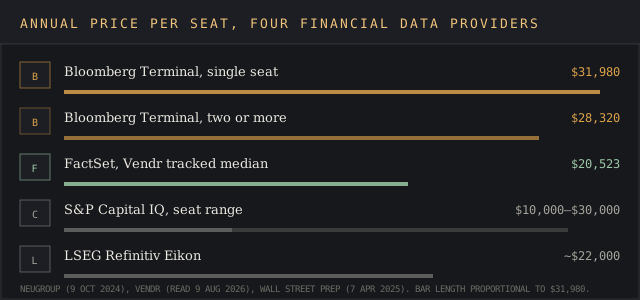
A Bloomberg Terminal renewing on or after 1 January 2025 lists at $31,980 a year for a single seat and $28,320 a seat where a firm takes two or more, per NeuGroup's 9 October 2024 report of the notice Bloomberg sent clients. FactSet publishes no rate card anywhere on factset.com, and Vendr's tracked contract data puts the median FactSet deal at $20,523 a year against a $4,200 low.
At that renewal price, a single Terminal seat can cost an arm and a leg before a desk even adds a data license on top.
This page compares the two financial data providers on price, contract terms, data coverage, analytics, the Excel and PowerPoint tools each ships, artificial intelligence features, review scores and the financial position of both companies. Every figure traces to a vendor document, an SEC filing, a public procurement record or a named publisher, with an access date.
It's written for the financial professionals holding a quote:
- Heads of equity research at asset managers
- Investment banking associates who build models
- Portfolio managers running attribution
- Procurement staff who justify a five-figure line item
Both platforms bill annually per user and neither posts a price, so the number on the paper is whatever a sales team quoted that week. Knowing what other buyers paid is the only real bargaining position finance teams have, which is why this page leads with the costs before it reaches the data and the analytics.
↑ COMPARISONWhat a Bloomberg Terminal and a FactSet seat cost in 2026
There is no basic price for either platform. Bloomberg's Terminal page offers a demo request and no figure, its order-now page carries none, and the fee-schedule URL at bloomberg.com/professional/download/fee-schedule returns an empty page. FactSet's pricing page renders as an empty shell whose only pricing language sits in the page metadata, reading "pricing tailored to your needs". Both checked 9 August 2026.
Both vendors beat around the bush and leave the page without a number.
So the figures below come from three kinds of source: a named publisher reporting a rate card, a procurement tracker recording closed contracts, and a public body disclosing what it paid for access to market data.
| Published figure | Amount | What it covers | Date |
|---|---|---|---|
| Bloomberg Terminal, NeuGroup | $31,980 a year | Single terminal, subscriptions renewing on or after 1 Jan 2025 | 9 Oct 2024 |
| Bloomberg Terminal, NeuGroup | $28,320 a year each | Two or more terminals, up from $26,580, a 6.5% rise Bloomberg attributed to weighted global inflation | 9 Oct 2024 |
| Bloomberg Terminal, Wall Street Prep | $27,660 a year | Single licence, falling to $24,240 each at two or more | 7 Apr 2025 |
| Bloomberg Terminal, Quartz | $24,000 a year | Reported alongside 315,000 terminal subscribers | updated 21 Jul 2022 |
| Bloomberg Terminal, University of Glasgow | £255,327 excluding VAT | Direct award to Bloomberg LP, annual Terminal subscription, ref PPE1001875 | concluded 28 Jun 2024 |
| Bloomberg Terminal, Ofgem | £135,936 total | Terminal licence, 11 Apr 2025 to 10 Apr 2029, about £33,984 a year | awarded 20 Mar 2025 |
| FactSet, Vendr tracked contracts | $20,523 median a year | Header stat block, low $4,200, high $25,160 | read 9 Aug 2026 |
| FactSet, Wall Street Prep | $12,000 a year | Described as the full product | 7 Apr 2025 |
| S&P Capital IQ, Wall Street Prep | $10,000 to $30,000 a year | Range for a Capital IQ seat | 7 Apr 2025 |
| LSEG Refinitiv Eikon, Wall Street Prep | about $22,000 a year | The former Thomson Reuters product, now inside London Stock Exchange Group | 7 Apr 2025 |
Vendor list price where published, tracked contract median or a named publisher's figure where not. Neither Bloomberg nor FactSet publishes a rate card for these tools.
Vendr's Bloomberg page contradicts itself on one screen. The header stat block reports a $1,108 median across 31 tracked deals with a $985 low and a $26,294 high; the body prose further down the same page puts a terminal at $24,000 to $27,000 a year.
Only the header comes from contracts that closed, and a $1,108 median across 31 deals is describing Bloomberg subscriptions that aren't Terminal seats. It's one of the self-contradictions logged in our report on software pricing errors.
The two UK procurement records are the cleanest read anywhere on Bloomberg Terminal costs. Ofgem's four-year Terminal licence works out at about £33,984 a year, close to NeuGroup's $31,980 once converted, and it settles how long these contracts run. Records like these are as by-the-book as pricing evidence gets in this market.
FactSet's model is modular, and its costs follow from that. The Marketplace catalogue lists over 300 data feeds, APIs and platforms, and a firm licenses the subset matching its specific requirements, which is how one platform produces both a $4,200 Vendr low and a $25,160 high.
A boutique buying standardised company financials and screening tools pays nothing like an asset manager adding portfolio analytics, ownership data and real time market data. Bloomberg's per-terminal model runs the other way: the seat is the unit, and data costs scale on top of it through Data License and B-PIPE as a desk adds asset classes.
Two other FactSet ranges circulate in this SERP, $12,000 to $50,000 and $15,000 to $40,000 a year. Both are estimates repeated between comparison sites; FactSet publishes neither figure. The same holds for the roughly $4,000 entry-level terminal price, which Vendr's tracked $4,200 low at least corroborates. Where a tracked median exists, use it: $20,523 came from contracts that closed.
A little bird told someone those wider ranges once, and they've circulated site to site ever since with nothing behind them.
↑ COMPARISONContract length, retention and support you can measure
Ofgem's award runs 11 April 2025 to 10 April 2029, so Bloomberg writes four-year Terminal contracts for public bodies. FactSet reports the other side in its filings: 91% of client companies renewed at 31 August 2025, and annual ASV retention stayed above 95% through Q3 FY2026. Its Technology Overview claims 90% client retention sustained for more than 15 years across 60 global offices.
Support is where the published detail favours FactSet. It runs a 24/7, 365-day desk staffed by client service professionals reachable by phone, email or in-application instant message, and prints both numbers on its own site: +1.877.322.8738 for support, +1.866.322.8738 for sales. Bloomberg publishes no uptime figure, no service level agreement and no support-hours commitment on any page checked, so users get no measurable baseline.
That's FactSet going the extra mile on a commitment most vendors leave vague.
Neither provider gives a compliance officer much to file, so compliance teams work from process descriptions. FactSet's status page covers only what it will do during an incident, with no uptime history.
Its Technology Overview documents process:
- Defence in depth as the stated security model
- Internal assessments against OWASP, BSIMM and OSSTMM
- Yearly third-party vulnerability assessments
- Data centre locations at region level only: Americas, EMEA and APAC
It names no SOC 2 and no ISO 27001 certification.
Access control is the one area FactSet documents in full. Users access the platform through SAML single sign-on or a four-zone trust model with single-factor or two-factor logon, eight-character minimum passwords, ten-password history and 60-day expiry, over 256-bit AES from desktop to data centre. Switching costs sit in that plumbing: the feeds, the access entitlements and the Excel workbooks a research team already built around one vendor's financial data.
None of that plumbing is set in stone, but untangling it always costs more than switching vendors saves upfront.
↑ COMPARISONData coverage: instruments against companies
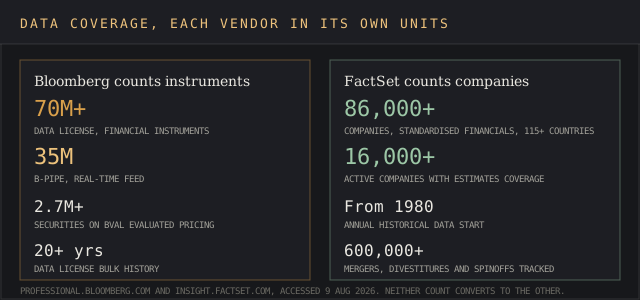
Bloomberg counts instruments. FactSet counts companies. Both companies publish real figures, and the gap in what each measures is why one head-to-head coverage number can't be stated honestly, so the table keeps each vendor's figures in its own units.
| Coverage | Bloomberg | FactSet |
|---|---|---|
| Companies with standardised financials | Not stated as a company count | 86,000-plus across 115-plus countries |
| Estimates coverage | Consensus estimates inside Company Financials | 16,000-plus active companies, 90 countries, 800-plus contributors |
| Historical market data depth | 20-plus years on Data License bulk datasets | Annual from 1980, semi-annual from 1994, quarterly from 1995 |
| Evaluated fixed income pricing | BVAL, over 2.7 million securities, 12,000 curves | Not published |
| Transcripts | Hundreds of millions of documents in Document Search | 40,000-plus companies a year for events, transcripts for about 10,000, from 2003 |
| Deals and transactions | Not published as a count | 600,000-plus mergers, divestitures and spinoffs, 300 to 450 updated daily |
| Exchanges and contributors | 330-plus exchanges, 5,000-plus contributors | 800-plus data sources behind the Workstation |
| Data fields | 40,000-plus on Data License, 8,500-plus reference fields | 750-plus items in Fundamentals, 125-plus industry KPI metrics |
Bloomberg's extensive data coverage is stated two ways on its own domain. The real-time feed page puts B-PIPE at 35 million instruments; the Data License page claims 70 million-plus financial instruments alongside 100 billion data points published daily across 8,000-plus datasets. Both are current Bloomberg pages describing instrument breadth, and the second is the more recent.
FactSet's own user count carries a larger discrepancy. Its Technology Overview, revised 1 May 2025, states 133,000 users. A press release three and a half months earlier, dated 15 January 2025, states "more than 8,200 global clients, including over 218,000 individual users". The audited answer sits in the results: 237,324 individual users and 8,996 client companies at 31 August 2025, rising above 247,000 users and 9,100 companies by Q3 FY2026.
Depth beyond the headline counts runs a long way on both sides. Both smaller FactSet counts came straight from the horse's mouth, the vendor's own published documents, and neither one matched the audited figure that followed.
- Bloomberg's liquidity tools cover 4.2 million securities.
- Bloomberg's MiFID II feed spans about seven million instruments across 120 fields, with 65 fields on transaction reporting and more than 50 corporate action event types.
- FactSet's Debt Capital Structure feed links 75,000-plus reporting entities to 45,000-plus ultimate parent companies from 2006.
- FactSet's ownership file collected positions for 5,200-plus 13F filers across 70-plus countries.
- Alexandria applies sentiment analysis to 430,000-plus transcripts covering 18,000-plus companies across 250-plus topics, which is where FactSet's transcript insights come from.
An accurate evaluated price for an illiquid bond is what Bloomberg sells through BVAL. It draws on TRACE, MSRB, exchanges and broker quotes, filters and verifies that data, then publishes across sectors and asset classes: 939,000 US municipals, over a million securitized products, and more than 600 corporate and government sector curves, all of it market data a trading desk prices against.
BVAL doesn't cut corners on that verification work, which is exactly why a trading desk is willing to price against it.
FactSet's financial data is accurate in a different sense, normalised so companies in different sectors and reporting regimes compare cleanly, with 244-plus logic and quality checks on the Mergers feed before release.
↑ COMPARISONFront office against research desk
These platforms answer different questions, which is the part a price comparison hides. Bloomberg's focus is real-time pricing, fixed income and news: the chat function reaches a network Bloomberg describes as more than 350,000 decision makers, its AI news summaries draw on more than 30,000 news sources, and its evaluated pricing feeds the trading blotter.
Traders and front-office professionals pick it for that, and many financial professionals never access it for anything else. News is why the Terminal sits on desks that never run a screen.
FactSet's focus is the model. Buy side analysts and investment bankers who know the ropes reach for it because standardised company financials, custom screening and combining datasets are what the tools do, and because source documents trace back to the original SEC filings and the other regulatory filings behind them.
Portfolio managers run its advanced analytics for attribution, risk management and financial analysis, and company profiles, ownership and supply-chain relationships for millions of companies sit in the same workspace.
Collaboration works differently on each. Bloomberg's messaging is the industry standard because everyone else is already on it, and that institutional ubiquity is the one thing FactSet can't buy.
FactSet's collaboration tools point inward: IRN 2.0 for shared research notes, and workflow solutions a firm builds itself through ExcelConnect, ActivePublishing and the VB API. Both are institutional-grade platforms carrying institutional-quality data, and the difference is where each puts the emphasis.
The user interface is the other split. Bloomberg runs on a command-line language of function codes, DS<GO> for Document Search and the rest, and the learning curve is real: G2 reviewers score it 7.7 on ease of use against FactSet's 8.6. Ease of setup runs 7.1 against 8.8. That gap earns real money when a graduate hire has to be productive inside a week.
Getting fluent in Bloomberg's function codes is easier said than done, and that's exactly what the ease-of-use gap is measuring.
FactSet's Technology Overview describes three routes behind one factset.net login, Workstation, Web and Mobile, with the last two needing no physical installation and the Workstation itself running as a Windows application whose workspace rearranges more freely than a fixed terminal layout.
Both vendors sell global market intelligence to overlapping desks, so the honest framing is emphasis. Bloomberg leads on real-time prices across asset classes, on fixed income analytics, and on the volume of financial information moving through international markets and the wider financial markets in a session.
FactSet leads on standardised fundamentals, equity research workflow, portfolio management and the risk management wrapped around it. Global market intelligence in the sense a strategy team means it, sizing markets and tracking competitors, is a third job neither platform is built for. Neither vendor is a jack of all trades stretching into that third job; each earns its keep on a narrower brief.
Research resources come bundled on both, and those resources are staffed by people.
- Bloomberg Intelligence puts more than 350 research professionals behind the Terminal.
- ASKB draws on sell-side and independent research from over 800 providers, enabling users to access third-party insights without leaving the screen.
- FactSet's estimates run on 800-plus contributors.
- FactSet's business advisory and client data integration teams carry knowledge of 2,000-plus buy-side clients and 120-plus custodians.
- FactSet's indexing tools publish benchmarks with geographic revenue exposure built in.
↑ COMPARISONExcel, PowerPoint and how each platform reaches a model
FactSet's Office integration ships with the Workstation install. Add-ins land in Excel, Word, PowerPoint, OneNote and Outlook across Office 2016, 2019, 2021 and 365, and they include DealMaven, the "=FDS" formula codes, ExcelConnect, ActivePublishing and VB API access.
The PowerPoint plugin is the one bankers name, because it automates pitchbook production. Pitch Creator extended it in January 2025 with three parts:
- A Tombstone Generator
- A Chart Creator covering 20-plus chart types
- A Template Assistant holding 200-plus pre-built Excel templates
The insights land in the deck already formatted. Pitch Creator brings a lot to the table when a banker is assembling a pitchbook under deadline pressure.
Bloomberg's Excel integration pulls financial data through BQL, its query language, alongside the older BDH and BDP formulas. Bloomberg calls BQL its most advanced data API and it reaches Python through the BQL Object Model. Bloomberg publishes no daily or monthly financial data quota for the Excel add-in on any page checked, which matters because an informal cap on access is what users hit first.
Data delivery diverges past the spreadsheet. Bloomberg runs four routes out, FactSet three.
- Bloomberg Data License over REST API, SFTP or cloud, with per-security and bulk options
- Bloomberg B-PIPE for consolidated feeds
- BLPAPI for Windows, macOS ARM and Linux
- BQuant Desktop, bundled with Bloomberg Anywhere
- FactSet Cornerstone batch scheduling over SFTP
- FactSet OnDemand datafeeds over authenticated HTTPS
- FactSet real-time exchange datafeeds over a proprietary TCP/IP API
Those last three let users move the same content into internal analytics tools, so a research team can get the ball rolling on its own analytics without waiting on a vendor's dashboard.
↑ COMPARISONArtificial intelligence features, by product name
Bloomberg has been building machine learning and natural language processing tools in the finance domain since 2009, by its own account. Four named products carry that work.
- BloombergGPT, announced as a 50-billion parameter model trained on over 700 billion tokens
- AI-Powered Earnings Call Summaries, launched 22 January 2024 alongside Document Search
- ASKB, an agentic interface coordinating a network of AI agents built on multiple commercial and open-weight models, in beta
- AI Portfolio Commentary inside PORT, turning attribution data and news coverage into written reporting
That last one puts the insights in a client letter without an analyst retyping them.
FactSet moved on a similar clock, and every release is dated.
- 14 December 2023: FactSet Mercury, a large language model-based knowledge agent aimed at junior banker workflows in corporate finance, went to beta.
- 30 April 2024: Portfolio Commentary, producing source-linked commentary for any attribution report in roughly 30 to 60 seconds.
- 21 November 2024: the Intelligent Platform initiative put Mercury underneath the product line, shipping a Conversational API and IRN 2.0 as research management and analytics tools.
- 15 January 2025: Pitch Creator launched.
FactSet's transcript engine races against the clock, working at a pace few humans could match. Near real-time transcripts identify speakers within 10 seconds of a live call, which is where the platform's transcript coverage starts.
↑ COMPARISONFactSet's results, leadership changes and share price
FactSet was founded in 1978 and is the only one of the two companies you can read accounts for. FY2025 ended 31 August 2025.
- Revenue $2,321.7 million, up 5.4%
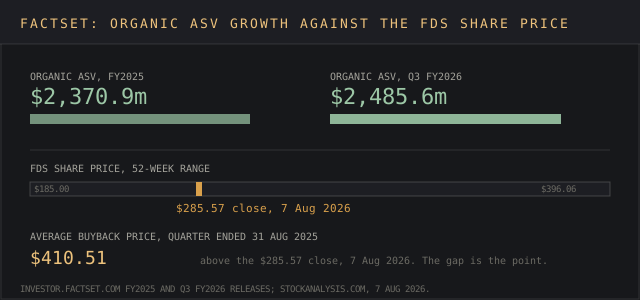
- Organic ASV $2,370.9 million, up 5.7%
- GAAP operating margin 32.2%
- Free cash flow $617.5 million
- GAAP diluted EPS $15.55
- Headcount 12,800
The Americas contributed 65% of revenue, EMEA 25% and Asia Pacific 10%. The buy side accounted for 82% of organic ASV against 18% for the sell side, which is where investment banking sits.
Growth held into FY2026. Q3, ended 31 May 2026, brought revenue of $622.9 million, up 6.4%, organic ASV of $2,485.6 million, up 7.1%, and free cash flow up 11.1% to $254.0 million.
The share price tells a different story from the ASV line, which is what people mean when they ask why FactSet is falling. FDS closed at $285.57 on 7 August 2026 against a 52-week range of $185.00 to $396.06, and FactSet repurchased its own stock at an average $410.51 during the quarter ended 31 August 2025.
Q3 FY2026 carried a $19.629 million restructuring and severance charge, GAAP operating margin fell to 26.7%, and FY2026 guidance reaffirmed on 1 July 2026 set adjusted EPS at $17.25 to $17.75. Every cloud has a silver lining, and FactSet's is that organic ASV still grew 7.1% the same quarter the market punished the margin miss.
Leadership turned over across the same window. Sanoke Viswanathan became CEO on 8 September 2025, succeeding Phil Snow after a 3 June 2025 announcement. Malcolm Frank became board chair on 17 September 2025. Joshua B. Warren became CFO on 13 April 2026, succeeding Helen Shan.
| Acquisition | Price | Announced | Completed |
|---|---|---|---|
| Cobalt Software | $50.0 million net of cash | 12 Oct 2021 | Oct 2021 |
| CUSIP Global Services | $1.925 billion cash | 27 Dec 2021 | 1 Mar 2022 |
| Irwin | $123.2 million net of cash, including $12.7 million contingent | 28 Oct 2024 | 5 Nov 2024 |
| LiquidityBook | $246.5 million cash | 10 Feb 2025 | 7 Feb 2025 |
Bloomberg files nothing, so every figure about it carries a publisher's name.
- Forbes: Michael Bloomberg's stake at 88%, 2024 revenue at about $15 billion, roughly 26,000 employees.
- Bloomberg's own company information: Terminal subscribers at about 325,000 as of 2022.
- Wall Street & Technology: Terminal sales at over 85% of revenue, the closest thing to a market share reading anyone can check in this corner of finance.
- Chartis: 9th overall in RiskTech100 2026, a fourth consecutive year in the top ten, with category awards for evaluated pricing in fixed income and for corporate bond credit data.
No audited filing confirms any of it, because the platform sits inside a private partnership. Set against FactSet's audited $2,321.7 million, the Forbes estimate makes Bloomberg roughly six times the size, and that's the only market share arithmetic these two disclosures support. An unaudited estimate running six times an audited number is par for the course when only one side of a duel ever files with anyone.
↑ COMPARISONReview scores, with sample sizes
Every score below rests on fewer than a hundred reviews, so read the counts before the numbers. A 4.9 on nine reviews and a 4.4 on fifteen are not comparable claims about two platforms selling to hundreds of thousands of finance professionals across the financial markets.
| Source | Bloomberg Terminal | FactSet |
|---|---|---|
| G2 overall | 4.4 of 5 on 69 reviews | 4.3 of 5 on 35 reviews |
| G2 ease of use | 7.7 on 58 reviews | 8.6 on 22 reviews |
| G2 quality of support | 8.5 on 57 reviews | 9.3 on 20 reviews |
| G2 meets requirements | 9.3 on 57 reviews | 9.2 on 22 reviews |
| G2 ease of setup | 7.1 on 13 reviews | 8.8 on 8 reviews |
| TrustRadius | 8.3 of 10 on 58 reviews | 8.6 of 10 on 70 reviews |
| Capterra | 4.4 of 5 on 15 reviews | 4.9 of 5 on 9 reviews |
| Gartner Peer Insights | 4.3 on 8 ratings | 4.5 on 10 ratings |
Two caveats matter more than the gaps. Gartner lists both under Corporate ESG Ratings and Research, which is nobody's reason for buying a terminal, and Bloomberg's separate vendor entry sits in a Trading Platforms market Gartner has marked retired. No Magic Quadrant or Forrester Wave evaluates the two together in a shared category, so peer insights are the only third-party read available on either set of tools.
The one score with a purchase attached is value for money, where GetApp puts Bloomberg at 3.2 of 5. That's the lowest sub-score either platform carries on any site, and it sits against a $31,980 renewal. A 3.2 out of 5 on value for money is a bitter pill to swallow at that price.
↑ COMPARISONWhich platform fits which desk
Front-office trading, credit, rates and anything priced intraday goes to Bloomberg. Bloomberg's fixed income analytics cover over 2.7 million securities through BVAL, intraday evaluated pricing refreshes as often as every 15 seconds on around 30,000 investment grade USD credit securities, and the chat network is where counterparties already sit.
Institutional investors running credit or rates books in the capital markets have no equivalent option, and the risk of mispricing a position is what they pay to remove.
Investment banking analysts and associates building models and pitchbooks go to FactSet. The Excel add-in, the =FDS codes, DealMaven and Pitch Creator remove the copy-paste step, and a $20,523 median contract against a $31,980 renewal buys more seats for a deal team. So does equity research.
Asset managers and portfolio managers split by what they run. A long-only equity shop doing attribution, screening and ownership analysis is served by FactSet's analytics capabilities, and FactSet offers the portfolio management tools, mutual fund reference data (40,000-plus funds, 190,000-plus share classes) and 8,000-plus private fund benchmarks that go with it.
That combination gives a long-only shop the best of both worlds, screening and ownership data sitting inside the same workspace as attribution.
A multi-asset book carrying derivatives, mortgages and inflation exposure needs the advanced analytics tools in MARS and PORT, which means Bloomberg.
Financial professionals on smaller budgets look at Capital IQ at $10,000 to $30,000 or LSEG's Refinitiv Eikon at around $22,000. Capital IQ is the usual third choice for a lean corporate development team, and plenty of banks run Capital IQ for company profiles and screening across sectors alongside a handful of Bloomberg seats on the floor.
As an analytics provider Capital IQ competes with FactSet on transactions data and with neither on real-time pricing. A firm running Capital IQ for screening and Bloomberg for the desk carries two contracts and one duplicated dataset, and the duplication is rarely priced when the second contract is signed.
Common FactSet and Bloomberg questions
Who is Bloomberg's biggest competitor?
LSEG, through the former Thomson Reuters Refinitiv business, is the closest competitor by breadth of financial information, news and real-time coverage of the financial markets. FactSet, S&P Global's Capital IQ and MSCI compete on narrower fronts: research workflow, company profiles and transactions data, and index and risk analytics. Each is a smaller platform with a tighter focus. All three are in the same boat, fighting on narrower fronts than Bloomberg's breadth.
Who is FactSet's biggest competitor?
Bloomberg and S&P Global's Capital IQ, depending which side of the business you look at. Against Bloomberg, FactSet competes for the research desk. Against Capital IQ, it competes on price and on the depth of transactions data behind an investment banking pitch.
Why is FactSet falling?
The operating business grew through FY2025 and Q3 FY2026, so the share price move is about margin and expectations. GAAP operating margin fell from 32.2% in FY2025 to 26.7% in Q3 FY2026, that quarter carried a $19.629 million restructuring and severance charge, and reaffirmed FY2026 adjusted EPS guidance sits at $17.25 to $17.75. A CEO change in September 2025 and a CFO change in April 2026 landed inside the same window.
What is better than Bloomberg?
Nothing beats it on real-time prices, fixed income analytics or the chat network. For standardised financials, screening and Excel-driven financial analysis, FactSet does the job at a lower median contract, which is why corporate finance teams end up there. For a team that only needs company profiles and comparable transactions, Capital IQ at $10,000 to $30,000 covers those specific use cases at a third of the price.
Does JP Morgan use FactSet?
FactSet names no individual clients in its SEC filings or press releases. What it does disclose is scale: more than 9,100 clients and over 247,000 individual users as of Q3 FY2026, with 82% of organic ASV from the buy side, and a client data integration team carrying experience across 2,000-plus buy-side clients and 120-plus custodians.
How do I choose the right financial data platform?
Start from the output. If the deliverable is a trade, the right financial data platform is the one with intraday pricing and the counterparty network, which is Bloomberg. If the deliverable is a model, a screen or an attribution report, it's FactSet. Then price the seat count against the two published anchors, $31,980 and $20,523, and ask both providers to quote against the specific needs you can write down. Finance teams that skip that step pay the asking price.
Do finance professionals need both?
Large banks buy both and split them by desk. Smaller finance teams pick one and fill the gaps with a cheaper analytics provider, most often Capital IQ for transactions data or a market data vendor for a single asset class. In finance, the split follows the desk.
Which one to buy
Pick Bloomberg if anything you do is priced intraday. The $31,980 single-seat renewal drops to $28,320 at two or more, Ofgem's four-year award shows the contract shape, and BVAL, MARS and the messaging network have no substitute at any price for a desk carrying real risk. The costs are a 7.7 ease-of-use score, a 3.2 value-for-money rating and no published quota, SLA or support commitment for users.
Pick FactSet if the output is a model, a screen or an attribution report. A $20,523 median contract, modular licensing across 300-plus catalogue items, Office tools shipping with the install, a 9.3 support score and analytics capabilities running from screening to attribution reporting are the case, alongside access to 86,000-plus companies of standardised financial data going back to 1980.
Weigh the 26.7% Q3 margin and two executive changes in eight months if a four-year commitment is on the table.
Firms that need both usually buy both, with a small number of Terminals on the trading floor and FactSet across research. That's the most common arrangement at any bank large enough to have the question, and it's why neither of these companies will quote a price until they know what the other one offered.
Sources: professional.bloomberg.com (Terminal, Data License, B-PIPE, BVAL, LQA and MiFID II pages); insight.factset.com (Fundamentals, Estimates, Transcripts, Ownership, Mergers, Debt Capital Structure and People datafeeds); download.factset.com (Technology Overview, web authentication policy); investor.factset.com (Pitch Creator, FY2025 and Q3 FY2026 results, leadership changes); sec.gov (FactSet 10-K and 8-K filings).
Also: neugroup.com (9 Oct 2024); wallstreetprep.com (7 Apr 2025); qz.com (updated 21 Jul 2022); find-tender.service.gov.uk and contractsfinder.service.gov.uk; vendr.com/marketplace/factset and /bloomberg; stockanalysis.com; forbes.com; en.wikipedia.org/wiki/Bloomberg_Terminal; bloomberg.com/company/press (19 Dec 2025); G2, TrustRadius, Capterra and Gartner Peer Insights listings for both products. Accessed 9 August 2026.