AlphaSense vs FactSet: Document Search Against Structured Financial Data (2026)
 By Jan Suski. I go deep on every review, checking every number against its source and digging up details other coverage misses, a habit from six years of SEO and link building for tech companies. Bylines at Surfer, Brand24, and Senuto. How the scoring works.
| WHAT EACH ONE DOES | ALPHASENSE | FACTSET |
|---|---|---|
| Core job | Document search | Financial datasets |
| Broker research | 1,700+ providers | Summaries in dev |
| Expert transcripts | 300,000+ interviews | No expert network |
| Company coverage | 27,000+ public cos | 86,000+ companies |
| AI over text | Generative Search | Beta from Jan 2026 |
| MCP tools | 2 tools, beta | 24 tools, v1.17 |
| Agent query cost | 100 credits, deep | In the data license |
| Portfolio analytics | None sold | Attribution and risk |
| Skip it if | You build models | You read for a living |
| WHAT YOU GET | ALPHASENSE | FACTSET |
|---|---|---|
| Vendor list price | $20,000 a user, AWS | Contact sales only |
| Vendr median | $18,375, 40 deals | $25,160 |
| Vendr range | $9,750 to $51,300 | $4,200 to $28,179 |
| Public contract | £6,300 a seat, FRC | None found |
| Plans | 2 plans, unpriced | Modular by module |
| Ownership | Private, $7.5bn | NYSE: FDS |
| Revenue | $600M+ ARR, Q1 2026 | $2.48bn, FY2026 |
| Customers | 8,000+ enterprises | 9,200+ clients |
| G2 rating | 4.6 on 335 | 4.3 on 35 |
StrongerWeakerNo edge
Twenty-seven further documented limits sit behind the button below: AlphaSense’s agent-credit mechanics and connector limits, FactSet’s MCP catalogue, datafeed history depths and Office add-ins. Test scenario: one research team choosing which renewal to keep.
AlphaSense counts come from alpha-sense.com (product overview, pricing page, Bloomberg comparison page) and developer.alpha-sense.com; FactSet counts from developer.factset.com, insight.factset.com and its SEC filings.
Prices are AlphaSense’s own AWS Marketplace listing, Vendr’s header stat blocks for both vendors, and a UK Contracts Finder notice, all read 17 October 2026. Review scores are G2’s head-to-head page, read 17 October 2026, with sample sizes. Neither vendor publishes a rate card.
| AlphaSense | WHAT IT DOCUMENTS |
|---|---|
| Pre-built peer sets | 115+ sectors |
| Sentiment Indices | 15+ sectors |
| Fast and auto timing | About 30 s fast, 30 to 90 s auto |
| ThinkLonger mode | 25 credits, 60 to 90 s |
| DeepResearch run time | 12 to 15 minutes per call |
| Document Search via API | 0 credits |
| Over the credit limit | HTTP 429 Too Many Requests |
| Broker research via MCP | Full text withheld; link and disclaimer returned |
| Web search via MCP | None; answers stay inside AlphaSense content |
| Languages indexed | 37, no machine translation |
| FactSet | WHAT IT DOCUMENTS |
|---|---|
| Entity reference | 16 million+ entities |
| Price history via MCP | Back to 2006, with corporate actions and dividends |
| EDGAR filings via MCP | From 2022 |
| MCP audit links | 18 data sources, versions 1.16 and 1.17 |
| Other MCP servers | FPE MCP 23 tools, Knowledge Services 2 tools |
| Portfolio Analytics MCP | Limited release, 26 June 2026 |
| Alexandria sentiment | 430,000+ transcripts, 18,000+ companies, 250+ topics |
| Transcript latency | Speakers identified within 10 seconds |
| Ownership filers | 5,200+ 13F filers, 70+ countries |
| Ownership history | Equity from 1999, fixed income in funds from Sept 2013 |
| Mutual fund reference | 40,000+ funds, 190,000+ share classes |
| Mergers history | Global from 2003, US from 1992, Europe from 2000 |
| Debt capital structure | 75,000+ entities to 45,000+ parents, from 2006 |
| PE and VC benchmarks | More than 8,000 funds |
| Office add-ins | Excel, Word, PowerPoint, OneNote, Outlook |
| Pitch Creator | 20+ chart types, 200+ Excel templates |
| Transport encryption | 256-bit AES desktop to data centre |
Which vendor page, filing or contract each count and price came from
Every count in the tables above comes from a page the vendor owns: alpha-sense.com for the document, broker, transcript, peer-set and plan figures, developer.alpha-sense.com for credits and connector limits, developer.factset.com and insight.factset.com for FactSet’s MCP catalogue and datafeed history, and FactSet’s SEC filings for users, clients and revenue.
Prices come from AlphaSense’s AWS Marketplace listing, Vendr’s tracked contract data for both vendors and a UK Contracts Finder notice, read 17 October 2026, because neither vendor prints a rate card on its own site.
FactSet states its user count two ways. Its fiscal 2026 results filing says over 260,000 individual users, and its Technology Overview PDF (revised May 2025) says 133,000. The ownership table on this page carries the filing’s figure.
Neither publishes a seat minimum, a contract length, a trial term, an uptime SLA or an incident log.
Buy AlphaSense if your analysts spend the day reading: broker research, expert call transcripts, company filings and trade publications, searched in plain English with a citation behind every answer. Buy FactSet if the deliverable is a model, a screen or a portfolio report built on structured financial data across asset classes. The two work as complements more often than substitutes, and the gap between them has narrowed from both ends since October 2025.
This page is for the research lead holding one renewal and wondering if the other platform could absorb it. The factset vs alphasense question gets asked more often now because each vendor shipped the other's headline feature: AlphaSense launched Financial Data in October 2025, and FactSet put AI Document Search in front of more than 85,000 users in March 2026.
Prices come from a public contract, a vendor listing and Vendr's tracked deals. Counts come from each vendor's own pages, read on 17 October 2026.
↑ COMPARISONTwo research platforms built for opposite halves of the job
AlphaSense started in 2011 as a search engine for documents. Its AlphaSense review covers the full product, but the short version is that it reads text: filings, earnings transcripts, broker reports, news and its own expert transcripts. That's qualitative research, and the platform was built to cut the hours an analyst spends on it.
FactSet is 33 years older, founded in 1978, and it sells numbers. Fundamentals, estimates, ownership, prices and portfolio analytics, delivered through the Workstation, data feeds and an Excel add-in. Our FactSet review scores it on that structured data, which is what equity research and asset management teams build financial models on. Both platforms serve finance professionals, and they grew up serving different workflows inside the same firm.
Put another way, AlphaSense is a market intelligence tool for qualitative research content, and FactSet is a financial research system for quantitative data. The first answers questions from public filings, earnings transcripts and expert calls. The second answers them from earnings data, estimates, prices and holdings. A market research team at a consumer brand and an equity analyst at a fund both shop for research platforms, and they usually end up at different ones.
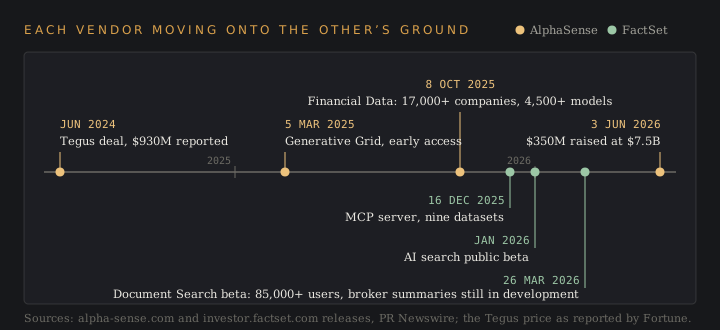
The last two years blurred that line. Each vendor has spent money and engineering time moving onto the other's ground, and the dates matter for anyone signing a multi-year contract today.
| Date | Vendor | What shipped or changed |
|---|---|---|
| June 2024 | AlphaSense | Agreed to buy Tegus, the expert transcript provider, in a deal Fortune reported at $930 million |
| 5 March 2025 | AlphaSense | Generative Grid in early access, asking several questions across many documents at once |
| 8 October 2025 | AlphaSense | Financial Data launched: historical financials and consensus on 17,000+ companies, 4,500+ Canalyst models |
| 16 December 2025 | FactSet | AI-Ready Data MCP server announced with nine datasets, later reaching 24 tools |
| January 2026 | FactSet | Public beta of its AI-enabled search over transcripts and filings opens |
| 26 March 2026 | FactSet | Document Search beta reaches 85,000+ users, broker research summaries still in development |
| 3 June 2026 | AlphaSense | $350 million raised at a $7.5 billion valuation, ARR above $600 million |
Read the table from the bottom up and the picture is two vendors racing against the clock to sell one subscription where firms now pay for two. AlphaSense added quantitative data and Canalyst financial models. FactSet added AI-driven insights over its transcripts, news and filings. Neither has finished the job, and the next two sections count what each still lacks.
↑ COMPARISONData coverage, counted in each vendor's own units
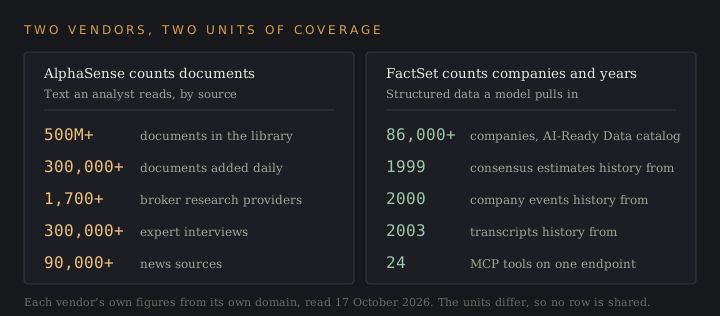
The two companies count different things, so a single shared row would mislead. AlphaSense counts documents and sources. FactSet counts companies, entities and years of history. Each column below is the vendor's own figure from its own domain, and the units are left as published.
| Vendor | Measure | Published figure |
|---|---|---|
| AlphaSense | Documents in the content library | 500 million+, with 300,000+ added daily |
| AlphaSense | Broker research providers | 1,700+ |
| AlphaSense | Expert transcripts | 300,000+ interviews |
| AlphaSense | News sources | 90,000+ |
| AlphaSense | Public companies with standardized statements and consensus | 27,000+ |
| AlphaSense | Private funding rounds / M&A deals | 765,000 / nearly 1 million |
| FactSet | Companies in the AI-Ready Data catalog | 86,000+ |
| FactSet | Consensus estimates history | From 1999 |
| FactSet | Company events / transcripts history | From 2000 / from 2003 |
| FactSet | MCP tools on one endpoint | 24 |
AlphaSense's counts come from its product overview and its Bloomberg comparison page. FactSet's come from its developer portal, its estimates datafeed sheet and its transcripts datafeed sheet.
Two of those rows grew fast. AlphaSense's Financial Data launch claimed 17,000+ companies and 685,000 private funding rounds in October 2025; a year later the same vendor's pages say 27,000+ and 765,000. That's a product still filling in, which is worth a line in any procurement memo.
Card spend, web traffic and app download panels come from alternative data sources sold separately, and neither vendor lists them among the counts above. Keep an eye on that gap if a fund's process leans on them.
Broker research and premium content
The data coverage split bites hardest here. AlphaSense lists broker and independent research as included content in both of its plans, drawn from 1,700+ providers, so sell-side analyst reports sit inside the same search results as filings and expert transcripts. FactSet's own March 2026 release says secure, fully attributed broker research summaries are something it is developing. Today, FactSet's new search tool covers transcripts, earnings calls, news and filings.
Premium content is the lion's share of what an AlphaSense subscription buys. Its value to a sell-side or buy-side team rests on reading proprietary content that a plain web search never reaches. FactSet's premium content is its numbers: fixed income, equities, ownership and estimates, cleaned and mapped to one entity model.
Private companies are a weak spot for both. AlphaSense's funding data counts 765,000 private rounds, and FactSet's March 2026 release added AI document ingestion for private capital markets clients through its Cobalt business. Neither is built for vc deal sourcing on early stage companies, where a database of funding events such as Crunchbase does the job for a fraction of either price.
For private equity deal sourcing on later-stage targets, both sit beside PitchBook more often than they replace it. Data coverage on private companies is also where the two sets of counts compare worst, because AlphaSense counts rounds and documents while FactSet counts entities, so a like-for-like test means running your own target list through both trials.
↑ COMPARISONAI search over text: Generative Search against FactSet Document Search
AlphaSense's search reads natural language queries and expands them with Smart Synonyms, which widen a term to the jargon an analyst missed. Generative Search then writes one answer across many documents with a citation on each claim. Smart Summaries condense earnings calls into the quarter's figures, the analyst outlook and the bull and bear cases.
Sentiment analysis colour-codes passages as positive, negative or neutral, which is how teams track customer sentiment across transcripts.
FactSet's answer is newer and narrower. It searches FactSet's transcripts, earnings calls, news and filings, adds a comparison grid and an AI agent for questions in plain English, and links every result to its source. The release counted more than 85,000 beta users and a phased global rollout through late spring 2026. FactSet's FY2026 results say AI solutions ASV added in the year more than doubled, without a dollar figure.
| AI capability | AlphaSense | FactSet |
|---|---|---|
| Text searched | Filings, broker research, expert transcripts, news, internal uploads | Transcripts, earnings calls, news, filings |
| Multi-document grid | Generative Grid, early access from March 2025 | Comparison grid, beta from January 2026 |
| Agent | SuperAnalyst agent | AI agent for questions in plain English |
| MCP tools for Claude and other clients | 2, beta, switched on per account | 24, version 1.17 |
| Cost per agent query | 10 credits fast, 100 credits Deep Research | Covered by the FactSet data license |
The MCP row is the widest gap in that table. FactSet exposes 24 tools mapped to its content APIs, a spread our FactSet MCP review walks through tool by tool. AlphaSense exposes two, and its credits page charges 100 credits for one Deep Research call. Our AlphaSense MCP review covers that beta gate. For API access into a firm's own technology stack, FactSet is further ahead of the curve.
AlphaSense's Enterprise Intelligence plan answers a different need: uploads through API access put a firm's own files into the same content library as the vendor's.
The devil's in the details. AlphaSense searches broker reports and expert call transcripts that FactSet doesn't hold, so its generative AI features have more text to work from. FactSet's AI capabilities answer from cleaner numbers, which suits deep analysis across a peer set. A question like "what did management say about gross margin" favours AlphaSense; "screen for every software company whose gross margin rose three years running" favours FactSet.
↑ COMPARISONExpert calls, primary research and the third option buyers pick
Expert calls are where the two products stop overlapping. AlphaSense's pricing page includes the Expert Transcript Library in both plans and lists expert calls as an add-on, so a team can read 300,000+ expert interviews and then book one on one calls with industry practitioners for primary research of its own. FactSet runs no expert network. A FactSet shop that wants expert calls buys them from someone else.
That someone is usually an expert network: GLG, AlphaSights or Third Bridge, which sells both one on one consultations and a transcript library, so it competes with the half of AlphaSense that came from Tegus. Both AlphaSense's add-on and Third Bridge provide direct access to a former executive or customer. A view straight from the horse's mouth is billed per call, and our expert network cost report prices those calls against an annual library subscription.
On the structured side, the third option is Capital IQ from S&P Global, which sells company financials, screening and private company data into the same banks and asset managers as FactSet. Bloomberg is the other name in the room, for real time market data, fixed income trading and Bloomberg News, a fight our FactSet vs Bloomberg comparison settles seat by seat.
Lists of top AlphaSense alternatives tend to mix these categories. The useful split is by what you're replacing:
- The expert calls and expert transcripts: Third Bridge, GLG or AlphaSights.
- The AI search over filings and analyst reports: FactSet's new search tool or Hebbia.
- The structured data under a model: FactSet, Capital IQ or Bloomberg.
- Private companies and private markets: PitchBook or Crunchbase.
Our ranking of investment research platforms scores all of these leading platforms on one rubric, and the financial data providers ranking covers the quantitative side.
↑ COMPARISONWhat each one costs per seat
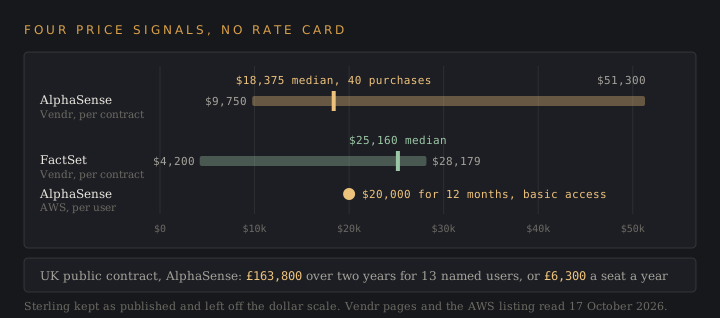
Neither vendor prints a rate card. AlphaSense's pricing page compares two plans, Market Intelligence and Enterprise Intelligence, and says "Please reach out". FactSet's pricing page carries a "Contact Us For A Personalized Proposal" button. So the numbers below are signals, each labelled with where it came from.
| Price signal | AlphaSense | FactSet |
|---|---|---|
| Vendor-listed price | $20,000 for 12 months, basic access per user, AWS Marketplace | None listed |
| Vendr median contract | $18,375 a year, 40 purchases | $25,160 a year |
| Vendr lowest contract | $9,750 | $4,200 |
| Vendr highest contract | $51,300 | $28,179 |
| Public contract on file | £163,800 over two years, UK Financial Reporting Council | None found |
The AlphaSense list price is on its own AWS Marketplace listing. The Vendr figures are the header stats on AlphaSense's Vendr page and FactSet's Vendr page, read 17 October 2026. The UK contract is on Contracts Finder, running 1 December 2024 to 30 November 2026.
Run the math on that public contract. £163,800 over two years is £81,900 a year, and the regulator's requirement named 13 users, so each seat cost about £6,300 a year. That's well under the $20,000 AWS list price, which tells you the list price is a ceiling and a 13-seat buyer negotiates down from it.
Scale that to a ten-seat team and the spread gets wide: $200,000 a year at the AWS list price, or roughly £63,000 at the regulator's per-seat rate. The number you land on depends on seat count, content add-ons and how hard procurement pushes at renewal, so treat any single figure as an opening bid for the conversation with the account team. For scale, a Bloomberg Terminal lists at $31,980 a year for a single seat, per NeuGroup.
The AlphaSense plan split decides what lands on the invoice:
- Both plans: company documents, broker and independent research, the expert transcript library, news, regulatory content, 24/7 live help and a dedicated account manager.
- Enterprise Intelligence only: search over internal content, uploads through the API, private cloud hosting, IT support, professional services and custom training.
- Add-ons on either plan: expert calls and Canalyst financial models.
Dedicated account management comes with both AlphaSense plans by name. FactSet's model is modular: the price scales with seats, data feeds and modules, so two firms with the same seat count can land on different invoices. The detailed numbers sit in our AlphaSense pricing report and FactSet pricing report.
↑ COMPARISONReview scores, reconciled
AlphaSense's interface centres on one search bar, while FactSet's Workstation spreads detailed financial analysis across many screens and codes. G2's head-to-head page scores the two at 8.6 each for ease of use, on samples that differ elevenfold.
| G2 measure | AlphaSense | FactSet Workstation |
|---|---|---|
| Star rating | 4.6, 335 reviews | 4.3, 35 reviews |
| Ease of use | 8.6, 243 reviews | 8.6, 22 reviews |
| Ease of setup | 8.8, 137 reviews | 8.8, 8 reviews |
| Quality of support | 9.3, 232 reviews | 9.3, 20 reviews |
| Meets requirements | 8.9, 239 reviews | 9.2, 22 reviews |
Scores read from G2's comparison page, 17 October 2026. Eight reviews behind FactSet's setup score can't carry much weight, and 22 behind ease of use is thin. The complaint that repeats in written FactSet reviews is a steep learning curve: a new analyst takes time to know the ropes of its screening language and Workstation layouts. AlphaSense draws the same complaint in its own reviews, where new hires need structured onboarding before the alerts and dashboards pay off.
FactSet wins one row outright, meets requirements, at 9.2 against 8.9. That fits a product people buy for a defined job, pulling numbers into a model, and grade on that job alone.
↑ COMPARISONOwnership, money and the switching bill
AlphaSense is private and growing on venture capital. FactSet is public and growing slowly. Both facts change what a long contract is worth.
| Measure | AlphaSense | FactSet |
|---|---|---|
| Founded | 2011 | 1978 |
| Ownership | Private, $7.5 billion valuation, June 2026 | NYSE: FDS, $10.73 billion market cap |
| Revenue disclosed | ARR above $600 million, Q1 2026 | $2.48 billion, fiscal 2026 |
| Customers | 8,000+ enterprises, 92% of the S&P 100 | 9,200+ clients, 260,000+ users |
| Headcount published | Over 2,000 people, March 2025 | 12,800, fiscal 2025 |
| Chief executive | Jack Kokko, co-founder | Sanoke Viswanathan, since 8 September 2025 |
AlphaSense's figures come from its June 2026 funding release, its March 2025 product release and its pricing page, which now claims 8,000+ customers against the 7,000+ in the June release. FactSet's come from its fiscal 2026 results filing of 30 September 2026, its fiscal 2025 results and a 16 October 2026 market quote.
The elephant in the room for FactSet is margin. GAAP operating margin fell to 28.3% in fiscal 2026 from 32.2% a year earlier, and diluted EPS fell to $14.57 from $15.55, while organic ASV still grew 7.0% to $2,568.2 million. Guidance for fiscal 2027 is $2,600 to $2,625 million in revenue. Annual ASV retention stayed above 95%, which says clients aren't leaving; they're paying for a company spending heavily on AI.
AlphaSense's risk runs the other way. Well over $1 billion of outside money sits behind a $7.5 billion valuation, so the company has to keep growing ARR at the pace that took it from $500 million in October 2025 past $600 million by Q1 2026. A private vendor that size can be sold, and a buyer gets a say in your renewal terms.
Switching off either one costs more than the contract:
- Leaving FactSet means rewiring every Excel model that pulls live data through its add-in, plus the screens and portfolio reports built in the Workstation, a pile of manual data work nobody budgets for.
- Leaving AlphaSense means rebuilding saved searches, alerts and dashboards, and on Enterprise Intelligence re-uploading the internal research reports and corporate research the firm pushed into it.
Start that work a quarter before the notice window, because a stitch in time saves nine.
↑ COMPARISONWhere each one wins, by team
The decision comes down to what the team produces at the end of the week. Read between the lines of each team's deliverable and the purchase picks itself:
- Equity research desk building and updating financial models: FactSet, with AlphaSense added once the reading load justifies a second seat.
- Portfolio teams running attribution and risk: FactSet. AlphaSense sells no portfolio analytics.
- Corporate strategy and market research teams reading competitor filings, expert calls and trade publications: AlphaSense.
- Private equity diligence on a sector: AlphaSense for expert transcripts and broker research, with a private markets database beside it for funding data.
- Credit and fixed income analysts: FactSet over AlphaSense, and Bloomberg over both for real time market data.
- Consultants writing market intelligence for clients: AlphaSense, for citations a client can check.
Research teams that sit across two of these rows can justify both licences. Paying twice for overlapping AI search is the waste to cut, and FactSet's own search tool makes that overlap bigger every quarter. The jury's still out on how much of AlphaSense's search FactSet can match before broker research lands in its index.
AlphaSense and FactSet questions
Can AlphaSense replace FactSet?
For a market research or market intelligence team that mostly reads, yes. AlphaSense now carries standardized statements and consensus on 27,000+ public companies and 4,500+ Canalyst models, which covers light modelling. For a team that screens across asset classes, runs portfolio analytics or wires live data into Excel models, no. FactSet's estimates history from 1999, its ownership data and its Excel add-in have no AlphaSense equivalent on the vendor's own pages.
Who is FactSet's biggest competitor?
Bloomberg, S&P Global's Capital IQ and LSEG Workspace. Bloomberg wins trading floors on real time market data and messaging. Capital IQ competes on the same banking and research seats. AlphaSense competes with FactSet on the document side, where FactSet's search tool is still in rollout.
Two figures circulate on comparison pages without a named publisher: that Bloomberg and FactSet together reach about 80% of finance professionals, and that market intelligence software grows from $12.38 billion in 2025 to $28.96 billion by 2033. We couldn't trace either to a survey or a research firm, so neither carries weight here.
Who are AlphaSense's biggest competitors?
On search, FactSet's Document Search and AI-first products like Hebbia. On private markets data, PitchBook. On expert content, Third Bridge, GLG and AlphaSights, the expert network firms AlphaSense competes with since it bought Tegus. Our Bloomberg Terminal pricing report covers the terminal often licensed beside either one.
Why is FactSet falling?
FactSet shares hit a 52-week low of $185.00 and closed at $301.67 on 16 October 2026, against a $320.48 high. The filings show what changed: operating margin down from 32.2% to 28.3% and EPS down from $15.55 to $14.57 in fiscal 2026, while the company paid for an AI rollout and a new chief executive. Revenue still grew to $2.48 billion and client count rose past 9,200, so the business is shrinking at the margin line and growing at the top line.
Which one to buy
Pick AlphaSense when your question is "what did someone say": management on an earnings call, a former employee in an expert interview, a broker in a research note. It searches 500 million+ documents with 1,700+ broker research providers and 300,000+ expert transcripts behind them, and every answer carries a citation. Expect around $18,375 a year at the Vendr median, and less per seat at volume.
Pick FactSet when your question is "what does the number say": estimates, fundamentals, ownership, portfolio returns across asset classes, pulled straight into Excel. Its 24-tool MCP server already makes that data available to an AI agent, and its Document Search is closing the reading gap. Expect around $25,160 a year at the Vendr median.
If you can only keep one, keep the one whose output your team ships. Putting all your eggs in one basket works for a corporate strategy team on AlphaSense and for a quant desk on FactSet. Everyone in between pays for both and trims the overlap at renewal.