AlphaSense MCP review: two tools, a beta gate, and 100 credits per deep research call
 By Jan Suski. I go deep on every review, checking every number against its source and digging up details other coverage misses, a habit from six years of SEO and link building for tech companies. Bylines at Surfer, Brand24, and Senuto. How the scoring works.
Best for
Hedge funds, banks, consulting firms and corporate strategy teams that already pay for AlphaSense and want Claude or another MCP client to query filings, transcripts and analyst notes with citations.
Not for
A solo analyst or a startup shopping for a cheap financial data feed: the connector is a beta the account team has to switch on, and the one public price is a $20,000 annual AWS Marketplace listing.
What it costs
No published rate card. AWS Marketplace lists basic access at $20,000 for 12 months per user, and every MCP question spends credits: 10 for a fast answer, 100 for Deep Research.
- Hosted connector status
- Beta, switched on per account by AlphaSense
- Connector tools
- 2: alphasense_search and alphasense_search_specific
- Self-hosted server tools
- 2: alphasense_search (4 modes) and alphasense_document_search
- Server credentials
- 5 environment variables, including client secret and password
- Web search through the connector
- None; answers stay inside AlphaSense coverage
- Broker research through the connector
- Full text withheld; a link and a disclaimer come back
- Fast and auto modes
- 10 credits, about 30 seconds and 30 to 90 seconds
- ThinkLonger mode
- 25 credits, 60 to 90 seconds
- DeepResearch mode
- 100 credits, 12 to 15 minutes
- Document Search
- 0 credits
- Over the credit limit
- HTTP 429 Too Many Requests
- Access token life
- 24 hours
- AWS Marketplace listing
- $20,000 for 12 months, basic access per user
- Vendr median
- $17,500 across 38 brokered purchases
- Plans
- Market Intelligence and Enterprise Intelligence, both unpriced
- Customers
- 7,000+ enterprises, 92% of the S&P 100
- Documents
- 500 million plus, 300,000 added daily
- Sell-side research providers
- 1,700 plus
- Expert interviews
- 300,000 plus
- Languages indexed
- 37, with no machine translation
Alternatives to AlphaSense MCP
FactSet MCP
Not forA team whose question is what management or an expert said about a number, which sits in AlphaSense’s transcripts.
LSEG MCP
Not forAn equity analyst whose question lives in an expert call or a broker note.
Pairs well with AlphaSense MCP
AlphaSense is a market intelligence platform for financial professionals, and its MCP is two separate things that share a name. One is a hosted connector, still labelled beta, that drops AlphaSense's Generative Search into an MCP-capable chat client such as Claude. The other is a Python script in AlphaSense's Agent API documentation that a developer runs on their own machine with five credentials.
Both expose 2 tools. Both answer from the same AlphaSense platform of 500 million plus documents.
That library is what AlphaSense markets to the world's leading corporations as one platform for SEC filings, company documents, transcripts and broker notes, sold as actionable intelligence. Through MCP, the same intelligence platform answers inside the assistant an analyst already has open.
This review covers what each route reads across AlphaSense's data sources, what every call costs in credits, how the AlphaSense AI features behind it (Generative Search, Deep Research, Workflow Agents and the newer SuperAnalyst) shape the answers, and where the setup breaks. It sits beside our main AlphaSense review, which covers the platform and its contracts, so this page stays on the connector and the research workflows it changes.
The audience is narrow. AlphaSense says on its pricing page that it serves 7,000+ enterprise customers, including 92% of the S&P 100, 90% of the top investment banks and 95% of the top consultancies. The MCP only works for those customers, and only after their account team turns it on.
Why now: model vendors spent 2025 and 2026 bolting financial data onto chat clients. FactSet shipped an MCP server in December 2025, LSEG wired ten tools into Claude in February 2026, and AlphaSense answered with a connector of its own. Our MCP tools list ranks 76 servers; AlphaSense ships the smallest tool count of any server in its top 16.
↑ FACT SHEETWhat the hosted AlphaSense connector exposes
The hosted connector exposes two tools, per AlphaSense's MCP Connector Overview. alphasense_search is the default for questions that don't name specific content, and it's the tool that handles broker research and analyst views. alphasense_search_specific fires when a prompt names a filing, an earnings transcript, an expert call or a news item.
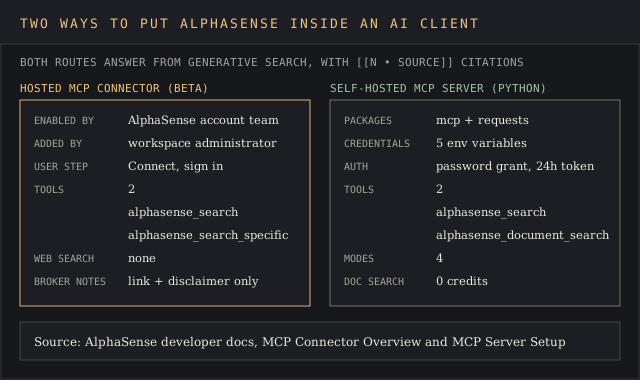
Each answer comes back with inline citations, a Sources list and a link that opens the same conversation inside AlphaSense. Follow-up questions continue that thread, so an analyst can ask about Q3 guidance, then ask what the CFO said on the earnings calls, without restating the company. In a nutshell, the connector is AlphaSense's AI-powered search wearing an MCP badge.
Retrieval mirrors each user's existing entitlements, so the relevant information a seat can see in the app is the relevant information Claude gets.
A seat without the expert transcript library gets no expert transcripts through Claude either, which keeps a firm's licence boundaries intact. Broker research is the one exception: full broker content never passes through the connector. When a broker perspective exists, the response carries an extra link back to that search in AlphaSense plus a disclaimer.
That carve-out matters for equity research desks. Sell-side notes are the content a broker subscription is priced around, and AlphaSense's pricing page lists equity research from 1,000+ sell-side and independent firms in both plans. Through MCP, that library turns into a pointer.
Web search is switched off. The connector's limits section says results are restricted to AlphaSense coverage, and that answers come from Generative Search, so users should click through to verify citations and numbers. Source links also need an active AlphaSense session in the browser.
Setting up the connector
Setup runs in three steps, and the user owns one of them. An administrator adds AlphaSense as a custom connector for the organization, following an admin guide that requires an AlphaSense login to read. The user then opens connector settings, clicks Connect and signs in. Finally the user confirms the connector is switched on for the conversation, since most clients toggle connectors per chat.
AlphaSense's troubleshooting notes read like a list of the calls its support desk already takes. If AlphaSense is missing from the client's list, the administrator hasn't added it. If it's listed and returns nothing, the user hasn't signed in or hasn't enabled it for that chat. Every other question goes to support@alpha-sense.com.
Firm IT teams decide how fast that AI-powered access goes live. A TrustRadius reviewer, a Market Intelligence Senior Director at Samsung Semiconductor, described the blocker in October 2026:
Related to security as well, until IT doesn't fully understand the security implemented, we won't be able tu maximize tools access like Microsoft plug-ins and connectors.
TrustRadius review, Market Intelligence Senior Director, Samsung Semiconductor, 8 October 2026
↑ FACT SHEETThe self-hosted MCP server for developers
The second route is a script. AlphaSense's MCP Server Setup page ships Python code that needs the mcp and requests packages and five environment variables: API key, client ID, client secret, email and password. Miss one and the script raises an error at startup.
Authentication is a password grant. The script posts credentials to api.alpha-sense.com/auth, caches the bearer token and refreshes it 300 seconds before expiry. Tokens last 24 hours, per the Credits & Rate Limits page. SSO customers follow a separate refresh-token flow that the account team has to enable.
The server's two tools differ from the connector's pair. alphasense_search takes a prompt and a mode (auto, fast, thinkLonger or deepResearch) and returns markdown with citations in the format [[N • Source]]. alphasense_document_search takes a keyword, a limit that defaults to 100, a date preset that defaults to the last two years, and optional company and source IDs.
The devil's in the details. The document search tool promises keyword snippets, yet the GraphQL query in the published script never requests a snippets field, and the formatting code defaults that field to empty. A developer who copies the script as written gets document titles back with no snippet text, and it's back to the drawing board to patch the query by hand.
AlphaSense's script calls mcp.run() with no arguments, which runs over stdio on the developer's own machine. That makes this route a fit for a developer running Claude Desktop or Cursor locally. A 40-person research team that wants one governed endpoint should wait for the hosted connector to leave beta.
Developers who need more than the two tools can call the Agent API directly and hit the ground running. The Agent API quickstart promises "Auth to first GenSearch result in under 5 minutes" and lists follow-up threads, Workflow Agents run by ID, and On Behalf Of requests that call the API as an end user with that user's entitlements and usage.
↑ FACT SHEETCredits per call: what Deep Research costs through MCP
Every alphasense_search call spends AI credits, and the mode decides how many. AlphaSense's GenSearch modes page prices them in one table.
| Mode | Credits | Typical time | AlphaSense's stated use |
|---|---|---|---|
| fast | 10 | ~30 seconds | Quick answers, simple lookups |
| auto | 10 | ~30 to 90 seconds | Recommended default |
| thinkLonger | 25 | ~60 to 90 seconds | Multi-factor comparisons |
| deepResearch | 100 | ~12 to 15 minutes | Detailed competitive analysis, investment memos |
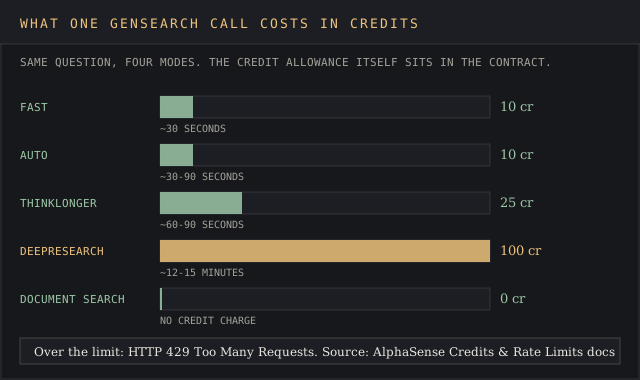
One deepResearch call costs the same as ten fast ones. The docs list "comprehensive research reports" as the job deepResearch exists for, and a 12-minute wait inside a chat client is long enough that most MCP clients will show a spinner the whole time. The self-hosted script's timeout for that mode is 1,800 seconds, so a stalled job errors out after 30 minutes with no partial result.
Document Search and other GraphQL queries cost nothing, and a 10-credit fast answer is a drop in the bucket next to one deepResearch run. That makes alphasense_document_search the cheap way to pull SEC filings and press releases by keyword before spending credits on synthesis, a pattern worth writing into any agent's instructions.
How many credits a customer gets is set "per your commercial agreement," and so is the polling rate. When a team runs out, the gateway returns HTTP 429 before the job starts. AlphaSense publishes no requests-per-minute figure. A Credit Usage Dashboard with per-user export exists, in beta, and the account team has to enable that too.
Workflow Agents bill at their fixed execution mode, so a DEEP_RESEARCH agent costs 100 credits per turn. A daily agent across 20 watchlist names would spend 2,000 credits a day, a figure to raise with the account team before anyone schedules it.
↑ FACT SHEETDue diligence, earnings calls and market insights through MCP
AlphaSense's developer portal pitches the Agent API at meeting prep and idea generation. In practice, the two tools map onto four research workflows that deal teams and corporate strategy groups already run by hand, each with a different credit bill.
Due diligence is the obvious one, and it's where the MCP turns market research into data-driven decisions fastest. A deal team can ask alphasense_search_specific for every mention of a target's customer concentration across SEC filings, earnings call transcripts and expert call transcripts, then run one thinkLonger pass for 25 credits to set the answer against three peers.
That's strategic research an associate used to spend a morning on, and strategic research is exactly what AlphaSense prices as actionable intelligence, done with direct citations a reviewer can click.
Earnings calls are the cheap case for AI-powered research workflows, where fast mode lets an analyst cut to the chase. A fast-mode question about one metric in last night's earnings transcripts costs 10 credits and returns in about 30 seconds, quick enough to check a number between a call ending and a note going out. Event transcripts, press releases and news articles sit in the same index, so the agent doesn't need a second data source for the headline.
Monitoring is where credits pile up. AlphaSense's own Portfolio Monitoring at Scale guide prices a 500-company watchlist at "10 credits × 500 companies = 5,000 credits/day on Auto mode." Its fix is to monitor companies with a free Document Search pass first and run GenSearch only when a ticker has 3 or more new documents.
To maximize efficiency, that gating pattern is the most useful page in the docs. It's also a stitch in time: one cron job that skips quiet tickers saves thousands of credits a week, and the guide's per-document cutoffs mean a missed run doesn't leave a gap.
Competitive analysis and the key debates around a sector belong to deepResearch, which AlphaSense's 2025 launch release pitched for primers covering the bull versus bear case. At 100 credits a run, it's the mode to schedule weekly and review by hand, since the output becomes source material for a client deck. Expert calls booked off the back of that report still go through AlphaSense's expert network add-on.
↑ FACT SHEETAlphaSense AI: Generative Search, Deep Research and agents behind the MCP
Everything the MCP returns comes out of AlphaSense's generative AI stack, so the quality of that stack is the quality of the connector. Four pieces matter, and each one answers natural language queries over the same data sources.
Generative Search and AI-powered search
Generative Search is the conversational search tool that answers natural language questions with citations to the exact snippet of text a claim came from, per AlphaSense's AlphaSense vs Claude page. AlphaSense's March 2025 release described it searching 450 million documents across equity research, event transcripts, company filings, news and trade journals.
The next generation shipped on 27 January 2026, per AlphaSense's launch article.
The launch article says the first generation was "trained on hundreds of millions of premium documents." The new one added a multi-agent research system that reads structured financial data (M&A transactions, funding rounds, equity metrics) alongside qualitative content, plus slide and report generation from research. That's the piece that pairs quantitative data with qualitative content in one answer.
AlphaSense users who've lived with the AI-powered search tool rate it on speed, and the AI search layer underneath is older than the generative one: Smart Synonyms expands a query to cover financial language the analyst didn't type. A TrustRadius reviewer, an Associate Director of Corporate Strategy at Ford Motor Company, wrote in May 2025 that "its new Generative Search feature makes it easier to get to the information you are looking for quickly."
That expansion carries a lot of the relevant information retrieval. A G2 reviewer, a Vice President at an enterprise firm, wrote in August 2026:
Even if I don't type the exact phrasing, it still finds all the relevant mentions in broker research and financial reports.
G2 review, Vice President, Enterprise (>1,000 employees), 27 August 2026
The consolidation is the other half of the praise. A G2 reviewer, an Aeronautical Analyst at a mid-market firm, wrote in July 2026 that "I don't have to jump between different logins for various types of information." An MCP pushes that one step further, into the chat window.
Generative Grid, the table view that runs one question across many documents, gets similar marks. A TrustRadius reviewer, an Associate Director at EY, wrote in March 2026 that "The Generative Grid is really good platform for generating insights using AI" and asked in the same review for exactly what the Agent API now sells:
It would be great to see some Agentic AI capabilities in AlphaSense in future that can execute standard research tasks
TrustRadius review, Associate Director, EY, 2 March 2026
Deep Research
Deep Research launched on 10 June 2025 as a mode of Generative Search. AlphaSense's launch article says it runs dozens of searches across tens of thousands of sources, reasons over the results and writes a cited report, taking 10 to 30 minutes in the app. The API docs quote 12 to 15 minutes for the same mode.
AlphaSense's examples were M&A screening, idea generation and meeting prep, and its platform page says Deep Research compresses "weeks of analysis into minutes." That claim is AlphaSense's own, with no published benchmark behind it.
Workflow Agents and SuperAnalyst
Chris Ackerson framed the March 2026 release with "Today's business professionals demand more than AI-enabled research."
Workflow Agents are pre-built research workflows AlphaSense first shipped in fall 2025; custom and scheduled agents followed in March 2026, reported by IT Brief, alongside an AI interview agent that runs expert calls and returns a summary of key points, plus PowerPoint and Excel add-ins. The Agent API runs any of these agents by ID, which is how an MCP client would reach one.
SuperAnalyst came on 3 June 2026, per AlphaSense's GlobeNewswire release: an always-on agent that monitors filings, earnings and expert transcripts, keeps memory across sessions and edits Excel, Word and PowerPoint files. The release mentioned "expanding connectivity" with no named MCP clients, and AlphaSense's October 2026 AlphaSummit recap named none either, and that recap is hot off the press as of this review.
The slide output still trails the search, close but no cigar for anyone hoping to skip the formatting. A G2 reviewer, a Senior Market Research Analyst at a mid-market firm, wrote in July 2026:
it takes a long time for the slides to generate, and then the final output is not detailed enough and/or underwhelming
G2 review, Senior Market Research Analyst, Mid-Market (51-1,000 employees), 21 July 2026
That matters for anyone expecting a slide agent to finish the job inside Claude. The MCP returns markdown, and deck building stays inside AlphaSense or its PowerPoint add-in.
↑ FACT SHEETThe content the MCP reaches
An MCP is only as good as the data sources behind it, and AlphaSense's library is the reason anyone pays its price. Its What is AlphaSense page, published 2 July 2026, counts 500 million plus documents with 300,000 plus added daily, broker research from 1,700+ providers, news from 90,000+ sources and financial data on 27,000+ companies.
The AlphaSense vs Claude page adds 300,000+ expert interviews, 4,500+ Canalyst models, nearly 1 million M&A deals and 750,000 private funding rounds. Most of the expert transcripts came with Tegus, which AlphaSense bought for $930 million in 2024; our Tegus pricing report covers what that library cost on its own.
Language coverage is wide and literal. AlphaSense's help center lists 37 indexed languages, from Arabic to Vietnamese, and states that "Translation capabilities are not available in AlphaSense currently." A Polish annual report comes back in Polish.
Internal content is the Enterprise Intelligence upsell, aimed at knowledge workers whose own memos never reach a market intelligence vendor.
That plan connects shared drives, Box, Google Drive, SharePoint and S3 so memos and meeting notes sit beside external research, and AlphaSense's site counts 20+ work-system connectors, covering the collaboration tools most research teams already use. Through MCP, that means one question can hit a firm's proprietary content and its sell-side subscription together, the best of both worlds for a firm willing to bite the bullet on the Enterprise Intelligence price.
Collaboration tools stay inside the AlphaSense platform
Several features never cross the MCP boundary. AlphaSense's product overview lists Notebook+ and commenting for annotating and sharing research, customizable dashboards, and real-time alerts on watchlists. The connector returns answers; it doesn't create a notebook entry, edit a dashboard or set an alert.
So the AlphaSense platform stays the system of record. Saved searches and watchlists built in the app can feed the API (the monitoring guide reads watchlist IDs), and the Ford reviewer noted in May 2025 that "its watchlists make it simple to do repeatable searches." Internal content uploaded for Enterprise Intelligence also stays governed in the app.
Private company data is the soft spot. A G2 reviewer at an enterprise financial services firm wrote in December 2022 that AlphaSense's "profiles on private companies can sometimes be a bit less robust than other platform like Pitchbook or Factset." A TrustRadius reviewer, an Analyst in Finance and Accounting at a 10,001+ employee company, listed "Limited private company data." as a con in June 2025.
↑ FACT SHEETWhat AlphaSense says about MCP and AI search
AlphaSense has a public position on the protocol it's shipping. Chris Ackerson, SVP of Product, published MCP in Production: Architecture, Strengths, and Limits on 10 June 2026. Ackerson's piece reads like a memo to business professionals who've heard MCP pitched as a cure-all. He defines MCP as "a standardized way for an LLM application to discover and invoke capabilities exposed by an external server," built around three primitives: Tools, Resources and Prompts.
The article's argument is that thin connectors, which pass a search and a fetch call straight through to a source API, inherit that source's search quality and load whole documents into context. If the answer sits in one paragraph of a 30-page filing, the model still receives all 30 pages. AlphaSense's alternative is pre-indexing: classification, chunking, entity resolution and sentiment scoring done at ingest time.
Ackerson concedes the trade. Pre-indexed systems have to replicate permissions and keep them in sync, ingestion pipelines break when sources change shape, and the index lags the source. For live structured market data he writes "Stale would be worse than thin." His conclusion: choose "per workload, not per ideology."
That framing explains the product, and it's the market insights pitch AlphaSense makes against every AI-powered search assistant without a licensed library.
AlphaSense's connector is the pre-indexed kind exposed through MCP, which is why it returns synthesized answers and refuses to hand over raw broker PDFs. Stale data is the risk it accepts for document search, and a filing indexed this morning is rarely stale data by lunch; for current data such as real-time pricing, a structured MCP like FactSet's or LSEG's is the better tool, since stale data on a bond price is a trading loss.
The CTO's view runs one layer down. Raj Neervannan's July 2026 context graph article describes a knowledge graph of facts extracted at ingestion, with a second machine learning model checking each fact, topped by a context graph of tools, memory and reasoning traces that SuperAnalyst runs on. His line: "Context is only an asset if it can be trusted."
The vendor's comparison page goes further. It notes Claude for Financial Services ships "pre-built MCP connectors to platforms like FactSet, S&P Capital IQ, Morningstar, and PitchBook," and argues each requires a separate subscription. That's true, and it cuts both ways: AlphaSense's own connector requires an AlphaSense subscription too.
↑ FACT SHEETPricing and who can switch the connector on
AlphaSense publishes no rate card. Its pricing page compares two plans, Market Intelligence and Enterprise Intelligence, and says only that AlphaSense provides "annual subscriptions for all team sizes, ranging from enterprise packages to per-seat options."
The one vendor-published number sits on AWS Marketplace, where AlphaSense lists basic access, billed per user, at $20,000 for a 12-month contract, with private offers available. That's roughly $1,667 a month. Buyer data lands nearby: Vendr's median across 38 brokered purchases is $17,500 in total contract value, covered in our AlphaSense pricing report.
The MCP itself carries no separate price on any AlphaSense page. What it does carry is a credit meter, and credit allowances are contract terms. Two firms on the same plan can get different MCP headroom, so the credit number belongs in the order form before signature. The ball is in the buyer's court on that one.
Expert calls and Canalyst financial modeling are add-ons outside both plans, and AlphaSense's pricing FAQ says the full package helps buyers "get the competitive edge." AlphaSense claims expert calls run at "up to 70%" savings against traditional expert networks; our expert network cost report sets that against GLG and AlphaSights pricing.
Access starts with a free trial request on AlphaSense's product pages, then an annual subscription. For a small team that's going to cost an arm and a leg, and a reviewer on G2 put the price problem plainly:
a steep, enterprise-tier price tag that makes it cost-prohibitive for smaller teams or individual analysts
G2 review, eTMF Specialist, Enterprise (>1,000 employees), 27 August 2026
↑ FACT SHEETSecurity, permissions and where research data goes
AlphaSense holds SOC 2 Type II and ISO/IEC 27001 certifications, per its October 2026 security announcement. The same release states customer data isn't used for model training and isn't retained across its models and tools, and lists SAML 2.0 single sign-on, SCIM provisioning, AES-256 at rest and TLS 1.2 in transit.
The MCP inherits two of those controls. The connector mirrors each user's entitlements, and Enterprise Intelligence offers permission mirroring for internal documents, so access controls on a SharePoint folder carry over. Bring-your-own-key and bring-your-own-bucket options let documents stay inside a customer's AWS environment.
What AlphaSense can't control is the client. Once an answer lands in Claude or another assistant, that vendor's retention terms apply to the conversation. A compliance team that works by the book should read both policies before the green light, since material non-public information in an expert transcript is the kind of content a bank's compliance desk tracks by the line.
Licensing limits travel too. The G2 reviewer quoted in the pricing section added that "strict licensing limits make it difficult to share annotated research with team members who lack an active subscription." The connector keeps that rule: a colleague without a seat can't open the citation links.
↑ FACT SHEETWhere the connector falls short
Synthesis over long time windows is the most specific complaint on record. A TrustRadius reviewer at The Motley Fool, a Senior Analyst and Lead Advisor, wrote in June 2025:
The AI does a good job of handling one document at a time but often delivers ineffective results if searching for insights over a longer timeframe
TrustRadius review, Senior Analyst and Lead Advisor, The Motley Fool, 18 June 2025
Another TrustRadius reviewer, an R&D analyst at a 1,001 to 5,000-person firm, made the same point about sentiment across dealer reports in June 2025:
not useful for generating a synthesis that reads through these reports and summarizes what the sentiment actually is in a reliable way. Still need to manually go through to develop a reliable synthesis.
TrustRadius review, Analyst in Research & Development, 25 June 2025
Both reviews predate the January 2026 multi-agent rebuild, so treat them as a baseline to test against. An MCP pilot should ask the same trailing-12-month question in thinkLonger and deepResearch modes and compare the answer to an analyst's manual research before anyone trusts the cheaper mode.
Verification stays manual. A G2 reviewer, a Senior Analyst at a small business, wrote in September 2026 that "The AI-generated insights are helpful, but I still prefer to verify anything important against the original sources." AlphaSense's own connector docs say the same thing. Checking every figure is easier said than done when Deep Research cites dozens of documents in one answer.
Inside Claude, the learning curve moves to the filters. G2 users describe AlphaSense's interface as dense; one Senior Lead Software Engineer at a small business wrote in August 2026 that "the platform can sometimes feel overwhelming because of the large amount of information and features available." The MCP hides the interface, but filters such as source IDs, GICS industry codes and watchlist IDs still need someone who knows the platform.
Finally, the beta label is doing work. No published rate limit, an admin guide behind a login, and a sample script with a snippets bug add up to a product still being ironed out. Teams who need production SLAs today should hold their horses.
↑ FACT SHEETWho runs AlphaSense
Jack Kokko founded AlphaSense in 2011 with Raj Neervannan and runs it as CEO, per the pricing page FAQ, which says he built it after doing manual research as an investment banker at Morgan Stanley.
On 3 June 2026 AlphaSense announced a $350 million round at a $7.5 billion valuation, and more than $600 million of annual recurring revenue in Q1 2026, up from $500 million in October 2025. Vitruvian Partners, Accenture Ventures and J.P. Morgan Asset Management led; CapitalG, Goldman Sachs Alternatives and Viking Global Investors returned.
↑ FACT SHEETAlphaSense MCP vs FactSet, LSEG, Crunchbase and AlphaSights
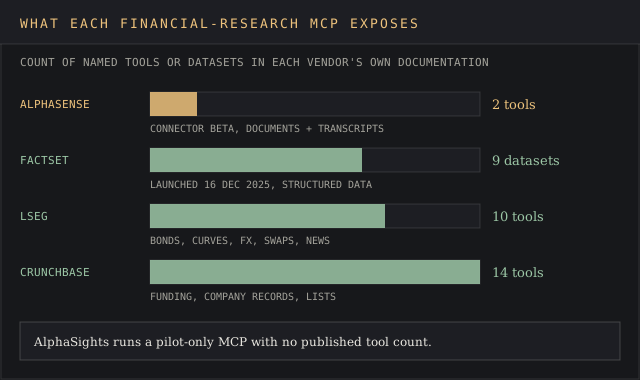
The financial-research MCPs split by what they return: documents or numbers. Picking the right one is the competitive advantage, since each answers a different question. AlphaSense returns synthesized answers from text. The others mostly return structured records.
FactSet
FactSet wins when the question is a number, and it got ahead of the curve by shipping first. Its MCP server, announced 16 December 2025, exposes nine datasets including fundamentals, consensus estimates, ownership, global M&A and events, after a beta with 45 firms and 800+ users. AlphaSense wins when the question is what management or an expert said about that number. Our FactSet MCP review covers its 24 tools and the license gate in front of them.
FactSet's entry seat starts at $12,000 a year per our FactSet review, with real seats at $14,000 to $22,000. The FactSet vs Bloomberg comparison covers how its terminal stacks up on structured data. Our AlphaSense vs FactSet comparison runs the same number-or-commentary split across both full platforms.
LSEG
LSEG's MCP connects Claude to ten tools spanning bonds, yield curves, FX, swaps, options, equities, volatility surfaces, time series and news, per its February 2026 announcement. It wins for fixed income and rates desks, providing access to live curves AlphaSense doesn't carry. It loses for anyone whose question lives in an expert call. Our LSEG review puts an Eikon seat at about $22,000 a year.
Crunchbase
Crunchbase's server names 14 tools across expert queries, structured lookup and list-building, per its tool reference. It wins on price and private-company funding data: Pro runs $99 a month, per our Crunchbase review. It carries no sell-side notes or transcripts.
AlphaSights
AlphaSights, the expert network that sued AlphaSense over its name in January 2025, runs an MCP in Claude that searches its research library and call transcripts. It's pilot-only, like AlphaSense's beta, and it covers only AlphaSights' own calls. AlphaSense wins on breadth; AlphaSights wins for firms already buying its calls.
For the wider field, our investment research platforms ranking and financial data providers ranking place each vendor by use case. Other MCP builds on this site, including the Bright Data MCP review and the DataForSEO MCP review, show what a published, priced, self-serve server looks like by contrast.
↑ FACT SHEETFAQ
What does AlphaSense AI do?
AlphaSense AI runs AI-powered search and document summarization across 500 million plus business documents for market intelligence and financial research teams: Generative Search answers questions with citations, Deep Research writes multi-source reports, and Workflow Agents run scheduled research. The MCP exposes the first two inside chat clients.
Is AlphaSense free?
No. AlphaSense sells annual subscriptions, offers a free trial on request, and lists basic access at $20,000 for 12 months on AWS Marketplace.
How much does AlphaSense cost per month?
The AWS listing works out to about $1,667 a month per user. Vendr's buyer median of $17,500 a year is about $1,458 a month.
Who are AlphaSense's main competitors?
FactSet, LSEG, Bloomberg, PitchBook and S&P Capital IQ for financial data, plus AlphaSights and other expert networks for transcripts. G2 lists Bloomberg Terminal, PitchBook and FactSet Workstation as its most compared products.
Is AlphaSense worth it?
For teams already reading sell-side notes and transcripts daily, the 4.6 rating across 366 G2 reviews and the MCP's cited answers back it up. For occasional research, a $99 Crunchbase seat or the free tier of a general assistant costs a fraction.
↑ FACT SHEETVerdict
AlphaSense's MCP is for market intelligence teams, financial institutions and consulting groups that already hold AlphaSense enterprise contracts whose analysts already live in Claude or another MCP client. For due diligence and earnings work, two AI-powered tools that return cited answers from 500 million plus documents, with their own entitlements enforced, beat copy-pasting between windows. The credit meter, 10 to 100 per question, is the number to negotiate.
It isn't for anyone who'd be buying AlphaSense to get the MCP. The $20,000 AWS listing, the account-team gate and the beta label put it out of reach for a solo analyst, and Crunchbase's 14 tools at $99 a month cover private-company lookups for a fraction of that.
It might suit a developer team building internal research agents, with caveats: the self-hosted script needs five credentials and a patch to return snippets, broker research stays behind a link, and no request rate is published. Test deepResearch against a manual research pass on one company before scheduling agents across a watchlist.