
The numbers AlphaSense pricing, as of 1 August 2026
AlphaSense publishes no rate. The $17,500 median across 38 purchases is the only comparable-company evidence a buyer can bring to the table.
One reported enterprise seat costs $50,000, close to the $51,000 top of every contract Vendr recorded.
Bloomberg lists $27,000 a terminal against Koyfin's $600 a seat, and AlphaSense sits between them. LSEG's Refinitiv Eikon seat ran about $22,000 a year in April 2025, per Wall Street Prep.
Ask for the quote broken out by platform, content tier and add-on, since expert calls and Canalyst are priced separately.
I'll write a 2,500+ word report on the vendor you name, with tracked contracts, add-ons and renewal terms sourced line by line. Yours to publish, from $200.
AlphaSense’s cheapest logged contract, $9,250, sits close to half its $17,500 median. Its priciest one, $51,000, lands within $1,000 of the $50,000 that one buyer reported for a single enterprise seat. AlphaSense posts no rate card anywhere on its own site, so every one of those figures comes from Vendr’s marketplace data, which tracked 38 purchases and put the spread at $9,250 to $51,000.
This report breaks down what each package includes, what pushes a quote up, and how AlphaSense compares against the other market intelligence platforms buyers shortlist: Bloomberg Terminal, FactSet, S&P Capital IQ and Koyfin. It’s aimed at a research or competitive-intelligence lead who needs a real number before that first sales call, since the gap between $9,250 and $51,000 is the difference between a starter seat and a full desk of licenses.
AlphaSense pricing compared to the alternatives
Two of the platforms below publish a rate. The rest quote per deal, so the figures are buyer-reported ranges from Vendr's transaction data.
| Platform | Published rate | Annual cost, small team | Content strength | Our review |
|---|---|---|---|---|
| AlphaSense | None | $9,250 to $51,000, median $17,500 | Broker research, expert call transcripts, filings | AlphaSense review |
| Bloomberg Terminal | $24,000 to $27,000 per terminal | $240,000 to $270,000 for ten seats | Real time market data, consensus estimates, messaging | Not reviewed |
| FactSet | None | Quoted, modular by feature set | Analytics, screening, portfolio management | Not reviewed |
| S&P Capital IQ Pro | None | Quoted, tiered | Real-time market prices, M&A visualization, credit research | Not reviewed |
| GlobalData | None | Quoted per report and per account | Market research reports, company profiles | GlobalData review |
| Similarweb | $199 a month Starter | Around $15,000 team, $30,000 business | Web traffic, digital market share | Similarweb review |
| Exploding Topics | $39 to $249 a month | $468 to $2,988 | Trending topics in finance and startups | Exploding Topics review |
| Koyfin | $400 to $600 per seat | $4,000 to $6,000 for ten seats | Filings, financials, charting | Not reviewed |
Copy these lines into an email, fill them in and send. I reply with scope and a price within 2 to 3 business days.
Open the emailAlphaSense sits between the trend tools and the terminals. A Bloomberg terminal costs one and a half to two and a half times an AlphaSense seat & sells a different job; Exploding Topics runs at a fortieth of the price and answers a narrower question.
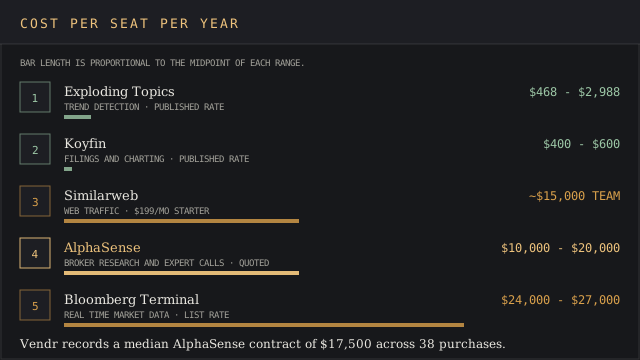
Why AlphaSense won't quote exact prices
AlphaSense does not publish a rate card, and neither do Bloomberg, FactSet or S&P Capital IQ Pro. Transparent pricing would remove the vendor's ability to price by segment, and a hedge fund and a mid-size manufacturer buying identical seat counts get quoted different numbers.
The practical consequence for a buyer is that comparable-company data is the only bargaining position available. That's why the $17,500 median across 38 purchases matters more than any list figure.
How much does AlphaSense cost
The median AlphaSense contract
$17,500 a year is the midpoint of Vendr's AlphaSense dataset, drawn from 38 recorded purchases and last updated in February 2026. The low end is $9,250. The high end is $51,000.
That spread reflects seat count more than anything else. A three-person corporate strategy team and a twenty-analyst equity research desk buy the same market intelligence platform and sign totals an order of magnitude apart.
Vendr also reports AlphaSense pricing varies by 30 to 50 percent between buyers with similar seat counts. Same product, same scope, half again the price.
AlphaSense cost per seat
Reported per-seat pricing runs from roughly $10,000 to $20,000 a year for the core platform. Enterprise packages with premium content and expert access have been reported as high as $50,000 per seat.
Per-seat rates fall as seat count rises. Vendr's dataset shows volume thresholds at 5, 10, 25, 50 and 100 seats, and buyers at 25 to 50 seats with premium content commonly negotiate 15 to 30 percent below the per-seat rate a smaller team pays.
Most contracts start at 5 to 10 seats. AlphaSense doesn't sell a single license through a checkout page; the company runs a free signup on its own site, and every paid plan is an annual subscription built from a sales conversation.
$17,500 across 38 recorded purchases, with $9,250 at the bottom and $51,000 at the top. Vendr's dataset is the only comparable-company evidence available in this category, and quoting it back is the one move that reliably moves an opening number.
The two AlphaSense packages
AlphaSense's own pricing page names two plans. Neither carries a price.
Market Intelligence
The Market Intelligence package covers company documents, broker and independent research, the expert transcript library, news and regulatory content. Broker research spans more than 1,000 sell-side and independent firms, delivered both real-time and aftermarket.
Service on this tier includes 24/7 live help, a dedicated account manager, ETL integration services, and virtual & in-person training. Hosting is standard SaaS.
This is the tier most corporate strategy teams, competitive intelligence groups and market research functions buy.
Enterprise Intelligence
Enterprise Intelligence adds internal content integration. AI search and summarization run across a company's own documents alongside the external content library, so an analyst searches company filings, earnings calls and last quarter's internal deck from one query box.
The tier also unlocks private cloud hosting, IT support, professional services, a custom training program, and uploads through the AlphaSense API.
Confidential data handling is the practical reason buyers move up. AlphaSense is SOC 2 Type II and ISO/IEC 27001 certified, and Enterprise Intelligence supports bring your own key and bring your own bucket deployments with permission mirroring, so internal customer data can stay inside a company's own AWS environment.
Key features included in the subscription
Content covered at the base price
Company documents, company filings and SEC filings across public and private companies, earnings call transcripts, press releases and investor presentations. Financial data covers company financials, employee data and peer comparisons, with life sciences content spanning clinical trials and biomedical research, the coverage our life science intelligence tools ranking scores it on.
The platform indexes external content from more than 2,000 premium business sources across 27,000 public and private companies. Consumer search engines index almost none of it.
Search platform features
The research platform runs AI search, Smart Synonyms, saved searches and alerts on any query. Trend tracking works by watching a term across the document set over time.
Filters narrow by company, sector, document type and date, which is what turns 500 million documents into relevant data.
Internal content integration
Enterprise Intelligence is the piece that makes AlphaSense a single search platform. A company's own customer data, past decks and research notes sit alongside filings and broker research under one query, with existing permissions carried over.
Buyers who already run a knowledge management tool should price that overlap before adding the tier.
Add-ons priced outside the platform fee
Two products sit alongside the subscription and carry their own line items.
Expert calls
AlphaSense Expert Calls, the Tegus network the company bought for $930 million in 2024, connects buyers to a pool AlphaSense describes as one million pre-qualified experts. Savings run up to 70 percent against traditional expert networks; transcriptions, translations, brokered calls and a compliance portal are included.
AlphaSense bought Tegus and its expert call network for $930 million in 2024, and now sells it as AlphaSense Expert Calls.
What AlphaSense paid for Tegus, 2024
Source: AlphaSensee.g. the acquisitions reshaping your category
Source: linked, checked, datedPricing runs on call credits bought in advance, or per-call fees that vary by expert type and geography. Unused credits may expire or roll over depending on the contract.
Canalyst financial models
Canalyst covers financial modeling: industry-specific KPIs, non-GAAP metrics, auditable model data, and structured financial data pulled from company filings. Excel tools handle model updates and audits. It's quoted separately.
Together, expert calls & premium content represent 20 to 40 percent of total contract value for buyers who use them heavily, according to Vendr. On a $50,000 contract that's $10,000 to $20,000 sitting outside the base platform licence.
Enterprise pricing above 50 seats
Enterprise pricing stops being a per-seat calculation past a certain size. Vendr reports buyers at 50 seats and up negotiate on total contract value instead, with expert call credits, API usage and professional services broken out as separate line items.
That shift works in the buyer's favour. A per-seat conversation caps the discount at the volume table; a total contract value conversation opens prepayment, term length and bundled add-ons at once.
Enterprise pricing also reflects reference value. An investment bank running 200 analyst seats is a logo AlphaSense wants, and the quote shows it.
What drives an AlphaSense quote
Seat count
Licenses are named-user. Every person who logs in needs one, and per-seat pricing steps down at the volume thresholds above. Some contracts distinguish power users from read-only users, though that split is less common.
Content tier
Standard content covers public filings, transcripts and news. Premium content adds broker research, proprietary datasets and trade journals, and it carries a real per-seat premium. Historical archives, international content and niche verticals can add further fees.
Buyers who don't read equity research pay for it anyway if they let the tier get bundled without asking.
Wall Street Insights and the broker research premium
Wall Street Insights is the AlphaSense equity research collection built for corporate buyers, drawing on more than 1,500 research providers including Goldman Sachs, J.P. Morgan, Morgan Stanley, UBS and HSBC. It covers company financials, peer analysis, deal commentary and industry themes, most of the sections our equity research report template sets out for a single stock.
Corporations historically couldn't buy sell-side research at all, since brokers distributed it to trading clients. That access is most of what the premium content tier sells.
Ask which providers are in scope before signing. Coverage differs by package.
Contract term and timing
Multi-year commitments of two to three years typically unlock 10 to 20 percent discounts. Annual prepayment adds another 5 to 10 percent against quarterly billing.
AlphaSense's fiscal year ends in December. Timing purchases near quarter-end, and near the October to December year-end in particular, improves negotiating power. Sales cycles run 30 to 90 days.
Costs that land outside the subscription line
Contracts commonly include 3 to 5 percent annual price escalation on renewal. Over a three-year term that compounds, and negotiating a flat renewal or a cap is standard practice.
Auto-renewal is the other trap. Most AlphaSense contracts renew unless cancelled 60 to 90 days in advance, and missing that window locks in terms for another year.
Mid-contract seat additions are usually priced at list unless the expansion rate was negotiated upfront. API access may require the Enterprise tier or a separate licence, and may be metered by usage volume. Custom training and dedicated account management can be bundled or charged as professional services.
How to negotiate AlphaSense pricing
AlphaSense pricing is negotiable at every line. Engage 90 to 120 days before the target start date or renewal deadline, which is long enough to run a competitive evaluation and removes the time pressure that closes negotiations early.
Anchor to your budget number. Vendr data shows buyers who anchor to budget and name a competing platform often land 20 to 30 percent below the initial quote.
Run a parallel evaluation and say so. Bloomberg Terminal, FactSet and S&P Capital IQ Pro are the alternatives that move an AlphaSense quote, and Koyfin works as a floor for smaller teams. Our AlphaSense vs FactSet comparison prices the most common of those pairings.
Trade term length for price protection. A two or three year commitment with flat renewal pricing or increases capped at 2 percent yields 15 to 25 percent total savings against annual contracts carrying standard escalation.
Pre-negotiate seat expansion. If you expect to add 10 to 15 users over the next year, get that rate into the original contract; added mid-term, those seats price at list.
Unbundle the add-ons. Starting on Market Intelligence and adding expert calls later cuts the initial contract value and keeps a second negotiation in reserve.
Who pays for AlphaSense
Investment banks and hedge funds
These buyers take premium content, expert call transcripts and the Canalyst financial modeling add-on together, which is how a contract clears $50,000. An analyst validating a thesis needs the sell-side note and the operator interview in the same session.
Hedge funds buy fewer seats at a deeper content tier. Investment banks buy wide, which puts them past the 50-seat threshold where per-seat rates drop sharply. Both sit inside the wider financial data provider market.
Private equity and asset management
Private equity buys AlphaSense for diligence: filings, expert calls & industry research on a target before the bid. Among the top asset management firms, the use case is portfolio monitoring, tracking macro themes and company signals across holdings. The diligence documents themselves sit in the seller's data room, a cost our virtual data room pricing report breaks down by vendor.
Both segments lean hard on expert calls, which is why their contracts carry the 20 to 40 percent add-on premium more often than corporate buyers do.
Corporate strategy teams
Corporate strategy teams are the segment most likely to land near the $17,500 median. They typically buy Market Intelligence content at 5 to 15 seats, skip the Canalyst models, and use expert calls sparingly.
Competitive analysis and market sizing don't need real time market data or consensus estimates, so the cheaper tier holds up.
Business intelligence, sales and investor relations
Business intelligence groups value AlphaSense as one search platform over external and internal content, which is why a general business intelligence tool rarely replaces it. Investor relations teams use it to track how analysts describe their own company.
A sales team uses the same research tool differently: reading an account's earnings calls and filings before a renewal conversation, so the pitch matches what the buyer told the market. Competitive intelligence groups run it against rival disclosures on the same subscription.
Product and marketing teams run primary research against the expert transcript library, skipping the cost of commissioning interviews. Consultancies buy widest of all: AlphaSense reports 95 percent of the top consultancies as customers.
AlphaSense compare: pricing against the alternatives
Every AlphaSense compare exercise hits the same wall. Three of the four enterprise alternatives publish nothing either, so Koyfin anchors the low end by default.
AlphaSense vs Bloomberg Terminal
Bloomberg lists at roughly $24,000 to $27,000 per terminal per year. Ten terminals is $240,000 to $270,000 at list, against an AlphaSense median contract of $17,500.
The two aren't substitutes. Bloomberg carries real time market data, consensus estimates and the messaging network traders live in. AlphaSense carries research depth: 500 million documents, expert call transcripts, broker research from 1,000+ firms.
AlphaSense vs FactSet
FactSet prices modularly, so total cost depends on which modules a buyer takes: analytics, screening, portfolio management. Neither vendor publishes rates, and both discount for multi-year terms and competitive pressure.
Comparing per-seat rates between them is misleading. Compare the module list against the content tier and price the whole scope.
AlphaSense vs S&P Capital IQ Pro
S&P Capital IQ Pro offers real-time market prices and M&A visualization alongside credit research, screening and Excel integration, and prices competitively with AlphaSense for corporate users. Vendr reports both vendors commonly negotiate 20 to 30 percent below list under competitive pressure.
The expert call network is the piece Capital IQ Pro's core offering doesn't match.
AlphaSense vs Koyfin and Exploding Topics
Koyfin publishes its tiers at roughly $400 to $600 per seat a year. Ten seats runs $4,000 to $6,000, against $9,250 at the bottom of AlphaSense's observed range. It's a reasonable floor for a small team doing financial analysis. Deep research work needs more than Koyfin's tier covers.
Exploding Topics tracks trending topics in finance and startups from $39 a month, which is a different job at a hundredth of the price. Neither replaces broker research, and both are useful numbers to put in front of an AlphaSense rep. Our trend research ranking covers that end of the market.
What the AI search layer adds to the price
AI search and generative search
AlphaSense's AI search reads a full question in plain language, then retrieves the passage that answers it. Generative search synthesises an answer across several sources, with citations back to each filing, transcript or broker note it drew from.
The citation is the product. An analyst can hand a client a claim and point at the source document, which a general chatbot can't do.
Analysis tools built on the library
Sentiment analysis and summarization run across earnings calls, filings and financial reports, surfacing themes an analyst would need days to read for by hand. Deep Research and Generative Grid extract insights across a set of companies at once.
Every one of those AI capabilities runs against licensed content. That's the pricing mechanism: the models are cheap to serve, and the broker research they read is not.
Why AlphaSense commands premium pricing
AlphaSense aggregates more than 500 million business documents: SEC filings, earnings call transcripts, press releases, financial reports, trade journals, equity research and expert call transcripts, indexed under a layer running natural language processing across the lot.
Premium broker research isn't available free anywhere. Neither are Tegus expert transcripts. A search engine returns news articles; AlphaSense returns the sell-side note.
The demand side supports the price. AlphaSense passed $700 million in annual recurring revenue in June 2026, up from $600 million in Q1 2026 and $500 million in October 2025, and reports it's taking steps toward an IPO. A $350 million round on 3 June 2026 valued the company at $7.5 billion, nearly double its previous $4 billion mark.
More than 7,000 enterprises use it, including 90 percent of the S&P 100, 90 percent of the top investment banks & 95 percent of the top consultancies. Gartner named AlphaSense a Leader in its inaugural Magic Quadrant for Competitive and Market Intelligence Platforms on 21 April 2026, positioned highest on both Ability to Execute and Completeness of Vision.
Delivered for your site and your byline. Hosting here is optional.
Common questions about AlphaSense pricing
How much does AlphaSense cost per user?
Roughly $10,000 to $20,000 a year for the core platform, with enterprise packages including premium content and expert insights reported as high as $50,000 per seat. Per-seat rates fall at 10, 25, 50 and 100 seats.
How much is an AlphaSense seat for a small team?
Five to ten seats on Market Intelligence content lands near the $17,500 median, with $9,250 the lowest figure in Vendr's dataset of 38 purchases.
Why is AlphaSense so expensive?
Premium broker research from 1,000+ firms, the Tegus expert transcript library, and licensed content carrying per-user redistribution costs AlphaSense pays through. The AI search layer sits on content the company licenses.
Is AlphaSense worth it?
For investment banks, hedge funds, private equity and corporate strategy teams running constant due diligence, the median $17,500 contract is small against the analyst hours it replaces. For a team running occasional market research, Koyfin at $400 to $600 a seat covers most of the need. Our AlphaSense review scores the product itself against the four-pillar rubric.
Does AlphaSense have a free tier?
The site carries a Get Started for Free signup. Every paid plan is an annual subscription quoted by sales, so there's no self-service paid tier and no monthly billing.
How does AlphaSense make money?
Annual per-seat subscriptions to the Market Intelligence and Enterprise Intelligence packages, plus separately priced add-ons for expert calls and Canalyst financial models.
Who is AlphaSense's competitor?
Bloomberg Terminal, FactSet and S&P Capital IQ Pro at the enterprise end; PitchBook for private markets and deal intelligence; Koyfin and Exploding Topics at the low end. Tegus was a direct rival until AlphaSense bought it for $930 million in 2024.
How much is AlphaSense worth?
$7.5 billion, as of the $350 million round closed on 3 June 2026. That's nearly double the $4 billion valuation from its previous round.
What to budget
Take the $17,500 AlphaSense median as the anchor. Five to ten seats on Market Intelligence content lands near it. Premium broker research, expert call credits and Enterprise Intelligence internal search each push the number toward the $51,000 top of the observed range, and past it at scale.
Then add 20 to 40 percent if expert calls will get heavy use, because that's what Vendr's dataset says heavy users pay on top. The wider market intelligence platform pricing report sets those tiers against the rest of the category.
Ask for the quote broken out by platform, content tier and add-on. AlphaSense pricing arrives as a single blended number, which is the hardest possible thing to negotiate against.
Research platforms, expert networks and procurement advisers use reports like this one in sales calls and renewal prep.
A report on your topic for a blog page, gated content or a lead magnet.
Written for your client and published under their brand, with my name left off.
Your report on marketintelligencetools.com, with 2 to 3 CTAs carrying your sponsored links.
Default terms: the report is yours to publish, and I keep the right to republish it on this site behind a gate, outside Google's index.