
The numbers 6sense pricing, as of 1 October 2026
6sense publishes no paid price. Every figure here comes from buyers reporting what they signed.
The same platform sold at $11,376 and $176,809, and account volume drives most of that spread.
Buyers negotiating through Vendr took 16.77 percent off the quote on average.
6sense ended its free plan on 12 August 2026, and every button on its pricing page now books a demo.
Get the quote itemised by account tier, module, credits and implementation before the first negotiation call.
ABM vendors and agencies get asked about 6sense contracts before every deal. Send the vendor and I'll source a version you own.
6sense does not publish paid pricing. The company runs a custom pricing model built per deal, and the only hard numbers come from buyers reporting what they signed.
Vendr's marketplace records a median 6sense contract of $62,440 a year across 385 purchases, with observed deals running from $11,376 to $176,809. Buyers negotiating through Vendr saved an average of 16.77 percent off the quote.
6sense also discontinued its Sales Intelligence free plan on 12 August 2026. Its pricing page now lists three paid bundles with no dollar figures.
This page covers the end of the free plan, the three Sales Intelligence packages, how data credits work, the hidden costs that sit outside the subscription, and how 6sense pricing compares against Demandbase, ZoomInfo, Terminus (now DemandScience), AdRoll ABM (formerly RollWorks) and Warmly. Figures were checked on 1 October 2026.
6sense pricing compared to the alternatives
Every platform below quotes per deal. The prices are the median annual contracts from the stat block at the top of each vendor's Vendr marketplace page, read on 1 October 2026. Vendr's Terminus and RollWorks pages return a 404, so those two rows carry no figure.
| Platform | Vendr median annual contract | Purchases behind it | Advertising | Intent depth | Our review |
|---|---|---|---|---|---|
| 6sense | $62,440 | 385 | Separate module | Multiple sources, predictive scoring | 6sense review |
| Demandbase | $68,591 | 187 | Platform fee plus media | Comparable scoring and orchestration | Demandbase review |
| ZoomInfo (all products) | $33,500 | 1,574 | Not a core module | ZoomInfo intent, database-first | ZoomInfo review |
| Terminus (now DemandScience) | No Vendr data | None | Included in core platform | Basic scoring and segmentation | Not reviewed |
| AdRoll ABM (formerly RollWorks) | No Vendr data | None | Included in core platform | Single source, basic signals | Not reviewed |
| Warmly | $14,550 | Not published | Not a core module | Web visitor signal, lighter scoring | Not reviewed |
Copy these lines into an email, fill them in and send. I reply with scope and a price within 2 to 3 business days.
Open the emailDemandbase's median runs $6,151 above 6sense's $62,440. ZoomInfo's $33,500 blends every ZoomInfo product, sales data included. Warmly's $14,550 median is under a quarter of the 6sense figure, the floor of this table.
ZoomInfo's median rests on 1,574 purchases, the deepest sample in the table, which is one reason it gets used as the price anchor in so many 6sense negotiations.
How the pricing models work
None of these vendors publishes exact prices. Every custom pricing quote is assembled from account volume, module count and contract length, so two companies of the same size can sign widely different numbers. Vendr's tracked 6sense contracts run from $11,376 to $176,809.
Tiered pricing exists inside a quote. 6sense has volume steps, but you only see where they fall once a rep builds the proposal.
Transparent pricing would remove the vendor's ability to price by segment, which is the reason it stays absent from the category.
How much does 6sense cost
The median 6sense contract
$62,440 a year is the midpoint of Vendr's dataset, drawn from 385 recorded purchases and last updated in February 2026. Vendr has handled 204 6sense deals directly.
The full observed range
The low end of Vendr's dataset is $11,376. The high end is $176,809.
An $11,376 contract is a small team on a narrow module set with a limited account list. A $176,809 contract is an enterprise revenue org running predictive scoring, account based advertising & conversational email across a large addressable market.
Same vendor, fifteen times the price. Almost none of that gap is negotiation; most of it is scope.
Why 6sense pricing moves so much
Total addressable market is the primary cost driver. 6sense prices on how many accounts you want the platform to monitor and score, so a company selling to 2,000 named accounts pays a fraction of what one selling to 20,000 pays.
Module selection is the second lever. The core platform, Sales Intelligence, Advertising, Conversational Email and Revenue AI each carry their own cost, and buying multiple modules at signature prices better than adding them one at a time.
Premium data packages are the third. Baseline intent data is included; extra intent sources, expanded technographic coverage and third party data for contact enrichment are not.
The 6sense free plan
What happened to it
6sense discontinued its Sales Intelligence free plan on 12 August 2026. Free plan accounts can no longer log in, new registrations are closed, and paid subscriptions carried on unchanged.
The free tier was a contact lookup covering company and people search, sales alerts, the List Builder and the Chrome extension, paid for in credits. A rep who used it to test data quality now has to book a demo to see the same records.
What the free plan left out
It left out intent data, predictive scoring, CRM integration and workflow automation.
Those four are the core product, and the paid bundles below are now the only way to get them.
The credit based system
Unused credits don't roll over. 6sense's credits documentation says paid credits expire with the contract's credit pool and are lost if unused, so a team that buys a credit volume against peak usage pays for capacity it may never draw.
This credit based system is the single most common source of 6sense budget surprise. Model data credits consumption against your slowest month, then negotiate the top-up rate separately.
Ask for a detailed breakdown of what draws a credit before signing. Record unlocks, exports and enrichment all draw down, the rates differ by record type, and nothing carries into the next pool.
6sense pricing tiers and packages
6sense's public pricing page names three Sales Intelligence configurations. None carries a price.
Sales Intelligence + Data Credits
The prospecting configuration. Key features cover the Chrome extension, AI Writer in beta, Persona Map, technographics, psychographics, web visitor identification, job postings and third-party intent, plus alerts, Intelligent Workflows for Sales and corporate hierarchy.
Credits unlock the data: company data acquisition, Buyer Discovery, and the List Builder all draw down against them. Integration covers CRM, sales engagement platform and web app, with reporting, advanced analytics and CRM filters included.
This is the cheapest real entry point, and it behaves most like a contact database.
Sales Intelligence + Predictive AI
The prioritisation configuration. Predictive AI adds the model, scores and dashboards, plus Sales Copilot with AI Recommended Actions and AI Account Summaries.
What it doesn't add is export capacity. Predictive analytics tells sales teams which target accounts are in market; without credits, pulling the contact records out still costs.
Sales Intelligence + Data Credits + Predictive AI
Both halves together, and the configuration most buyers end up on. Scoring identifies the high value accounts, credits unlock the people inside them, and the two are close to useless separately.
6sense sells them apart anyway, which is worth knowing before the first quote arrives.
Enterprise pricing and the top tier
The Revenue Marketing side enters at enterprise scale, usually on a two-year commitment. Its top-tier package automates targeted ad campaigns across display, social and other platforms, alongside Conversational Email, Audience Builder and Smart Form Fill.
Key features you're paying for
Intent data and buying signals
6sense tracks keyword searches and content consumption across its publisher network, which the company calls Signalverse, then converts that activity into buyer intent data at the account level. When several people at one company research the same topic, those intent signals stack into a score.
Real time buying signals refresh as new activity arrives, so sales and marketing teams see a stage change the day it happens. Weak intent signals get filtered out before they reach a rep.
Intent data separates the paid bundles from a plain contact lookup, and Vendr's lowest tracked 6sense contract, $11,376, is already five figures. Our intent data providers ranking prices the same signal bought on its own.
Vendr's lowest tracked 6sense contract comes to $11,376, already five figures, since intent data separates the paid bundles from a plain contact lookup.
Lowest tracked 6sense contract
Source: Vendre.g. the entry contract at the platform you sell against
Source: linked, checked, datedAccount identification and website visitors
The web visitor ID layer tracks anonymous website traffic by mapping IP addresses to specific companies, matching that browsing activity against firmographic company data already on file.
An unnamed IP address in Google Analytics becomes a named account record with job titles attached. Reviewers name this as the feature that most often justifies the contract.
Predictive AI and account scoring
The predictive AI model scores every account by fit and by buying stage: awareness, consideration, decision, purchase. Predictive analytics compares current engagement against patterns from accounts that already closed.
That's the difference between knowing a target account is interested and knowing roughly where it sits in the buying cycle.
AI agents, Sales Copilot and the Chrome extension
Sales Copilot surfaces AI Recommended Actions and AI Account Summaries inside the workflow, and RevvyAI answers questions against the 6sense data a team already licenses. These AI agents are pitched as turning company insights into actionable insights a rep can work from directly.
The Chrome extension is the piece sales teams touch daily, pulling contact data while browsing LinkedIn without leaving the tab. Ask exactly which AI agents are in the quoted package, because they move between tiers.
What drives a 6sense quote
Total addressable market size
The number of accounts 6sense monitors and scores sets the base. Per-account pricing falls as the TAM grows.
Right-sizing this is the cheapest saving available. Teams routinely license a TAM built from an aspirational market map. The right TAM is the accounts their sales representatives will touch this year.
Multiple modules
Each module adds to total contract value. Sales Intelligence, Advertising, Conversational Email and Revenue AI are priced separately from the core platform.
Buying multiple modules at initial purchase yields better overall pricing than adding them at renewal, according to Vendr's transaction data. The reverse holds too: modules added incrementally price at their own rate with no bundle discount to trade on.
Data sources and enrichment
Baseline intent from Signalverse is included in platform pricing. Premium intent providers, expanded technographic coverage and additional contact databases carry incremental fees.
Ask which sources are in the quote by name. Intent data included covers a wide range of depths.
Contract length
Multi-year commitments of two to three years generally price lower per year than single-year contracts.
6sense usually requires two years minimum for its better rates, so long term contracts are often cheaper per year than the flexible option. Contract length is the lever most buyers under-use.
Existing tech stack and integration work
Connecting 6sense to a CRM, marketing automation platform, data warehouse and ad stack takes work. Some connections are native and included; others need middleware or custom API development.
Salesforce and Microsoft Dynamics are native. Marketing automation tools including Marketo, Eloqua, HubSpot and Pardot are supported, as are Snowflake and BigQuery. Exporting segments to Google Ads or LinkedIn Ads is the gap reviewers flag most.
Hidden costs that sit outside the subscription
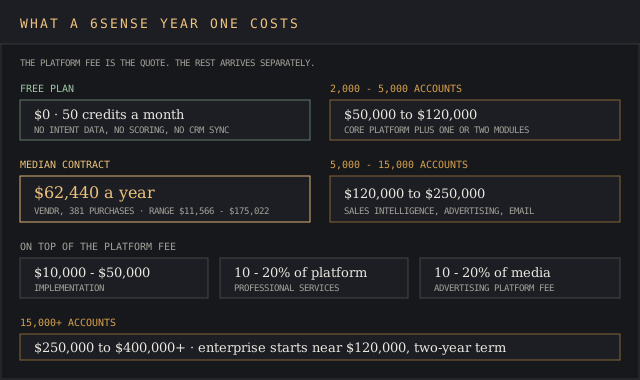
Implementation, premium data, services and media spend are quoted as separate lines, so the platform fee understates year-one cost, and the $62,440 headline number leaves all four out.
Implementation fees
6sense charges implementation separately, and the fee scales with deployment complexity. Get it quoted as its own line.
Implementation covers platform configuration, data integration, user training and initial campaign setup. Most deployments run four to eight weeks before real data reaches the dashboard, longer for a company connecting several CRM systems at once.
Implementation costs scale with how much cleaning your existing contact data needs before the account identification layer can trust it.
Professional services and additional training sessions
Ongoing strategic support, campaign optimisation and additional training sessions are sold as optional packages.
Teams new to account based marketing tend to need them. Teams with an account based marketing motion already running often don't.
Advertising media spend
If you activate the advertising capabilities, the platform fee and the media budget are separate lines. The platform fee is set as a share of media spend or as a flat annual fee.
Advertising capabilities also pull budget across multiple channels at once, so plan media separately or the first quarter's invoice will be a surprise.
Overage fees
Contracts include usage caps: accounts monitored, email sends, API calls. Exceeding them triggers overage fees at rates worth reading before signature.
Renewal escalation
6sense contracts commonly carry annual price increase clauses. On a three-year term starting at $62,440, a 10 percent escalator would add more than $19,000 across the life of the deal.
Cap it, or tie it to CPI, and do it in the first negotiation.
6sense pricing by company size
Account volume and module count decide where a contract lands between Vendr's $11,376 low and $176,809 high. The low end is a small account list on one or two modules. The high end adds advertising, conversational email and premium data across a large addressable market.
Smaller buyers get the most out of stating hard budget constraints early. Enterprise buyers negotiate custom structures, multi-year discounts and bundled professional services.
Who 6sense is priced for
Revenue teams with enough named accounts and enough sellers to work them are the buyer profile the pricing assumes. Sales teams get a ranked list of target accounts; marketing gets the same account data for advertising and website personalisation.
The two sides sharing one record set is the argument for the price. Sales teams and marketing departments working from separate lists duplicate outreach, and 6sense's pitch is that one platform ends that.
A single marketer or a team of three sales reps won't use enough of it. Marketing efforts at that scale are better served by a narrower contact tool, and Warmly's Vendr median is $14,550 a year against 6sense's $62,440.
How to negotiate 6sense pricing
State the budget ceiling early and treat it as fixed. 6sense sales cycles run through several discovery calls before pricing appears, and buyers who name a number upfront get first quotes closer to it.
Run Demandbase, ZoomInfo and DemandScience in parallel, and say that you are. Competitive pressure is the single strongest lever a buyer has, and Vendr's buyers averaged 16.77 percent off their 6sense quotes.
Negotiate the total contract value as one number. 6sense quotes break out modules, data packages and services separately, which invites a series of small arguments; one conversation about the total, backed by contract length and prepayment, moves more.
Time the signature to the fiscal calendar. Deals that close at quarter-end or year-end carry quota pressure the rep has to answer to.
Pay annually upfront. Annual prepayment is the easiest concession to trade for a rate cut, and enterprise buyers can negotiate longer payment terms.
At renewal, bring usage data. Buyers who show a willingness to switch vendors or cut scope get better renewal pricing than those who accept the first number. If adoption came in below plan, that's a bargaining chip.
What teams evaluating 6sense should ask for
Teams evaluating the platform should get the quote itemised before the first negotiation call, while the rep still wants the deal. Ask for the account volume tier, the module list, the credit allocation, the data sources by name, and implementation quoted separately.
Then ask what each line costs on its own. A blended annual number is the hardest possible thing to argue with, and it's what the proposal will lead with.
6sense pricing vs competitors
6sense vs Demandbase
Demandbase is the closest match on both capability and price. Vendr's Demandbase median is $68,591 across 187 purchases, $6,151 above 6sense's $62,440, with a tracked range of $24,000 to $164,037.
The structural difference is packaging. Demandbase bundles sales intelligence into higher tiers; 6sense prices it as a separate module.
Running the two against each other is standard practice, and Vendr reports it moves the price on both sides. Both sit in our sales intelligence tools ranking.
6sense vs ZoomInfo
Vendr's ZoomInfo median is $33,500 across 1,574 purchases, and that figure blends every ZoomInfo product, sales data included. It's cheaper, and its contact data is deeper.
6sense's predictive scoring and buying-stage models are the more advanced of the two. Sales teams that mainly need contact records find better value in ZoomInfo's bundle; revenue teams that need to know which accounts are in market pay the 6sense premium for a reason.
Using ZoomInfo's number as an anchor in a 6sense negotiation is common enough that reps expect it. Our ZoomInfo review covers the wider product line.
6sense vs Terminus (now DemandScience)
Terminus merged into DemandScience on 12 November 2024, and the combined company sells under the DemandScience brand. Terminus has no Vendr marketplace page, so no buyer-reported median exists for it. It includes advertising in the core platform where 6sense charges for it separately.
The trade is analytical depth. Terminus does basic scoring and segmentation; 6sense runs predictive models across a larger intent network.
6sense vs AdRoll ABM and Warmly
RollWorks was rebranded AdRoll ABM in August 2025, and AdRoll says the product itself stayed the same. Vendr has no marketplace page for it under either name, and it includes advertising in the base platform. Its intent data draws on a single source with basic signals against 6sense's multiple sources.
Warmly's Vendr median is $14,550 a year, under a quarter of the 6sense median. For a mid market team with a tight budget, the depth difference is not worth four times the price.
Buying the intent signal on its own
Bombora sells raw buyer intent data that some buyers license directly. If the only thing you need is the signal, feeding it into an existing CRM costs a fraction of a 6sense contract.
The company data providers market covers the firmographic half of the same problem.
Is 6sense worth the price
The case for paying it rests on account identification. 6sense de-anonymises website visitors at the company level and scores them by buying stage, so sales teams work a ranked list of accounts, sorted by buying stage, ahead of an unsorted lead queue.
Teams report the platform flagging high value accounts weeks before those accounts made contact. That head start is the product, and it's what the $62,440 buys.
The case against is ramp time and opacity. Users describe a steep learning curve of two to three months to get segments configured, and intent signals that don't always show which behaviour drove a score. False positives send sales reps at accounts that were never in market.
The break-even test is straightforward. Count the accounts in your addressable market and the reps working them. If the platform's cost divided by your sales representatives exceeds what one more hire would cost, the maths stops working. Our 6sense review scores the product against the four-pillar rubric.
Delivered for your site and your byline. Hosting here is optional.
Common questions about 6sense pricing
How much does 6sense cost per year?
The median buyer pays $62,440 a year according to Vendr's dataset of 385 purchases. Observed contracts run from $11,376 to $176,809, and Vendr's buyers saved 16.77 percent off the quote on average.
Is 6sense free?
6sense discontinued its Sales Intelligence free plan on 12 August 2026. Its pricing page now lists three paid bundles, each sold through a demo.
What are the hidden costs of 6sense?
Implementation fees, professional services, media spend once advertising is active, and overage charges on monitored accounts or API calls. 6sense quotes each one as its own line, outside the platform fee.
Does 6sense require a multi-year contract?
Not strictly, but its better rates do. Two years is the usual minimum for discounted pricing, and long term contracts carry lower annual costs than single-year deals.
How much are 6sense implementation costs?
6sense publishes no implementation fee. It quotes implementation separately and scales it with deployment complexity, covering configuration, data integration, user training and initial campaign setup. Ask for it as its own line before the first negotiation call.
How much is the 6sense Enterprise plan?
6sense publishes no enterprise price. The highest contract in Vendr's 6sense data is $176,809 a year, and enterprise deals typically run on a two-year commitment.
Can you negotiate 6sense pricing?
Yes, and buyers who prepare do well. Vendr's buyers saved 16.77 percent off 6sense quotes on average. Competitive evaluations, multi-year terms, annual prepayment and year-end timing are the levers that move a quote.
What is a 6sense data credit?
A unit that unlocks or exports data. One credit reveals a contact's email and phone number, and exporting a record costs one as well. Credits expire with the contract's credit pool and don't roll over.
What is the cheapest alternative to 6sense?
Warmly, at a $14,550 Vendr median, is the cheapest alternative here with buyer-reported data. It trades multi-source intent depth for the lower entry cost.
What does 6sense sell?
Intent data from its Signalverse publisher network, predictive account scoring, web de-anonymisation, and orchestration across multiple channels for sales teams and marketing. 6sense was founded in San Francisco in 2013 by Amanda Kahlow and Viral Bajaria, raised $200 million at a $5.2 billion valuation in January 2022, and was named a Leader in The Forrester Wave for B2B Revenue Marketing Platforms in Q1 2026.
What to budget
Start at $62,440 and adjust on account volume. A small account list with a light module set sits below it, and a large one with advertising and email running sits above.
Add implementation and first-year services on top, each quoted as a separate line. Add media spend separately if the advertising module is in scope. The market intelligence platform pricing report sets those tiers against the rest of the category.
Then hold the itemised quote next to what comparable companies paid. The $62,440 median across 385 purchases is the only number in this category that a vendor can't argue with.
Try it yourself
Sign up for Lusha
Free plan available, credit-based pricing after that.
 Visit Lusha →
May earn a commission if you sign up through this link, at no extra cost to you. Full affiliate disclosure.
Disclaimer
This page includes one or more affiliate links. If you sign up for a product through one of them, this site may earn a commission at no extra cost to you.