Medallia pricing: what the EDR model costs in 2026
 By Jan Suski. I go deep on every review, checking every number against its source and digging up details other coverage misses, a habit from six years of SEO and link building for tech companies. Bylines at Surfer, Brand24, and Senuto. How the scoring works.
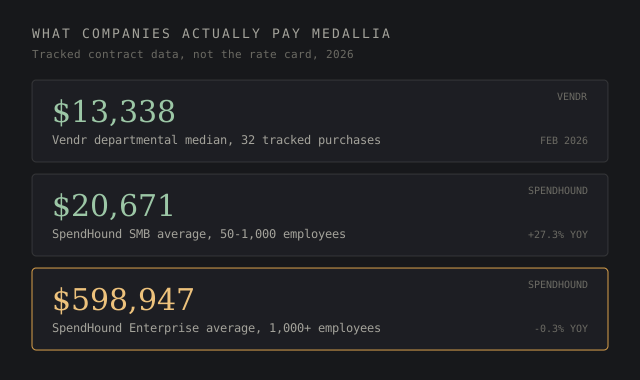
Medallia publishes no rate card, so every figure a buyer sees before a sales call is a guess dressed up as a fact. Tracked contract data closes that gap. Enterprise accounts average $598,947 a year, SMB accounts average $20,671, and the gap between those two numbers has nothing to do with feature toggles & everything to do with how Medallia counts Experience Data Records.
This report puts real numbers against Medallia price claims that repeat across the search results without ever tracing to a source. A platform this well regarded can still cost an arm and a leg, and the point of the numbers below is to show which arm and which leg.
What follows pulls from Medallia's own pricing page, tracked contract data from Vendr and SpendHound, user reviews on G2, TrustRadius and Capterra, and reporting on the company's 2026 debt restructuring. It covers how the Experience Data Record model works, what drives a quote up, what buyers report paying against what Medallia's marketing promises, and how the pricing compares against Gainsight and Qualtrics.
It's built for a CX or procurement lead sizing a first Medallia Experience Cloud contract or a renewal, because the number a rep quotes rarely resembles the number that lands on next year's invoice once EDR volume, add-on modules and a renewal increase stack up.
Procurement experts who negotiate these deals for a living describe the same dynamic. Pricing withheld until a sales call is a lever, and a buyer who treats the demo price as the real price finds out otherwise at signature, once the leverage has already moved to the other side of the table.
The numbers EDR contract pricing, checked 8 September 2026
An enterprise account pays roughly 29 times what an SMB account pays.
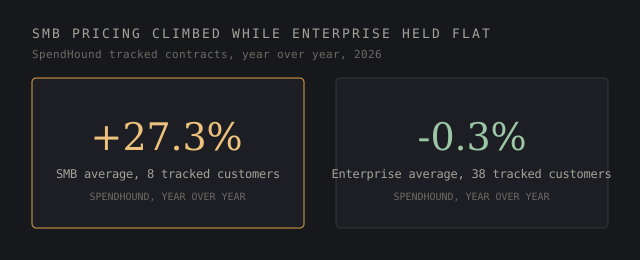
SMB pricing rose 27.3% year over year while enterprise pricing barely moved.
None of these figures come from Medallia itself. The vendor has never published a rate card.
A creditor group carrying $3 billion of Medallia's debt has a sharper reason to protect renewal revenue than a growth-stage owner would.
I'll write a 2,500+ word report on the platform you name, with tracked contracts, renewal uplift and add-on billing sourced line by line. Yours to publish, from $200.
Medallia pricing compared to the alternatives
Buyers who don't love the first Medallia quote have real pricing options to check it against. None of the three vendors below publish a rate card, and none offer a self-serve tier, but the tracked contract data still shows real gaps between them.
| Vendor | SMB average | Enterprise average | Pricing model |
|---|---|---|---|
| Medallia | $20,671/yr | $598,947/yr | EDR volume, quote-only |
| Gainsight | $87,784/yr | $240,442/yr | Module + seat based, quote-only |
| Qualtrics | $30,000/yr* | up to $139,920/yr* | Response + license based, quote-only |
*Qualtrics figures are a Vendr tracked median and range ceiling, 211 to 318 purchases. Medallia and Gainsight figures are SpendHound tracked averages. See this site's Medallia vs Qualtrics comparison for the full feature breakdown.
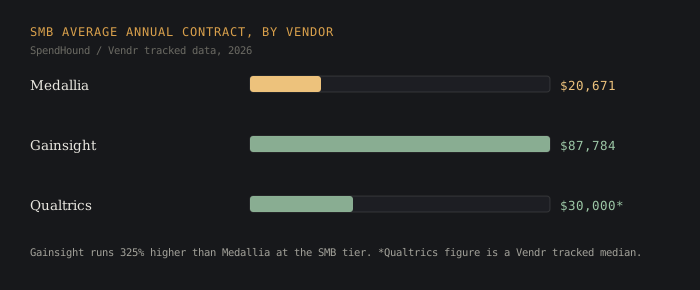
Gainsight costs more than Medallia at the SMB tier, 325% more by SpendHound's tracking, but less at the enterprise tier, about 60% less. A small program pays a premium for Gainsight's structure. A large one pays a premium for Medallia's.
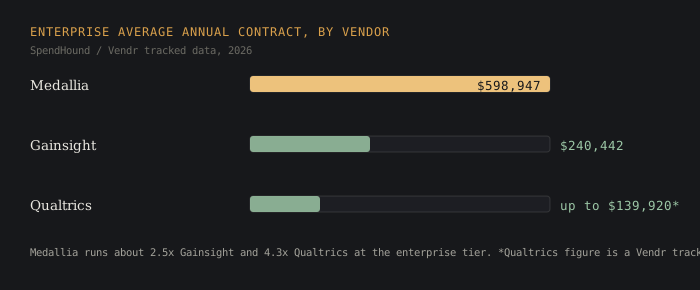
Medallia's enterprise average runs about 2.5 times Gainsight's and 4.3 times Qualtrics's tracked ceiling, which matters most for the buyer this report is written for: a company already running enterprise CX at scale.
That price gap is one reason it's worth scoring Medallia against Qualtrics and the rest of the field in our customer feedback management platforms ranking before signing an enterprise contract.
How much does Medallia cost
Medallia's own pricing page rejects the seat-based model outright, calling pricing tied to survey volume or user count "obsolete" for a company trying to cover customer experience and employee experience under one roof. In its place sits the Experience Data Record, or EDR: every discrete interaction a customer or employee has with a company becomes one record, and Medallia prices in annual EDR volume tiers, a different meter from per-seat or per-survey billing.
Medallia's own site calls the result flexible and scalable, since a company can add multiple channels, from email to speech to social, without a separate contract for each one. That flexibility is real. It's also the reason a first quote rarely stays the final number once every channel gets counted.
Copy these lines into an email, fill them in and send. I reply with scope and a price within 2 to 3 business days.
Open the emailThe pitch is a unified platform, unified pricing: unlimited users, role-based reporting, alerting, case management, PII redaction and the AI-driven insights layer (Medallia calls it Athena) all sit inside the same EDR fee, with "no nickel-and-diming" for extra access licenses. One G2 reviewer, a Director of Client Experience at an enterprise account, listed that exact line as a pro: "The pricing model not charging for additional access licences."
It's a real selling point, and it's also only half the picture once a contract gets negotiated.
What drives an EDR quote up
Five inputs decide where a Medallia quote lands, and none of them appear on the pricing page as a number:
- EDR volume: higher interaction counts push an account into a higher annual tier.
- Module selection: digital experience, contact center, employee experience and text analytics are each priced as their own line, and each one adds implementation complexity along with cost.
- Seats with elevated access: role-based reporting is unlimited, but admin and developer seats still get negotiated.
- Implementation and professional services: survey design, integrations and dashboard build usually run as a one-time cost layered on top of the license, plus training for the team that will run the program day to day.
- Contract length: multi-year commitments and quarter-end timing shape the discount a buyer can pull out of a rep.
Settle those details before you sign, because third-party software directories put implementation costs anywhere from $5,000 to over $50,000, on top of the license, and Medallia's own Forrester-commissioned Total Economic Impact studies confirm services spend recurs across the life of a contract, past the signing year. A buyer who prices only the EDR fee is pricing maybe half of what a working Medallia program will cost by year two.
Employee experience adds to the EDR count
Employee listening runs through the same EDR meter as customer feedback. Every survey response, exit interview or pulse check an employee submits counts toward the same annual volume tier that customer surveys do, so a company running both programs at scale hits its next pricing tier faster than one running customer feedback alone.
Medallia's roots are in Net Promoter Score tracking and Voice of the Customer programs; the employee satisfaction side of the platform points that identical scoring logic at staff.
Medallia positions the combination as a reason to consolidate vendors, and the volume climb that follows is the quiet upside for Medallia's own top line.
It's worth reading between the lines on what "unlimited users" covers. Vendr's tracked buyer data contradicts Medallia's "all included" pitch on two specific line items: text analytics and outbound integrations, which Vendr's data shows get billed separately on a meaningful share of tracked contracts.
Get that in writing before you budget, because an EDR quote that looks all-inclusive on the pricing page can arrive with two extra invoices attached, and the sales deck won't provide that detail unprompted.
What the SERP gets wrong about Medallia pricing
A "$100,000 to $500,000 annually" figure shows up across blog roundups and AI-generated answers for "Medallia price," and it traces to neither Medallia's own site nor Vendr's tracked contracts. Third-party blogs that cite it disagree with each other: one puts the floor at $5,000 a year, another asserts a $657,997 average with no visible source.
A number with no named tracker and no Medallia citation behind it is marketing copy repeating itself into a fact, the same pattern this site documented across a dozen other vendors in our report on software pricing errors.
One widely cited figure is stale in the other direction. Several AI Search summaries currently state that Medallia's SMB pricing fell 0.29% year over year. SpendHound's own live page, last updated 14 July 2026, shows the opposite: SMB pricing rose 27.3% year over year on its 8 tracked SMB customers, while enterprise pricing fell 0.3% on 38 tracked customers.
Want a year-over-year price chart like this for the vendors your buyers compare? Send the names.
Email a briefBoth versions agree that enterprise and SMB pricing move in different directions, and that part holds up. The direction of the SMB move is the detail the AI summaries currently get backwards.
Hidden costs: renewal uplift and add-on billing
A pricing structure most buyers don't see up front is Medallia's separate "unit" and "user" charge. One Program Manager who ran a Medallia deployment across three business segments described it plainly in a TrustRadius review:
"Medallia charges for both 'units' and users. 'Units' are defined as named individuals in surveys, but don't have log-in privileges."
Program Manager, Professional Services, via TrustRadius, Nov 2019
In that reviewer's case, "units" meant customer service agents and business consultants who never logged into the platform but still counted toward the bill, on top of the licensed users who did. That's a cost most buyers only discover once the invoice arrives.
Renewal is the second landmine. This site's own review of Medallia has previously reported a 10% price increase applied without the client's consent, sourced to user reviews on G2 and TrustRadius.
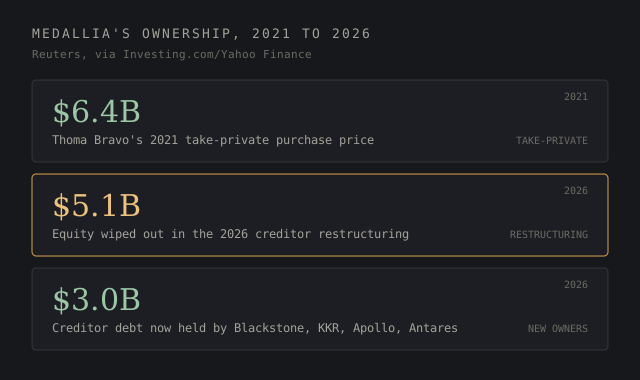
With Medallia now under a creditor group carrying $3 billion of restructured debt, that group has a sharper reason to protect renewal revenue than a growth-stage owner would, and an unbudgeted uplift on top of the units-and-users surprise adds insult to injury for a buyer who already thought the quote was final. Cap the annual uplift in writing while the signature is still yours to withhold.
How to negotiate Medallia pricing
Two TrustRadius reviewers, writing three years apart, land on the same complaint from different angles. A reviewer who rated the platform 2 of 10 wrote:
"It's an expensive system and I don't think we have achieved a good return on investment."
Verified User, via TrustRadius, Nov 2019
A reviewer who rated the platform 10 of 10, and who liked the product, still flagged the same budget line:
"This is designed as an enterprise solution, smaller businesses may find it difficult to justify the cost."
Director, Customer Service, via TrustRadius, Sep 2020
Two Capterra reviewers made the same point from the buyer's side of the sales call, one in the cons field of a 2017 review and one in a 2018 review of the same product:
"Price Point. Only dealing with large implementation, large complex enterprises, not an SMB solution. Long implementation lead times."
Verified Reviewer, Marketing, via Capterra, Dec 2017
"Cost is always a concern. There is a steep learning curve to consider your team fully utilizing all of the features that this product delivers."
Contact Center Industry Consultant, via Capterra, Apr 2018
Once the quotes are in hand, the negotiating leverage sits with the buyer. Bring Vendr's tracked median, zero in on the EDR volume your program needs and hold that number against whatever a rep proposes, then ask for a written cap on renewal uplift before signature, since that's the one term impossible to add back once you're a year into the contract.
Contract length is a real lever too: Medallia's own program documentation confirms multi-year commitments unlock deeper discounts, so a two- or three-year term negotiated up front usually beats a string of one-year renewals that reset the negotiation every time. Our customer intelligence framework guide covers the same timing lever across the wider category, and it's worth using against Medallia, Gainsight or Qualtrics alike.
Medallia against Gainsight and Qualtrics
Neither vendor cuts corners on marketing polish, and both cut the actual pricing page down to a "talk to sales" button, so the tiers that would make the difference visible never publish.
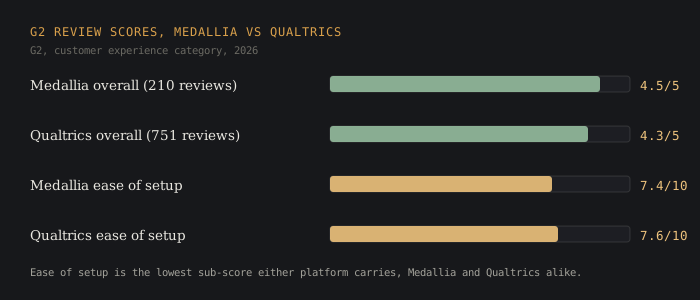
On support quality the two enterprise leaders run close. G2 puts Medallia Customer Experience at 4.5 of 5 across 210 reviews against Qualtrics Customer Experience at 4.3 of 5 across 751 reviews, and both share the same weak spot: ease of setup scores 7.4 for Medallia and 7.6 for Qualtrics, the lowest sub-score either platform carries.
- The platforms and tiers to compare
- Regions, years and segments
- Where it runs: blog, white-label, gated or lead magnet
- Whose byline goes on it
- Deadline
- 2,500+ words, human-written
- Every figure linked to its source
- Yours to publish, under your name or none
- Hosting here for +$200, with your sponsored links
The whole enterprise CXM category charges that same steep-learning-curve tax, Medallia included, and neither vendor's support tier alone will improve that curve without paid training on top.
Who Medallia's pricing is built for
Medallia counts 2,000-plus customers, concentrated in retail, hospitality and financial services, and its EDR pricing reflects that base.
Each industry brings its own volume pattern, and a retail chain running receipt surveys at thousands of locations doesn't provide the same EDR count a mid-size financial-services firm does, which is one more reason the quote never looks the same twice. An organization running national survey volume across thousands of locations gets economies of scale a smaller company never reaches.
A 10-person marketing team evaluating Medallia against a $99-a-month survey tool is comparing the wrong category: the EDR model, the professional services layer and the enterprise-only sales motion all assume a company that can staff a dedicated CX operations function to run the platform. That function is a full-time job, and a founder checking a dashboard between other jobs won't fill it.
The accounts that already know the ropes of enterprise procurement get a real negotiation before a single call happens. The accounts that show up without that standing tend to pay whatever the first quote says. Getting a smaller CX team up to speed on that negotiation, using our own buyer feedback intelligence rankings as a starting comparison set, is the cheapest item on this whole list.
What to budget for a Medallia contract
A realistic Medallia budget carries four line items, above and beyond the EDR fee alone. The EDR license itself, sized to the volume your program will generate on its own numbers, over the volume a rep estimates. Implementation and professional services, realistically $5,000 to $50,000-plus depending on integration count.
A renewal reserve, since a written uplift cap only works if you've budgeted for the increase it still allows. And internal headcount: someone has to own the surveys, the dashboards and the closed-loop follow-up, and that person's salary is a real cost of the program even though it never appears on Medallia's invoice.
None of this is easy to model on a spreadsheet built for a $99-a-month tool, and treating the EDR fee as the whole budget is how a program provides less value than the contract promised. Skip that last line item and the sticker price looks reasonable right up until the program stalls for lack of anyone to run it, which is its own way of paying for software you can't use.
Delivered for your site and your byline. Hosting here is optional.
Frequently asked questions
What is Medallia used for?
Medallia Experience Cloud captures customer and employee feedback across surveys, digital channels, contact centers and social signals, then routes it through AI-driven analytics into role-based dashboards and closed-loop case management so a company can turn what customers and employees report into action. A Salesforce integration is common enough that Medallia builds a tailored dashboard for it, letting account teams act without leaving the CRM they already use daily.
The platform also ships a mobile app so alerts reach a manager away from a desk, which reviewers credit with helping teams improve response times on live complaints.
What are the top alternatives to Medallia?
Qualtrics is the most-compared alternative at the enterprise tier; Gainsight, InMoment and SurveyMonkey Enterprise cover adjacent price points and use cases. None of them publish pricing plans either, so the comparison still comes down to a sales call on every option.
Who bought Medallia?
Thoma Bravo acquired Medallia for $6.4 billion in 2021. A restructuring reported in April 2026 handed control to a creditor group, including Blackstone, KKR, Apollo Global and Antares Capital, who together held $3 billion of Medallia's debt and absorbed a $5.1 billion equity wipeout in the process.
Blackstone's global head of private credit, Brad Marshall, said in February 2026 that Medallia had been "underperforming, not because of anything related to AI, but due to what we believe to be execution-driven issues, particularly in its go-to market function." Mark Bishof has been CEO since January 2025, and improving renewal performance under the new ownership sits on his desk alongside the product roadmap.
Is the Medallia survey legit?
Medallia itself is a real, established company; it's on the federal government's own approved-vendor list for regulated healthcare surveys. The confusion comes from scammers who spoof Medallia's branding in phishing emails, often posing as a retailer's customer satisfaction survey.
The BBB's Scam Tracker has logged reports of exactly that pattern. Treat an unexpected "Medallia survey" text or email the way you'd treat any unsolicited link: verify through the company you supposedly did business with before you click anything.
Bottom line
Medallia's EDR model replaces one pricing puzzle with another. It's a fairer meter than counting seats, and it genuinely bundles analytics, alerting and case management that competitors sell as add-ons.
But "unified pricing" still means a quote nobody outside a sales call can verify, a professional services line that routinely doubles the sticker price, and a renewal process buyers describe as opaque enough to let a 10% increase move under the radar until the invoice lands.
Enterprise accounts pay $598,947 a year on average and SMB accounts pay $20,671, and the honest number for your company sits somewhere the pricing page will never print. Bring Vendr's tracked data, your own EDR volume estimate and a written renewal cap into the negotiation, and treat every "$100K to $500K" figure you find on a blog as a starting guess that a real quote will replace.
CX vendors, experience consultancies and procurement teams use reports like this one in renewal talks and budget reviews.
A report on your topic for a blog page, gated content or a lead magnet.
Written for your client and published under their brand, with my name left off.
Your report on marketintelligencetools.com, with 2 to 3 CTAs carrying your sponsored links.
Default terms: the report is yours to publish, and I keep the right to republish it on this site behind a gate, outside Google's index.
Sources, and what Medallia doesn't publish
Pricing structure and product claims come from Medallia's own pricing page, accessed 8 September 2026. Tracked contract figures are SpendHound's Medallia pricing page and Vendr's Medallia marketplace listing, both accessed 8 September 2026; SpendHound's page was last updated 14 July 2026, and Vendr's tracked median of $13,338 across 32 purchases matches the figure cited above.
User reviews are drawn from G2, TrustRadius and Capterra, cited inline with reviewer role and date. The Thoma Bravo acquisition is reported by Business Wire, 26 July 2021; the 2026 creditor restructuring is reported by Reuters, via Investing.com. Gainsight and Qualtrics comparison figures are SpendHound and Vendr tracked data for those vendors' own listings.
Medallia publishes no rate card, no EDR volume pricing table and no public breakdown of what counts as a "unit" versus a "user." None of the three vendors compared here publish self-serve pricing.