Supply chain intelligence software: 9 platforms ranked and priced for 2026
 By Jan Suski. I go deep on every review, checking every number against its source and digging up details other coverage misses, a habit from six years of SEO and link building for tech companies. Bylines at Surfer, Brand24, and Senuto. How the scoring works.
· Prefer this source on Google
Quick comparison of supply chain intelligence platforms
Columns carry only the dimensions that separate a full planning suite from a single-purpose specialist. Cloud deployment and named customers exist across all nine.
| # | Tool | Primary job | Platform type | Published pricing | Adoption or anchor fact |
|---|---|---|---|---|---|
| 1 | Blue Yonder | Full planning + execution suite | Suite (planning, retail, TMS/WMS) | No, $600K-$1.2M mid-market benchmark | 3,000+ customers, 81 countries |
| 2 | Kinaxis | Concurrent planning at scale | Planning specialist (public company, TSX) | No, $100K-$500K-plus benchmark | Lockheed Martin, Volvo Cars |
| 3 | o9 Solutions | Integrated business planning | Planning specialist | No, no benchmark available | Amazon, PepsiCo |
| 4 | SAP IBP | S&OP and response planning | Suite module on SAP HANA, cloud-only | No | 1,000+ companies (SAP) |
| 5 | Oracle Fusion Cloud SCP | Constraint-based supply planning | Suite module (public company) | Yes, $200-$1,250 per user/month | Gartner 4.8 from 169 ratings |
| 6 | Everstream Analytics | Supply disruption risk monitoring | Risk-monitoring specialist | No, no benchmark available | Google, Unilever; $74M raised |
| 7 | E2open | Multi-enterprise network execution | Network + 5 suites (WiseTech Global) | No | 500,000+ connected enterprises |
| 8 | Coupa Supply Chain Design | Network design and optimization | Design specialist (Thoma Bravo) | Usage-based, no figures | Former LLamasoft, $1.5bn |
| 9 | Z2Data | Component risk and compliance | Compliance / BOM-risk specialist | No, no benchmark available | Qualcomm, Tesla; 1B+ parts tracked |
Supply chain intelligence software turns supply chain data, warehouse feeds, carrier tracking, supplier risk signals, into forecasts and alerts a planning team can act on the same day. This guide ranks 9 platforms, with a full features, pricing, and limits breakdown for each.
Most of these vendors don't publish a supply chain software price list. Oracle is the single exception, and its list prices are quoted in full below. Blue Yonder, Kinaxis, o9 Solutions, and Everstream Analytics all sell through a custom quote, so pricing comparison here comes down to named tiers and third-party estimates.
The category splits by job more than by feature count. Blue Yonder, Kinaxis, o9 Solutions, SAP IBP, and Oracle Fusion Cloud compete on demand forecasting and integrated planning at enterprise scale, and E2open runs execution across a multi-enterprise network. Everstream Analytics competes on a different job entirely: supply disruption risk monitoring.
Z2Data solves a third, narrower problem, component-level risk and regulatory compliance for hardware manufacturers, despite frequently getting lumped into the same demand-planning category by outlines and search results. That mismatch keeps it under the radar for buyers who assume the label matches the job.
Tool facts, funding figures, and ownership history were verified on 26 July 2026. One vendor's spin-off lineage in this guide gets corrected from a claim that circulates in some summaries; it's flagged where it appears.
For the vertical-wide picture beyond these nine tools, our supply market intelligence guide covers supplier risk, resilience mapping, and shipment visibility as well.
What supply chain intelligence software costs
This category doesn't price by seat the way a sales or recruiting tool does. Blue Yonder, Kinaxis, and o9 Solutions license by module, supply chain node count, and deployment complexity, so the closest real comparison point is what a mid-market manufacturer pays in year one.
Oracle is the only vendor here that publishes a rate card. Every other figure below comes from vendor-benchmark aggregators drawing on buyer-reported contracts.
| # | Tool | Year-one cost, mid-market deployment | Basis | Implementation |
|---|---|---|---|---|
| 1 | Blue Yonder | $600,000 to $1,200,000 software; $900,000 to $2,400,000-plus all-in with implementation | Vendor-benchmark aggregators (Locus, Forthcast, VendorBenchmark) | 50% to 100% of year-one license cost; 12 to 24 months to full production |
| 2 | Kinaxis | $100,000 to $500,000-plus software; $500,000 to $2,000,000 all-in for enterprise deployments | Vendor-benchmark aggregators | $150,000 to $500,000 one-time; 4 to 12 months |
| 3 | o9 Solutions | Not published | One vendor-comparison site infers six-to-seven-figure annual contracts from o9's enterprise-only customer base and $3.7 billion valuation; o9 doesn't confirm this directly | 3 to 6 months |
| 4 | SAP IBP | Not published | SAP publishes no list price; reseller aggregator figures trace to no SAP source | Not disclosed |
| 5 | Oracle Fusion Cloud SCP | $200 to $1,250 per user per month at list | Oracle Fusion Cloud Service Global Price List, 16 July 2026 | Three-year standard term; 10-user minimum on Supply Planning |
| 6 | Everstream Analytics | Not published | No third-party contract data available on Capterra, G2, or Gartner Peer Insights | Not disclosed |
| 7 | E2open | Not published | No published price or licensing metric | Not disclosed |
| 8 | Coupa Supply Chain Design | Usage-based, unlimited users, no figures published | Coupa pricing FAQ | Not disclosed |
| 9 | Z2Data | Not published | No third-party contract data available on TrustRadius, Capterra, or GetApp | Not disclosed |
Blue Yonder is the most consistently documented of the nine: individual-module pricing starts near $100,000 a year, mid-market multi-module deployments average $600,000 to $1,200,000, and large enterprise contracts exceed $2,000,000. Budget 50 to 100% of that license cost again for implementation in year one, particularly for a WMS or TMS module, and expect 12 to 24 months from signature to full production.
At the high end, a deployment like that can cost an arm and a leg before a single warehouse goes live.
Kinaxis pricing scales with the number of supply chain nodes, manufacturing sites, distribution centers, and suppliers requiring visibility.
Vendor-benchmark aggregators put software licensing at $100,000 to $500,000-plus a year, implementation services from a certified partner at $150,000 to $500,000 as a separate one-time cost, and total year-one investment at $500,000 to $2,000,000 once training and integration are included.
o9 Solutions, Everstream Analytics, Z2Data, SAP, and E2open publish nothing, and unlike Blue Yonder and Kinaxis, no aggregator site carries buyer-reported contract figures for any of them either. o9's July 2023 funding round, in which existing investors added capital at a $3.7 billion valuation, is the only public number close to pricing, and it describes the company's valuation.
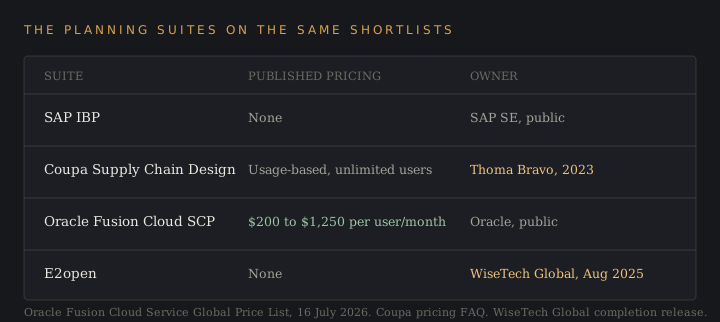
The four suites in the table above are the ones whose pricing disclosure and ownership changed most recently, so they are worth reading side by side before a shortlist gets fixed.
Why this category is crowded right now
The supply chain visibility market is valued at $3.5 billion today and is projected to triple by 2034 to roughly $11 billion, according to Z2Data's own published research. That growth is why demand-planning suites, risk-monitoring platforms, and component-compliance data companies now all market themselves as supply chain intelligence software. Every vendor in the space wants to look ahead of the curve while the market keeps expanding this fast.
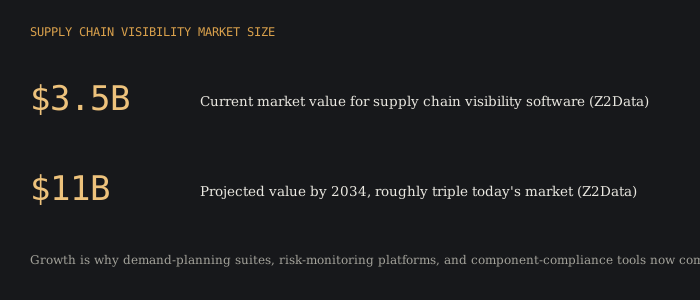
That crowding matters for a buyer because the label alone doesn't say which job a tool does. Z2Data, profiled below, is the clearest example: it gets categorized as a demand-planning platform in some outlines and searches, and it isn't one.
Evaluation criteria for supply chain intelligence software
Six factors separate a platform worth a pilot from one that produces a confident-looking dashboard nobody trusts.
- Forecast accuracy and method. Probabilistic demand models that output a range and a confidence level, run well past a single moving-average line.
- Multi-tier supplier visibility. Mapping and performance tracking that reaches beyond direct, tier-one suppliers into tier-two and tier-three sites.
- Native connectors to enterprise systems. How the platform ingests ERP, WMS, and TMS feeds, and how long that integration realistically takes.
- Machine learning explainability. The platform should let a planner audit the reasoning behind a forecast.
- Cloud-native deployment. Modern architecture versus legacy on-premise code carried forward from an older platform generation.
- Named reference customers. Verifiable, checkable customers in a comparable industry, past a logo wall.
Test scenario modeling against your own disruption history during the pilot, a real supplier failure or demand spike from the last two years. A model tuned to a clean demo case can still miss the messy version of your actual data.
Leave no stone unturned when picking that scenario, since an easy one only proves the vendor can handle a good day.
What supply chain intelligence software does
A working platform pulls from three data sources: internal enterprise systems (ERP, WMS, TMS), supplier and network data (bill-of-materials records, tier mapping, financial health), and external signals such as geopolitical events, weather, and port congestion. Apparel teams use tier mapping to trace the garment factories behind fashion brands, in an industry employing more than 90 million people, per an ILO brief from March 2025.
It then analyzes data across all three, builds models against the combined feed, and surfaces a recommendation a planner can act on.
Every machine learning recommendation needs an explanation a human can check. A black-box forecast a planner can't audit loses credibility after the first miss, and native connectors carry more weight than a vendor's marketing suggests: a platform that can't ingest ERP and WMS feeds without months of custom integration won't deliver the real-time data a planner needs to forecast demand and mitigate risk before it compounds.
Top supply chain intelligence platforms, ranked
Nine platforms, ranked by how completely they cover the six criteria above, each with its key features, pricing, and limits broken out. Four of the nine are enterprise supply chain management software suites that run planning across supply chain operations; the other five run intelligence over it.
Buyers meet both sets on the same shortlist. Any top 10 supply chain roundup mixes them without saying so, and someone searching for supply chain software gets all nine back in one list.
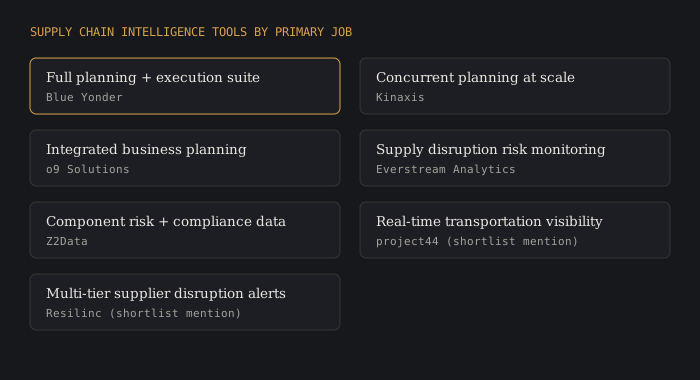
Blue Yonder
·top pick·The widest planning-and-execution suite in this ranking, from demand forecasting through warehouse and transportation. It goes the whole hog on breadth where rivals specialize.
Blue Yonder runs supply chain planning, retail merchandising, and transportation management from one platform, serving 3,000+ customers across 81 countries, among them DHL, Carlsberg, Walgreens, Driscoll's, Renault, Nestlé Purina, Bayer, and Morrisons.
Why it's ranked #1. Blue Yonder is the only platform in this ranking that covers planning, retail execution, and transportation from a single vendor, which matters most for a buyer trying to consolidate contracts under a single vendor. It ranks first because that breadth is verified against its own named customer list.
Features
- Supply chain planning across demand, supply, and fulfillment.
- Retail category management and merchandise operations.
- Order management, warehouse management, and transportation management.
- Supply Chain Command Center for cross-functional visibility.
Pricing and limits
Pricing isn't published. Vendor-benchmark aggregators put individual-module pricing near $100,000 a year, mid-market multi-module deployments at $600,000 to $1,200,000, and large enterprise contracts above $2,000,000. Implementation adds 50% to 100% of the license cost in year one, and enterprise rollouts run 12 to 24 months from signature to full production.
Implementation alone can claim the lion's share of that first-year total on a multi-module rollout.
Who should skip it
Teams that need just a narrow point solution. Blue Yonder's breadth adds implementation overhead a smaller operation may not need.
Switching trigger. Once the need narrows to concurrent planning at scale ahead of retail execution, Kinaxis is built specifically for that job.
Kinaxis
Publicly listed on the Toronto Stock Exchange, and named a leader in Gartner's 2026 Magic Quadrant for Supply Chain Planning Solutions.
Kinaxis runs its Maestro platform, built on the concurrent-planning engine formerly branded RapidResponse, for customers including Lockheed Martin, Unilever, ExxonMobil, Geodis, Siemens Healthineers, Jabil, Bosch, BAT, and Volvo Cars.
Why it's ranked #2. Kinaxis's concurrent-planning model runs demand, supply, and inventory against one shared data set, avoiding the reconcile-three-datasets-later approach common elsewhere, and is the most technically distinct approach in this ranking. It ranks below Blue Yonder because it's a planning specialist; a buyer still needs warehouse or transportation modules elsewhere.
Running everything off one data set puts a planner in the driver's seat, free from stitching three separate views together by hand.
Features
- Concurrent planning across demand, supply, and inventory in one data model.
- AI-driven demand sensing.
- Scenario simulation for testing disruptions before they happen.
- Named a leader in Gartner's 2026 Magic Quadrant for Supply Chain Planning Solutions.
Pricing and limits
Pricing isn't published and scales with the number of supply chain nodes, manufacturing sites, distribution centers, and suppliers. Vendor-benchmark aggregators put software licensing at $100,000 to $500,000-plus a year, implementation from a certified partner at $150,000 to $500,000 as a separate one-time cost, and total year-one investment at $500,000 to $2,000,000 including training and integration.
Who should skip it
Procurement-only teams without a broader planning mandate. Kinaxis is built around end-to-end concurrent planning.
Switching trigger. A buyer that needs demand and supply planning bundled with merchandise and revenue-growth management in one system moves to o9 Solutions instead.
o9 Solutions
Dallas-based, and the only platform here that's made the Inc. 5000 list seven years running. That's a seven-year streak of being on a roll by Inc.'s own measure.
o9 Solutions, co-founded by CEO Chakri Gottemukkala and Chairman Sanjiv Sidhu, runs its Digital Brain platform for customers including Amazon, PepsiCo, T-Mobile, Comcast, Kroger, REI, and Bass Pro Shops. The company made the Inc. 5000 list for 7 consecutive years through 2024 and ranked #430 on Deloitte's 2024 Technology Fast 500 for North America.
Why it's ranked #3. o9's Digital Brain bundles demand and supply planning with merchandise planning and revenue growth management on one data model, a wider planning scope than Kinaxis covers. It ranks behind Kinaxis and Blue Yonder because it doesn't disclose the public financials or the multi-decade customer base either of the top two can point to.
Features
- Integrated business planning across demand, supply, and merchandise.
- Demand and supply planning on a shared data model.
- Revenue growth management.
- Digital Brain platform architecture built for cross-functional planning.
Pricing and limits
Pricing isn't published, and unlike Blue Yonder and Kinaxis, no aggregator site carries buyer-reported contract figures for o9 either. The closest public number is o9's own funding history: a July 2023 round in which existing investors added capital at a $3.7 billion valuation, which describes the company's worth. Implementation runs 3 to 6 months.
Finding an actual dollar figure for o9 is a needle in a haystack, and the valuation is the only number out in daylight.
Who should skip it
Buyers wanting a narrow, single-module tool. o9's Digital Brain is an integrated planning layer across functions.
Switching trigger. A buyer already running SAP in the ERP layer will find SAP IBP the shorter integration path.
SAP Integrated Business Planning
The most widely deployed planning suite here, and the one most likely already sitting in your ERP contract.
SAP IBP sits inside the wider SAP supply chain management portfolio, runs on SAP HANA, and ships cloud-only. Its key capabilities span six named areas. SAP's own FAQ puts adoption above 1,000 companies worldwide, and it holds 4.7 from 186 Gartner Peer Insights ratings.
Why it's ranked #4. IBP covers six named capability areas in one module set and integrates natively with S/4HANA, which is decisive for the large share of buyers already running SAP. It ranks below the top three because it's a planning suite, and reviewers describe less room to bring in outside technology once committed.
Features
- Demand management and demand sensing.
- Response and supply planning.
- Inventory management and demand-driven replenishment.
- Sales and operations planning, plus a supply chain control tower.
Pricing and limits
SAP publishes no list price for IBP. Starting figures circulating on reseller aggregator sites trace to no SAP source, so treat them as unverified until a quote arrives from SAP directly.
Who should skip it
Organizations without SAP in the stack. One Gartner reviewer describes the business becoming dependent on SAP because of its "limitations or low flexibility to new changes," and that lock-in is easier to accept when the ERP is already SAP.
That leaves a non-SAP shop between a rock and a hard place, weighing the lock-in against reconciling systems by hand.
Switching trigger. A buyer that wants a published price before opening a sales conversation goes to Oracle instead.
Oracle Fusion Cloud Supply Chain Planning
The only platform in this ranking that publishes a per-user list price.
Oracle prices Supply Chain Planning by hosted named user and publishes every module rate in its Fusion Cloud Service Global Price List. A verified Gartner reviewer names the differentiator as constraint-based planning that weighs capacity, material availability, lead times, and business priorities in a single run. It holds 4.8 from 169 Gartner ratings, the highest here.
Oracle cuts to the chase on pricing where every other vendor here makes a buyer ask first.
Why it's ranked #5. Published pricing and the strongest peer rating in the list would place Oracle higher, and the recurring data-loading complaint holds it here. One reviewer writes that the supply module is "functionally restricted when it comes to creating policies to manage planning" and that mass upload is limited or unusable depending on the module.
Features
- Constraint-based supply planning in a single run.
- Demand management and sales and operations planning as separate licensed modules.
- Supply chain collaboration with trading partners.
- Fusion SCM Analytics, licensed per named user or per hosted employee.
Pricing and limits
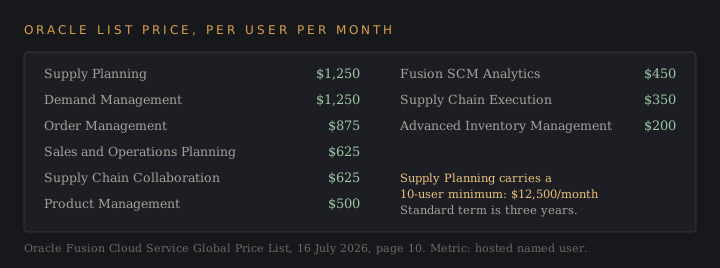
| Module | Part number | List, per user per month |
|---|---|---|
| Supply Planning | B91059 | $1,250 |
| Demand Management | B91060 | $1,250 |
| Order Management | B93429 | $875 |
| Sales and Operations Planning | B91061 | $625 |
| Supply Chain Collaboration | B87862 | $625 |
| Product Management | B91056 | $500 |
| Fusion SCM Analytics | n/a | $450 |
| Supply Chain Execution | B91057 | $350 |
| Advanced Inventory Management | B111756 | $200 |
Figures from the Oracle Fusion Cloud Service Global Price List dated 16 July 2026.
Supply Planning carries a 10-user minimum, so the entry commitment on that module alone is $12,500 per month at list. Oracle notes the standard subscription term for cloud services is three years.
Who should skip it
Teams that load data in bulk and often. The mass-upload limitation is the complaint that repeats across reviews, and it bites hardest on an organization migrating years of history.
Switching trigger. A buyer whose priority shifts from planning output to monitoring disruption needs Everstream Analytics instead.
Everstream Analytics
A DHL spin-off, despite the Kuehne+Nagel lineage some summaries claim, now backed by Morgan Stanley.
Everstream Analytics traces to DHL's Resilience360 unit, incubated in 2012 and spun out in 2018, then merged with weather-risk analytics firm Riskpulse in 2020 to form Everstream under CEO Julie Gerdeman.
The company raised a $24M Series A in May 2022 and a $50M Series B in April 2023, backed by Morgan Stanley Investment Management, Columbia Capital, StepStone Group, and DHL, for $74M total. Customers include Google, Schneider Electric, Unilever, Campbell's, Evonik, Glanbia, Danone, and Medtronic.
Everstream is sometimes described as a Kuehne+Nagel spin-off. Its own "About" page lists DHL among its investors; Kuehne+Nagel doesn't appear there, and the spin-off lineage runs through DHL's Resilience360 unit. Check vendor lineage claims against the company's own materials ahead of a secondary summary. The company's own materials are the horse's mouth on this one, ahead of any secondary summary repeating an old claim.
Why it's ranked #6. Everstream is built for disruption detection. That's the wrong platform for a buyer trying to plan output, but it ranks here as the most heavily funded, largest-customer-base risk-monitoring platform in this specific list, ahead of Resilinc and project44, which get a shortlist mention below, short of a full ranked slot.
Features
- Network mapping: a digital twin of the supplier network.
- Global monitoring and alerting in real time.
- Automated supplier performance and risk scorecards.
- Sub-tier visibility beyond direct suppliers.
Pricing and limits
Pricing isn't published, and no aggregator site, Capterra, G2, or Gartner Peer Insights among them, carries a third-party contract figure either. One Gartner Peer Insights reviewer notes it can be hard to tell which capabilities are included in a signed contract versus billed separately, since the underlying package can change after signing.
Who should skip it
Teams that need demand forecasting over risk monitoring. Gartner Peer Insights reviewers also flag frequent, disruptive platform updates and unclear contract scope for which features are included.
Switching trigger. A buyer needing multi-enterprise network execution across channel, trade, and logistics moves to E2open.
E2open
Bought by WiseTech Global in August 2025, entirely with debt.
E2open runs five suites, Channel, Planning, Global Trade, Logistics, and Supply, under a shared interface called Harmony. Its e2net network claims more than 500,000 connected enterprises and 19.5 billion transactions a year, on a canonical data model with an SAP-certified adapter for S/4HANA and ECC. That's the whole nine yards of multi-enterprise connectivity in one network.
Why it's ranked #7. The network reach is real and the multi-enterprise connectivity is the widest here, which is why it ranks above a pure design tool. It sits below Everstream because its planning product carries the weakest peer rating of any platform in this list.
Features
- Five suites: Channel, Planning, Global Trade, Logistics, and Supply.
- Harmony, a shared interface across the suites.
- e2net multi-enterprise network with a canonical data model.
- SAP-certified adapter for S/4HANA and ECC.
Pricing and limits
E2open publishes no price or licensing metric. Ownership changed on 3 August 2025, when WiseTech Global completed its acquisition at $3.30 per share, an enterprise value of $2.1 billion funded entirely with debt. Gartner now lists the products under WiseTech Global.
Who should skip it
Teams buying primarily for planning quality. E2 Planning and Response rates 3.7 from 9 Gartner ratings with 11% at two stars, and the surfaced review headline calls it a powerful planning engine whose reporting capabilities need improvement.
That reporting complaint puts the planning module on the rocks next to the rest of E2open's suite.
Switching trigger. A buyer whose real question is network design and scenario modeling moves to Coupa.
Coupa Supply Chain Design & Planning
The former LLamasoft, and the only vendor here selling on usage.
Coupa's product page names six modules: Network Optimization, Transportation Optimization, Inventory Optimization, App Studio, Demand Modeling, and Tariff Impact Planning. The product is the former LLamasoft, which Coupa acquired in November 2020 for roughly $1.5 billion. Coupa itself was acquired by Thoma Bravo for $8.0 billion in February 2023.
Why it's ranked #8. Network design is a narrower job than the seven above it, and Coupa does it with a documented pricing model that removes the per-seat argument entirely. It ranks this low because the most detailed independent assessment available disputes its planning credentials outright.
Features
- Network Optimization, with Coupa Data Flow and Rapid Network Explorer.
- Transportation Optimization and Inventory Optimization.
- Demand Modeling and Tariff Impact Planning.
- App Studio for building custom models on the platform.
Pricing and limits
Coupa's FAQ states the company "has moved to a usage-based pricing model" delivered in "a single package that includes unlimited users, so your whole team can collaborate and scale without per-seat fees." No dollar figures accompany it. Thoma Bravo completed an $8 billion take-private of Coupa in 2023 at $81 per share, a 77% premium.
Unlimited users with no strings attached remove the per-seat math that complicates pricing elsewhere on this list.
Who should skip it
Buyers wanting a supply-chain-native planning vendor. Léon Levinas-Ménard of Lokad, in a review last updated April 2026, scores Coupa 5.3 out of 10 for supply chain, 4.8 on technical transparency, and 2 on failure-mode awareness, concluding: "Public evidence does not support treating Coupa as a supply-chain-native planning company overall."
Switching trigger. A hardware or electronics manufacturer whose real problem is component obsolescence and regulatory compliance needs Z2Data instead.
Z2Data
Not a demand-planning platform, despite how it gets categorized in some searches.
Z2Data, headquartered in Santa Clara and led by CEO Mohammad Ahmad, is a component-risk and compliance data company.
Part Risk Manager tracks 1B+ electronic parts for obsolescence risk, Compliance Manager screens against 270+ regulations including RoHS and REACH, and Supply Chain Watch maps manufacturing sites across 4 supplier tiers. Customers include Qualcomm, Teradyne, NetApp, Palo Alto Networks, Dell, Tesla, Airbus, and Enphase.
Z2Data's own published research puts the supply chain visibility market at $3.5 billion today, projected to triple by 2034 to roughly $11 billion, the growth driving so many adjacent categories to brand themselves supply chain intelligence software.
Z2Data shows up in outlines and searches for demand-planning and forecasting software. It doesn't do either. Z2Data's own competitor content names Everstream Analytics, Resilinc, Exiger, Oracle SCM Cloud, Blue Yonder, and Prewave as its actual competitive set; Kinaxis and o9 Solutions are absent from that list, confirming this is a component-risk and compliance category.
Why it's ranked #9. Z2Data ranks last in this list because it solves a different problem than the other eight. It's here because buyers researching supply chain intelligence software run into it constantly, and the accurate answer is that it earns a spot on a hardware manufacturer's shortlist for a different reason entirely.
A buyer expecting demand forecasting here is barking up the wrong tree from the start.
Features
- Part Risk Manager: obsolescence risk across 1B+ electronic parts.
- Compliance Manager: screening against 270+ regulations including RoHS and REACH.
- Supply Chain Watch: manufacturing-site mapping across 4 supplier tiers.
- Supplier Insights covering 1M+ suppliers.
Pricing and limits
Pricing is not published, and no aggregator site, TrustRadius, Capterra, or GetApp among them, lists a rate or a buyer-reported contract figure. Z2Data's Part Risk Manager quotes volume price breaks on individual components, a different number from what a subscription costs.
Who should skip it
Any team looking for demand forecasting, S&OP, or scenario planning. Z2Data's value is BOM-level component risk and regulatory compliance, a different job than the eight planning, execution, and risk platforms above.
Switching trigger. A hardware manufacturer that later needs broader supply disruption monitoring alongside component risk moves to Everstream Analytics or Resilinc for that layer.
Demand planning, demand forecasting, and operational efficiency
Demand forecasting needs probabilistic models that output a range and a confidence level. A single moving-average line breaks down during demand volatility. Demand planning built on that forecast should update inventory levels daily based on demand probability, and inventory management improves every time that forecast tightens. A model that hits the nail on the head with its range and confidence keeps that daily update honest.
Operational efficiency follows from automated decision-making. A platform that adjusts stock levels and triggers automated alerts on its own can minimize excess stock and cut operating costs, and the savings compound once those alerts feed standing planning processes, beyond one-off fixes.
How to choose based on your priorities
Match the tool to the job it performs. A team forecasting demand across multiple channels needs Blue Yonder, Kinaxis, or o9 Solutions. A team worried about supply chain risk and resilience needs Everstream Analytics, project44, or Resilinc.
A hardware manufacturer building procurement strategy around part obsolescence and compliance needs Z2Data, and none of the demand-planning tools substitute for it given shifting market conditions and global trade exposure.
Run a 90-day pilot before signing a multi-year contract. Start with a data-readiness check: can the vendor ingest complex data from existing systems without months of custom work. Then track forecast error, service levels, and inventory-days reduction against a baseline before expanding past the pilot scope.
Customer experience, customer satisfaction, and service levels
Service levels tie straight back to customer satisfaction: fill rate and on-time delivery are the two numbers procurement and logistics teams argue about most. A platform with real-time monitoring across carriers and warehouses can improve customer satisfaction by flagging a late shipment before the customer notices, ahead of a complaint arriving.
Customer experience also depends on proactive communication. Collaboration tools that let a supplier, a carrier, and a planner see the same exception in real time shorten the time to corrective action and keep service-level analysis grounded in what customers experience.
Seeing the same exception in real time keeps a supplier, a carrier, and a planner on the same page as it happens.
The operational metrics these platforms move
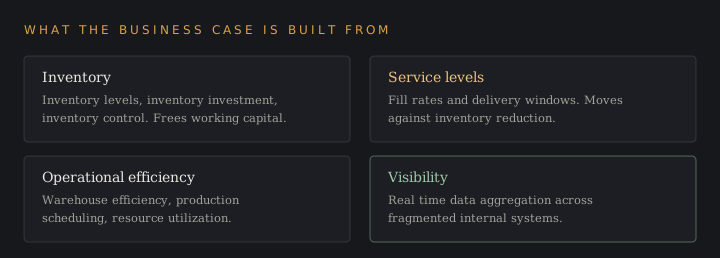
Supply chain intelligence software gets bought on a business case, and the case is always built from the same short list of measures. Knowing which one your organization is failing on decides which platform fits.
Inventory
Inventory optimization carries the clearest financial line. Cutting inventory levels frees working capital directly, so inventory investment is the number a finance director signs against, and inventory control is what stops the reduction turning into stockouts.
The mechanism is forecast quality. Better demand forecasting narrows the safety stock buffer, and the buffer is where most excess inventory sits. Demand volatility widens it again, which is why the ability to forecast demand under volatility is the capability that pays for itself.
Service levels and customer satisfaction
Service levels run against inventory reduction, which is why the two get planned in the same meeting. Tighten inventory levels too aggressively and fill rates fall.
Evolving customer expectations on delivery windows then show up as churn, and customer satisfaction becomes the metric that catches a planning error nobody logged.
Operational efficiency and cost reduction
Warehouse efficiency, production scheduling, and resource utilization are where operational efficiency is measured on the floor. Warehouse management and transportation management systems execute those supply chain processes; intelligence platforms decide what the systems get told to do. Whoever owns the plan calls the shots on the floor.
Teams that improve operational efficiency here do it by changing the instruction. Improve supply chain operations at the planning layer and the execution systems inherit the gain.
Resource allocation across logistics networks is the planning-side version, and reducing costs there needs no headcount change. Cost reduction that survives a year comes from the same fleet covering more lanes.
Visibility and fragmented data
Fragmented data is the constraint every platform in this category sells against. Order, inventory, shipment, and supplier records sit in separate internal systems, and real time data aggregation across them is what turns four partial views into one real time picture.
Internal data is only half of it. Joining that record set to external signals is what makes informed decision making possible when supply chain disruptions arrive from outside the four walls.
Real time data analysis on top of that aggregation turns records into actionable insights. Artificial intelligence and advanced analytics do the pattern work at a scale a planning team can't cover by hand.
Data driven decisions follow from the aggregation. A platform reporting the same fragmented data faster produces faster confusion.
Where the suites and the intelligence platforms divide
End to end planning across the entire value chain is what the suites sell: supply planning, operations planning, financial planning, and product lifecycle management joined in one model. Global trade management and trading partner demands sit in the same suites, enabling businesses to replace four reconciled plans with one.
Replacing four reconciled plans with one model kills two birds with one stone, cutting reconciliation work while closing the gaps where the numbers used to disagree.
Supply chain analytics and risk management over that plan is what the intelligence side sells. Modern supply chains usually run both, and supply chain decision making improves when the intelligence layer feeds the planning layer.
Overall supply chain performance is the shared measure. Supply chain optimization on the planning side and supply chain visibility on the intelligence side both report into it, which is why buyers comparing supply chain planning solutions against intelligence platforms are rarely comparing like for like.
Other supply chain intelligence tools worth a shortlist mention
project44 and Resilinc cover adjacent ground worth naming directly. project44 tracked 1.5 billion shipments annually across 220,000+ carriers as of its November 2022 funding round, built for real-time transportation visibility; our full project44 review covers it in more depth. It sits at #6 in our freight intelligence platforms ranking, behind five rate benchmark tools led by DAT iQ’s $1 trillion invoice dataset.
Resilinc's EventWatch platform, used by more than 15,000 supply chain professionals, maps suppliers to the part and site level for disruption alerts, covered further in our Resilinc review.
Volza covers similar ground from the customs side: shipment-level import and export records across 200-plus countries, useful for checking a supplier's actual trade volume and buyer network. It skips the multi-tier risk mapping Everstream or Resilinc sell.
Use it to verify a supplier's trade volume and buyer network, then feed that into a risk platform for the deeper mapping. That extra step is going the extra mile on supplier risk, past what trade-volume data alone can show.
Verify a supplier's trade record
Try Volza's free trial
7 days, unlimited searches, no card required.
May earn a commission if you sign up through this link, at no extra cost to you. Full affiliate disclosure.
Supply chain intelligence software FAQ
What's the difference between supply chain intelligence software and an ERP module?
An ERP module records transactions after they happen. Supply chain intelligence software forecasts what happens next and recommends corrective action, running predictive analytics and scenario simulations an ERP doesn't perform on its own.
Do these platforms replace a TMS or WMS?
Blue Yonder and o9 Solutions both include transportation and warehouse modules. Kinaxis, Everstream Analytics, and Z2Data are built to sit alongside an existing TMS or WMS, leaving it in place.
Is Everstream Analytics a Kuehne+Nagel spin-off?
No. That claim circulates in some secondary summaries, but Everstream's own site lists DHL among its investors; Kuehne+Nagel doesn't appear there, and its lineage runs through DHL's Resilience360 unit, incubated in 2012 and spun out in 2018.
Is Z2Data a demand-planning tool?
No. It's a component-risk and regulatory-compliance platform for hardware and electronics manufacturers, built around bill-of-materials data. Its own published competitor list names Everstream Analytics, Resilinc, Exiger, Oracle SCM Cloud, Blue Yonder, and Prewave; Kinaxis and o9 Solutions are absent from it.
How long does implementation typically take?
None of the vendors above publish a standard timeline. A 90-day pilot against a defined data set is the benchmark buyers use to test integration depth and forecast accuracy before a full rollout. Ninety days is enough to race against the clock on integration without betting a full year on an unproven fit.
How much does supply chain intelligence software cost?
Eight of the nine publish no rate card. Oracle is the exception: its list price runs from $200 per user per month for Advanced Inventory Management to $1,250 for Supply Planning or Demand Management, on a standard three-year term.
Vendor-benchmark aggregators put Blue Yonder's mid-market deployments at $600,000 to $1,200,000 a year, rising above $2,000,000 for large enterprise contracts, and Kinaxis at $100,000 to $500,000-plus a year with $500,000 to $2,000,000 in total year-one investment once implementation is included. o9 Solutions, Everstream Analytics, and Z2Data carry no published pricing and no third-party contract data on any aggregator site.
Which tool is best for a hardware or electronics manufacturer?
Z2Data is the only platform in this ranking built specifically for component obsolescence and compliance risk. A manufacturer that also needs demand forecasting still needs one of the eight planning or risk-monitoring platforms alongside it.
Bottom line
Blue Yonder, Kinaxis, o9 Solutions, SAP IBP, and Oracle Fusion Cloud compete on the same job: demand forecasting and integrated planning at enterprise scale. Oracle is the only one of the nine that will tell you what it costs before a sales call.
Everstream Analytics, E2open, project44, and Resilinc compete on a different job, spotting disruption or moving goods across the network. Coupa Supply Chain Design solves a narrower one again: modeling the network before anything ships. Z2Data solves a third, narrower problem, component-level risk and compliance for hardware manufacturers.
Buyers who match the tool to the actual job, using verified vendor facts, avoid the most common mistake in this category: signing a platform sold as end-to-end supply chain intelligence that turns out to cover only one layer of it. Sign the wrong one and the integration work alone can mean biting off more than you can chew. The same job-first logic applies in adjacent categories: see our procurement intelligence ranking for how it plays out there.