Resilinc review: what supplier-declared mapping buys you in 2026
 By Jan Suski. I go deep on every review, checking every number against its source and digging up details other coverage misses, a habit from six years of SEO and link building for tech companies. Bylines at Brand24 and Senuto. How the scoring works.
· Prefer this source on Google
Best for
Large electronics, automotive and life sciences manufacturers, the NVIDIA, Honeywell and Roche tier, with risk staff able to chase supplier declarations through a mapping rollout that can run two years.
Not for
Small or mid-size teams without procurement or supply chain risk headcount, and buyers who want user evidence: G2 has zero reviews and Capterra has one, from 2020.
What it costs
Basic lists at $1,400 per feature per month, vendor-provided on G2 and Capterra, with a free trial. Past that figure, a custom quote set by the functions and tier chosen.
- News feeds
- 150M+ monitored monthly per the counter; page copy says 100M+
- Languages
- 100
- Countries
- 200
- Disruption-cost claim
- Up to 40% lower, the vendor's own unaudited figure
- List price
- Basic at $1,400 per feature per month, "Pricing provided by Resilinc" on G2; same figure on Capterra
- Free trial
- Available per Capterra; no free version
- Rate card on resilinc.ai
- None; the pricing page routes to a custom quote
- What sets the price
- Product functions and tiers chosen, per Gartner Peer Insights
- Pre-sale offer
- A free SCRM ROI business assessment report
- Gartner Peer Insights
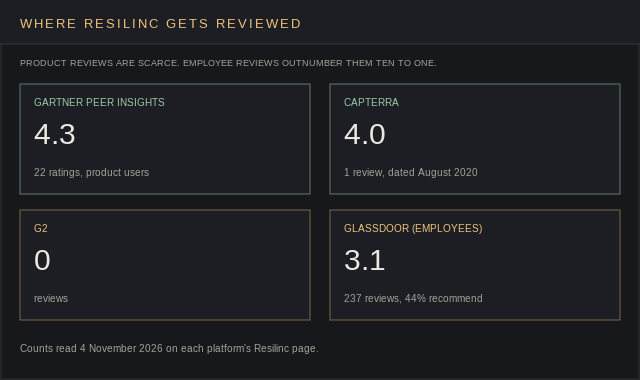
- 4.3 from 22 ratings
- Capterra
- 4.0 from one review, August 2020; Features 2.0
- G2
- Zero reviews: "Resilinc hasn't been reviewed yet"
- Glassdoor
- 3.1 across 237 employee reviews, 44% would recommend
- Ownership
- Private; Vista Equity Partners' Endeavor Fund invested May 8, 2023, terms undisclosed
- CEO
- Kamal Ahluwalia since February 4, 2025; founder Bindiya Vakil is Executive Chairwoman
- Headcount
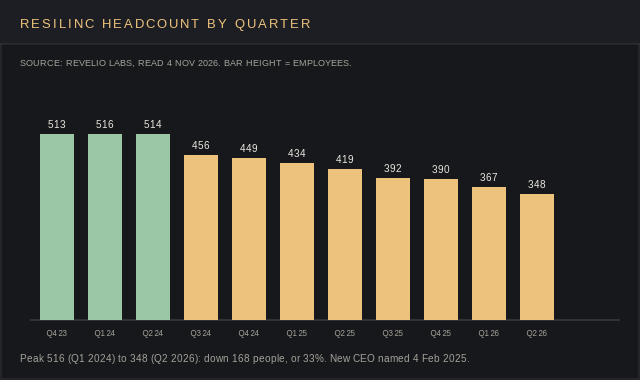
- 516 in Q1 2024 to 348 in Q2 2026 per Revelio Labs, a 33% drop
- Analyst recognition
- Leader in the 2025 and 2026 Gartner Magic Quadrant for Supplier Risk Management Solutions
- Suppliers mapped
- 800,000+ "down multiple tiers," per the homepage counter
- Parts linked
- 4M+ parts tied to real supplier locations
- Validated sites
- 1M, per the homepage counter
- Agentic AI suite
- Three modules: SC Watch, SC Monitor, SC Command
- Named AI agents
- Tariffs, Forced Labor Compliance, Disruption and EUDR agents
- Revenue exposure
- RiskShield scores exposure across suppliers, sites and parts
- Historical data
- 15+ years training the AI agents
Everstream Analytics
Not forA team that wants a published price, a free tier or self-serve signup.
Exiger
Not forA hardware maker tracking part-level obsolescence, where Z2Data's 1B+ part library fits better.
Pairs well with Resilinc
Which Resilinc numbers are the vendor's own, and which come from third parties
The supplier, site, parts, news-feed, language and country counts are Resilinc's own homepage counters, and the 40% disruption-cost figure and the automotive case come from its own site. The $1,400 Basic price is also vendor-supplied: G2 labels it "Pricing provided by Resilinc," and Capterra shows the same figure.
Ratings come from each review platform on 4 November 2026, and headcount comes from Revelio Labs' quarterly series. Resilinc publishes no revenue; the only public hint is the Endeavor Fund's $10 million recurring-revenue floor.
This Resilinc review starts from one specific claim the company makes: suppliers tell it where they are & what they make, and Resilinc's map is built on those declarations first. That's the opposite default from most of the supply chain risk management field, where inference from public records drives the map of a global supply chain.
Bindiya Vakil, who worked at Cisco, Flextronics and Broadcom, founded the company in 2010 and created its map around supplier declarations. Buyers are making a decision about people and process as much as software: the platform only works if suppliers fill out its forms.
This review is built to support buying decisions with sourced numbers, and it covers what that supplier-declared model buys a buyer today: the multi-tier mapping product, the EventWatchAI monitoring layer, the AI agent suite, and what little pricing detail exists outside a sales call.
It also covers what changed inside the company since 2024, which most coverage skips: a new CEO, a headcount that fell by a third, and a review record that's thin on the product side and loud on the employer side. Resilinc carries zero G2 reviews and exactly one Capterra review as of 4 November 2026, and that's the elephant in the room for anyone hunting for user evidence.
It's built for large manufacturers. Resilinc's homepage shows NVIDIA, IBM, Keysight, AT&T, Eaton, Bombardier, Roche, Takeda, and Honeywell as customers, companies running complex, multi-tier hardware or life sciences supply chains that treat supply chain resilience as a board-level line item. A team without dedicated procurement or supply chain risk staff will find little here that a lighter tool from our supply chain visibility software ranking doesn't already cover.
↑ FACT SHEETWhat the agentic AI suite covers
Resilinc packages its product as three modules under one agentic AI umbrella: SC Watch, SC Monitor, and SC Command. Each sits on top of the same mapped data set, so a buyer adds modules to one onboarding and skips a second implementation. The multi-tier mapping page says SC Command can "Map tier 1-to-n supplier networks," and the homepage pitches the whole stack as AI that can detect a risk and then act on it.
Four named AI agents sit inside the suite: a Tariffs Agent, a Forced Labor Compliance Agent, a Disruption Agent, and an EUDR Agent for the EU deforestation rules. Resilinc doesn't publish what model architecture drives them or how often they're retrained, so treat "agentic" as a product label you can't benchmark against a competitor's stack.
The new CEO, Kamal Ahluwalia, told the market in the May 2026 Gartner release that the company is "differentiated by delivering decision-grade intelligence through AI agents." The jury's still out on that, and some of the people building it disagree, as the employee section below shows.
Implementation complexity is the recurring theme in what user feedback exists. A Gartner Peer Insights customer, two years into the product, wrote of the multi-tier approach:
"The multi-tier approach should soon bring us even greater added value. This is currently being implemented."
Gartner Peer Insights review, likes section, 2026
Two years of use with the flagship mapping capability still mid-rollout tells you how time-intensive the initial deployment runs. Buyers should plan the timeline around supplier response rates, and keep the AI agent announcements out of the project plan.
↑ FACT SHEETHow the map gets built: supplier-validated data over inference
Multi-tier mapping is the product Resilinc's entire pitch rests on. The mapping page says it "combines supplier declarations, ERP integrations, and machine-learned patterns," with the promise of "combining real-time, supplier-validated data with advanced AI algorithms."
Combined, those inputs produce what the homepage counter puts at 800,000-plus global suppliers "mapped down multiple tiers, including sub-tier sites, parts, and raw materials," plus 4M+ parts linked to real supplier locations and 1M validated sites.
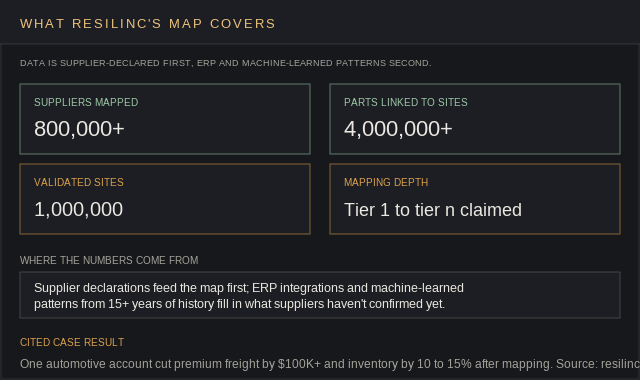
Direct suppliers, the tier-1 relationships, get the most reliable coverage because they're the ones filling out Resilinc's forms. Sub tier relationships, tier 2 and deeper, lean harder on machine-learned patterns and ERP data, and the devil's in the details there.
The mapping page itself says the map gets refined "with new insights from supplier updates, public datasets, and event monitoring," which is the vendor describing how gaps get filled where a supplier hasn't declared.
That's a structural tradeoff. A platform that infers every relationship from public records, the model Interos leans on more heavily, never needs supplier cooperation, and it never gets the certainty a declared site record carries either.
User participation decides how well Resilinc works: a supplier that stops answering update requests leaves a stale record behind, and the mapping page's "Drive supplier collaboration at scale" pitch is the company admitting that engagement is the input everything else depends on.
Resilinc's own automotive case on the same page claims "Over $100K saved in premium freight" and a 10 to 15% inventory reduction from mapping tier-1 to tier-3 suppliers. No comparable number exists from a source outside the vendor, so weigh it as a best-case outcome. A Gartner Peer Insights reviewer, a Manager of IT Services at a $1B-10B company, April 23, 2026, gave the independent version:
"This has enabled us to identify several single points of failure in our supply chains."
Gartner Peer Insights, Manager of IT Services, IT services industry, 4.0 stars, April 23, 2026
For context on how mapping-first tools compare with monitoring-first ones, our supply chain risk management software ranking scores Resilinc against the rest of the field on the same criteria.
↑ FACT SHEETHow Resilinc's own numbers moved, 2021 to 2026
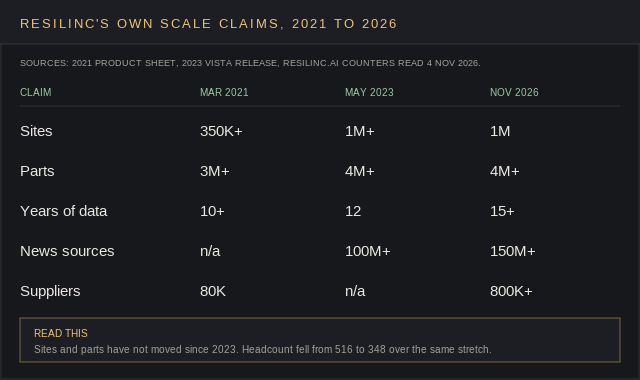
Resilinc publishes its scale claims, and it has done so for years, which lets you trace how they changed. Three dated sources line up: a March 2021 multi-tier mapping product sheet, the May 2023 Vista investment release, and the live homepage counters read on 4 November 2026.
Claim | March 2021 | May 2023 | November 2026 |
|---|---|---|---|
Suppliers mapped | 80K, plus 375K+ sub-tier suppliers | 1M+ supplier sites | 800K+ suppliers |
Sites | 350K+ sites monitored | 1M+ supplier sites | 1M validated sites |
Parts | 3M+ | 4M+ parts and raw materials | 4M+ parts |
Years of data | 10+ | 12 | 15+ |
News sources scanned | Not stated | 100M+ | 150M+ monthly (counter) |
The sites and parts lines are the ones to read between the lines on. Both grew fast from 2021 to 2023, then held flat at 1 million sites and 4 million parts for three years, the same stretch in which the company's headcount fell from 516 to 348.
The supplier-count wording also shifted from "suppliers" plus "sub-tier suppliers" in 2021 to "supplier sites" in 2023 and back to "suppliers" in 2026, so the series isn't one consistent unit. News-source scanning is the only line still climbing.
Resilinc's vendor blurb on Capterra still reads "over 1 million supplier sites mapped encompassing over 4 million parts," the same pair of figures as the 2023 release.
The AI agents monitoring revenue impact
Revenue impact is the number the mapping product exists to protect. Resilinc's RiskShield page says the module can "assess revenue exposure across suppliers, sites, and parts," link part-level data to revenue through bill-of-materials analysis, "Simulate potential disruption impacts across suppliers and sites," and "Rank mitigation priorities by business value."
Configurable scoring weights determine how sites rank, and they include geography, revenue impact, ESG performance, and regulatory compliance.
That ranking is meant to drive a specific corrective action, and the same page promises users can "Visualize high-risk sites, suppliers, and parts in real time," which is how Resilinc's AI agents claim to show an entire supply network on one screen.
A revenue score is only as good as the map under it, though. A site record created from a supplier declaration eighteen months ago produces a stale score. Keeping declarations current is easier said than done, and Resilinc doesn't publish a refresh cadence for declared records.
↑ FACT SHEETEventWatchAI: monitoring scale and what it flags
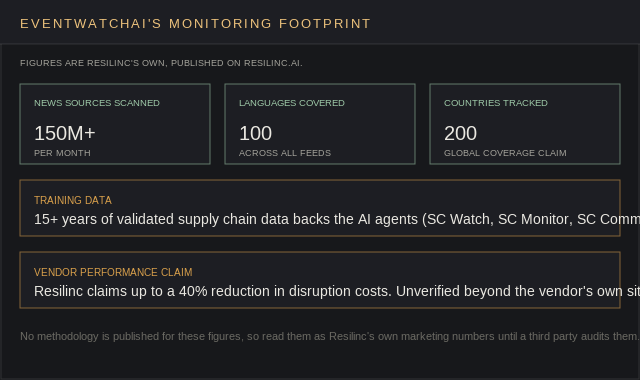
EventWatchAI is the disruption-detection layer sitting on top of the map. Resilinc's homepage counter puts it at 150 million-plus news feeds monitored monthly across 100 languages and 200 countries, while copy lower on the same page says "AI monitoring of 100M+ sources."
The AIAG marketplace listing repeats the higher figure: "over 150 million data sources in 100+ languages." The company credits its AI with proactive alerts on disruptions across every supply tier, plus tailored mitigation recommendations and a suggested action once an event hits a mapped site.
Predicting disruptions is part of the pitch. Vista's 2023 release cited more than 250 disruptive events hitting supply chains each week, and said Resilinc's predictive tools forecast delays, price moves, and supply constraints up to three months ahead.
None of these figures come with a published methodology, so treat them as claims to test in a pilot. The separate claim that Resilinc's AI can reduce disruption costs by up to 40% carries the same caveat: it's the vendor's number on the vendor's site, and talk is cheap until a third party audits it.
The mechanical risk with a system scanning at this volume is alert fatigue, and finding the one alert that matters can turn into a needle in a haystack. The April 2026 Gartner reviewer flagged exactly that:
"While the alerting system is comprehensive, it also has its challenges"
Gartner Peer Insights, Manager of IT Services, April 23, 2026 (translated from German by Gartner)
The same reviewer adds that alerts must be configured closely to each user's needs. Resilinc doesn't publish a default alert threshold, so a new account's first weeks are the tuning process, and the notification system needs careful work from the buyer's own team to stay useful.
↑ FACT SHEETPricing: what's public and what isn't
Resilinc's own site publishes no rate card. Its pricing page asks for company details and routes every visitor to a custom quote, offering a free "SCRM ROI business assessment report for qualified companies" as the pre-sale incentive.
The vendor information on Gartner Peer Insights states that "Pricing is based on the product functions and tiers chosen by the user." So the functions and tiers you pick determine the price. That's par for the course in enterprise supplier risk, where our supply chain software pricing report found quote-only pricing is the norm.
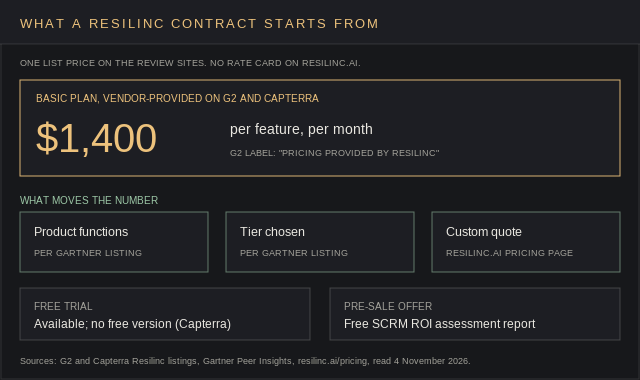
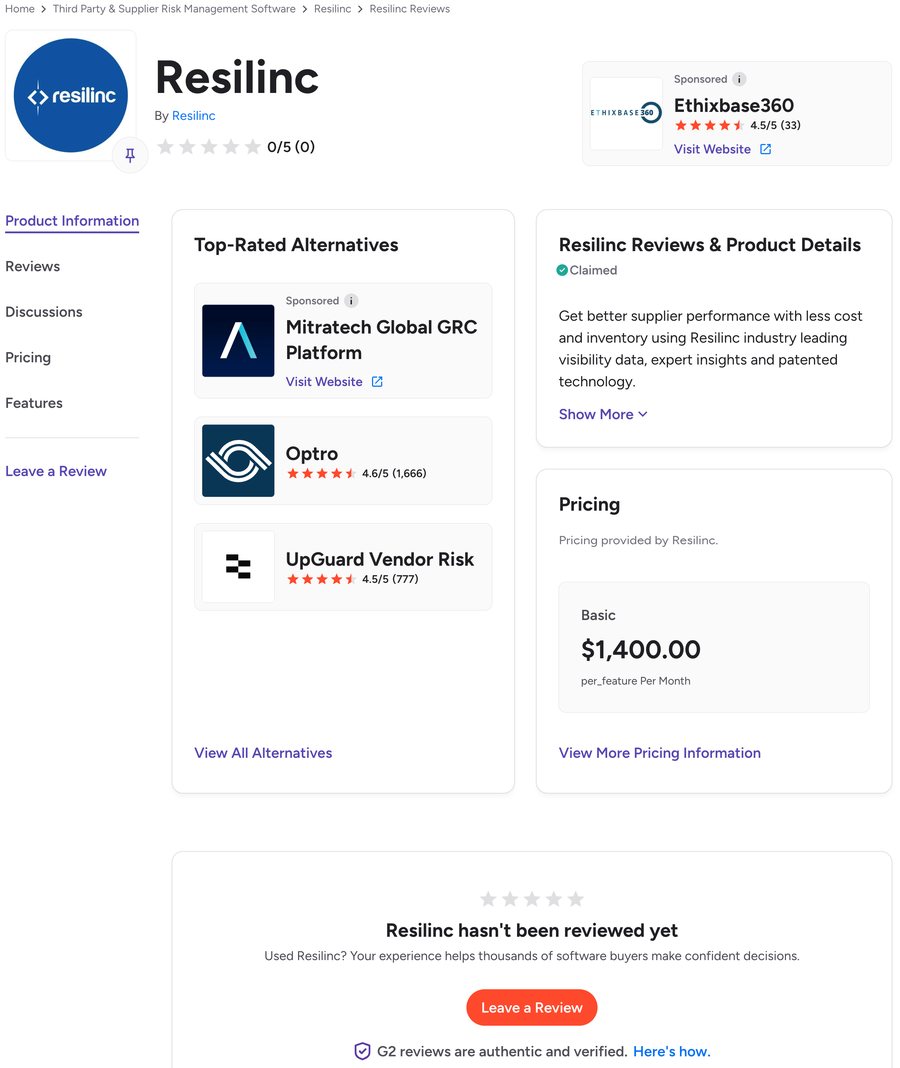
The one list price comes from Resilinc itself, by way of the review sites. G2's pricing panel shows a Basic plan at $1,400.00 per feature per month under the label "Pricing provided by Resilinc." Capterra lists the same $1,400 starting price per feature, per month, with a free trial available and no free version.
Neither listing defines a feature or says how many a typical contract carries. Read $1,400 as the floor for one function: three features at that rate come to $4,200 a month before the tier and module choices Gartner's listing describes enter the quote. A team wanting a real number still has to bite the bullet and run the sales process, so the decision to buy rests on a sales call.
↑ FACT SHEETWhat existing users say: G2, Capterra, and Gartner Peer Insights
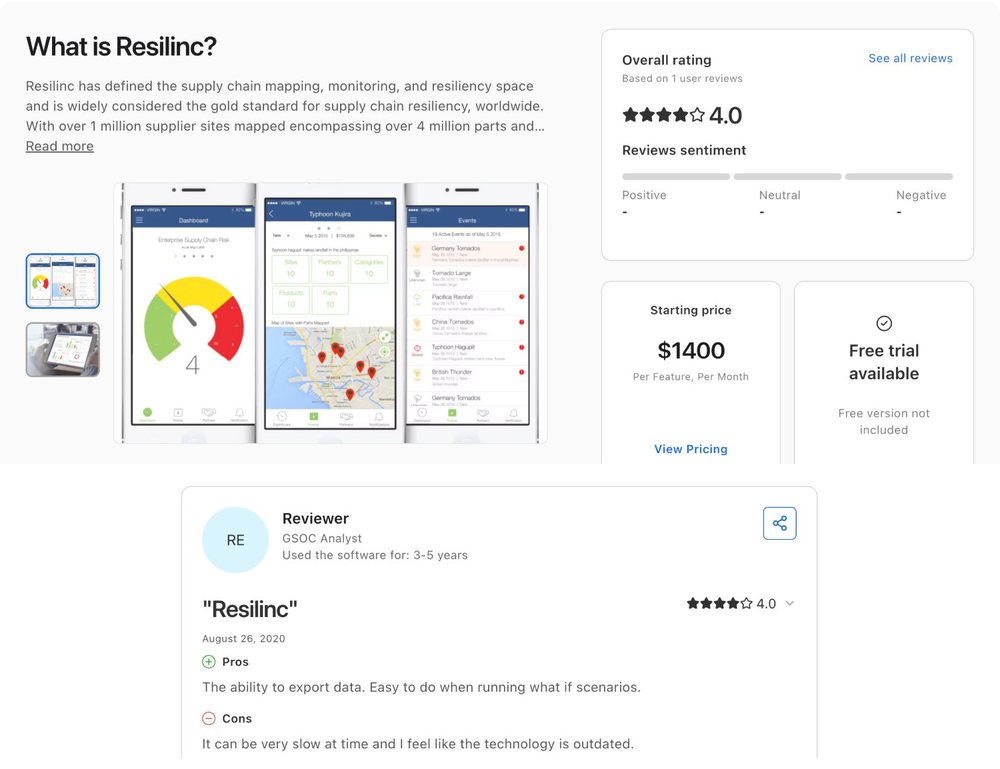
The review record for Resilinc is small enough that every source is worth naming. G2 shows zero reviews as of 4 November 2026, with the profile reading "Resilinc hasn't been reviewed yet," despite a claimed listing under Third Party & Supplier Risk Management. Capterra carries exactly one, from a GSOC analyst who had used the product for 3 to 5 years, posted August 26, 2020.
That review rates Resilinc 4.0 overall, with Features at 2.0, Value for money at 4.0 and Customer service at 4.0, all out of 5. Under pros:
"The ability to export data. Easy to do when running what if scenarios," the reviewer wrote, adding under cons:
"It can be very slow at time and I feel like the technology is outdated."
GSOC Analyst, 3 to 5 years of use, Capterra review, August 26, 2020
Gartner Peer Insights carries the deepest record: 22 ratings averaging 4.3 out of 5, split 45% five-star, 36% four-star, 14% three-star, zero two-star, and 5% one-star. Gartner's supplier risk market listing shows Resilinc at 4.4 across 19 ratings. So customer satisfaction runs from Capterra's single 4.0 to Gartner's 4.4, and 22 ratings is a drop in the bucket against the "hundreds of multinational organizations" Vista's release says use the platform.
The praise is specific. One Gartner customer wrote, "We are very satisfied with the risk monitoring, the resulting analyses, and the supplier evaluation." The criticism is just as specific, and it lands on product pace. A three-star review from a Director of IT at a $30B+ healthcare and biotech company, February 18, 2026, carried this title:
"Customer Experience Highlights Stable Performance but Stagnant Feature Growth in Solution"
Gartner Peer Insights review title, Director of IT, healthcare and biotech, 3.0 stars, February 18, 2026
A dislike entry on the same page goes further:
"Resilinc is not evolving as fast as expected as a product, and their say/do ratio is still quite low"
Gartner Peer Insights, dislikes section, 2026
That reviewer says many roadmap items get sold as separate products or licenses, and adds: "Personally as a customer I have not benefited from any new capabilities in the two years of use of the solution."
Put those next to the four-star praise and you get a platform that satisfies buyers on core monitoring while drawing complaints about how fast new capability ships. Ask Resilinc for reference customers you can call, and hear it straight from the horse's mouth before you sign.
↑ FACT SHEETCompany stability: ownership, a new CEO, and a shrinking team
Funding and ownership
Resilinc is private and headquartered in Milpitas, California. Its 2016 venture round, amount undisclosed, came from Bright Capital, Procyon Ventures, and Salesforce Ventures.
Vista Equity Partners, through its Endeavor Fund, announced a strategic growth investment on May 8, 2023, with financial terms undisclosed. The same release says the Endeavor Fund targets companies with at least $10 million in recurring revenue, the only public hint at Resilinc's size. No acquisitions by Resilinc turned up in this research.
A new CEO in 2025
Vakil ran the company for 15 years. On February 4, 2025, Resilinc named Kamal Ahluwalia CEO, previously President of Ikigai Labs and Eightfold.ai and CRO at Conga, and Vakil moved to Executive Chairwoman of the board.
Gartner named Resilinc a Leader in its inaugural Magic Quadrant for Supplier Risk Management Solutions, published April 24, 2025, and repeated the placement in the 2026 edition, announced May 6, 2026. That's an analyst judgment on capability and execution, separate from the 4.3-star Peer Insights average built from users. Our Gartner pricing report covers what a seat to read those reports costs.
Headcount and layoffs
The red flag sits in the headcount. Revelio Labs tracks Resilinc at 516 employees in Q1 2024, then 456 in Q3 2024, 419 in Q2 2025, and 348 in Q2 2026, a 33% drop from the peak. The steepest quarter was Q3 2024, down 58.
Active job postings fell to 11 in 2026 from 25 in 2025: fewer open jobs while the company pitches a bigger AI roadmap. Resilinc hasn't announced layoffs, so the cuts stayed under the radar of the trade press. The chart below is created from Revelio's quarterly series.
Employees describe the cuts directly. A Glassdoor reviewer posting on June 10, 2026 wrote:
"Strategy seems to be to continue to lay people off while sales suffer"
Glassdoor employee review, "Great colleagues overshadowed by toxic leadership and chaos," 1.0 stars, June 10, 2026
The same reviewer lists "Selling products before they're built, tested and ready" as a con, which echoes the say/do complaint from the customer side.
What employees say on Glassdoor
Glassdoor rates Resilinc 3.1 out of 5 across 237 reviews, against a 3.8 average for information technology. Only 44% would recommend it to a friend, 41% approve of CEO Kamal Ahluwalia, and 41% hold a positive business outlook. Culture and career opportunities both sit at 2.9. A former employee of 5+ years, September 6, 2026:
"CEO is not moving the company in the right direction with forcing AI and alienating good customers."
Glassdoor, "Great colleagues, but issues with the CEO," former employee, 1.0 stars, September 6, 2026
Some reviews read warmer. An October 28, 2025 five-star review calls the company "Tough and fast-paced in the best possible way," with "Strong culture (despite being fully remote)." Should you trust employer reviews when buying software? Treat them as an early warning. People who build and support the product are the first to see a roadmap slip, and a customer success team in churn is a team you'll be working with on renewal.
What searchers and AI engines see
Searchers who type the brand into Google continue to land on employer reviews first. A DataForSEO pull of the US top 10 for "resilinc review" on 4 November 2026 put a Glassdoor employee review titled "Big mess - mostly self created" in the first organic slot.
Three of the nine organic results went to employer-review sites (Glassdoor, Indeed, and a Naukri overview of work culture and jobs at Resilinc), four to Resilinc's own domains, and none to an independent product review.
Demand is shrinking too. Google Ads data via DataForSEO shows 1,000 US monthly searches for "resilinc" in September 2026, down from 1,600 in October 2025. Exiger draws 4,400 a month.
In Google AI answers, DataForSEO counts 39 US responses mentioning Resilinc: resilinc.ai is cited in 17, gartner.com in 15, and competitor exiger.com in 9. So a rival's site shapes one in four AI answers about this vendor, and Resilinc doesn't call the shots on how it's described there. That's worth knowing before you learn about Resilinc from a chatbot.
↑ FACT SHEETResilinc against four supply chain risk alternatives
Interos
Interos wins on breadth of scoring. Its i-Score "detects hidden ESG, Cyber, Financial, Restrictions, Geopolitical, Catastrophic and other vulnerabilities," and the company says it can "Discover hidden supplier relationships," surfacing sub tier relationships five layers deeper without waiting on a questionnaire.
Companies that need one score across every risk type before Resilinc has finished collecting supplier declarations should start there. Interos pays for that speed on accuracy: inferred relationships need validation on a buyer's most critical direct suppliers, where Resilinc's declared data starts closer to correct. Full detail is in our Interos review.
Everstream Analytics
Everstream wins on lead time. Its homepage pitches forecasting disruptions early, arguing that "Most disruptions leave signals days, weeks, even months, before they hit," and it pairs predictive risk scores with a network-mapping digital twin.
Everstream says it ranked first in 3 of 4 use cases in Gartner's 2026 Critical Capabilities report, and Gartner's market listing shows it at 4.6 across 8 ratings. Resilinc's predictive claim tops out at three months ahead, per its own 2023 release. See the Everstream review.
Exiger
Exiger wins on government-facing due diligence. Its homepage claims 150+ Fortune 500 customers and more than 60 US federal agencies, with a Department of Defense testimonial naming its DDIQ tool. Exiger also raises the bar on third-party ratings: 4.8 out of 5 across 32 ratings on Gartner's supplier risk market listing, ahead of Resilinc's 4.4 across 19.
A defense contractor or regulated buyer needing audit-ready documentation should weight Exiger first, and buyers comparing broader vendor-risk tools can check our third-party risk management tools ranking.
Z2Data
Z2Data wins on component-level detail for a narrower buyer. Its site claims "Component intelligence across 1B+ electronic parts" and "Risk profiles for 1M+ suppliers worldwide," tying obsolescence and compliance risk to the specific part and raw materials on a bill of materials. Resilinc's 4 million mapped parts are a fraction of that library.
Hardware manufacturers worried about a chip going end-of-life need Z2Data's part library more than Resilinc's site map. Gartner shows Z2Data at 4.0 across only 3 ratings, so its user evidence is thinner still. Our automotive market intelligence guide covers the parts-heavy buyers both tools chase.
For a wider field, including tools that watch geopolitical and cyber signals, see our risk intelligence software ranking, the supply chain intelligence tools ranking, and the supply chain market intelligence guide.
↑ FACT SHEETVerdict
Resilinc fits a large manufacturer, most often in electronics, automotive, or life sciences, that's willing to get suppliers to fill out declared-data forms in exchange for site-level accuracy inference-first tools can't match. It fits a buyer with procurement or supply chain risk staff able to run a long mapping project before the monitoring pays off, since the Gartner customer above was still rolling out multi-tier mapping two years in.
It's a poor fit for a small or mid-size team without that headcount, and for a buyer who needs a full rate card before committing budget: the only list figure is $1,400 per feature per month on G2 and Capterra, with no definition of a feature.
The 2024 to 2026 record should shape the negotiation. Headcount fell 33%, the founder handed the CEO seat to an AI executive, sites and parts claims have sat flat since 2023, and customers on Gartner complain about stagnant feature growth. That raises a fair question about staying power for any supply chain resilience program built on this vendor.
Keep an eye on release pace: ask Resilinc for the features shipped in the last 12 months, who will own your account after the cuts, reference customers you can call, and contract terms that tie renewal price to delivered roadmap items. Every claim in this verdict traces to a figure or quote already on this page.