Supply Chain Visibility Software: 10 Platforms Ranked (2026)
 By Jan Suski. I go deep on every review, checking every number against its source and digging up details other coverage misses, a habit from six years of SEO and link building for tech companies. Bylines at Surfer, Brand24, and Senuto. How the scoring works.
· Prefer this source on Google
Supply chain visibility software compared
Ten supply chain visibility platforms in ranked order, with each one’s published network or coverage figure, its entry price and the buyer it fits.
| # | Provider | Published network or coverage | Entry price | Best fit |
|---|---|---|---|---|
| 1 | project44 | 246,000 carriers, 180+ countries | $48,150 median* | Multimodal shippers with global freight |
| 2 | FourKites | 500,000+ carriers, 176 countries | Quote only | CPG and food shippers running yards and docks |
| 3 | Descartes MacroPoint | 435,000+ carriers and drivers | $8,833 median, all Descartes products* | Brokers and 3PLs tracking truckload freight |
| 4 | Shippeo | 6 transport modes | Quote only | European road-heavy shippers |
| 5 | GoComet | 5,000+ carrier integrations, 70+ countries | Quote only | Importers managing ocean and air freight |
| 6 | Overhaul | $1.4T of goods protected (vendor claim) | Quote only | High-value and theft-prone cargo |
| 7 | FarEye | 9 products, last-mile focus | Quote only | Retailers tracking final delivery |
| 8 | Tive | 30+ day tracker battery at 60-minute pings | Quote only | Cold chain and pharma shipments |
| 9 | Terminal49 | 10 active containers free | $0 | Small importers tracking ocean containers |
| 10 | ShipsGo | 160+ shipping lines, 160+ airlines | $1,000 for 500 credits | Occasional importers who pay per container |
Medians marked * are anonymized buyer-reported contract values published by Vendr. The table follows the ranked order below. Prices are the lowest figure each vendor or Vendr publishes, and "quote only" means the vendor's site lists no number.
Where these figures come from
Carrier counts, mode lists and prices are each vendor’s own published figure, read on 17 October 2026. The two medians marked * are Vendr’s anonymized buyer-reported contract values, for project44 and for Descartes Systems Group as a whole. Ratings, review counts and implementation times come from each product’s G2 page. FourKites, Shippeo, GoComet, Overhaul, FarEye and Tive print no price on their sites, and Vendr shows no median for them.
This page ranks shipment tracking. Planning suites sit on our supply chain intelligence ranking, supplier-risk monitoring on the supply chain risk management ranking, and freight-rate benchmarks on the freight intelligence ranking.
Supply chain visibility software tells a shipper where a truck, container or parcel is right now and when it'll arrive. project44 says its network tracks more than one billion shipments a year across 246,000 carriers, and buyers pay for that scale.
This page ranks ten supply chain visibility tools on five tests a buyer can run before signing: carrier network size, transport modes covered, entry price, verified review volume and time to go live. Every figure links to the vendor's own site, to G2's product page, or to Vendr's anonymised buyer data.
It's written for supply chain managers, logistics leads and the procurement teams who sign multi-year visibility contracts. Planning suites sit on our supply chain intelligence ranking, supplier-risk monitoring on the supply chain risk management ranking, and freight-rate benchmarks on the freight intelligence ranking. This list covers shipments in motion.
Evaluation criteria for supply chain visibility software
Five criteria decide the shortlist, and the ranking below applies them in this order. Each one is a test you can run against a vendor's own site or a public review page in under ten minutes.
Published carrier network size
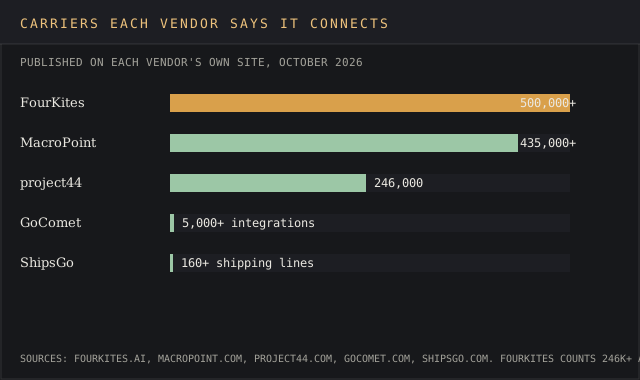
Count the carriers each of the supply chain visibility tools says it connects. Real time visibility depends on carriers sharing ELD, telematics or API data, so a network of 435,000 carriers covers lanes a 5,000-integration network can't.
Transport modes covered
List the modes the vendor tracks natively: full truckload, LTL, parcel, ocean, rail and air. A shipper moving freight on four modes needs four, and a missing mode means a second contract.
Entry price or Vendr median
Take the vendor's published price, or the Vendr median where buyers have reported contracts. A tool without either number gets no credit here, because a buyer can't budget against "contact sales".
Verified review volume and rating
Read the G2 rating and the review count together. A 4.7 across 750 reviews is harder to fake than a 4.9 across 14, so review volume breaks ties between close ratings.
Time to go live
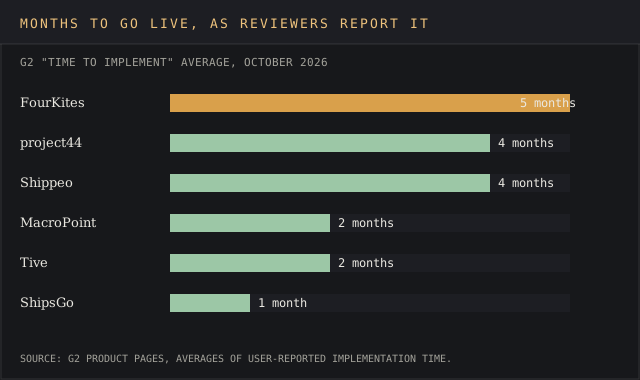
Check G2's "Time to Implement" average, which reviewers report themselves. It ran from 1 month to 5 months across this list, and every month of onboarding is a month of manual processes, check calls and lost operational efficiency.
The 10 best supply chain visibility software platforms
project44
Best fit
Shippers moving freight across road, ocean, rail and parcel in more than one region.
project44 sells a multimodal supply chain visibility platform that its site says covers over 180 countries, 2,100+ telematics integrations and 80+ TMS and ERP integrations. Its platform page lists 300+ integrated yards, 140+ port terminals and 600+ rail lines. Our project44 review tracks the product as it expands.
The data points come from 246,000 carriers feeding GPS, ELD and EDI events into one shipment record. That record is the single source of truth a supply chain manager, a carrier and a customer service rep can all read.
Key features
- AI-powered ETAs built from GPS, ELD and telematics data plus machine learning on historical lanes
- Mo, an AI analyst, and the AI Disruption Navigator for weather and news alerts
- AutonomousTMS and the Agentic Workflow Manager for no-code automation
- Rail visibility at wagon level with predictive ETAs
- Tariff Analyzer and AI document integration
Pricing
Project44 publishes no price list. Vendr's anonymised buyer data puts the median contract at $48,150 a year, with a low of $21,150 and a high of $77,630.
Pros
- 246,000 carriers and more than one billion shipments a year in the network
- G2 rating of 4.7 across roughly 750 reviews
- Coverage runs from raw materials procurement to the customer's doorstep, per the vendor
Cons
- The most expensive Vendr median of the ten
- G2 reviewers report a 4-month average implementation
- Support response is the recurring complaint in low-rated reviews
"Their Support Center is extremely slow (months to resolve tickets). Additionally, a better partnership to fix broken ELD connections and onboard new carriers would be nice."
A verified enterprise user in transportation, G2 review, 21 December 2021
A mid-market user on G2 (October 2023) put the upside in one line: "real time tracking since our previous tracking would ping every 15m to 1 hr."
Why it’s ranked #1. project44 beats FourKites on review volume, 4.7 across about 750 G2 reviews against 4.5 across 269, and publishes 2,100+ telematics integrations. It has no rival above it on this list.
FourKites
Best fit
Consumer goods and food shippers who need yard, dock and inventory visibility next to shipment tracking.
FourKites says on its site that it has tracked 116.2 million loads across 176 countries, with 500,000+ carriers, of which 246,000+ are active. It names 1,600+ brands as customers, including 9 of the top 10 CPG companies.
The product has moved from tracking into AI agents, and buyers should keep an eye on which ones ship in their contract. Tracy handles carrier operations, Sam handles suppliers, and Polly handles compliance and documentation, which covers regulatory compliance checks that used to sit in spreadsheets.
Key features
- Six named AI agents: Tracy, Sam, Alan, Cassie, Polly and Sophie
- Digital twins for orders, shipments, inventory, facilities and assets
- Dynamic ETA for arrival prediction
- Dynamic Yard for yard management systems and dock scheduling
- 3.2 million tracked events a day, per the vendor
Pricing
FourKites lists no prices. G2's pricing panel shows reviewers reporting an average 12% discount and a 16-month return on investment.
Pros
- 500,000+ carriers, the largest network figure published in this ranking
- Yard and facility modules cut the distance between tracking and dock work
- Customer story claims a 98.6% cut in detention costs at Trane Technologies
Cons
- 5-month average implementation on G2, the longest here
- Driver app setup depends on phone location permissions
- No published price
"Walking drivers who are not tech savvy thru the process, which can take anywhere from 3 to 30 minutes."
Charlie S., mid-market brokerage, G2 review, 7 November 2024
A material planner on G2 (November 2024) wrote after six months of use: "I can say its accuracy is 95% while tracking the shipments".
Why it’s ranked #2. FourKites publishes 500,000+ carriers, beating MacroPoint's 435,000. It trails project44 on G2 volume, 269 reviews at 4.5 against about 750 at 4.7, and takes 5 months to implement against 4.
Descartes MacroPoint
Best fit
Freight brokers and 3PLs who need truck location from carriers they don't own.
MacroPoint is the visibility arm of Descartes Systems Group. Its site says it connects shippers to 435,000+ carriers, logistics providers and drivers, and it pulls location through ELD data or a driver's phone app.
Brokers use it to cut check calls, and it has been in the game long enough to know the ropes with small fleets. It also claims a #1 position in G2's supply chain visibility category for ten straight seasons, and it carries 913 G2 reviews, the most of any tool here.
Key features
- ELD+ dual-source tracking that blends telematics and mobile app pings
- AI-driven capacity matching for carrier sourcing
- Integrations with TMS platforms including MercuryGate, Aljex and e2open
- Automated status emails for manage-by-exception workflows
Pricing
Descartes publishes no MacroPoint price. Vendr's buyer data across all Descartes products shows a $8,833 median from 34 purchases, ranging from $3,163 to $36,209.
Pros
- 913 G2 reviews at 4.7, the largest review base in the category
- 2-month average implementation, per G2 reviewers
- Lowest Vendr median among the vendors with one
Cons
- The 435,000 figure counts carriers, logistics providers and drivers together
- Reviewers flag spoofing by fraudulent carriers
- Helpdesk hours don't match 24/7 trucking
"Easily spoofable. A lot of scammers are able to pretend to use the service."
Sean k., manager at a small business, G2 review, 3 July 2024
A trucking reviewer on G2 (October 2023) gave the case for it in nine words: "Tracking keeps an honest man honest. Or in this case, an honest driver, honest."
Why it’s ranked #3. MacroPoint goes live in 2 months against Shippeo's 4 and carries 913 G2 reviews. It sits below FourKites, whose 500,000+ carrier network tops MacroPoint's 435,000.
Shippeo
Best fit
European manufacturers and retailers whose freight is mostly road, with some ocean and air.
Shippeo tracks six transport modes: road FTL, road LTL and parcel, ocean, ports and terminals, intermodal rail and air. Its customer stories include Carrefour Belgium, which tracks 1,500 trucks and 370,000 loads a year across 850 stores.
Shippeo lists an ETA Accuracy SLA on its homepage. Its G2 page shows 4.7 across 168 reviews.
Key features
- AI-powered ETAs backed by an ETA accuracy SLA
- Smart Tracking Analyzer and performance monitoring for carrier performance
- Carbon Visibility for emissions reporting
- Global Map view for ocean shipments
Pricing
Quote only. Shippeo's site publishes no tiers.
Pros
- Six modes covered natively, the widest published mode list here
- Written SLA on ETA accuracy
- Recent reviews (2026) praise support response
"The real-time visibility and highly accurate ETA predictions have significantly reduced the time our team spends chasing updates from carriers."
Olga C., logistics manager, G2 review, 18 June 2026
Cons
- No company-wide carrier network figure on the site
- 4-month average implementation on G2
- Telematics gaps interrupt GPS feeds, per reviewers
A mid-market transport user wrote on G2 in July 2026: "Occasionally, GPS tracking is interrupted when there's an issue with the telematics connection."
Why it’s ranked #4. Shippeo covers 6 modes, beating GoComet, whose published figures center on 2.1 million tracked containers. It falls below MacroPoint on review volume, 168 against 913, and publishes no network total to match MacroPoint's 435,000.
GoComet
Best fit
Importers and exporters in Asia, the Middle East and Europe managing container and air freight.
GoComet lists 5,000+ carrier integrations, 500+ enterprise customers, 70+ countries and 2.1 million containers tracked. It bundles freight procurement with tracking, so the same tool books and follows a shipment.
Key features
- Incident Lens, an AI agent watching shipments, ports and global events
- Viera for conversational analytics and GoVista for shipment emails
- Auto-detection of carrier and mode from a tracking number
- Go Procure module for freight tenders
Pricing
Quote only. The site directs buyers to a demo.
Pros
- G2 rating of 4.9 across 242 reviews
- Procurement and tracking in one contract
- A December 2025 reviewer reports going live within a few days
Cons
- Fewer G2 reviews than MacroPoint, 242 against 913
- No published price
- Carrier count is integrations, a smaller unit than carriers
"they automatically identify the carrier and related information just by entering a tracking number, saving me significant effort."
A verified manufacturing user, G2 review, 6 November 2025
Why it’s ranked #5. GoComet's 5,000+ integrations and 4.9 rating beat Overhaul, which publishes no network count. It trails Shippeo, which documents six modes including road FTL and LTL.
Overhaul
Best fit
Shippers of pharmaceuticals, consumer electronics and other high-theft cargo.
Overhaul combines real time visibility with in-transit risk management. Its homepage claims $1.4T of goods protected and $5B in assets recovered, and a Microsoft executive quoted there reports a 4x return in the first peak season.
The product watches GPS, cargo sensors and vehicle cameras, then routes alerts to Overhaul's intel and response team for recovery. It's the only tool here sold on what happens after an alert.
Key features
- FraudWatch for screening high-risk carriers before pickup
- Device-agnostic tracking across third-party sensors
- Intel and response team for theft recovery
- Essential, Advanced and Premium packages
Pricing
Quote only. Overhaul names three packages without prices.
Pros
- Recovery service included, beyond tracking alone
- G2 rating of 4.6 across 171 reviews
- Case study: $3.5 billion+ in shipments secured with RXO
Cons
- Headline figures are vendor claims with no measurement period
- No carrier network or country count
- Service quality varies by country, per reviewers
"Over the last period, my perception of the MX service has been quite different compared with the level of involvement I've seen from the team in other regions."
Kathy C., security specialist, G2 review (AI translated), 13 July 2026
A senior specialist at an enterprise (G2, October 2025) said the dashboard lets them "check shipment location, temperature, and handling via one dashboard, eliminating all in-transit blind spots".
Why it’s ranked #6. Overhaul adds a recovery service with $5B recovered, which FarEye lacks. It falls below GoComet, which publishes 5,000+ carrier integrations where Overhaul publishes none.
FarEye
Best fit
retailers, grocers and distributors who need final delivery visibility from distribution centers to the door.
FarEye sells nine products under one platform: Ship, Route, Plan, Smart, Track, Execute, Experience, Grow and Analyze. It claims 600 million miles saved a year through route planning.
Key features
- Auto Routing for delivery planning
- Track and Experience modules for customer delivery updates
- Carrier onboarding tools, which FarEye says cut onboarding time by 85%
- Analyze module for delivery reliability reporting
Pricing
Quote only.
Pros
- Nine products built around last-mile delivery
- G2 rating of 4.7 across 347 reviews
- Customer expectations on delivery windows are its core use case
Cons
- Ocean and long-haul visibility are outside its core
- Reviewers report slow web and mobile apps
- No published price or network figure
"Both web and mobile applications are too heavy to load, so they feel slow and less responsive"
Estu K., enterprise supermarket chain, G2 review, 27 February 2023
A retail user on G2 (January 2024) wrote that "It provides the status of shipment in seconds, without downloading."
Why it’s ranked #7. FarEye's 347 G2 reviews beat Tive's 148. It sits below Overhaul, whose $5B recovery record and 171 reviews at 4.6 cover theft risk FarEye leaves open.
Tive
Best fit
Cold chain, pharma and food shippers who need temperature and shock data per shipment.
Tive sells cellular trackers and the software behind them. The Tive Solo 5G reads temperature, humidity, shock, light and location, and runs 30+ days at 60-minute reporting or 100+ days at 6-hour reporting.
Because the tracker rides with the freight, Tive works with any carrier.
That's the trade, since every shipment needs a device, and on a 5,000-load year those devices add up fast enough to cost an arm and a leg.
Key features
- Solo 5G, Solo Lite and Solo Pro trackers on LTE-M and 2G
- Reporting intervals settable from 5 minutes to 24 hours
- Shareable tracking links for customers and carriers
- Light sensing that flags a trailer opened mid-route
Pricing
Quote only. Tive prices hardware and software on request.
Pros
- Carrier-independent tracking with condition data
- 2-month average implementation on G2
- G2 rating of 4.5 across 148 reviews
"I have 4 repeat trackers weekly that are setup in under 5 mins."
Mario D., business development manager, G2 review, 21 November 2024
Cons
- Per-device cost on every shipment
- Readings thin out in the air, per reviewers
- No published price
An air logistics specialist on G2 (November 2024) noted the trackers "have little connectivity in the air. Once up there the readings become more sporadic."
Why it’s ranked #8. Tive reports condition data at intervals down to 5 minutes, which Terminal49 doesn't collect. It falls below FarEye on review volume, 148 against 347.
Terminal49
Best fit
Small and mid-size importers who track ocean containers and want an API.
Terminal49 tracks containers across shipping lines and terminals, then pushes updates by webhook. Its free tier covers 10 active containers, 3 users and 50 document credits.
Key features
- API access and webhooks on the Essential plan
- Intermodal rail tracking after the port
- Predictive ETAs and automated workflows on Complete
- Free, Lite, Essential, Complete and Enterprise tiers
Pricing
The Free plan costs $0 with a 10-container cap. Lite, Essential and Complete are quoted on request.
Pros
- A real $0 tier for testing
- G2 rating of 4.9
- Developer documentation praised by reviewers
Cons
- Only 14 G2 reviews
- Ocean and rail only, with no road or air
- Paid tiers carry no published price
"Their webhook automation has significantly reduced the need for manual ETA checks, saving us both time and effort."
Horacio S., systems administrator, G2 review, 25 March 2025
Why it’s ranked #9. Terminal49's $0 tier for 10 containers beats ShipsGo's $1,000 entry. It falls below Tive, whose 148 G2 reviews outweigh Terminal49's 14.
ShipsGo
Best fit
Occasional importers who want to pay per container with no subscription.
ShipsGo charges $1,000 for 500 credits, about $2 a container, with no membership fee. Credits last a year, and one Master B/L uses one credit however many containers sit under it.
Key features
- Coverage of 160+ shipping lines and 160+ airlines
- Tracking API with an annual usage fee
- 3 free credits at sign-up
- Re-queries of a tracked shipment cost nothing
Pricing
$1,000 for 500 credits, with bulk discounts quoted by sales.
Pros
- Fully published per-unit price
- 1-month average implementation on G2
- G2 rating of 4.6 across 91 reviews
"The pricing of 2USD per tracking seems a lot at first glance, but the advantage gained from time savings and transparency outweighs it and can thus be considered fair."
A verified wholesale user, G2 review (AI translated), 9 October 2026
Cons
- Ocean and air only
- API carries an unpublished annual fee
- Uploads don't always return full data on first query
A farming business testing the API on G2 (October 2026) reported that "the uploads did not return all the data immediately, and we had to query again when they finished processing."
Why it’s ranked #10. ShipsGo publishes a $2 per-container price no other paid tool here matches. It falls below Terminal49, whose $0 tier covers 10 containers before any spend.
What supply chain visibility software does
Visibility platforms pull raw data from GPS enabled devices, ELDs, telematics units, carrier APIs, EDI messages and port systems, then clean it into one shipment status per load. Data collection is the hard part, and the devil's in the details. A carrier that sends pings every hour gives a worse ETA than one sending every 15 minutes.
Telematics capture where a truck is and how it's moving. IoT sensors like Tive's monitor temperature, humidity and shock along the route. RFID reads at a dock door log a pallet without a manual scan, and project44 lists 100+ yard cameras with OCR doing the same job for trailers.
Machine learning and predictive analytics then turn those data points into ETAs, alerts and actionable insights. project44's platform runs 14+ day weather forecasts next to shipment data, so a planner sees a port closure before the container arrives. Automated alerts replace the check call, and exception management routes only the late loads to a person.
Data integration decides the value of supply chain data. A supply chain visibility platform feeds its events into the transportation management system, the warehouse management system and the ERP, which ends the data silos where each team kept its own spreadsheet. The inventory analytics ranking covers the tools that use those feeds to set inventory levels.
Critical capabilities of supply chain visibility solutions
Supply chain visibility solutions differ on six critical capabilities, and a buyer can check each one in a 60-minute demo.
- Real time shipment tracking across every mode you ship, with the ping interval stated in minutes
- Predictive ETAs trained with machine learning on your own lanes, backed by an accuracy figure or an SLA like Shippeo's
- Exception management that alerts on late or off-route loads only, so teams mitigate risks before the customer calls
- Data integration with the TMS, WMS, ERP and yard management systems, which keeps data consistency across every screen
- Carrier performance and supplier performance scorecards built from the same tracking events
- Advanced analytics that turn raw events into actionable insights for supply chain operations
Modern visibility platforms now add AI agents on top of tracking. FourKites runs six named agents and project44 sells AutonomousTMS, and both pitch them as a way to take check calls off a supply chain manager's desk. Those agents push real time insights to the planner, enabling proactive decision making while the truck is still moving.
Supply chain leaders get the most from one demo request, the share of their own top 20 carriers already on the vendor's network. Ask for it as a number, because every carrier missing from a supply chain visibility platform needs onboarding before it tracks.
Why is supply chain visibility important
Global supply chains have many moving parts, and a delay at one port spreads to every customer downstream. Extreme weather and geopolitical events both trigger supply chain disruptions, and a shipper without real time data learns about them from the customer.
Supplier locations are the blind spot most teams carry, and finding a tier-3 supplier in an ERP export is a needle in a haystack. Visibility tools follow shipments once they move, while supplier mapping sits with tools like Everstream Analytics and Interos.
The lion's share of the money shows up in detention and labour. FourKites says Trane Technologies cut detention costs by 98.6%, and project44 claims customers see 85% faster exception resolution and 60% fewer manual tasks. Treat both as vendor claims and test them in a pilot.
End to end visibility across the value chain also sharpens an organization's ability to identify bottlenecks. A dock that holds trucks longer than its peers shows up in the detention data, and fixing it brings reduced costs on every lane that touches it.
Supply chain visibility feeds risk management too. When a port closes, a team with live supply chain data reroutes orders with global suppliers and supply chain partners the same day, which keeps business operations running and builds operational resilience. Inventory optimization follows, since accurate ETAs let planners hold less safety stock and still meet supply chain performance targets.
Customer satisfaction follows delivery reliability. A buyer who gets an accurate arrival time plans labour and stock around it, and a shipper who can't give one loses the account to a competitor who can. That's the competitive advantage the category sells.
Supply chain visibility software pricing
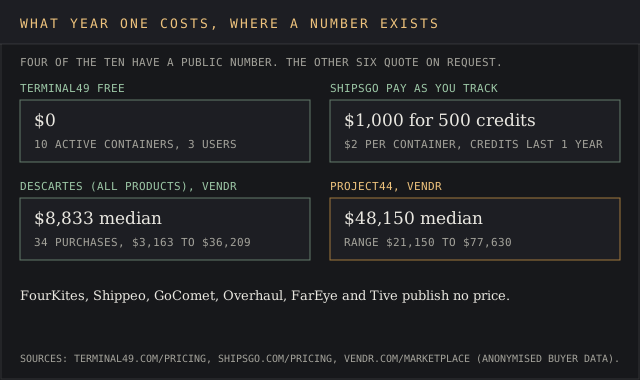
Four of the ten visibility tools have a public number. Terminal49 starts at $0, ShipsGo at $1,000 for 500 credits, Descartes buyers report a $8,833 Vendr median and project44 buyers a $48,150 median. The other six supply chain visibility tools quote on request, which is par for the course in enterprise logistics software.
Watch three costs that don't show on a quote:
- Carrier onboarding takes staff time on your side.
- Telematics fees can land on carriers who then raise rates, a red flag for brokers on thin margins.
- Multi-year contracts lock in a price before you know your real tracked-load volume.
Our supply chain software pricing report compares contract terms across planning and visibility vendors.
How to improve supply chain visibility with a trial
- Pick 50 recent loads across your top three lanes and modes.
- Ask each of the visibility platforms what share of those carriers it already connects, so you're all on the same page about coverage.
- Run a 30-day pilot with two visibility platforms and compare predicted ETAs with actual arrival times.
- Count check calls before and after, and record the cost savings in hours.
- Read the G2 reviews sorted by lowest rating before signing, since talk is cheap on a demo call.
Don't count your chickens before they hatch on carrier coverage. A vendor's 500,000-carrier network is a drop in the bucket if your regional carriers aren't in it.
Our notes on how G2 makes money explain why vendor-invited reviews skew high.
Supply chain visibility FAQ
What is supply chain visibility?
Supply chain visibility is the ability to see where every order, shipment and unit of inventory sits, from raw materials to final delivery, with up to date information. Supply chain transparency adds who made a product and how, which is a sourcing question.
Which software is used in logistics?
Most supply chain teams run a transportation management system for planning and booking, a warehouse management system for inventory in buildings, and a visibility platform for freight in motion. Planning suites from Blue Yonder and Kinaxis sit above all three.
What is a control tower in supply chain management?
A control tower is one screen that shows shipments, inventory and alerts across partners. project44, FourKites and GoComet all sell control tower views on top of their tracking data.
What are the best supply chain visibility tools?
On the five criteria above, project44, FourKites and Descartes MacroPoint lead the supply chain visibility tools ranked here. Terminal49 and ShipsGo are the cheapest supply chain visibility tools to start with, at $0 for 10 containers and $2 per container.
How does supply chain visibility differ from supply chain management?
Supply chain management covers planning, sourcing, making and delivering. Supply chain visibility is the tracking layer that feeds real time data into that work, so supply chain operations teams make informed decisions on today's loads.
Will AI replace supply chain managers?
The vendors here sell artificial intelligence agents for check calls, documents and exceptions, and FourKites names six of them. Supply chain leaders still own carrier contracts, customer escalations and the call on what to expedite. See our demand forecasting ranking for the planning side.
Bottom line
project44 is the pick for a multimodal shipper with global freight and a $48,150 budget, and its 2,100+ telematics integrations plus about 750 G2 reviews give the deepest proof base. FourKites fits CPG and food shippers who want yard and dock tools with tracking. MacroPoint suits brokers who need truck location fast, with a 2-month go-live.
Shippeo covers six modes for European road freight, and GoComet suits importers on ocean and air. Overhaul is the choice when theft is the main risk management concern. FarEye wins on final delivery, Tive on cold chain condition data, and Terminal49 and ShipsGo serve importers who want a free tier or a $2 per-container price before any contract.