Best manufacturing forecasting software in 2026: 10 tools ranked
 By Jan Suski. I go deep on every review, checking every number against its source and digging up details other coverage misses, a habit from six years of SEO and link building for tech companies. Bylines at Brand24 and Senuto. How the scoring works.
· Prefer this source on Google
Quick comparison of manufacturing forecasting software
Ten tools with how each one carries the forecast toward production, the entry price where one exists, and the buyer each fits. Rows marked Quote route buyers to a sales call for pricing.
| # | Provider | How the forecast reaches production | Entry price | Best fit |
|---|---|---|---|---|
| 1 | Atlas Planning | Demand, supply and factory schedule in one model | Quote; ForecastX add-in $99/user/month | Plants running monthly S&OP |
| 2 | Smart IP&O | Connectors to Epicor, NetSuite, Dynamics, SAP, Sage | Quote | Spare parts, high-mix plants |
| 3 | Dynamics 365 SCM | Forecast reduced by orders in master planning | $210/user/month; $300 Premium | Microsoft shops |
| 4 | NetSuite | Work orders for every level of a multi-tier assembly | $74,782/year median* | Existing NetSuite customers |
| 5 | MRPeasy | Sales forecast linked to the MPS | $99/user/month | Small plants leaving spreadsheets |
| 6 | Acumatica | Time-phased MRP recommendations | Under $2,185/month, unlimited users | Plants adding users fast |
| 7 | DELMIAworks | Forecast updated with each MRP run | Quote | Plastics and injection molding |
| 8 | StockTrim | BOM drilldown forecasts each component | $49/month + BOM add-on | Small food and kit makers |
| 9 | Katana | Forecast feeds replenishment suggestions | Free up to 30 SKUs | Makers on Shopify |
| 10 | Odoo Manufacturing | Manual forecast in a 12-period MPS | €11.90/user/month year one | ERP on a tight budget |
The median marked * is Vendr's anonymized buyer-reported contract value for NetSuite. Every other price is the one the vendor publishes itself.
Where these figures come from
Prices come from each vendor's own pricing page or documentation, and Capterra review counts were checked on 16 October 2026. The NetSuite median comes from Vendr's marketplace page. Atlas, Smart IP&O and DELMIAworks publish no price, and Vendr tracks no Smart IP&O purchases, so those rows read Quote.
Three of these ten also appear on our inventory analytics software ranking: NetSuite, Katana and Odoo, judged there as inventory tools. The enterprise supply chain planning suites sit on our demand forecasting software ranking. This page judges how far the forecast travels toward a work order.
Manufacturing forecasting software predicts product demand and turns that number into production schedules, material orders and capacity plans. A retail forecast stops at the shelf. A manufacturing forecast has to explode through a bill of materials and land on a work order, which is where most tools in this category quietly hand the job back to a spreadsheet.
This ranking covers ten tools built for that handoff, from John Galt's Atlas Planning to a $49-a-month StockTrim plan. Our demand forecasting software ranking covers the enterprise supply chain planning suites (o9, Kinaxis, Blue Yonder, SAP IBP). This page ranks what a production planner buys when the forecast has to drive MRP, the master production schedule and S&OP.
Every price links to the vendor's page or to Vendr's anonymised buyer data, and every user quote links to its review.
Manufacturing forecasting tools win or lose on three numbers: the forecasting methods they document, the price they publish and how far the forecast travels toward a work order without a person retyping it.
Deloitte's 2026 outlook reports that 78% of manufacturers surveyed by the NAM named trade uncertainty their top concern in Q3 2025, up from 56% in Q4 2024, and supply chain plans built from last year's averages are skating on thin ice.
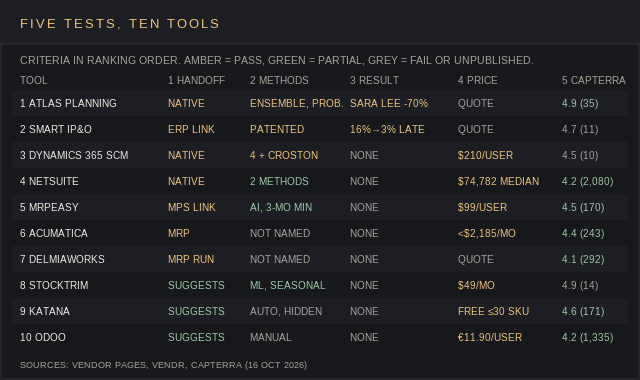
Evaluation criteria for manufacturing forecasting software
Five criteria decide the shortlist, and the ranking below applies them in this order. A buyer can run each one against a demo, the vendor's documentation or the supply chain team's own data and get a yes, a no or a number.
Forecast-to-production handoff
Does the forecast become a planned work order or purchase order without a CSV export into supply chain management tools? Native MRP, master planning or a certified connector to existing ERP systems named on the vendor's site scores a yes. Tools that only suggest replenishment score partial.
Documented forecasting methods
Count the demand forecasting methods named in the documentation and look for one built for intermittent demand. Spare parts often sell zero units most months, and a moving average misses the mark on them. Croston's method or a probabilistic model is the yes, and it's the biggest lever on forecasting accuracy for spare parts.
Named manufacturing customer result
A manufacturer named on the vendor's own domain, attached to a measured result such as late shipments falling from one rate to another. Logos without numbers score zero.
Price visibility before a sales call
A published price, or a Vendr median with its purchase count, scores a yes.
Review depth on Capterra
Review count and rating on Capterra, checked 16 October 2026. Under 30 reviews means the stars rest on a handful of manufacturing companies.
Top manufacturing forecasting software, ranked
Atlas Planning (John Galt Solutions)
Best fit
Manufacturing companies that run a monthly S&OP meeting and want demand, supply and the factory schedule in one forecasting model.
Atlas Planning draws on what John Galt calls 30 years of supply chain expertise, and Nucleus Research named it a Leader in its 2026 value matrix for the sixth consecutive year. Its demand module lists eight capabilities, including AI ensemble forecasting, probabilistic forecasting and parts replacement (time-to-failure) models for aftermarket demand.
Key features
- AI ensemble forecasting that blends several models per item
- Attribute-based forecasts for new products with no sales history
- Schedule module for resource allocation across factory materials and capacity
- Scenario planning with several what-if scenarios run in parallel
Pricing
Atlas is quote-only. John Galt does publish ForecastX: $500 per user for installation, then $99 per user per month ($1,188 a year).
Pros
- Sara Lee Frozen Bakery cut inventory write-offs by 70% and Reddy Ice cut out-of-stocks by 50%, per John Galt's site
- 4.9 across 35 Capterra reviews
- Production forecasts and production schedules come from one model
Cons
- No published Atlas price
- Data loading can need custom programming
- Configuration has its own language to learn
"The forecasting is outstanding and makes us confident that good information is flowing from the demand side to the supply side."
Ryan H., Director of Demand Planning, Food & Beverages, Capterra, 16 October 2023
"Integration was a challenge. Custom programming written to aggregate our data, and populate the tables for data load into the software."
Robert D., Senior Supply Chain Manager, Furniture, Capterra, 25 March 2021
Why it’s ranked #1. Atlas and Smart IP&O tie on the first four criteria. Atlas wins criterion five with 35 Capterra reviews to Smart's 11, and it schedules the plant in the same model where Smart writes back to an ERP.
Smart IP&O (Smart Software, an Epicor company)
Best fit
High-mix, low-volume and spare-parts manufacturers on Epicor Kinetic, NetSuite, Dynamics or SAP who need to predict future demand for items that sell zero units most months.
Smart IP&O comes from Smart Software, which advertises 40+ years of forecasting products. Epicor bought it on 1 May 2024 and describes it as built on "patented, probabilistic AI and machine learning models." It's a planning layer that writes forecasts and reorder points back into ERP systems such as Epicor Kinetic.
Key features
- SmartForecasts statistical engine
- Spare Parts Planning with a patented probabilistic method for intermittent demand
- Connectors for Epicor, Sage, NetSuite, Dynamics, SAP, IBM Maximo and Hexagon EAM
- S&OP and demand planning modules
Pricing
Quote-only, and Vendr tracks no purchases.
Pros
- Specialty chemicals maker Bedoukian Research cut late shipments from 16% to 3%, finished goods by 4% and raw materials by 5%, per Smart's customer page
- Intermittent-demand method in production use
- 7 named ERP and EAM connectors plus 5 more
Cons
- No public price
- 11 Capterra reviews (4.7)
- Two of the first eight reviewers flag reporting
"The tight integration with our Epicor ERP\Kinetic software. Without a solution to generate demand for our high mix - low volume products we would be in the dark."
Mike H., ERP Manager, Automotive, Capterra, 15 November 2022
His con: "The cost is a bit high for our size company."
Why it’s ranked #2. Smart's patented intermittent method is in production and Dynamics 365's Croston fallback is preview, so Smart wins criterion two over #3. It loses to Atlas on criterion five, 11 Capterra reviews to 35.
Microsoft Dynamics 365 Supply Chain Management
Best fit
Manufacturers on Microsoft 365 and Power BI who want forecasting, master planning and MRP inside integrated systems.
The Demand planning app offers four demand forecasting algorithms, listed in Microsoft's algorithm guide: auto-ARIMA, ETS, Prophet and XGBoost, and a best fit forecasting model that picks one per product using mean absolute percentage error (MAPE). When more than 80% of a series is zero it falls back to Croston's method, still labelled preview.
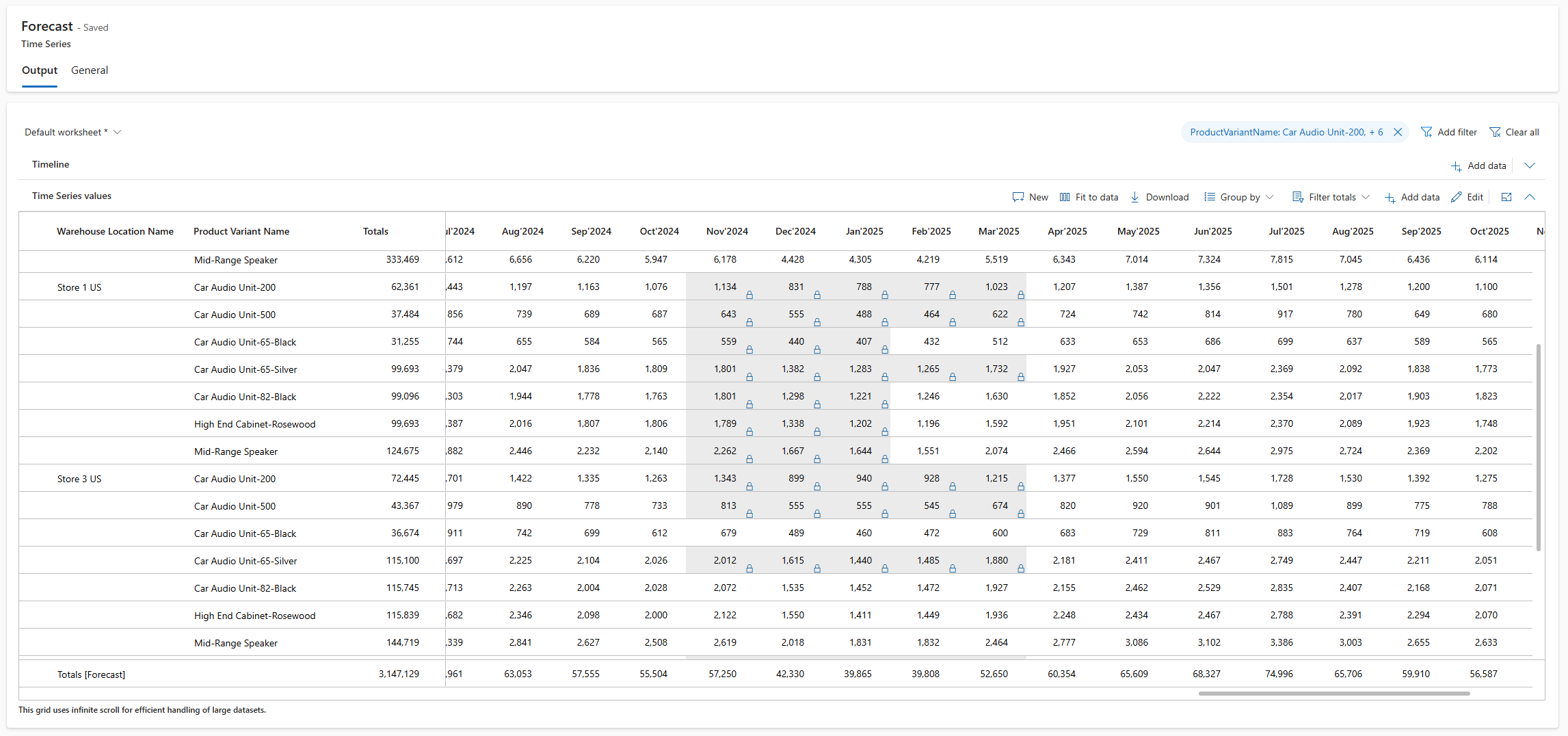
In its forecast reduction example, a 1,000-unit forecast with a 200-unit sales order leaves an 800-unit forecast requirement, and master planning creates planned orders for both.
Key features
- Auto-ARIMA, ETS, Prophet, XGBoost and custom Azure Machine Learning models
- Croston's method for intermittent demand (preview)
- Time fences that lock agreed periods against manual edits
- Four forecast reduction methods in master planning
Pricing
$210 per user per month, paid yearly, or $300 for Premium. Demand planning is marked "Limited" in the base plan and included in Premium.
Pros
- Four named algorithms plus MAPE-driven best fit
- Forecast consumption rules published with worked numbers
- Published per-user price
Cons
- Full demand planning sits in the $300 tier
- Croston's method is preview
- Partner implementation adds cost
"The cost is pretty crazy and high, so implementation costs should be considered carefully and make sure you understand all the costs."
Ray W., Senior Consultant, Computer Software, Capterra, 14 November 2025
Why it’s ranked #3. Four documented algorithms beat NetSuite's two forecast methods on criterion two. It trails Smart IP&O because its intermittent method is preview and Microsoft names no manufacturing result with a number.
Oracle NetSuite
Best fit
Mid-market manufacturers already on NetSuite financials who want demand plans to generate work orders for every sub-assembly.
NetSuite's Demand Planning builds a plan from historical sales or from open quotes and orders. The supply plan then suggests purchase and work orders from lead times and safety stock, and "all levels of a multi-tier assembly are considered." One run handles up to 10,000 items.
Key features
- Two demand plan methods: past sales trend or current pipeline
- Supply plans covering every sub-component of a build
- Lead times and safety stock inside supply calculations
- 10,000-item ceiling per run
Pricing
Vendr's anonymised buyer data puts the median NetSuite contract at $74,782 a year* across 1,514 purchases, ranging from $7,166 to $298,606. Demand Planning also requires Advanced Inventory Management, and at the $298,606 end a contract can cost an arm and a leg.
Pros
- Multi-level BOM explosion from forecast to work order
- Vendr median with purchase count
- 2,080 Capterra reviews at 4.2
Cons
- Two forecast methods, none for intermittent demand
- Demand Planning sits behind Advanced Inventory Management
- Manufacturing fit draws complaints
A sporting goods controller wrote on Capterra in May 2026: "NetSuite is a bit of a challenge in a manufacturing environment."
Why it’s ranked #4. NetSuite documents two forecast methods and plans work orders down every assembly level, which beats MRPeasy's single AI method on criterion two. It sits below Dynamics 365, which documents four methods to NetSuite's two.
MRPeasy
Best fit
Small manufacturers moving off spreadsheets who want MRP, an MPS and a forecast at a published per-user price.
MRPeasy's sales forecasting "combines AI-assisted forecast generation with manual input," building forecasts from customer order history and linking them to the master production schedule. Under three months of history, automatic forecasting won't run; under two years, seasonal patterns can slip under the radar.
Key features
- AI-assisted forecast with a manual override table
- Forecast linked to the MPS
- MRP I and capacity planning
- Integrations with Shopify, QuickBooks Online, Xero and ShipStation
Pricing
MRPeasy lists $49, $69, $99 and $149 per user per month. Sales Forecasting first appears in the $99 Enterprise plan.
Pros
- Cheapest published per-user price for a forecast linked to an MPS
- Documented history thresholds
- 170 Capterra reviews at 4.5
Cons
- Forecasting locked out of the $49 and $69 plans
- No auto-created orders for lower BOM levels
- One reviewer hit a cap on stored BOMs after two years
"Improved our materials forecasting requirements for different factories based on current orders."
Andre V., Production Planner, Construction, Capterra, 5 November 2025
A consultant's con on the same page: "I wish it was able to recursively auto-create MOs for subassemblies at lower BOM levels."
Why it’s ranked #5. MRPeasy documents its method and its 3-month history minimum, which Acumatica doesn't, and publishes a $99 price. It sits below NetSuite, which plans work orders across every assembly level.
Acumatica Manufacturing Edition
Best fit
Growing manufacturers moving off entry-level ERP systems and adding planners and shop-floor users faster than they can budget per-seat licences.
Acumatica's MRP generates "time-phased recommendations" from demand, inventory, planned supply and open orders, and its demand planning generates forecasts from historical data. Advanced Planning and Scheduling combines finite and infinite capacity in one production order. Unlimited users mean a new shift supervisor can hit the ground running without a licence request.
Key features
- MRP with safety stock and reorder points
- APS against shop calendars and shifts
- DRP for multi-warehouse distribution
- Unlimited users on every licence
Pricing
Under $2,185 a month for APEX for Manufacturing, with supporting services for support and implementation included.
Pros
- 20 extra shop-floor seats cost nothing in licences
- Published starting price
- 243 Capterra reviews at 4.4
Cons
- Forecast methods not named
- Item setup forces forecasting or replenishment
- Customisation adds cost
"Limitations based on setup without hybrid options such as having to choose between forecasting vs replenishment on inventory."
Amber H., Project manager, QA engineer, Retail, Capterra, 27 January 2026
Why it’s ranked #6. Acumatica publishes a starting price under $2,185 a month and DELMIAworks publishes none, so it wins criterion four. It sits below MRPeasy, which names its method and history threshold.
DELMIAworks (Dassault Systèmes)
Best fit
Plastics, injection molding and medical device plants that want forecasting inside a manufacturing ERP.
DELMIAworks is the former IQMS, which Dassault Systèmes bought for $425 million on 8 January 2019, when it served 1,000 customers. Its Forecasting module projects throughput and resource needs, and "time-phased planning is updated regularly with each MRP run."
Key features
- Production forecasts tied to each MRP run
- What-if and simulation formulas
- Forecast views by customer, part or plant
- Real time data links to sales and inventory modules
Pricing
Quote-only.
Pros
- Forecast and MRP share one database
- Quoting, scheduling and shipping built for molders
- 292 Capterra reviews at 4.1
Cons
- No published price
- Methods not named
- Heavy training load
"IQMS offers everything needed to run a injection molding business and more."
Program Manager, Plastics, Capterra, 15 January 2019
An automotive manager in August 2026: "Overall DelmiaWorks can be difficult to use and require extensive training."
Why it’s ranked #7. DELMIAworks refreshes its forecast on every MRP run, which beats StockTrim's suggestion-only handoff on criterion one, and its 292 Capterra reviews dwarf StockTrim's 14. It trails Acumatica because it publishes no price.
StockTrim
Best fit
Small food, consumer goods and kit manufacturers on Katana, QuickBooks, Unleashed or NetSuite who want a forecasting add-on.
StockTrim for manufacturing forecasts finished goods and "converts this into a schedule of requirements to produce the final product." A BOM drilldown forecasts every component, then purchase orders follow across suppliers, locations and lead times.
Key features
- Machine learning forecast with automatic seasonality
- BOM drilldown to component level
- Forecasts for new products without history
- Connectors for Katana, QuickBooks, MYOB, Shopify, Unleashed and NetSuite
Pricing
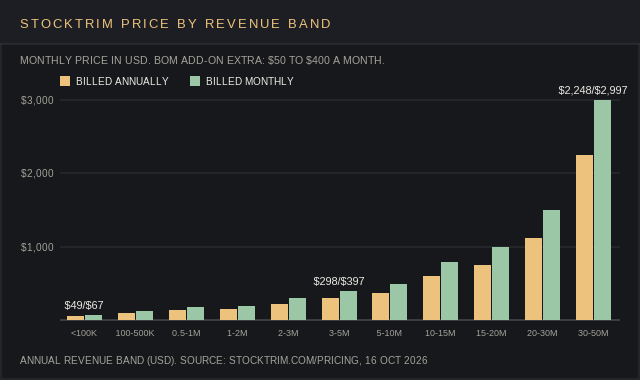
StockTrim prices on revenue. Its pricing page runs from $49 a month billed annually (under $100K revenue) to $2,248 (the $30M to $50M band), or $67 to $2,997 billed monthly. The BOM add-on costs $50 to $400 a month more, and onboarding is $299.
Pros
- Unlimited users and SKUs in every band
- 14-day free trial, no card
- 4.9 on Capterra
Cons
- Manufacturing BOM forecast is a paid add-on
- Work orders don't sync
- Six of the first eight Capterra reviews are dated 25 June or 1 July 2025, a red flag for a 14-review base
"Not being able to synch work orders or transfers may be limiting, although there are simple workarounds to overcome this."
Rhys R., Founder, Information Technology and Services, Capterra, 17 November 2022
Why it’s ranked #8. StockTrim names machine learning, seasonality and BOM drilldown, which beats Katana's undisclosed method on criterion two. It sits below DELMIAworks because its 14 reviews and suggestion-only handoff stop short of a work order.
Katana
Best fit
Direct-to-consumer makers on Shopify and QuickBooks Online starting with fewer than 30 SKUs.
Katana's demand forecasting arrived late. It launched Planning and Forecasting on 3 May 2024. Forecast demand "automatically analyzes your historical sales data to calculate forecasted demand for each item," accepts weekly or monthly overrides and feeds replenishment suggestions.
Key features
- Automatic per-item forecast from sales data
- Weekly or monthly manual overrides
- SKU-level lead times and minimum order quantities
- StockTrim integration
Pricing
Katana's Free plan covers 30 SKUs with unlimited users; Advantage is quoted on one annual contract.
Pros
- Free for up to 30 SKUs
- Manual forecasts cover new products
- 171 Capterra reviews at 4.6
Cons
- Forecast method undisclosed
- No automatic demand without consumption history
- Forecasting shipped late
A food production director wrote on Capterra in August 2023, eight months before launch: "One of the features that is missing, but they are working on it, is sales forecasting by SKU."
Why it’s ranked #9. Katana computes a forecast from history and Odoo's MPS needs every number typed in, so Katana wins criterion two. It trails StockTrim, which documents machine learning and component-level forecasts for 4.9-rated buyers.
Odoo Manufacturing
Best fit
Small manufacturers who want ERP, MRP and an MPS for under €15 a user and will enter forecasts by hand.
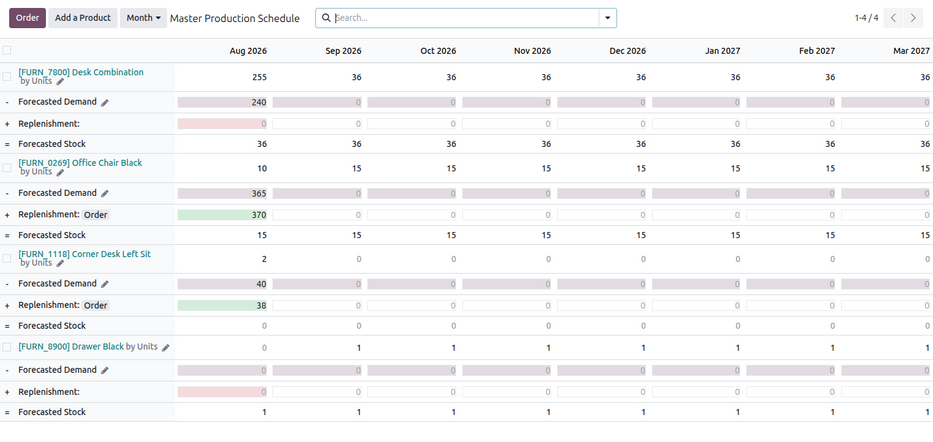
Odoo's Master Production Schedule plans replenishment "against a manually-adjustable demand forecast" over yearly, monthly, weekly or daily periods; 12 monthly periods is the documented example. It suggests quantities and creates no order until someone clicks Order, so a planner building a forecast from scratch types every number into the grid.
Key features
- MPS rows for forecasted demand, indirect demand, replenishment and forecasted stock
- Safety stock targets that drive suggestions
- Confirmed sales orders shown next to the forecast
- Every app in one subscription
Pricing
Odoo's euro price list shows Standard at €11.90 per user per month for 12 months, then €14.90, billed yearly.
Pros
- Cheapest per-user MPS here
- Production, inventory and purchasing in one database
- 1,335 Capterra reviews at 4.2
Cons
- Every forecast number is typed in
- Reordering rules clash with MPS products, per Odoo's docs
- Billing disputes on unsupported versions
"Odoo attempted to charge us a large unsupported-version fee that we dispute and do not believe we ever contractually accepted."
Brian B., President, Automotive, Capterra, 11 May 2026
Why it’s ranked #10. Odoo costs €14.90 a user and covers 12 MPS periods out of the box, which earns the last slot. It trails Katana because every Odoo forecast number is entered by hand.
Entries eight to ten stop short of a work order. StockTrim's work orders don't sync, Katana feeds replenishment suggestions, and Odoo's MPS creates no order until someone clicks Order. Plants that need the forecast to land on the shop floor start with entries one to seven.
What manufacturing forecasting software does
Manufacturing forecasting predicts product demand for production planning and supply chain management, so output can match customer demand. NetSuite's guide calls it "the science of trying to anticipate demand for products," and MRPeasy's guide says a good forecast "turns sales expectations into achievable output targets."
The forecasting process takes historical data on sales, open orders and production data, runs a forecasting model, then hands the production forecasts to MRP. MRP explodes the bill of materials, nets out inventory levels and creates planned orders. Accurate forecasts minimise excess inventory and stockouts together, which protects production costs, resource allocation and customer satisfaction in the same move.
Push systems and pull systems
Push systems estimate production based on anticipated demand: make-to-stock plants build to the forecast. Pull systems produce goods based on actual customer orders, and in MRPeasy's words "nothing save for critical safety stock is produced ahead of incoming orders." NetSuite calls pull "the most accurate way of forecasting demand" and notes it leaves plants exposed to supply chain disruptions.
Most plants run both. Forecast consumption reconciles them: actual orders reduce the forecast, as in the Dynamics 365 example, so the plant doesn't build twice for the same customer demand.
Sales-driven and production-driven forecasts
Sales-driven forecasts rely on historical sales data and miss shocks like a new product launch or a lost account. Production-driven forecasts are based on production capacity, meaning machine hours, labour and material lead times, and they lose sight of consumer demand. Production forecasts built on production capacity alone miss demand shifts and market shifts. Many manufacturers blend both, then adjust production schedules when the two drift apart.
Demand forecasting methods: quantitative and qualitative
Manufacturing forecasting uses quantitative and qualitative methods. Quantitative forecasting methods rely on historical data: time series models read historical patterns, and causal models tie demand to drivers like advertising spend, economic indicators or current market trends.
Qualitative methods rely on judgment, such as the Delphi method, "developed by Rand Corp. in the 1950s" per NetSuite, plus market research and input from sales teams. Demand forecasting software automates the quantitative side; the qualitative side still runs through S&OP meetings with sales teams and business units.
- Moving average and exponential smoothing: steady sellers with stable demand patterns
- ARIMA, ETS and Prophet: trends and several seasonal cycles
- Croston's method: intermittent demand with many zero periods
- Machine learning and predictive analytics (XGBoost, ensembles): several inputs at once
- Delphi and sales input: new products, market trends and market expansions with no history
Forecast accuracy is tracked with MAPE and bias. The devil's in the details here: MAPE breaks on intermittent items, because one zero month divides by zero, so spare-parts planners track forecasting errors as bias and fill rate. Sales teams' optimism is the usual source of bias.
Artificial intelligence widens the inputs. Nicholas D., a forecasting manager in consumer goods, told Capterra in May 2021 that Atlas pulls in "outside data needed to build forecasts (Weather info)," and Dynamics 365's XGBoost reads several signals at once. Atlas's demand sensing also monitors point-of-sale data and other external factors. Advanced analytics and data analysis turn relevant data into actionable insights only when data quality holds up.
What manufacturing forecasting software costs
Prices come in three units: per user, per revenue band and per contract. One scenario makes them comparable for manufacturing companies: 5 planning seats, $3 million to $5 million in revenue, first-year subscription, forecasting-capable tier.
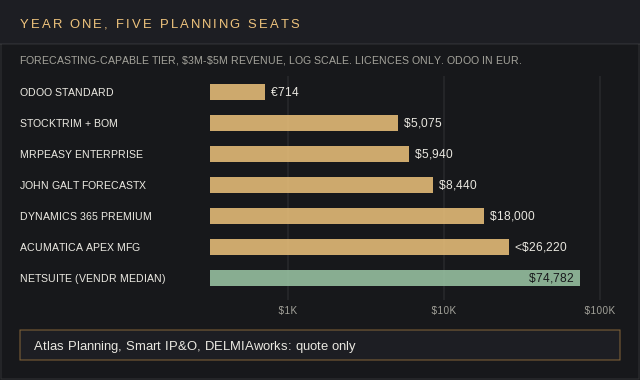
- Odoo Standard: €11.90 × 5 × 12 = €714
- StockTrim: $298 × 12 + $100 × 12 BOM add-on + $299 onboarding = $5,075
- MRPeasy Enterprise: $99 × 5 × 12 = $5,940
- John Galt ForecastX: $500 × 5 + $1,188 × 5 = $8,440
- Dynamics 365 SCM Premium: $300 × 5 × 12 = $18,000 before implementation
- Acumatica APEX for Manufacturing: under $26,220, unlimited users
- NetSuite: Vendr median $74,782 for the whole ERP
- Atlas, Smart IP&O, DELMIAworks: quote-only
Ranked tools that publish no price at all: Atlas, Smart IP&O and DELMIAworks. Each one routes a buyer to a sales call before any number appears.
Licence fees are a drop in the bucket next to implementation on the ERP tools. Our supply chain software pricing report covers the planning suites priced above this range.
Manufacturing forecasting challenges and data gaps
NetSuite and MRPeasy each list seven hurdles. The overlap explains most failed supply chain planning rollouts:
- Demand volatility: unexpected demand spikes lead to stockouts, lost sales and lower customer satisfaction
- Inaccurate historical data: unrecorded recalls or duplicate orders cause overproduction or underproduction
- External factors: economic shifts and tariffs move demand outside the plant's control
- Demand fragmentation: more variants spread the same volume across more SKUs
- Limited supply chain visibility: upstream delays surface only when a component is late
- Supplier lead-time variability: a fixed reorder point breaks when lead times swing
Fix data gaps first; a stitch in time saves nine. MRPeasy won't forecast on under three months of history and Katana won't generate replenishment demand without consumption data.
Clean the item master and lead times before any demo, because NetSuite's supply plan and StockTrim's order plan both read lead times per item, and a stale field produces a late purchase order. The inventory analytics software ranking linked above covers tools for managing inventory data before it reaches a planner.
How to run a forecast accuracy trial
Give every finalist the same holdout from your own supply chain data. Vendor demos run on clean sample data, so claims to improve forecasting accuracy only count on your own history.
Iron out the details with each vendor before step one: same item list, same months, same metric.
- Export 36 months of history for 200 items: 100 steady, 60 seasonal, 40 intermittent.
- Give vendors the first 24 months and keep the last 12.
- Score each forecasting model on MAPE for steady and seasonal items, bias for intermittent ones and fill rate, the number tied closest to customer satisfaction.
- Ask each vendor to explode the forecast through one multi-level BOM into planned work orders and production schedules.
Step four splits this manufacturing forecasting ranking in half. Accurate forecasts on steady sellers are common. Accurate demand forecasting that never reaches a work order still leaves a planner retyping numbers, and that's easier said than done at 2,000 SKUs.
Manufacturing industry outlook for 2026
US manufacturing employment slipped from 12.76 million in January 2025 to 12.72 million in August 2025, and the ISM manufacturing PMI stayed below 50 for much of the year, per Deloitte's 2026 manufacturing industry outlook. Manufacturers expect input costs to rise about 5.4% over the next year.
Deloitte's survey of 600 executives found 80% plan to put 20% or more of improvement budgets into smart manufacturing, and 92% call smart manufacturing the main driver of competitiveness.
The One Big Beautiful Bill Act raised the advanced manufacturing investment credit from 25% to 35%, which puts production forecasts for new lines in front of the board. Smart manufacturing budgets cover advanced technologies such as advanced analytics and AI. Industrial manufacturers who want to keep an eye on upstream supply chain risk can start with the supply chain risk management ranking and the supply chain industry guide.
Manufacturing forecasting software FAQ
What software is used for manufacturing forecasting?
Dedicated planning platforms (Atlas, Smart IP&O), ERP systems with forecasting modules (Dynamics 365, NetSuite, Acumatica, DELMIAworks, MRPeasy, Odoo) and add-ons (StockTrim, Katana). Enterprise supply chain suites appear in our Kinaxis review and Blue Yonder review.
Can Excel be used for forecasting?
Yes, for a few hundred SKUs, and John Galt sells ForecastX as an Excel add-in at $99 per user per month. Excel breaks on BOM explosion and shared editing once a second supply chain planner joins.
What is the best ERP for manufacturing forecasting?
Among ERP systems, Dynamics 365 on documented demand forecasting methods: four algorithms and published forecast consumption rules. NetSuite if multi-level work order planning matters more.
What is the best production planning software for manufacturing?
Atlas Planning for industrial manufacturing plants running S&OP, since its Schedule module allocates capacity from the same model. MRPeasy for small plants at $99 per user.
How do you forecast inventories?
Predict demand and future demand for finished goods, explode the BOM, subtract stock and open orders, and add safety stock for lead time variability. NetSuite's supply plan and StockTrim's BOM drilldown automate it.
How do you use AI to forecast demand?
Load 24 months of history for demand forecasting, let a best fit or ensemble forecasting model choose per item, and compare its MAPE with your current forecast on a 12-month holdout. The predictive intelligence software ranking covers future predictions outside the plant.
Bottom line
Atlas Planning wins for manufacturers who run S&OP and want demand, supply and the factory schedule in one forecasting model. Smart IP&O wins for spare parts and high-mix plants on Epicor or another supported ERP, where accurate forecasts on zero-heavy items matter most. Microsoft shops should start at Dynamics 365's $300 Premium tier, and NetSuite customers already own multi-level work order planning.
MRPeasy at $99 a user and StockTrim from $49 a month cover small plants; Odoo covers the ones willing to type the forecast in. For the wider supply chain view, see the supply chain intelligence ranking, the procurement intelligence ranking and the automotive industry guide.