Logility pricing in 2026: quote-only contracts after Aptean's $14.30-a-share buyout
 By Jan Suski. I go deep on every review, checking every number against its source and digging up details other coverage misses, a habit from six years of SEO and link building for tech companies. Bylines at Surfer, Brand24, and Senuto. How the scoring works.
The numbers Logility pricing, checked 6 November 2026
Logility sells subscriptions now: $14.5 million of subscription fees against $0.1 million of licences in one quarter.
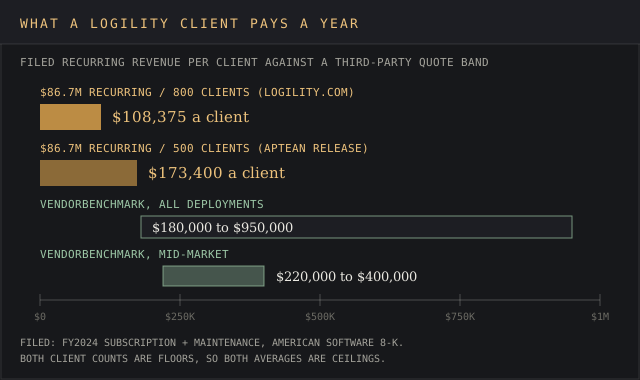
Recurring revenue of $86.7 million across 500 to 800 clients puts the average client at $108,375 to $173,400 a year.
Aptean's 27.0% premium bought a business whose total revenue fell 5% while subscription growth ran at 10%.
I'll write a 2,500+ word report on the vendor you name, with SEC figures, buyer benchmarks and contract terms sourced line by line. Yours to publish, from $200.
Logility pricing sits behind a demo form. The vendor's pricing URL carries two buttons, Request Demo and Let's talk, and no dollar figure. Aptean took the company private on 4 April 2025 at $14.30 a share in cash, which ended the quarterly filings that once showed exactly how Logility makes its money.
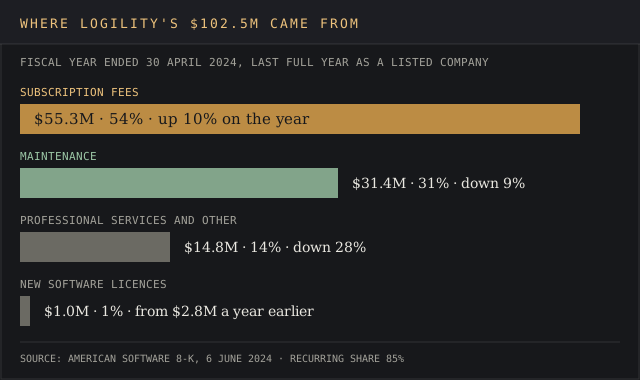
Those filings still do the heavy lifting. The last full fiscal year on record, ended 30 April 2024, booked $102.5 million in revenue, $55.3 million of it subscription fees. Divide recurring revenue by the client count and you get a ceiling on what the average client pays a year, which is the closest thing to a list price this vendor has ever published.
This report covers how Logility charges, what each module group covers, what the filings and buyer benchmarks say a contract costs, the hidden line items, and how Logility compares with Kinaxis, Blue Yonder, o9, SAP IBP and Oracle. It's written for supply chain planning leads and finance teams sizing a budget before the first sales call.
How Logility pricing works
Logility sells a modular subscription. Aptean's product page describes Logility Supply Chain Planning as "modular by design", built for "mid-sized and large organizations", and covering demand, supply, inventory, procurement and network optimization on one platform. Every contract is a quote assembled from the modules a buyer picks.
Logility's own cloud migration guide gives one hard term: "The default pricing for the Logility Digital Supply Chain Platform includes one non-production environment". A second test or training environment is a line item in the pricing.
The same guide lists the on-premises cost categories that a cloud subscription replaces: hypervisors, servers, licences, maintenance and support. It also says Logility ships updates and enhancements up to six times a year, so upgrades for cloud users arrive inside the subscription fee and on-premises clients pay for upgrades through maintenance and project work.
The shift from licences to subscriptions shows up in the filings. Licence revenue fell from $2.8 million to $1.0 million in fiscal 2024, while subscription fees rose 10%. By the quarter ended 31 October 2024, subscription fees were $14.5 million, maintenance $7.1 million and licences $0.1 million. A buyer in 2026 is quoted a subscription. Perpetual licences survive mainly as maintenance contracts on older installs.
Copy these lines into an email, fill them in and send. I reply with scope and a price within 2 to 3 business days.
Open the emailDemand planning, inventory optimization and other modules
The quote is built from module groups. Logility's site lists ten, each with its own named products, and a buyer licenses only the groups it needs. Gartner files the product in its supply chain planning solutions market, and Logility's own homepage title reads "AI-based Supply Chain Planning Solutions".
| Module group | Named products on logility.com | What a planner gets |
|---|---|---|
| Demand | DemandAI+, Demand Sensing | AI and machine learning demand forecasting on promotions, events, seasonality and trends |
| Inventory | InventoryAI+, MEIO, Automated Inventory Policies | Multi echelon inventory optimization across plants and distribution centres, plus inventory optimization policies per SKU |
| Supply | Supply Optimization | Constrained production and replenishment plans |
| Scenario planning | Operational Scenario Planning, Decision Command Center, S&OP, S&OE | Integrated business planning and what-if analysis |
| Supply chain design | Network Optimization | Network design for plants, warehouses and lanes |
| Deployment | Intelligent Order Response, Allocation & Deployment | Allocation of constrained stock to orders |
| Supplier management | Vendor, Sourcing, Quality & Product Compliance, Traceability | Supplier quality, sourcing and traceability records |
| Product | Merchandise Planning, Product Lifecycle Management | Assortment and range plans for retail and apparel |
| Manufacturing | Manufacturing Execution, Manufacturing Optimization | Shop-floor scheduling |
| Platform | AppCentral, Orchestration Center, Data Management, Advanced Analytics | Generative AI agents, data integration, machine learning features and dashboards |
Inventory is where the pricing gets technical. Logility's MEIO page sells multi echelon inventory optimization, which sets stock targets across every tier of a network at once, and buyers with one warehouse pay for capabilities they won't use.
Decision Command Center sits above the planning modules. Logility pitches it as a "single system of record and collaboration" for cross-functional decisions, which makes it the decision support capabilities layer that ties demand, supply and inventory plans together.
The platform tier is where Aptean is adding AI capabilities and features. Logility's homepage says generative AI "puts information at the fingertips of any supply chain stakeholder", and it calls AppCentral "the AI platform purpose built for industries". Ask which AppCentral agents and features are inside the subscription pricing and which are metered, because the devil's in the details on AI add-ons across this market.
What drives a Logility quote
Five inputs move the number. These come from Logility's product pages, its migration guide and the buyer-side benchmarks below:
- Module count, from one demand planning module to the full ten-group suite.
- Users, split by role into planners who build each plan and viewers who read the data and dashboards.
- SKU and location volume, which sets the size of the forecast, the supply plan and the inventory models.
- Environments, with one non-production environment in default pricing.
- Integration scope: the number of ERP, warehouse and customer relationship management systems that connect to the platform and feed the plan.
Integration scope is the hardest input to price up front. Logility's data management page describes a net-change method that only moves data changed since the last update and claims up to 90% less integration effort.
A Briggs & Stratton manager quoted there credits "very rapid and reliable integration with SAP". Buyers on an Oracle or Microsoft Dynamics ERP should get the connector work priced in writing, since the page names only SAP. Integration scope also drives the services bill, which sits outside the platform fee.
What buyers pay in practice
The filings put a ceiling on the average client's bill. Subscription fees of $55.3 million plus maintenance of $31.4 million made $86.7 million of recurring revenue in fiscal 2024. Logility's homepage claims 800+ customers, while Aptean's completion release cites "over 500 clients in 80 countries". Both counts are floors.
That gives two averages. At 800 clients, the average is $108,375 a year in recurring fees. At 500, it's $173,400. Because the client counts are minimums, both figures are ceilings on the average, and individual contracts spread on both sides of them.
VendorBenchmark, a buyer-side benchmarking company that sells negotiation software, publishes a Logility pricing page. Its methodology note cites a "$2.1B+ contract benchmark database" without a Logility contract count. Its estimates:
- Annual subscriptions of $180,000 to $950,000, with mid-market deployments at $220,000 to $400,000.
- Demand planning at $80,000 to $220,000 a year, inventory optimization at $60,000 to $180,000, and supply planning at $80,000 to $320,000.
- Power users costing about 2.5 to 3 times a standard user.
- SKU tiers from up to 10,000 SKUs to 500,000+, with the jump from the 50,000 to the 150,000 tier adding $80,000 to $140,000 a year.
- Discounts of 18% to 30% off list, contract terms of 3 to 5 years, and annual escalators of 3% to 5%.
The filed averages sit below VendorBenchmark's floor of $180,000. Treat its band as the price of a new multi-module deal in 2026 and the filed average as what the installed base, including small single-module clients, paid in 2024.
Want a spend-per-client chart like this for the planning suite you sell against? Send the vendor name.
Email a briefHidden costs: implementation, escalators and renewals
Implementation is billed outside the subscription, and support for the rollout often comes from a partner. Logility booked $14.8 million in professional services and other revenue in fiscal 2024, down 28%. Its Q2 fiscal 2025 release blames a further 10% services decline on "outsourcing of some services to systems integrators", so a 2026 buyer often pays a partner firm for the rollout on top of the subscription.
VendorBenchmark's research tells buyers to budget 50% to 90% of first-year subscription for implementation under Logility's implementation methodology, says mid-market projects run 4 to 8 months, and says scope creep pushes costs 30% to 50% over the estimate. G2's Logility listing, built from 132 reviews, puts average time to implement at 4 months and return on investment at 25 months.
Escalators compound. On a $220,000 subscription, a 5% annual escalator makes year five cost $267,411. Renewal is the other trap: VendorBenchmark puts Logility's proposed renewal increases at 5% to 9% absent any scope change, and advises opening talks 90 to 120 days before the term ends.
Setup time shows up in user reviews. A Gartner Peer Insights reviewer, a Director of Data and Analytics at a manufacturer with $50 million to $1 billion in revenue, wrote on 21 May 2026:
"We worked for months with the platform team who were amazing in customizing a unique solution for our company."
Gartner Peer Insights, Director of Data and Analytics, manufacturing, May 2026
A Software Advice reviewer in IT services at a 201 to 500 person company put it more bluntly in June 2026: "Setup was longer than we were told - i mean a lot longer."
What reviewers say about the money
Price complaints cover licence cost and setup effort. Software Advice lists 98 Logility reviews at 4.6 out of 5, with value for money at 4.5 and customer support at 4.6. A verified reviewer at an 11 to 50 person software company wrote in September 2026 that "The cost of licensing is completely ridiculous for small sized teams."
Brian W., at a 501 to 1,000 employee electronics manufacturer, wrote on Software Advice in September 2026:
"They are charging way too high of prices for this application considering at times how clunky it performs. Also getting set-up initially was a significant amount of effort as well."
Software Advice review, Brian W., electrical and electronic manufacturing, September 2026
Gartner Peer Insights tells a calmer story: 4.7 out of 5 across 234 ratings, with 0% at two stars or below. One critical review from a consumer goods Director of Operations, dated 19 May 2026, carries the title "Ease of use appreciated, but AI Stat forecast module feels clunky".
What the money buys
Logility backs its price with named customer results and the analytics capabilities behind them, from trends detection to anomaly flags. Its homepage lists Ferguson raising forecast accuracy by 70%, Tillamook County Creamery Association cutting finished goods inventory by 75%, Reynolds Consumer Products raising forecast accuracy by 20%, and U.S. AutoForce improving inventory turns by 10%. All four are vendor-reported figures.
The industries list runs to 12 on logility.com, and apparel, retail, and food and beverage each get a separate industry page. The list covers apparel, food and beverage, electronics and high-tech, chemicals, retail, process manufacturing and wholesale distribution.
Tillamook, a dairy cooperative, is the food production case, and Berry Global's Director of Integrated Supply Chain is quoted on Aptean's page crediting Logility with a consistent integrated business planning process across acquisitions.
For a planning team still running spreadsheets, the pitch is that planners respond faster and make more informed decisions from one platform that gives sales, finance and supply the same demand plan and the same visibility into inventory.
Logility's homepage tagline reads "Act smarter. Respond faster. Lead with confidence." The test is cheaper: ask for the forecast accuracy baseline on your own history during the demo, and get the ball rolling on a paid pilot before the full contract.
Who Logility pricing is built for
Aptean pitches Logility at "mid-sized and large organizations", and the price points match. Gartner's Peer Insights profile lists the business at 201 to 500 employees with an Atlanta head office, serving over 500 clients in 80 countries around the world.
Logility's homepage names four challenges that its pricing is meant to solve for organizations with complex supply chain processes:
- Complexity that keeps growing across products, plants and channels.
- Systems, teams and data that sit in silos.
- Uncertainty that planning processes struggle to manage.
- A workforce that has changed, with "no going back".
The buyer who gets the most from that pricing runs an ERP such as SAP, Oracle or Microsoft Dynamics, plans thousands of SKUs across several sites, and has outgrown spreadsheets.
Reviewer company sizes on Software Advice run from 2 to 10 employees up to 10,000+, and one of the two price complaints quoted above comes from a company under 200 people. A five-person planning team on a single site has cheaper tools to consider first, and Netstock at $900 a month or Dynamics 365 at $210 per user a month covers the basic plan.
Logility against its alternatives
Logility flies under the radar next to Kinaxis and o9 in market research, and it prices like them: by quote.
The supply chain planning market splits into vendors that publish rates for users and vendors that quote every deal. The rivals that do publish a number are the ERP vendors. Microsoft lists Dynamics 365 Supply Chain Management at $210 per user a month, SAP prints an IBP starter edition at $2,707 a month for 10 concurrent users, and Oracle's Fusion Cloud global price list puts Supply Planning at $1,250 per user a month.
| Vendor | Published entry price | Gartner Peer Insights rating | Ratings count |
|---|---|---|---|
| Logility (Aptean) | Quote only | 4.7 | 234 |
| Kinaxis Maestro | Quote only | 4.4 | 318 |
| Blue Yonder Supply Chain Planning | Quote only | 4.6 | 226 |
| o9 Digital Brain | Quote only | 4.8 | 203 |
| SAP IBP | $2,707 a month, 10 concurrent users | 4.7 | 190 |
| Oracle Fusion Cloud SCP | $1,250 per user a month, Supply Planning | 4.8 | 171 |
- The planning suites and modules to compare
- Regions, years and segments
- Where it runs: blog, white-label, gated or lead magnet
- Whose byline goes on it
- Deadline
- 2,500+ words, human-written
- Every figure linked to its source
- Yours to publish, under your name or none
- Hosting here for +$200, with your sponsored links
The SAP IBP and Oracle figures are vendor list prices, read off sap.com and Oracle's Fusion Cloud global price list. Logility, Kinaxis, Blue Yonder and o9 publish no price and sell by quote. No row uses a Vendr median.
Ratings come from Gartner research, via the alternatives panel on Logility's Gartner Peer Insights page. On price, a ten-user Oracle Supply Planning deployment costs $150,000 a year at list before services, which sits inside the filed Logility average of $108,375 to $173,400.
Smaller buyers have published alternatives. Netstock starts at $900 a month, laid out in our Netstock pricing report and the Netstock review.
For the full field, the supply chain software pricing report compares 18 vendors, and the demand forecasting software ranking places Logility seventh on documented forecast accuracy. Inventory-first buyers should read the inventory analytics software ranking, and plant-level planners the manufacturing forecasting software ranking.
How to negotiate a Logility contract
Logility's sales team knows the ropes, so walk in with your own data: SKU counts, user counts by role and the ERP systems the platform has to connect to. Four levers move the price:
- Bring a competing quote. Kinaxis, o9 or SAP IBP on the table changes the discount conversation, and VendorBenchmark puts achievable discounts at 18% to 30%.
- Cap escalators in writing at 3% or CPI, whichever is lower, for every year of a 3 to 5 year term, and put support levels and upgrade rights in the same clause.
- Price viewer seats separately from planner seats, so business users outside the planning team can read the plan.
- Ask for fixed-fee implementation tied to integration scope, with the partner firm named in the contract.
Ownership is the fifth lever. Aptean's CEO said in the deal announcement that he looked forward to welcoming Logility's "loyal customers and experienced team", and Logility's CEO said it would keep providing "AI-first solutions" alongside Aptean. Aptean sells industry-specific software to manufacturers and distributors, so ask for Logility priced standalone and bundled with any Aptean product you already run, and compare the two.
Budget against the filed average first. Use $108,375 a year as the anchor, and make every dollar above it map to a module, a SKU tier or a user count named in the quote. Keep a line for support and training too, since a new platform changes planning processes for every planner who touches the demand plan.
Delivered for your site and your byline. Hosting here is optional.
Frequently asked questions
How much does Logility cost per year?
Logility sells by quote. Its filed fiscal 2024 recurring revenue of $86.7 million across 500 to 800 clients puts the average client at $108,375 to $173,400 a year, and VendorBenchmark estimates new subscriptions at $180,000 to $950,000.
Is Logility an ERP system?
It's a supply chain planning layer that sits on top of an ERP. Logility pulls orders, inventory and demand history from SAP, Oracle, Microsoft Dynamics and other ERP systems through its data management module, and sends the supply and demand plan back.
What is Logility software?
It's supply chain planning software for demand planning, inventory optimization, supply planning, integrated business planning and network design. Aptean has owned it since 4 April 2025 and sells it as Logility Supply Chain Planning. The listed company was called Logility Supply Chain Solutions, Inc. before the buyout.
Who owns Logility?
Aptean, a provider of industry-specific software for manufacturers and distributors, bought Logility for $14.30 a share in cash, a 27.0% premium to its 23 January 2025 close.
How much does supply chain management software cost?
Published rates run from $210 per user a month for Dynamics 365 Supply Chain Management to $1,250 per user a month for Oracle Supply Planning. SAP IBP's starter edition costs $2,707 a month. Planning suites from Logility, Kinaxis and Blue Yonder sell by quote.
How much does project44 cost?
project44 sells by quote. Our supply chain software pricing report lists it with Kinaxis, o9 and Blue Yonder among the vendors that publish no rate card, and the supply chain visibility software ranking covers its tracking product.
Bottom line
Logility pricing is a quote built from modules, users, SKU volume, environments and integration scope. The last filings before Aptean's buyout show a company that sold $1.0 million of licences and $55.3 million of subscriptions in one year, so every 2026 deal is a subscription with implementation billed on top.
The filed numbers set an average of $108,375 to $173,400 a client a year, and VendorBenchmark's $180,000 to $950,000 band shows where new multi-module deals start. Cap the escalator, price viewer seats and get implementation fixed-fee before signing.
Planning vendors, ERP partners and operations teams use reports like this one in sales calls and budget reviews.
A report on your topic for a blog page, gated content or a lead magnet.
Written for your client and published under their brand, with my name left off.
Your report on marketintelligencetools.com, with 2 to 3 CTAs carrying your sponsored links.
Default terms: the report is yours to publish, and I keep the right to republish it on this site behind a gate, outside Google's index.
Sources, and the Logility numbers that went private with Aptean
Revenue, subscription, maintenance, services and licence figures come from the SEC filings on sec.gov: American Software's fiscal 2024 results release of 6 June 2024, Logility's Q2 fiscal 2025 release for the quarter ended 31 October 2024, and the deal announcement of 24 January 2025. The close date and the client count come from Aptean's completion release on aptean.com.
The pricing URL, module list, customer count, customer results and the one non-production environment term were read off logility.com, and the "modular by design" positioning off Aptean's product page. Buyer-side price bands, discounts, escalators and implementation ratios are VendorBenchmark estimates from vendorbenchmark.com. Rival list prices come from microsoft.com, sap.com and Oracle's Fusion Cloud global price list.
Ratings and reviews come from Software Advice, Gartner Peer Insights and G2, dated in the text, with quotes verbatim. Everything was checked 6 November 2026.
Logility has published no rate card and no per-module price since the buyout, and Aptean files no quarterly numbers, so the fiscal 2024 filings are the last first-party revenue data on record.