Netstock review: what $900 a month buys a distributor running a mid-market ERP
 By Jan Suski. I go deep on every review, checking every number against its source and digging up details other coverage misses, a habit from six years of SEO and link building for tech companies. Bylines at Surfer, Brand24, and Senuto. How the scoring works.
Best for
Distributors and light manufacturers on NetSuite, Sage, Acumatica, Microsoft Dynamics or SAP Business One who order from spreadsheets today and want safety stock, classification and suggested purchase orders in one place.
Not for
Manufacturers with deep bills of materials, planners who need same-day data, or anyone who wants a monthly contract. Users report a 24-hour ERP lag, and Netstock sells annual subscriptions only.
What it costs
Pricing starts at $900 a month, or $10,800 a year, on an annual term. Every bundle above that floor is a custom quote, and one CFO reports paying about $2,400 a month on a 24-month agreement.
- Founded
- 2009, by four co-founders including Tony Sinton
- Owner
- Strattam Capital, majority stake since October 2020
- CEO
- Ara Ohanian, since December 2021
- Customers
- 2,500+ in 67 countries, 20,000 users
- Inventory managed
- $26 billion across customers
- Core module
- Predictor Inventory Advisor
- S&OP module
- Predictor IBP, from the Demand Works deal
- Forecast buckets
- Weekly or monthly
- Forecast approaches
- Bottom-up, top-down, middle-out
- ERP integrations
- 12 named on solutions pages, 33 logos on the integrations page
- ERP sync
- Daily data extraction and import
- Published floor
- $900 a month, $10,800 a year
- Term
- Annual subscription
- Bundles
- Essentials, Advanced, Commercial, plus a Demand Planning add-on, all quoted
- Vendor rollout claim
- 6 to 10 weeks
- Security
- ISO 27001 on both products
- G2
- 4.6 out of 5 across 181 reviews
- Capterra
- 4.8 out of 5 across 75 reviews
- TrustRadius
- 8.3 out of 10 across 33 ratings
GMDH Streamline
Not forA buyer who wants a price before the first call, which Netstock prints at $900 a month.
Kinaxis
Not forA 20-person distributor that needs suggested purchase orders this quarter.
Pairs well with Netstock
What Netstock publishes about itself, and which figures are its own
The $900 floor, the annual term, the 6 to 10 week rollout and ISO 27001 come from netstock.com/pricing; bundles from netstock.com/packages; customer, user and inventory counts from the homepage, all read on 19 October 2026. Founding, ownership and CEO come from Strattam Capital’s 2020 and 2021 releases.
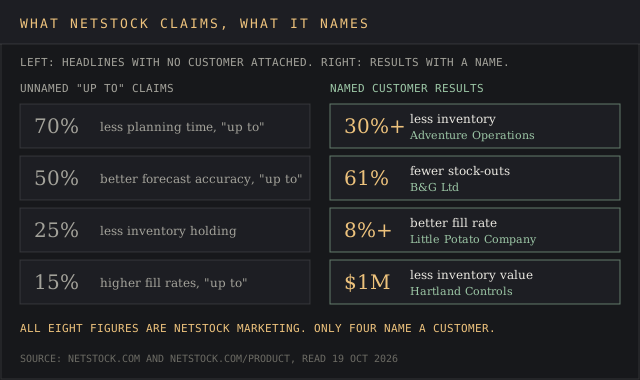
The 30%, 61%, 8% and $1 million results and the “up to” claims are Netstock’s own marketing. G2, Capterra and TrustRadius figures describe those platforms’ review sets, read in October 2026; most Software Advice and Capterra reviews are vendor-invited.
What is Netstock? It's a cloud-based supply and demand planning platform for inventory management. It sits on top of an ERP, reads its raw data once a day, and tells a buyer what to order, how much safety stock to hold and which SKUs are drifting into excess stock. It doesn't replace the ERP. It replaces the spreadsheet a business bolts onto it for purchasing.
This review covers the modules, the demand forecasting engine, the data sync, the bundles and the contract terms behind the $900 a month starting price, plus five alternatives.
The timing matters. Netstock only started printing that floor in late July 2026, after years of form-gated pricing, according to PricingSaaS's page tracker. For a 50-person distributor that's the first hard number to put next to a quote from GMDH Streamline or Slimstock, neither of which prints one. Small companies can finally budget for supply chain planning software before the demo.
What is Netstock, and who owns it
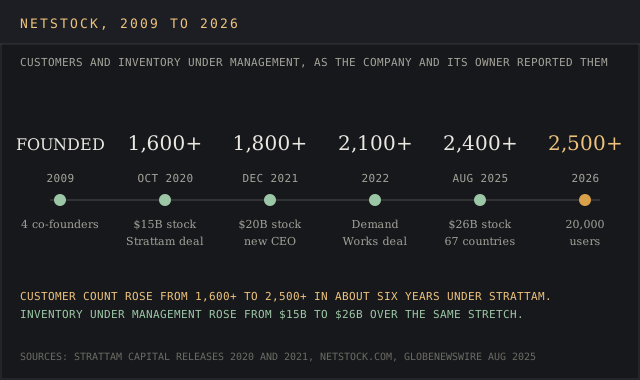
Netstock was founded in 2009 by Tony Sinton, Barry Kukkuk, Craig de Kock and Andy Hiscox, per Strattam Capital's December 2021 release. Strattam took a majority stake in October 2020, when the supply chain planning vendor reported 1,600+ customers and $15 billion of inventory under management. The same release named Ara Ohanian, a former Infor executive, as CEO in place of Sinton.
The company then bought Demand Works, an S&OP vendor for mid-sized and larger manufacturers and distributors, and the combined business passed 2,100 customers. By August 2025 a GlobeNewswire release put it at 2,400+ customers, 67 countries and $26 billion of inventory. The homepage now says 2,500+ customers and 20,000 users on its cloud-based platform.
Two product names from its inventory planning history still float around partner sites. Predictor Inventory Advisor is the core replenishment module, listed under that name on the Sage marketplace. The higher level sales and operations planning layer that came with Demand Works is sold as Predictor Integrated Business Planning. Netstock isn't part of NetSuite and isn't an ERP; NetSuite is one of the systems it plugs into.
Key features of the inventory optimization and inventory planning modules
The inventory optimization module classifies every item by sales value and sales velocity, then sets safety stock per class so stock arrives at the right time, to reduce stock outs and reduce excess inventory at once. Demand planners set target fill rates by category, so the inventory policy balances stock levels against customer service levels and customer satisfaction.
The exception-based dashboard surfaces urgent stock issues by listing the top 5 SKUs under each KPI: stock outs, excess stock and fill rate. That's how the platform points a buyer at the lines worth a look, since nobody reviews 8,000 SKUs a week.
Those exception-based dashboards come pre-configured and give full visibility across locations, which is most of the onboarding pitch for this inventory management solution and its demand planning features. An executive dashboard sets sales and inventory KPIs against past performance, so sales trends and stock trends show up by location. Other planning features worth naming:
- Suggested purchase orders that optimize order quantities around MOQs, lot sizes, vehicle loading (a logistics limit) and lot expiration dates.
- Supplier performance monitoring that adjusts safety stock when lead times slip, and AI that drafts emails for late orders, per the product page.
- Excess redistribution, which converts surplus at one site into transfer orders in the source system, according to the Sage listing.
- An AI container builder in the Commercial bundle to optimize container fills.
- A report builder producing .xlsx files in five report types, Netstock's answer to customizable reports, plus scenario comparisons and policy modeling.
- Stock projection, which predicts stock, fill rate and supplier spend for the next 12 months.
On top sits the artificial intelligence layer, built to focus attention on the supply and demand exceptions that cost money. The Opportunity Engine generated a new recommendation for a customer every 90 seconds and passed one million recommendations by August 2025, per the GlobeNewswire release. The release describes it as reading real-time inventory data. In practice the input is yesterday's ERP extract, so treat those real time insights as daily ones.
New users hit the ground running, according to a G2 reviewer at a veterinary supplier, July 2026:
"With our previous system, training took several weeks, and even then it still required months of additional training. With Netstock, we can have new users up and running within a week."
G2 review, mid-market veterinary distributor, July 2026
A wholesaler on Software Advice, March 2020, singled out the ordering solver: "The solver ability to build orders up to a volume (such as a container) is a real time saver as well." (Software Advice, wholesale, 11-50 staff)
How Netstock's demand forecasting works, and where it breaks
Netstock's demand planning add-on builds forecasts bottom-up, top-down or middle-out, in weekly or monthly buckets, across product, customer, channel and region hierarchies, and adds forecast performance monitoring.
Sales, operations and finance each enter a view on top of sales history, and the planning process merges them into one demand plan in any currency or unit. That's collaborative forecasting, where operations teams and finance get on the same page. Without the add-on, demand planning stops at item-level forecasting for ordering.
Under the hood, Netstock says its forecasting uses machine learning that reads promotions, events, seasonality and baseline trends from historical patterns to project future demand, and its advanced algorithms pick a model per item. It doesn't publish which models.
Lokad scored Netstock 4.0 out of 10 on supply chain depth and 3.4 on "decision and optimization substance," and wrote that "the AI layer is marketed more aggressively than it is technically explained." Lokad sells a competing forecasting product, so discount its take on Netstock's artificial intelligence. Users say similar things.
"Some forecasting models are rigid, requiring manual overrides for unique or volatile SKUs. Lead time accuracy is heavily dependent on ERP data quality, so results vary if master data isn't clean. Reporting customization is limited, and deeper analytics sometimes require exporting to Excel or BI tools."
Software Advice review, inventory manager, consumer goods, December 2025
A purchasing user on G2 in May 2021 put it more bluntly: "Sales forecast - although sometimes I sit and wonder why it's been 100, 100, 100 for the last 3 years - then question 200." The same reviewer added that "if there are a lot of BOM components, I think it needs development." (G2, small business, May 2021)
That BOM point is the line between finished goods and raw materials. Demand forecasting for finished goods works well enough in distribution. For supply chain planning through multi-level bills, the territory of our manufacturing forecasting software ranking, the devil's in the details, and the clearest failure sits in a G2 review from a CFO in October 2026:
"These included issues involving fractional units of measure and BOM conversions. At one point the system produced an obviously unusable recommendation with approximately $27 million of model value for shrink wrap."
G2 review, CFO, mid-market manufacturer and distributor, October 2026
Accurate forecasting for seasonal demand draws the same complaint. A consumer goods reviewer on G2 titled a 2.5-star review "not great for seasonal modelling" (September 2024). A wholesaler on Software Advice, January 2023, noticed forecasts miss on "slower movers and seasonal needs" (Software Advice, wholesale).
ERP integration and the 24-hour data lag
Netstock's solutions pages name 12 systems: NetSuite, Sage, Acumatica, Microsoft Dynamics, SAP Business One, Unleashed, MYOB, Cin7 Core, Klipboard ERP One, Klipboard Manufacturing, SYSPRO and Fishbowl.
The integrations page shows 33 logos, and the pricing page claims more than 60 systems. Integration is the strongest selling point of this inventory management and demand planning software, and the reviews back it. Buyers who want advanced analytics will still end up in a BI tool, per the consumer goods review above.
"The integration between NETSTOCK with our Acumatica ERP was relatively straightforward. We achieved a 50% reduction in stockholding and a 15% fill rate improvement."
Software Advice review, retail, 51-200 staff, June 2020
The catch is freshness. The help center describes "daily data extraction and import", and suggested orders go back as uploaded purchase orders and transfer orders. A replenishment manager on Software Advice, December 2025, called "being 1 day behind our ERP" a challenge "in the scheduling of our processes." A buyer in automotive the same month went further:
"The lack of live data has been a real challenge when looking for backordered items specifically. We often still need to be looking in our ERP system while ordering."
Software Advice review, buyer, automotive, December 2025
For a weekly purchasing process a one-day lag costs nothing, since supplier lead times measured in weeks swallow it. For a team chasing backorders by the hour, it means two screens open, a red flag to raise in the demo. Ask what period the sync covers and when it runs, so orders land at the right time.
Netstock pricing, bundles and the contract
The pricing page says "Pricing starts at $900/month" on an annual subscription. The packages page lists three bundles and an add-on, each marked "Get a custom quote." Our Netstock pricing breakdown walks through what drives each quote.
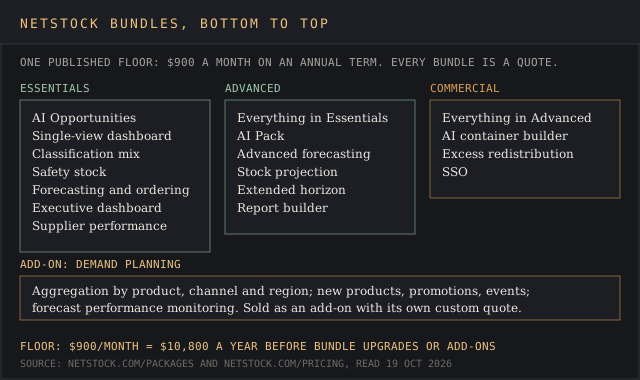
Essentials covers the inventory planning basics: classification, safety stock, demand forecasting and ordering. Stock projection and the report builder need Advanced. Excess redistribution across locations and SSO need Commercial, two steps up.
The one real contract price on record comes from that October 2026 G2 review: "At approximately $2,400 per month, Netstock needed to provide a meaningful improvement over what we were already able to accomplish internally with Excel, Jet Reports, and direct ERP data. It never cleared that bar."
The same CFO tried to leave early and couldn't:
"Netstock reviewed the request multiple times, including with senior customer success and finance leadership, and declined both an early release and any financial compromise. Their final position was that they were not permitting customers to exit contracts early given current economic conditions."
G2 review, CFO, mid-market, October 2026
Add-ons draw the other price complaint. A packaging reviewer on Software Advice wrote in July 2023 that "There isn't much flexibility without extra costs," and a construction reviewer said in March 2020 that some "pay extra" features "are not as high value for the money as the main system." The automotive buyer quoted above also flagged "the surprise rate increase." Read the renewal clause before signing.
A retail reviewer on Software Advice, July 2024, listed the full bill as "software licenses, implementation fees, and possibly ongoing maintenance or subscription fees." For a distributor carrying millions in stock, $10,800 a year is a drop in the bucket next to one bad buying season, but a locked 24-month term is a different bill. Run both term lengths through the NPV calculator before signing.
The other side exists too. A wholesale reviewer in September 2022 wrote that they "love the monthly subscription, no high implementation costs, great customer service," and a food and beverage reviewer in February 2020 called it a "Great low risk adoption commercial model." The second one came through a vendor referral.
Implementation and the planning process: 6 to 10 weeks on paper
Netstock's pricing page says implementation "typically takes 6-10 weeks," with a dedicated support team and training during setup. Timing depends on data complexity, business size and the ERP, per the same page, which also says both Netstock products are ISO 27001 certified.
On the homepage, it promises "fully operational in 90 days or less." G2's sidebar lists 3 months as the time to implement. Datup, a competitor, claims 2 to 6 months in its FAQ, against 4 to 8 weeks for its own fixed monthly, unlimited-user plan.
The vendor's figure is the one to hold it to. The outlier on record is the CFO: "Roughly nine months into a twenty-four-month agreement, Netstock was still describing us as only then beginning a six-week "Active Use" phase prior to onboarding completion." That review adds, "We were also billed throughout the extended implementation."
The common thread in the analysis of these reviews is raw data quality, and it's where operations and finance should focus first. Cleaning years of ERP history is easier said than done. A founder in apparel on Software Advice, August 2026, rated it 5 overall but 2 on ease of use:
"The setup process requires a solid amount of time and effort up front, particularly around getting historic ERP data cleaned up and mapped correctly. If your underlying data isn't clean, the forecasting models take extra tweaking before you can fully rely on the recommendations."
Software Advice review, founder, apparel, 2-10 staff, August 2026
A consumer goods reviewer in October 2022 found implementation problems "months after implementation that cost us thousands of dollars in unnecessary inventory investment."
A stitch in time saves nine: audit lead times and units of measure before the planning process starts, and the analysis Netstock produces has something solid to stand on. Most implementation trouble in these reviews traces back to data, and companies that skip the cleanup pay for it in excess inventory.
What users praise most: less excess inventory and full visibility
Strip out the "up to" claims on the product page (70% less planning time, 50% better forecasting accuracy) and the named results still stack up.
Netstock's homepage credits Adventure Operations with 30%+ less inventory, B&G with 61% fewer stock-outs, the Little Potato Company with an 8%+ fill rate gain, and Hartland Controls with $1 million of inventory value cut. Two of the four companies cut excess inventory, and B&G's 61% is the pitch to reduce stock outs in a single number.
Users report the same direction without the gloss. The veterinary reviewer on G2 wrote: "Since start of year we have reduced working capital by 19% across 9 warehouses (2 in NZ and 7 in Australia) and increase fill rate at the same time." Higher fill rate with less cash tied up is the growth that justifies $10,800 a year.
"It takes the guesswork out of purchasing, saves hours every week on purchase order creation, and gives us clear visibility into optimal safety stock levels."
Software Advice review, founder, apparel, August 2026
A wholesaler on Software Advice, September 2022, gave the reason for switching in one line: "Netstock was like a Ferrari vs. a wheelbarrow." That's par for the course for companies leaving spreadsheet forecasting.
The ratings are high: 4.6 from 181 reviews on G2, 4.8 from 75 on Capterra, and 8.3 from 33 on TrustRadius. Most Software Advice and Capterra reviews are marked as vendor-invited or incentivized, and the harshest G2 review is marked organic. Read between the lines.
Which companies and supply chain teams Netstock fits
Lokad, a competitor, describes the base as SMB-heavy and "lower-mid-market," and the vendor's own industry pages focus on wholesale, retail and manufacturing companies. The fit is a business with many suppliers, thousands of SKUs and nobody with time to run supply chain planning by hand in a spreadsheet, which is the gap this planning software fills at the SMB end of the market.
Supplier complexity, with lead times that vary by vendor, is where the inventory optimization earns its fee.
"We now have around 3000 SKU's and use 80 odd suppliers while turning inventory around 8.5 times per annum with minimal excess"
Software Advice review, hospitality, 11-50 staff, February 2020, vendor-referred
Distribution companies with logistics constraints, such as container fills, get the most from the ordering solver. Supply planning across plants and capacity needs Predictor IBP, a bigger supply chain project. For growth from one warehouse to nine, redistribution in Commercial matters most. Large enterprises with multi-tier networks are a different market, served by Kinaxis or o9 Solutions.
Frequently asked questions
Is Netstock part of NetSuite?
No. Netstock is an independent company owned by Strattam Capital. NetSuite is one of 12 systems it names as a pre-built integration.
Is Netstock an ERP system?
No. It's a supply and demand planning platform for inventory management that reads data daily and sends purchase and transfer orders back. It needs an ERP underneath.
Who owns Netstock, and who is the CEO?
Strattam Capital has held a majority stake since October 2020. Ara Ohanian has been CEO since December 2021, succeeding founder Tony Sinton.
How much does Netstock cost?
Pricing starts at $900 a month on an annual subscription, so $10,800 a year at the floor. Bundles and add-ons are quoted. One mid-market user reports about $2,400 a month.
What is the best demand planning software?
The right demand planning software depends on company size and forecasting needs. Our demand forecasting software ranking puts o9 Solutions and Kinaxis on top for enterprise demand planning and Netstock at #9 as the pick for small distributors that want a visible price.
Netstock vs alternatives
GMDH Streamline. Streamline says 2,000+ businesses use it and lists 26 named connectors, including Excel, ODBC and QuickBooks. G2 lists 263 reviews at 4.4 out of 5, a shade under Netstock’s 4.6. It wins for a QuickBooks shop or a team that wants demand planning and forecasting off a spreadsheet export. It loses on price visibility: its pricing page is a request form, where Netstock prints $900 a month.
Slimstock Slim4. Slimstock reports 1,700+ customers in 75 countries, operating since 1993. It wins for larger companies in wholesale or retail that want local consultants on site for inventory optimization. It loses for a 20-person distributor that wants a price before a supply chain consultant shows up.
Inventory Planner by Sage. Inventory Planner prices by the volume of inventory managed and includes unlimited users. It's a Shopify-first solution and wins for Shopify, Amazon and WooCommerce sellers that need demand forecasting by channel. It loses for a distributor on SYSPRO or Acumatica, which aren't on its list.
Kinaxis. Kinaxis booked $548.0 million of revenue in 2025 and sells a concurrent supply chain planning solution to large manufacturers. G2 lists only 13 reviews for it. It wins on scenario depth and multi-tier supply planning, covered in our Kinaxis review. It loses for a small team, which gets no rate card and a project sized for a global manufacturer.
Cin7 Core. Cin7 Core runs $349 to $1,199 a month and sells ForesightAI forecasting as a paid add-on. It wins when the business needs the inventory system itself. It loses on supply chain planning depth, and Netstock lists it as a supported integration.
For a wider field, see the inventory analytics software ranking and the price ranges in our supply chain software pricing report.
Verdict
Netstock is for a distribution business or light assembler with a supported ERP and a buyer drowning in spreadsheet demand forecasting. The $900 a month floor, a week of training for new users and reported results like 19% less working capital make the case. That's the 82 for fit in the scores above.
It isn't for a manufacturer that needs deep BOM supply planning, a team that needs intraday data, or a buyer who wants an exit clause. The $27 million shrink-wrap recommendation, the 24-hour sync and a CFO refused an early release on a 24-month contract explain the 45 for forecasting depth and the 30 for contract flexibility.
It might suit mid-market companies whose supply planning needs S&OP through Predictor Integrated Business Planning, provided they price the Demand Planning add-on and the Commercial bundle in the first call and clean master data first. Get the renewal cap in writing, and the ball is in Netstock's court to prove its supply chain forecasting on your own data.