Kinaxis review: what Maestro's concurrent planning delivers
 By Jan Suski. I go deep on every review, checking every number against its source and digging up details other coverage misses, a habit from six years of SEO and link building for tech companies. Bylines at Surfer, Brand24, and Senuto. How the scoring works.
· Prefer this source on Google
Best for
Large enterprises, generally $1 billion or more in revenue, replacing a sequential legacy APS like SAP APO and needing real cross-functional what-if scenario simulation.
Not for
A buyer wanting self-serve pricing, a fast go-live, or a published rate card. None of those exist here, and Capterra confirms there's no free trial to kick the tires before signing.
What it costs
No published rate card. Vendor-benchmark aggregators put licensing at $100,000 to $500,000-plus a year, and total year-one cost with implementation at $500,000 to $2,000,000.
- Core platform
- Maestro, formerly RapidResponse, a single in-memory data model spanning demand, supply, inventory, capacity and production
- Concurrent planning
- Replans the whole network in near-real time when one input changes
- Scenario simulation
- Unlimited what-if sandboxes that don't touch live data
- Concurrent execution
- Added August 2022, extending the model into orders, logistics and transportation
- Developer Studio
- Opened to third-party developers October 2020
- Deployment
- Cloud SaaS only, on a proprietary in-memory database
- Founded / HQ
- 1984 as Cadence Computer Corporation, headquartered in Ottawa, Canada
- Current CEO
- Razat Gaurav, appointed 12 January 2026
- FY2025 total revenue
- $548.0 million, up 13% year over year
- SaaS revenue
- $362.4 million, up 17%, 66% of total revenue
- Annual recurring revenue
- $433 million at the Q4 2025 exit, up 20%
- 2026 guidance
- $620 million to $635 million in total revenue
- Published rate card
- None; every path on kinaxis.com ends at "Request a demo"
- Pricing model
- Custom quote, negotiated per module and per user count
- Free trial
- None; Capterra lists no trial option
- Implementation
- Six to eighteen months, typically with a systems integrator
- Reference customers
- Lockheed Martin, Unilever, ExxonMobil, Geodis, Siemens Healthineers, Jabil, Bosch
- Named industries
- Automotive, aerospace, life sciences, semiconductor and CPG
- AI forecasting
- Planning.AI and Demand.AI, statistical and machine-learning models
- Composable AI / agents
- Maestro Agents launched 17 October 2025, with Agent Studio in limited availability
- Analyst standing
- 2026 Gartner Magic Quadrant Leader, Discrete and Process Industries
- Third-party rating
- 4.4/5 across 300 ratings on Gartner Peer Insights
- Technical transparency
- 4.0/10 per Lokad, for AI claims without published solver names
Alternatives to Kinaxis
Blue Yonder
Not forA buyer who needs Kinaxis's concurrent, cross-functional replanning depth without adding execution modules it doesn't need.
o9 Solutions
Not forA buyer who wants the deepest possible evidence base before committing; o9's independent review volume is thin.
Pairs well with Kinaxis
Kinaxis sells Maestro, an AI-assisted supply chain planning platform built around what the company calls concurrent planning: a single data model that pushes a change in one part of a supply chain out to every other part of it in near-real time. This review covers what that architecture delivers in production against what the vendor claims.
It draws on FY2025 financial results, Gartner Peer Insights and G2 ratings, and firsthand accounts from a 2025 r/supplychain implementation thread and Kinaxis's own Indeed and r/ottawa employee reviews. It's written for supply chain leaders weighing an advanced planning purchase where an eighteen-month implementation and a six-figure systems-integrator bill weigh on the decision from day one.
The timing matters. Kinaxis reported record fourth-quarter 2025 results on 4 March 2026, installed a new CEO on 12 January 2026, and enters the year defending Leader status in the 2026 Gartner Magic Quadrant against SAP, o9 Solutions, Blue Yonder and Anaplan. None of that settles if concurrent planning is worth the price for a given company; it means the figures below are current enough to check against what users report.
Our supply chain intelligence ranking covers Kinaxis against the rest of the category, including what to look for if you're new to the space.
What Maestro does
Kinaxis defines concurrent planning as a model that "takes into view the whole planning network and aligns data so that a change in one part of the supply chain triggers corresponding changes and communications in the rest of the chain, in near-real time." Demand, supply, inventory, capacity and production planning share one dataset, the same numbers every module reads and writes in real time.
Older systems like SAP's APO pass files between separate modules running on separate schedules.
The platform has grown well beyond that core planning engine:
- Concurrent execution, added August 2022, extends the same model into order, logistics and transportation decisions.
- Developer Studio, opened to outside developers in October 2020, lets customers build custom apps on the platform.
- A proprietary in-memory database and native Node.js bindings power the scenario engine, documented on Kinaxis's own engineering blog in more technical detail than most SaaS planning vendors publish about their internals.
- Kinaxis listed the platform, then still branded RapidResponse, on the Google Cloud Marketplace in 2023, giving buyers already on Google Cloud infrastructure a procurement path that skips a separate hosting contract.
"It's pretty robust for scenario planning and its agile approach to demand/supply disruptions. Through my line of work, it's been successful for semiconductor and CPG companies."
A user in a 2025 r/supplychain thread on Kinaxis, describing where the tool has worked well
"The scenario sandbox is handy for reviewing impacts of different constraints though and I like you can easily rotate through different units of measure and the alert reports can be very useful."
A supply/production planner in the same r/supplychain thread, comparing Maestro to SAP APO and spreadsheet workarounds
AI agents and Composable AI: how much of it is proven
Kinaxis launched Maestro Agents on 17 October 2025: AI co-workers embedded in the platform that analyze live data, flag issues, recommend next-best actions and automate routine analysis, with human-in-the-loop review and an "explainable reasoning" claim attached. A limited-availability Agent Studio lets customers build their own agents, and Kinaxis has said a broader agent marketplace is coming in 2026.
"Kinaxis agents are already helping our planning team collaborate more effectively with customers and contract manufacturers."
John Finnigan, Jabil's senior director of advanced planning, in Kinaxis's own vendor-published launch materials
Independent scrutiny of the underlying AI claims is thinner. A technical review by supply chain analyst Lokad scored Kinaxis 4.0 out of 10 on technical transparency specifically because Planning.AI and Demand.AI claims arrive without solver names, benchmark protocols or reproducible evaluation evidence, even though Kinaxis's own engineering blog posts about its database and Node.js layer are concrete.
The lowest mark went to vendor seriousness, 3.8/10, on the finding that a company with forty years of real planning-engine work is increasingly reframing that substance through AI and agent language "not yet supported by equally strong public technical evidence." Supply chain depth scored highest at 4.8/10, crediting Kinaxis with genuine domain coverage across demand, inventory, supply, capacity, production and sales-and-operations planning under one model.
The gap sits specifically between the older, documented planning core and the newer agent claims layered on top of it.
Company history: from Cadence Computer to Maestro
Kinaxis was founded in Ottawa, Canada in June 1984 as Cadence Computer Corporation. Four decades of milestones turned it into the company defending a Gartner Leader position today:
- 1986: ships an in-memory planning engine that cuts MRP run times from days to minutes.
- 1996: releases what it calls the first advanced supply chain planning platform with scenario-building.
- 2005: renames itself Kinaxis and launches a cloud-based version the same year.
- 2014: lists on the Toronto Stock Exchange under ticker KXS.
- 2015: first appears as a Gartner Magic Quadrant Leader, a position it has now held for over a decade.
- 2020: acquires Prana Consulting in February for services capability, and Rubikloud in July for retail and AI-adjacent technology.
- 2022: acquires MPO in August, supplying the orchestration features behind concurrent execution.
- 2026: Razat Gaurav becomes CEO on 12 January, with board chair Bob Courteau stepping back from the interim role.
Gaurav spent five years as CEO of Planview and previously held senior roles at LLamasoft, Blue Yonder and i2 Technologies, giving him direct experience at three of Kinaxis's own competitors before he arrived to run it. His stated vision was to "champion the next generation of AI-driven decision making and supply chain orchestration, using the Maestro platform," a continuation of the agent strategy already underway.
Financial health: what FY2025 says about the vendor
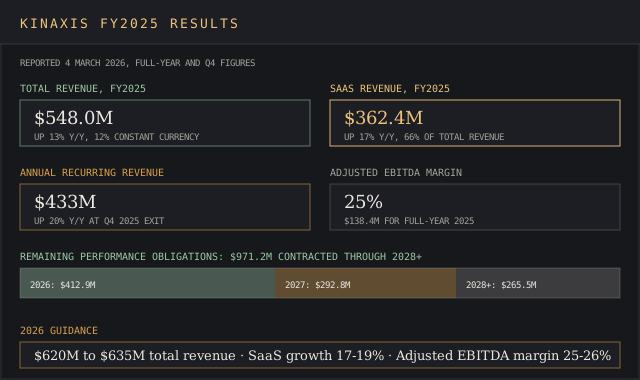
Kinaxis reported $548.0 million in total FY2025 revenue, up 13% year over year, with SaaS revenue of $362.4 million growing 17% and now making up 66% of the total. Annual recurring revenue closed the year at $433 million, up 20%, against a 25% full-year Adjusted EBITDA margin.
Contracted revenue through 2028 and beyond, including $412.9 million due in 2026 alone. Guidance for 2026 calls for $620 million to $635 million in total revenue and 17% to 19% SaaS growth, roughly in line with FY2025's pace.
For a buyer weighing a multi-year contract, those numbers say the vendor is growing and profitable enough to be around for the life of the deal, which isn't a given in a market that has seen Blue Yonder acquired by Panasonic and JDA rebranded twice in the past decade.
Pricing: what buyers face without a rate card
Kinaxis publishes no pricing tiers anywhere on its own site; every path on kinaxis.com ends at "Request a demo," and Capterra lists no free trial for the platform. That leaves buyers negotiating from a blank page, which cedes negotiating power to the vendor's sales team during the deal.
| Cost component | Range | Source |
|---|---|---|
| Software licensing, annual | $100,000 to $500,000-plus | Vendor-benchmark aggregators |
| Implementation, one-time | $150,000 to $500,000 | Vendor-benchmark aggregators |
| Total year-one, all-in | $500,000 to $2,000,000 | Vendor-benchmark aggregators |
| Implementation timeline | Four to eighteen months | Vendor-benchmark aggregators and user accounts |
In the absence of a rate card, a documented competitive evaluation is the lever users describe moving the number: bringing evidence that a named alternative was evaluated tends to shift the quote. That's standard practice in this market.
Implementation and the learning curve
Multiple users describe implementations that ran into real friction before going live. One person going through a rollout wrote that the process left them "feeling a little underwhelmed vs. what was expected," and a planner working the supply and production side reported specific trust problems with the platform's disaggregation logic.
"On the supply/ production planning side I've had a lot of issues trusting forecast consistency, and top down disaggregation. Our Demand Planning team is having to relearn a lot, needs to be vigilant with cleansing, and spends way more time validating the forecast stability in the next 30 days..."
A supply chain planner in a 2025 r/supplychain thread, describing implementation-phase issues with Maestro's demand module
"The demand planning/forecasting piece is very hard to manage at implementation and creates a ton of work for validation of updates. The forecasting scenario comparisons and scorecards did not live up to the hype."
The same planner, on the gap between Maestro's marketed forecasting tools and what shipped
Another commenter pointed to root cause: implementations that go badly are often staffed with consultants who don't know the platform, since a poorly configured "workbook structure" is a common failure point. That tracks with the six-to-eighteen-month, systems-integrator-dependent rollout pattern users describe elsewhere in the discussion.
What users say works
Where Maestro draws genuine praise, it's specific: the scenario sandbox, the ability to rotate units of measure without rebuilding a model, and head-to-head comparisons against SAP Integrated Business Planning, the incumbent most Kinaxis buyers are replacing or running alongside.
"I prefer it over SAP IBP. Scenario planning is a great feature and overall looks like a more solid tool."
A r/supplychain user in 2025, comparing Maestro directly to SAP IBP after using both
Another user who had implemented both systems put a finer point on it: Kinaxis "does edge out SAP IBP scenario planning for sure and there is more functionality for collaboration," while noting the demand forecasting overhead was comparable across both platforms.
A third user who works data integration on Kinaxis projects for a living made the case for the platform's core value proposition in plainer terms: "the benefit is that all data is in one place so you don't have to pull it from different sources," and API-fed data from a client's ERP holds up because it isn't re-keyed by hand.
What users complain about
The most consistent complaint across the same discussion thread is that Maestro doesn't fully replace the spreadsheet habits it's supposed to end. One user described exporting Kinaxis output back into Excel to build the workarounds the platform itself was meant to eliminate: "It doesn't get me what I need on most days and often put it into excel and use my own workarounds."
A second, mid-implementation, expected the same outcome before go-live: "we'll still wind up exporting to Excel," predicting the main win would be having supply and demand data centralized.
The gap between marketing and delivered experience is widest for teams that have already used a comparable system. "If you have never used an APS before, Kinaxis would look mind blowing," one user wrote, "but I just haven't yet seen it be hugely better than other planning systems." The thread's original poster, already mid-rollout after prior SAP IBP experience, put it more bluntly: Maestro is "basically just IBP with a nicer UI but less flexibility."
Working at Kinaxis: what the company's own employees say
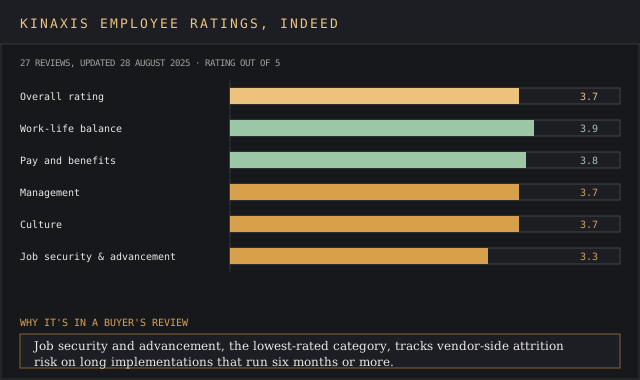
A software vendor's stability as an employer is a proxy for delivery risk on a multi-year contract: high turnover on the team building and supporting your platform shows up later as slower support tickets and staff who don't know your instance. On Indeed, Kinaxis carries a 3.7 out of 5 overall rating across 27 reviews.
- Work life balance: 3.9, the highest-rated category.
- Pay and benefits: 3.8.
- Management and culture: 3.7 each.
- Job security and advancement: 3.3, the lowest-rated category.
Kinaxis offers unlimited paid time off, a benefit multiple commenters said they don't fully understand or trust once they've asked how it's tracked in practice, though several called it a great place to work in the same breath as flagging it. Colleagues who have stayed a decade or more show up repeatedly across both threads, described as friendly more often than not.
The point every account agreed on, good or bad, is that advancement depends more on tenure and internal relationships than on the job title stamped on someone's badge, an important distinction for a candidate weighing career opportunity against near-term pay.
"John Sicard, was a very kind, loyal leader. Refused to do any layoffs while I was there to make shareholders happy," and "many employees have been there for 10+ years."
A self-described three-year former employee, in a 2025 r/ottawa thread, on then-CEO John Sicard
"It's a secure job with a well capitalized, reliable company that has global customers, so isn't subject to the lean Ottawa economy that has few similar prospects."
A r/ottawa commenter in 2025, on Kinaxis's standing as a local employer
The complaints cluster around below-Ottawa-average pay and a promotion culture several described as clique-y, favoring long-tenured staff over new hires regardless of prior experience.
"My biggest gripe was exactly the management 'club' and the theft of my ideas by those who were close to that club. Also I heard their pay isn't competitive anymore (for Ottawa it's average)."
A self-described two-year former Kinaxis employee, r/ottawa, 2025
"This was an amazing company to work for before the CEO left and the Shareholders forced a profit at all costs ideology. The cost is jobs, which they're actively moving to either India, or replacing with mythical AI solutions."
A Content Developer based in Kanata, Ontario, posted on Indeed on 28 May 2025
Management replied beneath that review, thanking the reviewer and confirming it would forward the comments to its management team, care it extends to most reviews on the page regardless of sentiment.
Kinaxis's own recruiting materials, via the Canada's Top 100 Employers project published by Mediacorp Canada Inc., put concrete numbers on the culture claims above:
- 999 full-time employees worldwide, with 579 in Canada, concentrated in Ottawa and Toronto.
- 36 years, the longest-serving employee's tenure.
- Roughly 60 co-op students per semester run through structured onboarding.
- $60,000 to $65,000 starting salary for new graduates.
On Indeed, the page's featured review calls Kinaxis a "fun work place" where "the new building is amazing." A r/ottawa commenter with five years in the job said the in-person schedule of three days a week "sucks," but that free parking and the cafeteria made up for it. None of that settles if a given job title is worth the below-market pay several commenters described; it gives a candidate numbers to weigh before signing.
Kinaxis versus its main competitors
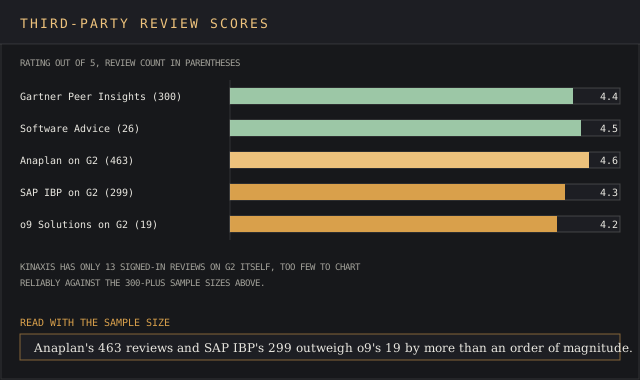
| Competitor | Rating | Wins for |
|---|---|---|
| Blue Yonder | Not on G2 | One contract spanning planning, warehouse and transportation execution |
| SAP Integrated Business Planning | 4.3/5, 299 G2 reviews | Native integration for a company already on SAP S/4HANA |
| o9 Solutions | 4.2/5, 19 G2 reviews | One vendor spanning demand, supply and revenue planning |
| Anaplan | 4.6/5, 463 G2 reviews | One modeling layer across finance and supply chain together |
Blue Yonder is the closest competitor on execution breadth. Panasonic acquired the company, then still branded JDA Software, for $8.5 billion in 2021, and it now serves more than 3,000 customers on a single Azure-hosted platform. It loses for a buyer wary of vendor risk after Blue Yonder's November 2024 ransomware attack disrupted service for retail customers, an incident Kinaxis has no equivalent of on the record.
SAP Integrated Business Planning is the incumbent most Kinaxis prospects are replacing. Multiple users who had run both systems told the same story independently: Kinaxis's scenario planning and collaboration tooling "edge out" SAP IBP, but demand-forecasting overhead at implementation is comparable on both.
o9 Solutions markets itself as the more AI-native of the group but carries only 19 reviews on G2, an order of magnitude less feedback than SAP IBP or Anaplan. It loses on the same technical-transparency problem Lokad flagged for Kinaxis, with far fewer independent reviews to check the marketing against.
Anaplan is the broadest of the four, rated highest of any vendor here. It's a connected-planning platform built for finance and supply chain together, which makes it the pick for a company that wants one modeling layer across both functions. It loses against Kinaxis for a pure supply chain buyer needing the concurrent, execution-aware planning depth Lokad scored at 4.8 out of 10 specifically; Anaplan's generalist engine isn't purpose-built for that the way Maestro is.
Buyers weighing risk exposure should also check our supply chain risk management ranking, a different job than what any of these four planning tools solve.
Verdict
Kinaxis Maestro is for a large enterprise that has budget for a six-to-eighteen-month implementation with a systems integrator and can absorb a sales-led, quote-only procurement process. It's for teams replacing a sequential, module-siloed advanced planning system like SAP APO, where the concurrent model's real-time cross-functional replanning is a genuine architectural upgrade over what they're leaving.
It's not for a team that has already run a comparable APS and expects a step change; multiple users who came from SAP IBP describe Maestro as an incremental upgrade, sharper on scenario planning and collaboration, with forecasting overhead unchanged.
It might suit a mid-market company willing to accept a longer, integrator-dependent rollout in exchange for concurrency the incumbent doesn't offer, provided the demand-planning team has the bandwidth for the validation overhead multiple implementers describe.
Ask specifically how disaggregation accuracy and forecast scorecards perform against the vendor's own demo data, then ask for the same numbers from a live customer instance. Run the comparison through a structured vendor evaluation scorecard, since the gap users describe sits between marketed and delivered forecasting tools, while the platform's core planning logic holds up in practice.
FAQ
Is Kinaxis better than SAP? Users who ran both systems say Kinaxis's scenario planning and collaboration tools edge out SAP Integrated Business Planning, while forecasting validation overhead is comparable on both; the better fit depends on the buyer already being standardized on SAP S/4HANA.
Is Kinaxis free? No. Kinaxis publishes no pricing and Capterra lists no free trial; every path on the vendor's site leads to a sales-led demo request.
What does Kinaxis software do? Maestro unifies demand, supply, inventory, capacity and production planning in a single in-memory data model, with concurrent execution added in 2022 to extend the model into orders, logistics and transportation.
Who are Kinaxis's main competitors? Blue Yonder, SAP Integrated Business Planning, o9 Solutions and Anaplan are the four most frequently named alternatives across G2 comparisons and user discussion.
Does Kinaxis pay well? Indeed's 27-review sample rates pay and benefits at 3.8 out of 5, and multiple former employees in a 2025 r/ottawa thread independently described pay as below the Ottawa tech-industry average, though several said the trade-off was strong work life balance and job security.