Supply chain risk management software: ranked buyer's guide for 2026
 By Jan Suski. I go deep on every review, checking every number against its source and digging up details other coverage misses, a habit from six years of SEO and link building for tech companies. Bylines at Surfer, Brand24, and Senuto. How the scoring works.
· Prefer this source on Google
Quick comparison of supply chain risk management software
Every vendor here quotes per deal. None publishes a rate card, so the pricing column names the basis a quote is built from, which is the number you can negotiate against.
| # | Platform | Strongest risk coverage | Priced by | Best fit |
|---|---|---|---|---|
| 1 | Interos | Multi-tier mapping across financial, cyber, ESG and geopolitical risk | Supplier count and tier depth | Teams needing one score across every risk category |
| 2 | Everstream Analytics | Predictive disruption and logistics risk | Monitored supplier count and modules | Teams acting on disruptions days ahead |
| 3 | Resilinc | Sub-tier mapping with part-level detail | Mapped suppliers and sites | Manufacturers tracing risk to a component |
| 4 | Exiger | Sanctions, ownership and defence-grade due diligence | Modules and screening volume | Regulated and government supply chains |
| 5 | Z2Data | Component and part obsolescence risk | Component libraries and users | Electronics and hardware sourcing |
| 6 | Prewave | AI news and social monitoring in 100+ languages | Monitored suppliers | European teams with due diligence duties |
| 7 | IntegrityNext | ESG and regulatory compliance at supplier scale | Suppliers assessed | Compliance-led risk management programs |
| 8 | SAP Ariba Supplier Risk | Risk inside an existing procurement workflow | Ariba licence and supplier tier | Companies already running SAP Ariba |
Supply chain risk management software watches your suppliers so a plant fire, a sanctions listing or a quiet insolvency reaches you before the missed shipment does. The category sits apart from the rest of supply chain management: a demand planner tells you what to order, and supply chain risk management software tells you which supplier will fail to deliver it.
Global supply chains now run through enough intermediaries that most organizations cannot name their own tier-three exposure, and that gap stays under the radar until an audit or a disruption drags it into view.
Ivalua's research puts 68% of supply chain leaders on record expecting risk exposure to rise, with geopolitical events touching more than 80% of companies' supply chains and operational delays costing the logistics industry an estimated $184 billion a year. The software market answering that has grown to roughly $3 billion, with projections past $8 billion by 2030.
The supply chain risks that stop a production line are rarely the ones a quarterly review catches. Eight platforms are ranked below on the depth of their supplier data, how far down the tiers they map, and how much of the alerting survives contact with a real risk management team.
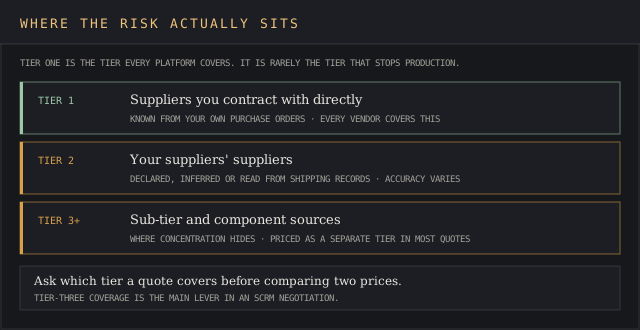
Evaluation criteria for supply chain risk management software
Tier depth. Tier-one visibility is table stakes and rarely where the risk lives. Ask how a platform discovers sub tier suppliers: customer-declared data, shipping records, or inference from a model. Each answer carries a different error rate, and vendors mix all three under one confidence score. Supply chain visibility claims usually describe tier one, where the supplier network is already known.
Alert precision. A continuous monitoring feed that flags every news mention trains a team to ignore it. A platform that cries wolf on every headline burns the credibility it needs for the one alert that matters. Ask for the false positive rate on a named supplier over a real month, and ask who tunes it after go-live.
Risk categories covered. Financial risks, operational risks, compliance risks and cyber risks are separate data problems arriving on separate schedules from separate sources. Most platforms lead on two and buy or infer the rest, so a single risk score can hide a thin category underneath.
Supplier data provenance. Registry filings, credit files, shipping manifests, job postings and news each age differently. A platform refreshing financials quarterly and news hourly still reports one blended risk rating, which is where risk awareness quietly decays.
Workflow, past the dashboard. Risk identification is the cheap half, and risk insights that stop at a dashboard change nothing. Ask what happens after a flag: does the platform open a corrective action, route it to a named owner, and hold an audit trail regulators accept?
Risk assessment and scoring
A supply chain risk assessment turns scattered risk indicators into one number a category manager can act on. Most organizations score suppliers from 1 to 100 and then find the scale hides its own reasoning.
Ask a vendor to open the components behind one supplier's rating. Identifying potential risks earns its cost only when a team can see which input moved and why it moved.
Risk events are the real test. When a supplier files late, lands on a sanctions list or suffers a fire, how fast does the score change, and does the platform explain the change or restate it? A score that merely restates the event leaves the buyer to read between the lines alone.
Top supply chain risk management software, ranked
Interos
Best fit: risk management teams that want financial, cyber, ESG and geopolitical risk resolved into one supplier view.
Interos maps supplier relationships as a network and scores each node across six risk factors at once. The multi-tier graph is the product; the scores sit on top of it.
Key features
Automated discovery of sub tier suppliers without a customer questionnaire. Six risk categories scored per entity. Continuous monitoring with event-driven rescoring. Concentration analysis showing where many tier-one suppliers share one tier-three dependency. Supplier performance history alongside the risk score. API delivery into procurement systems.
Pricing
Quoted, scaled by supplier count and how deep the mapping runs. Tier-three coverage costs materially more than tier-one, and that boundary is the main lever in a negotiation.
Pros
Widest risk category coverage in this list. Concentration risk analysis few rivals match. Discovery works without supplier cooperation.
Cons
Inferred relationships need validation on your critical suppliers. Enterprise pricing rules out small teams. The single composite score invites more trust than the thinnest input deserves.
Why it's ranked #1. It answers the question buyers arrive with: where is my exposure concentrated. Everstream predicts disruptions better; Interos explains the structure that makes one costly.
Read our Interos review for the platform detail.
Everstream Analytics
Best fit: teams that want a disruption flagged days before it reaches the dock.
Everstream leans on predictive analytics over historical data and live signals, weather, port congestion, labour action, to forecast where a shipment breaks down. That combination keeps subscribers ahead of the curve on a lane failure well before the missed delivery would have flagged it.
Key features
Predictive scoring on logistics lanes and sites. Weather and climate risk modelling. Real time risk monitoring on ports and routes, using real time data from carriers and weather services. Sub tier mapping. Corrective workflow and alerting into existing systems.
Pricing
Quoted, by monitored supplier count and module selection. Logistics risk and supplier risk license separately in most deals.
Pros
Genuine lead time to mitigate disruptions before they reach production. Strong logistics and lane coverage. Alert quality is better tuned than most.
Cons
Lighter on financial and compliance risk than Interos or Exiger. Predictions need your own lane data to reach full accuracy. Module structure fragments the quote.
Why it's ranked #2. Best-in-class on the disruptions that stop production, and the only platform here selling meaningful lead time. It ranks below Interos on breadth of risk categories.
See the Everstream review, and the supply chain intelligence ranking where the same platform is scored on planning fit.
Resilinc
Best fit: manufacturers that need a risk traced to a specific part at a specific site.
Resilinc built its map from supplier-declared data: sites, parts and recovery times collected directly, then monitored by EventWatchAI against global news. It's data straight from the horse's mouth, gathered directly from each supplier.
Key features
Supplier-declared site and part mapping. EventWatchAI news monitoring across languages. Recovery time and revenue-at-risk per site. Multi-tier visibility built on declared relationships. Playbooks for identified risks.
Pricing
Quoted, driven by mapped suppliers and site count. Mapping is a project cost before the subscription starts.
Pros
Declared data is more accurate than inference at the site level. Revenue-at-risk quantification is unusually concrete. Long history in electronics and automotive.
Cons
Coverage depends on suppliers responding. Onboarding is slow against inference-first rivals. Weaker outside manufacturing.
Why it's ranked #3. Most accurate sub-tier picture here when suppliers cooperate, and that condition is what keeps it behind two platforms that map without asking.
The Resilinc review covers the mapping process.
Exiger
Best fit: regulated buyers and government contractors where an ownership chain has to survive an audit.
Exiger runs supply chain risk management around entity resolution and screening. DDIQ reads filings, sanctions lists and adverse media to answer who owns a supplier and who owns them.
Key features
Sanctions, watchlist and adverse media screening. Beneficial ownership resolution through opaque structures. Software bill of materials analysis for supply chain security. Defence and federal deployments. Audit-ready documentation on every identified risk.
Pricing
Quoted, by module and screening volume. Government deployments price separately from commercial.
Pros
Strongest ownership and sanctions work in the list. Documentation regulators accept without a follow-up. Deep US federal footprint.
Cons
Narrower on operational disruption than Everstream. Interface expects an analyst who already knows the ropes. Modules make the total hard to model up front.
Why it's ranked #4. Unmatched on the compliance and ownership questions, and it drops below the first three because most buyers arrive needing disruption coverage first.
Z2Data
Best fit: hardware and electronics teams whose risk is a component going end-of-life.
Z2Data works at part level. Its library covers more than 1 billion components and 1 million suppliers, tying obsolescence, compliance and sourcing risk to the specific part on a bill of materials.
Key features
Component-level lifecycle and obsolescence data. Bill of materials risk analysis. Cross-reference to alternative parts. Site and supplier risk layered above the component. Regulatory compliance flags per part.
Pricing
Quoted, by component library scope and user count.
Pros
Component depth no generalist matches. Alternative-part suggestions turn a flag into an action. Practical for engineering as well as procurement.
Cons
Narrow outside electronics and hardware. Company-level risk is thinner than the part data. Small vendor against SAP or Exiger.
Why it's ranked #5. The best answer in this category for a specific buyer, and its narrowness against the four above it is exactly why it sits here.
It also appears on our supply chain intelligence ranking scored against a different job.
Prewave
Best fit: European teams carrying due diligence obligations under supply chain legislation.
Prewave monitors news, social and regulatory sources in more than 100 languages, surfacing supplier incidents that never reach English-language coverage, the kind of needle in a haystack a purely Anglophone monitoring feed would miss entirely.
Key features
Multilingual AI monitoring across local sources. Tier-N supplier mapping. ESG and labour incident detection. Supplier onboarding and supplier compliance workflow. German supply chain due diligence reporting.
Pricing
Quoted, by monitored supplier count.
Pros
Local-language coverage that Anglophone rivals miss. Built for European regulatory requirements. Fast supplier onboarding.
Cons
Lighter financial risk data. Smaller North American footprint. Newer than most names here.
Why it's ranked #6. Genuinely differentiated on language coverage, held back from a higher place by thinner financial and component data.
IntegrityNext
Best fit: compliance-led risk management programs assessing thousands of suppliers on ESG.
IntegrityNext runs supplier assessments at scale, combining self-assessment questionnaires with continuous monitoring of public sources.
Key features
Automated supplier assessments across ESG and compliance topics. Continuous monitoring layered over questionnaire responses. Reporting built to ensure regulatory compliance under European due diligence law. Supplier engagement and corrective action tracking. Scales past 100,000 suppliers.
Pricing
Quoted, by number of suppliers assessed.
Pros
Handles supplier volume few rivals manage. Engagement workflow closes the loop past the alert. Reporting maps to named regulations.
Cons
ESG and compliance focus leaves operational risk thin. Depends on supplier response rates. Limited component or logistics detail.
Why it's ranked #7. Strong on the compliance half and quiet on disruption, which is par for the course at this end of the market and the trade its buyers accept.
SAP Ariba Supplier Risk
Best fit: companies already running SAP Ariba that want risk inside the procurement workflow.
Ariba Supplier Risk scores suppliers using third-party data feeds and surfaces the result at the moment a buyer raises a requisition.
Key features
Risk scoring embedded in Ariba sourcing and procurement. Third-party data feeds across financial and compliance categories. Engagement risk assessments per project. Alerts routed to category owners. Native supplier management and master data alignment with existing Ariba records.
Pricing
Quoted, tied to the Ariba licence and supplier tier count.
Pros
No integration project when Ariba is already in place. Risk lands where buying decisions happen. Master data is already aligned.
Cons
Weakest as a standalone purchase. Risk data is licensed from third parties. Sub-tier visibility trails specialists.
Why it's ranked #8. The workflow advantage is real and the underlying risk data is bought in, so it ranks last on a list judged on data depth.
Other platforms worth a shortlist mention
Sphera pairs supply chain risk with environmental health and safety data, which suits process industries running both programs, and gives them the best of both worlds in a single system. Craft sells supplier intelligence with an n-tier mapping product and an alerts layer, and prices below most enterprise names. Tealbook focuses on supplier data quality underneath a risk program.
Volza approaches the same problem from the customs side: shipment-level import and export records across 200-plus countries, useful for surfacing a supplier's real trade exposure, geography and buyer concentration ahead of a full risk-mapping platform.
Check a supplier's trade exposure
Try Volza's free trial
7 days, unlimited searches, no card required.
May earn a commission if you sign up through this link, at no extra cost to you. Full affiliate disclosure.
What supply chain risk management software does
The category collapses into four jobs. It maps who supplies you, including the suppliers your suppliers use. It monitors supply chain operations continuously against external supply chain data, which is how these tools improve visibility past the first tier. It scores identified risks so a team can triage, turning raw feeds into risk intelligence someone will read. It routes the survivors into a workflow with an owner and an audit trail.
The platforms that monitor supply chain operations well do all four without anyone opening a dashboard.
Everything else is packaging. A platform strong at mapping and weak at workflow produces a map nobody acts on, and the reverse produces fast action against an incomplete picture.
Risk categories a program has to cover
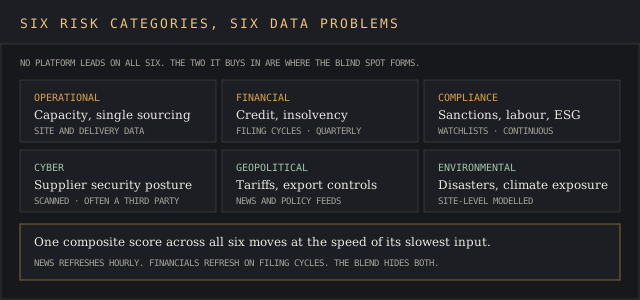
A program has to cover six categories, and each one reads a different data source.
- Operational risk: plant capacity, single sourcing and delivery failure.
- Financial risk: credit files and insolvency signals.
- Compliance risk: sanctions, labour and environmental requirements.
- Cyber risk: supplier security posture.
- Geopolitical risk: tariffs, export controls and conflict.
- Environmental risk: natural disasters and climate exposure to specific sites.
Third party risk programs in security teams cover the same suppliers from a different angle, and the two rarely share a system. For the compliance category, supplier scores from EcoVadis sit beside investor raters like MSCI on our list of top ESG data providers.
No platform leads on all six, and the gaps are where supply chain vulnerabilities survive a review. Buying one score across all six from a vendor strong in two is the most common way a risk management program buries its head in the sand on the other four and develops a blind spot it cannot see.
How this differs from supply chain intelligence software
Supply chain intelligence platforms plan: demand forecasting, inventory positioning, integrated planning. Risk platforms watch the supply base and warn. Blue Yonder and Kinaxis improve a plan; Interos and Everstream tell you which supplier makes the plan undeliverable.
Buyers routinely price one against the other and find the feature lists barely overlap. Our supply chain intelligence ranking covers the planning side, and the procurement intelligence ranking covers spend and supplier discovery.
Building supply chain resilience past the alert
Software surfaces risk, and risk mitigation strategies come from the supply chain teams reading it. The platforms that repay their cost are wired into how a company already works: alternative suppliers identified before a disruption, safety stock sized against real lead time variance, dual sourcing agreed on every part a single site controls.
Supply chain continuity planning depends on that sequence. A resilient supply chain is one where each critical part carries a named second source and a tested switchover, and the software's job is telling you which parts have neither. Nobody wants all their eggs in one basket when a single supplier goes dark, and a second source is the cheapest insurance against it. Building supply chain resilience is the outcome; the alert is one input to it.
Workflow automation decides how long the program survives and how quickly a team can mitigate risks once they surface, enabling companies to close a corrective action while alternatives still exist. Automatic supplier onboarding, scheduled supplier assessments and corrective actions that expire and escalate keep operational resilience work running after the launch enthusiasm fades.
A more resilient supply chain comes from that routine, and business operations feel the difference in fill rate before anyone sees it in a dashboard.
Supply chain risk management software FAQ
What is supply chain risk management software?. Software that maps a supply base, monitors it against external data sources, and alerts a team to supplier risks before they interrupt supply.
How is SCRM defined?. Supply chain risk management. In cyber security contexts the same initials cover software supply chain risk, a related discipline focused on code and component provenance.
What is the best software for supply chain risk management?. Interos for breadth across risk categories, Everstream for disruption lead time, Resilinc for sub-tier accuracy in manufacturing, Exiger for sanctions and ownership work.
How do these platforms assess supplier risk?. Through registry filings, credit data, shipping records, adverse media, questionnaires and inference from supplier relationship graphs. The mix varies by vendor, and it decides where each one is accurate.
What are the best risk management tools for a small team?. Supplier risk management solutions at this end of the market price for enterprise supplier counts. Teams under a few hundred suppliers usually start with credit monitoring and a structured supplier assessment cycle before buying a platform. An enterprise-grade contract at that stage is easy to bite off more than small teams can chew.
How does software help in reducing supply chain risk?. Software shortens the gap between a risk event and the response. Continuous monitoring means a team hears about supply chain disruptions in hours, and the supply chain challenges that follow get worked while alternatives still exist.
How current is the data?. News monitoring runs continuously. Financial data typically refreshes on filing cycles, quarterly at best. A blended risk score built from both moves at the speed of its slowest input.
Bottom line
Decide which risk category will stop your production line, then buy the platform that leads on it. Interos covers the most ground, Everstream buys the most time, Resilinc traces the deepest, and Exiger survives the closest audit.
Teams that stay ahead of disruption run the same drill on every shortlist. Ask each vendor for the false positive rate on one of your own suppliers over a real month. That question cuts to the chase faster than any pitch deck. The answer separates a working program from a feed nobody reads.