Interos review: supply chain risk mapping platform
 By Jan Suski. I go deep on every review, checking every number against its source and digging up details other coverage misses, a habit from six years of SEO and link building for tech companies. Bylines at Surfer, Brand24, and Senuto. How the scoring works.
·
Best for
Defense and enterprise procurement teams mapping multi-tier supply chains, the kind of buyer already on the roster: the Department of Defense, NASA, the Navy and the Missile Defense Agency.
Not for
Buyers who need compliance-led supplier vetting or environmental risk scoring alone. Avetta, Assent and Sphera specialize there, without the ramp time Interos requires first.
What it costs
No public price list. The clearest numbers are federal: a Defense Logistics Agency task order worth $3.95 million a year, and $12.2 million in lifetime prime awards.
- i-Score domains
- Cyber, financial, ESG, compliance, geopolitical and operational risk
- Claimed coverage
- 98% of supply chain risk, Interos' own figure
- Company map
- More than 250 million companies
- Relationship map
- 11 billion supplier relationships
- Sub-tier depth
- Two or three tiers past a direct vendor, where only 10% of Fortune 1000 firms can see
- Monitoring cadence
- Continuous real-time monitoring and alerts
- Risk reports
- Pulled from the platform, running on the same risk model the i-Score uses
- Sanctions screening
- Supplier names matched against sanctions lists
- Labor and ESG flags
- Unethical labor practices, emissions and regulatory fine exposure
- Geopolitical flags
- Location restrictions tied to named vendors
- Alternative sourcing
- Surfaces substitute suppliers when a disruption hits
- Vulnerability detection
- Flags physical, financial and cybersecurity vulnerabilities before they cause operational effects, per Interos' own description
- Defense contract
- $3,949,600 obligated by the Defense Logistics Agency for year one of a software subscription task order, bought through reseller ThunderCat Technology
- Contract ceiling
- $11,848,800 for base and all options to 13 August 2028, roughly $3.95m a year
- Federal prime awards
- $12,224,789.99 across 128 transactions lifetime, which excludes reseller-bought deals like the DLA one
- GSA SCRIPTS
- $919 million ten-year ordering ceiling to March 2035, shared across multiple awardees and a distributor, not revenue and not a price
- Public-sector users
- US Department of Defense, NASA, US Navy, Missile Defense Agency
- Vendor headcount
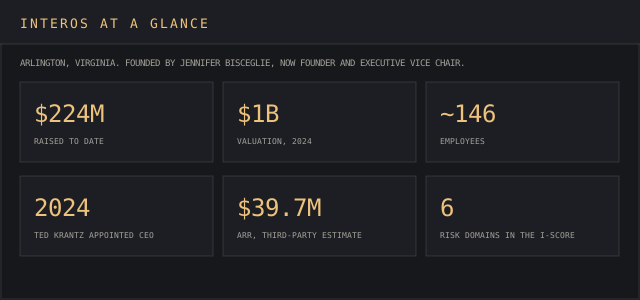
- Around 146 people
- Review sources
- G2, Software Advice and SoftwareReviews listings
- Revenue estimate
- Third-party estimates near $39.7 million ARR; Interos publishes no official figure
- Funding and valuation
- Roughly $224 million raised, $1 billion valuation in 2024
- Onboarding load
- Data-integration work first, then training before a team can read the output
- Rate card
- None. Pricing is available on request only
- Pricing model
- Personalized, tied to supplier count and integration needs
- Cost spread
- Differs between a mid-market procurement team and a defense contractor mapping a whole chain
Everstream Analytics
Not forA defense or federal buyer who needs national-security compliance coverage.
Resilinc
Not forA team that needs sanctions and ownership screening across a supplier base.
Prewave
Not forA buyer who wants a standalone risk platform.
Pairs well with Interos
Which Interos numbers are the company's own, and which come from third parties
The 98% risk-visibility figure, the 250 million companies and the 11 billion relationships are Interos' published claims, taken from its marketing copy and its G2 listing. The $39.7 million ARR stays a third-party estimate; the company doesn't publish revenue.
The prices on the cost side are published public contracts: what the Defense Logistics Agency obligated on one task order, bought through reseller ThunderCat Technology so the figure carries reseller margin, plus Interos Inc's own lifetime prime-award total. The $919 million SCRIPTS figure comes from Interos' own announcement and is a shared ten-year ordering ceiling, a spending cap separate from revenue and from any per-unit rate.
This review covers what the operational resilience company does, how its i-Score works, and who it's built for. Interos is an AI powered SaaS platform that maps and monitors digital supply chains at scale, backed by investors NightDragon, Venrock and Kleiner Perkins.
↑ FACT SHEETWhat is Interos: an AI powered SaaS platform for digital supply chains
Interos markets itself as a breakthrough Operational Resilience Cloud built to give companies an instant global view of the business relationships buried deep inside complex businesses. On its own G2 listing, Interos describes itself as the world's first, and only, automated supplier threat mitigation platform, built to protect organizations from regulatory fines, unethical labor practices and cyber-attacks.
The platform builds a living global map of supplier networks, tracking business relationships down to a single supplier several tiers removed from a company's direct vendors. Most companies manage supplier risk one relationship at a time, and that approach doesn't hold up for complex businesses spanning multiple continents and industries.
Jennifer Bisceglie founded the operational resilience company and now serves as Founder and Executive Vice Chair. Ted Krantz was appointed CEO in 2024, arriving as the business crossed a $1 billion valuation. Interos is headquartered in Arlington, Virginia, and has raised roughly $224 million to date across a backer list that also includes Accenture and Broadway Angels.
How the i-Score works: an instant global view of every relationship scenario
The i-Score assesses supply chains against multiple risk factors across six domains, including cyber and ESG. Interos says the score gives organizations an instant view into 98% of supply chain risk, built from a database that maps more than 250 million companies and 11 billion supplier relationships.
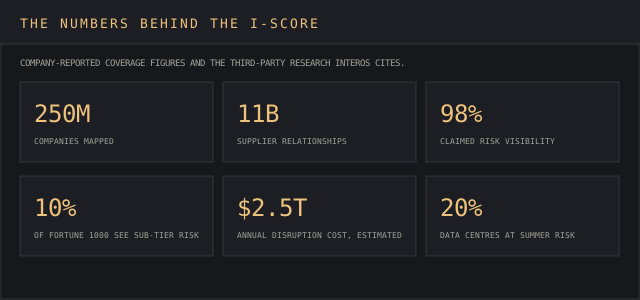
Only 10% of Fortune 1000 companies can see risk at the sub tier supplier level, where labor, cybersecurity and geopolitical problems tend to start and where a single supplier's financial distress can ripple through an industry. That scale is what the 250-million-company map is built to cover.
"We detect physical, financial, and cybersecurity vulnerabilities well before operational effects, with an instant global view of every relationship scenario you can imagine."
That relationship scenario framing is the difference from a traditional vendor questionnaire, which captures a supplier's own account of itself at a single moment.
↑ FACT SHEETInteros features
Six risk domains and detection
Interos uses artificial intelligence to detect vulnerabilities across cyber, financial, ESG, compliance, geopolitical and operational risk. The platform flags unethical labor practices, sanctions exposure and location restrictions tied to specific vendors, giving procurement teams confidence in supplier decisions.
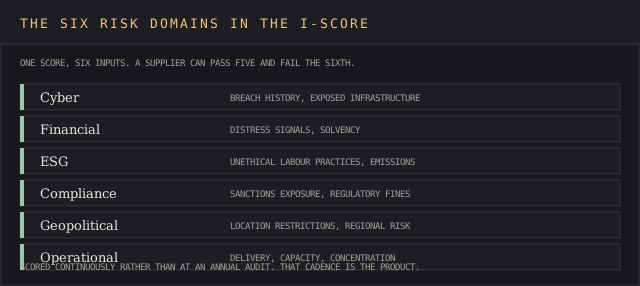
Teams pull risk reports straight out of the platform, helping them judge if a vendor relationship is worth the risk before a contract is signed. Those reports run against the same risk model the i-Score uses, so a flag in a report and a movement in the score trace to the same underlying data.
Multi-tier mapping across supply chain ecosystems
The platform maps multi-tier supply chain relationships to uncover dependencies a company wouldn't otherwise know exist. Interos supports identifying alternative suppliers when a disruption hits, shifting risk management from reacting to a once-a-year audit toward acting on continuous, real-time monitoring and alerts, so a single flagged supplier doesn't turn into a wider disruption across the supply chain.
Mapping supply chain ecosystems at that depth is what artificial intelligence contributes here: the living global map updates as relationships change, and the ability to see two or three tiers past a direct vendor is what most procurement operations lack today.
Who Interos is built for
Interos is built for large enterprises developing global, multi-tier supply chain ecosystems, including defense and government customers. Interos serves the U.S. Department of Defense, NASA, the U.S. Navy and the Missile Defense Agency, and it has been selected government-wide for national security and defense.
Inc. Magazine named Interos one of America's fastest-growing private companies, and it markets its breakthrough Operational Resilience Cloud to a host of Fortune 500 and government customers alike. Headcount sits near 146 people, small against the size of the customers it serves.
Procurement teams use Interos to assess new suppliers, matching names against sanctions lists so the job doesn't rely on one analyst's memory. A supplier's risk profile can change fast, and annual audits can't keep pace with a labor dispute or news that shifts exposure overnight. A lack of visibility into lower-tier suppliers has left companies unaware of what was going wrong until a disruption already happened.
Interos gives teams real-time visibility into a supplier's environment ahead of a crisis, replacing the once-a-year audit checklist with continuous monitoring.
Interos competitors and alternatives
Interos sits in a crowded field, and the named alternatives solve overlapping but distinct problems. Everstream Analytics leads on predictive risk analytics for automotive, chemicals, energy and food. Resilinc competes most directly on multi-tier mapping and resiliency scoring, with strength in aerospace and healthcare. Prewave monitors supplier risk and turns up as a named partner inside other procurement platforms, Jaggaer among them.
| Competitor | Where it competes |
|---|---|
| Everstream Analytics | Predictive risk analytics for automotive, chemicals, energy and food |
| Resilinc | Multi-tier mapping and resiliency scoring; aerospace and healthcare |
| Prewave | Supplier risk monitoring; also a named partner inside other procurement platforms |
| Avetta | Compliance and contractor vetting workflows |
| Assent | Compliance and contractor vetting workflows |
| Sphera | Environmental, health and safety risk |
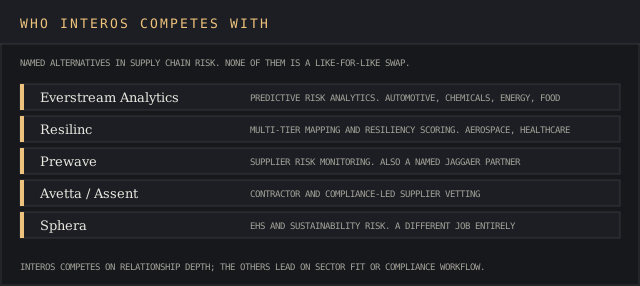
Avetta and Assent approach the same suppliers through compliance and contractor vetting workflows. Sphera addresses environmental, health and safety risk, a different job that buyers sometimes shortlist alongside the rest by mistake. Interos competes on relationship depth; the others compete on sector fit or on the workflow wrapped around the data. All of them are scored side by side in the supply chain risk management ranking.
Strengths and weaknesses
Organizations using Interos report value in managing global supplier networks, and reviews of the platform point to its visibility into supply chains beyond direct suppliers as its strongest capability. Reviews also note a real learning curve: users need training to interpret its output, and onboarding takes data-integration work before a team is running on the risk model.
Reviews on Software Advice and SoftwareReviews cover the same ground from different angles, and the pattern across both is consistent: strong intelligence on relationships nobody else surfaces, weighed against a setup that assumes a team with time to invest in it. Buyers comparing it against a traditional third-party risk tool should expect that trade.
Supply chain disruptions cost businesses an estimated $2.5 trillion in lost profit a year, and separate research found 20% of global data centers face high risk during summer months, the kind of exposure Interos aims to catch before it turns catastrophic.
↑ FACT SHEETInteros pricing
Interos pricing is available on request. Pricing follows a personalized model tied to supplier count and integration needs, so cost varies between a mid-market procurement team and a defense contractor mapping its entire supply chain.
One published federal contract is the hardest number available. The Defense Logistics Agency obligated $3,949,600 for year one of task order SP470425F0055, described in the record as "INTEROS SOFTWARE SUBSCRIPTIONS", against $11,848,800 for the base and all options from 14 August 2025 to a potential end of 13 August 2028. That ceiling divided by three years equals the year-one obligation exactly, so DLA is running at roughly $3.95m a year.
The prime on that order is ThunderCat Technology, a reseller, which placed it through NASA SEWP as a competitive small-business set-aside with five offers received. The figure therefore carries reseller margin on top of whatever Interos books, and Interos is the software named in the award. ThunderCat Technology is the awardee.
Interos Inc's own federal prime awards total $12,224,789.99 across 128 transactions over the company's lifetime. That understates the federal business badly, because reseller-bought deals like the DLA task order never appear with Interos as the recipient.
A fourth number gets quoted as though it were money, and isn't. Interos announced on 24 April 2025 that it had been selected for the $919 million GSA SCRIPTS blanket purchase agreement, available to defense and civilian agencies through Carahsoft to March 2035. The $919 million is a ten-year ordering ceiling shared across multiple awardees and a distributor: a cap on what agencies may buy, separate from Interos' own revenue and from any price it charges.
Frequently asked questions
Who is the CEO of Interos?
Ted Krantz is the CEO of Interos, appointed in 2024. Founder Jennifer Bisceglie moved to Executive Vice Chair of the board at the same time.
Where is Interos headquartered?
Interos is headquartered in Arlington, Virginia.
What is the valuation of Interos?
Interos reached a $1 billion valuation in 2024, on roughly $224 million raised to date.
What is an Interos score?
The i-Score is Interos' risk rating, assessing a supply chain against risk factors across six domains, including cyber and ESG exposure.
Is Interos legit?
Interos is a real risk-management company backed by NightDragon, Venrock and Kleiner Perkins, with government clients including the Department of Defense and NASA.
What are the alternatives to Interos?
Everstream Analytics, Resilinc and Prewave are the closest competitors on supply chain risk, with Avetta and Assent covering compliance-led supplier vetting and Sphera covering environmental and safety risk.
What is the revenue of Interos?
Third-party estimates put Interos' annual recurring revenue near $39.7 million; the company doesn't publish official figures.