DataForSEO pricing: what the pay-as-you-go API rates cost
 By Jan Suski, six years working in digital. How the scoring works.
The numbers DataForSEO API pricing, checked 23 August 2026
The Standard queue's $0.60 headline rate only holds at the default 10-result depth; ask for depth 100 and the same 1,000 SERPs cost $20.00 on Live mode.
A new account can test every API on a $1 trial credit and the free Sandbox before committing the $50 minimum deposit, and that balance carries forward with no monthly reset.
Business Data's per-item price looks nothing like SERP data's fractions of a cent: a million Business Listings records runs $372, most of it in the $0.00036-per-item charge, not the $0.012 task fee.
DataForSEO pricing: what the pay-as-you-go API rates cost
DataForSEO charges by the task and by the data row, not by the seat. This DataForSEO cost breakdown works from the rates published on the vendor's own pricing page, checked in a live browser on 23 August 2026, because the pricing widgets don't render for a plain page fetch. It's cross-checked against the DataForSEO FAQ for the billing rules the rate tables leave out.
It covers what a developer, an agency, or an AI-search team pulling SERP data, keyword data, and AI Optimization signals through the API pays. It also covers what a procurement team should check before signing off on a quote. Eleven separate API families share the same billing shape, so these numbers double as a template for reading any of the others.
A depth-100 SERP call costs ten times the number on the homepage, and nothing on that homepage says so. Every dollar figure below traces to a page fetched this run, dated where it matters.
How much DataForSEO charges across eleven APIs
DataForSEO sells data, not seats. Its pay as you go pricing model, the vendor's own phrase for it, charges a prepaid balance for setting a task and for every row of results the task returns. That spans eleven API families: SERP, Keywords Data, DataForSEO Labs, Backlinks, On-Page, Business Data, Domain Analytics, Content Analysis, Merchant, App Data, and AI Optimization.
Between them, the eleven families cover most of the SEO data a growth team would otherwise buy from four or five separate vendors. Rank positions, backlink counts, on-page audits, business listings, and AI-answer mentions all live on the same balance.
Two numbers repeat across almost every one of those APIs: a flat price for setting the task and a per-row or per-item price for what comes back. Backlinks API charges $0.024 to set a task plus $0.000036 per backlink row.
Business Listings charges $0.012 per task plus $0.00036 per item. Multiply either by real volume and the per-row charge dominates the bill within a few hundred rows, not the flat task fee.
Nothing here resembles a Semrush or Ahrefs monthly plan. There's no seat count to pick, no annual discount to negotiate, no plan name at all. The balance sits in a prepaid pool, & every API call spends part of it until that pool runs out.
SERP API: the Standard, Priority, and Live queues
SERP API prices by queue, and the queue sets both speed and cost. Standard queue tasks post now and complete in about 5 minutes on average, using a POST-then-GET flow. Priority queue tasks finish in about a minute. Live mode skips the queue entirely: one POST request returns results in roughly 6 seconds.
| Queue | Turnaround | Price per 1,000 SERPs | Best fit |
|---|---|---|---|
| Standard | ~5 min average | $0.60 | Scheduled rank tracking, overnight batch jobs |
| Priority | up to 1 min | $1.20 | Same-day refreshes, minute-fresh dashboards |
| Live | up to 6 sec | $2.00 | Interactive, user-facing lookups |
Prices are DataForSEO's own published per-request rates, checked 23 August 2026.
Standard and Priority sit exactly two to one: pay double for a five-minute wait to shrink to under a minute. Live mode breaks that pattern. It runs $2.00, not the $2.40 a strict doubling would predict, for a wait measured in seconds instead of minutes.
Every queue bills per SERP, & one SERP means the standard 10 organic results, the same unit a rankings dashboard reads on every refresh. A rank-tracking job checking 500 keywords once a day spends $0.30 a day on the Standard queue: trivial at that scale, and still just $9 a month. The same job at 50,000 keyword checks a month costs $30, before a single paid parameter gets added.
Depth, paid parameters, and the price multiplier
DataForSEO's own pricing page states the multiplier plainly: the depth parameter multiplies the base price "for each 10 search engine results." Ask for the default 10 results and Standard queue charges $0.60 per 1,000 SERPs. Ask for depth 100, ten full pages of Google results, and the multiplier applies ten times over: $6.00 on Standard, $12.00 on Priority, $20.00 on Live.
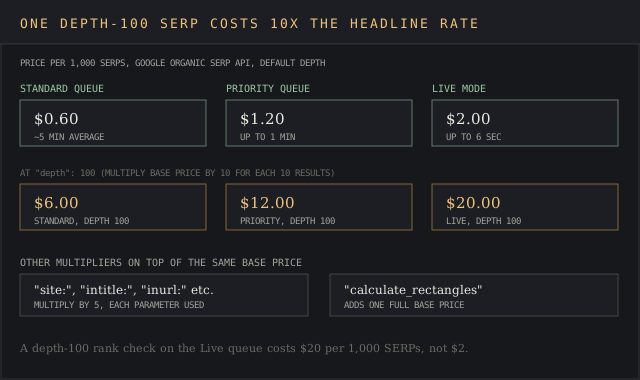
Search operators carry a separate multiplier. Any task using site:, intitle:, inurl:, allintext:, filetype:, or eight similar operators multiplies the base price by 5 for each one used. A single site: search on the Live queue at the default depth runs $10.00 per 1,000 SERPs instead of $2.00.
The calculate_rectangles parameter, which returns pixel coordinates for page elements, adds one full base price on top of whatever the task already carries.
DataForSEO's pricing page adds one line of warning and no combined example: "the final price can contain multiple multipliers." The hidden costs of a DataForSEO bill sit in that parameter table, not in a padded headline rate.
It is a common failure mode across vendor pricing pages, not a DataForSEO-specific one.
Budgeting for more than one paid parameter at once means running the math per parameter against the base rate instead of trusting a single sticker price copied from the homepage.
Business Data API and AI Optimization API pricing
Business Data API endpoints price the same way SERP pricing does: a flat per-task charge plus a per-item charge for whatever comes back. The Business Listings endpoint, which pulls point-of-interest records off Google Maps, charges $0.012 per task plus $0.00036 per item.
Pull the maximum 1,000 items per request. DataForSEO's own worked example puts a million items at $372 across 1,000 requests: 1,000 x $0.012 in task fees plus 1,000,000 x $0.00036 in item fees.
AI Optimization API prices two different ways depending on the endpoint. LLM Mentions, which tracks brand and keyword mentions inside LLM tools, bills $0.10 per request plus $0.001 per row, so 1,000 rows in one request runs $1.10.
LLM Responses, which captures how a model such as ChatGPT answers a branded query, charges a small DataForSEO fee, as little as $0.0002 on the Standard queue. On top of that sits "the price charged by the LLM," passed straight through, not marked up. The Live mode version prepays $0.01 toward that pass-through charge and refunds the difference if the model's own API charges less.
That pass-through detail matters for anyone budgeting an AI Optimization workflow. The DataForSEO fee itself is close to free. The bill still depends on which model answers the query, since a larger model and a smaller one don't charge the same rate for a completion.
DataForSEO raised prices across eight APIs on July 1, 2026. It rolled every affected endpoint onto pay-as-you-go, canceling the monthly-commitment option that used to sit under the Backlinks API & LLM Mentions API. The company's own change-log puts the standard bump at 20%, with the increase applied line by line, not as one flat surcharge.
Two of the endpoints priced above moved with it: Business Listings Search and Categories Aggregation rose 20%, and Google Hotel Searches Task POST rose 7% per request. Backlinks API, DataForSEO Labs API, Domain Analytics API, and most of the On-Page API and Content Analysis API endpoints took the same 20% hit. Merchant API absorbed the steepest jump: 50% on Amazon Products and Sellers Task POST calls.
SERP API escaped the hike. Its depth-100 multiplier above still runs off the same $0.60 to $2.00 base rates it always has. Anyone budgeting off a screenshot of last year's rate card is working from numbers DataForSEO already changed once this year. A vendor page can go stale the same way, without a redirect to announce it.
Pay as you go versus monthly subscriptions
DataForSEO runs pay as you go, full stop, with no alternative tier. There's no monthly subscription to opt into and no annual contract. Per the company's own FAQ, no signature is required either: "you don't have to sign any contracts and be bound by any conditions." An account tops up a balance, spends it against API tasks, and tops up again when it runs low.
There's no monthly reset, either: unused balance carries forward indefinitely instead of expiring at the end of a billing cycle, unlike a Semrush or Ahrefs seat once the month closes.
That structure changes what a flat monthly subscriptions plan buys instead: a fixed number of searches or credits bundled into one price, refreshed regardless of how much of last month's quota went unused.
"I dont have to have costly monthly subscriptions when I can get the items I need on demand."
G2 review, Jon J., Marketing Manager, July 2024
"Instead of paying $200+ per month for a seat, you only pay for what you use."
G2 review, Phuc D., Founder, small business, July 2026
Not every reviewer reads the pricing as simple. Andrew F., a co-founder and engineer, called the structure "a bit confusing" in a G2 review. He added "they return cost of each request with results," so the friction sits in the parameter table, not in hidden charges after the fact.
A flat monthly subscription is the simpler buy for a team running predictable, low-variance volume every month and wanting one line item instead of a balance to monitor. A variable or bursty workload is where pay as you go usually wins on total spend.
Cost effective ways to keep the bill down
Queue choice is the single biggest lever on a DataForSEO bill, and it's the cheapest cost effective move available before touching a single parameter. Standard queue costs a third of Live mode for the same SERP, and a scheduled rank-tracking job that runs once a day has no real use for Live's 6-second turnaround. Reserve Live mode for requests a user is actively waiting on & route every batch or overnight job to Standard instead.
Caching addresses the second-largest cost driver: repeat requests. A SERP for a stable, low-volatility keyword doesn't change meaningfully within a day. A workflow that re-checks the same keyword on every page load still pays the $0.60-to-$2.00 rate for data it already has.
Batching tasks into fewer, larger POST calls helps the same way Backlinks and Business Data pricing already rewards it. The per-task fee is fixed regardless of row count, so one request for 1,000 rows costs less per row than ten requests for 100 rows each.
"I can forecast spend precisely: each call lists its credit weight in the doc, and unused credits roll over."
G2 review, Luca P., Chief Operations Officer, July 2025
DataForSEO's own spend panel adds a third, genuinely cost effective lever: budget limits and usage alerts that catch a runaway integration before it drains the balance, not after. Sarfaraz K., an SEO manager in e-learning, put the trade in plain terms on Capterra: "its affordability gave me the flexibility to get greater insights at a lower cost."
Not every buyer finds the price easy to swallow. Vijay B., a textiles-industry manager, wrote the opposite on the same site: "the price can be hefty depending on your needs."
Estimate your real bill: a five-step worksheet
Five inputs turn a vague cost question into a number worth budgeting against.
Start with query volume and frequency: how many SERPs, backlink pulls, or Business Data lookups the workflow needs, and how often, daily, hourly, or on demand. Second, assign a queue per use case instead of defaulting everything to Live: Standard for anything that can wait five minutes, Priority for same-day, Live only for a user actively watching a screen.
Third, pick a result depth on purpose. Ten results, the default, covers most rank-tracking needs. Depth 100 belongs to competitive rankings research where every position from 1 to 100 matters, and it costs ten times as much per SERP either way.
Fourth, apply the relevant multipliers: site: and its seven siblings at 5x each, calculate_rectangles at one added base price, summed across the expected monthly total. A workflow checking the same keyword across several location and language pairs multiplies the request count, not the per-SERP rate.
Fifth, add a 15-to-20-percent buffer for retries, malformed queries, and the testing traffic a new integration generates before it's stable.
A concrete example: 2,000 keywords tracked daily on the Standard queue at the standard 10-result setting costs 2,000 x $0.0006, or $1.20 a day. That's close to $36 a month before any paid parameter or retry buffer.
Integration, rate limits, and billing details
DataForSEO caps concurrent traffic at 2,000 API calls per minute per account. The company says it will raise that limit on request for existing customers whose integration needs more, the same 24/7 support desk new customers reach during a test integration.
Most of the site's API families, SERP, Backlinks, Business Data, and AI Optimization LLM Mentions among them, support the same request pattern. It's a Live mode single POST for real-time results, or a Standard-queue POST-then-GET pair for scheduled work.
DataForSEO's own docs cover Python, PHP, Java, and cURL. The company also publishes a Python client library on GitHub, Postman collections, and no-code templates among its developer tools for teams that don't want to hand-roll requests.
New accounts don't need a credit card to start: registration unlocks the free Sandbox and a $1 trial credit before any payment method goes on file. Funding the balance beyond the trial credit requires the $50 minimum deposit, payable through FastSpring, the company's payment gateway, with Visa, Mastercard, PayPal, and Amazon Pay accepted for purchases under $5,000.
Purchases at $5,000 or more route to wire transfer or ACH instead, arranged through DataForSEO's support desk, and the company issues an invoice for every transaction regardless of payment method.
Developers integrating more than one API family should log every task's ID and cost, both of which DataForSEO returns in the API response. That turns a monthly balance drop into an auditable line-item history of SEO data usage instead of a mystery, the same discipline the spend panel's budget-limit tools are built to support.
DataForSEO against flat-rate alternatives
Google search APIs mostly price by the monthly subscription, not the task. That makes DataForSEO's per-1,000 rate for the same SEO data look inexpensive against a flat competitor at low volume, and closer to comparable at real scale.
SerpApi's pricing page, checked 23 August 2026, lists its Production plan at $150 a month for 15,000 searches, a $10.00-per-1,000 rate. Its entry Starter plan runs $25 for 1,000 searches, a $25.00-per-1,000 rate nowhere near DataForSEO's $0.60 Standard queue.
SearchAPI.io's pricing page scales down faster. Its Developer plan runs $4.00 per 1,000 searches, falling to $1.00 per 1,000 at its largest bundled tier, still above DataForSEO's Standard rate and roughly level with DataForSEO's own Priority queue.
| Provider | Entry rate per 1,000 searches | Billing model | Monthly minimum |
|---|---|---|---|
| DataForSEO Standard | $0.60 | Pay per task, no plan | $50 one-time deposit, no monthly floor |
| SerpApi Production | $10.00 | Flat monthly plan, 15,000 searches included | $150/month |
| SearchAPI.io Developer | $4.00 | Flat monthly plan, 10,000 searches included | $40/month |
All three rates are each provider's own published list price, checked 23 August 2026; none are Vendr median contract values.
The gap narrows for anyone who needs more than search results. SerpApi and SearchAPI.io both built single-purpose search-result tools, not a full data platform. Neither publishes the backlink, business, or AI Optimization SEO data that rounds out DataForSEO's eleven-API catalog, and neither lists named competitors of its own to compare against on price. A team switching to DataForSEO purely to cut the SERP bill is the easy case.
The harder migration trigger is consolidation. It means replacing three or four single-purpose data vendors with one account and one balance, which shows up as fewer invoices and a simpler audit trail more than as a smaller total bill. Pilot the switch against one workflow's real monthly volume before moving everything.
DataForSEO's task-based pricing rewards batched, predictable jobs and penalizes chatty, one-at-a-time usage a flat monthly plan would have absorbed for free inside its included quota.
Frequently asked questions
Does DataForSEO have a free trial?
Yes. Signing up unlocks the free Sandbox feature and a $1 trial credit on the balance, with, in DataForSEO's own words, "an unlimited trial period" and no credit card required to start.
What data can you get from DataForSEO?
Eleven API families: SERP rankings data from Google, Bing, and Yahoo across any location and language; keyword and search-volume data; DataForSEO Labs' derived SEO data such as competitor and ranked terms; backlink data; on-page and Lighthouse audits.
Also business listings and reviews; domain analytics and WHOIS records; content analysis; app store data; ecommerce data from Amazon and Google Shopping; and AI Optimization data covering LLM mentions and model responses.
What are some alternatives to DataForSEO?
SerpApi and SearchAPI.io both sell SERP data on flat monthly plans instead of DataForSEO's pay as you go model, at $10.00 and $4.00 per 1,000 searches respectively at each provider's mid-tier plan, checked 23 August 2026. Neither covers DataForSEO's wider catalog of backlink, business, and AI Optimization data under one roof.
Is DataForSEO good for beginners?
The free Sandbox and $1 trial credit let a new signup test real requests before paying anything, and DataForSEO describes an unlimited trial period, not a time-boxed evaluation. The friction reviewers flag most often is the per-parameter pricing table itself: simple for a single SERP call, more work to budget once depth, search operators, and multiple APIs enter one workflow.
Is DataForSEO good?
Reviewer sentiment splits along the same line as the pricing model itself. Sarfaraz K., an SEO manager, called the pricing "fair" on Capterra, and Kieran H., a marketing and advertising director, said it let him "scale our business affordably." Andre V., a marketing-agency CEO, took the other side on the same site: "it's a bit expensive."
Who is the CEO of DataForSEO?
Nick Chernets, per Crunchbase's company profile, is DataForSEO's founder and CEO. He also founded the SEO tool Rankactive before starting DataForSEO, which is based in Tallinn, Estonia.
What are the advantages of using DataForSEO?
No monthly subscription or seat count to budget around, a $50 minimum deposit instead of a multi-hundred-dollar monthly plan, a balance that never expires, free budget tools for spend analysis, and one login covering SERP, keyword, backlink, business, and AI Optimization data instead of a separate subscription per data type.
What is the cheapest Google search API?
Among the three compared on this page, DataForSEO's Standard queue is the cheapest at $0.60 per 1,000 SERPs, against SearchAPI.io's $4.00 and SerpApi's $10.00 at each provider's mid-tier plan, all checked 23 August 2026. A workflow with occasional, low-volume needs might still find a free tier, both competitors offer one, cheaper in absolute terms than DataForSEO's $50 minimum deposit.
Bottom line
DataForSEO's pricing model rewards a specific kind of buyer: one running scheduled, batchable jobs across more than one type of SEO data, comfortable maintaining a balance instead of a subscription, and willing to read a per-parameter table before shipping a workflow to production.
The $0.60 headline rate is real, and so is the $20.00 rate hiding one depth parameter away from it. Both numbers describe the same Live-queue SERP; the difference is 10 results against 100.
Budget the five-step worksheet above around actual query volume before trusting the headline rate, then watch the spend panel's alerts once the workflow ships. The balance doesn't reset itself to protect against a bug that loops.
Sources, and what DataForSEO's own rate card leaves out
Every per-task and per-item rate on this page comes from DataForSEO's own SERP, Backlinks, Business Data, and AI Optimization pricing pages, plus its FAQ, checked in a live browser 23 August 2026 because the pricing widgets do not render for a plain page fetch. The July 2026 rate increase is DataForSEO's own change-log announcement, published 1 July 2026 and checked 27 August 2026.
SerpApi's and SearchAPI.io's own pricing pages supplied the flat-rate comparison figures, both checked 23 August 2026. Semrush's current pricing page was checked 27 August 2026 to confirm its tier structure, and Nick Chernets is named DataForSEO's founder and CEO on Crunchbase's company profile.
User quotes are verbatim from G2 and Capterra reviews, linked and dated in place.
DataForSEO publishes no uptime SLA on its own status page, despite a competitor-comparison page elsewhere on its site claiming 99.95%; no discount schedule for high-volume accounts beyond stating one exists; and no exact API count past calling its catalog "15+."