Is Trustpilot legit: what the review record shows
 By Jan Suski. I go deep on every review, checking every number against its source and digging up details other coverage misses, a habit from six years of SEO and link building for tech companies. Bylines at Surfer, Brand24, and Senuto. How the scoring works.
· Prefer this source on Google
Trustpilot removed 4.5 million fake reviews in 2024, out of 61 million submitted that year. Italy's competition regulator fined the company €4 million in March 2026 for a different problem: not fake reviews, but how Trustpilot let businesses handpick who got invited to leave one.
Both facts are true at once, and neither settles if the customer feedback sitting on Trustpilot right now reflects honest opinions or a company's own management of its online reputation.
Trustpilot is an online review platform founded in Denmark in 2007, and it has grown into one of the largest independent review sites on the internet.
This report pulls together Trustpilot's own Trust Report data, the Italy fine, the US and UK rules written to govern fake reviews, and the comments reviewers and businesses have posted on forums the company doesn't moderate.
It's built for anyone who reads a Trustpilot score before a purchase and wants to know how much confidence that number deserves, and how it stacks up against a Google reviews listing or a platform like Tripadvisor.
The answer changes depending on which side of the transaction a reader sits on. A five star rating tells a shopper less than it tells the company that paid for the badge, and the platform is still sometimes called Trust Pilot by the people writing about it, a habit left over from its early UK branding still visible across forum threads and old news coverage.
The numbers Trustpilot review record, checked 14 August 2026
Trustpilot's detection rate is climbing faster than its review volume: fake submissions caught rose from 6.1% of the total in 2023 to 7.4% in 2024, which the company attributes to improving filters.
Regulators on two continents penalized Trustpilot for how it labels reviews. Hosting fake reviews itself wasn't the charge in either case.
None of Trustpilot's five paid business tiers lets a company delete a genuine negative review outright, and none buys a better reputation on its own; a subscription pays for reach. A friendlier rating isn't for sale at any tier.
How a review gets from a shopper's keyboard to a public score
Trustpilot's Trust Report 2025 describes a five-stage review pipeline:
A consumer creates an account.
The consumer writes a review.
The review passes through automated detection.
It posts if it clears that check.
The company keeps monitoring it afterward.
Every submission, close to 200,000 a day, runs through machine learning, neural network, and graph-based models that search for unusual patterns in how and when a review was submitted before it goes live. The system doesn't wait for a complaint; it screens on the way in.
Trustpilot's own stated aim, in its words, is to be "the universal symbol of trust" for anyone comparing companies online.
Businesses and consumers can also flag a live review after the fact. In 2024, consumers flagged 92,000 reviews and businesses flagged 61,000, and Trustpilot's Content Integrity team decides each case individually.
A review written by a person who never bought from the company still qualifies for publication: the guidelines require only a genuine customer experience, no receipt, and elsewhere describe that same bar as experiences shared in good faith. That single design choice sits behind most of the platform's criticism, since nothing stops a reviewer from writing about a company they've never used, positive or negative.
Trustpilot supports service reviews for companies without a physical product, location reviews for businesses with multiple branches, and product reviews tied to a specific item. The same detection pipeline screens all three categories, if the resulting posts are bad reviews or genuine reviews it can point to with confidence.
The case that Trustpilot's detection genuinely catches fraud
Trustpilot's own numbers show growth in both directions. The company caught 2.2 million fake reviews in 2020, according to the BBC, split between 1.5 million removed by fraud-detection software and 600,000 pulled manually; 469,000 companies had reported suspected fakes that year, evidence that businesses themselves treat the fake-review problem as real.
By 2024 the annual total had grown to 4.5 million, with 90% of it caught automatically before a human ever opened the case.
The company has also gone to court over the problem. In November 2024, the UK High Court ruled against three websites, TPR, SMM Service Buy, and SMM 420, that sold fake positive reviews and fake negative reviews to companies while implying Trustpilot had authorized the arrangement.
Trustpilot has taken legal action against 11 such operators since 2022, and names each one publicly after a win. It's the clearest evidence the company treats review manipulation, on either side of the star scale, as a legal claim worth pursuing.
Trust Pilot reviewers say the moderation cuts the other way
Not everyone flagged by the system agrees the outcome was fair. On the MoneySavingExpert forum, in a thread titled "Trust Pilot - can they be trusted?", a poster named br1anst0rm described three positive reviews (of a domain registrar, a computer-parts seller, and a garden-shed supplier) that Trustpilot removed as unverifiable, then rejected again after he supplied order confirmations and invoices naming the company, the date, and a reference number:
"Unfortunately, your review was initially filtered by our automated software, and after further manual assessment of the case, we have determined that the decision made by the software was indeed correct."
Trustpilot support reply, quoted by br1anst0rm on MoneySavingExpert forum, 1 February 2025.
Other posters on the same thread describe the opposite failure: fake negative reviews and fake five star reviews staying online while genuine, legitimate reviews came down.
"They remove perfectly valid 'bad' reviews too often and let 'good' but clearly fake ones stand too often."
TMSG, MoneySavingExpert forum, 1 February 2025.
"No faith in them at all. They've removed neutral reviews where I've provided documents to verify... The answer is that Trustpilot exists to make money for itself and no other reason."
PHK, MoneySavingExpert forum, 1 February 2025.
One reply on the thread pointed other posters toward the obvious test: post a review of Trustpilot on Trustpilot itself.
"Why not post a review of Trust Pilot.....on Trust Pilot."
flaneurs_lobster, MoneySavingExpert forum, 2 February 2025.
br1anst0rm took the suggestion, and reported that a critical one star review of Trust Pilot posted to the Trust Pilot website itself was accepted and published without incident, an outcome he found telling given how often his reviews of other companies had happened to be rejected.
On the Choice community forum in Australia, whose own focus is testing products, the pattern repeats around different companies. One poster, Gregr, corrected an assumption that Trustpilot's slow response meant it was negligent, pointing to its actual size:
"Do you realise that Trustpilot is an online site based in Denmark, with less than 1000 employees, maybe making US $30 million per year? Not a big IT company at all."
Gregr, Choice community, 21 February 2023.
A later reply on the same thread, from a poster called Honorable1, described a betting-site review pulled and reinstated more than once: "Trust Pilot is corrupt. It's a FAKE review site." A separate comment on the same thread made a point that applies to every review platform, Trustpilot included: "there is in that case probably a selection bias towards negative reviews," wrote a poster going by person, on 10 July 2026.
Trustpilot's business model, and what regulators found wrong with it
Trustpilot runs a freemium business model: consumers use it free, and companies pay a subscription to send review invitations and display widgets. That arrangement, on its own, wasn't the AGCM's complaint.
Italy's competition authority fined Trustpilot and its Italian units €4 million ($4.6 million) in March 2026 for letting paying businesses selectively choose which customers received review invitations while still labeling the results "verified" and representative, a practice the regulator treated as producing misleading reviews.
The regulator also found the interface used dark-pattern design that obscured which companies were paying customers. Trustpilot rejected that claim publicly and said it would appeal.
The FTC took a different angle in the US. On 14 August 2024 it finalized its rule on consumer reviews and testimonials by a 5-0 vote, effective 21 October 2024. The rule doesn't name Trustpilot; it bans six practices industry-wide, including reviews from people with no real experience of the product, reviews purchased conditional on their star rating, and undisclosed insider reviews written by employees.
Violators face penalties up to $51,744 per instance. Trustpilot told its users the rule matches safeguards it already had in place, a claim regulators haven't independently confirmed.
The UK took a third route: legislation. The Digital Markets, Competition and Consumers Act, in force since April 2025, added fake-review provisions Trustpilot lobbied on directly during drafting, and the Competition and Markets Authority is still writing the guidance that will accompany it.
What paying more buys a business, and what it doesn't
Trustpilot sells five tiers, each priced per domain on a 12-month contract:
Free
Starter, from $99 a month, 100 automated review invitations
Plus, from $319 a month
Premium, from $799 a month
Enterprise, negotiated rate, unlimited invitations
The difference between tiers is invitation volume, widgets, and analytics. Editorial control over ratings is off the table at every tier.
None of the five plans includes a way to remove reviews a company dislikes on taste alone; Trustpilot's own guidelines classify that request as against policy, and only flags tied to a suspected guideline violation, or a review that has gone stale after a company changes name, go through moderation.
Businesses tracking review sentiment as part of a wider monitoring stack typically pair Trustpilot with a dedicated social listening platform that tracks mentions off the review site too.
The practical experience companies report doesn't always match that policy on paper. On the MoneySavingExpert thread, poster PHK, who said their employer runs a Trustpilot business account, described "constant attempts to get more money out of you," and added that companies stay subscribed anyway because switching away means losing years of accumulated Trustpilot ratings, reviews, and history built into their online reputation.
PHK's verdict, stated flatly: "Trustpilot exists to make money for itself and no other reason," a claim that fits the freemium business model even if it overstates what any single subscription buys. Paying customers get more review invitations sent and more reviews collected. Flagging reviews out of existence, or removing fake reviews faster than a free account could, isn't part of what a subscription buys.
How Trustpilot compares with Google reviews and other platforms
This is the same test our Capterra legitimacy report ran on a different platform: verification model, cost to the business, and if a bad review can be deleted outright. The same report runs the identical checklist against GetApp, a third review platform, and Software Advice, a fourth under the same G2 umbrella, this one built around pay-per-lead access.
| Platform | Review verification | Cost to the business | Can a business delete a bad review |
|---|---|---|---|
| Trustpilot | Automated detection plus manual Content Integrity review; no purchase proof required for organic reviews | Free tier; paid plans from $99 to $799+ a month | No, only flag for a policy violation |
| Google reviews | Tied to a Google account; no purchase proof required | Free | No, only flag for Google to review |
| Better Business Bureau | Accreditation standards apply to listed businesses; complaints are logged separately from star reviews | Free to file a complaint; accreditation itself is paid | No |
| Tripadvisor | Asks for stay or visit details; runs algorithm-based fraud detection | Free; paid subscriptions cover business tools | No, only flag for review |
| Yelp | Recommendation software filters reviews it considers less reliable; no purchase proof required | Free; paid ads available | No, only flag for review |
| ConsumerAffairs | Focuses on customer satisfaction and transparency for regulated categories like insurance and lending | Free to review; accreditation plans are paid | No |
| SiteJabber | Focused on e-commerce and user-reported scams; no purchase proof required | Free; paid business tools available | No |
| Feefo | Collects only reviews from verified, invoiced customers | Paid, invitation-based subscription | No |
Yelp's algorithm gives a broader perspective on a business by weighting recommended reviews over a raw star average, which is closer to what Trustpilot's own detection pipeline tries to do computationally. Feefo takes the opposite approach from Trustpilot's organic model: it gathers verified reviews from real, invoiced customers only, so nothing posts without a matched transaction.
No platform in this table lets a business erase bad reviews it dislikes on request, which is worth stating plainly given how often forum comments assume the opposite. The Better Business Bureau is the outlier: it separates accreditation, a paid standards check, from the star ratings themselves, so a company can lose accreditation without a single review changing.
None of the other seven publishes a figure comparable to Trustpilot's own removal count, so the 4.5 million fake reviews Trustpilot reports catching has no direct benchmark to sit against.
What changed in the online reviews industry since 2020
The UK Competition and Markets Authority opened its review of the online reviews sector in May 2020, naming Trustpilot as one of the platforms under examination. That was the same year the BBC reported the 2.2 million fake-review removal figure, with 90,000 of those flagged directly by consumers and 469,000 companies reporting suspected fakes about themselves or competitors.
Trustpilot responded by investing in detection technology and later helped found the Coalition for Trusted Reviews, a 2023 cross-industry body for online reviews that also counts Amazon, Booking.com, and Tripadvisor as members.
An older episode shows what unmoderated gaming of the system used to look like before the current pipeline existed. The Times reported in March 2019 that Foxtons had five reviews on Trustpilot in August 2016, averaging 2.2 stars; a month later there were 467 reviews, 90% of them five star, after the estate agent began paying for Trustpilot's marketing tools.
Trustpilot said at the time it had found evidence some companies tried to game its system to inflate genuine reviews with a flood of positive noise, and it stated a zero-tolerance policy toward the tactic.
Four years after the CMA's original review, the removal total had roughly doubled to 4.5 million, and Trustpilot's Content Integrity and Fraud & Investigations teams had grown into a dedicated structure that didn't exist in its current form in 2020. Reviews written per year climbed alongside it, from a run rate well under 61 million in 2020 to that full-year figure by 2024.
Trustpilot also says it engaged directly with both the FTC during its rulemaking and UK lawmakers during passage of the Digital Markets, Competition and Consumers Act. That gap between an updated contact address and updated substance is the same one our reports on software pricing errors and end of life software found elsewhere: a regulatory or ownership change lands in a policy page long before it changes what a flagged reviewer experiences.
What a Trustpilot score can tell a buyer, and what it can't
This report weighs Trustpilot's own Trust Report numbers against forum records, the standard our editorial policy sets for every report published here.
A high TrustScore signals a company has collected enough reviews to be assessed at scale and hasn't crossed into cease-and-desist territory, which happened to 5,000 businesses in 2024 alone. It doesn't prove any single five star review is genuine.
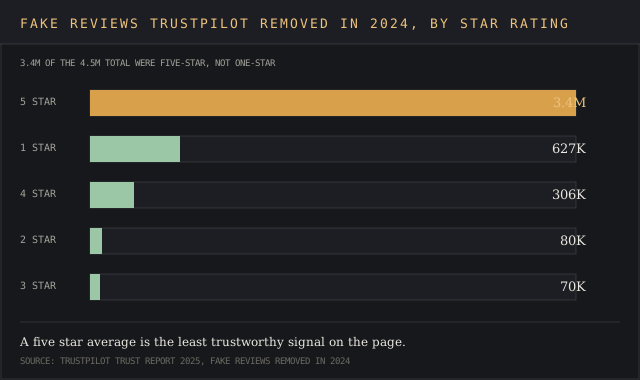
Trustpilot's own data shows the large majority of the fake reviews it removes, 3.4 million of the 4.5 million total in 2024, carried five stars, against 627,000 one star fakes over the same period.
A cluster of glowing single-review accounts, the exact pattern several forum users flagged independently for companies like Youi Insurance and Lebara, remains the most visible tell available to an ordinary reader among genuine star reviews, and Trustpilot's automated system doesn't catch every instance before publication.
The more workable habit: treat a TrustScore as one input among several, read the one and two star reviews before the five star reviews, and check any company under real financial consideration against a second source before deciding if to trust Trustpilot's number on its own.
A profile made up entirely of five-star reviews is a warning sign in itself; a mix of positive and negative feedback, spread across different reviewers and dates, does more for a profile's credibility than a spotless record does.
Consumers who use Trustpilot to spot recurring, specific complaints, a run of one-star reviews all citing the same shipping delay or the same billing error, tend to get more out of it than consumers who only check the star average. Software built to automate that kind of pattern-spotting across review platforms is covered in our customer feedback analysis tools rankings.
A buyer running a full vendor evaluation can enter a TrustScore as one line in a wider scorecard; our vendor evaluation scorecard template is built for that kind of side-by-side weighting.
Frequently asked questions
Are reviews on Trustpilot verified?
Only reviews tagged "Verified" went through a review-invitation flow the business itself initiated, tied to a real transaction. Reviews posted organically, meaning a consumer arrived at Trustpilot unprompted, carry no purchase-proof requirement; Trustpilot's guidelines ask only that the underlying experience be genuine and the reviewer be a real person, if the resulting post is a positive review, a negative review, or somewhere in between.
Does Trustpilot verify reviews?
Yes, through the automated pipeline every submission passes: pattern detection against past fraud signatures, invitation matching where one exists, and a Content Integrity team for flagged or appealed cases. That pipeline caught 4.5 million fake reviews in 2024.
It also flags authentic reviews, genuine reviews, and legitimate ones as suspicious often enough to be the top complaint reviewers raise in comments on forums like MoneySavingExpert. Trustworthy in aggregate doesn't mean every single flagged post was handled correctly.
Are Google reviews better than Trustpilot?
Neither platform requires proof of purchase before a review posts. Google ties every review to a Google account, which raises the cost of running fake accounts at scale, while Trustpilot screens submissions with machine learning and graph-based models before they go live.
Which one serves a company better depends mostly on how many online reviews that company already has on each platform, since a thin sample skews easily on both, and neither publishes a rate anyone outside the company can verify.
What is the most trusted site for reviews?
The answer depends on category more than brand. Google reviews dominates for local service businesses because it's built into Maps and Search, Trustpilot dominates for e-commerce and subscription companies, Tripadvisor leads for travel, and the Better Business Bureau serves accreditation-style confidence.
Opinions on which platform to trust vary by industry, and posting to more than one gives users a broader set of opinions than any single score can carry on its own.
What are the disadvantages of using Trustpilot?
Reviews can be removed even after a reviewer supplies documentation; multiple posters on MoneySavingExpert and Choice community described exactly that outcome, and Trustpilot's rejection message doesn't specify what evidence would have satisfied the appeal.
Businesses pay for invitation volume and analytics. Editorial control isn't part of the purchase, so a subscription never buys the ability to remove reviews a company finds unflattering, and it does nothing to change reviews already published under a previous business name.
What is more reliable than Trustpilot?
No single platform outperforms Trustpilot across every category. Google reviews carries more weight for a local business with a thin footprint elsewhere, and the Better Business Bureau adds an accreditation layer Trustpilot doesn't offer, since BBB accreditation requires a company to meet standards that go beyond hosting reviews, star ratings, and customer comments about its service.
Bottom line
Trustpilot removed more fake reviews in 2024, 4.5 million, than at any point in its published history, and it caught 90% of them before a human intervened. That's a real capability, confirmed by the numbers above. The same year, Italy's regulator fined the company for a separate failure in how it applied that capability, and the FTC's new federal rule set a floor the whole review platform industry now has to clear.
Trustpilot's system genuinely blocks a large share of fabricated reviews, and it also blocks a meaningful number of real ones, judging by the volume of documented comments from reviewers who supplied proof and still lost their appeal.
Read a TrustScore the way any single data point deserves to be read: useful in aggregate, unreliable at the level of any one five star review, and worth weighting toward the one and two star entries a company hasn't managed to get removed. That habit costs nothing, and it does more for an honest read on a company's reputation than trusting the headline star ratings or the customer service promises posted on a paying business's own profile page.
Sources, and what Trustpilot's own Trust Report doesn't break out
Trustpilot's review-pipeline description, submission volumes, and detection figures are read from Trustpilot's own Trust Report 2025 at corporate.trustpilot.com. The 2020 removal figure is from BBC News, technology-56100082. The AGCM fine is reported via Reuters, carried by Business Reporter, dated 23 March 2026. The FTC final rule is read from the Federal Trade Commission's own 14 August 2024 press release.
Forum quotes are from the MoneySavingExpert thread "Trust Pilot - can they be trusted?" and the Choice community thread "Trust pilot is not to be trusted," attributed by username where the platform doesn't publish a full name. All figures checked 14 August 2026.
Trustpilot publishes no public breakdown of appeal outcomes by category, no year-by-year figure for how many appealed removals get reversed, and no country-by-country detection-accuracy rate a reader could check against the forum complaints above.