
The numbers Deal terms and billing record, updated 5 August 2026
Adobe paid a 77% premium for measurement it couldn't build itself: keyword and backlink indexes, plus visibility inside AI answers.
Closing changed the owner. The terms carried over unchanged. The refund policy Adobe inherited was last updated 20 August 2025.
A monthly plan carries no refund right, and cancelling isn't the same act as asking for the money back.
On a monthly plan, cancel through the account form days before renewal and type the refund request into the comment field.
I'll write a 2,500+ word report on the deal you name, with price, premium, timeline and customer impact sourced line by line. Yours to publish, from $200.
Deal Terms and Timeline
Adobe announced a definitive agreement to acquire Semrush on November 19, 2025: an all cash transaction valued at $1.9 billion in total equity value, or $12.00 per share of Semrush Holdings, a 77% premium over the prior close. Semrush's stock jumped more than 70% on the news. After clearing the required regulatory approvals inside the projected first half of 2026, the deal closed on April 28, 2026.
The completion release, titled “Adobe Completes Semrush Acquisition, Strengthening CX Enterprise with Enhanced Brand Visibility Capabilities,” confirmed Semrush now operates as an Adobe company. Centerview Partners LLC served as exclusive financial advisor and Davis Polk as legal advisor on the Semrush side.
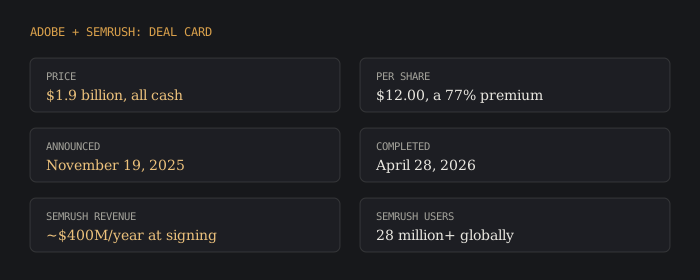
The price bought a business with roughly $400 million in yearly revenue and more than 28 million users across search engine optimization (SEO), content marketing, paid media, and competitive intelligence tools; a review of the platform's current state is in our Semrush review.
What Adobe Is Buying
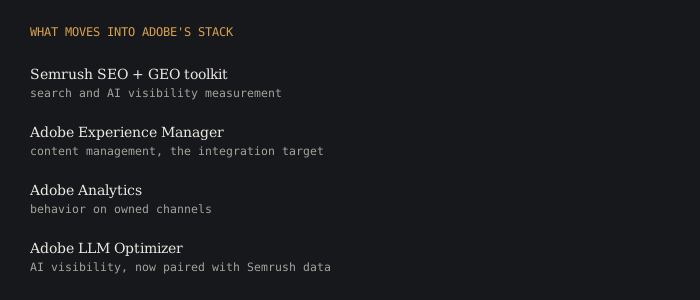
Semrush's announcement to customers called itself a leading brand visibility platform, which is the strategic frame: the SEO data corpus, keyword and backlink indexes covering the entire web, plus the generative engine optimization (GEO) tools it shipped ahead of most rivals.
Adobe gets measurement of a brand's presence across search engines and generative AI sources; Semrush's deep customer adoption, from small businesses up to global enterprises, gives Adobe a customer base its enterprise-priced Experience Cloud never reached.
The stated integration plan runs through Adobe Experience Manager for content, Adobe Analytics for behavior on owned channels, and the Adobe LLM Optimizer for visibility inside AI generated answers.
Anil Chakravarthy, who leads Adobe's digital experience business, framed the deal as uniting Semrush's discoverability intelligence with Adobe's content and customer experience stack to give chief marketing officers a complete view: how a brand shows up in traditional search, in large language models, and on the wider web, next to how customers behave once they arrive.
Semrush chief executive officer Bill Wagner made the same case in the customer FAQ, positioning the combined portfolio Adobe and Semrush will ship as a single solution for AI visibility in the agentic AI era.
Why Adobe Acquired Semrush
The timing tracks a measurable shift: AI agents and AI generated answers increasingly stand between brands and buyers, and traditional search engines are no longer the full picture of how customers find anything. Watching Adobe acquire Semrush at a 77% premium says how seriously the CMO opportunity-risk, losing relevance inside AI answers, is being priced. Our AI traffic report puts numbers on the shift.
Adobe already sold content creation, customer engagement, and customer experience measurement; what it lacked was seeing if that content earns more visibility in the places answers get assembled. Semrush measures exactly that, which turns search engine optimization and its GEO successor from a separate discipline into a feedback loop inside Adobe's stack: create in Experience Manager, measure visibility with Semrush, track behavior in Adobe Analytics, adjust.
Analyst reaction framed the acquisition of Semrush as the start of agentic search optimization as an enterprise category, generative engine optimization graduating from SEO-blog jargon to a $1.9 billion line item. Xamsor's analysis added the defensive angle behind Adobe's acquisition: only two companies offer competitive analytics at this depth, Semrush and Similarweb, so seeing Adobe acquire Semrush removes the data gap and denies it to rivals.
Owning brand visibility data is harder to copy than AI content features.
What It Means for Customers and the Category
For Semrush subscribers, the near-term answer from both companies' FAQ material: plans, pricing, and new tools continue, with integration arriving over time.
The categories to watch are data access and packaging. A global technology leader that unleashes creativity for enterprise buyers, as Adobe's boilerplate has it, historically prices for enterprises, so small businesses that adopted Semrush at $140 a month should watch renewal terms once the combined portfolio ships. Our Semrush pricing report has the current published tiers to compare against whatever a renewal quote asks for.
Adobe expands its digital experience business either way; if standalone Semrush stays a priority is the open question the deal documents do not answer.
Billing and cancellation terms Adobe inherits
The refund policy carries over with the rest of the business, and it is the term most subscribers find out about after they have been charged. Semrush advertises a 7-day free trial and, separately, a 7-day money-back guarantee. The published policy limits that guarantee to an initial subscription of twelve months or longer, or an initial add-on, and states that refunds aren't available for month-to-month subscriptions.
So a trial that converts to a monthly plan carries no refund right. The same document makes conversion automatic unless the customer cancels first.
Two procedural clauses sit on top of that. Cancellation runs through a logged-in form, and failing to answer every question on it can result in the request being denied. A refund is a separate act from a cancellation: the customer has to type the refund request into the comment field, and cancelling correctly while omitting that sentence leaves the charge standing.
The complaint record follows from the policy. Semrush, Inc. isn't BBB accredited and carries 55 complaints over three years, of which the bureau records 51 as unanswered and 4 as resolved. Accounts filed in the two months before the deal closed describe one pattern.
| Charge | Filed | What the complainant states | Stated reason for refusal |
|---|---|---|---|
| $199.95 | Apr 2026 | Cancelled the same day the charge landed | The cancellation came after payment processed |
| $216.91 | Apr 2026 | Trial converted; refund asked for within three hours, no usage | The monthly toolkit is non-refundable |
| $289.00 | Apr 2026 | Refund requested inside the advertised 7-day window | Same monthly-plan rule |
| $1,399.50 | Apr 2026 | Cancellation confirmed by email March 2025; billing resumed that May at $139.95 a month for ten months | No response to the complaint, or to Discover |
Four of the 55 complaints on file, selected as the clearest statements of the pattern. Unverified consumer allegations.
The last row ran furthest. Provisional credits issued by Discover were reversed because the bank got no answer, and the complainant then found the account disabled. Trustpilot reviews carry the same themes: denied refunds, a multi-step cancellation involving a form, an email confirmation, a verification link and a processing delay, and add-on toolkits activating after a trial without a separate opt-in.
A billing class action, Quinlan v. Semrush, Inc., case 2:25-cv-06924, was filed on 10 December 2025 in the U.S. District Court for the Eastern District of Pennsylvania. The docket is public and the allegations aren't yet reported, so the case is pending.
None of this is Adobe's doing. The refund policy carries a last-updated date of 20 August 2025, eight months before the deal closed on 28 April 2026, and every complaint above was filed while Semrush was still independent. What the acquisition changes is whose name the terms now run under.
Before starting a Semrush trial. A monthly plan gives you no refund rights under the August 2025 policy, which is the policy still in force. Cancel through the account form several days before the trial ends, answer every field, and type the refund request into the comment box even if you think you are inside the window.
For the wider market, Adobe's acquisition of Semrush confirms what the consolidation pattern across intelligence categories already showed: measurement layers get absorbed into platforms that serve marketers end to end. Independent SEO tools now compete with a suite that promises a single view of visibility plus actionable experiences on top, and the remaining independents, Similarweb chief among them, become both more valuable and more likely acquisition targets.
Buyers comparing the field can start with our Similarweb review and the market intelligence tools ranking; both Adobe and Semrush customers should read the deal as a signal that brand visibility data, search and AI alike, is now infrastructure, priced and fought over accordingly.
New value for marketers is the promise; a new growth channel for Adobe is the mechanism; more visibility into AI's answer layer is the product that has to deliver both.
Sources: Adobe press releases of November 19, 2025 and April 28, 2026; Semrush customer FAQ; Semrush Cancellation and Refund Policy, last updated August 20, 2025; Better Business Bureau complaint record for Semrush, Inc.; Trustpilot; CourtListener docket 2:25-cv-06924; Search Engine Journal; MediaPost; Reuters; Xamsor analysis.
Adobe's Semrush purchase isn't the only recent acquisition reshaping a data category; our MSCI acquisition report covers the $697 million Burgiss deal that built out MSCI's private-markets data business the same way.
SEO software vendors, investors and agencies use reports like this one in client notes and board packs.
A report on your topic for a blog page, gated content or a lead magnet.
Written for your client and published under their brand, with my name left off.
Your report on marketintelligencetools.com, with 2 to 3 CTAs carrying your sponsored links.
Default terms: the report is yours to publish, and I keep the right to republish it on this site behind a gate, outside Google's index.