
The numbers 2025 to Q1 2026 studies, updated 5 August 2026
The two studies don't disagree. HUMAN counts machines arriving at websites, Moccu counts people arriving from AI tools.
Google still sends 413 times more visits than every AI tool combined, so the referral channel hasn't moved yet.
Two-thirds of AI-driven traffic is training crawlers, and crawler hits never run the analytics script. Server logs are the only place they show up.
Segment the AI referrers in analytics, filter the bot user agents in your logs, and track share of sessions.
I'll write a 2,500+ word report on the slice you name, from HUMAN Security bot data to Moccu referral shares, every figure linked. Yours to publish, from $200.
The Key Numbers
Two 2025 to 2026 studies anchor this AI traffic report, and they measure different things. HUMAN Security's 2026 benchmark, drawn from bot defense telemetry, found AI-driven traffic grew 187% from January to December 2025, with agentic AI traffic up 7,851% year over year and AI scraper traffic up 597%.
Moccu's AI traffic report, built from analytics on more than 50 international B2C and B2B websites, found AI traffic share reached just 1.40% of total organic traffic by Q4 2025, while Google kept an organic share above 90%.
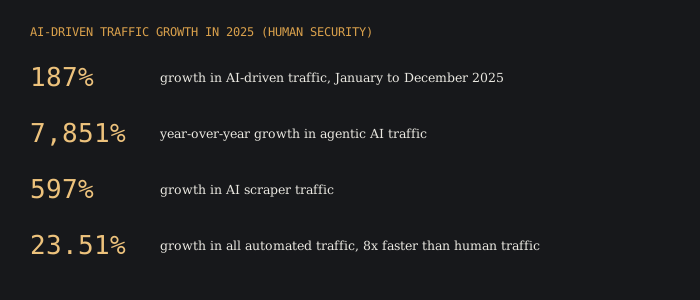
Both are right. HUMAN counts machines visiting websites: crawlers, scrapers, AI agents. Its data measures AI-driven traffic against human traffic across the sites its platform defends. Moccu counts humans arriving from AI tools: a person clicks a citation in ChatGPT and lands on a page. The first number describes what AI systems take from the web; the second describes what AI platforms give back in visits.
Any AI traffic report that quotes one side without the other is describing half the picture.
What an AI Traffic Report Measures
An AI traffic report measures website visitors and requests that originate from AI platforms.
In practice that covers three streams: referral visits from AI tools like ChatGPT, Perplexity, and Gemini; crawler requests from the bots that feed machine learning models; and agent sessions where AI agents browse product and search pages on a user's behalf, the stream growing fastest in every dataset this report tracks.
Identification rests on three signal types. User agent strings name the well-behaved bots: GPTBot, ClaudeBot, PerplexityBot. Infrastructure signals, IP ranges and autonomous system numbers, catch operators that do not announce themselves. And observed behavior separates the rest: automated traffic paces through pages at intervals human traffic never matches, and observed behavior plus infrastructure signals together catch most of what user agent strings miss.
The catch for anyone building their own traffic report: AI referral visits often hide under "Direct" or "Organic" in analytics, because several AI platforms strip referrer headers, so default dashboards undercount AI traffic from day one.
How Fast AI-Driven Traffic Is Growing
HUMAN's benchmark puts all automated traffic growth at 23.51% year over year in 2025, roughly eight times faster than human traffic growth over the same date range. Within that, the AI-driven slice grew 187%, meaning AI-driven automation is growing several times faster than automation overall.
The dataset behind those figures is large; HUMAN describes its observation base in quadrillion interactions across the network it defends; whatever the exact count, quadrillion interactions is the scale class where composition claims about internet traffic become credible.
The growth curve is steep enough that point-in-time numbers age in months. Search Engine Land's coverage of the same report led with the structural claim: automated traffic now exceeds human activity across the web, and the machines are no longer just indexing; they are using websites, completing forms, and moving through checkout flows.
Sector reports show the same slope from the demand side. Adobe's AI traffic trends work found AI traffic to U.S. travel sites up 194% year over year, with AI visitors surpassing some traditional sources, and TechCrunch reported Adobe's Q1 2026 figure of 393% growth in AI traffic to U.S. retailers, alongside revenue gains from those visits.
Whatever the exact multiplier, every published measurement agrees the AI traffic trends point the same direction: continued growth, concentrated where transactions happen.
What AI Bot Traffic Is Made Of
Copy these lines into an email, fill them in and send. I reply with scope and a price within 2 to 3 business days.
Open the emailTraining crawlers: 67.5%
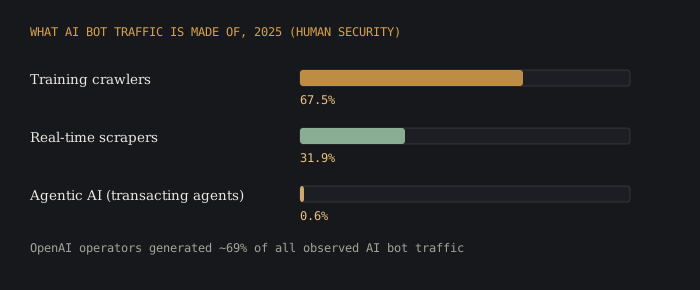
The bulk of AI-driven traffic is training crawlers gathering material for machine learning models. HUMAN found this slice more than doubled in 2025 and concentrates heavily in e-commerce, where product pages supply structured text at scale. These bots read; they do not click, convert, or appear in your analytics, since crawler hits never execute the analytics scripts. Server logs are the only place this traffic is visible.
AI scrapers: 31.9%
Real time scrapers fetch pages on demand so an AI assistant can answer with current information. Scraper traffic grew 597% in 2025 and targets publishers hardest, because news is what users ask AI tools about. Search data shows the same pull: sites that rank for fresh queries in the search engine get scraped for the same pages AI search wants to cite.
Unlike training crawlers, real time scrapers correlate with answers being generated about your content right now, which makes them a leading indicator for AI visibility even though the visits themselves convert nothing.
Agentic AI: small share, fastest growth
Agentic AI, software that browses, fills carts, and transacts for a person, grew 7,851% from a small base. HUMAN's data shows agents concentrating on product and search pages and actively transacting. OpenAI operators generated roughly 69% of all observed AI bot traffic across categories, which means one company's crawler policy decisions move the whole automated traffic picture.
AI Traffic Share Against Google
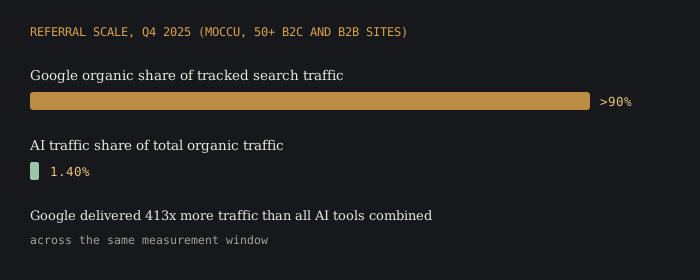
Moccu's measurement across 50+ websites is the sobering half of this traffic report, and the traffic share numbers deserve the emphasis. AI traffic share reached 1.40% of total organic traffic by Q4 2025, growing steadily quarter over quarter but from a base so small that Google delivered 413 times more traffic than all AI tools combined.
Their conclusion, published with the raw charts: AI brings some traffic growth, but it is no substitute for Google, and the biggest threat to Google's referral volume appears to be Google itself, as AI overviews answer user queries on the results page before anyone clicks through to websites.
The two datasets reconcile cleanly once you separate machines from human traffic and treat the AI traffic sources separately. AI systems consume web content at explosive rates (HUMAN), while human users arriving from AI platforms remain a small percentage of visits (Moccu).
For anyone forecasting organic traffic, that means the near-term risk is not AI referrals replacing the search engine; it is AI-powered search answering questions in place, cutting clicks from traditional search results while your server pays to feed the training crawlers.
Where AI Traffic Concentrates
HUMAN's vertical breakdown puts AI-driven traffic heaviest in retail, media, and travel. E-commerce draws training crawlers for its structured catalogs and agents for its checkout flows; publishers draw scrapers for freshness; travel draws all three, which matches Adobe's 194% figure for travel sites. Within sites, the concentration is on product and search pages, the two page types that answer the questions users ask AI assistants.
The business implication runs through conversion rates. Similarweb's tracking work shows visitors from AI platforms engage differently from search visitors, and several retail studies report higher conversion rates from AI referrals, plausibly because the assistant pre-qualified the visit during the conversation. A small percentage of visits with different behavior is exactly the segment a traffic report should isolate.
How to Build Your Own AI Traffic Report
Want a tracking checklist like this for your own analytics stack? Send the tools you use.
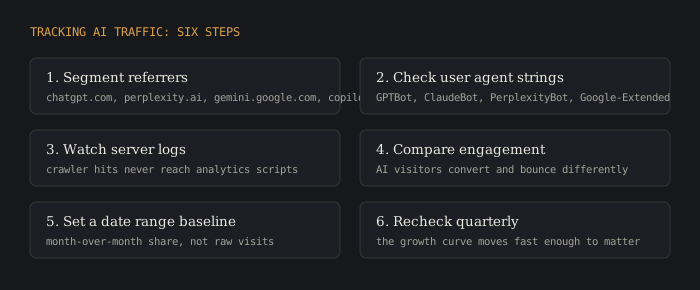
Email a briefThe tracking setup takes an afternoon. Segment referral sources for the AI domains: chatgpt.com, perplexity.ai, gemini.google.com, copilot.microsoft.com; ChatGPT now appends UTM parameters to many outbound links, which helps. Build a custom report in Google Analytics against that segment, and accept that it undercounts, since stripped referrers land in Direct.
For the machine side, pull server logs and filter the published user agent strings; that is where training crawlers and real time scrapers show up. Then compare engagement between AI visitors and search visitors over the same date range, because averages across both mislead.
Tool support has caught up. Similarweb runs an AI traffic tracker covering chatbot referrals and the prompts behind them, Semrush ships an AI traffic dashboard inside its Traffic and Market toolkit, and MonsterInsights added an AI traffic report to its WordPress analytics. Our AI market intelligence section covers the wider tooling, and the Adobe Semrush acquisition report explains why the analytics vendors are racing to own this measurement layer.
Set the baseline as AI traffic share of sessions, tracked monthly, and track it next to organic traffic from the search engine so both trends sit on one chart. Raw counts flatter the growth rate; share tells you if the channel matters yet for your business.
Recheck quarterly, because every study in this AI traffic report shows the growth curve moving fast enough to rewrite the numbers inside a year, and archive each quarter's data so your own trends survive tool changes.
What It Means for Visibility
Digital marketing planning now has to hold two ideas at once. Google remains the referral engine; above 90% organic share means search engine optimization keeps paying for years. And AI search is becoming the discovery layer: content that AI systems can parse gets cited by AI assistants, cited content earns AI visibility, and that visibility converts to visits at rates the retail data suggests are worth having.
Track visibility in the AI sources your customer base uses; a business selling to developers cares about different AI platforms than one selling shoes.
The practical move is not choosing between search and AI sources; it is instrumenting both, protecting checkout flows from hostile automated traffic, and deciding deliberately which AI scrapers and training crawlers to allow, since they consume bandwidth while feeding the systems that increasingly shape a brand's digital presence.
Track the trends. The panic is a separate feed. The AI traffic trends in every dataset here, growth rate, composition, sector concentration, point to a web where a significant portion of activity is machine-driven and a growing share of human discovery starts in a conversation. Websites that measure it now will notice the percentage point shifts as they happen; everyone else will notice them in a revenue report.
AI Traffic Trends, Quarter by Quarter
Moccu's dataset runs from Q2 2024 to Q4 2025, long enough to show the shape of the curve. AI traffic share has grown steadily every quarter: a small percentage point gain each period, no spikes, no reversals. In relative terms the growth looks dramatic, AI traffic roughly tripled its share across the window; in absolute terms it moved from well under one percent to 1.40% of organic visits. Steadily increasing, yes.
Across Moccu's Q2 2024 to Q4 2025 dataset, AI traffic roughly tripled its share and reached 1.40% of organic visits.
AI share of organic traffic, Q4 2025
Source: Moccue.g. AI referrals to sites in your industry
Source: linked, checked, datedExplosive at the level where budgets get set? Not yet.
The Google counter-check in the same traffic report is what makes the data trustworthy. While AI traffic grew, Google's traffic share held above 90% across the same websites and the same date range, which rules out the comforting story that AI visits are relabeled search visits. Users are adding AI tools to how they find things. Engine-swapping is a different behaviour.
Every AI traffic report published in 2026 should run this counter-check; most skip it, and the ones that skip it read like press releases for the growth curve.
Two forecasts from the Moccu team frame the range. If quarterly growth holds, AI traffic reaches the low single digits of total traffic by late 2026; if adoption of AI agents accelerates the slope, sooner.
Neither forecast puts AI sources anywhere near search engine scale inside the forecast window, which is the honest answer to the "Google killer" question their own report raises: the search engine's biggest traffic threat is Google answering in place. The AI platforms outside it rank second.
How AI Search Changes Search Behavior
The visits an AI traffic report counts are the last step in a search process that has already changed. In AI powered search, users describe a problem in conversation, the AI tools search the web, read pages, and answer with citations; the click that used to start at traditional search results now starts, when it happens at all, from a citation link. Search pages still matter, but they compete with the answer layer sitting on top of them.
Google runs both layers at once. AI overviews sit above its traditional search results and answer questions directly; Google says its AI search features send billions of clicks to websites weekly, and independent click-through studies say those clicks are fewer than the old blue links produced for the same search.
Both statements can be true, and neither settles what happens to your pages specifically, which is why tracking your own traffic beats quoting anyone's aggregate search data.
For search engine optimization the operational change is content structure. AI systems favor pages that answer questions cleanly: headings that match real questions, facts with sources, dates on claims. That overlaps almost entirely with what the search engine already rewarded, so the work is additive; the difference is measurement, where search console data misses AI citations and only an AI traffic report closes the gap in your visibility picture.
Definitions Used in This Report
AI traffic
Visits to websites that originate from AI platforms, say a human clicked a citation in ChatGPT or an agent fetched pages directly. Some measurement firms count only the human referrals; this traffic report separates the two wherever the underlying data allows.
AI-driven traffic and automated traffic
Automated traffic is everything nonhuman: search engine crawlers, uptime monitors, scrapers, and bots of every intent. AI-driven traffic is the subset tied to AI systems: training crawlers, real time scrapers, and agents. The distinction matters because search engine crawlers have visited websites for thirty years without controversy; the new AI traffic sources consume more, faster, and for different ends.
Agentic AI
Software that acts for users: AI agents browse product pages, compare options, complete purchases. Agentic AI is the smallest slice of AI traffic today and the fastest growing at 7,851%, and its traffic patterns look human enough that bot defense firms treat it as its own category, neither attack nor visitor.
AI traffic share
AI visits divided by all sessions over a date range, the metric this report recommends over raw counts. Share is comparable across websites of different sizes and immune to seasonality inflating everyone's visits at once.
What AI Traffic Means for Your Customer Base
The business case for tracking starts with who arrives. Early data from retail says visitors referred by AI tools convert at higher rates than search visitors; if that holds for your customer base, a channel at 1.40% of visits can carry a larger share of revenue, and ignoring it undercounts a growing segment of your users.
The reverse risk is quieter: if AI assistants describe your business inaccurately and users never click through, no analytics report shows the loss. Access to that failure mode requires asking the AI platforms your buyers use and reading what comes back, prompt-level tracking that Similarweb and a growing tool set now offer.
Digital marketing teams should also budget for the cost side. Training crawlers and scrapers consume bandwidth on every page they fetch, several times faster than human browsing, and sites with large catalogs report measurable infrastructure cost from bot access alone. The decision framework is the same as the visibility one: know which bots, which pages, and what the business gets back for the bandwidth, then grant or block access deliberately.
Benchmarks to Track Against This Report
Numbers to pin on the wall and re-test with your own traffic data as users shift. AI traffic share: 1.40% of organic traffic was the Q4 2025 cross-site average, so a business measuring 3% of traffic from AI is ahead of the curve and a business at 0.2% is behind it, useful context either way.
AI-driven traffic composition: two-thirds training crawlers, one-third scrapers, agents small but compounding; if your server data shows a different mix, your content type explains it. Growth: AI-driven automation grew 187% in a year, so any plan that assumes this quarter's traffic mix holds for two years is already wrong.
Watch three things through 2026. If AI agents cross from novelty to a measurable traffic share of transactions, and if AI agents get their own analytics category from Google, which the 7,851% growth in AI-driven agent traffic says to take seriously even from a small base.
If AI search referrals keep converting better than search engine visits, and if AI search share follows the same curve inside AI traffic share overall as more users arrive through them, since early conversion data tends to flatter new traffic sources while their users are early adopters.
And if the major AI sources start paying for content access at scale, which would turn the crawler cost line in this report into a revenue line for sites whose traffic data proves what the bots consume. Users decide the first two; lawyers and licensing deals decide the third. Record labels started licensing in late 2025, when Universal settled with Udio and Warner Music Group partnered with Suno, per our music industry statistics report.
Track all three in your own analytics, because aggregate data describes the web on average, and no business is average.
Delivered for your site and your byline. Hosting here is optional.
Common Questions
Is AI traffic replacing search engine traffic?
Not in any current dataset. AI referrals are 1.40% of organic visits against Google's 90%-plus share (Moccu, Q4 2025). The displacement risk is inside the search engine itself: AI overviews answering user queries before the click reaches websites.
How much of internet traffic is automated?
HUMAN's 2026 benchmark reports automated traffic exceeding human traffic across the web it observes, with automation growing 23.51% year over year against much slower human growth, so internet traffic composition varies by site but tilts machine-ward everywhere.
Should websites block AI scrapers?
Depends what the business sells. Publishers whose content is the product increasingly block or license; a complete picture of what the bots take makes the licensing math possible; e-commerce sites mostly allow, because being absent from AI answers costs more than the bandwidth.
The detailed breakdown in your server logs, which bots, which pages, how many times faster they hit than users browse, is the complete picture that call needs; make it with a date range of logs in hand.
Sources: HUMAN Security 2026 State of AI Traffic and Cyberthreat Benchmark Report; Moccu AI Traffic Report (Q2 2024 to Q4 2025 data); Search Engine Land; Adobe AI traffic trends coverage via TechCrunch and Hotel News Resource, 2026.
SEO agencies, analytics vendors and publishers use reports like this one as link bait and client briefs.
A report on your topic for a blog page, gated content or a lead magnet.
Written for your client and published under their brand, with my name left off.
Your report on marketintelligencetools.com, with 2 to 3 CTAs carrying your sponsored links.
Default terms: the report is yours to publish, and I keep the right to republish it on this site behind a gate, outside Google's index.