Music industry statistics 2026: recorded music reached $31.7 billion in 2025
 By Jan Suski. I go deep on every review, checking every number against its source and digging up details other coverage misses, a habit from six years of SEO and link building for tech companies. Bylines at Surfer, Brand24, and Senuto. How the scoring works.
The numbers Global and US recorded music, checked 4 October 2026
Paid subscriptions earned 52.4% of global revenue in 2025, more than physical, performance rights, downloads and sync combined at 30.4%.
Physical formats grew 8.0% against 7.7% for digital music, the second time on record that physical grew faster.
USA & Canada grew 3.5%, the second-slowest area, while holding 38.7% of global revenue.
Global recorded music revenue grew 6.4% to US$31.7 billion in 2025, the 11th straight year of growth, according to the IFPI Global Music Report 2026. Streaming brought in more than US$22 billion of that. 837 million people paid for a music subscription.
The US story is moving faster in 2026. RIAA's mid-year report puts first-half US revenue at US$5.97 billion, up 6.9%, with CD revenue up 58.6%. In the same months, Deezer said fully AI-generated tracks passed half of its daily uploads.
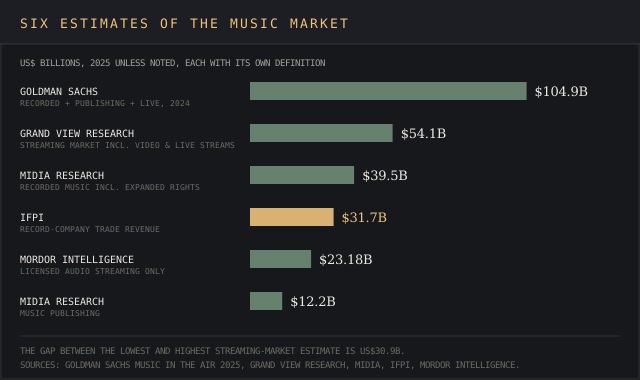
These are the music industry statistics published between January and October 2026 on revenue, streaming, music sales, regions, labels, artist payouts, listening and AI uploads, each linked to its publisher. They're for analysts, label managers and marketers sizing the recording industry, and they explain why its size reads US$12 billion to US$105 billion depending on the counter.
How big is the music industry in 2026
IFPI's US$31.7 billion is the standard figure for worldwide record sales. It counts what record companies earn around the world from streaming, physical, downloads, performance rights and sync. The 2025 total added US$2.0 billion, after 4.7% growth in 2024, per Music Business Worldwide's read of the IFPI data.
Wider definitions push the figure up. MIDiA Research puts the 2025 recorded music market at US$39.5 billion, up 9.4%, because it adds labels' expanded rights: merch, live and brand deals. Music publishing brought in another US$12.2 billion, up 9.6%, per MIDiA's September 2026 publishing estimate.
Goldman Sachs goes the whole nine yards. Its Music in the Air 2025 sums recorded music, publishing and live into US$105 billion for 2024 and puts future revenue near US$200 billion by 2035. Run the 2035 figure of US$196.8 billion through a CAGR calculator and the implied growth is about 5.9% a year.
Live music is the biggest slice of the industry. Live Nation alone reported US$25.2 billion of 2025 revenue, US$20.9 billion from concerts, with 159 million fans at 55,000 shows and 346 million fee-bearing tickets sold for venues and promoters.
Streaming, subscription and digital music statistics
Streaming took the lion's share of 2025 revenue: more than US$22 billion, or 69.6% of global recorded music income. Paid subscription revenue rose 8.8% to US$16.6 billion, per Variety's report on IFPI's figures, and ad-supported streaming, which gives consumers free access, grew 4.3%.
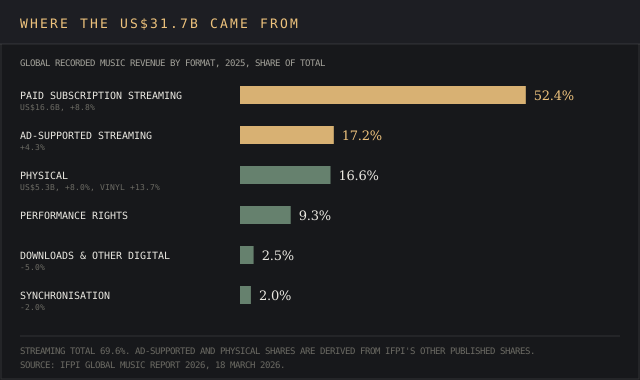
Digital music outside streaming keeps shrinking. Downloads and other digital formats fell 5.0% to 2.5% of global revenue in 2025, their 13th straight annual decline, per IFPI.
Paid accounts rose from a restated 764 million in 2024 to 837 million in 2025, so 73 million more people used a paid music subscription. Spotify, which says it accounts for roughly 30% of recorded music industry revenue, reported 300 million premium subscribers and 777 million monthly active users in its Q2 2026 shareholder deck. Revenue that quarter was €4.78 billion, up 14%.
YouTube says it has "over 125 million Music and Premium subscribers globally (including trials)" and that over 2 billion logged-in viewers watch music video content each month, per its October 2025 music update. It paid the music industry over US$8 billion in the 12 months to June 2025. Our YouTube statistics report covers the rest of the platform. Apple Music and Amazon Music keep their subscriber counts private.
Stream counts across streaming platforms keep climbing. Luminate counted 5.1 trillion global on-demand audio streams in 2025, up 9.6%, with 3.7 trillion outside the US. Four countries (the US, Mexico, Brazil & Germany) produced 48.9% of global premium streams. The first half of 2026 added another 9.8% growth, per Billboard's summary of the Luminate midyear report.
Physical music sales: vinyl, CDs and a 19-year run
Physical revenue rose 8.0% to US$5.3 billion in 2025, and vinyl has been on a roll for 19 consecutive years, up 13.7% in 2025 alone. Asia accounted for 45.1% of global physical revenue, and CD and music video revenue grew 3.7%. Physical beat digital music growth by a hair's breadth, 8.0% to 7.7%, the second time on record per Billboard's IFPI analysis.
US consumers spent more on vinyl than on any other physical format. RIAA data counted 46.8 million US vinyl units in 2025 worth US$1.04 billion, against 29.5 million CDs worth US$312.4 million. RIAA says US vinyl makes up nearly 50% of global vinyl revenue.
The first half of 2026 brought a CD surge. Per RIAA, CD revenue jumped 58.6% to US$171.1 million and vinyl rose 17.7% to US$543.8 million on 26.5 million units. Luminate's point-of-sale data puts K-pop albums behind more than half of the CD rise, and about half of Gen Z and millennial consumers who've bought a CD don't own a CD player.
The devil's in the details with unit counts. RIAA reports shipments, so its 46.8 million vinyl units for 2025 sit below Luminate's 47.9 million vinyl albums sold at the register. Taylor Swift's The Life of a Showgirl was Luminate's top vinyl album at 1.601 million copies.
Recorded music growth by region and country
Latin America grew 17.1% in 2025, the fastest of any region and its 16th straight year of growth, and streaming makes up 88.1% of its revenue. MENA and Sub-Saharan Africa each grew 15.2%. Asia grew 10.9%, and China rose 20.1% to pass Germany as the world's No. 4 music market.
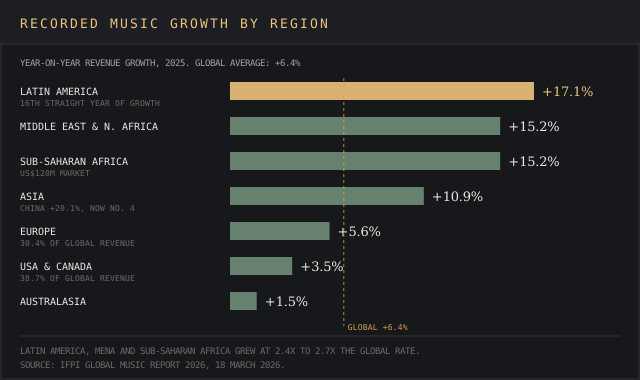
The two biggest blocs grew slowest. USA & Canada rose 3.5% and hold 38.7% of global revenue, while Europe grew 5.6% and holds 30.4%. Australasia added 1.5%.
| Rank, 2025 | Market | Change in rank | 2025 revenue growth |
|---|---|---|---|
| 1 | United States | 0 | +3.3% |
| 2 | Japan | 0 | +8.9% |
| 3 | United Kingdom | 0 | +4.8% |
| 4 | China | +1 | +20.1% |
| 5 | Germany | -1 | +1.7% |
| 6 | France | 0 | +3.7% |
| 7 | South Korea | 0 | n/a |
| 8 | Brazil | +1 | +14.1% |
| 9 | Canada | -1 | +5.6% |
| 10 | Mexico | +2 | +13.3% |
Rankings come from IFPI via Music Business Worldwide, and growth rates from IFPI's release. Canada's market reached US$957.9 million, per Billboard Canada.
US music sales and recording industry statistics
US recorded music revenue hit a record US$11.54 billion at wholesale value in 2025, up 3.1%, per the Recording Industry Association of America. Paid subscriptions averaged 106.5 million accounts and earned US$5.88 billion, 55.3% of the total. All streaming formats together brought in US$9.47 billion, about 82%.
RIAA's mid-year numbers are hot off the press. First-half 2026 revenue reached US$5.97 billion, up 6.9%, with 111.1 million paid subscriptions, sync licensing up 18.2% to US$231.8 million and digital music downloads down 12.7% to US$121.0 million, per the mid-year PDF.
Older figures need a conversion before any year-on-year comparisons. RIAA switched to wholesale-only reporting in mid-2025, per Billboard, so the recording industry's retail-value history and 2025's wholesale total sit on two bases:
- 1999: retail revenue peaked at US$14.6 billion.
- 2013 to 2015: wholesale revenue ran US$4.77 billion, US$4.86 billion and US$4.95 billion, against about US$7.0 billion a year at retail.
- 2016: streaming earned US$3.9 billion at retail and became the majority format for the first time at 51%, per RIAA.
- 2023: retail revenue reached US$17.1 billion, with streaming at US$14.4 billion (84%), 43 million vinyl units and 37 million CDs, per RIAA's 2023 report.
- 2025: wholesale revenue reached US$11.54 billion, a record on the new basis.
Genres split unevenly. Luminate counted 349.9 billion US streams for R&B/hip-hop in 2025, 260.5 billion for rock and 167.2 billion for pop, and US album consumption rose 4.8% to 1.138 billion albums and album equivalents, per Luminate data. Spanish-language tracks took 9.4% of US streams in the first half of 2026.
Record labels, publishers and market share
Three companies own the majority of recorded music. Majors held 53.3% of the global market by ownership in 2023, per MIDiA data reported by Billboard. Different fiscal calendars are par for the course, so the table dates every row.
| Company | Fiscal year | Total music revenue | Recorded music | Music publishing |
|---|---|---|---|---|
| Universal Music Group | To Dec 2025 | €12.51B (+5.7%) | €9.46B | €2.26B |
| Sony Music | To Mar 2026 | US$11.71B (+13.4%) | US$8.93B | US$2.79B |
| Warner Music Group | To Sep 2025 | US$6.71B (+4%) | US$5.41B | US$1.31B |
Sony's dollar figures are Music Business Worldwide's conversion from yen. On market share, MIDiA's 2024 figures put UMG first at US$10.5 billion in label revenue, Sony Music Group at a 21.7% share and non-major labels at 29.7%. Artists releasing direct earned US$2.0 billion.
Publishing is more concentrated each year. The three majors held 54.7% of global music publishing revenue in 2025, up from 53.4%, leaving 45.3% for independent publishers and catalogue funds. Sony Music Publishing is the largest. Anyone checking those splits against raw revenue can run them through a market share calculator.
What artists earn from streaming
Spotify paid the music industry more than US$11 billion in 2025, per company data, and nearly US$70 billion all-time, with roughly half going to independent artists and labels (March 2026 Loud & Clear update). Its own payout tiers for 2025:
- 1,500+ artists generated more than US$1 million.
- 13,800+ artists generated at least US$100,000, about 1,400 more than in 2024.
- 81,000+ artists generated at least US$10,000.
- The 100,000th-ranked artist generated more than US$7,300, against about US$350 in 2015.
Those tiers sit on a wide base of creators. About 13 million people have uploaded at least one song to the platform, and the company estimates around 250,000 of them pursue music professionally, per its Loud & Clear FAQ. More than 30% of that group earned US$10,000 or more.
Most tracks draw a sliver of listening. Luminate found 88% of tracks had 1,000 or fewer streams in 2025, and 120.5 million of 253 million tracks had 10 or fewer, per Hypebot's Luminate summary. Artists' share of label revenue rose to 35.5% in 2025 from 31% in 2016, per IFPI data reported by Billboard.
How people listen to music: streaming, radio and video
Streaming leads radio on daily music reach. Edison Research's Share of Ear insights for Q2 2026 put streaming at 46% of Americans 13+ each day, against 43% for AM/FM radio. In 2015 radio stood at 61% and streaming at 27%. 87% of Americans listen to music daily.
Older listeners drive the newest growth. The Infinite Dial 2026 found 81% of Americans 12+ (233 million people) listened to online audio in the past month. Within that audience, the 55+ share rose from 52% in 2024 to 70% in 2026. 84% use YouTube monthly. Our podcast industry statistics page breaks down the rest of that audio audience and its video habits.
IFPI's Engaging with Music 2023 survey of 43,000+ consumers in 26 countries found 20.7 hours of listening a week and 73% using licensed audio streaming. 76% said artists' music shouldn't be used by AI without permission.
Consumer trends shift by group. Luminate's midyear insights show Latin casual listeners among US music consumers rose from 44% in Q3 2021 to 54% in Q1 2026, the kind of audience demographics split that demographic market segmentation turns into a targeting plan.
AI-generated music and 150,000 daily uploads
Deezer receives about 90,000 fully AI-generated tracks a day, more than 50% of daily uploads at the June 2026 peak, up from 10,000 a day in January 2025. AI tracks now arrive in the millions, with 13.4 million detected and tagged in 2025. They draw 1% to 3% of streams, a drop in the bucket, and up to 85% of their 2025 streams were fraudulent, per Deezer's April 2026 release.
The rise in total uploads to streaming platforms makes every new release a needle in a haystack. Luminate counted 106,000 new tracks a day in 2025, and its chief executive now puts the number higher.
"We're now seeing close to 150,000 tracks a day being uploaded to streaming platforms, which is a material increase. Breaking through and reaching an audience is really hard."
Rob Jonas, CEO of Luminate, speaking to Billboard, 2026.
IFPI chief executive Victoria Oakley called streaming fraud "theft, plain and simple" in the March 2026 report and said services, "content aggregators and distributors" must act. In a Deezer and Ipsos survey of 9,000 music consumers in 8 countries, 97% couldn't tell fully AI-generated music from human tracks.
Labels started licensing. Universal settled with Udio on 29 October 2025 and announced a licensed creation platform launching in 2026, per the joint release. Warner Music Group partnered with Suno on 25 November 2025, and Suno says it has "nearly 100 million music makers".
Music data platforms behind the charts
Label and artist managers plan releases on daily numbers. They log in to music data platforms that track plays, playlist placements, social growth and chart data, then explore track performance by country and across genres to pick the next move and discover which playlist is driving momentum.
- Chartmetric tracks 40+ streaming and social platforms, more than 4,000 charts and 14 million+ artists, with access to more than 10 years of history for most platforms.
- Songstats covers Spotify, Apple Music, Amazon Music, Deezer, SoundCloud, YouTube and TikTok, plus Bandsintown and Songkick concert data and radio monitoring across 50,000+ radio stations and TV channels.
- Luminate draws on 500+ authorized data partners, and its data decides chart entry and status on the Billboard charts.
The same playlist and momentum signals feed broader trend research tools and social listening platforms, which track a brand or artist across social video. Our guide to market intelligence data covers how that depth of daily music data compares with annual marketing reports such as IFPI's, which publish consumer trends by country once a year for artist development and label planning.
Why music industry estimates diverge
Every publisher answers a different question, and a complete picture needs all of them. IFPI and, since mid-2025, RIAA count what labels receive at wholesale. MIDiA adds expanded rights. CISAC counts royalties collected by its member societies: €12.59 billion for music creators in 2024, per its Global Collections Report 2025.
| Estimate | Value | What it counts |
|---|---|---|
| IFPI recorded music | US$31.7B | Record-company trade revenue, excluding publishing and live |
| MIDiA recorded music | US$39.5B | Label revenue including merch, live and brand rights |
| MIDiA music publishing | US$12.2B | Global publishing revenue |
| Goldman Sachs total music | US$104.9B (2024) | Recorded music, publishing and live |
| Grand View Research streaming market | US$54.1B | Audio and video, on-demand and live streaming |
| Market.us streaming market | US$38.6B | Streaming including podcasts and audiobooks |
| Mordor Intelligence streaming market | US$23.18B | Licensed audio streaming revenue only |
The streaming estimates span US$30.9 billion for one calendar year. Grand View counts video and live streams, Market.us adds podcasts and audiobooks, and Mordor sticks to licensed audio, which lands it closest to IFPI's US$22 billion of label-side streaming. Our market sizing template puts that definition in the first row, and our note on secondary market intelligence covers how to cite a house's number with its scope attached.
Where the music numbers come from, and the figures labels keep private
Revenue and formats, checked 4 October 2026: ifpi.org (Global Music Report 2026, March 2026, and Engaging with Music 2023), riaa.com (2025 year-end report, March 2026, and the 2026 mid-year report, September 2026), midiaresearch.com (recorded music and publishing estimates, 2025 and 2026) and cisac.org (Global Collections Report 2025).
Companies and payouts: prnewswire.com and s206.q4cdn.com (Universal Music Group and Warner Music Group results), newsroom.spotify.com and loudandclear.byspotify.com (payouts of January 2026 and the March 2026 Loud & Clear update), s29.q4cdn.com (Spotify Q2 2026 shareholder deck) and news.livenationentertainment.com (full-year 2025 results).
Listening and AI: luminatedata.com, ssrs.com and edisonresearch.com (Share of Ear Q2 2026 and Infinite Dial 2026), blog.youtube (October 2025), newsroom-deezer.com (April and July 2026) and suno.com. Market sizing: goldmansachs.com (Music in the Air 2025), grandviewresearch.com, market.us and mordorintelligence.com. Coverage: billboard.com, ca.billboard.com, au.variety.com, musicbusinessworldwide.com and hypebot.com.
Spotify publishes no per-stream rate, since it pays by share of streams, and no tracker counts fully AI-generated uploads across every service. The AI figures here are Deezer's count of its own uploads and Luminate's total of all daily uploads.
Frequently asked questions
What are some interesting statistics about music?
Worldwide record sales reached US$31.7 billion in 2025, vinyl revenue has grown for 19 straight years, and US CD revenue rose 58.6% in the first half of 2026. Deezer now gets about 90,000 fully AI-generated tracks a day.
What is the most listened to song ever on Spotify?
The Weeknd's "Blinding Lights" became the first song to pass 5 billion Spotify streams, with 5,000,010,581 counted on 31 August 2025, per Guinness World Records.
How many streams on Spotify does it take to make $1,000,000?
Spotify pays by share of total streams. Capturing one in every million Spotify streams in 2025 earned about US$11,000, per Spotify, so US$1 million takes roughly 91 of every million streams on the service.
Is the music industry falling?
Global recorded music grew 6.4% in 2025, its 11th straight year of growth, and US revenue grew 6.9% in the first half of 2026. Downloads (down 5.0% globally) and sync (down 2.0%) are the formats shrinking.
What are the big record labels in the music industry?
Universal Music Group, Sony Music and Warner Music Group, the Big Three. The industry had four majors until EMI was broken up in 2012, with its recorded music going to Universal.
What percentage of artists make it in the music industry?
Of about 13 million people who've uploaded to Spotify, 1,500+ generated more than US$1 million in 2025, roughly 0.012%, and 81,000+ generated US$10,000 or more, about 0.6%.
What are the 3 biggest music markets in the world?
The United States, Japan and the United Kingdom, per IFPI's 2025 ranking. China moved up to fourth.
Bottom line
Recorded music grew on the measures with the most money in them: global revenue, paid subscriptions, physical formats and US first-half results. The fastest growth sits in Latin America, MENA, Sub-Saharan Africa and China, and the slowest in the two areas that hold 69% of the money.
Pick the definition before quoting a size. IFPI's US$31.7 billion, MIDiA's US$39.5 billion and Goldman's US$105 billion are all correct for what they count. The figure to keep an eye on next is supply. Uploads run near 150,000 a day, more than half of them fully AI-generated on Deezer, and they chase the same 837 million paying listeners of digital music.