Demographic market segmentation: variables, data collection, and how to apply it
 By Jan Suski, six years working in digital. How the scoring works.
·
The short version 11 points · 40 seconds
- 01Demographic segmentation groups people by counted factsAge, gender, income, education, household
- 02Six variables carry most of the weight in practiceThey show up in almost every marketing brief
- 03Census data is the free floor under any segmentThe ACS has run continuously since 2005
- 04CRM records add what a public dataset can'tPurchase history tied to age or income
- 05Surveys are the most direct collection methodHousehold size and relationship status
- 06Applying it means personas, then messages and channelsA 22-year-old renter and a 45-year-old owner
- 07Demographic segmentation is one branch of a larger practiceFour other axes each group by something else
- 08Coca-Cola's Share a Coke is a single-variable case250 teen names on bottles, 11% more volume
- 09Demographic data is an estimateGoogle says some users stay in an Unknown bucket
- 10Selling sensitive demographic-adjacent data carries riskThe FTC ordered Mobilewalla to stop in 2024
- 11Conversion and retention confirm a segment is workingA segment that moves neither gets folded back
Demographic segmentation splits a market into groups by measurable traits: age, gender, income, education, household composition, and similar counted facts about a person. The method works because those traits correlate with what people buy and how much they can spend, with no survey about attitudes or motives required.
This page covers the variables that make up demographic segmentation, where the data comes from, how to turn a segment into marketing strategies and products people want, and where the method breaks down.
It's written for marketers and product teams who already hold some customer data and want to group it by fact, because the alternative is a budget spent evenly across buyers who were never going to convert.
What demographic segmentation is, and what it isn't
Demographic segmentation divides a target market using traits a census form or a signup field can capture: age, gender, income, education, occupation, family size, marital status, and ethnicity. Each variable is discrete and reportable, which is what separates it from psychographic segmentation, the practice of grouping by attitudes, values, or lifestyle.
The distinction matters for how each gets collected. Household income has a defined answer a respondent can state in one field. A psychographic variable like brand affinity needs a multi-question survey instrument to even approximate.
Demographic segmentation is cheaper to collect and easier to verify, which is why it's usually the first pass a team runs before layering on behavioral or psychographic data. It isn't a complete picture of a customer on its own: two people who share an age, gender, and income bracket can want opposite things from the same product category.
The demographic variables behind every segment
Six variables account for most demographic segments in commercial use. The U.S. Census Bureau's American Community Survey, running continuously since 2005 across more than 40 topics, treats all six as standard fields, which is why they show up on nearly every intake form built for segmentation work.
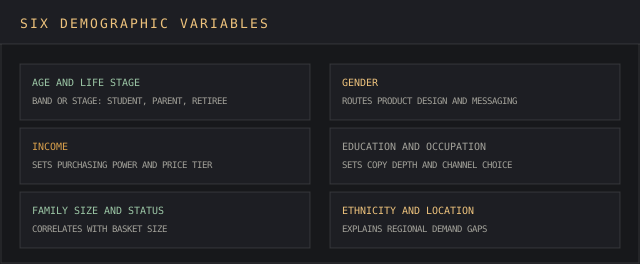
- Age and life stage: groups by age band (18 to 24, 25 to 34) or by stage: student, new parent, retiree. Age affects product needs and communication style more than almost any other single variable.
- Gender: still used to route product design and messaging angles, though narrower than it once was as a standalone axis.
- Income: sets purchasing power and shapes pricing strategies. Income range is one of the most requested demographic fields in B2C surveys.
- Education and occupation: shape the technical depth and tone of marketing copy, and occupation data targets specific job roles and industries directly.
- Family size and marital status: influence household buying habits, and they correlate with basket size in retail data more reliably than most other single variables.
- Ethnicity and geographic location: affect cultural buying decisions, and they combine with geographic segmentation to sharpen a regional campaign.
Age, gender, income
A field labeled age, gender & income remains the default starting block on most segmentation platforms, because those three are the fastest to collect and the easiest to verify against a public dataset. A retailer building its first pass usually starts here before adding education, household size, or geography.
Education, occupation, and family size
Education and occupation correlate with vocabulary and channel choice: a LinkedIn-heavy campaign reaches a different occupation mix than a TikTok-heavy one. Family size shifts basket composition, since a household of five buys differently than a single-occupant household at matched income.
Marital status, ethnicity, and geography
Marital status affects timing-sensitive categories like travel, housing, and insurance. Ethnic groups and geographic regions combine to explain regional demand differences a national average hides, particularly in food, apparel, and media.
How to collect demographic data
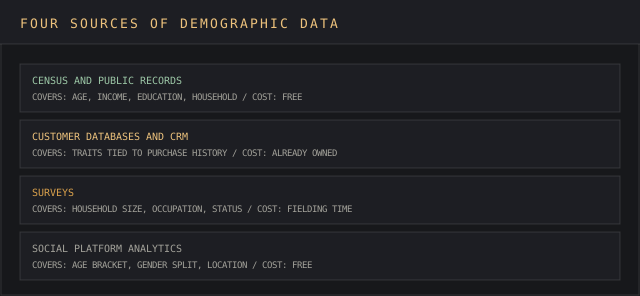
Effective demographic segmentation pulls from more than one source, because no single source covers every variable at acceptable accuracy. Four sources cover most of what a marketing team needs, and combining them beats relying on any one alone.
Census data and public records
Census data is the free floor for population-level demographic information. The ACS publishes age, income, education, and household figures down to small geographic areas at no cost, which makes it the starting point for market-sizing work before any first-party data exists. It's the same body of secondary market intelligence a team draws on before commissioning anything original.
Customer databases and CRM records
Customer databases and CRM records hold first-party demographic information tied directly to purchase history, which public data can't match. An email signup field that captures age range, paired with order history, produces a segment more predictive than a population average for the same geography.
Surveys and field collection
Surveys remain the most direct method for variables a company doesn't already hold: household size, occupation, and current relationship status rarely appear in transaction records. A short post-purchase question, asked once, beats years of inference.
Where to collect data with no budget
Social media platforms ship built-in demographic analytics for any account with an audience, covering age brackets, gender split, and top locations at no added cost. Combined with public census figures, that covers the core variables before a company spends anything on third-party data.
A small team with no research budget can combine public figures, platform-native analytics & a single post-purchase survey question, covering age, gender, income, geography, and household size inside one quarter. Attributing each figure to the source it came from is what keeps the mix auditable later.
How to apply demographic segmentation
Demographic segmentation only pays off once a segment changes a decision: the message, the channel, the price, or the product.
SurveyMonkey's demographic segmentation guide cites Harvard Business School research putting the failure rate for new product launches above 95%. That's the cost of shipping to an average customer nobody profiled first.
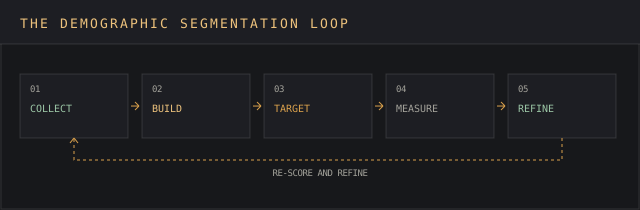
Create personalized campaigns. A segment defined by age and income justifies different creative, past a different subject line. Messages built for a 22-year-old renter rarely convert the same as messages built for a 45-year-old homeowner, even selling the identical product.
Select channels by segment. Younger age groups concentrate on different social platforms than older ones, so channel selection follows the demographic profile instead of one company-wide media plan. Better campaigns start with that routing decision.
Set pricing by income segment. Income range data supports tiered pricing or targeted discounts aimed at specific groups without discounting the entire target market, and it's the fastest lever for lifting marketing effectiveness on a fixed budget.
Prioritize product development. Household composition and life stage data point product teams toward products specific customer groups use, ahead of a general-purpose release built for buyers nobody profiled. It fits a product roadmap better than a guess ever could.
Teams that combine demographic data with a real research project report stronger customer loyalty on the segments they targeted deliberately, and their market intelligence strategy holds up longer than a single quarter.
Where demographic segmentation fits inside customer segmentation
Demographic segmentation is one method inside the broader practice of market segmentation, and most programs combine two or more axes.
A program built on age and income alone still misses buyers a psychographic or behavioral pass would catch, which is why the strongest work treats demographic data as the entry point. Campaigns built only on demographic segments tend to plateau faster than campaigns layered with a second axis.
| Method | Groups by | Typical data source | Best used for |
|---|---|---|---|
| Demographic | Age, gender, income, education, household size | Public records, CRM, surveys | Fast, verifiable first-pass targeting |
| Geographic | Region, climate, urban or rural | Shipping and billing addresses | Regional pricing and inventory |
| Psychographic | Values, attitudes, lifestyle | Surveys, interviews | Brand positioning and messaging tone |
| Behavioral | Purchase history, usage, loyalty | Transaction and product data | Retention and upsell targeting |
| Firmographic | Company size, industry, revenue | B2B firmographic databases | B2B account targeting |
Firmographic segmentation is the B2B equivalent: it groups companies by size, industry, and revenue the way demographic data groups individuals by age and income. A B2B team runs it first, then layers demographic detail about the individual buyer inside a target account, usually sourced from one of the B2B data providers that sell the underlying records. Behavioral segmentation is the axis most often stacked on top.
A worked example: Coca-Cola's Share a Coke campaign
Coca-Cola's 2014 U.S. Share a Coke campaign printed 250 of the most common teen names on bottle labels, targeting one demographic variable directly: age.
The campaign is documented in a Market Research Society case filing that recorded an 11% rise in sales of participating packages, an 11% revenue increase, a 1.6 point share gain, and about 1.25 million more teens having tried a Coke, all against the same period the prior year.
Building segments from age data alone
The campaign didn't need income, education, or geographic data to work. It needed one accurate age-based name list and a low-cost production change. That's the case for starting with the single variable that moves a metric the team already tracks. Further worked cases sit on the market segmentation examples page.
The limits and risks of demographic segmentation
Demographic data is an estimate. Google's own advertising documentation states that "We sometimes also estimate people's demographic information based on their activity from Google properties or the Display Network," and that "Unknown" covers people whose age, gender, parental status, or household income the company hasn't identified.
Treating an estimated age bracket as a verified fact produces inaccurate data downstream, in the segment and in every campaign built on it.
The FTC's December 2024 order against data broker Mobilewalla followed the collection of more than 500 million unique consumer advertising identifiers paired with precise location data between January 2018 and June 2020.
The categories covered pregnancy-related audience segments, churches, and a June 2020 report analyzing people who protested the death of George Floyd. The order bars the sale of sensitive location data and requires a supplier assessment program confirming consumer consent.
Demographic targeting that stops at broad categories underperforms too. Two people sharing an age bracket, gender, and income range can hold opposite purchase intent, so demographic segments perform best layered with behavioral or psychographic data. Demographic trends also date a segment faster than most teams expect.
How to measure demographic segmentation results
Two numbers confirm a demographic segment is worth keeping. Engagement and conversion rates measure how the targeted message performed against the un-segmented control. Customer retention measures if the segment keeps buying, past the first click.
A segment with strong conversion but weak retention usually got the first sale right and missed the reason customers stay. Sales data broken out by segment, tracked over two or three purchase cycles instead of one campaign, separates a real segment from a lucky send.
Continuous refinement matters here. Consumer trends shift the age brackets and pay bands that define a useful segment, and a profile built on stale employment or income data will quietly stop matching the audience that keeps buying. The market intelligence fundamentals that govern any standing data program apply to a demographic segment the same way, and the same analysis discipline decides when a bracket has moved.
FAQ
What is demographic segmentation?
Demographic segmentation is the practice of dividing a target market into smaller groups based on measurable traits: age, gender, income, education, household composition, and ethnicity. It's one of the four main types of market segmentation, alongside geographic, psychographic, and behavioral segmentation.
What are the four main types of market segmentation?
Demographic, geographic, psychographic, and behavioral segmentation are the four most commonly cited types. Firmographic segmentation is sometimes added as a fifth for B2B markets, grouping companies.
What is a demographic segmentation example?
Coca-Cola's Share a Coke campaign is a documented example: printing 250 of the most common teen names on bottle labels targeted the age variable directly and produced an 11% rise in sales of participating packages over one U.S. summer, per the campaign's Market Research Society case filing.
What are 5 examples of demographics?
Age, gender, income, education, and household size are the five most frequently used demographic variables, with occupation and ethnicity commonly added as a second tier.
How does demographic segmentation relate to customer segmentation?
Demographic segmentation is one method within a larger discipline. Customer segmentation is the umbrella term for any method of dividing customers into groups; demographic, geographic, psychographic, behavioral, and firmographic segmentation are the specific methods used to do it.
Where does demographic data come from?
Census data, customer databases and CRM records, surveys, and social media platforms' built-in analytics are the four primary sources. Public figures are free and cover population-level averages; CRM and survey data are more predictive for an existing customer list.
Why is demographic segmentation important?
Demographic segmentation lets a team spend a marketing budget on the customers most likely to buy, past the entire target market. It reduces waste in advertising spend and supports pricing suited to each income segment, and it's the fastest route to products that match specific demographics instead of an average buyer nobody matches.
Bottom line
Demographic segmentation works because its variables are countable. Age, gender, income, education, household composition, and geography can all be captured in a form field or pulled from public figures at no cost, which makes it the fastest segmentation method to stand up and the easiest to verify.
The method fails in two specific ways. Treating an estimated demographic category as verified identity produces inaccurate data downstream, and selling sensitive location or health-adjacent data alongside demographic profiles carries the kind of exposure the FTC demonstrated against Mobilewalla in December 2024.
Getting it right means combining sources, tracking conversion rates and customer retention, and refreshing the segment as consumer trends shift the brackets that defined it.
A demographic segment that isn't re-checked against current data is a segment built for a market that no longer exists. Marketing messages and products built on it start from a fact a team can verify instead of a guess dressed up as one, and that advantage lasts exactly as long as the data stays current.