Market segmentation: the types that hold up and the process that builds them
 By Jan Suski. I go deep on every review, checking every number against its source and digging up details other coverage misses, a habit from six years of SEO and link building for tech companies. Bylines at Surfer, Brand24, and Senuto. How the scoring works.
· Prefer this source on Google
The short version 13 points · 50 seconds
- 01Market segmentation splits a market into groups a team can act onNamed in 1956, practiced long before that
- 02Demographic segmentation sorts by age, income, and educationBuilt largely from census data
- 03Geographic segmentation sorts by location, down to the postal codeTUI's rebuild added tens of millions in 18 months
- 04Psychographic segmentation groups by values and lifestyleNeeds custom survey work
- 05Behavioral segmentation tracks what people doPurchase frequency, loyalty status, usage rate
- 06Firmographic segmentation is B2B's demographic layerIndustry, headcount, revenue, legal structure
- 07Consumer and business markets don't segment the same wayBuying centers change who a message has to reach
- 08B2B teams stack technographic and intent data on topSix methods once firmographics are covered
- 09The ADAMS test decides if a segment is worth buildingAccessible, differentiable, actionable, measurable
- 10Building market segments runs five steps, in orderScope, type, data, segment, strategy
- 11Segmented email out-opens unsegmented email by 14.3 pointsAcross 18 million sends Mailchimp analyzed
- 12Segmentation changes what a retention play looks likeA targeted save beats a blanket discount
- 13Market segmentation and market research aren't the sameOne runs continuously, one answers and stops
Market segmentation is the practice of splitting a broad market into distinct groups a team can act on: an age band, a postal code, a company's headcount, a purchase pattern. Wendell R. Smith named the practice in a 1956 Journal of Marketing paper, "Product Differentiation and Market Segmentation as Alternative Marketing Strategies."
This page covers the five types of market segmentation, how business markets segment differently from consumer markets, the test that tells a team if a market segment is worth building a strategy around, and the process that turns raw data into segments a marketing team will use. That process replaces one message aimed at everyone.
It's written for anyone who owns a segmentation project with no research department behind them: a product manager scoping a launch, a marketer who inherited a customer list with no structure, an analyst asked to justify a targeted pricing strategy.
What market segmentation is, and what it isn't
Market segmentation means dividing a market into distinct groups based on shared characteristics, then building marketing strategies, pricing strategies, and product decisions around each market segment.
The practice has a specific bar. A market segment has to hold up over time, respond differently to marketing messages than the rest of the broad market does, and be large enough to justify building something for it.
A list sorted by last name isn't a real market segment. A list sorted by purchasing habits, company size, or stated values is, because each of those smaller groups needs a different marketing message to convert.
Some teams call the customer-facing version of this work customer segmentation, especially when the group being split is an existing customer base. The mechanics of identifying segments stay the same either way, and this page treats the two as the same audience-narrowing work throughout.
The five types of market segmentation
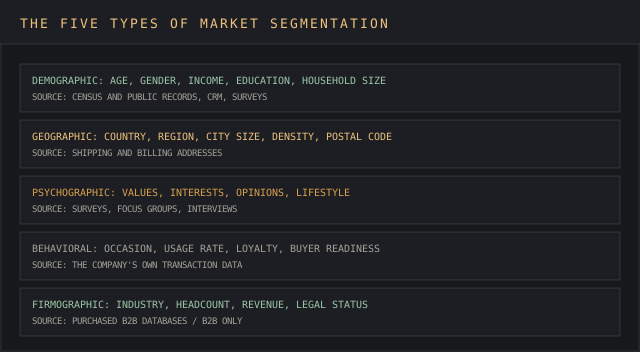
Most treatments name four core segmentation variables: demographic, geographic, psychographic, and behavioral. A fifth, firmographic segmentation, exists for B2B markets, where the buyer is a company. Hanover Research and Demandbase both use this five-way split, and it's the one this page follows.
Demographic segmentation: age, income, education
Demographic segmentation groups a market by age, gender, income, education level, occupation, and family size. It's the simplest of the five to run, because the underlying demographic data is public.
The American Community Survey, run continuously by the U.S. Census Bureau since 2005 across more than 40 topics, publishes income, education, occupation & household data down to the census tract. It's the base layer most demographic segmentation work in the United States starts from.
A skincare brand building separate product lines for teenagers and for buyers in their fifties is running demographic segmentation. So is a lender that prices a product differently by income bracket and geographic region.
The limit is that demographic factors describe who someone is. They don't describe what someone wants. Two 35-year-olds with identical incomes and the same geographic location can share nothing else, which is why demographic segmentation rarely stands alone in a mature strategy. The full breakdown of demographic segmentation variables covers where each one comes from and what it predicts.
Geographic segmentation: country down to postal code
Geographic segmentation divides a market by location: country, region, city size, population density, climate, or postal code. Retailers use it to stock differently by geographic region; a coat retailer doesn't run the same inventory plan in Miami that it runs in Minneapolis.
It can run as coarse as a country border or as fine as a single postal code, and geo-cluster methods that combine geographic with demographic data produce a sharper profile than either base alone.
The clearest evidence for what geographic segmentation is worth comes from travel group TUI. STRAT7 Bonamy Finch rebuilt TUI's segmentation to combine geography, ongoing category relationship, and trip-specific needs into one matrix.
The director overseeing the project said the rebuild delivered tens of millions in additional revenue in the first 18 months, driven through CRM targeting and communications briefs that used the new customer segments directly.
Psychographic segmentation: values, interests, lifestyle
Psychographic segmentation groups a market by values, interests, opinions, and lifestyle. It's sometimes called attitudinal or lifestyle segmentation, and it's the base that needs the most custom research: surveys, focus groups, and interviews.
A meal-kit company offering fully prepared meals to busy professionals and raw ingredient kits to people who enjoy cooking is running psychographic segmentation on the same demographic base.
Two customers can share an age, an income, and a geographic location and still need different products and services, because what separates them is what they value. Attitudinal segmentation is also the base most likely to catch a shift in consumer behavior before a sales report does, since values and opinions move before usage patterns do.
Behavioral segmentation: purchase, usage, loyalty
Behavioral segmentation divides consumers by purchase occasion, benefits sought, usage rate, loyalty status, and buyer readiness. Travel companies use it constantly, offering discounts to frequent flyers based on purchasing habits and a different promotional deal entirely to a first-time booker who hasn't converted yet.
It's the base most directly tied to purchasing habits, which makes it the easiest of the five to validate against a company's own transaction data.
Behavioral segmentation also drives loyalty programs & brand loyalty more broadly. A retailer that treats a customer who buys once a year the same as one who buys every month wastes spend on the wrong message for both groups. Behavioral segmentation is what tells a team which of its customer segments gets a retention offer and which one gets a win-back campaign.
Firmographic segmentation, the B2B layer
Firmographic segmentation groups companies, using industry, ownership and legal status, employee count, geographic location, and annual revenue. B2B teams often call this exercise customer segmentation when the market being split is a base of existing accounts.
It's demographic segmentation's B2B equivalent: the same logic of sorting by observable, structural traits, applied to an organization. Demographic segmentation applies that logic to a person. A vendor selling enterprise software segments prospects by company size and industry because a 40-person startup and a 4,000-person manufacturer need different pricing strategies, different implementation timelines & different sales messaging.
Firmographic data is also the base layer most B2B market intelligence programs build from, which is part of why the market intelligence fundamentals most B2B teams rely on start with company-level facts. Vendors selling that data are ranked separately in the firmographic data provider rankings.
Few programs run on a single base alone. A team layering demographic and behavioral segmentation together can spot niche markets neither base would reveal on its own, and a program built to identify segments across several geographic regions often finds the same psychographic pattern repeating in unrelated locations.
Consumer markets and business markets don't segment the same way
Segmenting consumer markets and segmenting business markets solve different problems. A consumer buys as an individual, often on emotion, and the transaction closes in one step.
A business purchase runs through a buying center, the group of people inside an organization who each carry some influence over the decision: a finance lead who owns the budget, an end user who has to live with the tool, a security team that has to approve it. Rational, need-based criteria dominate business purchases in a way they rarely do for a single consumer picking a product off a shelf.
| Dimension | Consumer markets | Business markets |
|---|---|---|
| Who buys | One person, usually deciding alone | A buying center of several roles |
| What drives it | Personal need, taste, emotion | Rational, need-based criteria |
| Useful variables | Age, income, location, values, behavior | Industry, headcount, revenue, tech stack, intent |
| Deal shape | One step, closes at the checkout | Several approvals across a budget cycle |
| Data source | Census files, surveys, transaction logs | Purchased business databases, intent feeds |
That difference is why firmographic and technographic data carry more weight in business-to-business segmentation than demographic data ever does. A company doesn't have an age or a gender; it has a headcount, an industry code, a tech stack, and a budget cycle.
Where B2B segmentation goes past firmographics
Firmographic segmentation gets a B2B team most of the way to a workable market segment. Mature programs stack more on top of it, and Demandbase names the methods B2B marketing teams add once the basics are in place:
- Technographic: what software and infrastructure a target company runs.
- Intent: behavioral signals that show a prospect is actively researching.
- Persona: marketing messages tuned to a specific job role inside the buying center.
- Journey stage: where a prospect sits between first awareness and closed deal.
- Transactional: order value and purchase frequency.
- Generational or life-stage: the age and circumstances of the individual decision-makers inside the account.
Technographic data in particular has become its own market intelligence category. A vendor that only sells to companies running a specific CRM or cloud platform can filter out every account that will never fit before a sales rep spends an hour on it, which is the logic behind the technographic data provider rankings.
None of these six replaces firmographic segmentation. Each one refines a firmographic segment into something a sales team can use the same week it arrives.
The ADAMS test: how to tell if a segment is worth building
Not every group that looks distinct on paper is worth building a strategy around. Rice University's open marketing textbook lays out five criteria, remembered by the acronym ADAMS, that a market segment has to clear before a team commits budget to it.
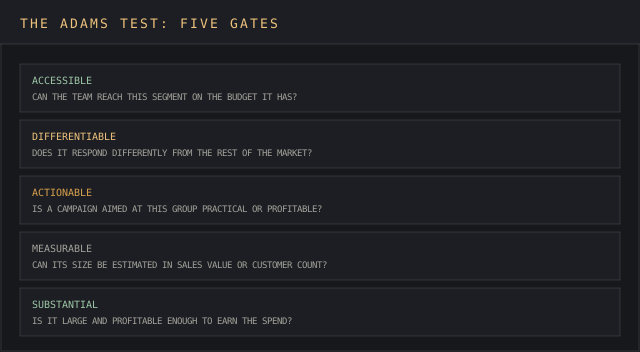
Accessible. Can the team reach this segment through channels it can afford? A segment a company can't reach affordably isn't actionable no matter how distinct it looks.
Differentiable. A real market segment is internally similar and externally different: the people inside it respond alike to marketing messages, and that response differs from how the rest of the target market responds. Without that gap, there's no reason to build a separate strategy at all.
Actionable. Is it practical, or profitable, to run a campaign aimed at this group? A segment has to move something measurable, awareness, intent, or a purchase.
Measurable. A team needs to estimate the segment's size in sales value or customer count before committing resources. Guessing at size is how a company overbuilds a strategy for specific segments too small to justify the spend.
Substantial. The segment has to be large enough, and profitable enough, to be worth the budget it consumes. A distinct group of forty customers rarely clears this bar.
Running a candidate through these five checks is what separates a segment worth a dedicated campaign from a data cut that only looks interesting in a spreadsheet. Segments that clear all five become actionable; the ones that don't get merged back into a broader target market.
The market segmentation process, step by step
The process runs in a fixed order, and skipping a step early tends to show up as wasted budget later. Hanover Research lays out a five-step version that holds up across consumer and B2B markets alike.
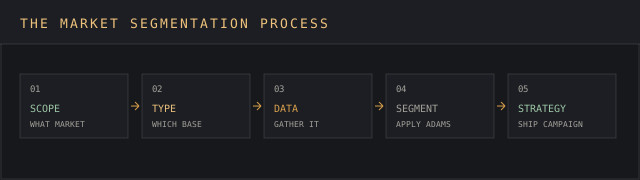
Define the market scope. Decide what target market is being segmented before picking a type. A software company segmenting its entire addressable market answers a different question than one segmenting existing customers for an upsell campaign.
Choose the segmentation type. Demographic, geographic, psychographic, behavioral, or firmographic, picked to match the objective the segmentation serves. A team optimizing digital advertising spend leans behavioral; a team scoping products and services for a new line often starts demographic or psychographic.
Gather the data. Surveys and interviews for psychographic detail, transaction records for behavioral data, purchased firmographic files for B2B accounts. Data quality matters more here than volume.
A smaller, accurate dataset produces usable market segments faster than a large one riddled with stale or duplicate records. Attributing each data point to the source it came from is what lets a team catch a problem before it reaches the segment. Skip that step, and a campaign goes out to the wrong people before anyone catches it.
Build the segments. Group the data into distinct groups based on real, shared characteristics. The ADAMS test applies here: a segment that fails accessibility, size, or measurability here gets merged into a broader target market.
Build the strategy. Pricing strategies, marketing messages, and product decisions get built around each finalized segment and shipped as real campaigns. A process that stops at step four, with a set of well-defined customer segments nobody builds a strategy for, delivers nothing.
The segment only pays for itself once a real campaign reaches its target customers. A company that never runs the campaign has spent its marketing efforts on analysis and nothing else.
Benefits of market segmentation
The case for market segmentation is a case about waste. A single message sent to an entire market reaches people it doesn't fit, spends budget on customers who were never going to convert on it, and undersells the segment that would have converted on a sharper one.
Qualtrics ties the benefits to four business functions: product development, which leans on knowing what a specific segment wants, and targeted pricing strategies, which lean on knowing what a segment will pay. The other two are marketing campaigns, which convert better when the message matches the segment, and customer service, which improves once a team can see which segment is showing early signs of churn.
The gap in open rate between segmented and unsegmented email campaigns, from a Mailchimp analysis of 18 million email sends cited in Rice University's marketing text. Same message, smaller and better-matched list.
Four benefits recur across most segmentation programs:
- Marketing effectiveness: spend concentrates on the target audience most likely to respond, which lifts the return on marketing spend.
- Product planning: a team designs products and services for a specific customer segment. An average customer who doesn't exist can't be designed for.
- Customer engagement: marketing messages match what a segment values. Nobody asked for the generic pitch that ignores it.
- Upselling and cross-selling: segment membership signals what a customer is likely to buy next, using existing customers already on file.
Together those four are the competitive advantage segmentation is supposed to produce, and they're why segmentation earns a standing line item in most marketing budgets.
What segmentation does for customer retention
Customer retention work changes shape once segmentation is in place. Without segmenting by risk and value, a retention team's only lever is a blanket discount offered to any existing customer who shows signs of leaving, which trains loyal customers to expect a discount they were never at risk of losing anyway.
With behavioral and psychographic segmentation in place, a retention team can tell the difference between a customer at real risk of churn and one whose usage dipped for a normal seasonal reason, and point the save offer only at the first group.
Brand loyalty compounds this over time. A segment that consistently receives relevant, well-targeted messages builds loyalty faster than one receiving the same generic campaign as the rest of the market, because relevance is what a customer notices.
Market segmentation and market research
Market research and market segmentation get treated as synonyms constantly, and they aren't the same thing. One is project-based: a survey, a set of focus groups, or a round of interviews built to answer one specific question and then close out.
Market segmentation is a standing structure a team keeps running against, refreshed as consumer behavior, competitor moves, and a company's broader target market shift underneath it.
The two feed each other. A one-off research project might be what surfaces a new psychographic pattern in the first place; the ongoing market intelligence strategy a team builds is what keeps that pattern current. A single research report always goes stale on its own. For worked cases with named companies and published figures, see the market segmentation examples page.
FAQ
What is the meaning of a market segment?
A market segment is a group of current or potential customers who share a characteristic relevant to a business decision, say an age band, a geographic location, a value system, a behavior, or, in B2B, a set of company traits, and who respond similarly to a marketing message tailored to that trait.
What is the simple definition of segmentation?
Segmentation is the process of dividing a broad market into smaller, more specific groups, sometimes called market segments and sometimes customer segments when the group being split is an existing customer base, so a company can build products and services, a price, or a message for each group. Treating the entire market the same way skips that step entirely.
What are the 4 types of market segmentation?
The four core types of market segmentation are demographic, geographic, psychographic, and behavioral. A fifth, firmographic segmentation, is the equivalent used specifically in B2B markets, where the customer is a company.
What are the 6 main types of market segmentation?
Counting firmographic segmentation as a fifth base and attitudinal segmentation as a distinct sixth, separate from psychographic segmentation in some frameworks, brings the count to six: demographic, geographic, psychographic, attitudinal, behavioral, and firmographic.
What is an example of a market segment?
A skincare brand's product line built specifically for buyers in their fifties is a demographic market segment. A B2B software vendor's pricing tier built specifically for companies with under fifty employees is a firmographic market segment.
What is an example of firmographic segmentation in B2B?
A vendor selling enterprise software that prices differently and messages differently for a 40-person startup versus a 4,000-person manufacturer is running firmographic segmentation, sorting prospects by company size and industry before a sales rep ever makes contact.
Bottom line
Market segmentation only earns its keep when a real strategy gets built on top of it.
Demographic, geographic, psychographic, behavioral, and firmographic segmentation each answer a different question about a target market. The ADAMS test, accessible, differentiable, actionable, measurable, substantial, is what separates a segment worth a dedicated campaign from a data cut that only looks interesting in a spreadsheet.
Getting it wrong costs money in both directions. Skip segmentation and a company spends its budget the way TUI would have before its rebuild, one generic message reaching an entire market that doesn't share the same needs. Build segments that fail the ADAMS test and a company spends resources maintaining specific segments too small, too vague, or too unreachable to justify a dedicated strategy.
The programs that get it right treat segmentation as a standing structure, refreshed on a schedule, fed by real customer data from named sources, and tested against a fixed bar before a dollar of budget gets committed to any single segment.