Beauty statistics for 2026 put the market at $355 billion to $1 trillion
 By Jan Suski. I go deep on every review, checking every number against its source and digging up details other coverage misses, a habit from six years of SEO and link building for tech companies. Bylines at Surfer, Brand24, and Senuto. How the scoring works.
The numbers Global and US beauty market, checked 4 October 2026
The widest two estimates sit 2.8 times apart, because each house counts a different set of categories at a different price point.
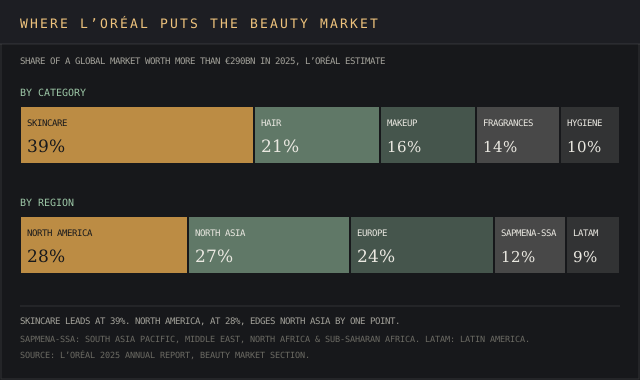
Skincare holds 39% of L'Oréal's market estimate, and fragrance posted the fastest U.S. mass-market growth at 15% in the first half of 2026.
A significant portion of U.S. beauty and personal care sales, 41%, already runs through e-commerce, against 28% of global beauty sales in McKinsey's channel split.
Global beauty sales grew 10% year on year, NielsenIQ reported on March 31, 2026, with e-commerce growing six times faster than in-store sales. L'Oréal puts 2025 growth at about 3.5% on a market worth more than €290 billion. McKinsey expects 5% a year through 2030.
This report collects beauty industry statistics from 2024 to 2026 on market size, categories, regions, companies, channels, consumers and regulation, and every figure links to the house that produced it. It's written for beauty brands, retailers, investors & analysts sizing the cosmetics industry, where the choice of market estimate moves the answer by $645 billion.
The houses disagree on the size of the overall beauty market by a factor of 2.8. Fortune Business Insights counts $354.68 billion for cosmetics without fragrance, and NIQ cites a $1 trillion market that takes in personal care.
The beauty industry was worth $446 billion in 2023 and heads for $590 billion by 2030
McKinsey put global beauty retail sales at $446 billion in 2023, up 10% from 2022, in its September 11, 2024 analysis. That market size covers four categories (skincare, fragrance, makeup & hair care) at retail prices.
Beauty industry growth has cooled since. McKinsey's August 28, 2025 report measured about 7% a year from 2022 to 2024, helped by inflation-driven price increases. The 2026 edition expects a 5% compound annual growth rate to $590 billion by 2030. In 2024 the same team had expected $590 billion by 2028 at 6%, so the target slid two years in 21 months.
L'Oréal's own series for the beauty industry shows the same slowdown after 2023.
| Year | Global beauty market growth, L'Oréal estimate |
|---|---|
| 2021 | +8% |
| 2022 | +6% |
| 2023 | +8% |
| 2024 | +4.5% |
| 2025 | about +3.5% |
Source: L'Oréal 2025 Annual Report, beauty market section.
Statista's Beauty & Personal Care outlook expects US$754.37 billion of revenue in 2026 and 3.71% annual growth from 2026 to 2031, with personal care the largest segment at US$350.55 billion. Every industry forecast here is expected to grow, at rates from 3.59% a year (Statista, skincare) to 14.99% (Fortune Business Insights, clean beauty).
Why the published beauty market estimates diverge
Seven houses publish a global market size, and the devil's in the details of what each one counts. The spread runs from $354.68 billion to $1 trillion.
| House | Year | Estimate | What it counts |
|---|---|---|---|
| Fortune Business Insights | 2025 | $354.68B | Hair care, skincare (sun care included) & makeup, with fragrance left out |
| McKinsey | 2023 | $446B | Skincare, fragrance, makeup & hair care, at retail prices |
| L'Oréal | 2025 | >€290B | Net manufacturer prices, hygiene included at 10%, with soap, toothpaste, razors and blades excluded |
| Precedence Research | 2025 | $639.47B | Beauty and personal care products |
| Grand View Research | 2025 | $644.6B | Skin, hair, color cosmetics, fragrances & other personal care |
| Statista | 2026 | $754.37B | Cosmetics, skin care, personal care, fragrances & beauty tech |
| NIQ | 2025 | $1 trillion | Beauty and personal care, the figure NIQ's Tara James Taylor cited in February 2025 |
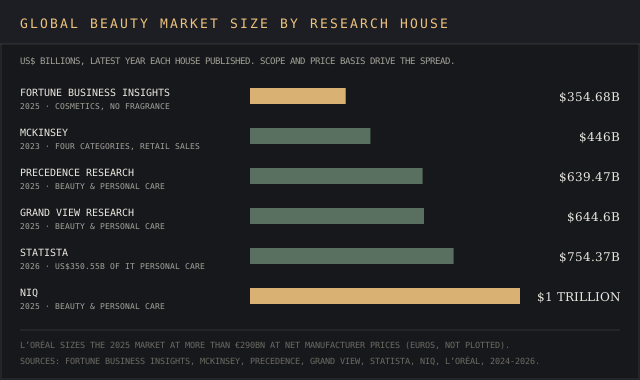
- Scope. Personal care alone is US$350.55 billion in Statista's model. Take it out and Statista's total drops to about $404 billion, close to McKinsey's $446 billion.
- Price basis. L'Oréal counts net manufacturer prices, per its registration document, which strips out retailer margin. McKinsey counts retail sales.
- Fragrance. Fortune Business Insights leaves out fragrance, a category McKinsey sized at 17% of beauty in 2023.
- Year and currency. The figures span 2023 to 2026, and L'Oréal reports in euros at constant exchange rates.
Growth rates split the same way. NIQ's 10% is value growth from point-of-sale data across 9 categories in 52 markets, and NIQ's February 2025 release names inflation as "a major driver" of value growth. L'Oréal's 3.5% is stated at constant exchange rates on a narrower market, so a six-point gap is par for the course.
Skincare holds 39% of the beauty market, and fragrance grows fastest
L'Oréal splits the 2025 market into skincare (39%), hair (21%), makeup (16%), fragrances (14%) and hygiene (10%). In McKinsey's 2023 split the skincare segment was the largest segment at 44%, growing 6%, while fragrance was the smallest at 17% and grew fastest, at 14%. By 2026 fragrance had passed color cosmetics to become the third-largest beauty category, per McKinsey's 2026 State of Beauty.
Skincare industry statistics
In the skincare industry, Statista sizes the global skincare market at US$209.06 billion in 2026, growing 3.59% a year to 2031, in its skin care outlook. Grand View Research puts the U.S. skincare market at $35.6 billion in 2025 in its U.S. skin care report, and that skincare market is expected to reach $62.9 billion by 2033.
The skincare industry slowed in 2025. Beiersdorf CEO Vincent Warnery called it a demanding year for the skincare industry, in Beiersdorf's March 2026 results, though its Derma brands grew 11.7%. Estée Lauder's brands sold $7.338 billion of skincare products in fiscal 2026, up 4% organically, about half its total.
Euromonitor's skincare industry statistics put nearly 40% of global sales of skincare products online by 2030, and online channels already take 54% of skincare industry sales in China, or $21.2 billion.
U.S. beauty sales by category in the first half of 2026
Circana tracks U.S. retail sales of beauty products in two tiers. Its August 11, 2026 release gives these changes for January to June.
| Category | Prestige sales growth | Mass sales growth |
|---|---|---|
| All beauty | +7% ($17.1B) | +7% ($39.2B) |
| Fragrance | +6%, average price +5% | +15%, units +7% |
| Skincare | +9%, units up double digits | Ahead of mass beauty overall |
| Sun care | +19% | Dollar and unit gains |
| Body care | +16% | Dollar and unit gains |
| Hair care | +11%, units +8% | +7%, units down |
| Makeup | +3% | +5%, units down |
Hair care has jumped on the skincare bandwagon, with hair and scalp care products borrowing skincare principles in a shift McKinsey calls the "skinification" of hair, and prestige hair serums grew nearly 60% in the half. Fortune Business Insights expects the hair care market to grow from $113.93 billion in 2025 to $213.47 billion by 2032.
Circana files nail care inside makeup, next to lip beauty products, and sun care inside skincare. Unilever's Personal Care unit sold €13.2 billion in 2025, more than its €12.8 billion Beauty & Wellbeing unit.
Asia Pacific grew 14.3% and North America holds 28% of beauty sales
Asia Pacific led growth in NIQ's State of Beauty 2025, released October 1, 2025, on demand for hair & skincare in China and the rise of Douyin, which grew 49%.
- Asia Pacific: +14.3%
- Latin America: +10.4%
- North America: +9.6%
- Europe: +5.8%
L'Oréal gives North America 28% of the market and North Asia 27%. Houses that count Asia Pacific as one block give it the lion's share, 39.84% at Fortune Business Insights and 39.5% at Precedence Research.
The United States remains the largest single country, at US$133 billion of 2026 revenue in Statista's model. Circana tracked $36 billion of prestige and $72.7 billion of mass sales in 2025, a combined $108.7 billion across the American beauty industry.
China is the weak spot for global brands. McKinsey found China's beauty market grew 3% in 2023, all of it from price. L'Oréal's North Asia revenue grew 0.5% like-for-like in 2025 to €10.08 billion, while Estée Lauder's mainland China sales rose 9% organically to $3.058 billion. Online sales take 87% of China's hair and skincare sales, per NIQ.
Europe is L'Oréal's largest region, at €14.86 billion of revenue and 4.4% growth in 2025.
L'Oréal tops the beauty companies with €44.05 billion of 2025 sales
L'Oréal is the #1 company in the cosmetics industry, and its own ranking of main global players puts it at $47.0 billion, ahead of Unilever ($26.0 billion), P&G ($15.4 billion), Estée Lauder ($14.7 billion) and LVMH ($9.2 billion).
| Company | Fiscal year | Beauty revenue | Growth |
|---|---|---|---|
| L'Oréal | 2025 | €44.05B | +4.0% like-for-like |
| P&G Beauty | To June 2026 | $16.02B | +4% organic |
| Estée Lauder | To June 2026 | $15.05B | +3% organic |
| Unilever Beauty & Wellbeing | 2025 | €12.8B | +4.3% underlying |
| Beiersdorf | 2025 | €9.9B | +2.4% organic |
| Shiseido | 2025 | ¥970.0B | -2.1% |
| LVMH Perfumes & Cosmetics | 2025 | €8.17B | 0% organic |
| Coty | To June 2026 | $5.81B | -5% like-for-like |
| e.l.f. Beauty | To March 2026 | $1.64B | +25% |
Company results releases from February to August 2026, with P&G Beauty covering hair care, skin and personal care.
Some of the industry's biggest beauty companies are in hot water. Coty fell 5% like-for-like and Shiseido 2.1%, and LVMH's perfume and cosmetics revenue was flat. e.l.f. posted significant growth of 25%, its 7th straight year of net sales and market share gains, at an average U.S. price of about $7. Its 10-K prices most products it lists at a fraction of a prestige twin, such as a $9 lip oil matched to a $42 prestige item.
McKinsey expects niche fragrances, sold to "in the know" consumers without leaning on celebrity endorsements, to drive fragrance growth. Niche brands and celebrity brands still share a shelf, and Fenty Beauty generated about $450 million of net sales in 2024, Reuters reported on October 21, 2025.
"In 2026, despite the macro uncertainties, we are optimistic about the outlook for the global beauty market, and confident in our ability to keep outperforming it thanks to L'Oréal's multi-division category strategy and to achieve another year of growth in sales and profit."
Nicolas Hieronimus, CEO, L'Oréal, 2025 annual results release, February 12, 2026
E-commerce holds 28% of global beauty sales and 41% in the U.S.
E-commerce is the largest beauty channel worldwide, at 28% of sales, followed by grocery at 19% and specialty beauty retail at 18%, per McKinsey's 2026 report. McKinsey expects global e-commerce penetration above 30% by 2030, and L'Oréal's own e-commerce passed 30% of its sales in 2025.
U.S. consumers shop online for 41% of their beauty and personal care spending, per NIQ, and Amazon gained 7.3 share points in four years. Online sales are expected to reach 30.6% of global beauty revenue in 2026, per Statista. McKinsey says Amazon & TikTok's combined core beauty sales could pass Sephora & Ulta Beauty's this year.
Social commerce, TikTok Shop and live streaming
Most consumers in NIQ's 2026 survey, 53%, purchase through social platforms, and 22% purchase directly via TikTok Shop.
- TikTok Shop was the 8th largest e-commerce health and beauty retailer in the U.S. in February 2025, with $1 billion of e-commerce beauty sales. 12.5% of U.S. online shoppers had made beauty purchases through it (NIQ).
- Sales of beauty products on TikTok are on track for $4 billion in 2026, about 2% of U.S. beauty sales, after growing roughly 260% a year since 2023. Some beauty brands hit the jackpot there, with TikTok Shop reaching 10% of their sales (McKinsey).
- Shoppable video makes up 66% of TikTok's U.S. beauty sales and live streaming about 22%. One in five live stream viewers report buying in every or nearly every session (McKinsey).
- In China, live streaming accounts for 70% of beauty sales on platforms like Douyin (NIQ, 2026).
Social commerce grows fastest of all beauty industry channels in McKinsey's report, which expects U.S. social commerce across consumer categories to reach $100 billion in 2026. NIQ found 68% of social commerce purchases of beauty products are impulse buys. Sellers tracking online shopping can compare ecommerce analytics tools and Amazon market intelligence.
Specialty retail and department stores
Specialty retail is expected to grow at a high-single-digit rate in most regions, per McKinsey, while department stores have declined 2% a year since 2019. Ulta Beauty's fiscal 2025 sales grew 9.7% to $12.39 billion across 1,591 stores.
Consumers find prestige brands at mass retailers. About 20% of brands at U.S. specialty beauty retailers are also stocked at Walmart, and Daiso's sales of beauty products grew 70% in 2025, per McKinsey. The retail industry statistics report tracks the wider store data.
U.S. households spent $978 on personal care in 2024
U.S. consumer units spent an average of $978 on personal care products and services in 2024, up 2.9% from $950, according to the Bureau of Labor Statistics. That's about 1.2% of the $78,535 average household budget.
Consumer spending habits shifted toward more trips and bigger baskets. NIQ counted 2% more shopping trips, 8% more spending per visit and 2.6% more units in its 2025 report. Almost half of consumers purchase across price tiers, mixing expensive brands with cheaper ones, McKinsey found, to get the best of both worlds.
"Beauty continues to benefit from consumers' willingness to shop across price tiers, selectively investing in products that deliver the strongest emotional and functional value."
Larissa Jensen, global beauty industry advisor, Circana, first-half 2026 release, August 11, 2026
Gen Z and teen beauty spending
Gen Z consumers are a major influence on the industry and buy beauty products on a budget. Piper Sandler's fall 2025 survey of 10,969 U.S. teens, average age 15.7, put the annual core beauty wallet at $336, down 2%. The October 9, 2025 release named the top beauty brands and stores.
- e.l.f. Cosmetics ranked first among cosmetics brands, with Rare Beauty "a distant second".
- Sephora ranked first among beauty retailers, followed by Ulta & Target.
- TikTok was teens' favorite social media app at 46%.
Wellbeing is a top priority for 63% of consumers, who prioritize mental wellness, per NIQ's 2026 report. Just over half of consumers in McKinsey's 2025 global survey said beauty means "feeling confident," and GLP-1 households spend an estimated 30% more on beauty products. Consumer brands study these shifts with consumer intelligence data from NielsenIQ and Circana.
Clean beauty grows 14.99% a year as EU Annex II reaches entry 1,766
Clean beauty is a growing trend with a small base. Fortune Business Insights values the clean beauty market at $10.79 billion in 2025, expected to reach $37.91 billion by 2034, with North America at 34%.
- Paraben-free skincare products: $11.5 billion in 2025, $23.7 billion by 2035 at 7.4% a year (Future Market Insights).
- Organic skincare: $21.16 billion by 2030 at 8.9% a year from 2022 (Grand View Research, April 2022).
Consumers want proof, such as third-party certification. In an NSF survey of 1,000 American consumers, 74% called organic ingredients important in personal care and 65% wanted a clear ingredient list to spot potentially harmful ingredients. Of those surveyed, 45% would pay more for certified organic cosmetic products, rising to 62% among 18- to 29-year-olds.
Only 9% of consumers completely trust voluntary labels, per NSF, so consumers checking for natural ingredients read between the lines.
Brands selling natural ingredients under organic claims answer to two U.S. agencies. The FD&C Act and the FPLA, the two laws FDA enforces for cosmetics, carry no definition of organic, and the USDA's National Organic Program sets that standard, FDA says.
The EU regulates harmful chemicals through a banned list, Annex II of its Cosmetics Regulation. Regulation (EU) 2026/78, adopted January 12, 2026 and applied from May 1, 2026, added 15 substances classed as carcinogenic, mutagenic or toxic for reproduction to Annex II as entries 1,752 to 1,766.
U.S. rules for the cosmetics industry widened in 2022. FDA calls the Modernization of Cosmetics Regulation Act the largest expansion of its cosmetics authority since 1938. Companies must report serious adverse events within 15 business days, renew facility registration every two years and list every cosmetic product with its ingredients.
L'Oréal spent €14.18 billion on advertising and promotion in 2025
Beauty companies spent billions to reach consumers. L'Oréal's advertising and promotion expenses reached €14.18 billion in 2025, 32.2% of sales, per its results release. e.l.f. Beauty spent $399.8 million on marketing and digital in fiscal 2026, about 24% of net sales, its 10-K shows.
Social media influencers are losing their touch. McKinsey found the relevance of influencers fell eight percentage points over two years in the U.S., China & Europe. AI is taking over some discovery from social media, with 49% of consumers receiving beauty recommendations from generative AI (NIQ). In a Euromonitor survey fielded March 2025, 28% of shoppers used GenAI for product recommendations.
Digital advertising and social media marketing budgets follow the platforms. Beauty brands planning creator spend on social media can check influencer marketing platform pricing, the social media statistics, Instagram statistics and YouTube statistics reports, and the advertising industry statistics. Social listening tools track what consumers say about brands.
Beauty industry trends for 2026 in fragrance, men's grooming, LED masks and AI
Five beauty industry trends for 2026 carry a published figure, and each marks growth opportunities for beauty brands across the industry.
- Fragrance and premium products. Consumers make 25% of U.S. prestige fragrance purchases in December, per Circana. 52% of U.S. fragrance purchases are made digitally, a share Euromonitor expects to reach 63% by 2030.
- Men's personal care. Allied Market Research expects the men's personal care market to grow from $124.8 billion in 2020 to $276.9 billion by 2030, at 8.6% a year.
- LED masks. Circana named red-light LED facial devices a standout in 2025, and Grand View Research expects the LED face mask market to reach $655.6 million by 2030.
- Tweakments. 35% of U.S. consumers say they'll change their skincare routine after a cosmetic procedure, per NIQ.
- AI shopping. McKinsey puts the ceiling for AI-driven e-commerce transactions at 35% within three to five years.
Men's grooming is ahead of the curve at 8.6% a year in Allied's model, against 5% for the overall beauty market. Brands tracking demand compare trend research tools and retail market intelligence.
The research houses, filings and surveys behind each beauty figure
Market size and growth: mckinsey.com (State of Beauty, 18 June 2026; 28 August 2025; 11 September 2024), nielseniq.com (releases of 25 February 2025, 1 October 2025 and 31 March 2026), loreal-finance.com and loreal.com (2025 Annual Report and results, 12 February 2026; 2023 Universal Registration Document).
Market trackers and research houses: circana.com and globenewswire.com (10 February and 11 August 2026), statista.com, fortunebusinessinsights.com, grandviewresearch.com, precedenceresearch.com, futuremarketinsights.com and alliedmarketresearch.com.
Companies: pginvestor.com, elcompanies.com, investegate.co.uk (Unilever), beiersdorf.com, corp.shiseido.com, lvmh.com, investors.coty.com, investor.elfbeauty.com, sec.gov (e.l.f. 10-K), businesswire.com (Ulta Beauty, 12 March 2026; Euromonitor, 15 May 2026), forbes.com (1 October 2026), marketscreener.com (Reuters, 21 October 2025) and cosmeticsbusiness.com.
Consumers and regulation: bls.gov (Consumer Expenditure Survey, 19 December 2025), pipersandler.com (teen survey, 9 October 2025), nsf.org, fda.gov and eur-lex.europa.eu (Regulation (EU) 2026/78).
Every figure was checked against its source on 4 October 2026. Each house sizes the global market on its own category list and price basis, so the range on this page compares seven differently built estimates.
Frequently asked questions
How big is the cosmetics industry?
Fortune Business Insights valued the global cosmetics market at $354.68 billion in 2025, excluding fragrance.
What is the #1 beauty company in the world?
L'Oréal, whose brands brought in €44.05 billion of revenue in 2025.
Who is the richest person in the beauty industry?
Françoise Bettencourt Meyers, whose immediate family owns more than a third of L'Oréal, had a Forbes real-time net worth of $90.9 billion on October 1, 2026, No. 21 in the world that day.
Who owns 50% of Fenty?
LVMH owns 50% of Fenty Beauty through its Kendo incubator and Rihanna owns the other half. Reuters reported in October 2025 that LVMH was exploring a sale, and Cosmetics Business named Jay-Z's MarcyPen Capital Partners as a possible buyer in June 2026.
Is the beauty industry declining?
The market is still growing, at about 3.5% in 2025 on L'Oréal's estimate, down from 8% in 2023, while NIQ measured 10% value growth. Coty, Shiseido and LVMH's beauty unit shrank or stalled, and e.l.f. grew 25%.
What is in high demand in the beauty industry?
Fragrance, sun care and hair treatments lead U.S. consumers' demand for beauty products. Mass fragrance sales grew 15%, prestige sun care 19% and prestige hair serums nearly 60% in the first half of 2026, per Circana.
Bottom line
These beauty industry statistics put the industry at $354.68 billion to $1 trillion depending on the house, and the range comes from scope and price basis. McKinsey and L'Oréal size core beauty, and Statista & NIQ size beauty with personal care.
Growth slowed to about 3.5% in 2025 on L'Oréal's series, skincare holds 39% of sales, fragrance & hair care grow fastest, and 41% of U.S. consumers' beauty and personal care spending is online. Keep an eye on TikTok Shop's $4 billion forecast and on China, where the global companies' results diverge most.