Social media statistics 2026: 5.79 billion users, and US social ad revenue passes search
 By Jan Suski. I go deep on every review, checking every number against its source and digging up details other coverage misses, a habit from six years of SEO and link building for tech companies. Bylines at Surfer, Brand24, and Senuto. How the scoring works.
The numbers Social media users and ad spending, mid-2025 to September 2026
Social media users worldwide grew 5.4% in a year while US social ad sales grew 32.6%, so the money is outrunning the reach.
One company holds most of the attention: Meta reaches 3.60 billion people a day, equal to over half (62%) of all social media accounts counted on Earth (our calculation).
Consumers punish silence. Nearly three in four say an unanswered post sends them to a competitor.
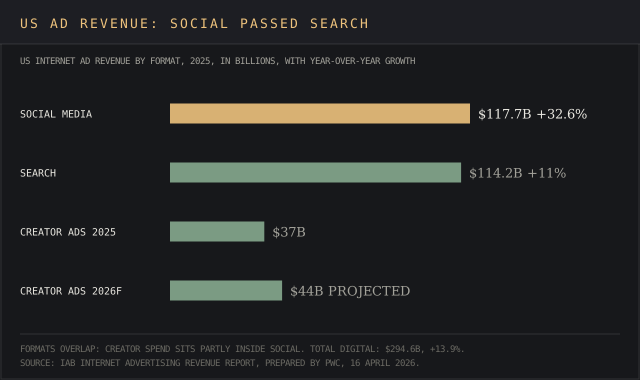
DataReportal counts 5.79 billion social media user identities in its April 2026 update, 69.9% of the world's population. In the US, the IAB and PwC put 2025 social media ad revenue at $117.7 billion, up 32.6%, which is $3.5 billion more than search earned.
This report collects the social media statistics published between mid-2025 and September 2026: user counts from Kepios and the platforms' own Q2 2026 earnings, US adoption by age groups from Pew Research Center, ad spending from the IAB and EMARKETER, and the social media marketing statistics marketers quote in budget meetings. Every figure links to the body that published it.
It's written for marketers and analysts checking a number before it goes into a deck.
How many people use social media in 2026
Kepios, the analyst behind DataReportal, counts 5.79 billion social media user identities as of April 2026, up 294 million (5.4%) in twelve months. That's 69.9% of a global population of 8.28 billion, against 6.12 billion internet users, so nearly all global internet users also hold a social account. The count adds about 800,000 new users a day, 9.3 every second. DataReportal puts social identities at 94.7% of the world's internet users and 94.5% of adults.
Mobile devices carry most of that use: Kepios counts 5.83 billion unique mobile users, 70.4% of the world. That's 5.83 billion possible screens for social media apps, against 5.79 billion social accounts.
Identities aren't people. One person running a personal Instagram and a work LinkedIn counts twice, and a dormant account still counts once.
The same research house reported 5.66 billion identities, 68.7% of the population, in its Digital 2026 overview. The 130 million extra users worldwide between the two Kepios reports are a few months of growth, so neither number is wrong. Quoting either without its date is par for the course in statistics roundups, and it's how a months-old figure lands in a 2026 deck.
For a wider read of how much budget chases these global users, our advertising industry statistics report tracks the $1 trillion-plus ad market they sit inside.
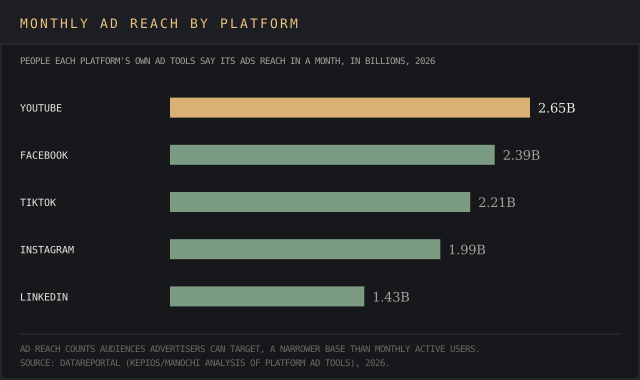
Ad reach is the second lens. It counts people the social platforms' own ad tools say advertisers can target in a month, a different base from the user base a company reports to investors. Instagram shows the gap: 1.99 billion in ad reach against 3 billion monthly users. On DataReportal's ad-audience figures, YouTube ads reach 2.65 billion people, Facebook 2.39 billion, TikTok 2.21 billion, Instagram 1.99 billion and LinkedIn 1.43 billion.
Time spent on social media: 18 hours 36 minutes a week
GWI's survey data, published by DataReportal, says the typical user spends 18 hours and 36 minutes a week on social media, which is how social media users worldwide spend more than one full waking day a week in their feeds. That works out to about 2 hours 39 minutes a day (our calculation), the daily figure quoted in many lists. Users spend that time across 6.5 different social platforms each month, down from the 6.75 that GWI reported in the Digital 2026 overview.
Among users worldwide, younger women log the most. GWI found women aged 16 to 24 spend 25 hours and 45 minutes a week in social and video feeds, more than 3 hours 40 minutes a day.
Keeping in touch with friends and family tops GWI's list, cited by more than half (50.2%) of adult users worldwide, followed by filling spare time at 39.7% and reading news stories at 35.4%. Brand research comes further down for the average person, but it's a heavy use on specific social media apps:
- 62.8% of active Instagram users say they use it to follow or research brands and products
- 56.2% of TikTok users say the same of TikTok
- 53% of Facebook users say it of Facebook
Those three percentages come from GWI's survey in the Digital 2026 analysis. They describe the people already on each app, and Instagram users and TikTok users lead the list.
Monthly active users by platform
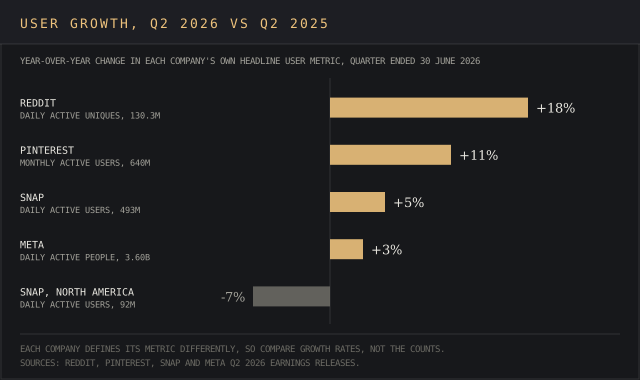
The large social media platforms each count a different thing, and the devil's in the details. Meta reports daily active people across its apps, Snap reports daily active users, Reddit counts daily active uniques, and Pinterest reports monthly active users. Raw numbers from different social media platforms side by side mislead, so the table below keeps each company's own metric next to its figure.
| Platform | Metric the company reports | Figure | Change | Period |
|---|---|---|---|---|
| Meta (all apps) | Daily active people | 3.60B | +3% | June 2026 |
| Monthly active users | 3B | from 2B in 2022 | September 2025 | |
| Members | 1.3B | double-digit member growth | FY26 Q4 | |
| Snapchat | Monthly active users | 971M | n/a | Q2 2026 |
| Monthly active users | 640M | +11% | Q2 2026 | |
| Threads | Monthly actives | 500M+ | n/a | Q2 2026 |
| Snapchat | Daily active users | 493M | +5% | Q2 2026 |
| Daily active uniques | 130.3M | +18% | Q2 2026 |
The number of monthly active users a platform discloses also changes over time. Meta's quarterly release reports daily active people across its family of apps and no separate Facebook monthly figure, which is why the "3 billion Facebook users" line in 2026 lists has no current filing behind it.
Facebook remains above 2 billion daily users
Mark Zuckerberg told investors on Meta's Q2 2026 call that "Facebook has reached more than 2 billion daily actives for a while now." Facebook users worldwide also top DataReportal's April ranking of self-reported use: 56.3% of internet users aged 16 and over say they use Facebook, ahead of YouTube at 55.3% and Instagram at 54.6%.
CFO Susan Li added on the same call that Facebook video time spent rose 9% globally and more than 10% in the US and Canada, so Facebook users spend more of their time on video than a year earlier. Meta Platforms' Reality Labs, its augmented reality and virtual reality unit, lost $4.62 billion from operations in the same quarter.
Instagram users: 3 billion monthly, 2 billion daily
Zuckerberg announced on 24 September 2025 that Instagram had reached 3 billion monthly active users, up from the 2 billion Meta disclosed in 2022. On the July 2026 call he said "Instagram reached 2 billion daily actives." Instagram time spent grew by double digits year over year in Q2, according to Li, on better Feed and Reels recommendations.
Instagram is also the platform most marketers use for marketing purposes. HubSpot's 2026 State of Marketing report found 70% of marketers use it, the highest of any network.
YouTube users and YouTube's place on the TV
Google doesn't publish a monthly count of YouTube users worldwide. The 2.65 billion ad reach from DataReportal is the cleanest public proxy. In the US, YouTube took 13.8% of all TV viewing in June 2026, up from 12.8% a year earlier, per Nielsen's June 2026 Gauge; Netflix held 7.9%.
TikTok users
TikTok's ads reach 2.21 billion users worldwide a month on DataReportal's figures, and the April update says reach to users aged 18 and above passed 2 billion.
In the US, TikTok's ownership changed on 22 January 2026, when a joint venture with Oracle, Silver Lake and MGX as managing investors closed, according to Fox Business. American investors hold 80.1% and ByteDance 19.9%; the company said more than 200 million Americans and 7.5 million businesses are active on TikTok.
LinkedIn users
LinkedIn lists a user base of more than 1.3 billion members and $19.8 billion in annual revenue, with revenue up 12% in Microsoft's fiscal Q4 2026. Members aren't monthly users: LinkedIn publishes no active-user count, so most LinkedIn users in that total can't be split into active and dormant from the outside. Microsoft told investors on its July 2026 call that member growth has been in double digits for five straight years.
Snapchat, Reddit and Pinterest
These three social platforms report quarterly, and Q2 2026 split them:
- Snap: 493 million daily active users (+5%); its number of monthly active users, 971 million, is about twice the daily count (our calculation), and North America fell 7% to 92 million
- Reddit: 130.3 million daily active uniques (+18%) and 514.6 million weekly (+24%)
- Pinterest: a record 640 million Pinterest users worldwide (+11% in monthly actives), with 377 million outside the US, Canada and Europe
Pinterest's user base skews international: the US and Canada added 4% to reach 106 million, against 15% growth in the rest of the world.
Reddit's user base runs on user generated content, and its logged-in daily uniques were 52.6 million, so about 60% of its daily audience reads without logging in (our calculation). Reddit is on a roll: Q2 was its eighth straight quarter of revenue growth above 60%. Our Reddit AI visibility study measures how often that content shows up in AI answers.
X (formerly Twitter) and Threads
X, formerly Twitter, is a private company and files no quarterly user numbers. Pew's 2025 survey gives the clearest outside read: 21% of US adults use X, and 10% use it daily. Threads, Meta's rival, "crossed 500 million monthly actives," Zuckerberg said in July 2026. Pew found 8% of US adults on Threads and 4% on Bluesky.
Who uses which platform in the US: Pew's age groups
Pew Research Center surveyed 5,022 US adults between 5 February and 18 June 2025 for Americans' Social Media Use 2025. YouTube tops the social media platforms in the survey at 84%, Facebook follows at 71%, and Instagram reaches half of adults.
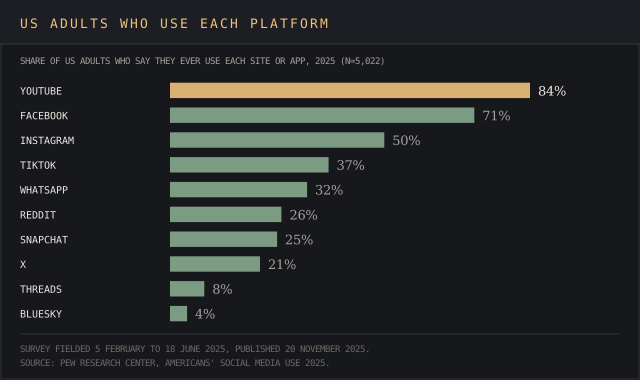
Pew's social media usage data shows the growth lower in the table. TikTok rose from 21% of adults in 2021 to 37% in 2025, Instagram from 40% to 50%, WhatsApp from 23% to 32% and Reddit from 18% to 26%. Daily use tells a sharper story: about half of US adults visit Facebook daily, about half visit YouTube daily, and 24% use TikTok every day. Among adults under 30, roughly half use TikTok daily.
Age is the biggest divider:
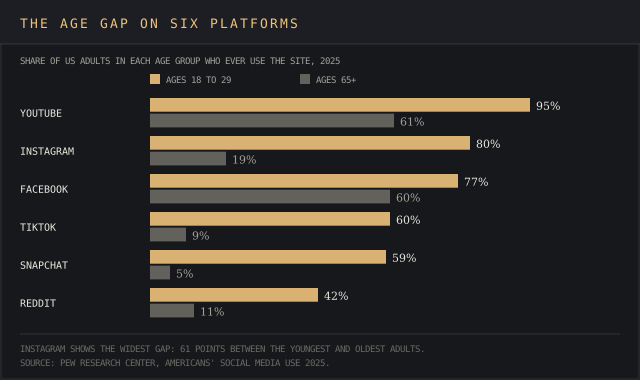
Facebook is the platform where the age groups converge: 77% of 18-to-29-year-olds and 60% of adults 65 and over use it. Snapchat and TikTok are close to young-only networks: each reaches over half of adults under 30, against 5% and 9% of the oldest group. Marketers planning by demographic can start from our guide to demographic market segmentation.
Teens and social media: Pew's latest research
Pew's December 2025 teen survey of 1,458 Americans aged 13 to 17 found roughly nine in ten use YouTube and about six in ten use TikTok and Instagram. Snapchat reaches 55%, Facebook 31% and WhatsApp 24%. TikTok holds the strongest grip: 61% of teens use it daily and 21% say they're on it almost constantly.
Social media advertising statistics
US social media ad revenue reached $117.7 billion in 2025, up 32.6%, in the IAB Internet Advertising Revenue Report prepared by PwC and released on 16 April 2026. Search brought in $114.2 billion, up 11%. That makes social media advertising the largest single format in a $294.6 billion US digital market.
Our search engine marketing statistics report covers the other side of that comparison, including what Google AI Overviews have done to clicks.
Worldwide, EMARKETER forecasts Meta's 2026 net advertising income at $243.46 billion, or 26.8% of global ad spending, edging past Google's $239.54 billion and 26.4%, per Marketing Dive. WARC's own Meta model, reported by MediaNews4U, lands at $240 billion, up 22.3%.
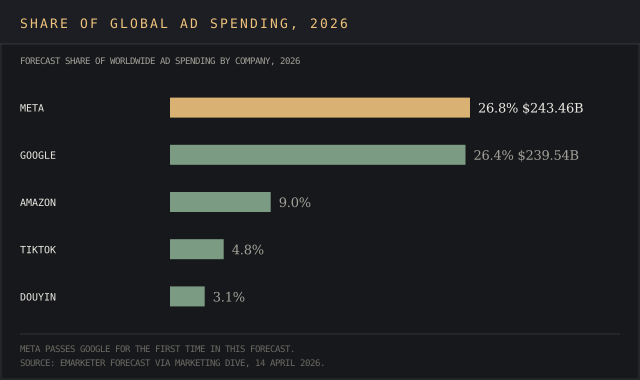
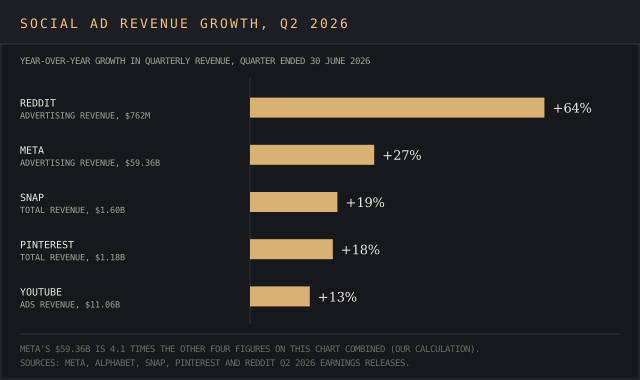
ByteDance takes 7.9% in the same forecast, 4.8% from TikTok and 3.1% from Douyin. In social media advertising, Pinterest, Snap and Reddit together booked about $3.5 billion of revenue in Q2 2026 (our calculation), a drop in the bucket next to Meta's $59.36 billion.
Ad sales by platform, Q2 2026
| Company | Q2 2026 revenue line | Amount | Year-over-year |
|---|---|---|---|
| Meta | Advertising revenue | $59.36B | +27% |
| YouTube (Alphabet) | YouTube ads | $11.06B | +13% |
| Snap | Total revenue | $1.60B | +19% |
| Total revenue | $1.18B | +18% | |
| Advertising revenue | $762M | +64% |
Meta got the best of both worlds: ad impressions rose 14% and the average price per ad 12%, per its Q2 2026 release. Alphabet's earnings release lists YouTube ads at $11,055 million against $9,796 million a year earlier. Reddit's ad sales grew fastest, and its average revenue per user rose 36% to $6.18. Snap's average revenue per user rose 13% to $3.25, and Pinterest's 7% to $1.86.
Competitive teams tracking which brands buy ad space on these social media platforms use ad intelligence software to see creative and estimated spend.
Social media marketing statistics
HubSpot's 2026 State of Marketing report gives the platform-level view from social media marketers. Its findings on social media marketing:
- 70% of marketers use Instagram, 69.6% use Facebook and 57% use TikTok
- Instagram is the most-cited platform for ROI; 43% rank Facebook among their highest-ROI platforms
- 32% say TikTok consistently delivers the highest ROI
- Short-form video (49%), long-form video (29%) and live-streaming video (25%) are the top three ROI formats
- 26% plan to sell products directly on social media in 2026
- Nearly 75% use AI for media creation, so AI is now part of content creation for most teams
B2B lead generation on LinkedIn
B2B data is older. HubSpot's page cites a 2023 Sprout Social figure that 89% of B2B marketers use LinkedIn for lead generation and 62% say it helps them generate leads effectively.
HubSpot doesn't publish one overall success rate for social media marketing. The 94% figure that circulates comes from CreatorIQ's 2025 creator marketing research, where 94% of organizations said influencer marketing delivers stronger ROI than traditional digital advertising, as listed on Sprout Social's statistics page. It measures influencer programs, so it doesn't answer the question for social media marketing as a whole.
Sprout Social's own research tracks the marketing leaders side. Its 2025 Index, built on 4,044 consumers, 900 social practitioners and 322 marketing leaders, found 97% of leaders say their teams must know how to use AI and 48% planned to raise AI spending. Brands that jump on the bandwagon of every viral trend pay for it: a third of consumers called trend-chasing "embarrassing" for brands.
For the cost of the tools that run this work, see our Sprout Social pricing breakdown and our Sprout Social review.
Organic social media and customer care
Organic social media is now a support channel as much as a publishing one for social media marketers. In the 2025 Sprout Social Index, 73% of consumers said they'd buy from a competitor if a brand doesn't respond on social. Sprout's Q3 2026 pulse survey of 2,250 consumers, fielded 11 to 18 August 2026, adds that 68% expect a reply within 24 hours and 24% within one to two hours.
Which platform do people turn to first? TikTok at 50% and Facebook at 46% in the same survey. Users expect brands to answer there, and brands that don't are skating on thin ice with three quarters of their audience.
Teams that monitor those mentions at volume use social listening software. Our social listening tools ranking compares the platforms, and the social listening pricing report shows what they cost per year.
Consumer behavior: product discovery and purchases on social
Social feeds are a shopping aisle. The 2025 Sprout Social Index found 81% of consumers say social media drives them to make impulse purchases. The Q3 2026 pulse survey found physical stores and social media tied at 46% as the top source of gift inspiration, with Gen Z at 54% and millennials at 50%. Nearly half of consumers (49%) said they're more likely to buy from a company that starts campaigns as early as August.
Product discovery claims need care in any study of consumer behavior. "Over 60% of product discovery" happening on YouTube, TikTok and Instagram appears in several lists; Sprout Social attributes it to Rise at Seven's Multi-Channel Search Report 2026, a search agency's study. GWI's brand-research figures above, 62.8% on Instagram, come from a global consumer survey.
Younger audiences search inside the apps. The Gen Z skew in Sprout's gift data and Pew's age gaps point the same way. Pew found Instagram users include 80% of adults under 30 against 19% of those 65 and over, so a brand that only shows up on Google search is absent from an app 80% of adults under 30 use. Our consumer intelligence guide covers how teams turn that behavior into research.
Social commerce in the US
EMARKETER puts US social commerce at $87 billion in 2025, up 21.5%, per a December 2025 analysis reported by Mass Market Retailers. TikTok Shop took 18.2% of it, or $15.8 billion, after a 400% jump in 2024. Facebook and Instagram account for about 75%.
That's 6.9% of US retail ecommerce, rising to 9.3% by 2029 on the same forecast. The "multi-trillion-dollar" social commerce claims in some lists carry no named publisher, and the US figure is a better anchor. The retail industry statistics report puts the ecommerce total in context.
Influencer marketing and creator content
The IAB put US creator advertising spend at $37 billion in 2025 and projects $44 billion in 2026, a 19% rise (our calculation). That US figure alone is above the "$28 billion global influencer market" line still quoted in lists, which carries no current named publisher.
Sprout Social's 2026 Influencer Marketing Report, surveying 2,250 consumers and nearly 300 social media professionals, found:
- Only 17% of consumers check a creator's follower count
- 40% discover new products through employee-generated content every month
- 44% are uncomfortable with brands using AI influencers
- 61% think companies should pay employees extra for promoting the brand on social
That 17% is the case for micro influencers in influencer marketing budgets. If 83% of buyers never check audience size, a niche creator isn't judged on follower count against a celebrity. Micro influencers and creator content from employees both benefit, and the 40% monthly discovery rate is the number to keep an eye on.
Budgets keep rising anyway. Linqia's 2026 State of Influencer Marketing report, a July 2025 survey of over 200 enterprise marketers, found 62% had higher influencer marketing budgets than a year earlier and 81% say creator content outperforms brand-created assets. Measurement lags: 79% named ROI their top challenge.
TikTok leads platform plans. Influencer Marketing Hub's 2026 benchmark, built on 600+ respondents, found 31% included TikTok in their influencer plans, the most selected platform, and brand awareness was the most selected campaign KPI.
Short-form video and video marketing statistics
YouTube CEO Neal Mohan said in June 2025 that Shorts were averaging over 200 billion daily views. In video marketing, short form video is also the format HubSpot's marketers rank first for ROI, at 49%, ahead of long-form video content at 29%.
Wyzowl's 2026 survey of 266 respondents found 91% of businesses use video as a marketing tool, 82% of marketers say it has given them a good ROI, and 63% of video marketers have used AI video tools to create or edit videos. On the buyer side, 85% of people say a video has convinced them to buy a product or service.
Facebook video time rose 9% globally in Q2 2026, and Instagram time spent grew by double digits on Reels recommendations. The IAB counts both in one category: $78 billion in US video ad sales in 2025, up 25.4%, including social video, CTV and the short form video platforms.
Why the published social media statistics disagree
Published social media statistics disagree for five reasons, and each has a fix:
| What differs | Example | How to read it |
|---|---|---|
| Identities vs people | 5.79B identities vs 6.12B internet users | Identities double-count people with several accounts; treat it as a ceiling |
| Report date | 5.66B (Digital 2026) vs 5.79B (April 2026 update) | Same house, different month; quote the date |
| Metric definition | Meta daily active people vs Reddit daily active uniques vs Pinterest monthly users | Compare growth rates across social platforms, not counts |
| Survey panel | Pew: 84% of US adults use YouTube; Sprout Index panel: 76% of social users have a YouTube profile | Pew samples US adults by address; Sprout surveys consumers online in four countries |
| Stale figures | "6.6 platforms per month" (2023) vs 6.5 (GWI, 2026 report) | Use the latest wave of the same survey |
Engagement benchmarks are the least comparable of all: each vendor computes an average engagement rate on its own panel of brand accounts, so the figure moves with the panel.
The Sprout row is the instructive one. Its 2025 Index found 90% of respondents with Facebook profiles and 82% with Instagram, far above Pew's 71% and 50%. Sprout's 4,044 consumers were surveyed online by Glimpse across the US, UK, Canada and Australia; Pew's 5,022 US adults were reached by address-based sampling. Read between the lines of every survey's sample before quoting it.
Our AI statistics and podcast industry statistics reports deal with the same problem in other categories.
Trust, AI content and regulation
AI-generated posts are now a measurable complaint. Sprout's Q1 2026 pulse survey of 2,250 social media users, fielded 5 to 9 February 2026, found 56% see "AI slop" on their feeds "often or very often," 88% say AI-generated video tools have eroded their trust in news, and 50% of Gen Z have blocked, muted or unfollowed a brand or creator over AI-feeling content, a red flag for AI-made brand posts. In the Q3 survey, 84% said they're concerned about AI deepfakes.
The same Q1 survey found social media has overtaken TV as the leading source of breaking news.
Regulation now reaches the youngest users. Australia's minimum-age law took effect in December 2025, and platforms deactivated or restricted 4.7 million accounts belonging to children in the first month, the government said in January 2026, per PBS NewsHour. Fines reach A$49.5 million. The law covers ten social media platforms: Facebook, Instagram, Kick, Reddit, Snapchat, Threads, TikTok, X, YouTube and Twitch.
Brand teams that track sentiment across these shifts use media monitoring tools, and the Brandwatch pricing, Brand24 pricing and Sprinklr pricing reports cover what three of the largest charge.
How to use these social media statistics in a plan
Start from reach, then narrow by age. Social media worldwide reaches 5.79 billion accounts, but a plan needs the slice that buys. Meta's 3.60 billion daily active people is the widest pool among social media platforms, Pew's age groups show which app reaches whom in the US, and GWI's brand-research percentages show where buyers go to compare. Don't put all your eggs in one basket on a platform whose own numbers shrink in your region, as Snapchat's did in North America.
Budget follows evidence. Social passed search in US ad sales in 2025, creator spend is projected at $44 billion, and short-form video leads HubSpot's ROI ranking. Those three facts justify a test budget. They don't promise a return on any single campaign, so track social's share of website traffic and sales in your own analytics. A platform's reach number says nothing about web traffic to your site.
Frequently asked questions
What is the #1 social media right now?
It depends on the measure. Facebook tops DataReportal's global ranking of self-reported use at 56.3% of internet users aged 16 and over, with more than 2 billion daily actives per Meta. YouTube is the top platform for US adult reach, at 84% per Pew. YouTube ads also reach 2.65 billion users worldwide a month, per DataReportal.
Is it true that 95% of teenagers use social media?
Pew's December 2025 survey reports use platform by platform: roughly nine in ten US teens use YouTube and about six in ten use TikTok and Instagram. Pew also found 97% of teens go online daily.
Is it true that 80% of the world's population will use social media by 2028?
The 80% figure has no named forecaster behind it. DataReportal counts 69.9% in April 2026. At 294 million new identities a year and a flat 8.28 billion population, 80% would arrive in about 2029 (our calculation), and real population growth pushes it later.
What are 5 facts about social media?
There are 5.79 billion social media users worldwide by Kepios's identity count. Users spend 18 hours 36 minutes a week on social media across 6.5 platforms. Meta reaches 3.60 billion people daily. US social ad sales hit $117.7 billion in 2025, above search. And 73% of consumers say they'll switch to a competitor if a brand ignores them on social.
What is the success rate of social media marketing?
No public survey measures one success rate. HubSpot's 2026 data is the closest: Instagram is the most-cited ROI platform, 43% of marketers rank Facebook among their highest-ROI platforms, and short-form video is the top ROI format at 49%.
Bottom line
Social media worldwide is a 5.79-billion-identity market in 2026, growing at 5.4% a year, while US ad sales on it grow at 32.6%. Meta holds the lion's share of both the attention and the money, and Reddit and Pinterest are the fastest-growing social platforms by their own metrics.
The numbers that move budgets are the ones with a named publisher and a date: Kepios for users, Pew for US adoption, the IAB for ad spending, the platforms' own filings for active users. Anything else on a slide deserves a source check before it ships.
Sources by publisher and date, plus the counts no platform reports
User counts are Kepios's, published by DataReportal in the Digital 2026 overview and the April 2026 mid-year update, with GWI survey data on time spent and reasons for use. Active-user and revenue figures are the platforms' own Q2 2026 releases and calls: Meta, Alphabet, Snap, Reddit and Pinterest, plus Microsoft's fiscal Q4 2026 call for LinkedIn.
US adoption figures are Pew Research Center's: adults surveyed 5 February to 18 June 2025, published 20 November 2025, and teens published 9 December 2025. TV share is Nielsen's June 2026 Gauge, released 18 August 2026. US ad sales figures are the IAB and PwC report of 16 April 2026; worldwide ad shares are EMARKETER's via Marketing Dive and WARC's via MediaNews4U.
Marketing and consumer survey figures are HubSpot's 2026 State of Marketing, Sprout Social's 2025 Index, its Q1 and Q3 2026 pulse surveys and its 2026 Influencer Marketing Report, plus Linqia, Influencer Marketing Hub and Wyzowl. Meta files no separate Facebook monthly count, Google publishes no monthly YouTube user count and X files no quarterly user numbers, so those three figures come from Meta's Q2 call, DataReportal's ad reach and Pew's survey.