Creator economy statistics 2026: $44 billion in US ad spend and 362 million creators
 By Jan Suski. I go deep on every review, checking every number against its source and digging up details other coverage misses, a habit from six years of SEO and link building for tech companies. Bylines at Surfer, Brand24, and Senuto. How the scoring works.
The numbers Creator economy, platforms and ad spend, checked 7 October 2026
US brands' creator ad spend more than tripled from 2021 to the 2026 projection, growing about four times faster than total media in 2025.
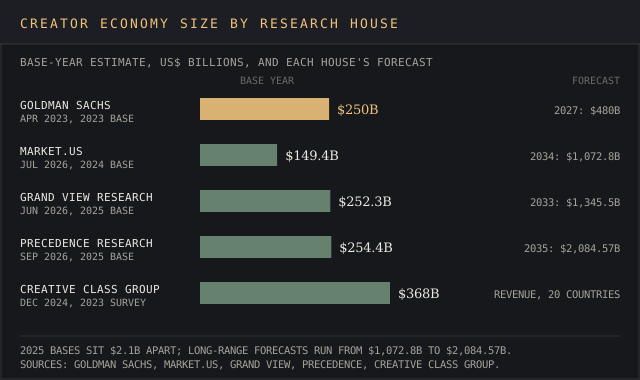
Grand View Research and Precedence Research agree within $2.1 billion on the 2025 creator economy. Market.us, Grand View and Precedence put their long-range forecasts $1,011.77 billion apart.
The vast majority of creators in the creator economy earn under $100,000; only 5.7% of US creators clear that line.
US brands will put $44 billion into creator advertising in 2026, the IAB projects, against $13.9 billion in 2021. Research houses price the global creator economy anywhere from $149.4 billion to $368 billion, depending on base year and definition.
Money pools at the top among creators. CreatorIQ found the top 10% of creators took 62% of payments to creators in 2025, and 48.7% of US creators in The Influencer Marketing Factory's 2026 survey earned under $10,000 a year. YouTube alone sent more than $100 billion to creators, artists & media companies in four years.
These creator economy statistics cover market size, advertising spend, how many creators there are, income, revenue streams, platform payouts, audiences, AI and burnout, each tied to the body that published the data and dated. They're for marketers setting a creator marketing budget, analysts sizing the creator economy, and creators who want the data behind earning money from creating content.
Creator economy statistics: market size in 2026
Goldman Sachs Research put the creator economy at $250 billion in 2023 and forecast $480 billion by 2027. Its April 2023 note counted 50 million creators with annual growth of 10% to 20%, with about 4% of creators earning more than $100,000.
The newer research-house figures land in the same neighborhood for 2025, though the devil's in the details of each definition. Grand View Research puts the creator economy at $252.3 billion in 2025 and $310.4 billion in 2026. Precedence Research data, updated 28 September 2026, says $254.4 billion in 2025 and $313.95 billion in 2026.
North America is the largest region in every house's split of the creator economy. Grand View gives it 33.2% of 2025 sales. Precedence gives it 35%, or $89.04 billion, with the US creator economy alone at $66.78 billion. Market.us puts North America at 37.4% and the US at $50.9 billion in 2024.
Creator economy by platform and content type
The segment data gives insights into where the creator economy earns. Grand View's split by platform gives video streaming 52.2%, and photography and videography lead creative services at 44.3%. Advertising is its leading revenue channel at 36%. Individual creators are 57.2% of end use. Market.us splits its 2024 creator economy data this way:
- By platform: social media platforms 27.8%, video streaming 24.5%, audio 12.6%, gaming 12.5%
- By content type: video 23.8%, music 18.3%, gaming 17.2%
- By monetization: brand collaborations 23.5%, ad revenue 20.9%, subscriptions 20.0%
- By creator type: amateur creators 64.1%, professional creators 35.9%
Why creator economy market estimates diverge
The houses measure different things. Goldman counts what creators earn from brand deals, platform ad shares and fan payments. Grand View and Precedence size a creator economy segmented by platform type and creative service. Market.us sizes platforms, content type and monetization method.
| Research house | Base estimate | Forecast | Growth rate | Published |
|---|---|---|---|---|
| Goldman Sachs Research | $250B (2023) | $480B (2027) | Creators up 10% to 20% a year | April 2023 |
| Market.us | $149.4B (2024) | $1,072.8B (2034) | 21.8% CAGR | July 2026 |
| Grand View Research | $252.3B (2025) | $1,345.5B (2033) | 23.3% CAGR | June 2026 |
| Precedence Research | $254.4B (2025) | $2,084.57B (2035) | 23.41% CAGR | September 2026 |
| Creative Class Group (for Meta) | $368B creator income (2023 survey) | No forecast published | No rate published | December 2024 |
Read between the lines and the gap is mostly arithmetic. A 23% compound growth rate held for ten years multiplies the base about eightfold. Precedence forecasts two years further out than Grand View, and its 2035 figure sits $739.07 billion above Grand View's 2033 one, from 2025 starting points within 1% of each other.
The highest base, $368 billion, comes from a survey of creators. The Creator Revolution, Richard Florida's Creative Class Group report commissioned by Meta, added up self-reported income for creators across 20 countries, $29 billion of it in the US. Survey totals pick up merchandise, courses and side businesses of creators that platform-based models of the creator economy leave out.
Influencer marketing, one slice of the creator economy, gets sized separately, and there the houses sit closer. Influencer Marketing Hub puts the industry at $32.55 billion in 2025, up from the $21.1 billion its 2023 benchmark report projected for 2023. CreatorIQ's figure for 2025 creator marketing is $32.6 billion, $50 million apart.
Creator economy advertising spend and influencer marketing budgets
US creator advertising spend
IAB data from the 2025 Creator Economy Ad Spend & Strategy Report, published 20 November 2025, put US advertising spend on creators at $13.9 billion in 2021 and $29.5 billion in 2024. That's more than double in three years, and the IAB projects $37 billion for 2025, up 26%, and $44 billion for 2026.
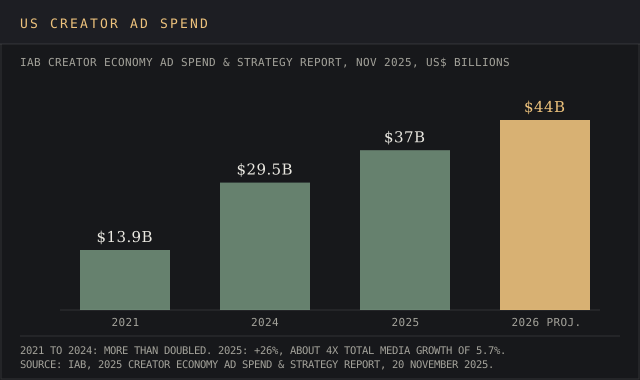
The 26% growth ran about four times the 5.7% growth the IAB forecast for the total media industry in 2025. Advertising buyers have jumped on the bandwagon: 48% now rank creators as a "must buy," behind only social media and paid search. Brands collaborate with creators on social media for brand awareness (43%), reaching new audiences (41%), reputation and trust (35%) and online sales to consumers (32%).
Finding the right creators is the bottleneck for brands in creator marketing. One-third of brands told the IAB it's their biggest hurdle, and 40% of advertising buyers use overall ROI as the primary KPI. Creator reputation (58%) and alignment with audiences (56%) top the selection list, ahead of follower count.
For scale against the rest of digital marketing, WARC Media forecast $286.2 billion of social media advertising spend worldwide in 2025, up 12.3%, and more than $300 billion in 2026. Our advertising industry statistics break down where the rest of the ads market goes, traditional media included.
Influencer marketing budgets for 2026
Budgets for creators keep climbing. In the Influencer Marketing Hub 2026 benchmark report, published 4 May 2026 from 600+ respondents, 87.49% of brands and agencies expect influencer marketing budgets to rise, 72.22% by 50% or more. The 5.55% expecting a cut is a drop in the bucket. Brands plan to grow user generated content (UGC) creator work too, at 50.00%.
Smaller creators with smaller audiences are getting a bigger slice, as brands move advertising money down the tiers. eMarketer forecast on 12 March 2026 that micro- and nano-influencers will capture 45.5% of influencer marketing spending in 2026, and that creators will earn over $21 billion from it. In the benchmark data, 52.83% of respondents plan to grow work with micro creators and 51.43% with nano creators, while macro creators sit at parity.
Creator marketing programs and long-term partnerships
Smart brands now run creators all year. Medill Spiegel Research Center surveyed 209 senior marketers for its August 2026 report: 91% run a creator program with an always-on component, 62% hybrid and 29% fully continuous. 80% are raising creator budgets in 2026, 25% by more than 10%, and 82% are increasing digital marketing budgets.
Long-term partnerships are where enterprise brands put creator content to work as ads in front of new audiences. 92% of Medill's respondents run creator content as paid social ads, and 44% rank creators as the most-trusted source, ahead of social media ads at 34%. Creators want the same stability: 44.9% of creators in The Influencer Marketing Factory's survey prefer consistent brand partnerships over one-off deals.
CreatorIQ's insights on Fortune 100 brands show why brands keep paying. In 2025, creators produced 33 times more brand-related content than brand-owned channels, reaching audiences with 11 times the impressions and 14 times the engagement across TikTok, Instagram and YouTube. That's the growing demand behind creator partnerships.
Pricing deals between brands and creators is a fight, and it takes two to tango. Shayna Macklin, a brand partnerships and influencer marketing strategist, put both sides of it in a LinkedIn post on 2 December 2025:
"Brands got arrogant and started asking for the world without paying for it. Creators inflated their rates to the point of delusion. Both sides are still guilty."
Shayna Macklin, LinkedIn, 2 December 2025
Our influencer marketing platform pricing report covers what brands pay for the software that finds and manages creator partnerships. Medill found 86% of brands run two or more creator tools and 11% run one platform.
How many creators there are in the creator economy
Headcounts of creators run from 50 million to 362 million, and the definition sets the count. Goldman's 50 million creators date from 2023. Linktree's 2022 Creator Report estimated about 200 million creators from survey data on 9,576, including 2 million mega influencers with audiences of 1 million or more followers and 139 million semi-pro creators with 1,000 to 10,000. 66% of creators surveyed were creating content part-time.
Adobe, in a study on the future of creativity, counted 303 million creators in August 2022, with 165 million more creators joining since 2020.
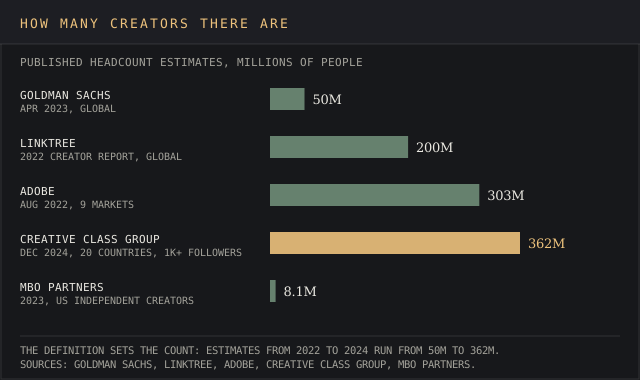
The largest count of creators comes with a clear floor. The Creative Class Group report counts 362 million creators with audiences of 1,000 or more followers on at least one social media platform. India leads with 137.3 million creators, then Indonesia (46.8 million), Brazil (40.1 million) and the US (38.7 million). Over half of those social media creators hold full-time jobs elsewhere while creating content, and nearly 40% report zero income.
Count only creators working for themselves and the US creator economy shrinks. MBO Partners data found 8.1 million US independent creators in 2023, down from 8.2 million in 2022, and 70% of those creators are creating content part-time.
Creator demographics: gender, Gen X and Gen Z
Content creation skews young, but the share of older creators is rising. MBO Partners found 53% of US independent creators are male and 63% are 40 or younger. Baby Boomers and Gen X rose from 27% to 35% of independent creators between 2022 and 2023.
Women lead paid content creation on social media in the creator economy. Collabstr's 2025 Influencer Marketing Report, built on its 2024 marketplace data for 100,000 creators and 40,000 advertisers, found 72% of its influencers are women: 78% on TikTok and Instagram and 65% on YouTube. Men still earned about 40% more per collaboration.
Gen Z wants into the creator economy. A Morning Consult survey of 1,000 Gen Z consumers, published 4 October 2023, found 57% would become an influencer if given the chance. Young adults lead the global count too, especially those aged 20 to 34, who make up 40% of creators in the Creative Class Group report.
Creator income: earning money from content creation
Most creators in the creator economy don't make ends meet from content creation alone. The Influencer Marketing Factory's 2026 Creator Economy Report, released 24 February 2026, surveyed 1,000 US creators:
- Under $10,000 a year: 48.7% of creators
- $10,000 to $100,000 a year: 45.6% of creators
- Over $100,000 a year: 5.7% of creators
- Earnings grew in 2025: 51.5% of creators
The Influencer Marketing Hub Creator Earnings Report 2025 lands close. Of 3,000+ creators surveyed, over half earn under $15,000 a year, and nearly 57% of full-time creators fall below a $44,000 living wage. MBO Partners found 9% of US independent creators earned over $100,000 and 71% under $30,000.
The top tier takes the lion's share. CreatorIQ's State of Creator Compensation, published 21 January 2026, found the top 10% of creators received 62% of payments in 2025, up from 53% in 2023. The top 1% of creators took 21%, up from 15%. The average campaign paid $11.4K; the median paid $3K.
Aggregate payments to creators still grew 59% year over year in CreatorIQ's data.
A full-time creator on Hacker News described the income split for channels with millions of subscribers in July 2026:
"Even YouTubers with millions of subscribers and mature audiences with disposable income often struggle to clear like $5K/month on Patreon. Which, for a multi-person business, is simply not enough. Meanwhile, that same creator might be pulling $20K/month through ads and a similar amount through sponsorships."
djaro, a self-described professional YouTuber, Hacker News, 2 July 2026
Our freelance statistics report puts creator economy income next to other independent work.
Revenue streams creators use to generate income
Creator economy income comes from four places: brand deals, platform ad revenue, subscriptions and commerce.
Brand deals, sponsorships and branded storytelling
Brand deals bring home the bacon for most creators. Goldman's survey data found brand deals make up about 70% of creator income. The Influencer Marketing Hub 2025 survey had brand sponsorships at 49% of creator income, down 10 points from 2023, and 64% of creators still want brand deals as their primary source.
Ad revenue from YouTube, YouTube Shorts and Facebook
Ad revenue shares for creators are published by each social media and video platform. The YouTube Partner Program pays creators 55% of net revenue from ads on long-form videos and 45% of the YouTube Shorts revenue allocated to them.
Facebook, the second-largest social media platform in Pew's count, is paying more creators. Meta's Creator Fast Track announcement in March 2026 said Facebook paid creators nearly $3 billion in 2025, up 35%. More creators earned over $10,000 a year on Facebook, with growth of more than 30%. The program pays $1,000 a month for three months to creators with audiences of 100,000 on other platforms, and $3,000 at a million. Our Facebook statistics cover the platform's users.
Paid subscriptions, digital products and recurring revenue
Creators who don't want all their eggs in one basket sell paid subscriptions for recurring revenue. Patreon announced on 5 August 2025 that fans had sent $10 billion to creators on the platform since 2013. Its 2024 review counted more than 300,000 active creators.
Substack's growth shows the same pull: the newsletter platform passed 5 million paid subscriptions on 11 March 2025, less than four months after it crossed 4 million. Creating digital products and courses rounds out new revenue streams for creators. In Linktree's survey, e-courses brought income to 10% of niche creators and 3% of others, and physical products to 23% and 18%.
Affiliate commerce and social commerce
Affiliate commerce pays creators a commission on each sale. The Influencer Marketing Factory found product and merchandise sales plus affiliate marketing make up 21.2% of creator income. Linktree's survey had affiliate marketing paying 15% of niche creators and 10% of others, and ads 13% and 9%.
TikTok Shop, the platform's in-app store, shows the scale of the social commerce side of the creator economy. Momentum Works data shows consumers spent $64.3 billion there worldwide in 2025, 94% growth, with the US at $15.1 billion across 15.4 million influencers and 803,500 stores. YouTube counted more than 500,000 creators in its Shopping program, its social commerce arm, in January 2026. Our TikTok statistics break down TikTok Shop by market.
What platforms pay creators
Platform payouts are the creator economy figures that come straight from the horse's mouth, since social media and video companies publish them. They still differ in who counts as creators: YouTube's figure includes record labels and media companies, Spotify's includes all rights holders.
| Platform | Payout figure | Period | Source, date |
|---|---|---|---|
| YouTube | $100B+ to creators, artists and media companies | Four years to 2025 | YouTube, 16 September 2025 |
| Spotify | $11B+ to the music industry | 2025 | Loud & Clear, 12 March 2026 |
| Patreon | $10B sent by fans | 2013 to August 2025 | Patreon, 5 August 2025 |
| Nearly $3B, up 35% | 2025 | Meta, March 2026 | |
| Substack | 5 million paying subscriptions | March 2025 | Substack, 11 March 2025 |
YouTube's sales across ads and subscriptions passed $60 billion in 2025, per Alphabet's fourth-quarter 2025 earnings release, with $11.383 billion of ads in the fourth quarter alone. Its 2025 US impact report, built with Oxford Economics and YouTube internal data and published 16 July 2026, credits YouTube's creative economy with more than $60 billion of US GDP and 540,000 full-time equivalent jobs.
77% of creators with a media career say it started on YouTube, and 76% of small businesses with a channel say it widened their customer base. Our YouTube statistics carry the full series.
Spotify's 2025 data shows how deep a payout pool runs. More than 1,500 artists generated over $1 million from Spotify alone, and more than 13,800 generated at least $100,000. Our music industry statistics and podcast industry statistics cover the audio side of the creator economy.
Audiences, trust and purchasing decisions
Creators move purchasing decisions for the consumers who follow them, and Modash measured trust across the creator economy. Modash's Creator Trust Report 2026, published 30 September 2026 from a June survey of 1,042 US consumers, found 84% of social media users who follow creators have bought something on a creator's recommendation. Only 40% of consumers in the survey said they trust creators, and about 1 in 6 consumers trust creators as much as friends and family.
Trust splits by age across audiences. 60% of Gen Z consumers consider creators trustworthy, against 34% of Baby Boomer consumers. Creators who visibly use the product win trust with 69% of consumers, and clear sponsorship disclosure helps with 55% of consumers. Poor product fit and AI-generated content are each a red flag for 43% of consumers, so content quality and audience relationships carry the sale.
Where audiences watch creators
Audiences are on video social platforms. Pew Research Center data from its 2025 survey of 5,022 US adults shows how many social media users each platform reaches:
- YouTube: 84% of US adults are users
- Facebook: 71% are users
- Instagram: 50% are users
- TikTok: 37% are users, up from 21% in 2021
YouTube reaches the most users of any platform in Pew's survey, and TikTok, Instagram, WhatsApp and Reddit kept gaining users among social platforms. TikTok reaches 63% of adults under 30 and 44% of those 30 to 49, and 68% of teens are users, per Pew's March 2026 analysis. Younger audiences carry the reach of creators on social platforms.
Creators compete with traditional media for news audiences, too. Pew's November 2024 study found 21% of US adults regularly get news from news influencers on social media, 37% of those under 30, and 77% of those influencers have no tie to a news organization. 55% of TikTok users regularly get news on the app. Our social media statistics and Instagram statistics track social media audiences on other platforms in more depth.
Higher engagement rates by follower count
Creators with smaller audiences post strong engagement rates on social media across the creator economy. HypeAuditor's 2025 trends and insights report, published 1 May 2025, measured engagement rates by tier: a 10.3% average for TikTok nano creators with a follower count under 10,000. Instagram's engagement rate across all accounts fell to 1.59% in 2024 from 1.85% in 2023.
Tier data from Captiv8, an influencer marketing platform, shows how the creator economy splits by platform. It was published by eMarketer on 28 March 2024. Instagram nano-influencers under 10,000 followers averaged 6.23%, with engagement falling as follower counts rise. On TikTok, creators above 1.5 million followers held 4.95%.
Single-digit engagement is par for the course on Instagram, and budgets follow the higher engagement of small accounts: eMarketer's 45.5% share for micro- and nano-influencers is the money chasing higher engagement rates. To compare a quote from creators with paid ads per thousand impressions, run it through our CPM calculator.
Platform preference differs between brands and creators. TikTok was the platform brands selected most often in the Influencer Marketing Hub 2026 benchmark, at 31%. Among creators in its 2025 earnings survey, TikTok led at 44%, Instagram fell to 27.55% from 62.68% in 2023, and YouTube rose to 9.59%.
AI tools in content creation
AI tools are standard kit across the creator economy. Adobe's Creators' Toolkit Report, a survey on creativity and AI, released 28 October 2025 from survey data on 16,000 creators in eight countries, found 86% of creators use creative generative AI. 76% said it sped up business growth or growth in their audiences, and 81% said it lets them make creative content they couldn't produce otherwise.
Creators use the new tools for editing and upscaling (55%), creating new assets (52%) and ideation (48%), and 60% use more than one of these tools. 69% worry about their original content being used to train AI without permission. 70% are optimistic about agentic AI, with automating repetitive tasks (51%) and performance insights (44%) at the top of the wish list. 72% of creators are often creating on mobile devices.
On YouTube, the platform said more than 1 million channels used its AI creation tools every day in December 2025, and more than 20 million users tried its Ask tool, per Neal Mohan's letter on the future of YouTube. Creators publish consistently at volume: 84.7% of creators in The Influencer Marketing Factory's survey post more than once a week.
Brands that hire creators are adopting AI just as fast. 93% of Medill's respondents invest in AI for creator marketing now. Nearly three in four IAB respondents use it or plan to within a year, mainly for content editing (49%), creator briefs (46%) and personalization (45%). 95% voiced concerns, and they keep an eye on one above all: loss of human connection.
Influencer Marketing Hub found 36.67% of respondents use AI tools to find creators. Our AI statistics report covers adoption outside the creator economy.
Burnout, storytelling and emerging trends
Creators burn the candle at both ends creating content to post consistently. Billion Dollar Boy survey data from 1,000 creators and 1,000 marketers in the US and UK, July 2025: 52% of creators have experienced burnout and 37% are considering leaving the profession. Financial instability ranked as the top cause, at 55%, ahead of creative fatigue (40%) and demanding content creation workloads (31%). MBO Partners found 41% of US independent creators struggle with burnout.
Marketers and creators see support differently. Only 48% of creators feel supported by brands and 49% by platforms, while 60% to 63% of marketers believe the support is there. That's a 12- to 15-point reality gap between how marketers and the creators who supply the creativity rate the same support.
Creators are building studios around storytelling. Neal Mohan's Cannes speech in June 2025 described creators as "the startups of Hollywood," and YouTube Shorts averages 200 billion daily views. Live is a storytelling format of its own: over 30% of daily logged-in YouTube users watched live content in the second quarter of 2025, per Made on YouTube. Our streaming statistics show where that viewing time comes from.
Three emerging trends show in the data, and each opens new opportunities for brands and creators:
- Spending shifts to smaller creators, at 45.5% of influencer spend in 2026.
- User generated content becomes social media advertising inventory, with 92% of brands running creator content as paid social ads.
- Payments keep concentrating, with the top 1% of creators at 21%.
Frequently asked questions
What is the creator economy worth right now?
Grand View Research puts the global creator economy at $252.3 billion in 2025 and $310.4 billion in 2026. Precedence Research says $254.4 billion and $313.95 billion. Goldman Sachs estimated $250 billion for 2023, across 50 million creators.
How much will the creator economy be worth by 2030?
Forecasts for the future of the creator economy diverge, and no house in this report publishes a 2030 point estimate. Goldman Sachs forecasts $480 billion by 2027. Grand View forecasts $1,345.5 billion by 2033 at 23.3% a year, Market.us $1,072.8 billion by 2034, and Precedence $2,084.57 billion by 2035.
Is the creator economy still booming?
Spending on creators is. US creator advertising spend rose 26% in 2025 per the IAB, and 87.49% of brands expect bigger influencer budgets. Earning money is more uneven, with the top 10% of creators taking 62% of payments.
Which social media platform pays creators the most?
YouTube's $100 billion over four years is the largest published payout in the creator economy. Facebook paid creators nearly $3 billion in 2025, and Patreon fans have sent $10 billion since 2013 on that platform.
What are the most cited creator economy stats?
The IAB's $44 billion 2026 projection, Goldman's $480 billion 2027 forecast and CreatorIQ's 62% top-tier share.
Bottom line
Three of the four house models put the creator economy near $250 billion, and the money flowing in from brands that want creators' audiences is the most reliable number in it. US creator advertising spend tripled between 2021 and the 2026 projection, and nearly every survey of brands and marketers shows budgets still rising.
Creators see less of the creator economy's money. Under 6% of US creators clear $100,000, payments concentrate further each year, and burnout hit 52% of creators in Billion Dollar Boy's survey. Pick your source by what it measures: platform payouts for what creators earn, IAB data for ad spend, and research-house models of the creator economy only when you can see their definition.
Every research house, platform and survey behind these creator figures
Market size and ad spend: iab.com (2025 Creator Economy Ad Spend & Strategy Report, 20 November 2025), goldmansachs.com (April 2023), grandviewresearch.com (June 2026), precedenceresearch.com (updated 28 September 2026), market.us (July 2026), creativeclass.com (The Creator Revolution, December 2024), warc.com and emarketer.com (12 March 2026; Captiv8 data, 28 March 2024).
Creator income and brand budgets: creatoriq.com (State of Creator Compensation, 21 January 2026), accessnewswire.com (The Influencer Marketing Factory, 24 February 2026), influencermarketinghub.com (2026 benchmark report, 4 May 2026; Creator Earnings Report 2025; 2023 benchmark report).
Creator counts and surveys: spiegel.medill.northwestern.edu (August 2026), linktr.ee (2022 Creator Report), news.adobe.com (August 2022; 28 October 2025), mbopartners.com, collabstr.com, pro.morningconsult.com (4 October 2023), modash.io (30 September 2026), blog.hypeauditor.com (1 May 2025) and billiondollarboy.com (July 2025).
Platforms and audiences: blog.youtube (16 September 2025; 16 July 2026), support.google.com, s206.q4cdn.com (Alphabet Q4 2025 earnings release), about.fb.com (March 2026), patreon.com (5 August 2025), post.substack.com (11 March 2025), thelowdown.momentum.asia, loudandclear.byspotify.com (12 March 2026) and pewresearch.org (18 November 2024; 20 November 2025; 2 March 2026).
Quotes come from linkedin.com (2 December 2025) and news.ycombinator.com (2 July 2026), each dated in the text.
Every figure was checked against its source on 7 October 2026. No house cited here publishes a 2030 point estimate, and the newest global creator headcount found is Creative Class Group's from December 2024.